
Day 1 of 30 days of Machine Learning Ops
With examples and projects…
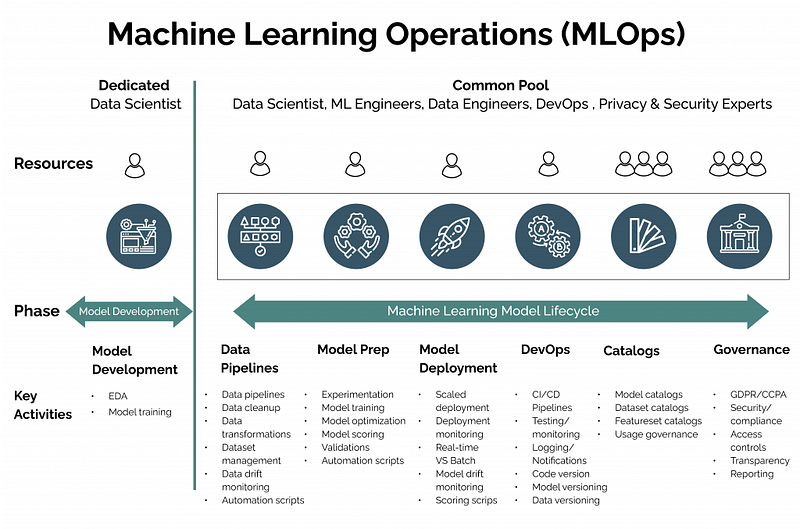
Welcome back peeps! Hope all is going well. So, after receiving a great response ( and some really good feedback and inputs) for 60 days of Data Science and ML with projects series, I’m excited to share that I’m starting a new Series — 30 days of Machine Learning Ops with (amazing) projects. PS: I’ll be writing as and when I’m free out of my busy work schedule.
Advanced SQL Series
Day 2 : SQL Basics, Query Structure, Built In functions Conditions
Day 4 : Set Theory Operations, Stored Procedures and CASE statements in SQL
Day 6 : Subqueries, Group by, order by and Having clauses in SQL and Analytical Functions
Day 7 : Window Functions, Grouping Sets and Constraints in SQL
Day 8 : BigQuery Basics, SELECT, FROM, WHERE and Date and Extract in BigQuery
Day 9 : Common Expression Table, UNNEST Clause, SQL vs NoSQL Databases
Day 10 : Triggers, Pivot and Cursors in SQL
Day 14 : MySQL in Depth
Day 15 : PostgreSQL inDepth
Complete Data Structures and Algorithm Series
Github —
Solved System Design Case Studies
Design Instagram
Design Netflix
Design Reddit
Design Amazon
Design Messenger App
Design Twitter
Design URL Shortener
Design Dropbox
Design Youtube
Design API Rate Limiter
Design Web Crawler
Design Amazon Prime Video
Design Facebook’s Newsfeed
Design Yelp
Design Uber
Design Tinder
Design Tiktok
Design Whatsapp
Most Popular System Design Questions
Mega Compilation : Solved System Design Case studies
Day 2 of 30 days of MLOps —
Let me get to the point — the prerequisite of this series is 60 days of Data Science and ML Series ( complete it before you jump the ship). You must have a basic knowledge of the Data Science and ML and terms that I’ll be using in this MLOps series —
The main aim of 30 days of Machine Learning Ops with (amazing) projects series to understand MLOps from a practical perspective and get hands on practice by implementing projects (without falling in the rabbit hole of too much theory)
Projects Videos —
All the projects, data structures, SQL, algorithms, system design, Data Science and ML , Data Analytics, Data Engineering, , Implemented Data Science and ML projects, Implemented Data Engineering Projects, Implemented Deep Learning Projects, Implemented Machine Learning Ops Projects, Implemented Time Series Analysis and Forecasting Projects, Implemented Applied Machine Learning Projects, Implemented Tensorflow and Keras Projects, Implemented PyTorch Projects, Implemented Scikit Learn Projects, Implemented Big Data Projects, Implemented Cloud Machine Learning Projects, Implemented Neural Networks Projects, Implemented OpenCV Projects,Complete ML Research Papers Summarized, Implemented Data Analytics projects, Implemented Data Visualization Projects, Implemented Data Mining Projects, Implemented Natural Leaning Processing Projects, MLOps and Deep Learning, Applied Machine Learning with Projects Series, PyTorch with Projects Series, Tensorflow and Keras with Projects Series, Scikit Learn Series with Projects, Time Series Analysis and Forecasting with Projects Series, ML System Design Case Studies Series videos will be published on our youtube channel ( just launched).
Subscribe today!
Tech Newsletter —
If you are interested, you can join my newsletter through which I send tech interview tips, techniques, patterns, hacks — Software Development, ML, Data Science, Startups and Technology projects to more than 30K readers. You can subscribe to Tech Brew :
Let’s get started!
I’l be covering only the most important topics in MLOps ( written below)—
1.MLOps Basics and Principles
What is MLOps?
Purpose
What’s important?
2. Data
Pandas and Numpy
Exploratory Data Analysis
Data preprocessing ( Collecting, Labeling and Validating data)
Data Labelling and Advanced Data Labeling Methods
Data Splitting
Feature Engineering
Data Augmentation
SQL Basics
Aggregations
Grouping Sets
Window Functions
BigQuery
Advanced Functions
Performance Tuning SQL Queries
MySQL, PostgreSQL and MongoDB
3.Modeling
Model Training and Evaluation
Model Baselines
Model Tuning and Optimization
Model Review and governance
Automated Model retraining
Model Deployment and monitoring
Model Inference and Serving
Model Resource Management Techniques
Model Analysis
High-Performance Modeling
4.Developing
End — to — End ML Workflow Cycle
ML workflows
MLOps Logging and Documentation
MLOps Makefile
ML Lake
ML Pipelines and toolkits
MLOps tools and Frameworks
5. Testing and Reproducibility
Versioning
Docker
6. Production
Continuous Integration
Continuous Delivery and Deployment
Monitoring and Logging
Feature Stores
MLOps architecture and Infrastructure Stack
Model Serving Patterns and Infrastructures
Model fairness, Explainability issues, and Mitigate bottlenecks
7. MLOps (Amazing) Papers
Some amazing MLOps research papers that I have read over the years to help you boot up to the industry standards and what’s next in this field.
So, Let’s dive in!
What is MLOps?
To put it in simple words, MLOps is the heart of ML engineering and processes. It lies at the intersection of Data Engineering, Machine Learning and DevOps.
MLOps is the process which is used to efficiently write, deploy, run the ML applications, establish collaboration and communication between data scientists and ML engineers team.
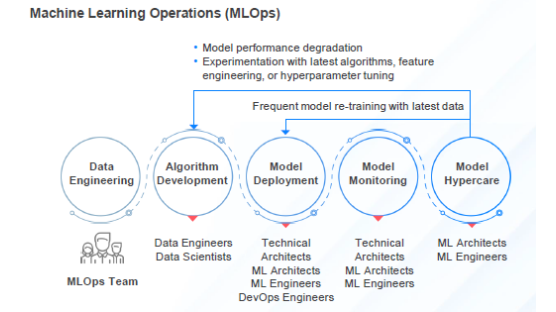
Why MLOps ?
- To automate the deployment of ML and DL models in large-scale production environments
- Robust testing of ML artifacts
- Enables agile principles to be used in ML projects
- Helps in Scaling and deploying ML models
- To improve the quality of production ML
- MLOps is more experimental
and many more things that you will learn as we proceed further in this series.
Stages of MLOps —
Data Collection and Labeling
Data analysis
Data pre-processing and transformation
Model training and validation
Model serving
Model monitoring and Logging
Model Retraining and experimentation
Data Feedback Looping
Purpose
To put it straight, the purpose here is to explore in depth how MLOps can help us streamline, automate and deploy the crucial stages of ML processes which is covered in the ML canvas below.
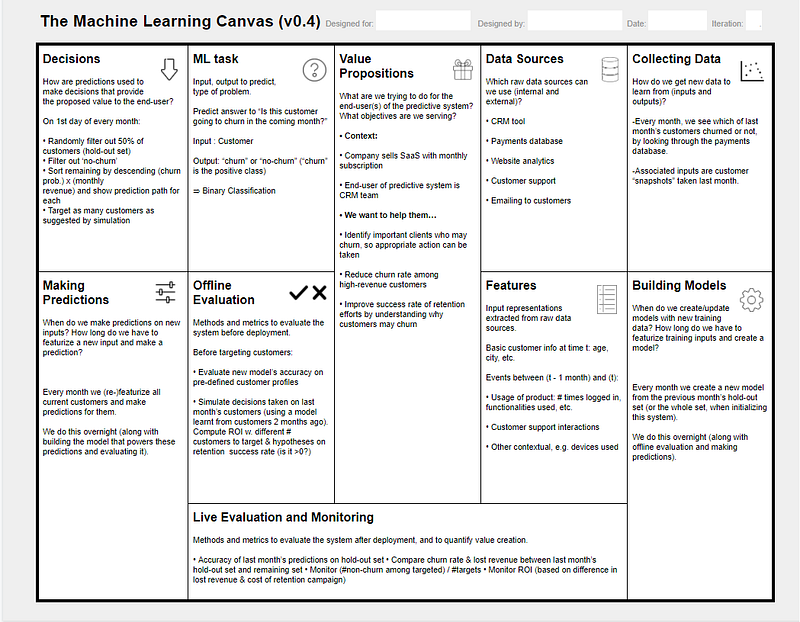
Following above template can help us answer transparently what and why, how and when of ML processes and product.
What’s Important?
While MLOps is a wide topic and honestly to be able to cover all of it isn’t the goal of this series, instead the goal is to cover the most important topics and build a depth which can boot you at your job as a data scientist/ML engineer. So, to summarize 4 things are important —
Clear ( and practical) Objective — Laying down a clear objective is important — i.e the key objectives that we want to focus on.
Checking the feasibility of proposed solution — core functionalities, constraints, integration, production deployment etc
Data — Collecting and validation of data, labeling the data well and preprocessing it
Evaluation and deployment — Laying down evaluation metrics and deployment processes.
That’s it for now!
Day 2 —
System Design Case Studies — In Depth
Design Instagram
Design Messenger App
Design Twitter
Design URL Shortener
Design Dropbox
Design Youtube
Design API Rate Limiter
Design Web Crawler
Design Facebook’s Newsfeed
Most Popular System Design Questions
Mega Compilation : Solved System Design Case studies
Complete Data Structures and Algorithm Series
Github —
Complete System Design Series Parts —
6. Networking, How Browsers work, Content Network Delivery ( CDN)
Github —
Keep learning and coding :)
30 days of Data Analytics Series —
Day 1 : Data Analytics basics and kickstart of Data analytics with projects series
Day 3 : Data Analytics Ecosystem — Data Life Cycle, Data Analysis complete process ( most important things)
Day 5 : Statistics
Day 6 : Basic and Advanced SQL
Day 8 : Pandas and Numpy
Day 9 : Data Manipulation
Day 10 : Data Visualization — Part 1
Day 11 : Project 1 : Data Visualization — Part 2
Day 12 : Data Visualization — Part 3
Day 13: Tableau — Part 1
Day 14: Tableau — Part 2
Day 15: Tableau — Part 3
Day 16 : Data Analysis Project 2
Day 17 : Data Analysis Project 3
Day 18: Data Analysis Project 4
Day 20 : Data Analysis Project 6
Day 21 : Data Analysis Project 7
Take Complete Hands On Tableau Course : Link
For Python Projects —
For complete 60 days of Data Science and ML : Day 1 — Day 60 : Quick Recap of 60 days of Data Science and ML
Follow for more updates. Stay tuned and keep coding!
For other projects, tune to —
Build Machine Learning Pipelines( With Code)
Recurrent Neural Network with Keras
Clustering Geolocation Data in Python using DBSCAN and K-Means
Facial Expression Recognition using Keras
Hyperparameter Tuning with Keras Tuner
Custom Layers in Keras


