
Should Lake Powell Be Drained?
Save it or drain it?
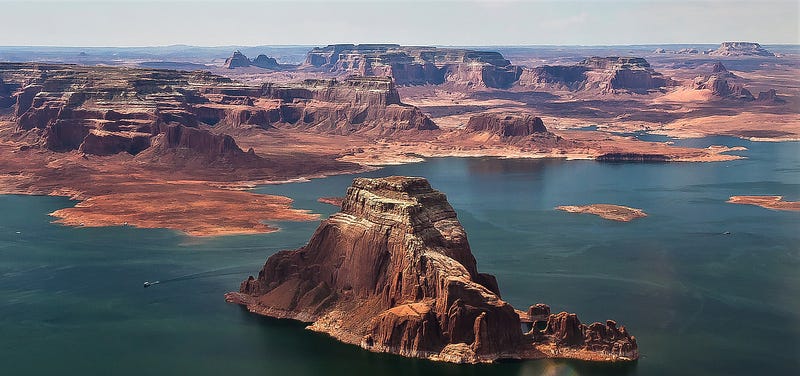
Editors note: “The Megadrought Series” has always been about how climate change affects the Colorado River Basin states, where growth is outstripping water availability. With this mini-series within a series, we’ll take a closer look at the six most problematic areas of the megadrought. Those are Lake Powell, Lake Mead, the Colorado River itself, Arizona, California and Nevada, and finally, a piece on other notably troubled areas west of the 100th Meridian. An index of all past stories can be found at the bottom of today’s article on Lake Powell. It’s not all doomsaying. Some action is taking place in the form of possible solutions, as the people and the legislators are now realizing the river can’t sustain the strains of 40 million users. Unfortunately, those actions just may not be popular.
Introduction
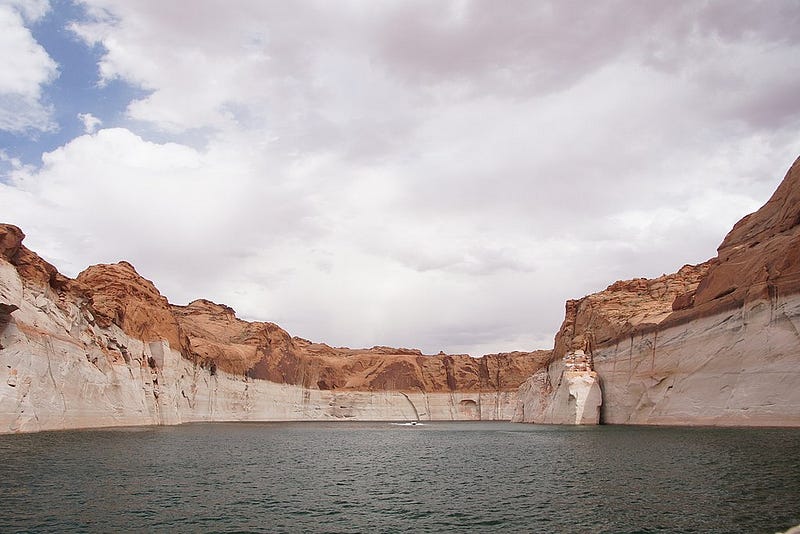
In the summer of 2021, I went to Lake Powell to see for myself what the fuss was all about. Between the summers of 2021 and 2022, the lake receded fifty feet. Looking at pictures of the lake in the summer of 2022, bluffs that were islands just a year earlier are rising from the lake floor. One can easily hike to them.
All that stands between Lake Powell being empty, for all intents and purposes, is 38 feet. That marker is known as the “minimum power pool,” when the lake’s surface would lap the top of eight underwater openings that allow water to pass through the hydroelectric dam, according to a report published in the Washington Post. At that point, the turbines used to generate hydroelectric power for 4.5 million users would shut down.
This was once seen as unfathomable. Now it could happen as early as July.
After the minimum power pool comes “dead pool,” the point where no water can pass through the dam. That’s only 120 feet below where the lake’s surface stands today.
“If that happens, you’re not going to have a river. It would be a catastrophe for the entire system.” ~ Tom Buschatzke, director for Arizona’s Department of Water Resources
Should this happen, precious little water would pass through Glen Canyon Dam, leaving the Colorado River running through the Grand Canyon essentially dry. That means a whole lot more than no whitewater river rafting.
The pressure from lower lake levels also reduces the dam’s ability to generate electricity — about 40% less so far, creating far higher prices for the Native American tribes who can scarcely afford it. As a result, the tribes and numerous smaller towns, especially on the Navajo reservation, would be forced to buy power from other sources at drastically inflated prices.
Just below Glen Canyon Dam, the city of Page, Arizona, with a population of 7,500, is drilling a tunnel below its current one to ensure water delivery to the town and its environs. But that won’t do anything for its power.
Four smaller bypass tubes could be cut into the sandstone beneath Glen Canyon Dam, lower than the dead pool level, but they still wouldn’t be able to deliver the volume of water the lower basin needs.
So as of January 4, 2023, Lake Powell is 22.73% full. Or should we say 77.27% empty? Thirteen marinas and boat launching areas are unusable. While the snowpack above the reservoir is at 142% of the average, it’s not enough to make much of a dent in the lake — the reservoirs above Lake Powell are only at 59% of capacity on average. So if releases above Glen Canyon are needed to preserve Lake Powell this year, there won’t be much to give.
Currently, Lake Powell is a shadow of its former self. At 23% of capacity, it hasn’t been this low since 1967.
There is so much going against Lake Powell. In addition to the limited inflow the lake receives, 123 billion gallons of water seep into the porous sandstone that contains the lake every year. About 10% more evaporates from the hot desert sun. That which evaporates is twice the 20% of its share of water Arizona gave up in the Tier 1 shortage of 2022.
A Brief History
In 1869, John Wesley Powell led an expedition down the Colorado and noted the Canyon for its “ensemble of features — carved walls, royal arches, glens, alcove gulches, mounds and monuments.”
With no significant roadways, the Canyon remained pristine, known only, for the most part, by Native Americans. The Canyon was full of evidence of historical cultures and artifacts, which were extracted and documented through grants from The National Park Service to the University of Utah and Northern Arizona Museum.
Organizations, chiefly the Sierra Club, were opposed to flooding the beautiful Canyon that most Americans had never seen, but those efforts fell on deaf ears.
Congress approved the building of Glen Canyon Dam in 1956 as part of an infrastructure bill known as The Colorado River Storage Project. It included Flaming Gorge Dam on the Green River, Navajo Dam on the San Juan River, and Blue Mesa Dam on the Gunnison River, all tributaries of the Colorado. This effectively harnessed or controlled the entire flow of the river.
Shortly after the bill was signed, work began on diversion tunnels around the dam's base so that the river could continue to flow uninterrupted. That work was completed in 1959.
There was no crossing from one side of the river to the other, which was needed to transport workers and materials. Rising seven-hundred feet above the river, the Glen Canyon Bridge, an engineering feat, was completed in 1957. It is the highest bridge of its kind in the country, eventually becoming part of U.S. 89. The town of Page, Arizona, was built about the same time to house the 2,500 dam workers.
The dam wall was completed in 1963, and water began accumulating. By 1964, the first electricity was generated, and in 1966 the dam was dedicated by First Lady, Lady Bird Johnson.
Today’s Dilemma
The lower Colorado River basin states (Arizona, Nevada, and California) require Lake Powell to deliver millions of acre-feet water they consume downstream to Lake Mead. In turn, the water level of Lake Mead determines how much water can be sent downstream to quench the thirst of cities such as Phoenix, Tucson, Los Angeles, and San Diego. The bigger piece of the pie is water needed for agriculture in the area, which is about 75% of the total.
However, a movement afoot wants to drain the lake altogether. The Glen Canyon Institute wants to restore the Canyon that was flooded in the 1960s to create the lake, the nation’s second-largest reservoir. Glen Canyon’s landforms and beauty are said to rival the Grand Canyon. Eric Balken, director of the institute, thinks the remaining water should be sent downriver to prop up Lake Mead, returning the area to a place for hiking, not boating.
“We can’t go on with business as usual and hope that more water fills the reservoir because it's probably not going to. It would be prudent for us to start planning for life after Lake Powell.” ~ Eric Balken
If that is the case, where will the power come from that the dam produced? Additionally, the lake’s four million annual visitors spend almost half a billion dollars, not a small sum for the National Park Service, the surrounding communities, and the Navajo Nation.
To make matters worse, the Lake Powell Pipeline is still under consideration by Utah’s legislature.
The pipeline would pump 86,000 acre-feet of water out of Lake Powell 150 miles west for $2.24 billion. The water would feed the need of the city of St. George, Utah, one of the fastest-growing metropolitan areas in the country.
Utah also thinks they haven’t received their fair share of Colorado River water, so the new pipeline would help make them whole. But St. George has some of the cheapest water in the country, which is ludicrous, based on where it was built. Additionally, located in Washington County, St. George’s residents use 302 gallons of water per day per capita. Utahns use more water than any other state except Idaho. Phoenix residents only use one-third of that per day! The U.S. average is 138 gallons per capita per day.
If that deal gets approved, I expect the decision to be sent to the Supreme Court. It’s not unprecedented. Water wars have erupted up and down the river for decades.
Lake Powell cannot afford to lose that much water.
“Based on the best data that’s available, it's really unlikely that this reservoir is going to be around in the decades to come.” ~ Eric Balken
Conclusion
There really is none. I see no solution going anywhere fast. Yet speed is what is needed.
The Bureau of Reclamation tries to keep roughly the same amount of water in Lake Powell and Lake Mead. But, unfortunately, today, there’s barely enough water to fill one of them.
One proposal offered by the Glen Canyon Institute is called “Fill Me First,” in which all Colorado River water would be sent straight to Lake Mead, leaving Lake Powell to further contract. For that to happen, new tunnels would have to be drilled around Glen Canyon Dam to allow the water to flow past the dam. There are no cost estimates for this plan.
Another faction wants to fill Lake Powell before Lake Mead.
Whatever decisions are made, no one is going to be happy.
Sources include:
- The Arizona Republic, 5/8/2022
- CBS News, 5/12/2022
- CNN, 6/18/2022
- LakePowellPipeline.org
- Newsweek, 1/11/2023
- The New Yorker, 8/21/2021
- The Salt Lake Tribune, 4/22/2021 and 1/9/2023
Stories About Climate Change and the Megadrought in the Southwest by Arthur Keith
The American West: Long on People, Short on Water How the West Went Dry 6 Of The Most Unsustainable Cities, Analyzed The East Gets Wetter and the West Gets Drier Water Crisis in the West — The Colorado River Story A Road Trip to Ground Zero of Climate Change, Part 1 A Road Trip to Ground Zero of Climate Change, Part 2 How the Bitch Stole Christmas 2 Rivers in Peril in One Thirsty State “Look, Up in the Sky, It’s a…Cloud!” This Might be the Dumbest Place to Grow a City “This is a National Disaster” — SoCal Must Reduce Water Use by 35% A Day Without Rain is Like 22 Years in America’s Southwest Climate Change is Me California’s Screamin’ (For Water) It Never Rains in Southern California And You Thought the Colorado River was in Trouble Californians: Due to Climate Change, You Must Move Fire and Rain: The Summer That’s Been, And What’s In Store Megadrought in the Southwest: Let the Water Wars Begin
For just pennies a day, you could save talented and creative writers like me and all the other writers from future homelessness! You’ll get to read every single article on Medium.com. Please, won’t you help?