avatarArthur Keith

Free AI web copilot to create summaries, insights and extended knowledge, download it at here

4722

Abstract

er Basin from the Lower Basin and assigned a percentage of the river’s flow to each state. Arizona balked and didn’t sign the agreement until 1944, the same year that Mexico got Congress to guarantee them 1.5 million acre-feet of Colorado River water.</p><p id="5593">The compact’s purpose is to deliver a minimum amount of water to each affected state and to keep water levels on the Colorado River and Lakes Mead and Powell at certain levels.</p><figure id="be55"><img src="https://cdn-images-1.readmedium.com/v2/resize:fit:800/1*mHSFFOj41VhrZ6ZQ8aC_cw.jpeg"><figcaption>Glen Canyon Dam at Lake Mead. Look how far down the water is! It’s trending towards being much worse. Photo by author in June 2021.</figcaption></figure><p id="fd84">Man, and old data, are responsible for much of this mess, but climate change is the driver. Also, since 2000, there have been many more La Niña years (1998–2001, 2005–2006, 2007–2008, 2008–2009, 2010–2012, 2016, 2017–2018, 2020–2022) than El Niño years. Based on water temperatures in the Pacific Ocean, La Niña generally means warmer temperatures and less precipitation in the American Southwest. El Niño years produce the opposite effect.</p><h2 id="2855">The Colorado River and the Lakes</h2><p id="0d12">With the government’s demand that the users of Colorado River water scale back their use, a highly contentious debate has been kicked off as to what states the most significant onus should be upon.</p><p id="26d2">Since they use less, the Upper Basin states have inferred that the Lower Basin states should take the majority of the cuts. If the Upper Basin states can stick to their current consumption levels, it would help to stabilize the water levels in Lakes Powell and Mead.</p><p id="a241">But while Arizona, California, and Nevada continue to see higher population growth, one metropolitan area in the Upper Basin wants more of the water to feed its growing population: Denver. As a result, two pipelines are proposed to divert water to the Front Range of Colorado. This is the exact opposite of what the government is mandating the river needs.</p><p id="2cf6">Says Kevin Wheeler, Oxford University engineer and a senior research associate of the cuts:</p><blockquote id="b4f2"><p>“They would definitely have to remain in place either until we know the drought has definitely ended and the reservoirs have recovered, or even greater shortages are required because of increasing aridification.”</p></blockquote><p id="34ec">When built, Glen Canyon Dam created Lake Powell, meant to be a backup for Lake Mead. It could hold enough water to pour its excess downstream through the Grand Canyon to Lake Mead in wet years. Now there is no excess. Instead, it has <i>less</i> water than it is supposed to send downstream in the coming year.</p><p id="6fbf">As the snowpack goes, so goes the river. Last year wasn’t terrible, but the ground was so parched that it absorbed the water before it could reach rivers and streams. If the snowpack this winter is below average, the water level in Lake Powell will dip below the dam’s hydropower intakes by the end of 2023. As many as five million households dependent on this power could go dark, including the entire Navajo Nation. Nearby Page, Arizona, has had to drill an emergency water pipeline link that starts <i>below</i> the current intakes. But even those tunnels are at risk of drying up.</p><figure id="22e3"><img src="https://cdn-images-1.readmedium.com/v2/resize:fit:800/1*TaX0BrSy7hLXBR8UTnm-nA.jpeg"><figcaption>The author in an uncentered (as usual) photo at Horseshoe Bend on the Colorado River, just south of Page, Arizona. It’s conceivable that this section of the river, between the two lakes, may run dry at times in the future.</figcaption></figure><p id="ca41">By the time 2023 rolls around and the Tier 2 shortage goes into effect, the seven states should have come up with a plan to save 2–4 million acre-feet of water/year, according to the U.S. Bureau of Reclamation Commissioner Camille Touton. (To put this into perspective, the entire allotment of the river Arizona receives annually is 2.8 million acre-feet.)</p><p id="5c8a">However, because it has senior water rights, California will not face cuts under Tier 2. As a result, only Arizona, Nevada, and Mexico will bear the brunt of how much more of the Colorado River water they‘ll have to forfeit. This is a big point of contention.</p><p id="2a07">Large stretches of the Colorado River could run dry parts of the year if an agreement isn’t reached. Can you imagine the Grand Canyon without the river running through it? This ecological disaster could happen.</p><blockquote id="5f48"><p>“It’s really hard to make predictions, especially about the

Options

future” ~<i>Yogi Berra</i></p></blockquote><h2 id="26e0">Nevada</h2><p id="3156">Because its population was the lowest of all the states in the original Colorado Compact, at 4%, Nevada got the lowest percentage of river water. Boulder Dam (now Hoover Dam) hadn’t even yet been built. The population of Las Vegas was only 2,304! Due to the lack of air conditioning, the West wasn’t very populated.</p><p id="1662">The Southern Nevada Water Authority (SNWA), which includes the Las Vegas Metro, has imposed strict water restrictions. There are two “nevers”: never water on Sunday, and never water on any day between 11 am and 7 pm. You may water six days a week or less from May through August. In September and October, that drops to three days or less.</p><p id="6d75">Nevada is the most arid state in the country, and they’ve learned to live with shortages. So they won’t put up with “water wasters.” In fact, the SNWA and the Las Vegas Valley Water District (LVVWD) have a water patrol. Dubbed the “water cops,” they patrol the city’s streets, looking for “water crooks.” Violators are issued warnings or fines.</p><p id="e9ef">Most of the indoor water in Las Vegas is recycled and returned to Lake Mead. That allows the city to take out as much water from the lake as it takes in. Outdoor water, however, cannot be recycled, thus the “water cops.”</p><p id="6e1a">Still, there is a lot of concern regarding Nevada’s exploding population and the state’s water usage. For example, the current population of Clark County is 2,376,683. About 3.38 million are expected to live there in 2060. In a far shorter time frame, suburban North Las Vegas’ population, currently at 432,588, is expected to be close to 570,000 by 2030.</p><p id="692e">I need to stop early before addressing Arizona and California. That is where water wars will likely be localized, with both sides duking it out for their fair share. We’ll explore that later this month.</p><p id="455d">Sources for the series include:</p><ul><li><i>Arizona Republic</i>, 8/16/2022</li><li><i>East Valley Tribune</i> (Mesa), 5/15/2022</li><li><i>Arizona Republic</i>, 5/19/2022</li><li><i>Arizona Republic</i>, 5/4/2022</li><li><i>Arizona Republic</i>, 5/7/2022</li><li>Univ. of Nevada Center for Business and Economic Research, 3/3/2022</li><li>KTNV Las Vegas-abc 13</li><li>KSNV Las Vegas-NBC 3</li><li><i>The Guardian</i>, 10/2/2022</li><li><i>Arizona Republic</i>, 10/3/2022</li></ul><p id="f703">For more background on the crisis in the American Southwest, check out these articles:</p><div id="9fb7" class="link-block"> <a href="https://readmedium.com/fire-and-rain-the-summer-thats-been-and-what-s-in-store-2955bd524cc9"> <div> <div> <h2>Fire and Rain: The Summer That’s Been, And What’s In Store</h2> <div><h3>A Southwest Regional Roundup of the Megadrought</h3></div> <div><p>medium.com</p></div> </div> <div> <div style="background-image: url(https://miro.readmedium.com/v2/resize:fit:320/1*Dw5VqRrvajmkm6h-2RRKoA.jpeg)"></div> </div> </div> </a> </div><div id="3337" class="link-block"> <a href="https://readmedium.com/6-of-the-most-unsustainable-cities-analyzed-158e1eaf94ee"> <div> <div> <h2>6 Of The Most Unsustainable Cities, Analyzed</h2> <div><h3>Turn off the Water When You’re Brushing Your Teeth!</h3></div> <div><p>medium.com</p></div> </div> <div> <div style="background-image: url(https://miro.readmedium.com/v2/resize:fit:320/1*qyhc5TI6r0JZjfY0HI0dig.jpeg)"></div> </div> </div> </a> </div><p id="8452">Like what you’re reading? Consider subscribing to Medium. For the price of a monthly magazine ($5/month), you’ll have access to all of my stories and thousands of other writers. And I’ll get a wee bit! Just click the link below.</p><div id="e88e" class="link-block"> <a href="https://artsma57.medium.com/membership"> <div> <div> <h2>Join Medium with my referral link - Arthur Keith</h2> <div><h3>Read every story from Arthur Keith (and thousands of other writers on Medium). Your membership fee directly supports…</h3></div> <div><p>artsma57.medium.com</p></div> </div> <div> <div style="background-image: url(https://miro.readmedium.com/v2/resize:fit:320/0*Yl5So9stiT6bAT5c)"></div> </div> </div> </a> </div></article></body>

THE MEGADROUGHT SERIES 2022 — PART 8

Megadrought In The Southwest: Let The Water Wars Begin

Making sense of the current disaster along the Colorado River
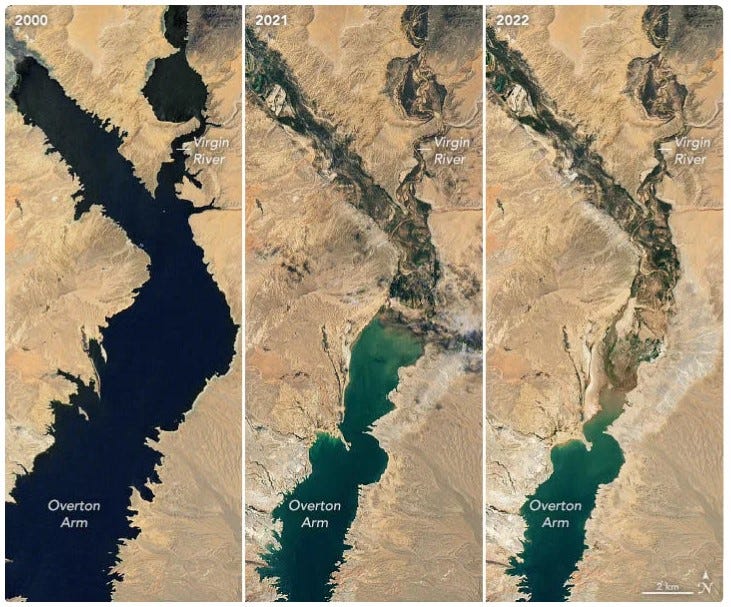
In addition to drought, evaporation, and the use of the river by the city of St. George, it has all but dried up by the time the Virgin River meets with Lake Mead. Photo credit: NASA Earth Observatory.

We were holding our breath.

It hadn’t rained since late March. Not. One. Drop. The Rio Grande dried up in Albuquerque.

June 15 came, which is the unofficial beginning of the monsoon season in the Southwest.

By June 17, we were dancing in the streets. It rained! And it continued to do so all season long, which ended September 30. Many of the rains were so heavy they created dangerous flash flooding in many locations. On the other hand, that water brought new life to the desert southwest. In Nevada, the rains were historical and added a few feet of water to Lake Mead. Death Valley even got in on the act.

It’s nice to see the mountainsides green in July.

But while they help the farmers in the short term, they don’t solve any long-term problems.

Be prepared: this article is a bit lengthy. In this chapter, we’ll focus primarily on the lower-basin states (Arizona, California, and Nevada) and their dependence on the Colorado River, as well as the lakes that quench the thirst and power the homes and businesses in the Southwest.

With that, let’s revisit the basics.

A Quick Summary of the Colorado River Dilemma

The most recent agreement on the apportionment of the river was enacted in 2007 and was expected to last through 2026. It included cuts to all seven states and Mexico.

However, by 2015, the U.S. Bureau of Reclamation determined that those cuts were not enough as the drought that started in 2000 wore on. So the states began working together on a Plan B.

Known as the Drought Contingency Plan (DCP), a tiered system was established in 2019 to protect the lakes from a “dead pool” status. (“Dead Pool” is the point at which a dam can no longer generate power because there’s not enough water to power the turbines.) So the federal government declared a Tier 1 shortage on the Colorado River due to the low level of the lakes in 2022. Because things have only worsened, Tier 2 begins on January 1, 2023, with massive water cuts.

The primary feature of the DCP is to curtail the amount of water being taken out of the Colorado River downstream from Lake Mead. The current water level of Lake Mead is 1,045 feet above sea level (as of 10/1/2022), or about 26% of capacity. As a result, dead pool occurs at 895 feet. Experts say this could happen as soon as July 2024.

Lake Powell, currently at 23% capacity, is at its lowest point since it was filled in 1963. Now, at 3,529 feet above sea level, it will hit dead pool when its level dips to 3,370 feet.
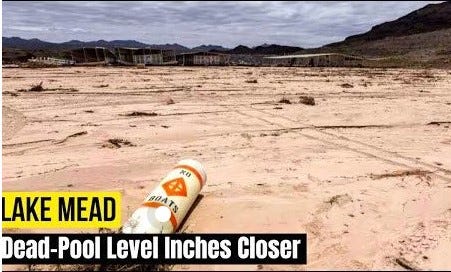
We’re not just talking about shortages now. We’re talking about the complete inability of the lakes to provide drinking water and power to millions and millions of people. Photo from the author’s Pinterest collection.

Based on these shortages in the lower Colorado River basin (Arizona, California, and Nevada), it’s inevitable water will be taken from agriculture, which uses about 80% of the river water. The recently-passed $4 billion climate bill will pay farmers, tribes, and businesses based on reduced water usage. Therefore, farmers will not plant in many fields, hurting food prices in an economy already suffering from inflation.

Drought also prohibits grass from growing, which means cattle ranchers have to buy ever-increasingly expensive feed for their herds since there’s nothing to graze on. For instance, average herd sizes have fallen 43% in New Mexico and 50% in Texas, resulting in higher beef prices.

Though more a part of the upper Colorado Basin states (Wyoming, Colorado, Utah, and New Mexico), Lake Powell, upstream from Lake Mead, stores water from these states based on the 1922 Colorado River Compact.

The compact is based upon records dating back to 1890, which were all wet, especially compared to today. It divided the Upper Basin from the Lower Basin and assigned a percentage of the river’s flow to each state. Arizona balked and didn’t sign the agreement until 1944, the same year that Mexico got Congress to guarantee them 1.5 million acre-feet of Colorado River water.

The compact’s purpose is to deliver a minimum amount of water to each affected state and to keep water levels on the Colorado River and Lakes Mead and Powell at certain levels.
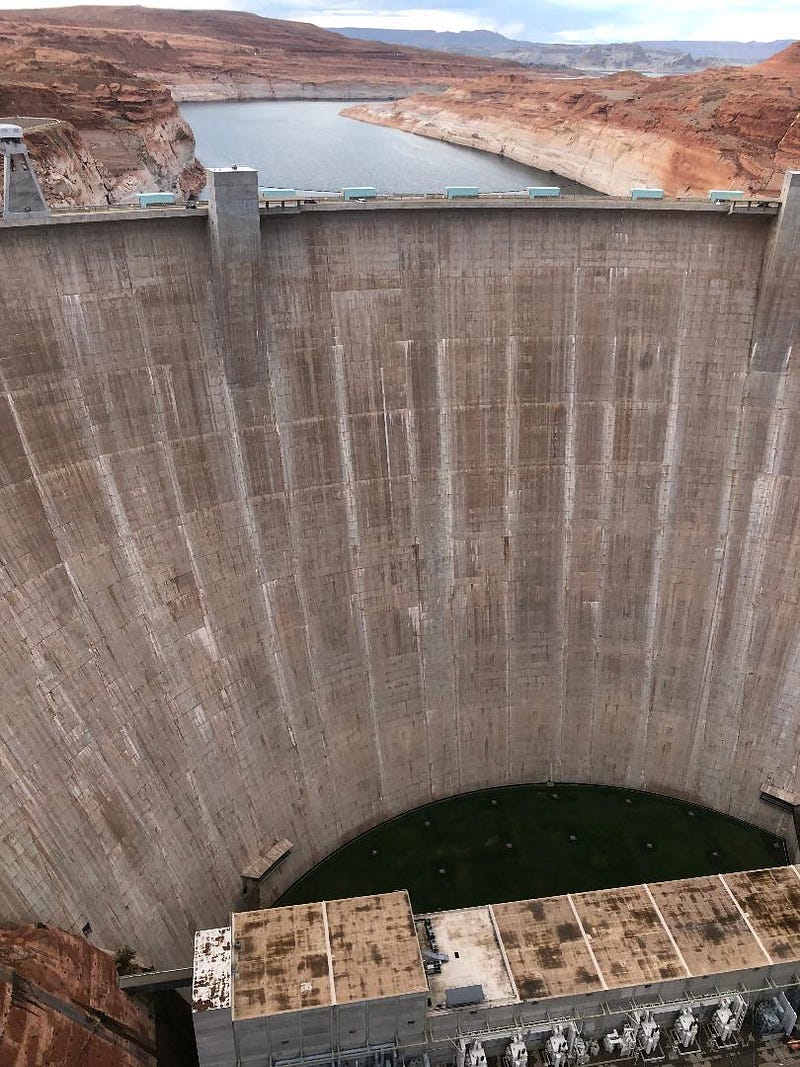
Glen Canyon Dam at Lake Mead. Look how far down the water is! It’s trending towards being much worse. Photo by author in June 2021.

Man, and old data, are responsible for much of this mess, but climate change is the driver. Also, since 2000, there have been many more La Niña years (1998–2001, 2005–2006, 2007–2008, 2008–2009, 2010–2012, 2016, 2017–2018, 2020–2022) than El Niño years. Based on water temperatures in the Pacific Ocean, La Niña generally means warmer temperatures and less precipitation in the American Southwest. El Niño years produce the opposite effect.

The Colorado River and the Lakes

With the government’s demand that the users of Colorado River water scale back their use, a highly contentious debate has been kicked off as to what states the most significant onus should be upon.

Since they use less, the Upper Basin states have inferred that the Lower Basin states should take the majority of the cuts. If the Upper Basin states can stick to their current consumption levels, it would help to stabilize the water levels in Lakes Powell and Mead.

But while Arizona, California, and Nevada continue to see higher population growth, one metropolitan area in the Upper Basin wants more of the water to feed its growing population: Denver. As a result, two pipelines are proposed to divert water to the Front Range of Colorado. This is the exact opposite of what the government is mandating the river needs.

Says Kevin Wheeler, Oxford University engineer and a senior research associate of the cuts:

“They would definitely have to remain in place either until we know the drought has definitely ended and the reservoirs have recovered, or even greater shortages are required because of increasing aridification.”

When built, Glen Canyon Dam created Lake Powell, meant to be a backup for Lake Mead. It could hold enough water to pour its excess downstream through the Grand Canyon to Lake Mead in wet years. Now there is no excess. Instead, it has less water than it is supposed to send downstream in the coming year.

As the snowpack goes, so goes the river. Last year wasn’t terrible, but the ground was so parched that it absorbed the water before it could reach rivers and streams. If the snowpack this winter is below average, the water level in Lake Powell will dip below the dam’s hydropower intakes by the end of 2023. As many as five million households dependent on this power could go dark, including the entire Navajo Nation. Nearby Page, Arizona, has had to drill an emergency water pipeline link that starts below the current intakes. But even those tunnels are at risk of drying up.
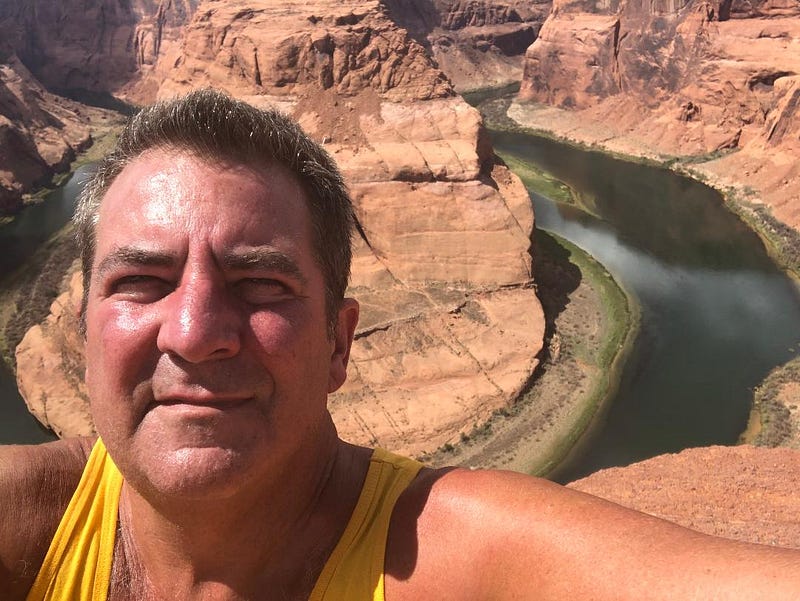
The author in an uncentered (as usual) photo at Horseshoe Bend on the Colorado River, just south of Page, Arizona. It’s conceivable that this section of the river, between the two lakes, may run dry at times in the future.

By the time 2023 rolls around and the Tier 2 shortage goes into effect, the seven states should have come up with a plan to save 2–4 million acre-feet of water/year, according to the U.S. Bureau of Reclamation Commissioner Camille Touton. (To put this into perspective, the entire allotment of the river Arizona receives annually is 2.8 million acre-feet.)

However, because it has senior water rights, California will not face cuts under Tier 2. As a result, only Arizona, Nevada, and Mexico will bear the brunt of how much more of the Colorado River water they‘ll have to forfeit. This is a big point of contention.

Large stretches of the Colorado River could run dry parts of the year if an agreement isn’t reached. Can you imagine the Grand Canyon without the river running through it? This ecological disaster could happen.

“It’s really hard to make predictions, especially about the future” ~Yogi Berra

Nevada

Because its population was the lowest of all the states in the original Colorado Compact, at 4%, Nevada got the lowest percentage of river water. Boulder Dam (now Hoover Dam) hadn’t even yet been built. The population of Las Vegas was only 2,304! Due to the lack of air conditioning, the West wasn’t very populated.

The Southern Nevada Water Authority (SNWA), which includes the Las Vegas Metro, has imposed strict water restrictions. There are two “nevers”: never water on Sunday, and never water on any day between 11 am and 7 pm. You may water six days a week or less from May through August. In September and October, that drops to three days or less.

Nevada is the most arid state in the country, and they’ve learned to live with shortages. So they won’t put up with “water wasters.” In fact, the SNWA and the Las Vegas Valley Water District (LVVWD) have a water patrol. Dubbed the “water cops,” they patrol the city’s streets, looking for “water crooks.” Violators are issued warnings or fines.

Most of the indoor water in Las Vegas is recycled and returned to Lake Mead. That allows the city to take out as much water from the lake as it takes in. Outdoor water, however, cannot be recycled, thus the “water cops.”

Still, there is a lot of concern regarding Nevada’s exploding population and the state’s water usage. For example, the current population of Clark County is 2,376,683. About 3.38 million are expected to live there in 2060. In a far shorter time frame, suburban North Las Vegas’ population, currently at 432,588, is expected to be close to 570,000 by 2030.

I need to stop early before addressing Arizona and California. That is where water wars will likely be localized, with both sides duking it out for their fair share. We’ll explore that later this month.

Sources for the series include:

  • Arizona Republic, 8/16/2022
  • East Valley Tribune (Mesa), 5/15/2022
  • Arizona Republic, 5/19/2022
  • Arizona Republic, 5/4/2022
  • Arizona Republic, 5/7/2022
  • Univ. of Nevada Center for Business and Economic Research, 3/3/2022
  • KTNV Las Vegas-abc 13
  • KSNV Las Vegas-NBC 3
  • The Guardian, 10/2/2022
  • Arizona Republic, 10/3/2022

For more background on the crisis in the American Southwest, check out these articles:

Like what you’re reading? Consider subscribing to Medium. For the price of a monthly magazine ($5/month), you’ll have access to all of my stories and thousands of other writers. And I’ll get a wee bit! Just click the link below.

Climate Change
Science
Technology
Drought
Water
Recommended from ReadMedium