avatarArthur Keith

Free AI web copilot to create summaries, insights and extended knowledge, download it at here

4803

Abstract

for Rio Grande water. One of Elephant Butte Reservoir’s primary purposes is to store water and send it downstream to Texas. Elephant Butte Lake is now only 13% full. New Mexico can’t afford to send any more of its water downstream, but it has to, in part, quench the need of cities downstream like El Paso and agriculture.</p><p id="022a">East of the Rio Grande is the Pecos River and its watershed. From the Pecos, we are also in arrears to Texas. See my story on this issue <a href="https://readmedium.com/2-rivers-in-peril-in-one-thirsty-state-8c098aec3c0b">here</a>. On top of that, the headwaters of the Pecos lie in the Northern New Mexico mountains, which wildfires have recently scorched. Any runoff from rain or snow, perhaps for years, will affect the quality of the water. Filtering ash is extremely expensive, and I imagine the federal government will have to step in to help with this double jeopardy situation.</p><blockquote id="66ce"><p>Sadly, the Southwest cannot seem to get into a reactive mode that offers real, long-range solutions because it's always in panic mode.</p></blockquote><h2 id="d8f6">ARIZONA</h2><p id="39d5">The <a href="https://readmedium.com/water-crisis-in-the-west-v5-0-the-colorado-river-story-8cececfce39a">Colorado River</a> is at the heart of the issue, directly affecting water and power customers in seven states and Mexico. The two main reservoirs, Lake Powell and Lake Mead, are barely at the level they need to be to deliver the resources they always have. As a result, residents in six states are under the threat of losing water, power, or both.</p><p id="071b">Below Lake Mead lies the intake for the Central Arizona Project (CAP), delivering fresh, clean water to the burgeoning populations of Phoenix and Tucson and substantial farmland. Arizona’s cities use only about 20% of this water, with the remaining going to agriculture. In a Tier 1 shortage, less water is being delivered, and many farmers have to let their fields fallow.</p><p id="8037">The CAP allowed Arizona to grow, now well beyond its means. The state’s population has increased by 955% since 1950! The Phoenix suburb of Mesa — with 504,258 residents is really a city of its own —is in particular trouble. It receives a disproportionate share of its water from the CAP. Without the benefit of groundwater supplies and water from the Salt River Project, it may have to lease water from other municipalities — if they have it to spare.</p><figure id="6ff6"><img src="https://cdn-images-1.readmedium.com/v2/resize:fit:800/1*ha4QD_Sgr0PsFCsxl9cNlw.jpeg"><figcaption>NOAA predicted temperatures for the summer of 2022. Looks like a repeat of last year. And the year before that. And…</figcaption></figure><p id="0db4">The state has already agreed to leave more than 800,000 acre-feet of its share of Colorado River water in Lake Mead this year, as it anticipates being in a Tier 3 shortage next year. This is the worst-case scenario for which the states in the lower Colorado basin (Nevada, California, Arizona, and Mexico) have planned.</p><p id="abaf">But what if it gets even worse? Recent history has taught us that it does.</p><p id="b95a">It hasn’t rained since March in both Phoenix and Tucson, and on both accounts, they’re running well below average in precipitation for the year.</p><p id="99f1">Arizona governor Doug Ducey’s planned “Arizona Water Authority” has a 1 billion budget to find new sources of water over the next three years.</p><p id="9262">In Arizona?!! I think if they haven’t found it by now, it doesn’t exist.</p><blockquote id="7117"><p>“We need significant action, really significant action.” ~<i>Arizona Water Resources Director Tom Buschatzke</i></p></blockquote><p id="025a">Anyway, in his recent “State of the State” address, the governor suggested some money could be spent to help fund a desalination plant in Mexico. The states that participated could take part in Mexico’s share of the Colorado River in return.</p><p id="9f75">Isn’t that sort of like taking back a gift you gave someone?</p><p id="d822">The river usually dries up before it reaches the delta at the Sea of Cortez. In its few short miles in Mexico, the river is used for agriculture, but it also has to tend to the needs of cities such as Mexicali (population of more than one million), and Tijuana with more than two million people.</p><p id="d171">I don’t know how they do it.</p><p id="a0b5">Meanwhile, back in Arizona, talk of a pipeline from the Mississippi River to Arizona is being revived. The pipeline would cost at least 8.6 billion, depending on its route. A parched western Kansas has expressed interest.</p><p id="7cbc">However, the experts predict the cost to be about 1,700 an acre-foot once delivered. At present, Arizonans pay less than 200 per acre-foot of Colo

Options

rado River water.</p><p id="1f6f">Arizona’s cities using water that flows from the CAP (Central Arizona Project) have not been ordered to curb outdoor watering. To impose them would be unprecedented.</p><p id="5600">Next year’s projected shortage of the Colorado will be made this August. As of now, it is predicted that Lake Mead will drop a few inches below the threshold that would mandate a cut to Tier 2. Arizona is already anticipating a Tier 3 situation in 2023. No one predicted the shortages would occur this fast.</p><p id="abb6">The loss of a few little inches in Lake Mead will make a difference in the lives of millions of people. Farmers stand to lose the most, given they are the primary users of Colorado River water in Arizona.</p><p id="7587">It looks like these two states are all that I’ll be able to get to for now. The megadrought is an overwhelming issue, and it is growing more alarming by the day. Aridification is spreading east, jeopardizing our food supply. I’ll be writing about that in a feature later this summer which will document a road trip through America’s Great Plains.</p><p id="92f5">Sources include:</p><p id="845a"><i>St. George</i> (Utah) <i>Spectrum</i>: <a href="https://www.thespectrum.com/story/news/local/arizona-environment/2022/05/07/arizona-will-have-to-dig-deep-for-money-as-water-shortage-worsens/9682189002/?utm_source=thespectrum-Daily%20Briefing&amp;utm_medium=email&amp;utm_campaign=daily_briefing&amp;utm_term=list_article_thumb&amp;utm_content=1530SP-E-NLETTER65"><b>https://www.thespectrum.com/story/news/local/arizona-environment/2022/05/07/arizona-will-have-to-dig-deep-for-money-as-water-shortage-worsens/9682189002/?utm_source=thespectrum-Daily%20Briefing&amp;utm_medium=email&amp;utm_campaign=daily_briefing&amp;utm_term=list_article_thumb&amp;utm_content=1530SP-E-NLETTER65</b></a></p><p id="4ca9"><a href="https://www.watereducation.org/topic-colorado-river"><b>https://www.watereducation.org/topic-colorado-river</b></a></p><p id="cc45">“Lake Mead could still tank in 2023, despite all we’ve done to save it” by Joanna Allhands in the <i>Arizona Republic</i>, 5/19/2022 “The American West should brace for a blackout summer, electricity regulator warns,” by Tristan Boves in <i>FORTUNE</i>, 5/19/2022 “Wildfire threatens ‘cultural genocide’ in New Mexico villages” by Andrew Hays in Reuters, 5/8/2022 “Climate Change in National Parks” — the National Park Service</p><p id="de13">U.S Drought Monitor and the NOAA for maps.</p><p id="7abf">For more perspective on the issue, check out these articles:</p><div id="7798" class="link-block"> <a href="https://readmedium.com/water-crisis-in-the-west-v5-0-the-colorado-river-story-8cececfce39a"> <div> <div> <h2>Water Crisis In The West, v5.0 — The Colorado River Story</h2> <div><h3>It’s Happening Faster Than I Can Write About It”</h3></div> <div><p>medium.com</p></div> </div> <div> <div style="background-image: url(https://miro.readmedium.com/v2/resize:fit:320/1*8keIATZgmF8KK438tOqd-g.jpeg)"></div> </div> </div> </a> </div><div id="3eac" class="link-block"> <a href="https://readmedium.com/the-east-gets-wetter-and-the-west-gets-drier-dd696f1a65f"> <div> <div> <h2>The East Gets Wetter And The West Gets Drier</h2> <div><h3>Why aren’t we building a water pipeline?</h3></div> <div><p>medium.com</p></div> </div> <div> <div style="background-image: url(https://miro.readmedium.com/v2/resize:fit:320/1*04kOb2cx4P26h-o-4hHcFA.jpeg)"></div> </div> </div> </a> </div><p id="0f7f">If you like what you’ve read, why not become a Medium member? It’s just $5/month and gives you access to all of my stories and those of all the other fine writers on Medium. Plus, I get a <i>small </i>commission which helps <i>a lot!</i> Just click on the link below. Thanks for being a member!</p><div id="46eb" class="link-block"> <a href="https://artsma57.medium.com/membership"> <div> <div> <h2>Join Medium with my referral link - Arthur Keith</h2> <div><h3>As a Medium member, a portion of your membership fee goes to writers you read, and you get full access to every story…</h3></div> <div><p>artsma57.medium.com</p></div> </div> <div> <div style="background-image: url(https://miro.readmedium.com/v2/resize:fit:320/0*yvVNmiKHLrLFrdKX)"></div> </div> </div> </a> </div></article></body>

THE MEGADROUGHT SERIES 2022, PART 3

A Day Without Rain Is Like 22 Years In America’s Southwest

Water uncertainty in Arizona and New Mexico
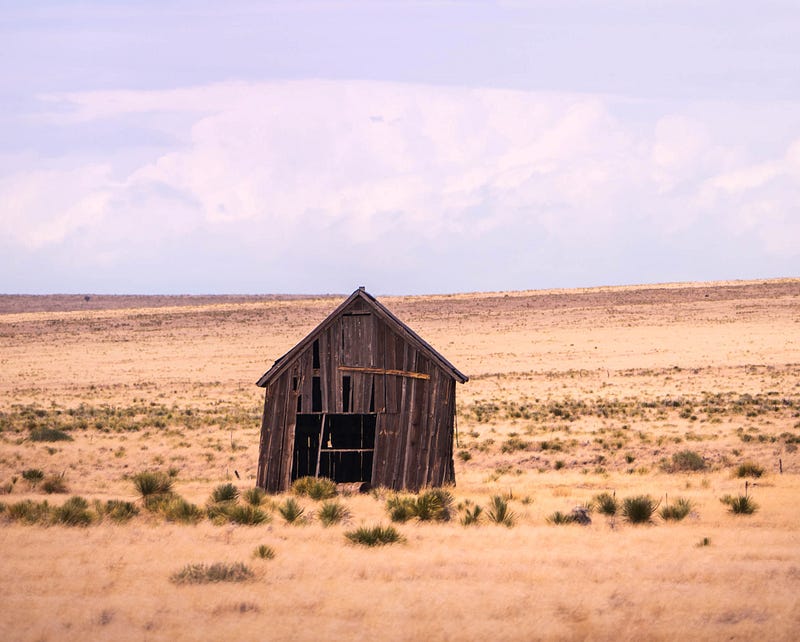
What most of Eastern New Mexico looks like at present. Only the yuccas are green. Cattle can’t eat yucca, so they go to market early. Another economic factor of the megadrought. Photo by Raychel Sanner on Unsplash

The Southwest is melting down. Between the heat and lack of moisture, it’s become an inferno.

This year is already worse than last year, which was a catastrophe. So should we call this catastrophe-plus?

Starting with “The American West: Long on People, Short on Water” in 2021, I‘ve written several stories about the current megadrought. This year it becomes a series. So today, I’ll tackle as much of it as possible without going overboard on length. That’s the beauty of a series!

While the American West is a tiny fraction of the total global landmass affected by climate change and drought, its effects are felt by a large percentage of the U.S population. The ten states most affected by the current drought are California, Nevada, Arizona, Utah, New Mexico, Colorado, Texas, Oklahoma, Kansas, and Nebraska. Collectively, the population of these states is 97.91 million, or 34% of the country’s population.

Think about the food that can’t be grown. Think about the livestock that have nothing to eat.

The threat is real. The danger is here.

NEW MEXICO

I start from home. It’s May in New Mexico, and as is the norm in the springtime, dry, gusty winds are taking their toll. With the wind comes the drying of the land, which takes every bit of moisture out of the ground and the vegetation. It’s a perfect recipe for disaster.

Not to speak of the dust the wind brings indoors. Dust is a real problem for someone who owns and collects model airplanes and displays them in three different places! You cannot keep anything dust-free here—first-world problems.

Burning since April 6, the Hermit’s Peak Calf Canyon wildfire began with a United States Forest Service prescribed burn. But then the winds came up, and now, with more than 300,000 acres burned, we have the largest wildfire in the state’s history. It is currently the largest wildfire in the country. It has burned down hundreds of homes and centuries of human history.
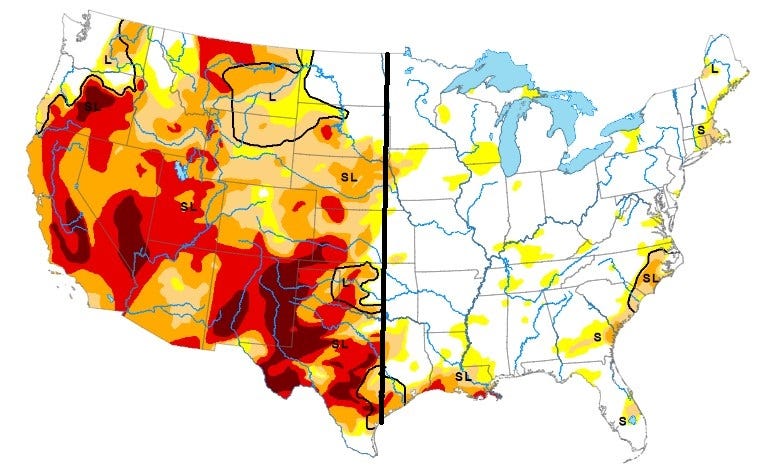
U.S. Drought Monitor as of 6/2/2022. Areas in the darkest shade of red are in an exceptional state of drought, the highest category possible. The thick black line represents the average “dry line” between the arid west and the humid east. Since first imagined in 1878 by John Wesley Powell, it has shifted about 150 miles east.

The entire state, the nation’s fifth-largest, is in some stage of drought. About one-third of the state is in exceptional drought, the highest the scale goes on the U.S. Drought Monitor’s map. Albuquerque currently has no water restrictions in place, even though it was a lousy runoff season. The city has received all of .55 inches of precipitation this year, so restrictions can’t be far ahead. It hasn’t rained since March 23.

Back in the early days of the drought, say around 2002, piñon pines, a tree that has lived here from time immemorial, suffered from stress to the point that they were invaded by pests, and there was a huge die-off. As the drought deepens the species continues to dwindle. Opportune junipers are taking their place. Drought changes everything. It can even change biomes, as we’ll see in the Great Plains.

New Mexico has only grown 310% in population since 1950. It could be because we have no mighty water source like the Colorado River. But we do have rivers. The Rio Grande is like life itself, roughly dividing the state in half from Colorado to Texas. Unfortunately, it is bound to run dry in several places this summer.

To make matters worse, based on agreements made many years ago, New Mexico is in arrears to Texas for Rio Grande water. One of Elephant Butte Reservoir’s primary purposes is to store water and send it downstream to Texas. Elephant Butte Lake is now only 13% full. New Mexico can’t afford to send any more of its water downstream, but it has to, in part, quench the need of cities downstream like El Paso and agriculture.

East of the Rio Grande is the Pecos River and its watershed. From the Pecos, we are also in arrears to Texas. See my story on this issue here. On top of that, the headwaters of the Pecos lie in the Northern New Mexico mountains, which wildfires have recently scorched. Any runoff from rain or snow, perhaps for years, will affect the quality of the water. Filtering ash is extremely expensive, and I imagine the federal government will have to step in to help with this double jeopardy situation.

Sadly, the Southwest cannot seem to get into a reactive mode that offers real, long-range solutions because it's always in panic mode.

ARIZONA

The Colorado River is at the heart of the issue, directly affecting water and power customers in seven states and Mexico. The two main reservoirs, Lake Powell and Lake Mead, are barely at the level they need to be to deliver the resources they always have. As a result, residents in six states are under the threat of losing water, power, or both.

Below Lake Mead lies the intake for the Central Arizona Project (CAP), delivering fresh, clean water to the burgeoning populations of Phoenix and Tucson and substantial farmland. Arizona’s cities use only about 20% of this water, with the remaining going to agriculture. In a Tier 1 shortage, less water is being delivered, and many farmers have to let their fields fallow.

The CAP allowed Arizona to grow, now well beyond its means. The state’s population has increased by 955% since 1950! The Phoenix suburb of Mesa — with 504,258 residents is really a city of its own —is in particular trouble. It receives a disproportionate share of its water from the CAP. Without the benefit of groundwater supplies and water from the Salt River Project, it may have to lease water from other municipalities — if they have it to spare.
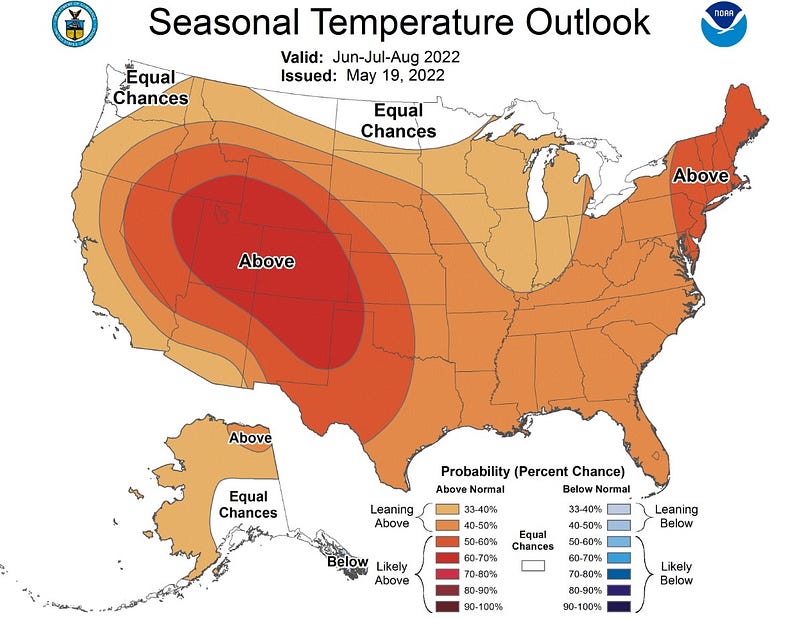
NOAA predicted temperatures for the summer of 2022. Looks like a repeat of last year. And the year before that. And…

The state has already agreed to leave more than 800,000 acre-feet of its share of Colorado River water in Lake Mead this year, as it anticipates being in a Tier 3 shortage next year. This is the worst-case scenario for which the states in the lower Colorado basin (Nevada, California, Arizona, and Mexico) have planned.

But what if it gets even worse? Recent history has taught us that it does.

It hasn’t rained since March in both Phoenix and Tucson, and on both accounts, they’re running well below average in precipitation for the year.

Arizona governor Doug Ducey’s planned “Arizona Water Authority” has a $1 billion budget to find new sources of water over the next three years.

In Arizona?!! I think if they haven’t found it by now, it doesn’t exist.

“We need significant action, really significant action.” ~Arizona Water Resources Director Tom Buschatzke

Anyway, in his recent “State of the State” address, the governor suggested some money could be spent to help fund a desalination plant in Mexico. The states that participated could take part in Mexico’s share of the Colorado River in return.

Isn’t that sort of like taking back a gift you gave someone?

The river usually dries up before it reaches the delta at the Sea of Cortez. In its few short miles in Mexico, the river is used for agriculture, but it also has to tend to the needs of cities such as Mexicali (population of more than one million), and Tijuana with more than two million people.

I don’t know how they do it.

Meanwhile, back in Arizona, talk of a pipeline from the Mississippi River to Arizona is being revived. The pipeline would cost at least $8.6 billion, depending on its route. A parched western Kansas has expressed interest.

However, the experts predict the cost to be about $1,700 an acre-foot once delivered. At present, Arizonans pay less than $200 per acre-foot of Colorado River water.

Arizona’s cities using water that flows from the CAP (Central Arizona Project) have not been ordered to curb outdoor watering. To impose them would be unprecedented.

Next year’s projected shortage of the Colorado will be made this August. As of now, it is predicted that Lake Mead will drop a few inches below the threshold that would mandate a cut to Tier 2. Arizona is already anticipating a Tier 3 situation in 2023. No one predicted the shortages would occur this fast.

The loss of a few little inches in Lake Mead will make a difference in the lives of millions of people. Farmers stand to lose the most, given they are the primary users of Colorado River water in Arizona.

It looks like these two states are all that I’ll be able to get to for now. The megadrought is an overwhelming issue, and it is growing more alarming by the day. Aridification is spreading east, jeopardizing our food supply. I’ll be writing about that in a feature later this summer which will document a road trip through America’s Great Plains.

Sources include:

St. George (Utah) Spectrum: https://www.thespectrum.com/story/news/local/arizona-environment/2022/05/07/arizona-will-have-to-dig-deep-for-money-as-water-shortage-worsens/9682189002/?utm_source=thespectrum-Daily%20Briefing&utm_medium=email&utm_campaign=daily_briefing&utm_term=list_article_thumb&utm_content=1530SP-E-NLETTER65

https://www.watereducation.org/topic-colorado-river

“Lake Mead could still tank in 2023, despite all we’ve done to save it” by Joanna Allhands in the Arizona Republic, 5/19/2022 “The American West should brace for a blackout summer, electricity regulator warns,” by Tristan Boves in FORTUNE, 5/19/2022 “Wildfire threatens ‘cultural genocide’ in New Mexico villages” by Andrew Hays in Reuters, 5/8/2022 “Climate Change in National Parks” — the National Park Service

U.S Drought Monitor and the NOAA for maps.

For more perspective on the issue, check out these articles:

If you like what you’ve read, why not become a Medium member? It’s just $5/month and gives you access to all of my stories and those of all the other fine writers on Medium. Plus, I get a small commission which helps a lot! Just click on the link below. Thanks for being a member!

Climate Change
Science
Drought
Sustainability
Southwest
Recommended from ReadMedium