
The American West: Long on People, Short on Water
Part 4A: As the Colorado River Goes, So Goes The West
Have you ever been in the midst of writing (or reading) a story where the context changes so fast you constantly have to revise or question the data? Climate change is one of those topics. Unfortunately, I can’t keep up with how quickly things are going downhill. There are tons of data, and I love to do research for which those stories require.
Everybody likes to talk about the weather, right? I’m sorry this forecast couldn’t be brighter.
This is the fourth story I’ve written about some of America’s fastest-growing and fastest declining cities. (See links to the first three at the bottom of this article.) I won’t mention much about the most declining (or quenched) cities in this edition. They are all in the East, and all are doing quite well with rainfall. They have bigger fish to fry at the moment, but not to say that they don’t have their problems with climate change. They have had too much rain, too many floods, and too many major storm events, not to speak of rising sea levels.
FUN FACT: For the weather geeks out there, three of the five “quenched” cities (Detroit, Cleveland, and Pittsburgh) are among the top ten cities with the most days of at least 0.01 inches of precipitation from 1981–2010. (Rochester and Buffalo tied for first place.)
Medium writer Jessica Wildfire wrote an excellent description in her recent article about climate change. (See link to the article at the bottom of this story.) Unfortunately, it is a doomsday, catastrophic view of how bad things might become, a genuine scenario.
Here, I’m only addressing water, or the lack thereof, right now, in the West. This article deals with what is. The next will deal with what we’re going to do about it — if there is anything we can do.
I live in Albuquerque, N.Mex., which is in the “exceptional” category of drought. You can see in the chart below how far below normal precipitation we were coming into 2021. This year-to-date, our rainfall is 1.67 inches, most of which occurred on a single day: June 2. Most all of the thriving cities lie in the extreme or exceptional drought categories.
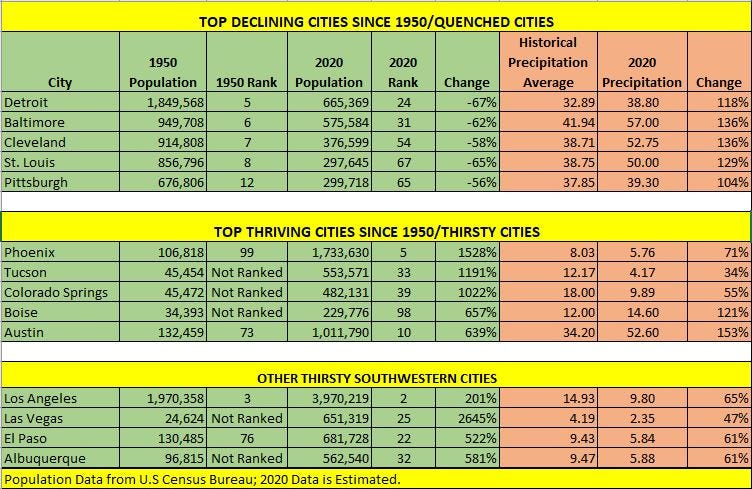
In the West, only Austin and Boise have had above-average rainfall. Austin has seen its share of drought, but a busy storm season in the Gulf of Mexico kept it at bay last year. As a result, except for extreme West Texas, the state is faring well this year.
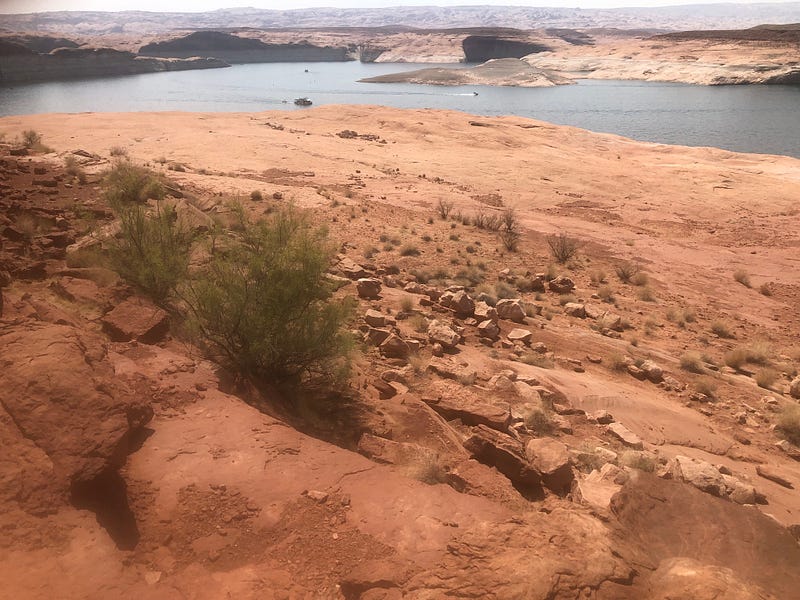
The arid southwest is my backyard, and I wanted to see for myself just how bad things are getting, so I set out on a road trip last week, the ultimate destination being Lake Powell.
I made several stops along the way, not only to take in the scenery and hike but also to note what was happening on the land. I was hoping to find water somewhere along the way — perhaps remnants from the spring runoff. But there was none to be found. Instead, all I saw was rock-hard soil, dying trees and sagebrush, and temperatures ranging from 105 to 115 degrees with no relief in sight.
Once I arrived at Lake Powell (at Hall’s Crossing, Utah), I was shocked. You can see the waterlines pronounced on the opposite side of the lake and walk right into areas where you should be underwater. Instead, its current capacity stands at 34%, the lowest ever, and it hasn’t been full since 1980.
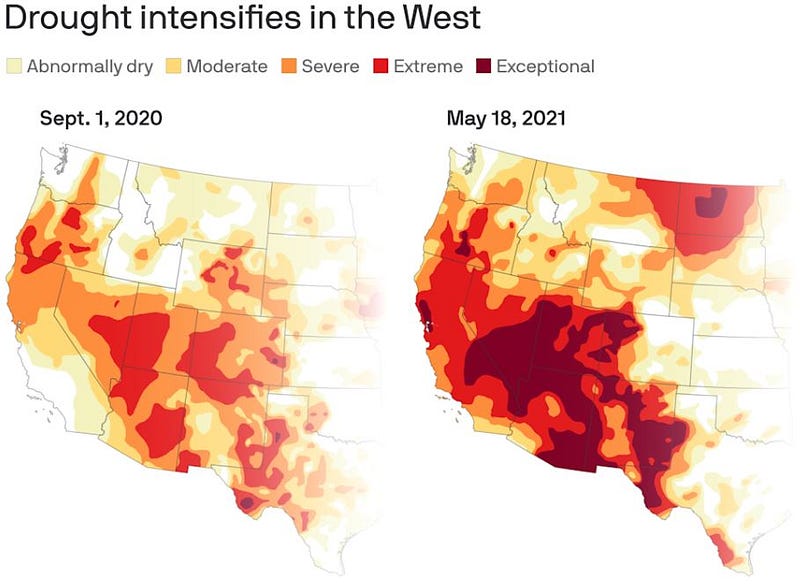
For many years, people were skeptical about climate change. But, of course, this is back some 20-plus years ago when it was popularly known as “global warming.”
The above graphic is based on scientific, measurable data, and folks are still in doubt. As a society, we will have to change our ways. Unfortunately, there is an element out there that does not like change in any shape or form. The previous administration didn’t help matters.
Much of the Southwest gets most of its rainfall during the monsoon season (July-September), when warm, moist air from the Gulf of California moves north and eastward. Last year the monsoons failed to materialize. They were weak the year before that. And practically non-existent the year before that. Snowpacks were light last year, creating little additional volume in the reservoirs. An early, warm spring meant much of the runoff evaporated before reaching a body of water.
We are holding our breath this year, but even one good monsoon season does not mitigate the damage that has been done over the last 20–40 years. Not to speak of the massive population growth in the Colorado River watershed.
Select records from the past year:
- Las Vegas had a record dry streak of 240 days without rain in 2020. It ended when one day, they got all of 0.04" rainfall. The previous record was 150 days.
Supplying enough water to sustain a city this size in the desert has long been controversial. ~Jim Robbins from the Yale School of the Environment, 2/19/2019
- Phoenix in 2020 had 145 days of 100 degree-plus temperatures. It was 110 or higher on 53 days and 115 or higher on 14 days. For a record 28 night stretch, the temperature did not fall below 90.
Phoenix is the “bulls-eye” of global warming, heating up and drying out”. ~Andrew Ross, Professor of social and cultural analysis at New York University.
- Nevada and Utah had their driest year ever in 2020. (Utah’s average precipitation statewide was just 7.23".) Yet, ironically, Utah is the nation’s fastest-growing state, according to the 2020 US Census.
We need more rain, and we need it now. We need some divine intervention. ~Governor Spencer Cox of Utah on June 3.
- 2020 was the most active wildfire season on record. Approximately four percent of California burned, the worst wildfire year on record for the state.
Vegetation is at near-record dry levels for this time of year. We are starting off in a more dire situation than we typically would for June. ~Craig Clements, San Jose State University
- Meanwhile, in October, the Arctic sea ice concentration was at its lowest value in Alaska since records began.
- And as I’m writing this, the Pacific Northwest is the next area to become parched. Temperatures are expected to push as high as 108 degrees in Portland, Ore., in the coming days. Montana and the Dakotas are showing signs of suffering as well.
Yes, folks. It’s s dire situation.
In Part 4B, I’ll delve into the history of drought in the Southwest, what actions our cities are taking to stem the pain, and the prognosis for the future. Or, as Wildfire implied in her exposé, is extinction is at our doorstep?
For further reading:
- “We’re Out Of Time To Save Ourselves From Extinction” ~Jessica Wildfire
- “The Rise and Fall of 5 Great American Cities” ~Arthur Keith
- “These 5 Cities Are Growing Faster Than Your Kids” ~Arthur Keith
- “13 American Cities Plagued With Murder And Death” ~Arthur Keith