
13 American Cities Plagued With Murder and Death
COVID-19 and homicide are inextricably linked

COVID-19 wasn’t the only big killer in 2020.
I clipped an article from the March 2020 issue of Fortune, thinking that I might want to comment on it someday. The press deadline for a March magazine has to be in the latter part of February, so not much was known at that time. This is what the article said about how it would affect businesses in general and airlines in particular:
Some of the world’s leading airlines have announced they won’t be flying to China, home to more than 1.3 billion people and the globe’s second-largest economy, until at least April.
Now that we’ve been through more than a year of COVID-19, this statement seems ludicrous. Some prognosticators said it would come and go. But getting to China is still difficult, and there are numerous obstacles and warnings. That’s an example of what little information we were getting a year ago in March. In the meantime, we’ve lost 586,000+ lives in the US alone as of this writing.
We were also killing ourselves.
I first conceived of this story in the middle of February, during Black History Month. I wanted to address systemic racism but came to realize it was far too big an issue to tackle in a ten-minute essay.
In this article, there are two stories. The first deals with skyrocketing murder statistics in our cities, in which Blacks are disproportionately the victims. The other is COVID-19’s attack on people of color. We’re buying more guns than ever, and homicides have only gotten worse in 2021.
On April 16, eight were killed at a FedEx facility in Indianapolis. I find it laughable that CNN, on April 17, reported it as “the country’s deadliest mass shooting since ten were killed at a grocery store in Boulder, Colo.”
That’s only thirty days, folks, and the reporting made it sound like, “didn’t we do good? No mass shootings in a whole month”.
There have been others. I was trying to keep all of them in my head, but I ran out of memory. They can all be recounted on Wikipedia under the heading, “List of mass shootings in the United States in 2021”.
Mass shootings can’t be generalized. Sometimes they’re targeted at ethnic groups, and others are completely random. It’s not normal, but they’ve become so common that we’re almost desensitized to them. They don’t even come at the top of the news feeds anymore.
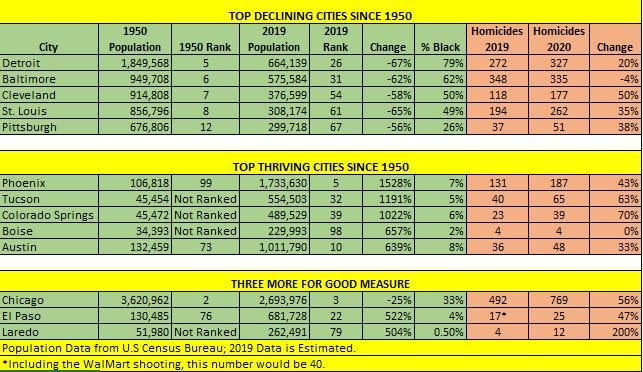
This is the third in a series of a look at some of our country’s largest cities. The Rise and Fall of 5 Great American Cities and These 5 Cities Are Growing Faster Than Your Kids being the first two. While the cities are very different in their growth or decay, one thing they have in common is murder. This pattern is not necessarily new, but it went off the charts in 2020 in both groups of cities.
I added three more cities noting similar characteristics: their growth, lack of diversity, and Chicago. Because it’s Chicago. The city with the most fingers pointed at and the most hands on the trigger. With homicide statistics added, here is where our 13 very disparate cities stand:
Diversity — or the lack thereof
Systemic racism has left our Black citizens in the dust, at least with the first group of cities. All of these cities were redlined, beginning with The Great Migration in 1914. Manufacturing needed the labor, but the citizens didn’t like the color of the newcomer’s skin, so they did everything in their power to keep them segregated.
All five of these cities (and Chicago) saw their population peak in the 1950 census. The White Flight began postwar when an enhanced highway system allowed easy access to the new suburbs that began springing up like dandelions. Blacks were outright banned from these affluent areas. They were not “allowed” to own property outside of their districts. Most couldn’t even afford cars, let alone obtain the financing necessary to purchase one.
These practices stripped generations of wealth from the Black community.
Detroit is most symbolic of what we might call segregation by default. Laws written by White men resulted in it being one of the least diverse cities in the country with respect to the number of Whites to Blacks. We made this happen. And yet, many blame them for where they are — stuck. This is what Systemic Racism is to me. Housing is but one component.
Boise, El Paso, and Laredo are polar opposites in terms of how they’re diverse.
- Boise is 89% White. Hispanics and Latinos of any race made up only 7% of the population. And at only 2% Black, it is one of the least diverse cities in the country.
- Being 81% White(including Hispanics and Latinos) and just 4% Black, El Paso is one of the least diverse cities. The remaining 15% are primarily Hispanics and Latinos of any race.
- Among all of the country’s largest cities, Laredo may be the least diverse of the bunch. Non-Hispanic Whites make up only 4% of the population. One-half of one percent are Black. It reported the greatest percentage increase in homicides of the 13 cities in 2020 at 200%.
Why This Matters
The COVID-19 death toll and the number of murders hit Black and Hispanic communities disproportionately hard. Businesses shut down in their neighborhoods which meant lost jobs and wages. Residents couldn’t pay their rent.
Mostly Hispanic and Latino, El Paso is a prime example of race and income’s effect on COVID-19. It was one of the worst-hit cities in the country, as cases peaked in October and November. Additionally, of the 25 most populous cities in the U.S., El Paso ranks fourth in those who live below the poverty level. Detroit, with the highest percentage of Blacks, ranks first.
The Marshall Project on April 8 stated, “Murders Rose Last Year. Black and Hispanic Neighborhoods Were Hit Hardest”. A Covid-strained social net. Entrenched distrust between cops and communities. “2020 was a tinderbox”.
The homicide statistics from 2020 bear a lot of truisms.
- In a Miami Herald editorial by Leonard Pitts, Jr., he stated that 93% of Blacks in America are killed by other Blacks. White assailants kill 83% of White murder victims. He went on to say that “the vast majority of violent crime is committed within racial groups. It’s a matter of proximity and opportunity”.
- The Philadelphia Inquirer on January 1 reported that “the vast majority of victims were young Black men, many from the impoverished areas and the economic havoc that Covid-19 produced”.
- Murders in Los Angeles almost all took place in Black or Hispanic neighborhoods. Ralph Campos, an LAPD officer on leave, said that “budget cuts and police reforms since George Floyd took away tools to fight crime. A decreased police presence on the streets translates to more violence”.
According to Vox.com, experts have cited the major reasons for the dramatic increase in the murder rate:
- The police killing of George Floyd and others. Depolicing and distrust in police.
- The bad economy.
- A huge increase in gun purchases in 2020. FBI statistics show that sales of guns peaked in March and again before the Presidential election.
- Boredom and social displacement as a result of physical distancing leading people to cause more trouble.
Some in law enforcement blame the spike in murders, in part, on “efforts to decrease jail population during the pandemic,” says a spokesperson from the Metropolitan Police Department of the District of Columbia. Others have remarked that protests, for example, are taking time from officers to carry out investigations and the slow criminal justice system and process.
The previous administration claimed that this lawlessness was only taking part in “Democrat-run cities.” According to FBI statistics, homicides are up by 86% in 51 major U.S. cities. They do not lean Democrat or Republican.
Go West, young man?
Looking at our thriving cities, all are in the West. Few Blacks migrated this way because there was no manufacturing might and little in the way of support systems. When The Great Migration from the South started in 1914, Boise, Colorado Springs, and Tucson could barely be called cities.
Murder increased markedly in every city but Boise.
ABC15 Arizona News reported that only Chicago had seen a larger increase in murder than Phoenix. “People being cooped up is going to lead to domestic violence,” according to Kevin Robinson, a criminology professor at Arizona State University. Domestic violence-related deaths grew 175% in 2020 in Phoenix. With lockdowns easing, these numbers should decrease.
And what about Chicago? Well, it looks like things are status quo. The Chicago Tribune reported on May 4 that there had been 201 murders in 2021 to date, 35 more than the same time in 2020. (Of 815 murder victims in the city in the last 365 days, 589 were black. Just 40 whites were killed in the same period.)
Where to now?
Out-migration is occurring at record levels from California, and most are going to Texas for political and tax reasons. While other western states are receiving California’s migrants, particularly Idaho, there is one more little thing that might drive millions of westerners east: climate change. Based on the lack of water, western cities cannot sustain the kind of growth they’ve seen over the years. We’ll talk about that in Part Four.
References:
- US Census Bureau, 2019 Estimates
- FBI-Uniform Crime Reporting, 2019
- Fortune, March 2020
- Philadelphia Inquirer, 1/1/2021
- CBSN News, 3/17/2021
- Chicago Tribune, 5/4/2021
- ABC15 Arizona News, Phoenix
- Vox.com, 12/10/2020
- El Paso Times, 5/5/2021
- Statista.com


