
THE MEGADROUGHT SERIES 2022, PART 4B
It Never Rains In Southern California
Except maybe every other Tuesday in January. In odd years.
I’m a bit late at writing this, part 4B of The Megadrought Series, as I took a two-week road trip to the Great Plains. Why? To check on the drought situation there and to get away from it all. It’s a great place to do that. And because nobody else goes there!
While we’re focusing on Southern California now, here’s a snapshot of what’s happening in your neck of the woods:
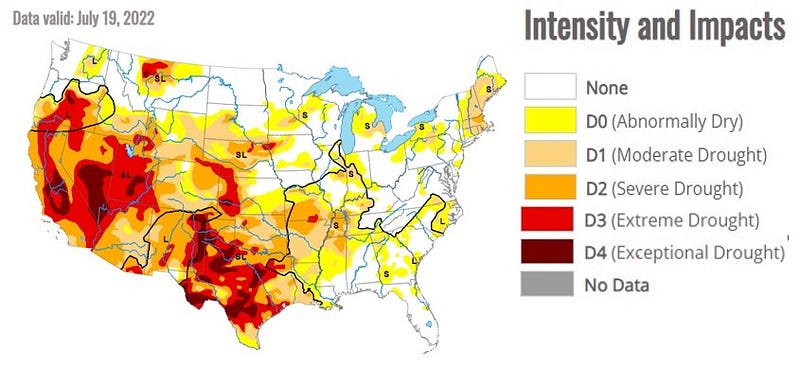
Due to the never-ending atmospheric river that hit the Pacific Northwest in the spring and moved east, there are improvements in the country’s northern tier. But elsewhere in the West, it’s as bad if not worse than last year, especially in Texas, which was relatively drought-free.
Drought around the globe
Even in drought, we forget how good we have it here in the U.S. Drought is affecting areas worldwide. Notably, Iraq’s Lake Sawa is now dry. Located near the Euphrates River, the lake was fed by abundant underground water sources. The lake has no inlet nor outlet. It is the consequence of thousands of illegal wells, decreasing water along the Euphrates.
Meanwhile, Central Chile’s primary water source for the city of Valparaiso, with a population of one million and the country’s second-largest city, has all but dried up. At a similar latitude as California and the Mediterranean, rainfall hasn’t come, the snowpack from the Andes has dwindled every year, and temperatures have risen. As a result, the Penuelas reservoir is nearly devoid of water. In addition, rising global sea temperatures are drawing Pacific storms away from Chile.
Stories coming out of Africa, particularly around the horn, tell of hunger and starvation in an area that hasn’t received rain in years.
Years.
It’s already affected their food supply, and it’s starting to affect ours.
They call the Imperial Valley of California America’s salad bowl because of the types of vegetables grown there. Many of the below items are grown in the Central Valley. Consider how much water it takes to grow:
- Almonds: 23 gallons per ounce
- Cherries: 12.2 gallons per ounce
- Asparagus: 20.3 gallons per ounce
- Tomatoes: 26 gallons per pound
- Eggplant: 43 gallons per pound
- Wine: 872 gallons per one gallon
- Potatoes: 34 gallons per pound (Remember that Idaho uses more water per capita than any other state.)
- Rice: 299 gallons per pound of processed rice
- Oranges: 67 gallons per pound
- Peaches: 109 gallons per pound
- Avocados: 141 gallons per pound
Depending on the source, agriculture uses 75–80% of California’s available water. The Central Valley of California once had a substantial aquifer that has been strained by private wells, so much so that as the water table dwindles, the land above it sinks. So it’s all at risk.
The Colorado River’s Role
I live in New Mexico, which, as a percentage of the state’s total area, has an area in extreme or exceptional drought almost as large as California’s. So when the seasonal monsoon rains started on June 17, we all breathed a collective sigh of relief. It had been three months since we’d seen anything wet come out of the sky. The last day we had previously had precipitation was March 23.
Pretty sad when you remember the days it rains.
It isn’t easy to talk about the megadrought in the West and only address one part. The Colorado River slacks the thirst of seven states and Mexico. California is the largest consumer of this water, particularly Southern California.
The lower Colorado River basin includes the states of California, Nevada, and Arizona. Together, their allotment is about nine million acre-feet of Colorado River water annually. (An acre-foot of water is the amount needed to cover an acre of land in one foot of water.) Cuts of two to four million acre-feet are required to keep the two main reservoirs (Lake Powell and Lake Mead) “above water.” The states are still debating each other in terms of who will take what cuts.
The deadline to hear what the states put forward for their needs is mid-August. After that, if there are no solutions, the federal government will enforce cuts the way it wants, and no state wants that.
“We have urgent needs to act now. We need to be taking action in all states, in all sectors, and in all available ways.” ~Tanya Trujillo, Interior Department assistant secretary for water and science
The State Water Project will only deliver five percent of what Los Angeles received last year. So the Colorado will remain LA’s most significant single water source, and the effort to conserve it is more important than ever. Arizona gave up a substantial portion of its original allotment of water to California to allow them to build the Central Arizona Project (CAP). Much of the water for Pinal County farmers (located between Phoenix and Tucson) has already been cut from the CAP. Will Tucson be next?
Scary times indeed.
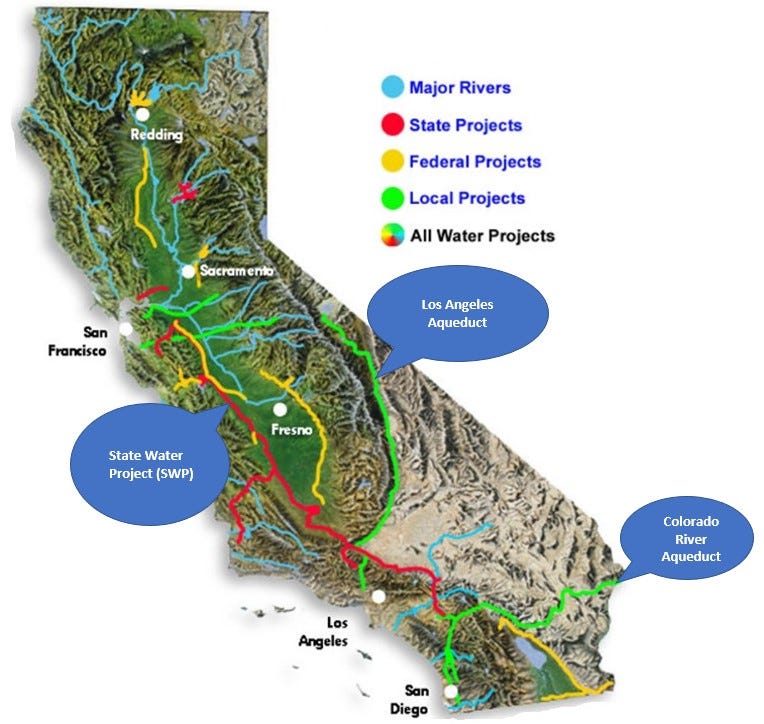
So, where does the water come from?
Most of the water used by the Metropolitan Water District of Southern California (MWD) comes from the Colorado.
The second source is the State Water Project (SWP) (formerly known as the California Aqueduct), the water of which comes from rivers in the middle and northern portions of the state. The SWP is primarily fed by runoff from the Sierra Nevada mountains and as far north as Shasta Lake.
About 70% of that water is used for commercial purposes (residential, industrial, and municipal). The Bay Area also gets a share of its water from the SWP. The other thirty percent is used for irrigation in the San Joaquin Valley.
The Los Angeles aqueduct (formerly the Owens Valley aqueduct) is the other source, primarily based on runoff from the Eastern Sierra Nevada. For all intents and purposes, it has made farming in the Owens Valley impossible and is responsible for the drying of Mono Lake.
Due to the ecological ramifications of the Owens Valley/Los Angles aqueduct on Mono and Owens Lakes, Los Angeles lost water from this source. As a result, up to 50% of the historical supply now goes to ecological maintenance in Mono and Inyo counties.
A secondary series of pipelines from the Los Angeles aqueduct were built to deliver water to cities surrounding Los Angeles. However, a court ruling stated that only Los Angeles could use water from the Owens Valley Aqueduct, so these cities annexed themselves to the city of Los Angeles. Eventually, several other towns got together with Los Angeles to form the MWD.
Needs have significantly outpaced the local water supply in San Diego. Presently it purchases 85–90% of its water from the Colorado River and the SWP, with 20% from groundwater supplies, which are being rapidly depleted due to nature’s inability to replenish them.
Elsewhere in California, Lake Oroville, the state’s largest reservoir (at 44% of capacity), supplies water via the SWP to up to 27 million people, mainly in northern California. Shasta Lake, at 38% capacity, is key to water in the Central Valley, from Redding down to Bakersfield. This is a federal project, and they announced they wouldn’t be providing any water for agricultural purposes. As a result, cities will only get about 25% of historical water use.
There is grave concern that lower water levels in northern California rivers, which result in warmer waters, will destroy the Chinook salmon population. And farmers can either fallow their fields or depend on groundwater, which is also in danger of being depleted.
It is hard not to be a doomsayer when writing about the megadrought.
It’s All About The Colorado River
The river has given its all. It’s spent. It’s done all it can to supply the water and power needs of more than 40 million Americans, and it’s tired. Consider the growth that has occurred among the seven states that rely on it since 1950:
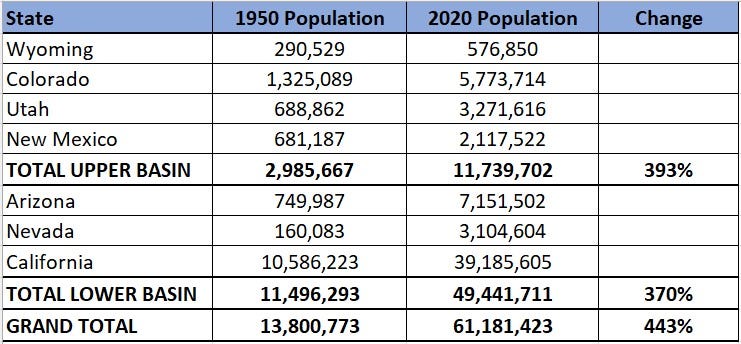
The Colorado River doesn’t serve all the needs of all seven states in the two basins, but you get the picture. Remember:
- The Colorado River Compact, the original agreement to allocate water to the states, was established in 1922 and ratified in 1944.
- The compact was written when the entire region received much more rainfall, which was taken as normal.
- Rain and snowfall have diminished precipitously since the agreement was written, and average temperatures have increased.
- Climate change began to be perceived by scientists in the 1950s. Periods of drought increased in the latter half of the 20th century.
- Drought has been in place for 23 years, becoming a megadrought, and it is now being referred to as the “Millenium Drought.”
The flow of the Colorado has drastically decreased, while those relying on it have increased. So, significant cuts and sacrifices will have to be made. This is clearly not sustainable.
Because they use less, the Upper Basin states have inferred the Lower Basin should bear the brunt of future cuts. By the time the river reaches Yuma, it also reaches the last dam on the river where water flows to the growing regions in both Arizona and the Imperial Valley. If farmers in those areas are asked to fallow their fields, expect that they will be asking the states or the Feds for compensation for their losses.
Upcoming cuts are in addition to all of the reductions already in place. They will have to remain in place for years.
“They would have to remain in place either until we know the drought has definitely ended and the reservoirs have recovered, or even greater cuts will be required because of increasing aridification.” ~ Kevin Wheeler, Oxford University engineer and senior research associate
When the drought has definitively ended.
When the reservoirs have recovered.
These are not within our lifetimes.
Keep our firefighters and first responders working on the Oak Fire and the hundreds of other conflagrations burning at this moment safe.
We’ll return to California for a final review, but next, I’ll take you to the breadbasket of America — The Great Plains. With worldwide food supplies tumbling, they’re not in shape to take on the shortfall.
Sources include:
- Reuters
- Fort Worth Star-Telegram
- Water Education Foundation, California Department of Water Resources
- Smithsonian Magazine
- The Huffington Post
- The United States Census Bureau
- The Arizona Republic
- Ventura County Star
- The Guardian
Please refer to these stories for further background on the megadrought:
Like what you’re reading? Consider subscribing to Medium. For the price of a monthly magazine ($5/month), you’ll have access to all of my stories and thousands of other writers. And I’ll get a wee bit! Just click the link below.