How the Bitch Stole Christmas
La Niña continues to terrorize the Southwest
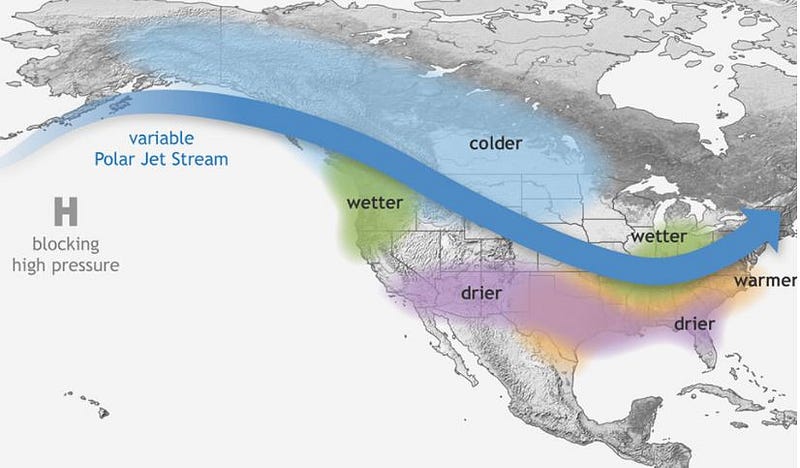
I don’t make a habit of calling little girls bitches (La Niña means little girl in Spanish). But this weather phenomenon is back to further torment the already bone dry Southwest and California after unleashing a brutal summer in 2021. She really never went away.
I also didn’t plan to write about this subject again until at least January — when we had an idea of how the winter was going to shape up. But the meteorologists now agree that La Niña will be with us, maybe through the spring of 2022. She’s the gift that keeps on giving.
The mountains in western New Mexico, southwestern Colorado, northern Arizona, and the Southern Sierra Nevadas may not see a white Christmas this year. All of those areas provide critical spring runoff to the Colorado River.
You’re just a bad seed, La Niña. You destroyed us last year, and you’ve been coming with too much frequency in the last 20 years. You wreak havoc all over the world, leaving destruction in your wake, and keeping the Southwest high and dry.
I hate you, La Niña.
About the Bitch
La Niña is not hard to explain, but I don’t have enough time to tell you in a full-blown fashion in the five minutes we have together, so I’ll give you the Cliff’s Notes version. (Does anyone know what that means anymore?)
A La Niña period occurs when the sea surface temperature across the Eastern equatorial part of the Pacific Ocean decreases by about 5–9°. The warmer water shifts west towards Indonesia. This is a BIG difference and can be devastating to sea life in the Pacific and human life throughout the world.
Conversely, her brother, an El Niño pattern, happens when the jet stream causes the warm water to be pushed back east towards South America. El Niño occurs a bit more frequently than La Niña periods.
During a La Niña period in North America, the Southwest and the Southeast suffer the most with below-average precipitation. It even fosters more frequent tropical storms and hurricane development in the Atlantic basin. On the other hand, El Niño prompts heavier precipitation over North America, particularly in the Southern portions of the U.S. (Here in the Southwest, we’re partial to El Niño.)
I moved to Santa Fe, N.M. in the late spring of 1982, and while I didn’t know it, a solid El Niño pattern was in place. It constantly rained, which consequently kept temperatures down. I thought that was normal.
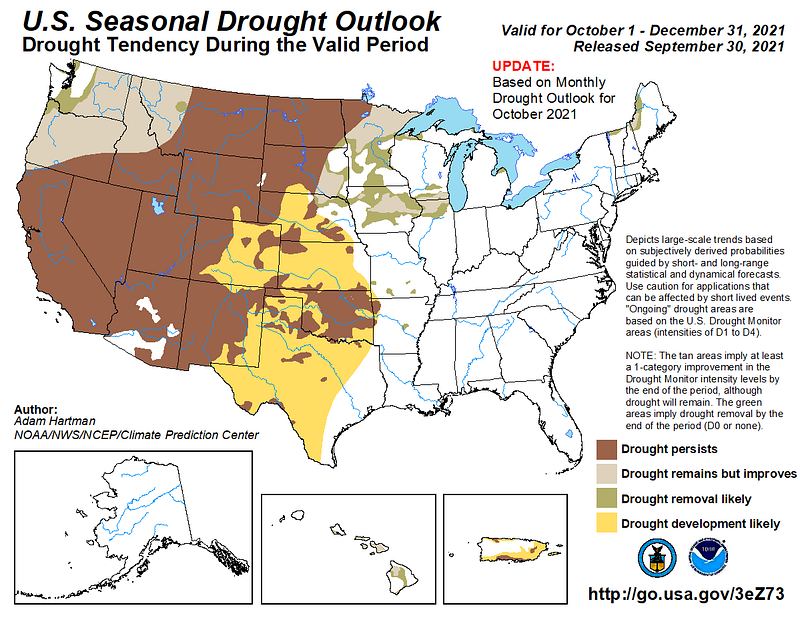
The Outlook/What It Means
Without a significant precipitation forecast for the Southwest and California, drought will persist. Much of Kansas and Texas, which miraculously escaped drought in 2021, will see a return to arid conditions. Drought is expected to ease in the Pacific Northwest.
If you live east of the Mississippi, things look good as ever! Damn. Mother Nature knows no equity.
Lake Mead’s volume in September continued to run at about 34% of capacity. Lake Powell has declined to about 30% of capacity. A popular lake where I spent many a summer, Vallecito Reservoir near Durango, Colo., is at 19% of capacity. Many of the smaller reservoirs in the Colorado River basin are in the single digits. The entire system is at work, trying to save Lake Mead.
The Colorado River Interim Guidelines for Lower Basin Shortages and the Coordinated Operations for Lake Powell and Lake Mead (yes, that is the organization’s name!) established “trigger levels” for the operational tiers of the river in 2007.
The lack of water in Lake Mead has forced Tier 1 reductions for Nevada and Arizona effective 1/1/2022. And California? Well, in the Arizona vs. California Supreme Court case, which dragged on for 11 years, the decision allowed the construction of the Central Arizona Project (CAP). Arizona, however, had to cave and agree that in the event of shortage conditions on the Colorado, California would have priority over CAP water supplies.
Bullies.
Meanwhile, in 2019, the seven states that make up the Colorado River basin finalized a DCP (Drought Contingency Plan) for the upper and lower basins that go through 2026. According to the plan — and the long-range forecast — Lake Mead could be in a Tier 2 water shortage by 2023. At that point, California becomes susceptible to cuts in water delivery from the Colorado. And, there is a one-in-four chance that Tier 3 could come as early as 2025. Tier 3 is the worst-case scenario spelled out under the DCP.
It’s getting scary.
There aren’t enough groundwater supplies to make up for what the states usually take from the Colorado.
The end game for Lake Mead is 1,020 feet above sea level. The level as of this writing is 1,067 feet. If the lake falls below 1,030 feet, all three states below Hoover Dam must reconvene to decide on steps to prevent the lake from falling below 1,020 feet. At that point, Hoover Dam could no longer generate electricity.
Finally, there are 30+ Native American Tribes having rights that trump all of the states involved. At present, 22 federally recognized tribes in the basin have quantified water diversion rights that have been confirmed by court decree or final settlement. Additionally, 13 other basin tribes have reserved water rights claims that have not yet been resolved.
Congress may be called upon to consider new settlements that may result in tribal rights to more Colorado River water.
Final Thoughts
Everything I have read points to the fact that no one thought it would get this bad. While various entities have prepared for the worst, the worst is worse than they could have fathomed. Many city officials who rely on Colorado River water have said not to worry, that there are reserves.
Well, the reserves are running thin because the aquifers are not being replenished. As a result, cities may survive at the expense of agriculture, and these areas feed the world.
And to think that it all comes down to the water that trickles from the mountains to the nearest streams, leading to the tributaries, and finally to the Colorado. The ground is just too dry. Snow runoff doesn’t reach its destination. So the trickle has been turned off.
As my grandfather used to say, La Niña, you’ve worn out your welcome.
Sources * https://oceanservice.noaa.gov/facts/ninonina.html * www.azcentral.com — “Lake Mead Could be in a Tier 2 Shortage by 2023. What That Means for Arizona.” — 5/21/2021 * Lake Mead statistics from the Bureau of Reclamation. * Congressional Research Service, Management of the Colorado River: Water Allocations, Drought, and the Federal Role. — 8/16/2021
Click on the links below to learn more about the megadrought and the fate of the Colorado River — all in ILLUMINATION.
6 Of The Most Unsustainable Cities, Analyzed The East Gets Wetter and The West Gets Drier Water Crisis in the West, v.5.0 — The Colorado River Story A Road Trip to Ground Zero of Climate Change-Part 1 A Road Trip to Ground Zero of Climate Change-Part 2
Your membership supports writers on Medium, and I receive a portion of those fees when you become a member using the link below. As a member, you have access to all of my content and that of thousands of others. It’s like creating your own feature magazine to read whenever and wherever you want!