
#TalkThree 14: What’s “Thematic Space”?
Partonomy, Taxonomy, and Space Affordances (10 min read, 2173 words)

The above picture is shared by Pascal BORNET on Linkedin. This is a tiny example of “Thematic Space”.
So, what’s a Thematic Space? How to understand the concept of “Thematic Space”?
The concept of “Thematic Space” combines Thematic Thinking and Spatial Thinking together.
If we make a list, then it refers to Thematic Thinking.
- Name
- Website
The above tiny list only contains four items which are four categories. Thematic Thinking sees things in differences and similarities.
In contrast, Spatial Thinking cares about the meaning and value of spatial structures of environments without considering categories.
- {
[@(singingbearshop].com)} - {email}
- [Instagram]
- (Website)
Thematic Thinking and Spatial Thinking follow two different logics.
Partonomy and Taxonomy
When we think about thinking, we usually think we are thinking in words. However, linguistic thought is not the only way of the human mind. Cognitive scientist and psychologist Barbara Tversky argued that spatial thought is the foundation of our abstract thinking in her 2019 book Mind in Motion: How action shapes thought.
I want to highlight three ideas I learned from Barbara Tversky. The first is about taxonomy and partonomy, the second is about individual differences in mental rotation, and the third is a story about the Feynman diagram. First, Tversky said, “Spatial hierarchies are partonomies, not taxonomies like the categories of objects, events, and scenes…Partonomies are hierarchies of parts; taxonomies are hierarchies of kinds…categories allow reducing the amount of information in the world…”(p.77)
While Thematic Thinking follows the logic of taxonomy, Spatial Thinking follows the logic of Partonomy. The designer of the above business card doesn’t just list the items below but organizes them in a structure of Partonomy.
- {email}
- [Instagram]
- (Website)
The outcome is awesome! We see both a meaningful whole and its several parts.
According to Barbara Tversky, “Like taxonomies, partonomies allow inferences, but inferences of containment, not of properties. If a knee is part of a leg and a leg is part of a body, then a knee is part of a body. ”(p.78)

Designers tend to see the world from the perspective of spatial thinking.
Individual differences in Mental Rotation
According to Tversky, “Mental rotation is a distinctly visual-spatial transformation. It has been likened to watching something actually rotate in space…mental rotation task has become one of the major measures of spatial ability.” (p.89–90)
She also pointed out the individual differences in mental rotation, “Surgeons, plumbers, electricians, football coaches, mathematicians, fashion designers, urban planners, gardeners, physicists, fire fighters, architects, basketball players, interior designers, dentists, and so many more use mental rotation and other forms of spatial reasoning regularly in their work…lawyers and journalists and historians and accountants and executives and philosophers and poets and translators don’t seem to need mental rotation in their work.” (p.91)
This is an interesting distinction. Why don’t Lawyers, journalists, historians, accountants, executives, philosophers, poets, and translators heavily rely on mental rotation in their work? Because they tend to work with words, languages, text, data, etc. What they need is thematic thinking, not spatial thinking.
Concepts and Diagrams
Tversky also directly talked about the diagram in chapter eight of Mind in Action. The title of the chapter is Spaces We Create: Maps, Diagrams, Sketches, Explanations, Comics. She said, “The ease of reasoning from well-designed diagrams has encouraged new fields to blossom, endeavors to make mathematics, logic, physics, and computer science diagrammatic, yet rigorous, in order to capitalize on our extraordinary abilities to see spatial relations and to reason about them. The rationale is the same, that diagrams use the power of spatial-motor reasoning for abstract reasoning.” (2019, p.210)
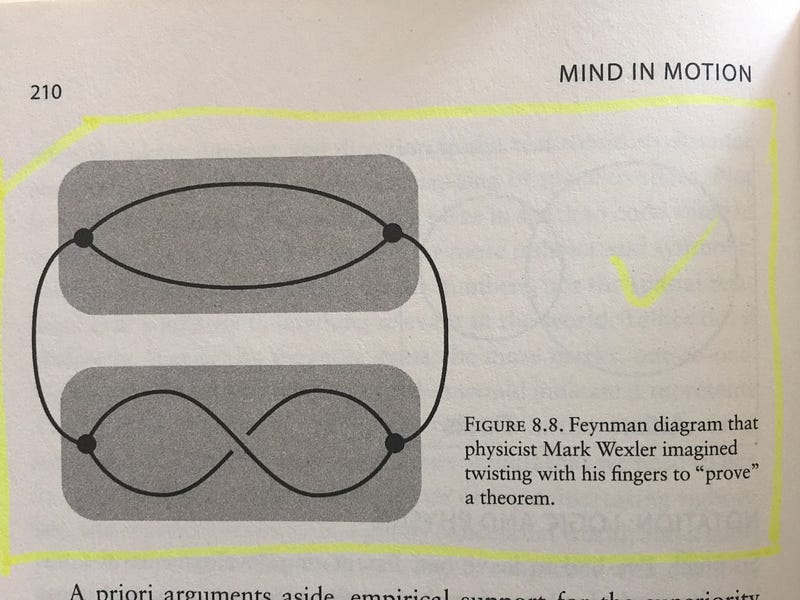
Tversky shared a story about the Feynman diagram with us, “Mark Wexler, now a cognitive scientist working on perception and mental imagery, used to be a physicist. When he was a physicist, he was working with the Feynman diagram in Figure 8.8. Each gray blob represents a separate universe. For the universe to be coordinated, the twist in the lower blob had to be undone. He imagined grabbing each of the lower ellipses with his thumb and index finger and twisting them in opposite directions, a bit like Cat’s Cradle. Doing that made him realize that untwisting the lower one twists the upper. The only way to remove the twist is to cut one of the attachments. This conclusion has implications for spacetime and quantum gravity, but that’s beyond me and thankfully beyond the scope of the book. His intuition turned out to be right, as he later showed in a rigorous line-by-line proof. Feynman diagrams are admittedly abstrute, as is the physics they represent, but once they are learned, like all effective visual spatial representations, they become a powerful thinking tool.” (p.211)
On Sept 3, 2020, I wrote a long article to review the Finnish educational researcher Yrjö Engeström’s work and his theoretical building from the perspective of diagrams and diagramming. Yrjö Engeström upgraded the activity theory from the individual activity level to the collective activity level with a conceptual model of “activity system” in order to apply activity theory to educational settings, organizational development, and other fields (Engeström,1987).
The goal of activity theory is for understanding various types of human activities in the real world. Engeström also targeted his audience as both researchers and practitioners. The value of learning activity theory is not only knowing some concepts and ideas but the real transformation in real life with the help of concepts and methods of activity theory. I want to claim that Engeström’s triangle and his graphical approach to theory building is a great case of “diagramming as theorizing”.
Since Barbara Tversky claimed the sixth law of cognition as “Spatial thinking is the foundation of abstract thought” (p.72), we should change our minds on theory development and knowledge building. It is time to switch from “language-based theorizing” to “spatial thinking-based theorizing”. Diagrams and Diagramming are great approaches for visualizing complex structural relationships such as “activity” and other social phenomena.
The Notion of “Thematic Space”
Can we combine “Thematic Thinking” and “Spatial Thinking” together?
This is the direction I am working on.
My work experience covers designing and writing. I can switch between verbal thinking and visual thinking. I like to develop brand-new abstract concepts and design brand-new concrete diagrams. I can switch between high-level strategic ideas and pixel-level interface design.
Knowledge frameworks are formed with concepts and diagrams. Eventually, I move in the direction of Knowledge Curation and consider Knowledge frameworks as my creative products.
In 2018, I wrote a 108-page personal thesis titled Diagram Explained which offers a theoretical model of diagrams and diagramming. I also collected over 80 cases for writing the thesis.
In 2021, I worked on the D as Diagramming project and produced two books (drafts) about diagramming and thoughts.
- Diagram Blending: Building Diagram Networks (Introduction, Tables of Contents)
- Diagramming as Practice: An Integrated Framework for Studying Knowledge Diagrams (Tables of Contents, Framework)
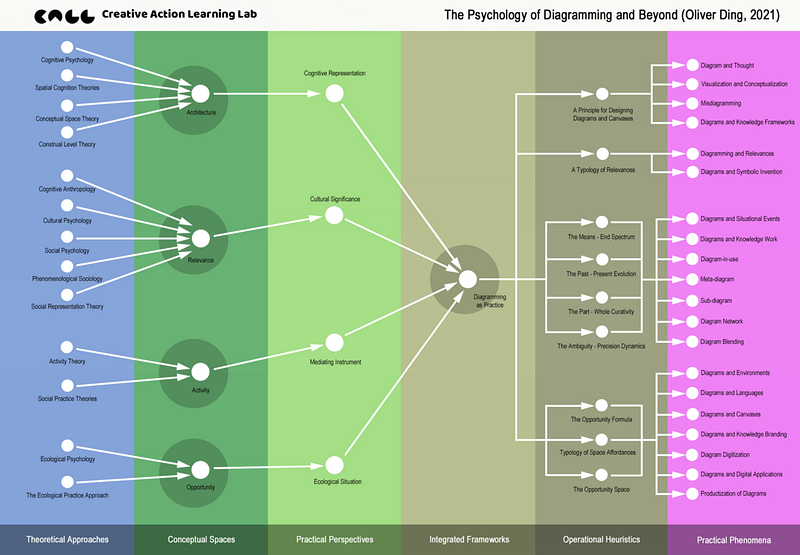
The above picture is the landscape of the Diagramming as Practice framework. In fact, it was based on a canvas for Knowledge Curation.
The canvas is a tool for the Model of Knowledge Curation.
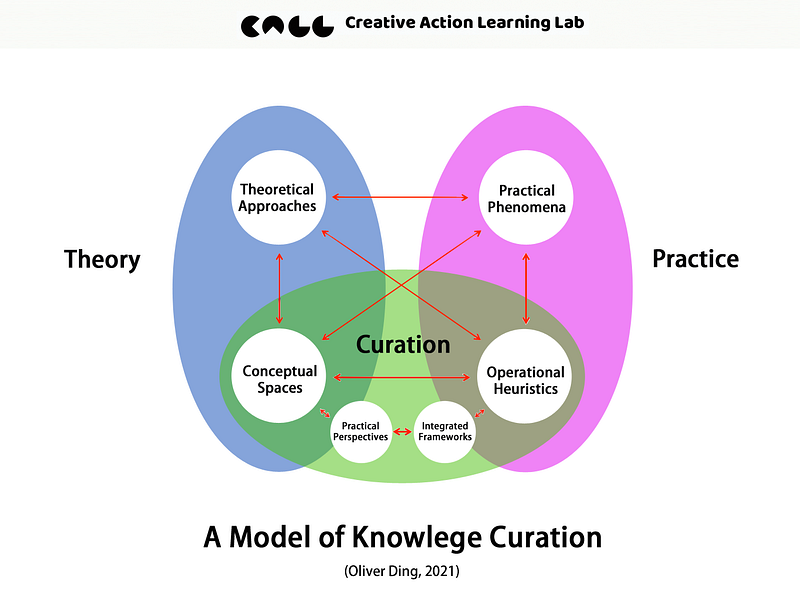
The model presents six types of “Objects of Curating” for a knowledge curation work:
- Theoretical Approaches
- Conceptual Spaces
- Practical Perspectives
- Integrated Frameworks
- Operational Heuristics
- Practical Phenomena
You can find more details from a previous article: The Diagramming as Practice Framework.
The term Conceptual Spaces is inspired by Peter Gardenfors’ 2004 book Conceptual Space: The Geometry of Thought. However, I roughly use it to describe large cognitive containers for curating similar theoretical approaches together.
I published the model and the canvas on Dec 16, 2021. Later, I realized that I should use a new term to replace Conceptual Spaces.
First, what I am talking about is not the original meaning of Peter Gardenfors’ concept of Conceptual Spaces.
Second, I use the word “theme” for Theme U, Theme Plus, and Themes of Practice. I think it is better to use Thematic Space for the model and the canvas.
In the beginning, I used the notion of “Thematic Space” for the Knowledge Curation project and used it to design the following meta-canvas.
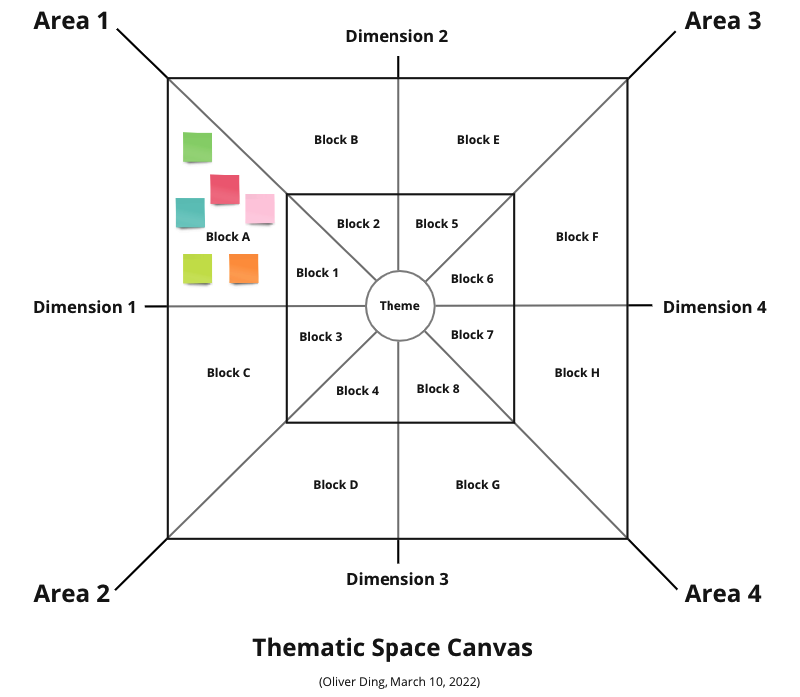
However, I recently realized that the notion of “Thematic Space” is an awesome idea that could be applied to my other frameworks, especially the “Themes of Practice” framework and the Ecological Practice approach in general.
The concept of “Thematic Space” was developed on Jan 5, 2022.
On May 26, 2022, I wrote the following piece about the notion of “Theme as Space”.
My notion of “Theme” can be understood as “Topic”. Originally, the source of “Topic” is “Topos”. According to the Merriam-webster dictionary, “Latin Topica Topics (work by Aristotle), from Greek Topika, from topika, neuter plural of topikos of a place, of a topos, from topos place, topos”.
According to Aristotle, we need a Topos because we can remember a thing by remembering the Topos in which the thing is placed.
If we use the technique of “Deep Analogy” and use “Etymology” as a perspective, then we can understand “Theme” and “Space” into one thing. Theme (Topos) is Space!
Originally, I read the idea of “Theme (Topos) is Space” from a Chinese scholar‘s book Spatial Narratology. The scholar quoted Christian Norberg-Schulz’s discussion about the topic — topos relationship from Genius Loci: Towards a phenomenology of architecture.
Traditional narratology is about the linear temporal narrative because a story or a text is easy to understand if its structure is organized in a temporal sequence. However, some modern writers use spatial simultaneity as the primary approach to organize their stories. They often use the technique of “Juxtaposition” to create a spatial sense in their writing.
The technique of “Juxtaposition” is a nonlinear spatial narrative approach. I adopt it for Thematic Space Reflection Report. If you read my thematic space reflection reports, you can find there is no linear temporal narrative structure. All notes are just listed without a predefined logic structure.
Though the Structure of Knowledge Discovery Canvas (and Life Discovery Canvas, etc) has its predefined logic structure, it is still a structure of “Juxtaposition”. All 16 blocks are not organized in a linear way.
A person can use Thematic Space Canvas in different ways by perceiving its spatial structure and potential connections between different blocks. The canvas doesn’t control the process of sensemaking but offers a space for sensemaking.
On July 2, 2022, I connected the notion of “Theme as Space”, the concept of “Thematic Space”, and the “Flow — Story — Model” metaphor.
From the perspective of the Slow Cognition project, Life Discovery is a particular type of Knowledge Discovery and the primary theme of Life Discovery is “My Life”.
The objective of the Life Discovery Activity is to Develop Tacit Knowledge about “My Life” and turn Tacit Knowledge into resources for actions.
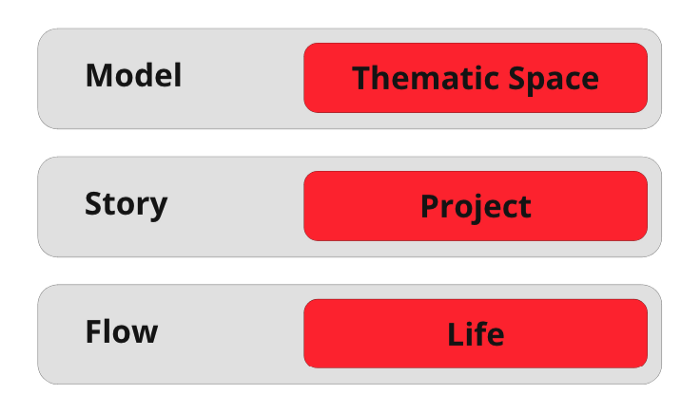
By connecting the Project-centered Approach and the concept of “Thematic Space” together, we can find the following connection:
Life = Project = Thematic Space
While Life is a chain of projects, it can be understood as a journey of moving between various thematic spaces.
Each project has its primary themes and other secondary themes. By joining projects and leaving projects, we are practicing our significant Life Themes. Thus, these projects are Thematic Spaces too.
This insight also echoes the model “Flow — Story — Model”. We can also find more details in Thematic Space: Project as Story.
In this way, I develop the 7th basic principle of the Life-as-Project approach: “Project as Thematic Space”.
The Final Words
1+1=?
I answered it in Knowledge Discovery: The “Double Theme” Strategy.
Thematic Thinking and Spatial Thinking are a pair of opposite themes. The concept of “Thematic Space” is the outcome of connecting this pair of themes.
The term Space can be understood as a Container. In Thematic Space: Place as Container, I point out that there are two types of environments for developing tacit knowledge: physical environments and social environments.
The Thematic Space Canvas is a cognitive artifact for visualizing Thematic Spaces. However, we can live with Thematic Spaces without using the Thematic Space Canvas. The diagram is an example of visualizing a Thematic Space with the Canvas.
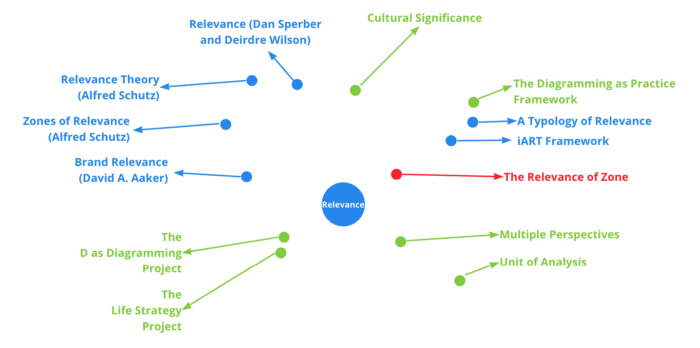
Moreover, we can understand the notion of “Thematic Space” from the perspective of Space Affordances. In order to discuss diagramming, I developed a typology of Space Affordances and coined the term “Graphical Space Affordances” for the integrated framework for studying knowledge diagrams in Dec 2021.
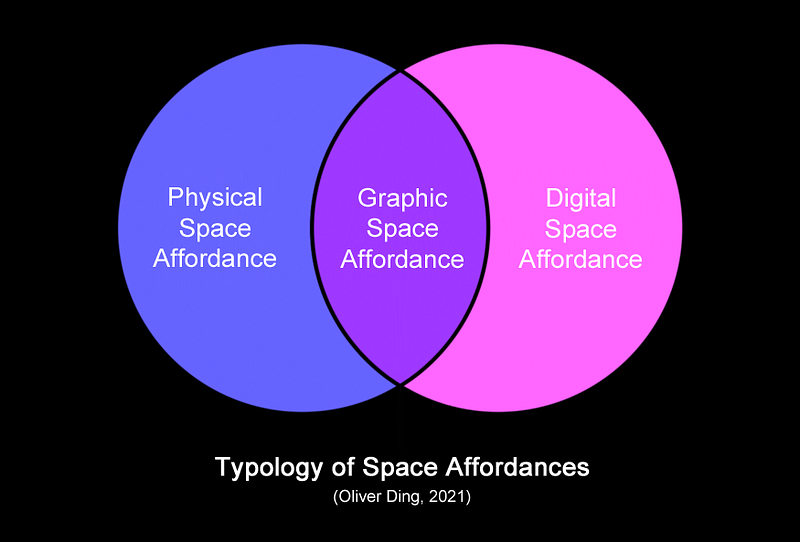
Originally, I only used it to discuss the affordances of white space in a graphic.
However, white space is a type of spatial structure of a graphic.
On June 19, 2022, I listed the following six types of spatial structures of the Theme U meta-diagram.
1. Dimensions 2. Fields 3. Paths 4. Fits 5. Areas 6. Connections
So I decided to expand the concept of “Graphical Space Affordances” from white space to all spatial structures of a graphic.
This is a relevant perspective for understanding the business card.
You can find more thinking tools in my book Knowledge Discovery (draft).

Knowledge Discovery: Developing Tacit Knowlege with Thematic Space Canvas
Related Articles
- Meet with Oliver Ding: 1 Mission, 4 Theories, and 12 Possible Books
- The Knowledge Curation Project
- How to Grow A Knowledge Enterprise
- Platform Genidentity: The Movements of Unfolding Uniqueness
- The Slow Cognition Project (Phase II): Activity Analysis for Creative Work Study
- CALL: The Launch Day of Curativity Center
- TalkThree: A Tiny Idea for Knowledge Engagement (June 2, 2022)
- #TalkThree 01: How to Read a Handbook? (June 2, 2022)
- #TalkThree 02: How to Name “X Innovation”? (June 3, 2022)
- #TalkThree 03: How to Use an Abstract Model? (June 6, 2022)
- #TalkThree 04: How Does Collective Learning Work? (June 7, 2022)
- #TalkThree 05: How to Connect X and Y? (June 8, 2022)
- #TalkThree 06: How to Approach Radical Innovation? (June 12, 2022)
- #TalkThree 07: How to Understand “X as Y” (June 14, 2022)
- #TalkThree 08: How to Expand a Framework with Friends (June 15, 2022)
- #TalkThree 09: The Art of Intelligence or Mind (June 16, 2022)
- #TalkThree 10: How to use a Hierarchy? (June 21, 2022)
- #TalkThree 11: How to find a SIG (Special Interest Group)? (June 26, 2022)
- #TalkThree 12: Re-learning Activity Theory (June 27, 2022)
- #TalkThree 13: How to Use the concept of “Self-reference”? (July 3, 2022)
I am also working on building a new website for the Platform Ecology project. You can save the following links:
- PlatformEcology.org
- Twitter: @PlatformEcology
- Linkedin: @PlatformEcology
You are most welcome to connect via the following social platforms:
Linkedin: https://www.linkedin.com/in/oliverding Twitter: https://twitter.com/oliverding Polywork: https://www.polywork.com/oliverding Boardle: https://www.boardle.io/users/oliver-ding


