
#TalkThree 08: How to Expand a Framework with Friends
Frame, Unframe, and Reframe

I am recently reading some papers about sociological theories and social theories in general. These papers remind me of a framework I made for my 2019 book Curativity.
It is called The Landscape of Social Thoughts.
Several days ago, I used the framework for a discussion with some friends on Linkedin. Then, I made a new version of the framework.
This is a wonderful experience. Today I’d like to share the whole story.
The Landscape of Social Thoughts
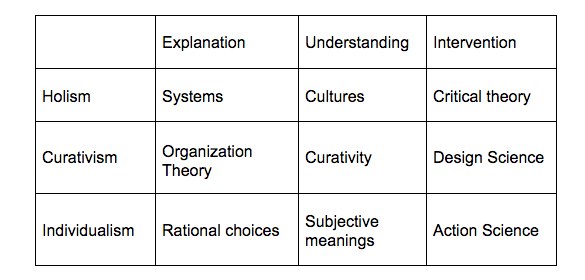
In 2019, I quoted a 2x2 matrix from Martin Hollis’ article Philosophy of Social Science for my book Curativity. In order to figure out the position of Curativity Theory, I expanded Hollis’s original 2x2 matrix into a 3x3 matrix.
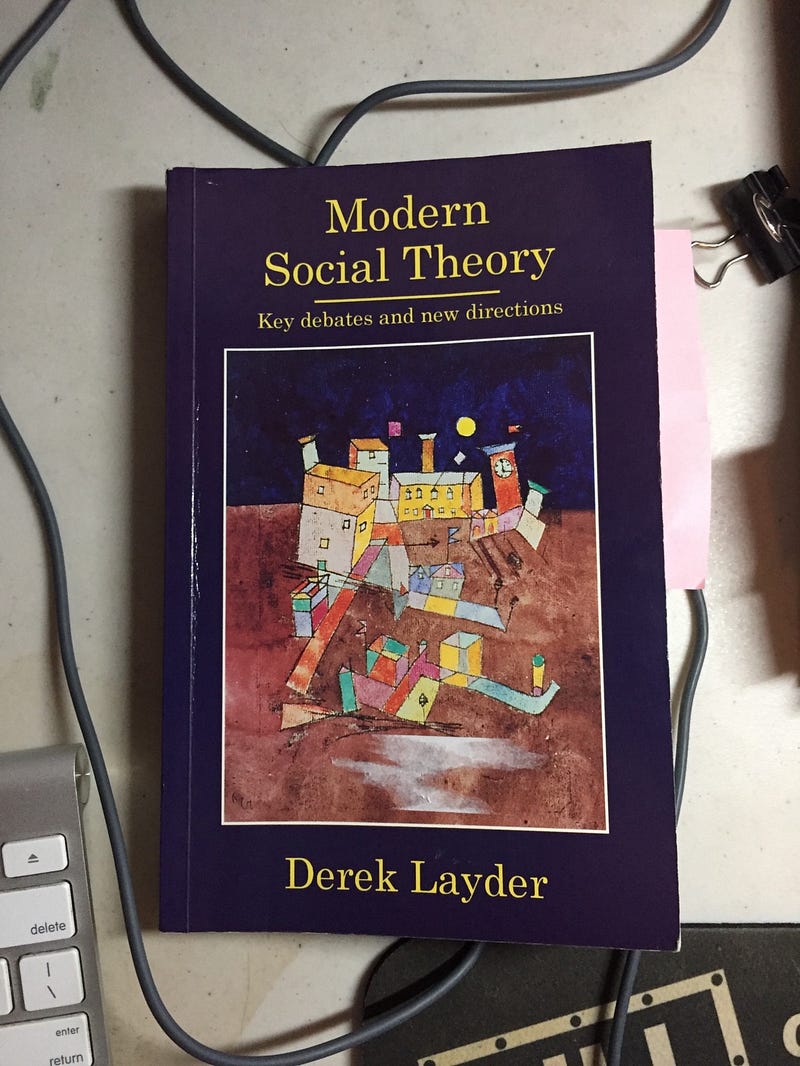
Derek Layder, the author of Modern Social Theory, reviewed modern social theories and developed his own account: social domains theory.
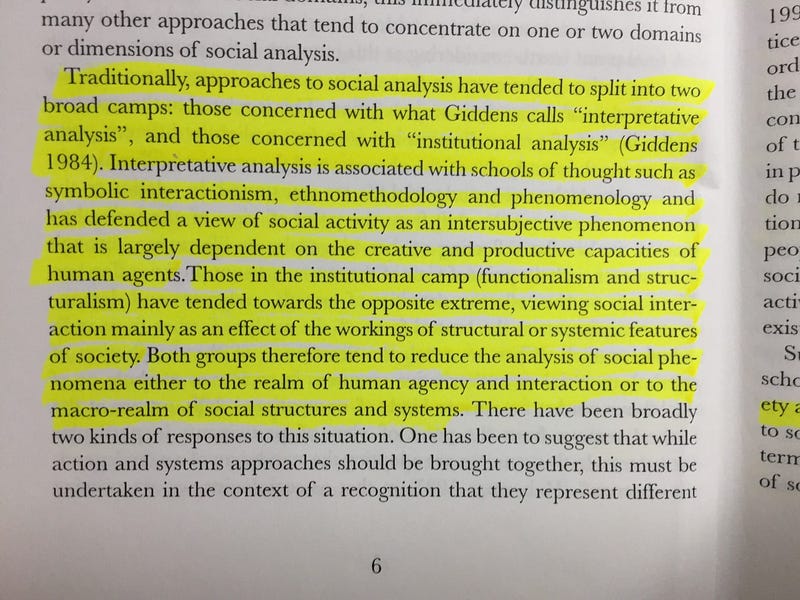
Layder said, “Traditionally, approaches to social analysis have tended to split into two broad camps: those concerned with what Giddens calls ‘interpretative analysis’, and those concerned with ‘institutional analysis’ (Giddens 1984)”.
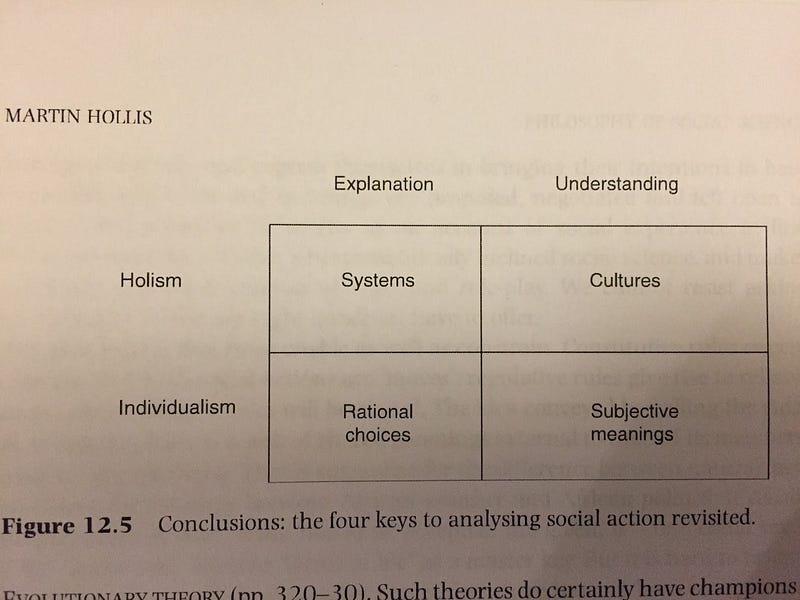
These two camps are really too broad. In 2019, I quoted the following 2x2 matrix from Martin Hollis’ article Philosophy of Social Science for my book Curativity.
Based on Martin Hollis’ typology, I expanded his matrix into the following nine-box matrix.
Martin Hollis is talking about academic knowledge from two perspectives: Explanation (more about objectivism) and Understanding (more about subjectivism).
I add “Intervention” to expand the scope from academic knowledge to practical knowledge such as professional service knowledge.
The term “Critical theory” refers to Marxist and related approaches.
The term “Design Science” is adopted from Herbert Simon and it refers to the scientific study of the artificial as opposed to the natural.
The term “Action Science” is adopted from Chris Argyris’ book Action Science: Concepts, Methods, and Skills for Research and Intervention.
The Practice of “Sensemaking” or “Sensemaking Science”
Three days ago, I had a discussion about the historical development of the community “Sensemaking” with GK VanPatter who is a SenseMaker and a CoFounder of HUMANTIFIC and NextDesign Leadership Network.
@Oliver Ding:
What is the historical development of “the sensemaking community”?
Yes yes, central to our practice for many years, we do write on this subject of sensemaking which has become a bit of a competitive wild west show and oddly often narrowing rather than expanding. Beware of the truncated root streams. More links for you!
Humantific: “The State of SenseMaking”: Not Exactly https://www.linkedin.com/pulse/exactly-gk-vanpatter/
Humantific: SenseMaking”: Now a Wild West Show https://www.linkedin.com/pulse/now-wild-west-show-gk-vanpatter/
@Oliver Ding:
“…sensemaking is an already occupied arena of real-world practice and has been for numerous decades. Much practical knowledge exists there, including long-running skill-building programs that also extend into the limitations of sensemaking and what comes next after sensemaking. Practice is leading the subject evolution, not academia, not social media. ”
Basically, we can say that “the sensemaking community” is a group of people working on “Understanding/consulting Human Complexity”.
Yes. In our practice, not just “working on understanding” but aiding collective sensemaking via inclusive information construction as fuel for changemaking.
One cannot get to inclusive information via the word-dominated Weick/Dervin Root Stream.
The Neurath/Wurman Root Stream connects back to the earlier pioneers of making the complex clear with the aid of visualizations.
Humantific: ReAppreciating Isotype https://www.humantific.com/post/before-during-after-isotype
Humantific: ReAppreciating Willard C. Brinton https://www.humantific.com/post/reappreciating-willard-c-brinton
Humantific: ReAppreciating Richard Saul Wurman https://www.humantific.com/post/reappreciating-richard-saul-wurman
Humantific: Data Visualization 1817 https://www.humantific.com/post/data-visualization-1817
GK VanPatter also shared the following diagram for sensemaking of the community of sensemaking.
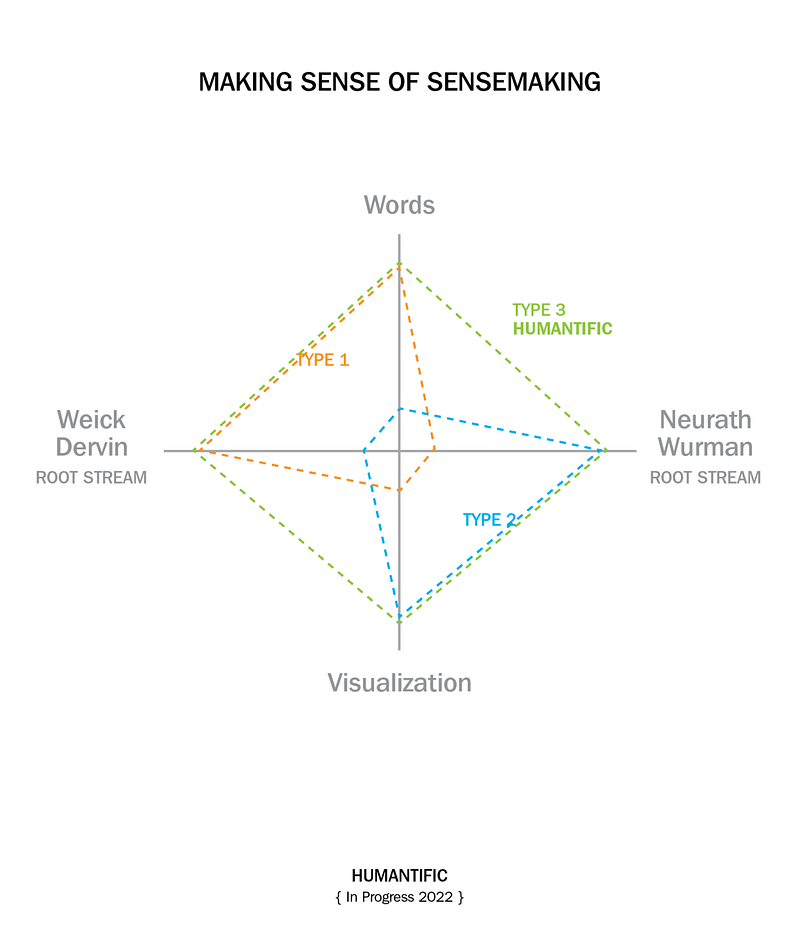
The above diagram inspired me to share the Landscape of Social Thoughts on Linkedin.
By using this 3x3 matrix, we can understand the practice of “sensemaking” or “Sensemaking Science” as “Subjective meanings + Design Science”.
The Neurath/Wurman root stream can be seen as a part of “Design Science” while the word-dominated Weick/Dervin Root Stream is more about “Subjective meanings”.
For the future development of the “Sensemaking Science”, I’d like to consider adding the third root system: the Polanyi “Tacit Knowledge” tradition. Any understanding or new meaning should be tacit knowledge first, then transform into explicit knowledge or solutions. Any solution can be transformed into explicit knowledge and tacit knowledge.
In this way, we can understand Practitioners as both knowledge users and knowledge makers.
The popular “System Thinking” is more about “Systems + Design Science”.
Not sure what your objective here is but what I would say about this one is that in practice we do not use the constructions that you refer to as most are fatally flawed. We do not spend alot of time debating Design Science, Action Science, etc.
To be brief: Most seasoned practices have already combined many hybrid notions so we are on our journey and you are on yours in a different place at a different time…:-)
Regarding tacit knowledge….In was in 1998 when we were asked to create a global innovation enabling system for a knowledge management group inside a large US corporation that we made the connection between innovation and knowledge creation, tacit knowledge and explicit knowledge, etc.
Our work is not just about sensemaking but how it connects to changemaking or innovation. One book that was popular then and still very relevant is the Knowledge Creating Company by Nonaka & Takeuchi published in 1991. Useful to you perhaps.
In 2013 Elizabeth Pastor presentated The OTHER Design Thinking at a design conf in Toronto in which she described an overview of some of the dots we connect, an ongoing process. Some appearred later in the Rethinking book.
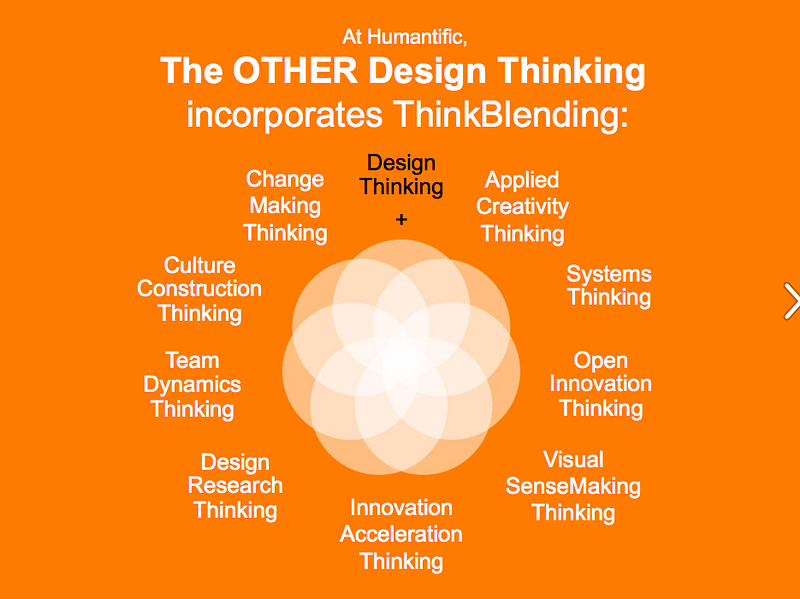
A version of this also appears in the Rethinking Design Thinking book: https://www.rethinkingdesignthinking.org
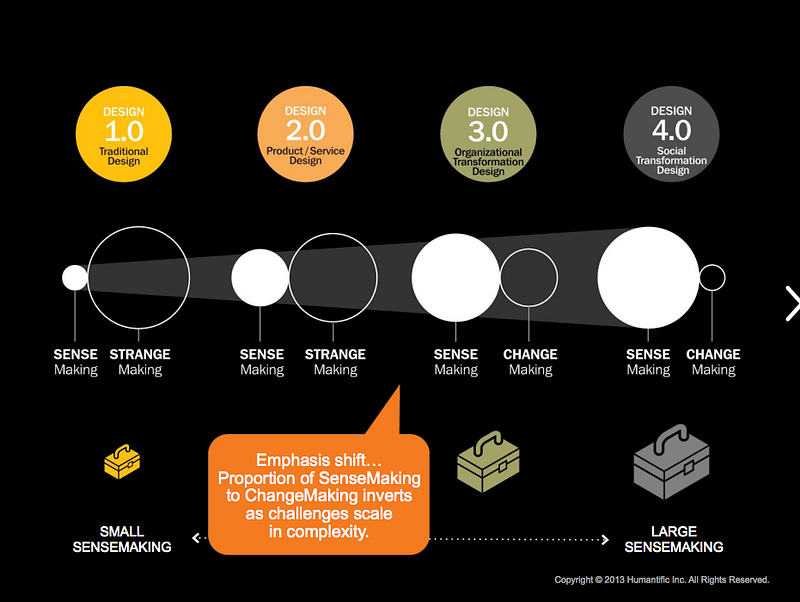
Eventually, our discussion went from sensemaking to design. GK VanPatter uses Sensemaking to understand the change in the field of Design. People tend to believe there are four stages or four types of designs, GK VanPatter adopts the perspective of Sensemaking to understand the landscape of Design as “from small sensemaking to large sensemaking”.
The Design Wisdom Triangle
The discussion inspired me to make the following diagram. I made a Triangle to connect “Systems”, “Design Science”, and “Subjective Meanings”. Then I also place “Systems Thinking”, “Design Thinking”, and “Strategic Design” on three edges of the triangle.
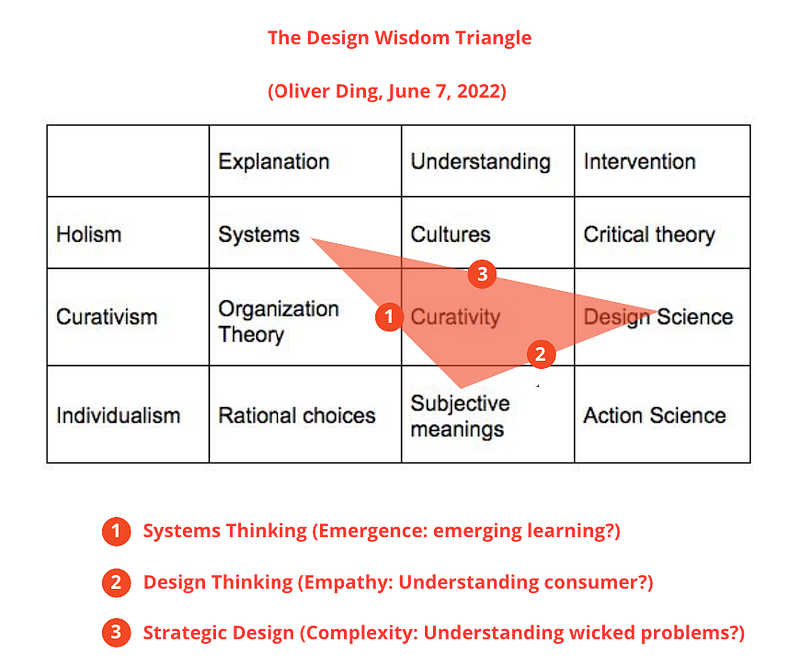
Why did I make it? It is part of the Design Wisdom Project which aims to encourage designers to adopt the Theory-based Reflection mindset. You can find more details about the project here.
Both researchers and designers are knowledge heroes. Designers are not only users of knowledge, they can be makers of new knowledge too. I hope the Design Wisdom project could help designers grow their design wisdom and contribute to the development of public knowledge.
The term “Design Wisdom” was inspired by Daiana Zavate, so I shared the above diagram with her.
Our discussion led to a new version of the Landscape of Social Thoughts.
@Daiana Zavate:
The landscape of the knowledge matrix is very intriguing but it makes me feel like something is missing, perhaps a unifying goal that brings the 3x3 together. Shouldn’t there be a place for the I0ntent that sets “the matrix into motion”?
@Oliver Ding:
The original goal of the matrix is to find the position for Curativity Theory. I made it in 2019 when I was writing the last chapter of the book about Curativity Theory.
Martin Hollis is talking about academic knowledge from two perspectives: Explanation (more about objectivism) and Understanding (more about subjectivism). I add “Intervention” to expand the scope from academic knowledge to practical knowledge such as professional service knowledge.
Would you say that it is necessary to place Curativity as a distinct field between the two? I think curativity is more fitting to interpret the matrix itself as you added Intervention in the model. I don’t know how to understand Curativism between Holism and Individualism as a parallel term, but more like the pivot between them to choose what approach is necessary for a specific instance.
@Oliver Ding:
Curativism is not a pivot between holism and individualism, but the third position. This issue is complex because it’s hard to understand this third position. There are many solutions for this third position. Curativism is one of these solutions.
I use Curativism to refer to “curate pieces into meaningful whole”, so this solution is a bridge to connect agency (individualism) and structure (holism).
Another solution is Emergence, which means Social Structures are born from Individual agency and behaviors. While I accept the Emergence account, I do believe there is a force of Curate/Organize that changes the historical development of society. So, I think it is better to understand “Emergence + Curativity” as a whole.
or we can say there are four: Individualism, Curativism, Emergence, and Holism.
So in a sense (with emergence added), they also constitute points of access towards the next one. A leap between individualism and holism would be a stretch in both theory and practice.
@Oliver Ding:
For “Practice”, it is all about “Intervention” while “Explanation” and “Understanding” are about “Theory”.
would there be another instance after intervention? and that would be a form of “cross-intervention”.
@Oliver Ding:
So, if we expand from “Design Wisdom” to the general “Practice Wisdom”, then we can draw more triangles for “knowledge curation” which means people curate knowledge resources from different perspectives for a particular work.
…after intervention?… Do you want to expand it from 3x3 to 4x4? Maybe we can add “Imagination”… it is about creativity and art…I didn’t think about it because the original matrix is about social theories.
What does “cross-intervention” mean?
I was just wondering about another form of practical knowledge that can follow the logic after Intervention. By cross-intervention I merely pointed out that certain knowledge can be transferred and applied to a different field. Even allowing a non-expert to place an intervention on a system they are not part of could be a pro-active application.
@Oliver Ding:
This “non-expert” is an expert of “boundary knowledge work” which means cross-boundary of different domains. It’s hard. And this is one of the challenges I am working on.
For example, my work on meta-diagrams and diagram blending is about “cross-intervention”. All meta-diagrams are not related to any domain, they are a pure form of thinking tool.
Other examples are 1) the “Themes of Practice” framework, I want to use the notion of “Themes of Practice” to connect people from different communities. Each community means a boundary.
2) Abstract Models. While Concrete Models are about practical domains, Abstract Models are about high-level thinking tools.
The 4X4 Matrix
After discussing with Daiana Zavate, I found our discussion expands the original 3x3 matrix into a new 4x4 matrix by adding the following two dimensions:
- Emergence
- Imagination
Then, I reflected on this new version. I asked myself the following questions:
- What does it mean for understanding the landscape of social thoughts?
- Is there a deep thing that could support the 4x4 matrix?
On June 7 (Tuesday), One of my mentors sent a live video record about his newest theory with me.
My mentor is an innovative psychologist in China. Last year he published a theoretical monograph about personality and social adaptability. Based on the established theory of “Dual Processing” (System I and System II), he connects it with “biological traits and social adaptability”. The outcome is four types of personality. He has been working on the new theory for almost eight years. He used an ecological test method to conduct empirical research.
To my surprise, his typology just echoes Stephen C. Pepper’s world hypotheses (1942):
- Formism
- Mechanism
- Contextualism
- Organicism
He told me that the value of the new theory is not a new typology, but the structure and dynamics of personality. By adopting the new theory, we can understand which part is not changeable and which part is changeable. Moreover, the ecological method is affordable to ordinary people, so people can understand the type of Others’ personalities by directly observing others’ behavior such as communicative styles and cognitive styles.
My mentor is a really innovative psychologist and an inventor. Ten years ago, he invented a brand new psychometric tool called Psychological Nested Dolls which is a non-text-based test tool. From the perspective of Activity Theory, the Psychological Nested Dolls is an instrument (mediation) between a psychological counselor (subject) and a patient (object).
I watched the live video record and connected his theory with the 4x4 matrix. My mentor once mentioned that his theory is not only about personality but also about personal epistemology. Moreover, we can apply it to discuss the ideas of scholars, scientists, and theorists.
This is an interesting connection!
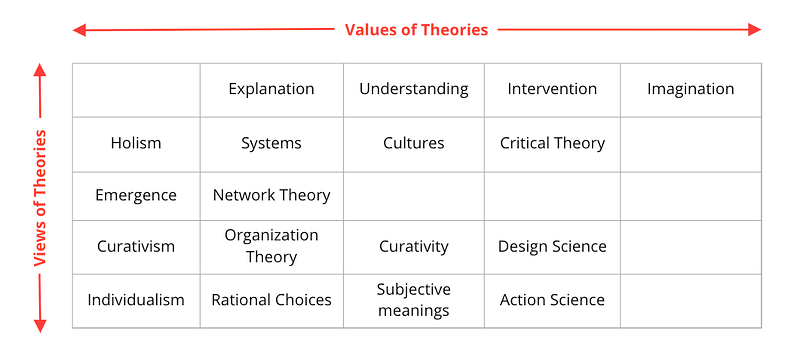
Finally, I made a new version of the landscape of social thoughts. The new 4x4 matrix is defined by Values of Theories and Views of Theories.
It’s an unfinished product. I invite you to join the journey of co-curation.
Knowledge Discovery: Developing Tacit Knowlege with Thematic Space Canvas
Related Articles
- Meet with Oliver Ding: 1 Mission, 4 Theories, and 12 Possible Books
- The Knowledge Curation Project
- How to Grow A Knowledge Enterprise
- Platform Genidentity: The Movements of Unfolding Uniqueness
- The Slow Cognition Project (Phase II): Activity Analysis for Creative Work Study
- CALL: The Launch Day of Curativity Center
- TalkThree: A Tiny Idea for Knowledge Engagement (June 2, 2022)
- #TalkThree 01: How to Read a Handbook? (June 2, 2022)
- #TalkThree 02: How to Name “X Innovation”? (June 3, 2022)
- #TalkThree 03: How to Use an Abstract Model? (June 6, 2022)
- #TalkThree 04: How Does Collective Learning Work? (June 7, 2022)
- #TalkThree 05: How to Connect X and Y? (June 8, 2022)
- #TalkThree 06: How to Approach Radical Innovation? (June 12, 2022)
- #TalkThree 07: How to Understand “X as Y” (June 14, 2022)
I am also working on building a new website for the Platform Ecology project. You can save the following links:
- PlatformEcology.org
- Twitter: @PlatformEcology
- Linkedin: @PlatformEcology
You are most welcome to connect via the following social platforms:
Linkedin: https://www.linkedin.com/in/oliverding Twitter: https://twitter.com/oliverding Polywork: https://www.polywork.com/oliverding Boardle: https://www.boardle.io/users/oliver-ding


