
#TalkThree 01: How to Read a Handbook?
Find, Select, and Print

Many people buy a lot of books or download free pdf books online and they don’t have time to read all of these books.
Me too!
In the past few years, I moved from the PRACTICE side to the THEORY side. How did I learn new theories since I was not trained as a scholar?
I used the following three steps:
- Find
- Select
The first step is Find.
Sometimes I find books from friends’ recommendations, sometimes I just directly search and find them from search engines.
What are the popular keywords I tend to use?
“Handbook”
Yes! I often search “X + Handbook” to find an academic handbook about a particular theme X. For example, I found The Handbook of Social Theory which was published in 2001.
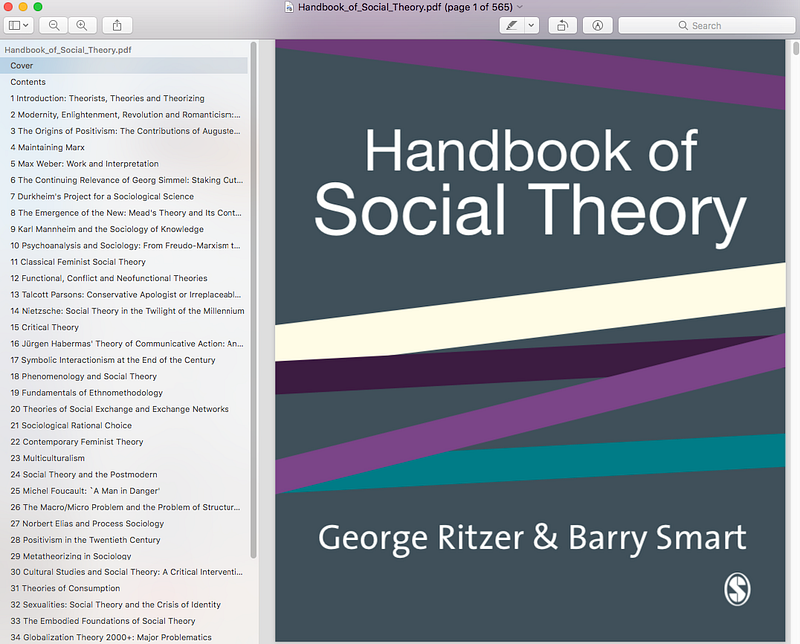
Why do you need a handbook about a particular theme X? Because it is a map of a particular domain. The Handbook of Social Theory has 39 chapters. By reading the titles of 39 chapters, you learn the landscape of the field of Social Theory Research.
In the field of social theory research, a 2001 book is still relevant for new learners in 2022. Though it can’t cover the newest progress of theoretical development from 2002 to 2022, you can know 80% of the main themes of the field.
What about the 20% newest themes? Following the editors of the handbook and the authors of the 39 chapters, you can find the newest ideas from their newest articles, books, and even social media updates.
The second step is Select.
The Handbook of Social Theory has 39 chapters and 566 pages. How to actually read this book?
If we don’t have to read all pages of a dictionary, then we don’t have to read all chapters of a handbook too.
You can only select three chapters for your reading. The section is a critical action of the Knowledge Curation method and Knowlege Engagement in general.
Life is short, it’s impossible to read all books and articles. We need to pay attention to the “people — knowledge” relationship and consider our interests and available resources.
Today I selected the following three chapters from the handbook.
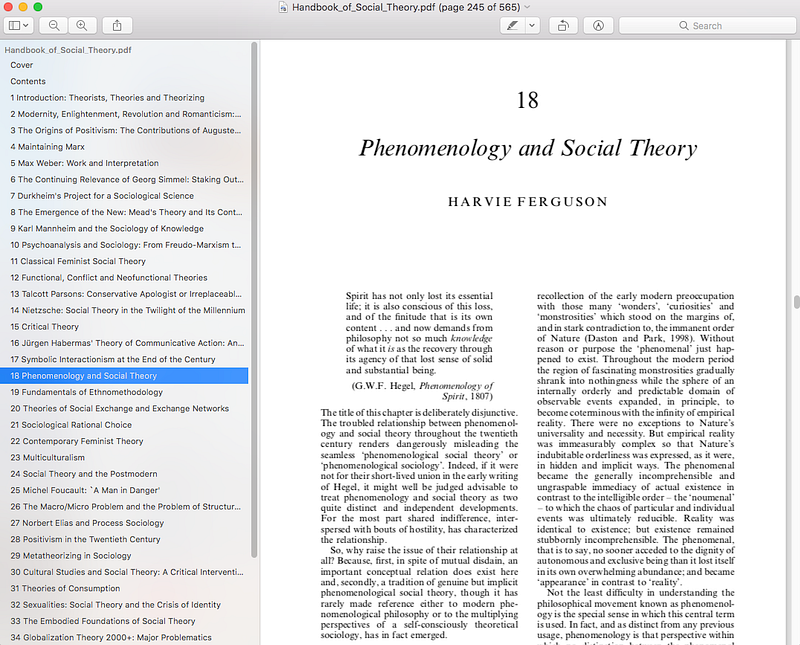
First, I chose Chapter 18: Phenomenology and Social Theory.
Why did I choose it this morning?
In Life Discovery: The Unfoldness of Activity, I shared a story that is relevant to it.
On April 14, 2022, I sent an email to a theoretical sociologist after I received a recommendation from Academia. We had an email conversion in the following ten days.
I started re-reading his books, papers, and articles. He developed a meta-theory of theoretical sociology and wrote three books and many academic papers in over 10 years.
On May 7, 2022, I had a wonderful afternoon in a beautiful park with my family. I read books and articles and wrote notes. Then, I had an insight into the theoretical sociologist’s work. I should consider his work as a case for the Slow Cognition project.
The theoretical sociologist is a well-known expert in phenomenology and social theory. His meta-theory is phenomenology-based theoretical sociology.
This is the reason I selected Chapter 18 from the handbook.
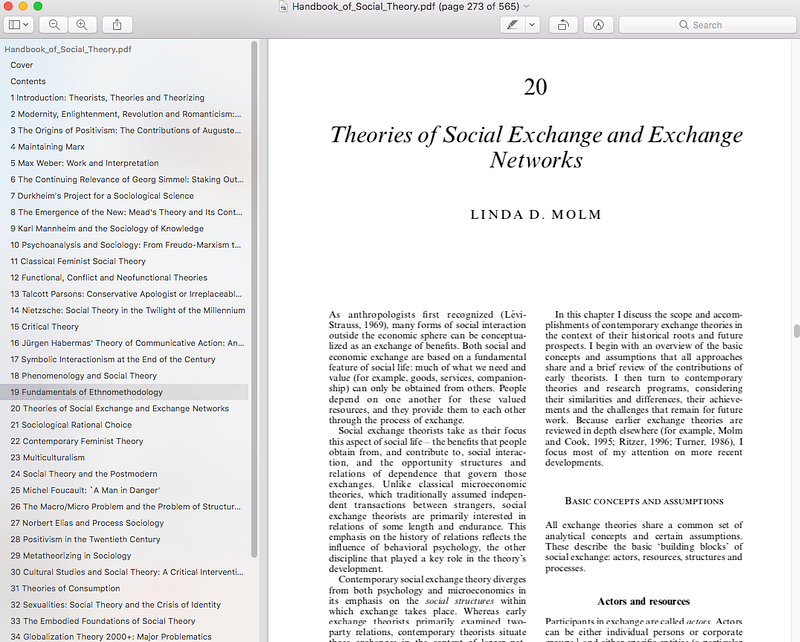
Second, I selected Chapter 20: Theories of Social Exchange and Exchange Networks.
Why did I choose it this morning?
There are two reasons.
I am recently working on the Life Discovery Project. The starting point of the project is the “Being by Doing” principle. I mentioned my goal behind the “Being by Doing” principle with the following diagram:
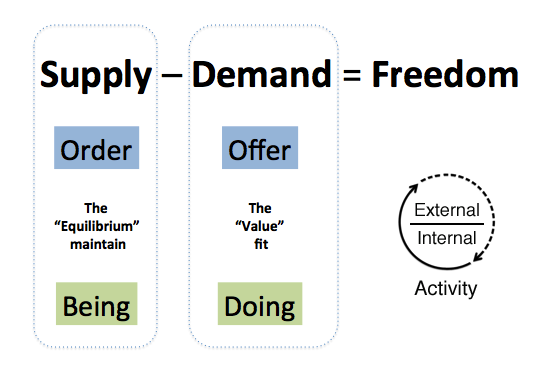
It is a rough idea. It refers to three types of freedoms: Material Freedom, Mental Freedom, and Cultural Freedom. The pair of concepts of “Supply — Demand” is inspired by economics. Also, I was inspired by the developmental psychologist Robert Kegan’s 1994 book In Over Our Heads: The Mental Demands of Modern Life.
Kegan’s “psychological — cultural” dialogue approach is the seed of my ideas about the above three types of freedoms. It’s clear that I want to expand the “psychological — cultural” dialogue to the “psychological — biological” dialogue and the “cultural — biological” dialogue.
This is the reason I am recently returning to the Social Capital theory. I re-read Nan Lin’s Social Capital: A Theory of Social Structure and Action. The Social Capital theory is part of the theoretical tradition of Social Exchange and Exchange Networks.
The second reason is about the concept of “Supportance” which is a core concept of my work the Ecological Practice Approach. You can find more details here. The concept of Supportance offers a new perspective on social support and other social phenomena. I consider it a starting point for a new theory of social action.
Traditionally, researchers pay attention to the effect of Social Support on health, quality of life, and especially mental health. I aim to adopt the ecological practice approach to discuss the notion of ‘social support’ in a broader scope in a general sense.
In the past few weeks, I started detaching the concept of “Supportance” from the context of “Social Support” from the perspective of psychology and attaching it to the context of “Social Exchange” from the perspective of sociology.
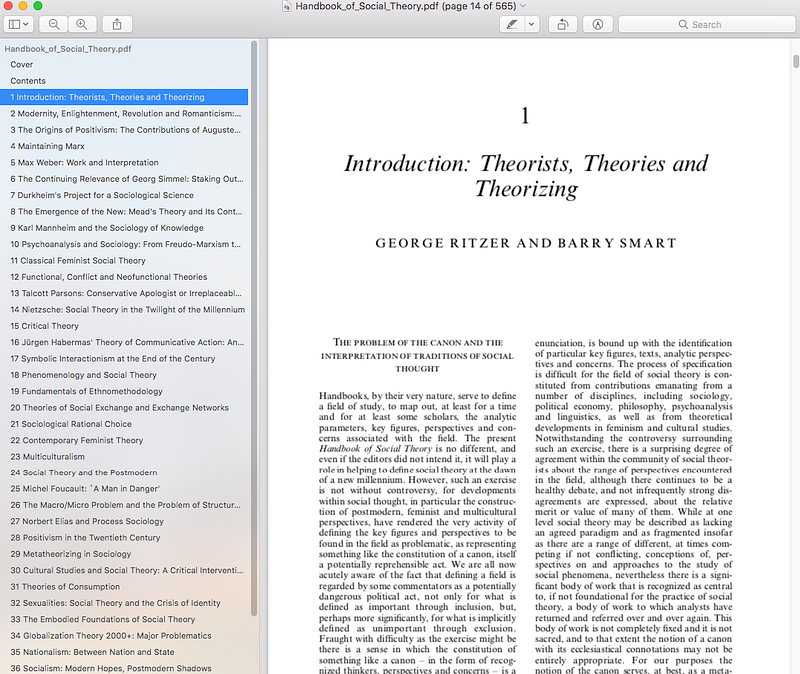
I downloaded the Handbook of Social Theory and read it several times two years ago. I found Chapter 1: Theorists, Theories, and Theorizing is relevant to my work the Knowledge Curation Method.
This morning I selected it again because I wanted to read it again and used some ideas from the chapter for the Slow Cognition project and the Knowledge Curation project.
The third step is Print.
Digital reading is different from physical reading. If you want to read 1) friction books such as popular novels, 2) news reports, and 3) personal stories, digital reading is perfect.
If you want to read 4) classic novels, 5) academic monographs, and 6) academic papers, it’s better to read physical books and files.
To be honest, I often read 5) and 6) online and offline. For some important papers, I’d like to print them and read them offline.
Physical Reading requires reading slowly. It’s perfect for the “Objective — Subjective” Knowledge Curation.
For the above three chapters, I have highlighted my motivations behind the reading activity. Since the “People — Paper” Relevance is high, I’d like to print them for reading and thinking slowly.
The final words.
There is a common sense of rational human behavior: Situation > Motivation > Decision > Action. Also, we should notice the other side of social life: irrational human behavior with many types of cognitive bias.
The above story is my experience. Since my primary interest is in connecting Theory and Practice, I read both academic materials and practical materials.
You can test the “Find > Select > Print” pattern in your life. If you don’t like academic knowledge resources, you can define your way of learning and reading.
You can pick a keyword to replace “Handbook” and design your own “X + a meta-keyword” formula for yourself.
You should pay attention to your motivation behind the routine of information consumption. Don’t waste your time on low-motivation reading. Find a significant Relevance between your Developmental Projects and the available knowledge resources.
Finally, print it out! Take it with you. Read it in a park, in a mall, in a kitchen…anywhere.
Related Articles:
- TalkThree: A Tiny Idea for Knowledge Engagement
- Meet with Oliver Ding: 1 Mission, 4 Theories, and 12 Possible Books
- Knowledge Discovery (Book)
- Ecological Practice Design (Book)
- CALL: How to Grow A Knowledge Enterprise
- The Slow Cognition Project (Phase II): Activity Analysis for Creative Work Study
I am also working on building a new website for the Platform Ecology project. You can save the following links:
- PlatformEcology.org
- Twitter: @PlatformEcology
- Linkedin: @PlatformEcology
You are most welcome to connect via the following social platforms:
Linkedin: https://www.linkedin.com/in/oliverding Twitter: https://twitter.com/oliverding Polywork: https://www.polywork.com/oliverding Boardle: https://www.boardle.io/users/oliver-ding


