
TalkThree: A Tiny Idea for Knowledge Engagement
A new series of short articles for knowledge creators: Read, Write, and Think.
Some readers asked me to write about Personal Knowledge Management. To be honest, I don’t like the term PKM because I don’t like “Knowledge Management” which is a term used in the field of corporate management.
I prefer to use “Knowledge Engagement” to describe the “people — knowledge” relationship. For me, the term “Knowledge Management” refers to a perspective that sees knowledge as an entity or substance, a thing. In contrast to this substance view, I use the term “Knowledge Engagement” to refer to a process view that sees the “people — knowledge” interaction as a dynamic process.
If you read my book Knowledge Discovery: Developing Tacit Knowledge with Thematic Space Canvas, you will find that I am using Activity Theory to design an instrument for Knowledge Discovery Activity.
Today I decided to start a new series of short articles about knowledge engagement. I am not going to develop a new theory or a new theoretical framework. I want to share some tiny ideas about my daily reading, learning, and thinking. Some ideas are habits, some ideas are strategic techniques, and some ideas are just for fun.
#TalkThree
I will use #TalkThree as the name of the new series of short articles. You can follow the hashtag #TalkThree on Medium, Twitter, and Linkedin.
The term “TalkThree” was a name of a game I developed in 2019. The game gives people two words and asks them to think about the third word. See the card below.
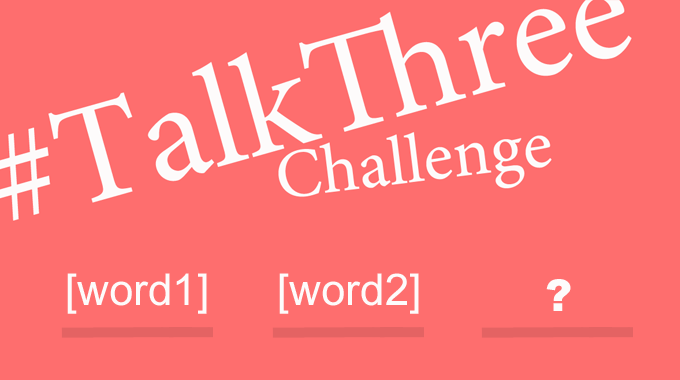
You can find version 1.0 of the game here. I also designed version 2.0 for the game. See the picture below.
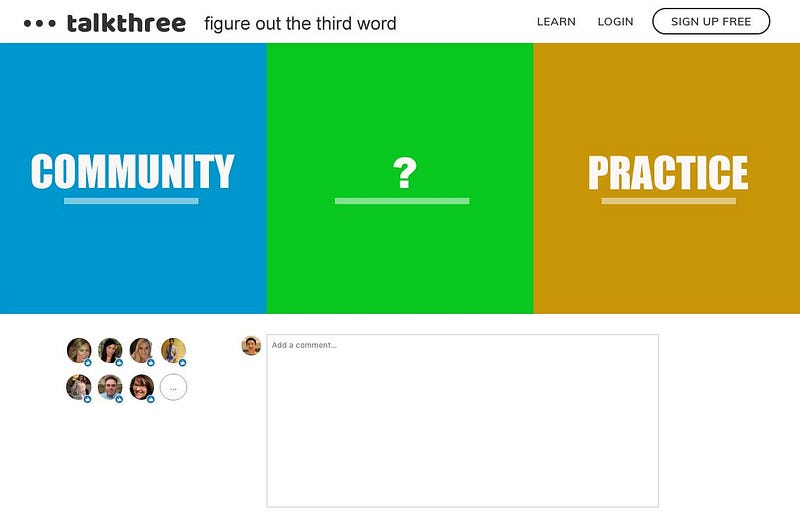
The above two words inspired me to think about the third word. The outcome is “Themes”. Later, I developed a framework called “Themes of Practice” and wrote a possible book.
We can see the new series of short articles as version 3.0 of the game.
What Do you Expect from Me?
As mentioned before, #TalkThree 3.0 is designed with the following ideas:
- Short articles
- Three ideas
- Habits, Techniques, and Games
- Learning, Reading, and Thinking
I tend to write long articles on Medium. Now I am going to challenge myself on writing short articles.
I will use “Three Ideas” to organize the content of each article. For example, a tiny book list of three books, a tiny action of three acts, a tiny group of three people, etc.
If you want to find new theories or new theoretical frameworks. You find some inspiration from my 12 possible books. #TalkThree 3.0 is only about sharing my daily habits, strategic techniques, and intellectual games.
The content of #TalkThree 3.0 will focus on three keywords: Learning, Reading, and Thinking.
The Community @ Twitter
If you have a Twitter account, you can join the #TalkThree community here:
https://twitter.com/i/communities/1537055879031398402
The List of Articles
You can find the archive of articles below.
- #TalkThree 01: How to Read a Handbook? (June 2, 2022)
- #TalkThree 02: How to Name “X Innovation”? (June 3, 2022)
- #TalkThree 03: How to Use an Abstract Model? (June 6, 2022)
- #TalkThree 04: How Does Collective Learning Work? (June 7, 2022)
- #TalkThree 05: How to Connect X and Y? (June 8, 2022)
- #TalkThree 06: How to Approach Radical Innovation? (June 12, 2022)
- #TalkThree 07: How to Understand “X as Y” (June 14, 2022)
- #TalkThree 08: How to Expand a Framework with Friends (June 15, 2022)
Related Articles:
- Meet with Oliver Ding: 1 Mission, 4 Theories, and 12 Possible Books
- Knowledge Discovery (Book)
- Ecological Practice Design (Book)
- CALL: How to Grow A Knowledge Enterprise
- The Slow Cognition Project (Phase II): Activity Analysis for Creative Work Study
I am also working on building a new website for the Platform Ecology project. You can save the following links:
- PlatformEcology.org
- Twitter: @PlatformEcology
- Linkedin: @PlatformEcology
You are most welcome to connect via the following social platforms:
Linkedin: https://www.linkedin.com/in/oliverding Twitter: https://twitter.com/oliverding Polywork: https://www.polywork.com/oliverding Boardle: https://www.boardle.io/users/oliver-ding


