
#TalkThree 05: How to Connect X and Y?
Container X, Container Y, and Container Z

How to connect X and Y? I designed the following diagram as a tool for myself.
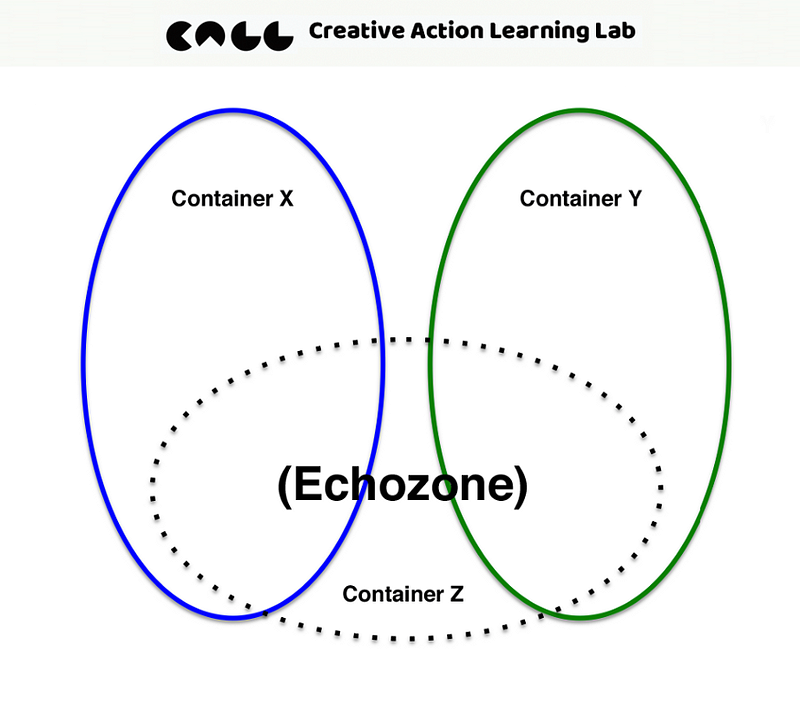
The above diagram is called the WXMY diagram which uses Container Z to connect Container X and Container Y. Container Z is also named Echozone because I name the approach the ECHO Way for knowledge curation and boundary innovation.
The concept of Container is the core of the Ecological Practice approach. By adjusting the quality and quantity of the Container, we can create advanced frameworks for discussing complex phenomena. The quality of the Container can be potential and actual, and the quantity of the Container can be one or two. If we develop a new framework with one potential container and two actual containers, the outcome is the above diagram.
I named the potential container (Container Z) Echozone which refers to a creative space containing echoes between Container X and Container Y. The term “Echo” of “Echozone” refers to a dialogue between two containers.
I have been using the WXMY/ECHO diagram many times. This article share three examples.
Example 1: The Notion of “Service Thinking”
On Feb 9, 2022, I had a talk with a friend who is a Service Designer. We talked about various topics such as design thinking, service design, strategic thinking, system thinking, cross-boundary thinking, Activity Theory, the Theory-Practice gap, etc. The conversation inspired me to connect Activity Theory and Service Design by creating a new thematic space called “Service Thinking”.
How to create a new thematic space such as “Service Thinking”? On Feb 10, 2022, I applied the WXMY/ECHO diagram to develop the notion of “Service Thinking”.
Now let’s apply it to connect Theory and Service which is a Practice. For the Theory side, I consider Activity Theory and other theories. For the Practice side, I consider Service Design.
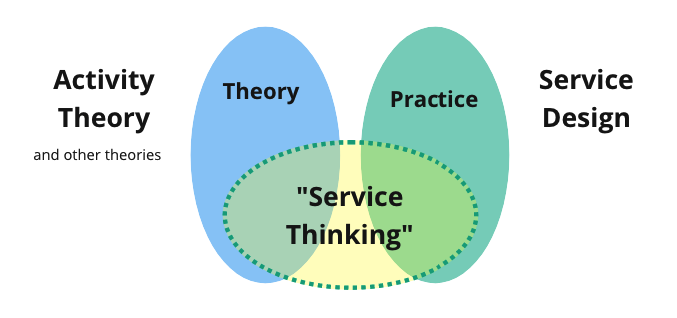
Then, we can roughly give a name to the third container. Let’s call it “Service Thinking”.
So far, the term “Service Thinking” is just a name and it points to a possible meaning. We don’t know the meaning of “Service Thinking”, but we know we can figure out its meaning later.
I’d like to emphasize this process is a highly personalized experience, at least for my “Service Thinking” case. My goal is not to define a new concept called “Service Thinking” for others. The “Service Thinking” thematic space is a connected hub that aims to connect Activity Theory and Service Design.
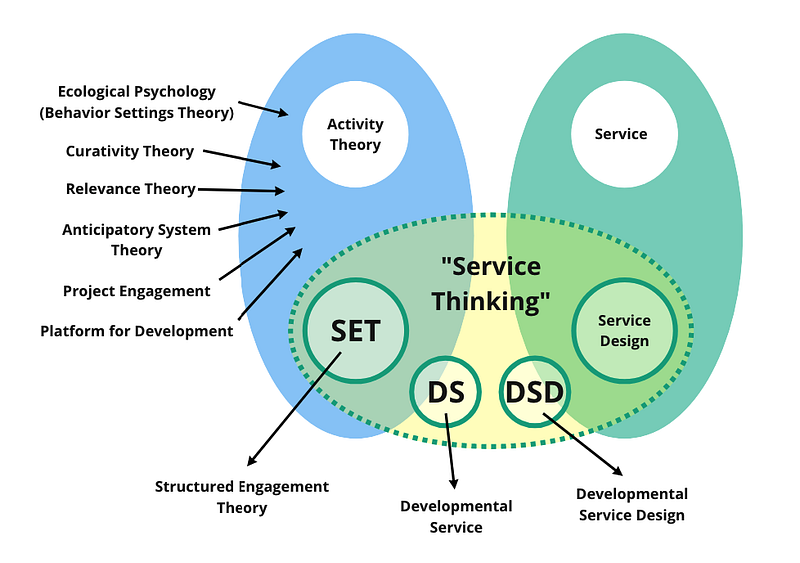
The above diagram represents the process of connection. My first spark is SET which stands for “Structured Engagement Theory”. To be honest, it is just a framework, not a theory. However, I want to keep the name “SET” because it points out the core of the framework. In order to keep the name “SET”, I have to keep the word “Theory”. Anyway, let’s call it SET or the SET framework.
In 2019, I started adopting some theories to reflect on my experience and thoughts about “Social (Digital) Design” which refers to digital products for interpersonal communications. Eventually, I developed the SET framework and used it for my own projects later.
The notion of “Developmental Service” is the newest idea. I just made it last night! It refers to a special type of service such as educational services, summer camps, adult life development programs, life discovery activities, etc. This notion refers to my own perspective of individual development. It also echoes the concept of “Developmental Platform” and the “Developmental Project Model”.
In 2021, I used the SET framework to study Digital Whiteboard Platforms in order to test my book Platform for Development. I recently used the SET framework to study an adult developmental program. This change encourages me to think about the connection between my theoretical frameworks and service design.
Finally, I found the notion of “Developmental Service Design” is a great connector.
Now, we see a set of ideas within the “Service Thinking” thematic space:
- SET: Structured Engagement Theory
- DS: Developmental Service
- DSD: Developmental Service Design
- SD: Service Design
This is version 1.0 of the meaning of the “Service Thinking” thematic space.
Example 2: The Model of Curated Mind
If you follow my writings and you probably are familiar with the following diagram.
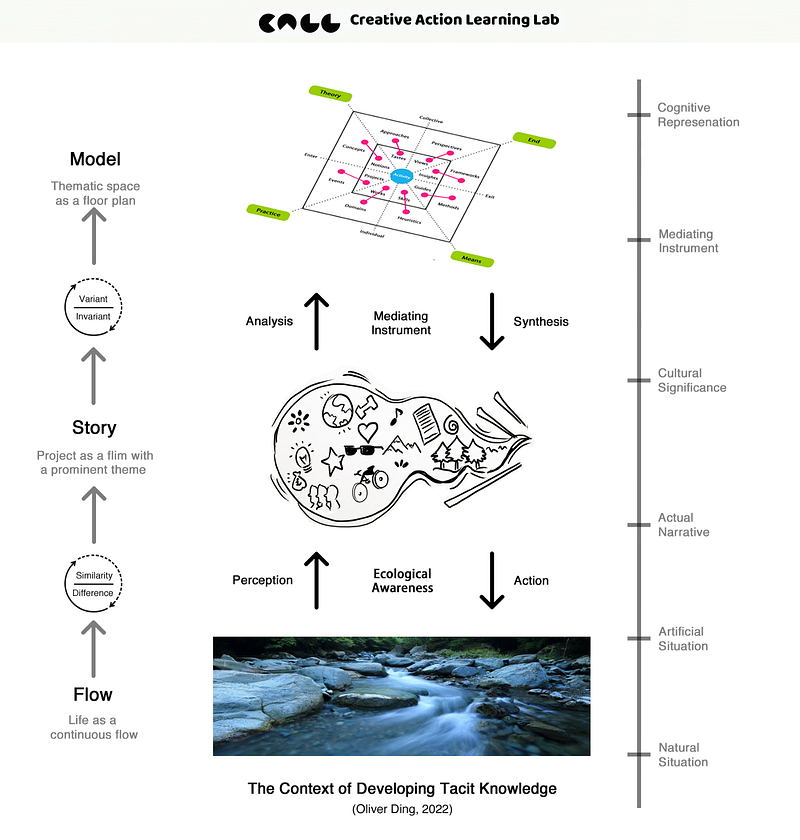
The above diagram is called the “Flow — Story — Model” metaphor which is an updated version of the Context of Developing Tacit Knowledge. Although the original title is called the Context of Developing Tacit Knowledge, I think it should be my new model of the mind or cognition.
- Flow: Life as a continuous flow
- Story: Project as a film with a prominent theme
- Model: all knowledge frameworks and models as floor plans
The “Flow — Story — Model” metaphor is also inspired by James G. March (1928–2018) who was an American political scientist, sociologist, and a pioneer of organizational decision making. He mentioned that there are three types of wisdom in his 2010 book The Ambiguities of Experience.
What are the three types of wisdom?
- Models: a model is an abstract cognitive representation.
- Stories: a story is a model too, but it is easy to understand.
- Actions: you just do it, then you get it.
What March suggested roughly echoes three types of social sciences.
- Models: Explanation (such as Systems and Rational Choices)
- Stories: Understanding (such as Culture and Subjective meanings)
- Actions: Intervention (Such as Critical theory and Action Science)
Why did I use a three-level structure? Because it is a normal form of hierarchy. However, there is a bug in the three-level structure because it doesn’t consider the direct connection between Flow and Model.
James March didn’t use such a hierarchy to discuss Models, Stories, and Actions.
The original three-level diagram is for discussing the context of Developing Tacit Knowledge. If I want to turn it into a model of the mind, I have to kill the bug.
I use the three-container meta-diagram to make the following new diagram.
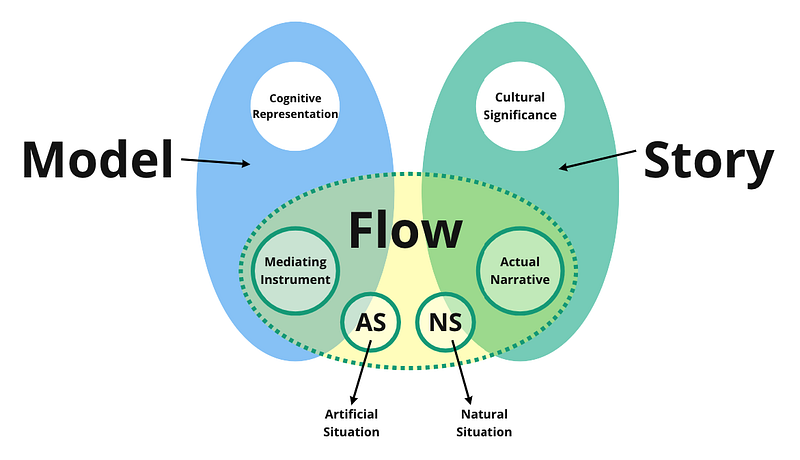
What’s the difference between the above three-container diagram and the above three-level diagram?
The three-level diagram doesn’t connect Model and Flow directly. It emphasizes two connections between three levels:
- Ecological Awareness: from Flow to Story.
- Symbolic Awareness: from Story to Model.
The three-level diagram was originally developed for discussing the Thematic Space Canvas. Its name is the Context of Developing Tacit Knowledge. I didn’t want to build a new framework of the Mind.
The three-container diagram places the Flow in the middle and suggests two directions of the transformation of Flow. The Left side is the Model while the Right side is the Story. Moreover, it has a Figure-ground structure:
- Figure: we can find four things inside the Flow container.
- Ground: there are “Cognitive Representation” and “Cultural Significance” out of the “Flow” container.
The Figure refers to Proximal Mind and the Ground refers to Pervasive Mind.
Example 3: The Model of Slow Cognition
On May 30, 2022, I designed the following diagram for discussing the Slow Cognition method.
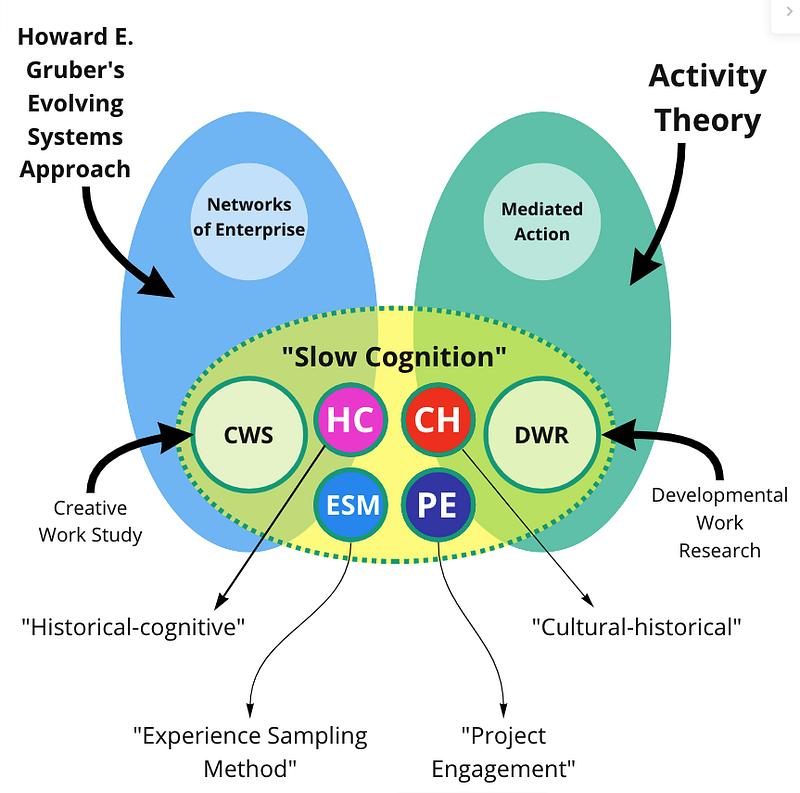
The concept of “Mediated Action” refers to Lev Vygotsky’s idea about human psychological development. Vygotsky claimed that human action and psychological functions are mediated by tools which refer to technical tools that work on objects and psychological tools that mediate the mind and environment. This concept is the foundation of Activity Theory and CHAT (Cultural-historical activity theory) in general.
The Developmental Work Research (DWR) methodology is developed by Yrjö Engeström who is the author of Learning by Expanding: An Activity-Theoretical Approach to Developmental Research (1987). The DWR is based on the Activity System model and the model of Expansive Learning. You can find more details in Activity U (IV): The Engeström’s Triangle and the Power of Diagram.
The concept of “Networks of Enterprise” refers to Howard E. Gruber’s Evolving Systems Approach. Gruber’s approach uses “Task — Project — Enterprise — Network of Enterprise” as a structure to understand a creative person’s work. It is different from Activity Theory’s “Operation — Action — Activity” hierarchy.
- Task
- Project
- Enterprise
- Networks of Enterprise
The concept of “Networks of Enterprise” refers to the pattern of work in the life of a creative individual. Gruber said, “We use the term enterprise to stand for a group of related projects and activities broadly enough defined so that (1) the enterprise may continue when the creative person finds one path blocked but another open toward the same goal and (2) when success is achieved the enterprise does not come to an end but generates new tasks and projects that continue it.” (1989, p.11)
Since Gruber’s approach focuses on creative people and their work, we can use “Creative Work Study” to describe the application of the approach.
Though these two approaches use different structures to organize work, there is a connection between Gruber’s approach and Vygotsky’s perspective on creativity. According to Seana Moran and Vera John-Steiner (2000), “For Vygotsky, creativity not only transforms objective materials into creative products, it also transforms the creator…The more differentiated his personality becomes, the better able he may be to contribute and possibly transform his or her culture…”
For Gruber, the primary focus of his approach is the uniqueness of a creative person. Gruber succinctly summarizes the dialectic of creativity and transformation: “How can I express this peculiar idea that such an [creative] individual must be a self-generating system?…The system regulates the activity and the creative acts regenerate the system” (quoted in John-Steiner, 1997, p. 78).
The Slow Cognition Method echoes the lifespan perspective and follows Vygotsky and Gruber. According to Seana Moran and Vera John-Steiner (2000), “Vygotsky’s lifespan perspective parallels that of several contemporary Western researchers. Barron (1970) focused on the creative life more than the single creative act: what a creative genius may be remembered for historically is only a small subset of the many ideas he produces in his lifetime. Helson’s (1990, 1999) longitudinal study of women found that personality development and creative achievement interact dynamically. Wallace and Gruber (1989) and Gardner (1993) both take lifelong perspectives in their studies of creative individuals, and Csikszentmihalyi et al. (1993, 1996) have studied creative work at various stages of the lifespan.”
You can find more details in D as Diagramming: The Path of Creative Life.
The Slow Cognition Method is also inspired by the following ideas:
- The Historical-cognitive method (HC)
- The Cultural-historical method (CH)
- Experience Sampling Method (ESM)
- Project Engagement method (PE)
The Historical-cognitive method combines historical research and cognitive research together. This method is developed by Gruber.
- Also, Nancy J. Nersessian used “A Cognitive-Historical approach” to name her approach to Creativity in Conceptual Change.
The Cultural-historical method refers to Activity Theorists’ methodology in general. We should notice the newest development of Activity Theory is CHAT which stands for Cultural-historical activity theory.
The Experience Sampling Method (ESM) is also called the Daily diary method, or ecological momentary assessment (EMA). It asks participants to report on their thoughts, feelings, behaviors, and/or environment on multiple occasions over time. The experience sampling method was developed by Larson and Csikszentmihalyi.
The Project Engagement method is called Cultural Projection Analysis which is inspired by Activity Theory and Ecological Psychology. You can find more details in Activity U (X): Projecting, Projectivity, and Cultural Projection.
The Final Words
The name of an Echozone— the third container — refers to a new theme or a new concept.
For example, “Service Thinking” and “Slow Cognition” are two new themes for further development.
On Jan 5, 2022, I started using the term “Slow Cognition” to name a project about the historical-cognitive approach and the long-term development of thoughts. I didn’t give a “scientific” definition to it. My understanding of the theme of “Slow Cognition” is learned from my practice of the Slow Cognition project.
After closing phase I of the Slow Cognition project, I start phase II and focus on the method. The above diagram shows my understanding of the “Slow Cognition Method”.
I also used the WXMY/ECHO diagram for the ECHO Way which is a framework for boundary innovation. See the diagram below and more details here.
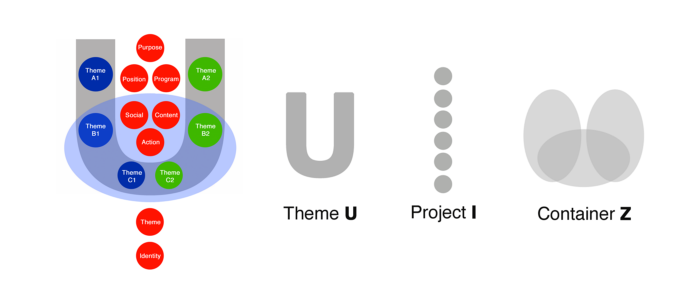
For the ECHO Way, the Echozone is a creative space for the transformation of self and mind. For example, let’s look at the Echozone of the Activity U project. The diagram below only shows the Echozone with some notes for discussing the process of fit between career themes and developmental projects.
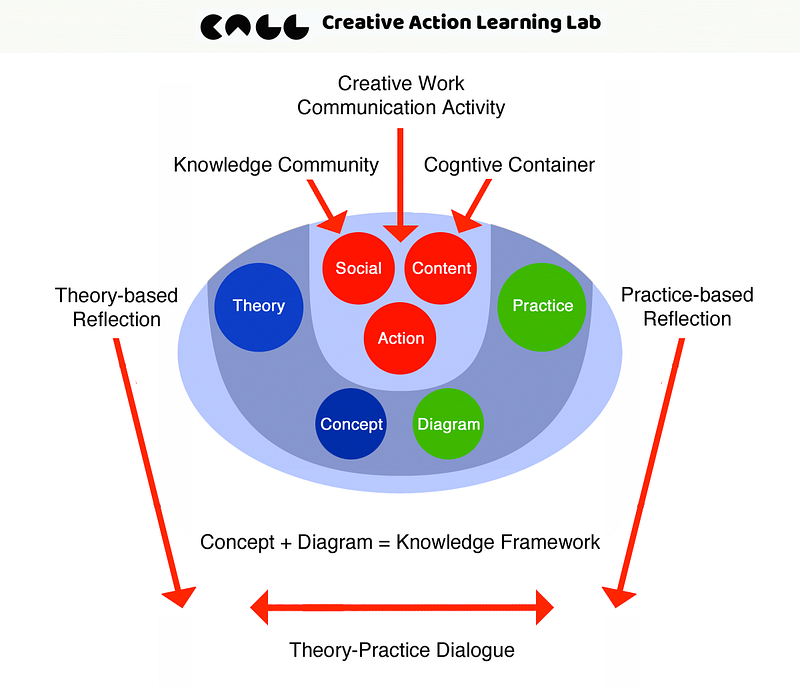
The above diagram presents fits of two pairs of opposite themes: the “Theory — Practice” Fit, and the “Concept — Diagram” Fit. You can find more details here.
Names, themes, and diagrams, all are containers of our tacit knowledge. The WXMY/ECHO diagram offers us a creative space for developing new ideas through cross-boundary dialogues.
Related Articles
- Meet with Oliver Ding: 1 Mission, 4 Theories, and 12 Possible Books
- The Knowledge Curation Project
- How to Grow A Knowledge Enterprise
- Platform Genidentity: The Movements of Unfolding Uniqueness
- The Slow Cognition Project (Phase II): Activity Analysis for Creative Work Study
- CALL: The Launch Day of Curativity Center
I am also working on building a new website for the Platform Ecology project. You can save the following links:
- PlatformEcology.org
- Twitter: @PlatformEcology
- Linkedin: @PlatformEcology
You are most welcome to connect via the following social platforms:
Linkedin: https://www.linkedin.com/in/oliverding Twitter: https://twitter.com/oliverding Polywork: https://www.polywork.com/oliverding Boardle: https://www.boardle.io/users/oliver-ding


