avatarOliver Ding

Free AI web copilot to create summaries, insights and extended knowledge, download it at here

6881

Abstract

Innovation (2022)</li><li>12. Knowledge Discovery: Developing Tacit Knowledge with Thematic Space Canvas (2022)</li></ul><h1 id="fdb3">The Toolkit</h1><p id="680d">In the past three years, I developed a series of frameworks, models, diagrams, canvases, and methods for the Knowledge Curation Project.</p><ul><li>The HERO U Framework</li><li>The HERO U Canvas</li><li>The Model of Knowledge Curation</li><li>The Knowledge Curation Canvas</li><li>The Thematic Space Canvas</li><li>The Concept Dynamics Framework</li><li>The HITED Framework</li><li>The Slow Cognition Method</li><li>The Mapping Thematic Landscape Method</li><li>A Set of Meta-diagrams</li></ul><p id="938b">Curativity Center will work on the further development of these tools.</p><h1 id="ed87">A Possible Book</h1><p id="4c06">On Oct 18, 2022, I closed <b>the Knowledge Curation project (phase 1)</b> with the following image.</p><figure id="8666"><img src="https://cdn-images-1.readmedium.com/v2/resize:fit:800/1*CfZO811lPzy53utXyN_o1Q.png"><figcaption></figcaption></figure><p id="84ed">On June 26, 2020, I published <a href="https://readmedium.com/herou-70e455c60352?sk=2b05a2d783206c5d8bdd22520b1d8bc1"><i>HERO U — A New Framework for Knowledge Heroes</i></a>. This was the starting point of <b>the Knowledge Curation project (phase 1).</b></p><p id="607b">In the past three years, I have developed a set of tools and run several sub-projects.</p><p id="739e">Now the Knowledge Curation Toolkit (v1.0) has 11 sub-frameworks.</p><p id="7a29"><i>#1: Theme U for Single-theory Curation #2: WXMY for Interdisciplinary Curation #3: Hamburger for Contextural Curation #4: Project I and The HERO I Canvas #5: WIDENESS for Multi-theory Curation #6: The Concept Dynamics Framework #7: The Knowledge Canvas Design Principle #8: The Means-End Spectrum #9: The HITED Framework for Methodological Empathy #10: The Applied Knowledge Curation Framework #11: The Model of Curated Mind</i></p><p id="b09a">The journey produces many by-products. One of the significant insights is <b>the Model of Curated Mind </b>which is an<b> </b>interdisciplinary approach to Mind.</p><p id="5f66">The Curated Mind is a holistic view of the mind and it considers individual actions (that refers to the proximal mind) and collective practices (that refers to the pervasive mind) as a meaningful whole.</p><ul><li><a href="https://readmedium.com/the-curated-mind-b7882698a8da?sk=acad26ce4b14785d8c45bc50e1ea0b1d"><i>Slow Cognition: The Curated Mind</i></a></li><li><a href="https://readmedium.com/slow-cognition-the-model-of-curated-mind-6d327a2e5cab?sk=2402c8548faa813c025b7fe378cd7562"><i>Slow Cognition: The Model of Curated Mind</i></a></li></ul><p id="e7a6">The Knowledge Curation project (phase 2) will focus on editing the possible book and turning the toolkit into learning programs.</p><h1 id="2fce">#1: Theme U for Single-theory Curation</h1><ul><li>23 min read</li><li>June 19, 2022</li></ul><div id="923d" class="link-block"> <a href="https://readmedium.com/theme-u-340b9fe9c43b"> <div> <div> <h2>The Knowledge Curation Toolkit #1: Theme U for Single-theory Curation</h2> <div><h3>The first tool of the Knowledge Curation Project</h3></div> <div><p>medium.com</p></div> </div> <div> <div style="background-image: url(https://miro.readmedium.com/v2/resize:fit:320/0*dQxakA1I_y2wLNUM.png)"></div> </div> </div> </a> </div><h1 id="4fdd">#2: WXMY for Interdisciplinary Curation</h1><ul><li>25 min read</li><li>June 24, 2022</li></ul><div id="e831" class="link-block"> <a href="https://readmedium.com/wxmy-b44baea99aa4"> <div> <div> <h2>The Knowledge Curation Toolkit #2: WXMY for Interdisciplinary Curation</h2> <div><h3>The advanced version of Theme U</h3></div> <div><p>medium.com</p></div> </div> <div> <div style="background-image: url(https://miro.readmedium.com/v2/resize:fit:320/1*uN7gBhcputdyQVEWWVnjug.png)"></div> </div> </div> </a> </div><h1 id="e82e">#3: Hamburger for Contextural Curation</h1><ul><li>16 min read</li><li>June 28, 2022</li></ul><div id="cf32" class="link-block"> <a href="https://readmedium.com/hamburger-50273d1d8d7f"> <div> <div> <h2>The Knowledge Curation Toolkit #3: Hamburger for Contextural Curation</h2> <div><h3>Understanding the context of a new knowledge framework</h3></div> <div><p>medium.com</p></div> </div> <div> <div style="background-image: url(https://miro.readmedium.com/v2/resize:fit:320/1*Mul-KGLpMhlzqCUg4i9m1A.png)"></div> </div> </div> </a> </div><h1 id="b98c">#4: Project I and The HERO I Canvas</h1><ul><li>22 min read</li><li>July 23, 2022</li></ul><div id="8aa6" class="link-block"> <a href="https://readmedium.com/hero-i-18abb830cdce"> <div> <div> <h2>The Knowledge Curation Toolkit #4: Project I and The HERO I Canvas</h2> <div><h3>Running a Knowledge Curation Project with the HERO I Canvas</h3></div> <div><p>medium.com</p></div> </div> <div> <div style="background-image: url(https://miro.readmedium.com/v2/resize:fit:320/0*ilZMXaiznpYhX4Cv.png)"></div> </div> </div> </a> </div><h1 id="ff1a">#5: WIDENESS for Multi-theory Curation</h1><ul><li>20 min read</li><li>Oct 18, 2022</li></ul><div id="b3d1" class="link-block"> <a href="https://readmedium.com/wideness-a355193f9f57"> <div> <div> <h2>The Knowledge Curation Toolkit #5: WIDENESS for Multi-theory Curation</h2> <div><h3>A canvas for building curated knowledge frameworks</h3></div> <div><p>medium.com</p></div> </div> <div> <div style="background-image: url(https://miro.readmedium.com/v2/resize:fit:320/0*-pIMyADa7kFNqR5E)"></div> </div> </div> </a> </div><h1 id="8bb6">#6 The Concept Dynamics Framework</h1><ul><li>15 min read</li><li>April 5, 2022</li></ul><div id="f4aa" class="link-block"> <a href="https://readmedium.com/concept-dynamics-12a5dc04b7b9"> <div> <div> <h2>Knowledge Discovery: The Concept Dynamics Framework</h2> <div><h3>Understanding the Complexity of Concept Ecology with Knowledge Discovery Canvas</h3></div> <div><p>medium.com</p></div>

Options

</div> <div> <div style="background-image: url(https://miro.readmedium.com/v2/resize:fit:320/1*LqGp17loOa40RNadBgG_Rw.png)"></div> </div> </div> </a> </div><p id="7ec5">Related articles:</p><ul><li><a href="https://readmedium.com/hypeword-84071a48cc61"><i>D as Diagramming: Don’t hate Buzzwords and Culture</i></a> — Oct 23, 2021</li><li><a href="https://readmedium.com/concepts-notions-6ae86a28831c?sk=0dad6781612861a8b061a53699e3110d"><i>Knowledge Discovery: Concepts, Notions, and the Concept Dynamics Framework</i></a> — March 29, 2022</li><li><a href="https://readmedium.com/talkthree-2-how-to-name-x-innovation-82cc7f3a9c09?sk=c795573a6e17dd3f97954017e2f0c24b"><i>#TalkThree 02: How to Name “X Innovation”?</i></a> — June 3, 2022</li><li><a href="https://readmedium.com/concept-dynamics-an-ontological-discussion-about-service-998804693055?sk=0be79030fca942cde73f1fbd63544c24"><i>Concept Dynamics: An Ontological Discussion about “Service”</i></a> — June 4, 2022</li><li><a href="https://readmedium.com/activity-circle-92aea8846971?sk=3cb1026656c6f71a61b8d93722909018"><i>Diagram Blending: “Activity Circle” + “Concept Dynamics”</i></a> — July 31, 2022</li><li><a href="https://readmedium.com/innovation-ecosystem-77fd3ca42e5e"><i>Against Conceptual Heterogeneity: A Case Study of Academic Knowledge Curation</i></a> — Sept 30, 2022</li><li><a href="https://readmedium.com/kpi-154c1ee31048?sk=d20028b8fca3873067754908245beb53"><i>#TalkThree 16: Concepts, Themes, and Culture</i></a> — Oct 6, 2022</li></ul><h1 id="26ac">#7 The Knowledge Canvas Design Principle</h1><p id="2deb">On Oct 22, 2021, I designed a knowledge canvas and developed a design principle:</p><blockquote id="0594"><p>A good canvas matches visual areas and conceptual spaces with a simple and unique style of spatial configuration.</p></blockquote><p id="2304">You can find more details in the original article:</p><div id="f983" class="link-block"> <a href="https://readmedium.com/creative-work-7243d546ee16"> <div> <div> <h2>D as Diagramming: The Creative Work Canvas</h2> <div><h3>How to design a canvas with a diagram?</h3></div> <div><p>medium.com</p></div> </div> <div> <div style="background-image: url(https://miro.readmedium.com/v2/resize:fit:320/1*LivaN3kBgr_aigEvIJ8rcw.png)"></div> </div> </div> </a> </div><p id="bee5">Related articles:</p><ul><li><a href="https://readmedium.com/an-integrated-framework-b86edddbbc23"><i>D as Diagramming: An Integrated Framework for Studying Knowledge Diagrams (Part 1)</i></a><i> — Nov 12, 2021</i></li><li><a href="https://readmedium.com/talkthree-diagrams-canvases-and-problem-solving-cce601dafe3e"><i>#TalkThree 17: Diagrams, Canvases, and Problem Solving</i></a> — Oct 13, 2022</li></ul><h1 id="8eec">#8 The Means-End Spectrum</h1><p id="3eb7">The Means-End issue is a complicated issue in the literature of Activity Theory and Vygotsky’s Cultural-historical theory of psychology because scholars have different interpretations of Vygotsky’s ideas.</p><p id="4472">On Nov 29, 2021, I developed the following diagram for the Diagramming for Practice framework. You can see more details in <a href="https://readmedium.com/diagramming-3a-3baaa78bea89">the original article</a>.</p><figure id="0d7d"><img src="https://cdn-images-1.readmedium.com/v2/resize:fit:800/0*yNQpVpgi1MJ7wkpQ.png"><figcaption></figcaption></figure><p id="f78a">The value of <b>the</b> <b>Means-End Spectrum </b>is highlighting<b> the dynamics of ontological position of diagrams</b> because it matches the dynamics of thoughts.</p><p id="aa4a">Though even the above discussion is about diagrams, we can replace Diagrams with other things and turn <b>the</b> <b>Means-End Spectrum </b>into a general framework.</p><p id="5511"><i>Related articles:</i></p><ul><li><a href="https://readmedium.com/ed457427c7e"><i>Life Discovery: The “Means-End” Spectrum and Becoming</i></a> — Feb 23, 2022</li><li><a href="https://readmedium.com/thematic-spaces-42aaa61b404d"><i>The Notion of Thematic Spaces</i></a> — Jan 5, 2022</li></ul><h1 id="6c05">#9 The HITED Framework for Methodological Empathy</h1><ul><li>Oct 4, 2022</li><li>9 min read</li></ul><div id="1308" class="link-block"> <a href="https://readmedium.com/hited-4e8baefe157c"> <div> <div> <h2>Design Wisdom: The HITED Framework for Methodological Empathy</h2> <div><h3>A new visual language for the Design Wisdom project</h3></div> <div><p>medium.com</p></div> </div> <div> <div style="background-image: url(https://miro.readmedium.com/v2/resize:fit:320/1*x5IYWs9eMrFOjfmuVLrY-Q.png)"></div> </div> </div> </a> </div><h1 id="b107">#10 The Applied Knowledge Curation Framework</h1><ul><li>July 13, 2022</li><li>24 min read</li></ul><div id="48a2" class="link-block"> <a href="https://readmedium.com/creative-holism-3070979d1495"> <div> <div> <h2>The Curated Mind: Creative Holism and Applied Knowledge Curation</h2> <div><h3>Managers as Knowledge Curators</h3></div> <div><p>medium.com</p></div> </div> <div> <div style="background-image: url(https://miro.readmedium.com/v2/resize:fit:320/0*Iqu2UHY1q8573gnX)"></div> </div> </div> </a> </div><h1 id="8dd6">#11 The Model of Curated Mind</h1><ul><li>March 21, 2022</li><li>6 min read</li></ul><div id="a0fe" class="link-block"> <a href="https://readmedium.com/slow-cognition-the-model-of-curated-mind-6d327a2e5cab"> <div> <div> <h2>Slow Cognition: The Model of Curated Mind</h2> <div><h3>Eight Operational Concepts for developing the Curated Mind framework</h3></div> <div><p>medium.com</p></div> </div> <div> <div style="background-image: url(https://miro.readmedium.com/v2/resize:fit:320/0*YZLu04bKTfab224f)"></div> </div> </div> </a> </div><p id="7841">I also work on related books and toolkits.</p><figure id="9c3c"><img src="https://cdn-images-1.readmedium.com/v2/resize:fit:800/1*rnep8ROxjSARbVui2XBDsA.png"><figcaption></figcaption></figure><h2 id="87dc">Knowledge Discovery (Book): Developing Tacit Knowledge with Thematic Space Canvas</h2><h2 id="49b6">The Project Engagement Toolkit (v1.0)</h2><h2 id="1318">The Life Discovery Toolkit (v1)</h2><h2 id="c2f9">The Thematic Engagement Toolkit (v1.0)</h2></article></body>

The Knowledge Curation Project (phase 1)

This project aims to Connect THEORY and PRACTICE by turning Pieces into a meaningful Whole

  • Started on June 26, 2020
  • Closed on Oct 18, 2022
Photo by Jeremy Yap on Unsplash

I have been working in the curation field for over ten years. I was the Chief Information Architect of BagTheWeb which was an early tool for content curation (We launched the site in 2010). This experience inspired me to make a long-term commitment to the Curation theme. After having 10 years of various curation-related practical work experiences and theory learning, I coined a term called Curativity and developed it as Curativity Theory.

Curativity Theory

From Sept 2018 to March 2019, I wrote a book titled Curativity: The Ecological Approach to Curatorial Practice. The book presents the Curativity Theory with a theoretical foundation Ecological Practice approach. Here is a brief of the book and the approach: The Ecological Practice Approach Toolkit.
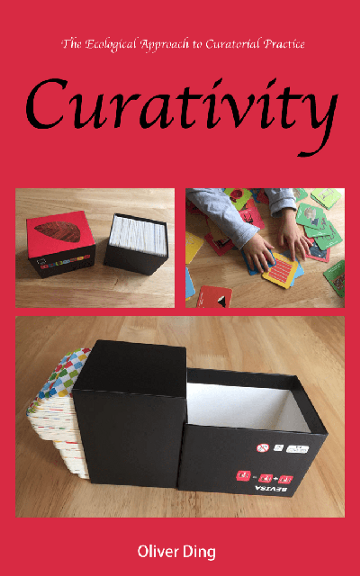
After March 2019, I continuously worked on revising Curativity and developing the Ecological Practice Approach as a new project. For the direction of Curativity Theory, I am looking for practical applications, for example:

  • Knowledge Curation
  • Action Curation
  • Life Curation
  • Platform Curation

I have written a chapter discussing knowledge curation in the book Curativity. For academic knowledge curation, I mentioned Dean Keith Simonton’s chance-configuration theory, Victor Kaptelinin, and Bonnie A. Nardi’s scientific curation case study “curation at Ajaxe”, and qualitative research. For practical knowledge curation, I focus on Cognitive Container since Container is a core concept of Curativity Theory.

Books and courses are typical cognitive containers, however, there are more types of cognitive containers. I highlighted five types of Cognitive Containers:

  • Knowledge Card
  • Knowledge Framework
  • Knowledge Diagram and Chart
  • Knowledge Workshop
  • Knowledge Sprint

It is not an accurate classification, but a rough recommendation. Also, I suggested that we not only adopt existing types of cognitive containers but also create new types of cognitive containers. Actually, this is the essential point of the Curation Theory. We are shaped by containers and we can make containers too.

In 2020, I decided to apply Curativity Theory to Knowledge Building and I started working on the Knowledge Curation project which led to several books later.

The mission behind the Knowledge Curation project is Connecting Theory and Practice.

Connecting Theory and Practice

The Theory-Practice Gap is an important issue in a wide range of disciplines including education, organization learning, and development, community building, academic development, enterprise R&D, professional service firms (PSFs), etc.

If we can find a good solution to close the Theory-Practice Gap, then we can improve existing social systems of knowledge production, knowledge application, and knowledge management at the individual level and the collective level.

In the past three years, I have developed a set of tools and run several sub-projects.

  • 2020: The HERO U framework | The Activity U project
  • 2021: The Model of Knowledge Curation and Canvas | The D as Diagramming project
  • 2022: The Thematic Space Canvas | The Life Discovery project

The outcome is pretty amazing. I produced various types of knowledge products such as concepts, diagrams, canvases, methods, toolkits, etc. I also wrote articles and edited books.

Four Theories

My primary theoretical interests are the following four theoretical approaches:

  • Curativity Theory
  • Ecological Psychology
  • Activity Theory
  • Anticipatory Systems Theory

Based on these theoretical resources, I developed several new knowledge frameworks such as:

  • The Knowledge Curation Framework (an application of Curativity Theory)
  • The Themes of Practice Framework (an application of Curativity Theory, also inspired by Activity Theory)
  • The Ecological Practice Approach (inspired by Ecological Psychology)
  • The Infoniche Framework (an application of the Ecological Practice Approach)
  • The Lifesystem Framework (an application of the Ecological Practice Approach, also inspired by Activity Theory)
  • The SET (Structured Engagement Theory) Framework (inspired by Activity Theory and Ecological Psychology)
  • The Anticipatory Activity System Framework (inspired by Activity Theory and Anticipatory Systems Theory)

In order to test these abstract frameworks, I also apply them to some domains such as adult development, career development, life transitions, platform innovation, tacit knowledge development, etc.

Twelve Books

From 2019 to 2022, I wrote 12 books and designed a set of meta-diagrams. These books are drafts. I call them Possible Books.
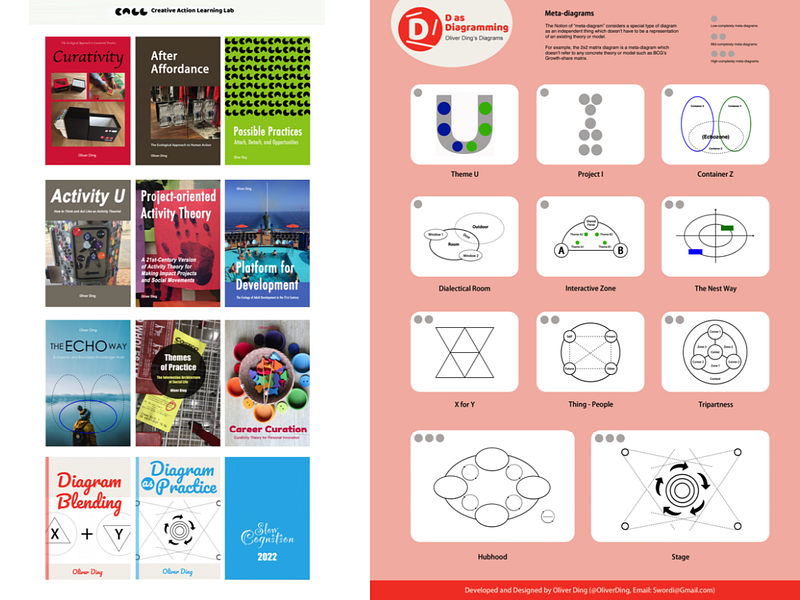
  • 1. Curativity Theory: The Ecological Approach to General Curation Practice (2019)
  • 2. After Affordance: The Ecological Approach to Human Action (2020)
  • 3. Activity U: How to Think and Act Like an Activity Theorist (2020)
  • 4. Project-oriented Activity Theory (2021)
  • 5. Platform for Development: The Ecology of Adult Development in the 21st Century (2021)
  • 6. The ECHO Way: Echozone and Boundary Knowledge Work (2021)
  • 7. Themes of Practice: The Information Architecture of Social Life (2021)
  • 8. Career Curation: Curativity Theory for Personal Innovation (2021)
  • 9. Diagram Blending: Building Diagram Networks (2021)
  • 10. Diagramming as Practice: An Integrated Framework for Studying Knowledge Diagrams (2021)
  • 11. Ecological Practice Design: The Lifesystem Approach to Everyday Life Innovation (2022)
  • 12. Knowledge Discovery: Developing Tacit Knowledge with Thematic Space Canvas (2022)

The Toolkit

In the past three years, I developed a series of frameworks, models, diagrams, canvases, and methods for the Knowledge Curation Project.

  • The HERO U Framework
  • The HERO U Canvas
  • The Model of Knowledge Curation
  • The Knowledge Curation Canvas
  • The Thematic Space Canvas
  • The Concept Dynamics Framework
  • The HITED Framework
  • The Slow Cognition Method
  • The Mapping Thematic Landscape Method
  • A Set of Meta-diagrams

Curativity Center will work on the further development of these tools.

A Possible Book

On Oct 18, 2022, I closed the Knowledge Curation project (phase 1) with the following image.
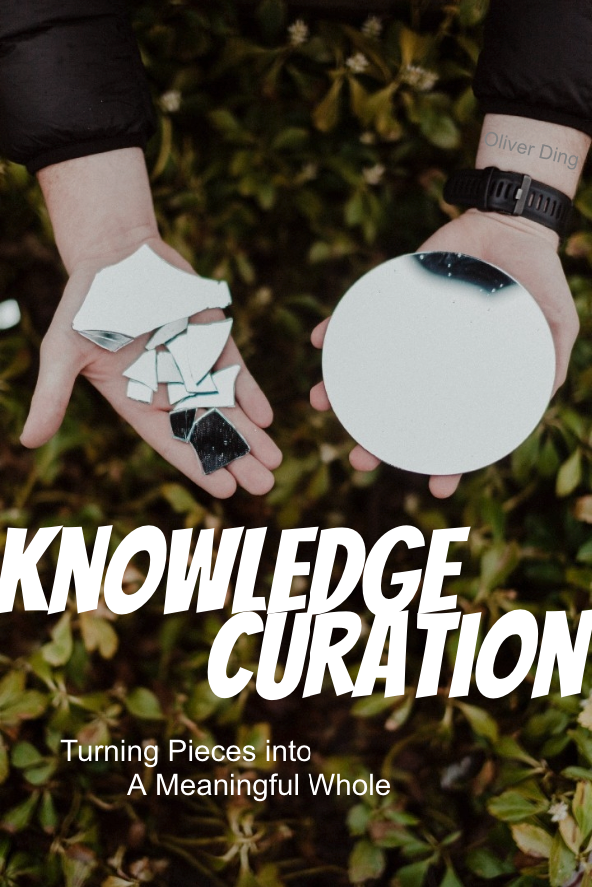
On June 26, 2020, I published HERO U — A New Framework for Knowledge Heroes. This was the starting point of the Knowledge Curation project (phase 1).

In the past three years, I have developed a set of tools and run several sub-projects.

Now the Knowledge Curation Toolkit (v1.0) has 11 sub-frameworks.

#1: Theme U for Single-theory Curation #2: WXMY for Interdisciplinary Curation #3: Hamburger for Contextural Curation #4: Project I and The HERO I Canvas #5: WIDENESS for Multi-theory Curation #6: The Concept Dynamics Framework #7: The Knowledge Canvas Design Principle #8: The Means-End Spectrum #9: The HITED Framework for Methodological Empathy #10: The Applied Knowledge Curation Framework #11: The Model of Curated Mind

The journey produces many by-products. One of the significant insights is the Model of Curated Mind which is an interdisciplinary approach to Mind.

The Curated Mind is a holistic view of the mind and it considers individual actions (that refers to the proximal mind) and collective practices (that refers to the pervasive mind) as a meaningful whole.

The Knowledge Curation project (phase 2) will focus on editing the possible book and turning the toolkit into learning programs.

#1: Theme U for Single-theory Curation

  • 23 min read
  • June 19, 2022

#2: WXMY for Interdisciplinary Curation

  • 25 min read
  • June 24, 2022

#3: Hamburger for Contextural Curation

  • 16 min read
  • June 28, 2022

#4: Project I and The HERO I Canvas

  • 22 min read
  • July 23, 2022

#5: WIDENESS for Multi-theory Curation

  • 20 min read
  • Oct 18, 2022

#6 The Concept Dynamics Framework

  • 15 min read
  • April 5, 2022

Related articles:

#7 The Knowledge Canvas Design Principle

On Oct 22, 2021, I designed a knowledge canvas and developed a design principle:

A good canvas matches visual areas and conceptual spaces with a simple and unique style of spatial configuration.

You can find more details in the original article:

Related articles:

#8 The Means-End Spectrum

The Means-End issue is a complicated issue in the literature of Activity Theory and Vygotsky’s Cultural-historical theory of psychology because scholars have different interpretations of Vygotsky’s ideas.

On Nov 29, 2021, I developed the following diagram for the Diagramming for Practice framework. You can see more details in the original article.
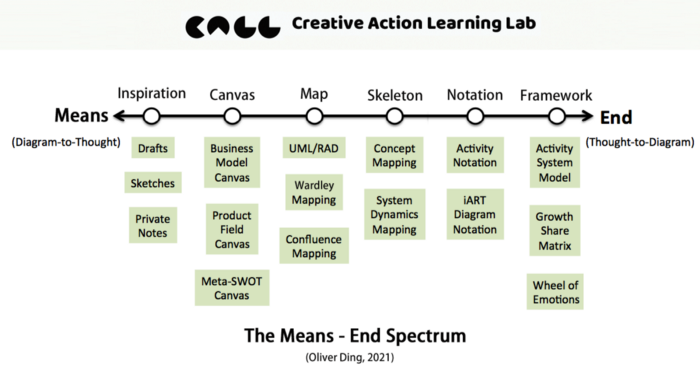
The value of the Means-End Spectrum is highlighting the dynamics of ontological position of diagrams because it matches the dynamics of thoughts.

Though even the above discussion is about diagrams, we can replace Diagrams with other things and turn the Means-End Spectrum into a general framework.

Related articles:

#9 The HITED Framework for Methodological Empathy

  • Oct 4, 2022
  • 9 min read

#10 The Applied Knowledge Curation Framework

  • July 13, 2022
  • 24 min read

#11 The Model of Curated Mind

  • March 21, 2022
  • 6 min read

I also work on related books and toolkits.
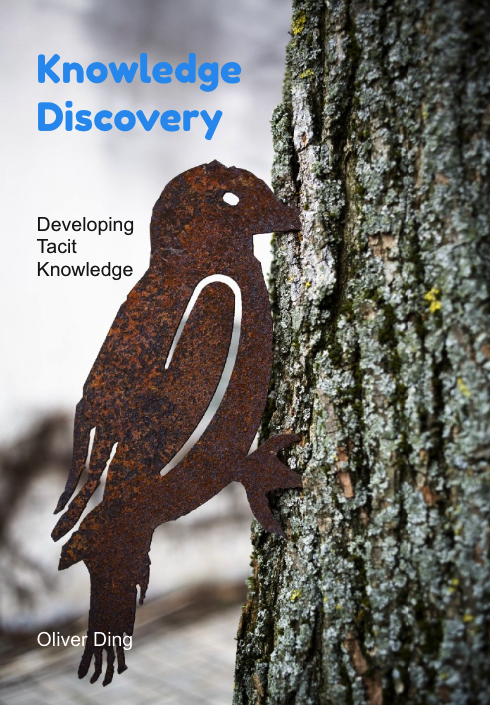
Knowledge Discovery (Book): Developing Tacit Knowledge with Thematic Space Canvas

The Project Engagement Toolkit (v1.0)

The Life Discovery Toolkit (v1)

The Thematic Engagement Toolkit (v1.0)

Recommended from ReadMedium
avatarswardley
On being lost

Chapter 1

28 min read