
Knowledge Discovery: Concepts, Notions, and the Concept Dynamics Framework
AMA: What’s the difference between “Notions” and “Concepts”?
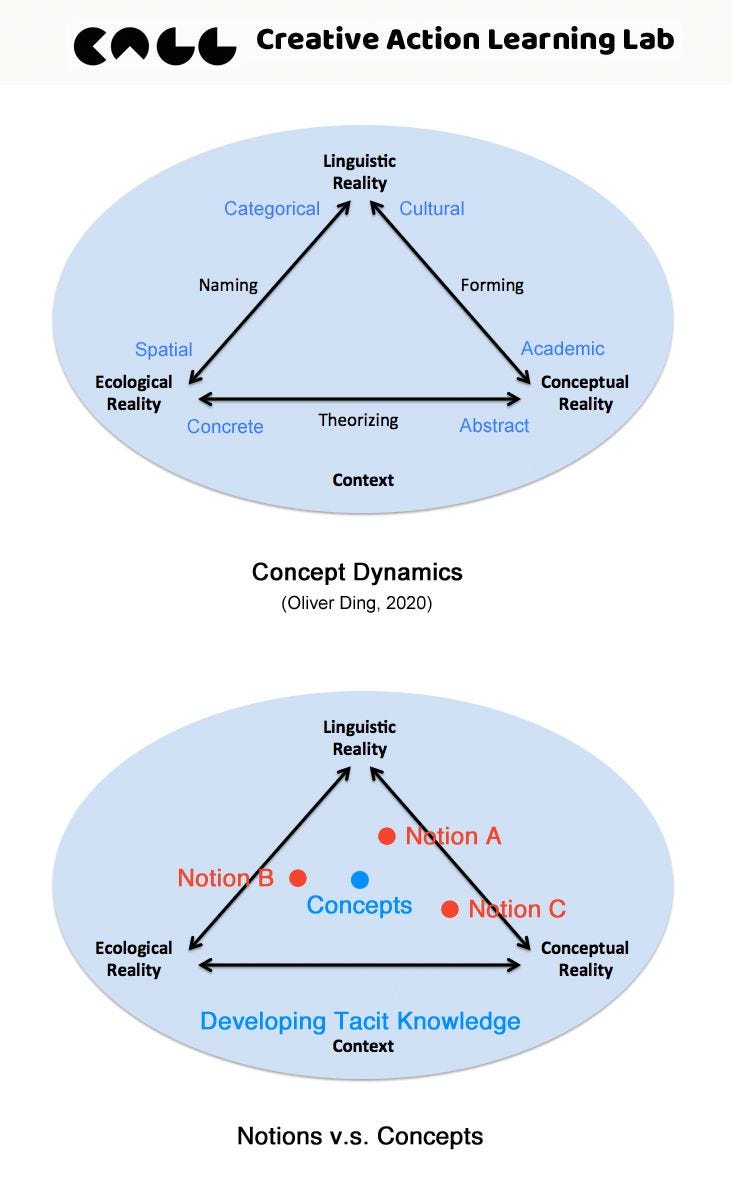
Three months ago, I made the above diagram for a Linkedin post about the following question:
What’s your perspective about the links between “notions” and “concepts”?
It was an interesting AMA(Ask Me Anything) because I didn’t pay attention to the difference between “notions” and “concepts”. The discussion inspired me to do a distinction between these two words in my daily life.
Later, I use the pairs of words “Concepts — Notions” for Knowledge Discovery Canvas. On Jan 5, 2022, I published an article titled The Notion of Thematic Spaces and introduced the Thematic Space Canvas. On March 11, 2022, I used “Knowledge Discovery Canvas” to rename the original Thematic Space Canvas because I decided to use “Thematic Space Canvas” to name a meta-canvas. You can find more details here.
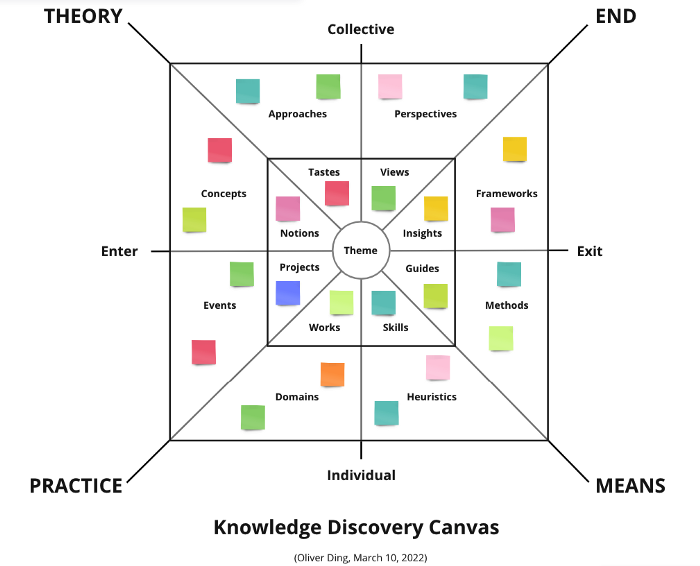
The above canvas has two nested squares which divide the thematic space into two sub-spaces: Inner Space and Outer Space. We can adopt the metaphor of the City to understand these two sub-spaces. While a city is a whole, we can clearly identify its inner space and its outer space. For Developing Tacit Knowledge, the Inner Space is all about personal knowing activities and personal thoughts while the Outer Space is related to social interactions and public knowledge resources.
There are the following eight types of mapping between Outer Space and Inner Space:
- Approaches — Tastes
- Concepts — Notions
- Events — Projects
- Domains — Works
- Perspectives — Views
- Frameworks — Insights
- Methods — Guides
- Heuristics — Skills
What do these mappings mean? You can find a case study based on my experience of Developing Tacit Knowledge about Activity Theory from the following article:
This article focuses on the “Concept — Notion” mapping. First, I will return to the discussion about the difference between “Concepts” and “Notions”. Second, I will share some cases about the difference. Third, I will share an example of the “Concepts — Notions” Mapping for the Knowledge Discovery Canvas.
Part 1: A Discussion
Three months ago, I started the #askmeanything project with the first question from Robert Ogilvie. Then I received the following question from Bülent Duagi 🇷🇴 :
What’s your perspective about the links between “notions” and “concepts”?
I published a post on Linkedin. If you want to join the discussion, you can find the original post. Below are my original answers and our discussions.
To be honest, I never thought about it. However, I really like this question.
First, I didn’t find any academic discussion about “notions” from the field of cognitive psychology and cognitive science in general. Thus, I think people use “notions” as a normal word. It’s a linguistic concept. On the contrary, scholars really like talking about “concepts” which is a major subject in the field of cognitive psychology and cognitive science.
Second, I personally use “the notion of X” as a normal phrase for my writing if I want to refer to the idea of X. For example:
In order to develop the notion of “Project as a unit of Activity” as a theoretical foundation of the new interdisciplinary theory of Activity, Blunden adopts Hegel’s logic and Vygotsky’s theory about “Unit of Analysis” and “Concept” as theoretical resources. The process is documented in four books: An Interdisciplinary Theory of Activity (2010), Concepts: A Critical Approach (2012), Collaborative Projects: An Interdisciplinary Study (2014), and Hegel for Social Movements (2019).
https://lnkd.in/e4bAebC (Source: an introduction to my book Project-oriented Activity Theory)
Here the X refers to “Project as a unit of Activity”.
If the X is hard to use one word or two words to describe, I’d like to use the above format for writing.
I also quoted some words from Andy Blunden in the same article. For example:
He says, “The rich context of the notion of collaboration also brings to light more complex relationships. The notions of hierarchy, command, division of labor, cooperation, exchange, service, attribution, exploitation, dependence, solidarity, and more can all be studied in the context of just two individuals working together in a common project. And yet almost all the mysteries of social science as well as a good part of psychology are contained in this archetypal unit: two people working together in a common project.” (2010, p.315)
Here the X refers to a concept (“collaboration”) or a group of concepts (“hierarchy, command, division of labor, cooperation, exchange, service, attribution, exploitation, dependence, solidarity, and more…”).
From the linguistic perspective, it seems that “notions” are more flexible than “concepts” because we can use “notions” to refer to more things than “concepts”.
Third, from the perspective of Developing Tacit Knowledge, I think we can develop the concept of “notions” as a useful concept for discussing knowledge curation and knowledge development since both “notions” and “concepts” are Conceptual Tacit Knowledge.
For further discussion. I’d like to use my framework Concept Dynamics.
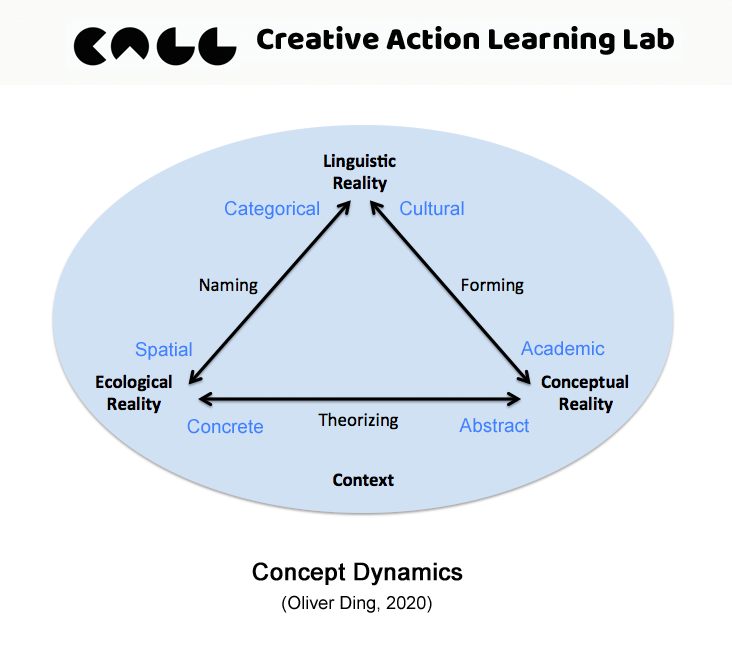
In order to discuss the complexity of the theoretical concepts, I created the above diagram which suggests every theoretical concept has three basic aspects: ecological reality, conceptual reality, and linguistic reality.
- Ecological reality refers to the real experience of discovery in the real world from the perspective of researchers.
- Conceptual reality refers to the outcome of the creative conceptualization process.
- Linguistic reality refers to expressional form with verbal and rhetorical effects.
Based on the framework, I believe that an ideal theoretical concept should not have intrinsic contradictions between these three aspects and extrinsic contradictions between these aspects and context which means the dynamic background of the concept. Thus, it is hard work to create an ideal theoretical concept. The harder work is detaching an existing concept from its original context and attaching it to a new context by reconceptualizing it with new meaning.
Now we can use the framework for discussing notions and concepts.
The above diagram shows the difference between Ideal Knowledge Concepts and Real World Notions.
- Ideal Knowledge Concepts: it is placed at the center which means a perfect match of three aspects.
- Real World Notions: It might appear at different places on the map.
Notion A: high linguistic reality, middle conceptual reality, and low ecological reality.
Notion B: middle linguistic reality, middle ecological reality, and low conceptual reality.
Notion C: high conceptual reality, low linguistic reality, and low ecological reality.
So, one strategy for developing tacit knowledge is turning Real World Notions into Ideal Knowledge Concepts.
Bülent Duagi 🇷🇴 responded to the above discussion with the following comment:
Intriguing conclusions, thanks Oliver!
Will have to reflect on this — the way I was linking “notions” with “concepts” was that “notions” are terms specific to various disciplines or fields (e.g. perception is a psychology notion, span of control is an org design notion, inflation is an economy notion, strategic intent is a strategy notion and so on), while “concepts” are the generic ‘cousins’ of “notions”, in the sense that “concepts” are not bounded by disciplines in any way. And usually you get to “concepts” when you synthesize multiple “notions” from various disciplines or fields (understanding underlying patterns that might connect the “notions”) to get to a more generic & versatile conceptual unit (“concept” as essence or distillation). Does this perspective link to yours now?
I replied to his comment with the following ideas:
This is an interesting topic since it is about interdisciplinary thinking. It’s fine to use words in any way if the audience understands the context. I think interdisciplinary thinking is very new for most people. Scholars have not done the job yet, so we don’t have existing terms for this purpose.
…And usually you get to ‘concepts’ when you synthesize multiple ‘notions’ from various disciplines or fields…
I did similar work for the Model of Knowledge Curation. I use a new term “Conceptual Spaces” to describe a similar notion :)
For example, The “Activity” conceptual space connects my work experience in various domains and my learning of Activity Theory and Social Practice Theories in general.
So, there are many ways to understand the meaning of “Activity”.
- For me, I have learned Activity Theory. If I consider “Activity” as a theoretical concept, then it refers to the notion from Activity Theory.
- If I look at the Medium mobile app and check the “Activity” page, then it refers to notifications.
- If I use [the “Activity” conceptual space], then it refers to the conceptual space which covers Activity Theory and other Social Practice Theories. It means human activities and social practice in general.
It all depends on the context. If we want to jump out of the level of language and move to the level of knowledge development, then we should consider any term with its context. A term has a particular value only if it belongs to a particular context.
For example, the notion of Conceptual Spaces is inspired by Peter Gardenfors’ 2004 book Conceptual Space: The Geometry of Thought. However, I roughly use it to describe large cognitive containers for curating similar theoretical approaches together for the Model of Knowledge Curation.
The Model of Knowledge Curation defines six types of objects of curating and offers a framework for understanding their relationship. So, the notion of Conceptual Spaces has its unique meaning in the framework. This week I am thinking if I can use “Thematic Spaces” as a new name to replace “Conceptual Spaces” since I am not adopting Peter Gardenfors’ theory for my framework
Update: I officially decided to use “Thematic Space” for my work about Knowledge Curation and other projects on Jan 5, 2022.
This topic is related to epistemic cognition. You can find more details about it here:
Some scholars have developed useful frameworks with special terms. For example, Andrea Disessa uses the following terms for his “Conceptual Ecology” framework:
- p-prims
- nominal facts
- narratives
- mental models
- coordination classes
Part 2: More Cases
Since this is a very attractive topic, I collected more cases about “notions” after the discussion. For example, I found the following two examples from the 2022 book Controversy Mapping: A Field Guide (Tommaso Venturini & Anders Kristian Munk).
2.1 The Notion of “Actants”
The book introduces a hybrid approach to research controversy. The authors adopt a social theory called ANT (Actor-network theory) and Digital Methods such as social network analysis. The following pieces are about ANT (2022, pp.121–122):
- Besides the general tendency to rely on an internalist and relational explanations, ANT derives two specific techniques from semiotics and particularly from the narrative theory developed by Algirdas Greimas. This theory resonates with ANT and its focus on action as the elementary ingredient to describe “the syntactic form of the organization of the world” (Greimasm, 1989, p.543).
- Generalizing the system introduced by Russian narratologist Vladimir Propp (1968) to catalogue folktales, Greimas (1989) defined the elements of any text according to what they do rather than what they are. A classic feature of traditional tales is indeed that their protagonists are not only humans, but also animals, spirits, and animated objects. Anything that acts is a character in its own right and it can fill a role in the story in the same way in which a human being would (a magic ring can cast spells like a magician, a magic sword can fight like an army of soldiers).
- Extending this idea to all types of texts, Greimas introduced the notion of “actants,” defined as anything that “accomplish tasks, undergo tests, reach goals” (Ricoeur, 1989, p.588). The openness of the notion of “actant” struck a chord in ANT, to which it offered a way to identify the ingredients of sociotechnical networks without having to bother whether they were human beings (e.g., scientists and engineers), natural elements (e.g., microbes, stars, molecules), objects (e.g., laboratory tools, technological artefacts) or something else.
Though the authors of the book use “notion” for “Actants”, we can consider it as a theoretical concept for ANT because it is the core of the theoretical approach.
2.2: The Notion of “Cartography”
The following piece is quoted from an interview with Bruno Latour (2022, p.285).
Bruno Latour (BL):The Adventure of controversy mapping started about 30 years ago. At the time, we had a very specific problem: to teach science studies to the engineering students of the Ecole des Mines without triggering all sorts of odd reactions…
…Finally, the notion of cartography came from the work that Michel Callon was doing on co-word analysis and scientometrics at the Centre de Sociologic de l’Innovation (CSI) at the Ecole des Mines. In fact, the actors of the early Web were themselves experimenting with this type of analysis (th old AltaVista system). So, we just grabbed all those cartographic metaphors. I’m not sure it was the best idea, but it did stick.
The method of Controversy Mapping is inspired by cartography. Michel Callon had the idea of applying a method that is similar to cartography for their project. The notion of cartography refers to a metaphor.
Part 3: The “Concepts— Notions” Mapping
I also designed an OS card for Knowledge Discovery Activty. The name “OS” stands for Objective — Subjective. For example, the picture below is an OS card for the “Concepts — Notions” mapping.
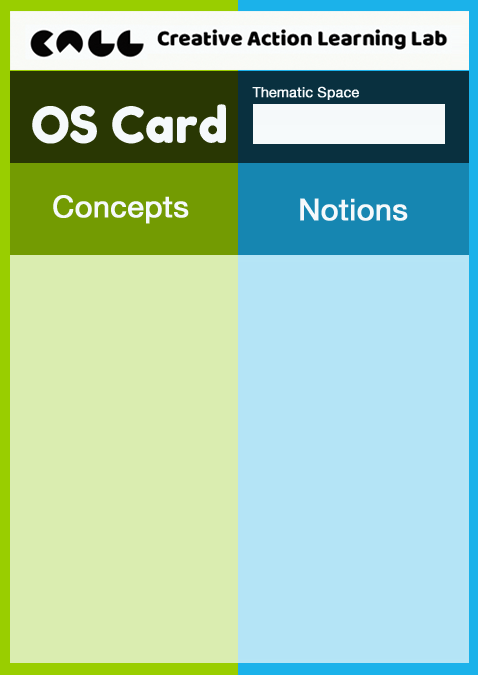
Each OS Card only records one mapping clue. The picture below is an example of a mapping clue.
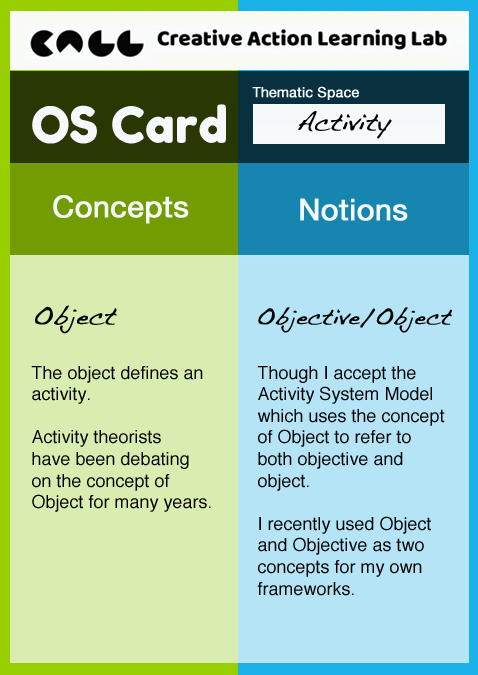
A mapping clue is a connection between a fact inside the outer space and a fact inside the inner space. The connection could be strong or weak. The above example “Object — Objective/Object” is a really strong connection.
3.1 The Concept of “Object”
The concept of “Object” is the foundational concept of Activity Theory. According to the founder of Activity Theory A. N. Leontiev, “Separate concrete types of activity may differ among themselves according to various characteristics: according to their form, according to the methods of carrying them out, according to their emotional intensity, according to their time and space requirements, according to their physiological mechanisms, etc. The main thing that distinguishes one activity from another, however, is the difference of their objects. It is exactly the object of an activity that gives it a determined direction.” (1978, p.98)
So, what’s the object of activity?
The answer from Leontiev is the motive of activity. Leontiev claimed, “According to the terminology I have proposed, the object of an activity is its true motive. It is understood that the motive may be either material or ideal, either present in perception or exclusively in the imagination or in thought. The main thing is that behind activity there should always be a need, that it should always answer one need or another.” He also added a note about the term motive, “Such restricted understanding of motive as that object (material or ideal) that evokes and directs activity toward itself differs from the generally accepted understanding”.(1978, p.98)
The Object-orientedness principle is similar to other theories’ terms such as “needs”, “intentionality” or “intention”. According to Kaptelinin and Nardi (2012), “…all human activities are directed toward their objects and differentiated from one another by their respective objects. Objects motivate and direct activities, around them activities are coordinated, and in them activities are crystallized when the activities are complete.” (p.29)
However, the concept of Object has a different meaning in the Activity System Model which was developed by Yrjö Engeström with the above triangle diagram. According to Kaptelinin and Nardi (2006), “For Leontiev, the object (predmet) of activity is an object of activities carried out by individuals, either collectively or individually, and is related to motivation. For Engeström, the object, introduced through the ‘subject — object’ distinction — that is, as objekt — is the object of collective activities. The object is defined as ‘the raw material’ or ‘problem space’ at which the activity is directed and which is molded and transformed into outcome…’ ” (2006, p.142–143)
Here we face two issues. The first one is the language issue. According to Kaptelinin and Nardi (2012), “In Russian there are two words with similar but distinct meanings: objekt and predmet. Both refer to objectively existing entities, but the notion of predmet typically also implies a relevance of the entity in question to certain human purposes or interests…Leontiev deliberately referred to the object of activity as predmet rather than object. However, this distinction is usually lost in English translation since both words are translated as ‘object.’ ” (p.29) The second one is the theoretical issue. Leontive and Engeström offer two theoretical accounts of human activities. One is about psychology while the other is about organizational change.
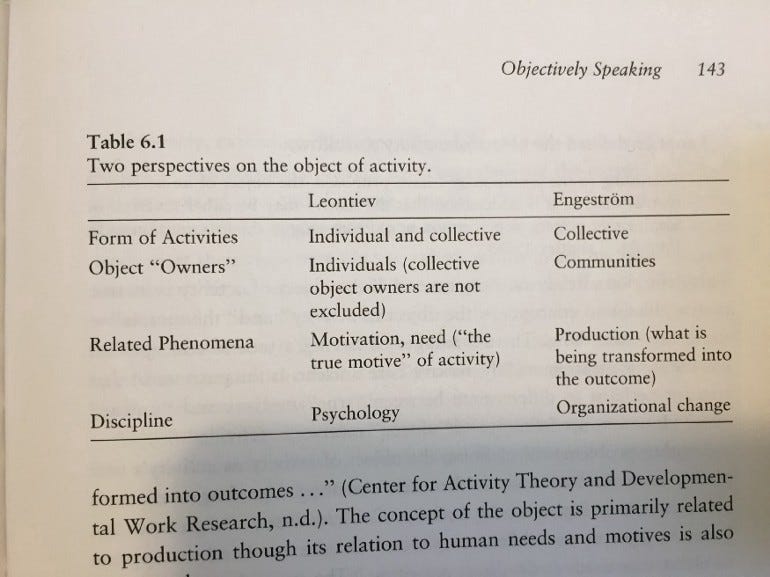
As organizational scholar Frank Blacker (2009) claimed, “For newcomers to activity theory, the notion of the object of activity is unfamiliar and may not be easy to understand. Indeed, the term is complex; objects of activity need to be understood as simultaneously given, socially constructed, contested, and emergent.” He also pointed out, “The complexity of the term should not be thought of as a shortcoming of activity theory, however. Rather, it both reflects and reveals the complexity of human activity. ”
Some North American scholars use a special format to use the concept of objective: object(ive). For example, David Russell use the following sentences to describe Activity Theory in a paper titled Activity Theory and Its Implications for Writing Instruction, “I use the term object(ive) because it refers not only to persons or objects in a passive state (what is acted on) but also to the goal of an intentional activity, an objective, although the objective may be envisioned differently by different participants in the activity system.”
3.2 The Notion of “Object/Objective”
In the past several months, I worked on a project called iART framework which led to a new framework called Anticipatory Activity System. The core of these two frameworks is the diagram below:
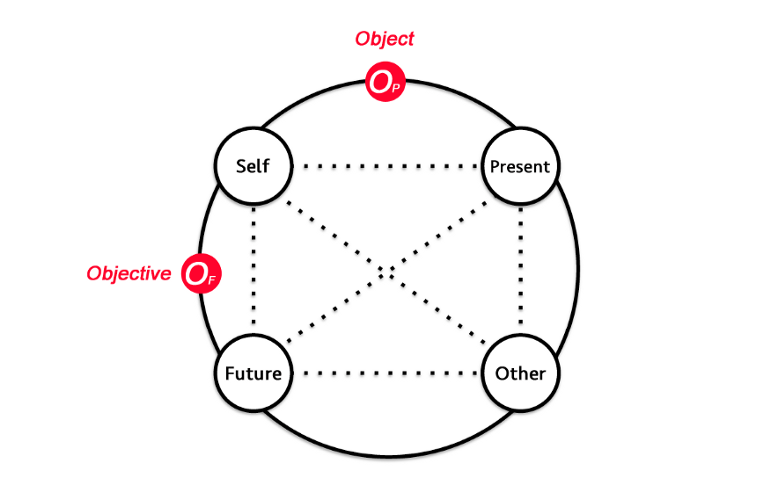
The iART framework focuses on “Self, Other, Present, Future” which considers the Complexity of Anticipation of Performance with a Shared Activity. For example, an investor and a founder share the activity of a startup. In fact, my original inspiration came from an adult life development program that adopted a peer-support approach and the OKRs method to build a supportive environment.
I also made the diagram below for concrete discussions. Since the phenomenon is about anticipation, I adopted Robert Rosen’s Anticipatory Systems theory as a theoretical resource for the iART framework.
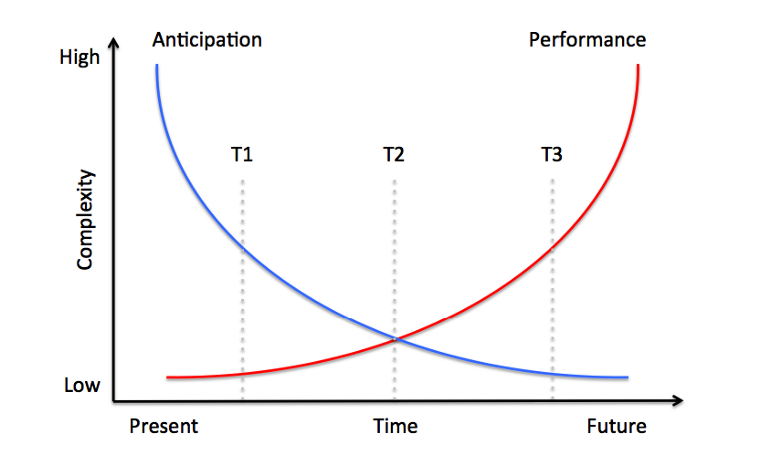
Eventually, I did a theoretical curation and produced a new framework called Anticipatory Activity System. During the process, I realized that I have to use two concepts for my frameworks.
From the perspective of the iART framework, it’s clear that we have to use two terms because Objective (what is motive about) is about Future while Object (what is acted on) is about Present. Moreover, for the iART framework, Objective is related to Anticipation while Object is related to Performance.
If you want to know more details, you can read the following two articles:
- Activity U (V): Typology of Activities and Other Practical Tools
- D as Diagramming: Strategy as Anticipatory Activity System
The first article offers a typology of activities. The typology is based on the concept of Object. The second article is about the Anticipatory Activity System. You can compare these two ways of using the concept of object, then you can have your own notion about the concept.
You are most welcome to connect via the following social platforms:
Linkedin: https://www.linkedin.com/in/oliverding Twitter: https://twitter.com/oliverding Polywork: https://www.polywork.com/oliverding Boardle: https://www.boardle.io/users/oliver-ding


