
Curativity Theory and The Ecological Practice Approach (v2, 2020)
A brief of Curativity Theory and the Ecological Practice Approach (v2, 2020)
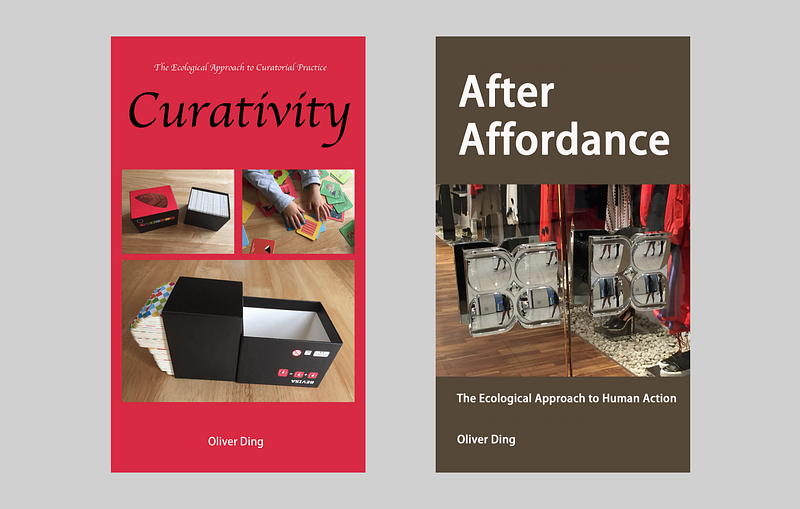
From Sept 2018 to March 2019, I wrote a book titled Curativity: The Ecological Approach to Curatorial Practice in order to reflect on one of my life themes: Curation. During the process of writing, I developed a new theoretical approach called the Ecological Practice Approach which aims to build an Affordance-based theory of action and apply ideas of ecological psychology for analyzing various social practices.
After March 2019, I continuously worked on revising Curativity and developing the Ecological Practice Approach as a new project. In July 2020, I wrote another book titled After Affordance: The Ecological Approach to Human Action in which I proposed several new theoretical ideas for expanding ecological psychology to the modern digital environment.
Both two books were written in Chinese. In fact, they are still unpublished drafts. Curativity is a 615-page Google Doc file while After Affordance is a 372-page file.
This article aims to introduce the Ecological Practice approach which is a set of theoretical concepts (see the diagram below). Originally, I called it the Gibson — Lakoff — Schön approach. Later, I realized it can be seen as a new approach to practice studies. Thus, I renamed it the Ecological Practice approach.
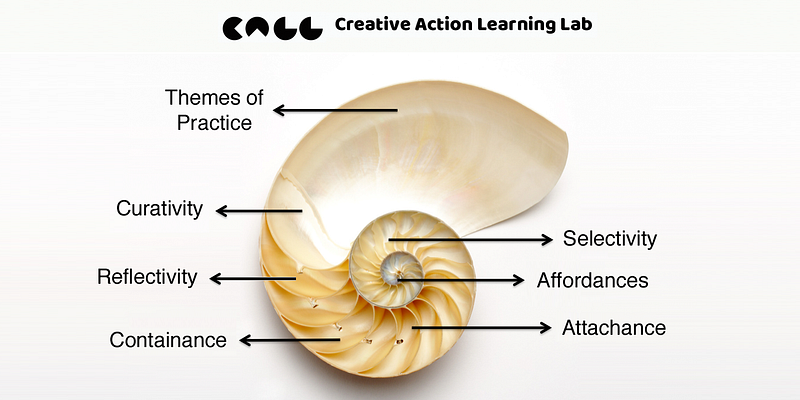
In a broad sense, the Ecological Practice approach has its philosophical roots in traditional Pragmatism and contemporary embodied cognitive science. Inspired by practice studies theorist Davide Nicolini (2013)’s “tool-kit approach” which curates various concepts from different theoretical accounts based on a family relationship, allowing a network of dissimilarities and similarities, I consider the Ecological Practice approach a toolkit.
The following sections will introduce the core theoretical concepts of the Ecological Practice approach. Since the approach was born from the process of writing Curativity, I shall tell the story of Curativity too.
This article was written in 2020. Later, I developed a new version of the Ecological Practice Approach (v3) in 2021. You can find more details in The Development of Ecological Practice Approach.
Contents
PART 1: Background
1.1 Curativity: From Pieces to Whole 1.2 The Transactional Worldview
PART 2: Concepts
2.1 Double Affordances 2.2 Nested Containers 2.3 Double Selectivity 2.4 Double Reflections 2.5 Affordances, Selectivity, and Reflectivity 2.6 Whole-in-Environment 2.7 Attach and Detach 2.8 Themes of Practice 2.9 Curativity, Self-reference, and Dialectical Hierarchy
PART 3: Toolkit
3.1 A Loose Coupling Toolkit 3.2 The Germ Cell of Ecological Practice Approach 3.3 The Field of Ecological Practice Approach 3.4 The Landscape of Ecological Practice Approach
PART 4: Future
4.1 An Interdisciplinary Approach for Practice Studies 4.2 Connect Visual Perceiving and Conceptual Thinking 4.3 Reconsider Ecological Physics 4.4 An Approach to Ecological Complexity 4.5 Complexity, Creativity, and Competence 4.6 From Existing Practice to Possible Practice
PART 1: Background
I have been working in the curation field for over ten years. I was the Chief Information Architect of BagTheWeb which was an early tool for content curation (We launched the site in 2010). This experience inspired me to make a long-term commitment to the Curation theme. After having 10 years of various curation-related practical work experience and theory learning, I coined a term called Curativity and developed Curativity Theory which became a book.
1.1 Curativity: From Pieces to Whole
The new term Curativity refers to “curating pieces into a meaningful whole” which means general curatorial practice. The reason why I coined the term is I was not satisfied with the specific view of curation such as “professional curation means art and museum.” I argued that there is a need to redefine “curatorial practice” as a general social activity and a universal experience. In other words, I was calling for an interdisciplinary view of curation or curatorial practice.
In order to avoid unnecessary debates on the concept of curation or curatorial practice, I coined the term Curativity to refer to my argument. Thus, Curativity is an ontological level invention. It points to a new space for knowing and understanding.
In philosophy and mathematical logic, researchers use “mereology” to describe the study of parts and wholes. Though I am also talking about the relationship between the pieces and the whole, what I want to explore is not mereology. My objective is “curating pieces into a meaningful whole” which refers to action, experience, and value. In other words, I care about the practice and activity of curating, not the abstract thinking about parts and whole.
Curativity Theory — originally called Ecological Curativity Theory — is an epistemological tool for knowing and understanding Curativity.
Curativity Theory adopts James Gibson’s “Affordance”, George Lakoff’s “Container” and Donald Schön’s “Reflection” as epistemological tools. The diagram below shows the basic elements of Curativity: Pieces — Container — Whole. The basic assumption behind the diagram and the new term is: “In order to effectively curate pieces into a meaningful whole, we need Containers to contain pieces and shape them.”
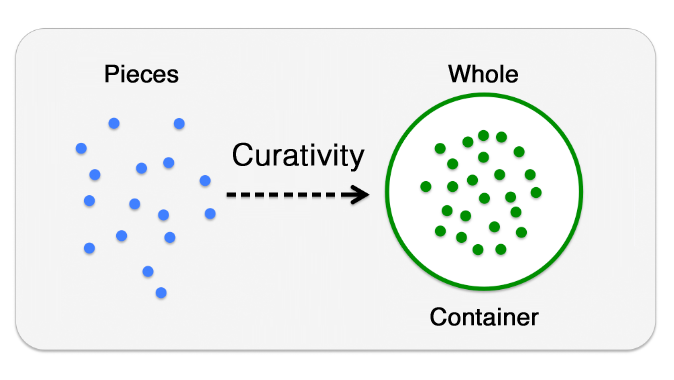
Pieces, containers, and Whole together form a triad which is the basic unit of analysis of Curativity Theory. Also, this unit of analysis establishes a new theoretical category at the ontological level. The concept of Curativity indicates three statuses of things:
- Things-in-Pieces
- Things-in-Container
- Things-in-Whole
Thus, Curativity Theory is all about understanding the structure and dynamics of these three statuses.
1.2 The Transactional Worldview
Curativity Theory adopted the transactionalism worldview as the theoretical foundation.
In 1942, Stephen C. Pepper pointed out that there are four root metaphors of world views or conceptual systems: formism, mechanism, contextualism, and organicism in World Hypotheses: a study of evidence. In 1987, Altman and Rogoff reviewed the world views of psychologists and suggested a similar typology: trait, interactional, organismic, and transactionalism.
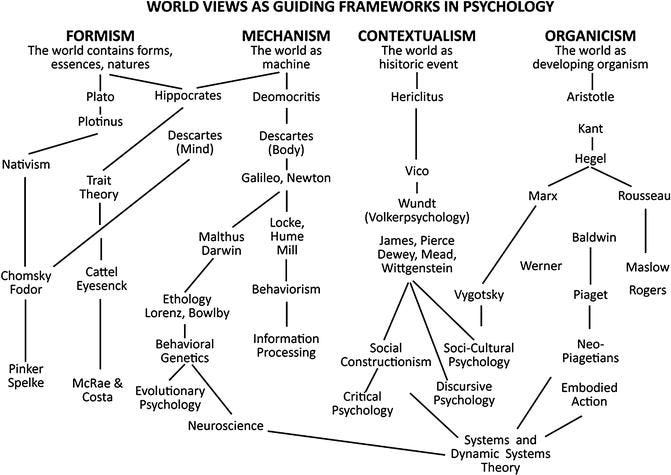
According to Harry Heft (2012), the foundation of various ecological approaches to psychology is transactionalism, “Frameworks more sympathetic to ecological thinking had been simmering among psychology’s early writings, notably in William James’ radical empiricism and Kurt Lewin’s field theory, but became realized only in the 1960s through the works of James J. Gibson, Roger G. Barker, and others. These frameworks share many of the assumptions of the ecological sciences and, collectively, can be located within a transactional worldview.”
The major difference between the interactional worldview and the transactionalism worldview is their unit of analysis.
- Interactional worldview: The unit of analysis is the individual viewed as a bounded, independent entity, operating separately from the surrounding, while subject to influences from outside its boundaries.
- Transactionalism worldview: The unit of analysis is the person-environment dynamic system. The components of this system operate in a relational, interdependent manner, rather than as independent entities.
Curativity Theory claims that the Pieces-Container-Whole triad is its unit of analysis. Without the Container, there are only Pieces. Without the Pieces, the Container doesn’t make sense. Without the Whole, the curating activity is not needed. Thus, these three components and three statuses are inseparate.
PART 2: Concepts
Though Curativity Theory adopts James Gibson’s “Affordance”, George Lakoff’s “Container” and Donald Schön’s “Reflection” as epistemological tools, I also developed my own concepts in order to solve some issues. These concepts comprise a new approach to discussing Curativity. Originally, I called it the Gibson — Lakoff — Schön approach. Later, I realized this approach can be seen as a new approach for practice studies. Thus, I renamed it the Ecological Practice approach.
2.1 Double Affordances
At the epistemological level, I adopted ecological psychologist James J. Gibson’s ecological approach as a tool for developing Curativity theory. One of the core ideas of Gibson’s approach is Affordances.
What’s Affordance? Let’s have a look at the original definition made by Gibson, “The affordances of the environment are what it offers the animal, what it provides or furnishes, either for good or ill. The verb to afford is found in the dictionary, but the noun affordance is not. I have made it up. I mean by it something that refers to both the environment and the animal in a way that no existing term does. It implies the complementarity of the animal and the environment.” (1979, p.119)
The affordance concept describes the possibilities for action that the environment including objects and other people offer for a particular person. The theory is complex, according to ecological psychologist Edward S. Reed (1996), there are two ways of using the concept of affordances: concrete analysis of affordanceS and abstract analysis of affordances. The former shows “how particular environment properties can promote a particular species’ habits of life (e.g., how this kind of terrain does or does not support human locomotion).” while the latter shows “these particular relationships between an organism and its habit are instances of ecological regularities or laws.”(p.40)
I adopted both two ways of affordance analysis for Curativity Theory. At the epistemological level, I used the abstract way. At the methodological level, I used the concept way. Curativity Theory claims that double affordances are its starting point.
- Pieces: things-in-pieces afford putting them into containers.
- Container: container affords containing things-in-pieces.

The above picture shows an example of double affordances. The shopping cart is a container, it affords containing various products which afford putting into the shopping cart.
2.2 Nested Containers
The concept of Container is inspired by George Lakoff and Mark Johnson’s conceptual metaphor Container and image schema Containment.
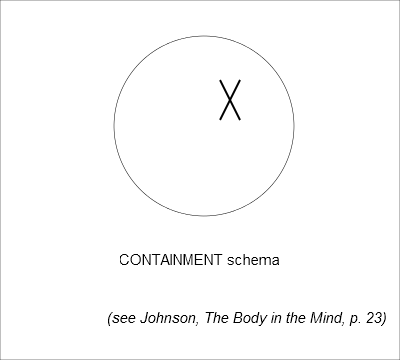
According to Mark Johnson (1987), “If we look for common structure in our many experiences of being in something, or for locating something within another thing, we find recurring organization of structures: the experiential basis for in-out orientation is that of spatial boundedness. The most experientially salient sense of boundedness seems to be that of three-dimensional containment (i.e., being limited or held within some three-dimensional enclosure, such as a womb, a crib, or a room).” He also pointed out there are at least five important entailments or consequences of these recurring experiential image-schematic structures for in-out orientation. (pp.21–22)
Why did I adopt the conceptual metaphor Container and image schema Containment since I already have the affordance of container? Because Gibson’s affordance is only suitable for physical things. For abstract non-physical things, I can use conceptual metaphor Container and image schema Containment.
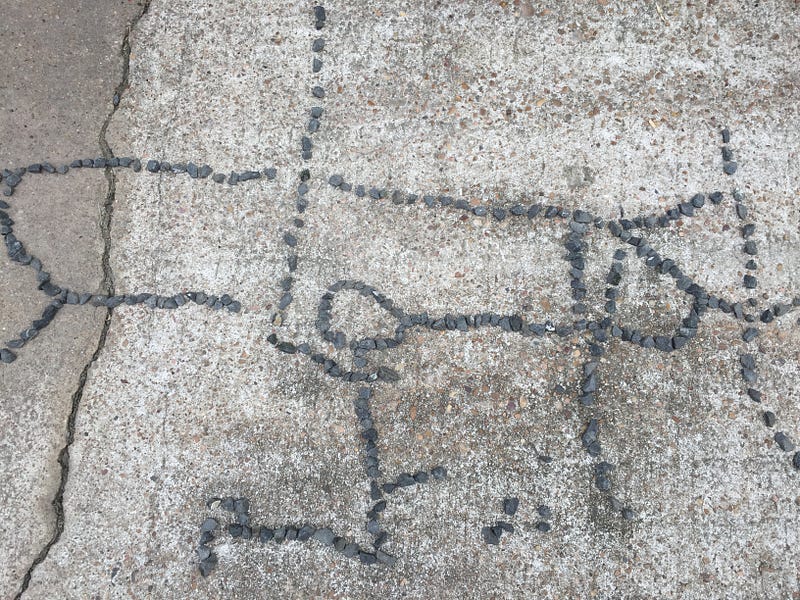
Moreover, physical containers and non-physical containers can work together in order to explain complex curating activities. For example, the picture below shows a scene of playing. Two months ago, my two sons played a rock game outdoors. From the perspective of Curativity Theory, there are three containers, 1) the land, 2) the rock-man picture, and 3) the game.
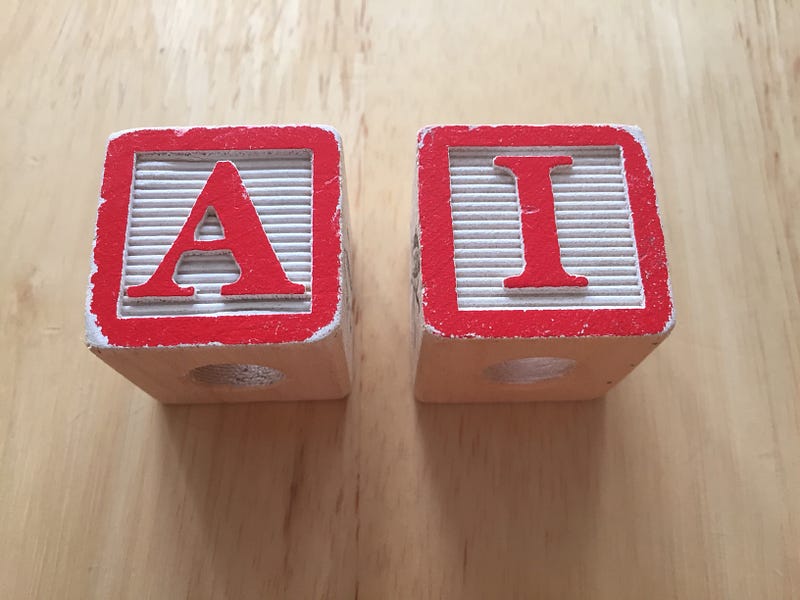
Another example is the picture below which shows two wood blocks. Here we see two containers, one is the desktop which is a physical container and another is the word “AI” which is a linguistic container.
The concept of Nested Containers expands the scope of Curativity Theory from the physical level to non-physical levels.
2.3 Double Selectivity
According to Harry Heft, the theoretical root of Gibson’s ecological psychology is William James’ Radical Empiricism. Inspired by Heft, I adopted the concept of Selectivity from Radical Empiricism.
Heft (2012) pointed out, “…in radical empiricism, knowing refers most fundamentally to a functional relation in experience between a knower and an object known. The defining characteristic of knowing is selectivity. Through knowing processes, structure is selected out of, or differentiated from, immediate experience. It is now time to consider the products of selective processes. To use James’s terminology, two products of the selectivity of knowing processes are percepts and concepts.”(p.37)
Curativity Theory claimed that double selectivity is the foundation of curating.
- The Selectivity of Perceiving
- The Selectivity of Thinking
According to Heft, “Perceiving is an action that entails selection of a flow of immediate experience out of the potential ground that is pure experience. Thinking or conceiving entails, in turn, selecting and fixing particular parts of this perceptual flow. Through this process, concepts are carved out of immediate perceptual experience at a remove from action and are abstracted from it. Abstracting from the immediate flow of experience makes it possible for the knower to isolate, and then to classify or otherwise manipulate, these extracted ‘moments.’ This cognitive capability enlarges the knower’s epistemic potential in incalculable ways. ” (pp.39–40)
For Curativity Theory, the orientation of selection is turning pieces into a meaningful whole. It requires perceiving and thinking of something as a container for things-in-pieces.
2.4 Double Reflections
I also adopted Donald Schön’s “Reflection” for Curativity theory. Schön expanded John Dewey’s “Reflection” to double reflections:
- Reflecting-in-action
- Reflecting-in-practice
Schön used reflecting-in-action for immediate situations while reflecting-in-practice refers to cross-situation activities.
Curativity Theory claims that reflecting-in-curating can happen at both the action level and the practice level.

For example, saving is a typical curating activity. Reflecting-in-curating can happen at both the action level (putting one coin into the piggy bank) and the practice level (saving).
2.5 Affordances, Selectivity, and Reflectivity
The cover of Curativity shows a story of playing cards. This story is a great example of affordances, selectivity, and reflectivity. Two years ago, my son came to my office and I gave him IKEA Bevisa memory cards.
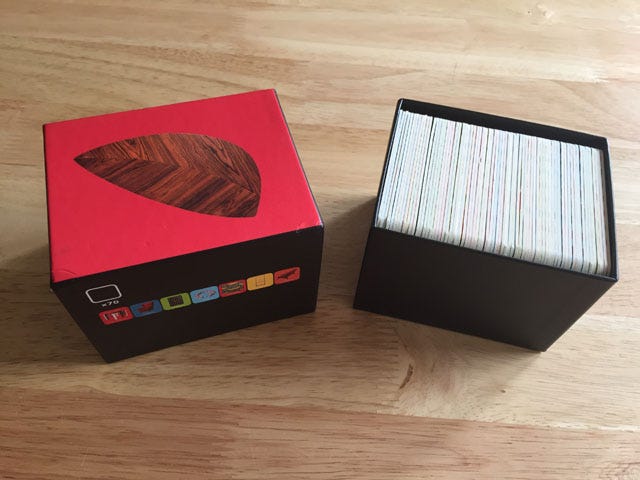
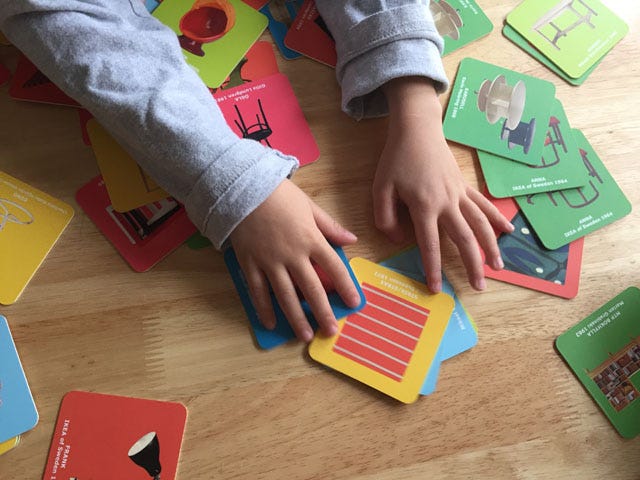
Usually, people play the memory card for training memory. You turn over any two cards. If the two cards match, then keep them. If they don’t match, turn them back over. If you can remember what was on each card and where it was, you can quickly match many cards and win the game. However, what my son played is not the normal way. He just randomly played these cards as “cards” instead of “memory cards” and turned them into a “truck”.
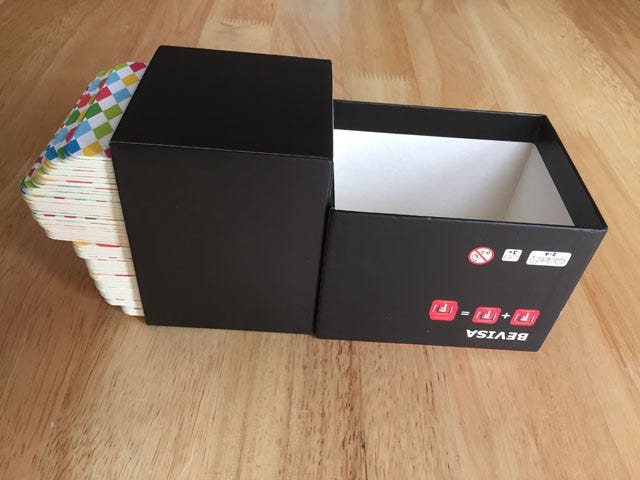
From the perspective of Curativity Theory, this story shows three core concepts for understanding Curativity.
- Affordances: Affordance is potential and Action is real, thus, there is a transformational process between affordance and action, ecological psychologists call this process Actualization of Affordances. The side of these cards offers an affordance for shaping, my son actualized this affordance and surprised me. He didn’t know the term affordance but the theory exactly explained his behavior.
- Selectivity: Since the environment offers so many affordances, any person has to pick up one or some of affordances from many affordances and actualize them in a particular situation. My son picked the affordance for shaping offered by the side of these cards. This is the Selectivity of Perceiving. Affordances are about perceiving, not thinking.
- Reflectivity: When I saw the “truck” my son built, I realized this is a great case of Affordance theory and Curativity Theory. Thus, I took pictures to record this case. At that moment, I did Reflecting-in-action on a particular situation. Later, I often did Reflecting-in-practice during the process of writing Curativity: The Ecological Approach to Curatorial Practice. I also used these pictures to design the cover for the book.
The “truck” is a new whole of these memory cards. This example also pointed out the relationship between Curativity and Creativity. In studying creative actions, we pay attention to what kind of affordances can lead to “Novelty” and “Surprise”. Some types of Whole are novel, and other types of Whole are normal. Curativity theory covers both novel types of whole and normal types of Whole.
The limit of this example is it only talks about Selectivity of Perceiving. As I mentioned above, Curativity Theory also considers Selectivity of Thinking which goes beyond the scope of Gibson’s ecological (perception) psychology. Gibson once mentioned, “Knowing is an extension of perceiving.” However, Gibson didn’t have enough time to develop a complete theory of “extension of perceiving.” Curativity Theory aims to provide a brick for building the house of “extension of perceiving” by incorporating William James’ Selectivity and Donald Schön’s Reflectivity.
2.6 Whole-in-Environment
Curativity Theory claims that there are many ways of perceiving and thinking of the Whole in the real world. For example, a typical normal routine practice can be a container for shaping a whole.
Two years ago, I went to Discount Tire to repair tires. I observed their routine work process and found there was a transparent plastic bag that contained my car key and the bill of my case (see the picture below).
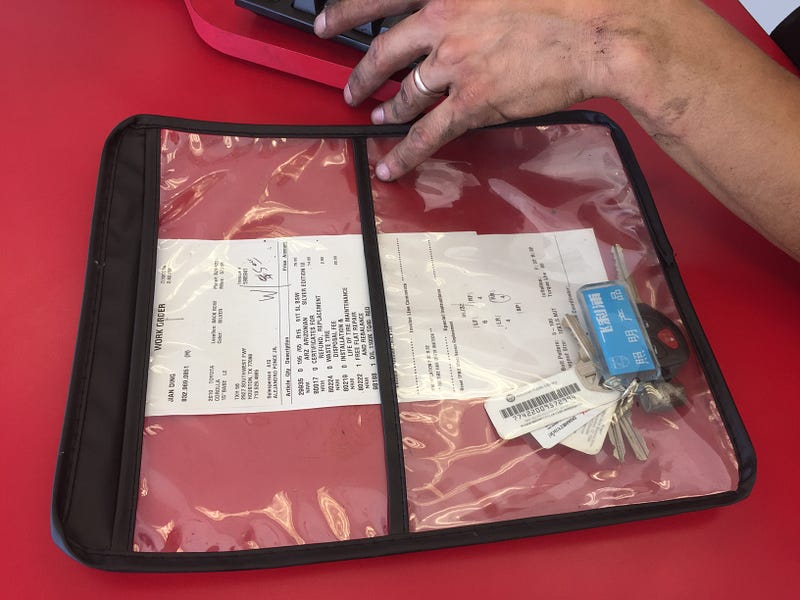
My car key and the bill of my case are two things-in-pieces. They connected together through a theme of practice: repairing tires. The company finds a simple way to make a container for containing these two things-in-pieces as a whole for their workflow.
As a normal container, the transparent plastic bag doesn’t make these two things-in-pieces as a whole. In fact, the whole is defined by the routine practice of repairing tires. The bag-in-use provides a material function that turns the whole-in-mind into the whole-in-environment.
2.7 Attach and Detach
In order to understand the structure and dynamics of the Piece-to-Piece relationship and the Piece-to-Container relationship, I combined “Attach” and “Chance” together and coined a new term “Attachance” as a core concept of Curativity Theory.
For Curativity Theory, the concept of Attachance means two types of events. One is Piece-to-Container, and another is Piece-to-Piece.

The term Attachance was inspired by Gibson’s writing about the relationship between people and environments, “When in use, a tool is a sort of extension of the hand, almost an attachment to it or a part of the user’s own body, and thus is no longer a part of the environment, graspable and portable, to be sure, but nevertheless external to the observer. This capacity to attach something to the body suggests that the boundary between the animal and the environment is not fixed at the surface of the skin but can shift. More generally it suggests that the absolute duality of ‘objective’ and ‘subjective’ is false. When we consider the affordances of things, we escape this philosophical dichotomy (1979, p.35)”
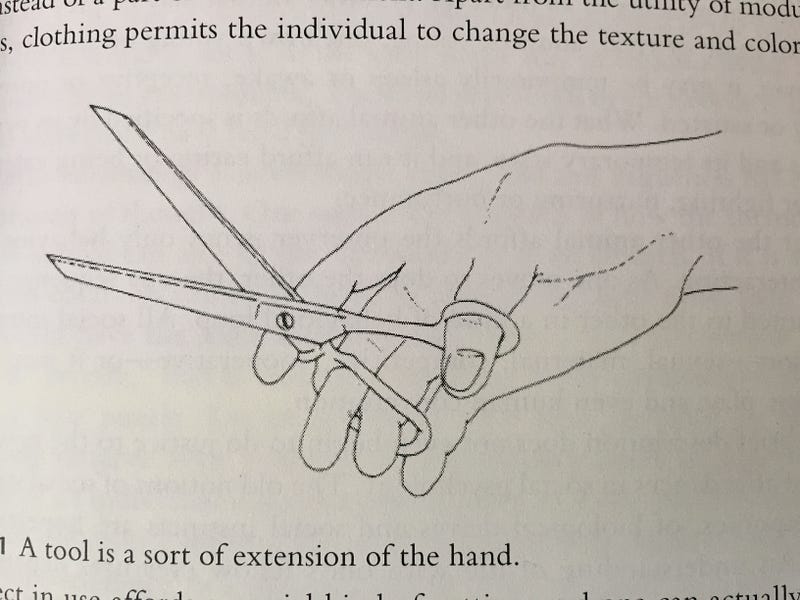
Gibson’s idea is not alone. The classic example of the blind man’s stick (Merleau-Ponty 1962; Polanyi 1962; Bateson 1973) described the same viewpoint. Gregory Bateson asked the below question in 1973: “Consider a blind man with a stick. Where does the blind man’s self begin? At the tip of the stick? At the handle of the stick? Or at some point halfway up the stick?” Merleau-Ponty, Bateson, and Gibson, seeded a great tree about the human mind. Today we see their ideas are driving the emergent embodied cognitive science.
Gibson didn’t develop a theory about “attach” and “detach”. He used terms such as “attached object” and “detach object”. For Gibson, an attached object refers to a layout of surfaces less than completely surrounded by the medium, and a detached object refers to a layout of surfaces completely surrounded by the medium. This piece is complex because Gibson used his own terms such as Medium, Substance, and Surfaces to describe the meaningful environment.
Gibson focused on the human body and environment, he considered objects and tools as environments too. His theory is body scale analysis. The Attachance concept I am working on goes beyond the body, I want to expand it to multi-level scales. In fact, this is the primary theme of After Affordance: The Ecological Approach to Human Action.
2.8 Themes of Practice
The whole can be whole-in-mind, whole-in-environment, whole-in-artifacts, and whole-in-activities. Curativity Theory developed a new concept called Themes of Practice as a tool for discussing the “meaning” of the meaningful whole.
Anthropologist Morris Opler (1945) developed a theoretical concept of “theme” for studying culture. Career counseling therapists and psychologists also developed a theoretical concept called “life theme”. If we put cultural themes and life themes together, we see a great debate in social science: “individual — collective”.
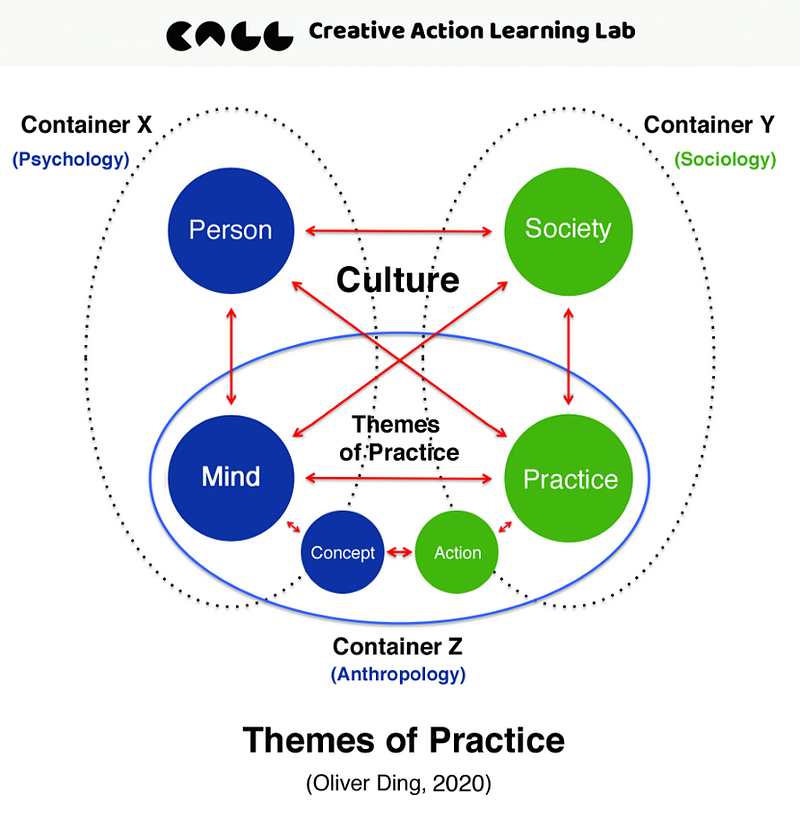
I consider the notion of Themes of Practice as a process type of concept, not a substance type of concept. Thus, it is not a new category of themes, but a transformational process between individual life themes and collective culture themes. It refers to both concept and action. It connects mind and practice. It indicates the transformation of both person and society.
2.9 Curativity, Self-reference, and Dialectical hierarchy
An interesting thing is one of the applications of Curativity Theory is Knowledge Curation which can be used to guide the development of Curativity Theory. Thus, I roughly make a theoretical self-reference.
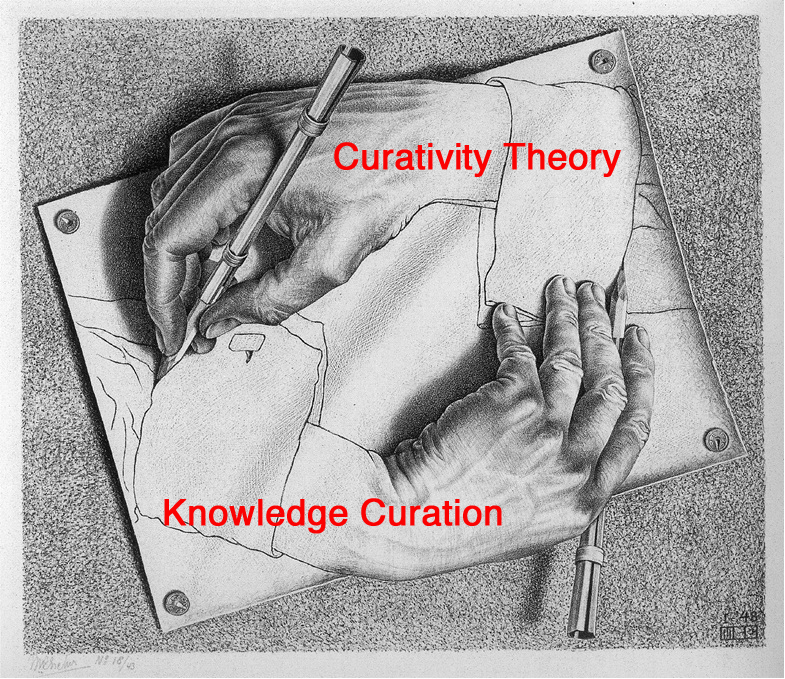
However, it depends on the boundary of the “self”. From the perspective of Curativity Theory, it is too naive to claim that the pieces and parts are determined by the whole. In fact, Curativity Theory embraces the dialectical hierarchy of the pieces-whole relationship. For example, as an application of Curativity Theory, Knowledge Curation is a piece while the whole is the Curativity Theory. The outcome of Knowledge Curation can be returned to guide the development of Curativity Theory.
Moreover, the dialectical hierarchy is one specific type of dialectical boundary of Container. Since this notion is not a part of George Lakoff and Mark Johnson’s conceptual metaphor Container and image schema Containment, I coined a new term Containance which refers to the dialectical boundary of Container and my other ideas about “Container — Containee” in general.
PART 3: Toolkit
The above sections introduce the Ecological Practice Approach within the context of Curativity Theory. Now it is time to detach it from the Curativity Theory and present it as an independent product for general purposes.
3.1 A Loose Coupling Toolkit
In a broad sense, the Ecological Practice approach has its philosophical roots in traditional Pragmatism and contemporary embodied cognitive science. Inspired by practice studies theorist Davide Nicolini (2013)’s “tool-kit approach” which curates various concepts from different theoretical accounts based on a family relationship, allowing a network of dissimilarities and similarities.
The above diagram displays core theoretical concepts which form a loose coupling toolkit. Each concept of the toolkit is independent, which provides flexibility for applications. Also, the whole toolkit is scalable because we can adopt concepts from other theoretical traditions and develop our own new concepts.
3.2 The Germ Cell of Ecological Practice Approach
According to Andy Blunden (2017), “The idea of the ‘cell’ originates with the philosopher of history, Johann Gottfried Herder (1744–1803). In his effort to understand the differences between peoples, Herder introduced the idea of a Schwerpunkt (‘strong point’)…Herder’s friend, Johann Wolfgang von Goethe (1749–1832), sought to utilize this idea in his study of botany during his Italian journey in 1786, to understand the continuity and differences between the plants found in different parts of the country. Goethe came to the idea of an Urphänomen ‒ not a law or principle, but a simple, archetypal phenomenon in which all the essential features of a whole complex process are manifested.”
A Germ Cell of a theoretical approach is its smallest entity which can represent the whole of thinking in different levels of analysis. The diagram below shows the germ cell of the Ecological Practice approach.
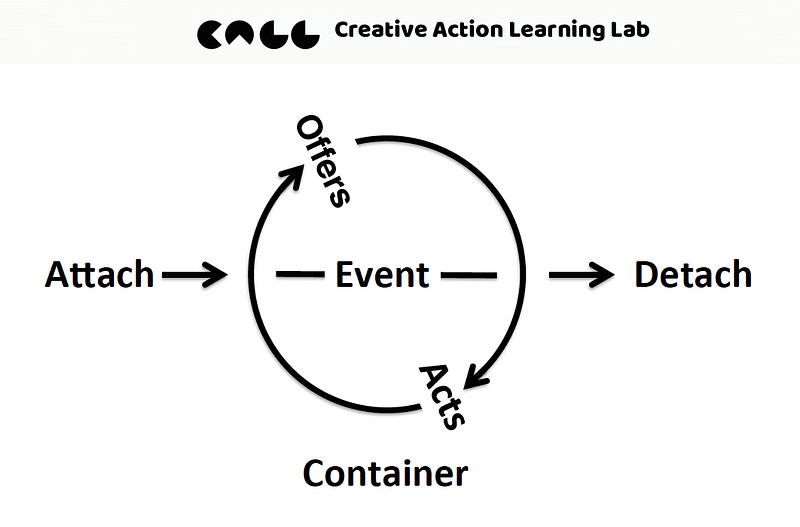
The above diagram combines three core concepts of the Ecological Practice approach together: Affordance, Attachance, and Containance. The term “Offers” is an affordance-inspired concept, it refers to opportunities afforded by the Container. The group of “Offer — Act” forms “Event” which changes the status of the Container. The new status of the Container affords new opportunities which guide the new acts and events.
The above diagram also represents the concept of Attachance at the level of Container. We can consider Entering the Container as an Attaching act and Exiting the Container as a Detaching act. However, the diagram doesn’t represent the second attachance which is inside the Container. In fact, the Ecological Practice approach considers the “Form of Act” as “Attach” or “Detach”. Any act is either an attaching act or a detaching act.
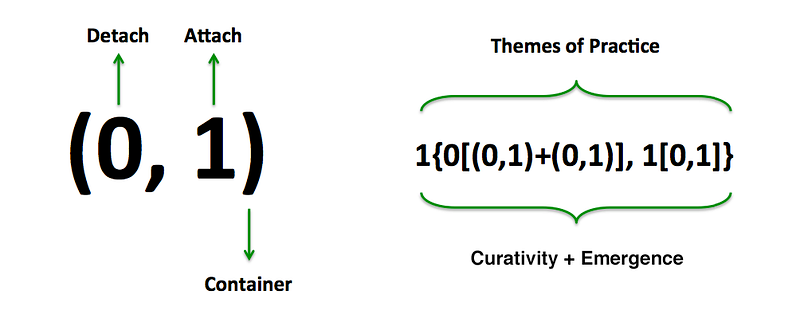
The above picture is another way of representing the germ cell of the Ecological Practice approach. The two forms of the act are represented by binary numbers. The 0 represents detaching act and the 1 represents attaching act. The parenthesis represents the Container. The right diagram shows an example of complex status which brings out other two concepts: Curativity and Themes of Practice. I also add the concept of Emergence from complexity theory to the above diagram.
3.3 The Field of Ecological Practice Approach
A Germ Cell of a theoretical approach is the starting point of any creative thinking project. By adjusting the quality and quantity of the Container, we can create advanced frameworks for discussing complex phenomena.
The quality of the Container can be potential and actual, and the quantity of the Container can be one or two. Now let’s develop a new framework with one potential container and two actual containers, the outcome is the following diagram.
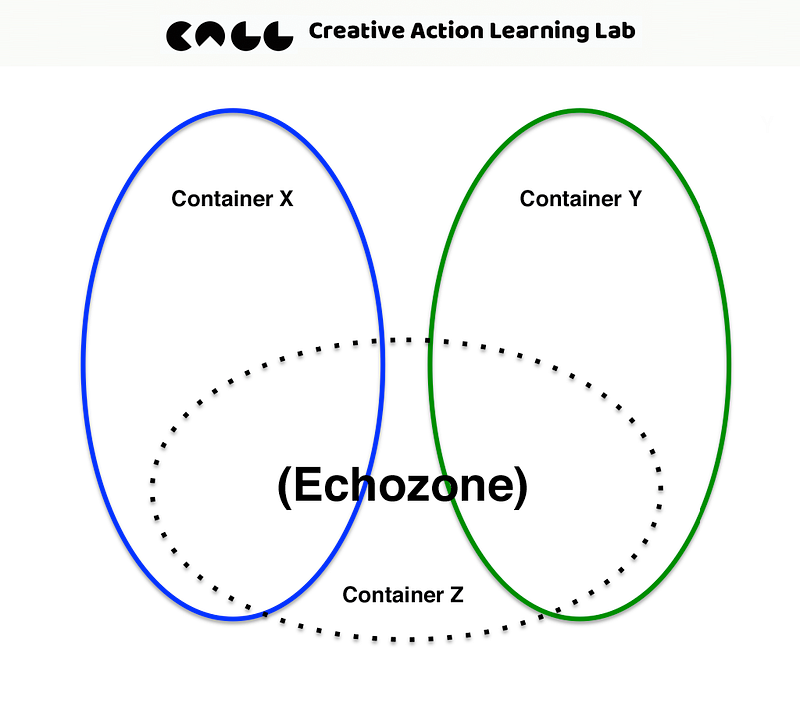
If you have read my previous articles, you know this diagram is the basis of When X Meets Y (WXMY) and HERO U. I named the potential container (Container Z) as Echozone which refers to a creative space containing echoes between Container X and the Container Y.
The Echozone is located at the field level of the Ecological Practice Approach.
3.4 The Landscape of Ecological Practice Approach
Let’s move to the landscape level to view the Ecological Practice Approach.
Based on the concept of Container, I coined two related ideas: Network and Platform. The Network refers to the pre-container status which means pieces loose coupling outside the container. The Platform refers to the post-container status which means pieces loose coupling within the super large container. These three ideas form a triad: Network — Container — Platform. I consider the triad as the basic form of collective contexts.
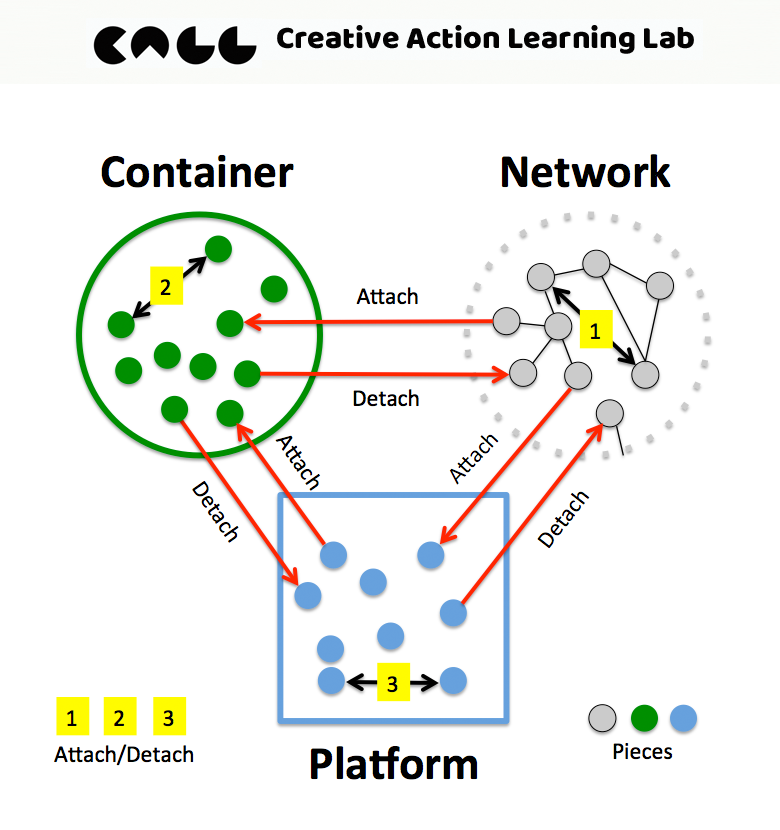
The above diagram represents a large map of the ecological practice approach. Here we see three basic types of collective context and attaching/detaching acts inside contexts and between contexts.
PART 4: Future
The Ecological Practice approach is a radical account with its transactional worldview. The approach is inspired by ideas from multiple disciplines. Thus, it is an interdisciplinary study itself. However, the Ecological Practice approach has its own focus: ecological complexity, which means the relationship between “the structure and dynamic of environments” and “human action and social practice”.
4.1 An Interdisciplinary Approach for Practice Studies
Both traditional Pragmatism and contemporary embodied cognitive science are broad-based movements with various theoretical approaches. Curativity theory doesn’t want to build a new approach to mind and cognition, its primary interest is the action and practice of turning pieces into a meaningful whole. As a by-product of writing Curativity, the Ecological Practice approach is inspired by ideas from multiple disciplines.
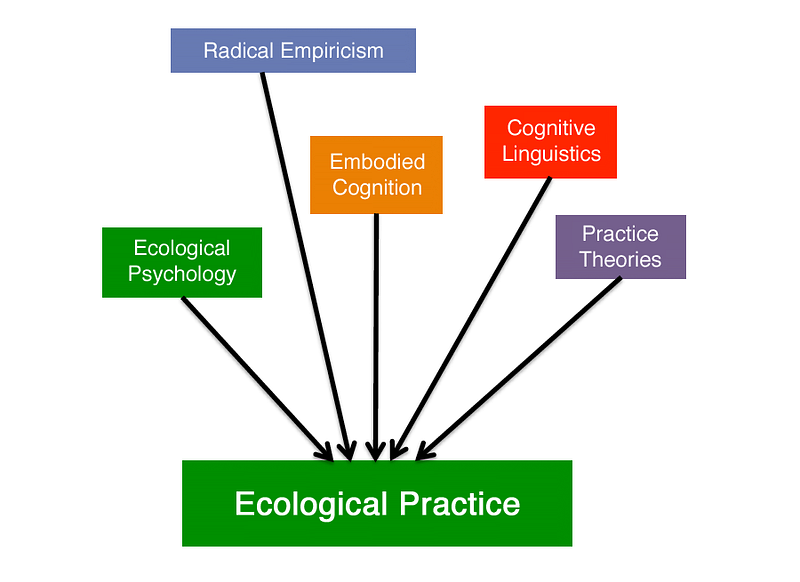
According to Harry Heft (2001), “The concept of affordances has its roots in James’ radical empiricist philosophy and the related functionalist approach to psychology. Eleanor Gibson (1982, Gibson’s wife) explicitly described the development of the affordance concept as reflecting ‘a renascence of functionalism’…Gibson made no mention in his brief history of the affordance concept of James’s formulation. However, it is not unlikely that he would have picked up this sort of conceptualization through his contact with Holt.”(p.126, p.127)
Lakoff and Johnson (1980) claimed their views were influenced by Gibson and other ecological psychologists, “Our ideas about the way our conceptual system is shaped by our constant successful functioning in the physical and cultural environment come partly from the tradition of research in human development begun by Jean Piaget and partly from the tradition in ecological psychology growing out of the work of J. J. Gibson and James Jenkins, particularly as represented in the work of Robert Shaw, Michael Turvey, and others.” (p.xii)
Lakoff and Johnson (1999) also claimed they were influenced by John Dewey and Maurice Merleau-Ponty, “…we want to honor the two greatest philosophers of the embodied mind. Any book with the words ‘philosophy’ and ‘flesh’ in the title must express its obvious debe to Maurice Merleau-Ponty…John, Dewey, no less than Merleau-Ponty, saw that our bodily experience is the primal basis for everything we can mean, think, know, and communicate. He understood the full richness, complexity, and philosophical importance of bodily experience. For their day, Dewey and Merleau-Ponty were models of what we will refer to as ‘empirically responsible philosophers.’ They drew upon the best available empirical psychology, physiology, and neuroscience to shape their philosophical thinking.” (p.xi)
According to Anthony Chemero, “More recently, Gibson has become one of the heroes of embodied cognitive science, which has adopted these views (substantially softened) as its own. Moving slightly closer to the present, we can trace the origins of the situated aspect of embodied cognitive science to situation semantics, the work in the philosophy of mind and language done in the 1980s by John Barwise and John Perry. Taking themselves to be providing a semantics for Gibsonian psychology, Barwise and Perry argued that we can’t understand meaning or cognition without taking into account that thinkers are spatially located (i.e., situated) and so have only incomplete, locally available information at their disposal.” (p.24)
Thus, the approach is an interdisciplinary study itself. However, the Ecological Practice approach has its own focus: ecological complexity, which means the relationship between “the structure and dynamic of environments” and “human action and social practice”.
4.2 Connect Visual Perceiving and Conceptual Thinking
There is a gap between Gibson’s “ecological realism” and George Lakoff’s “experientialist” approach. Lakoff (1987) pointed out, “One version of the world-as-understood defense of objectivist semantice invokes the ecological psychology of J. J. Gibson. Gibson stressed the importance of the constant interaction of human beings with, and as an inseparable part of, their environments. Our views concerning interactional properties and embodiment mesh with Gibson’s on this issue…The Gibsonian environment is not the kind of world-as-experienced that is needed in order to account for the facts of categorization. Suppose Gibson is right for perception. His account only deals with individual phenomena, not categories of phenomena. And it does not — and could not — deal with abstract categories.” (pp.215–216)
What’s Lakoff’s “experientialist” approach? According to Lakoff (1987), “The experientialist approach is very different: to attempt to characterize meaning in terms of the nature and experience of the organisms doing the thinking. Not just the nature and experience of individuals, but the nature and experience of the species and communities. ‘Experience’ is thus not taken in the narrow sense of the things that have ‘happened to happen’ to a single individual. Experience is instead construed in the broad sense: the totality of human experience and everything that plays a role in it — the nature of our bodies, our genetically inherited capacities, our models of physical functioning in the world, our social organization, etc.” It is reasonable to not choose the individual level for Lakoff because what he studied is language, category, and metaphors. However, what Gibson studied is perception. They worked on two things at two levels.
From the perspective of Curativity theory, the concept of Curativity can be considered as a bridge between Gibson’s approach and Lakoff’s approach. According to Lakoff, “Where objectivism defines meaning independently of the nature and experience of thinking beings, experiential realism characterizes meaning in terms of embodiment, that is, in terms of our collective biological capacities and our physical and social experiences as beings functioning in our environment.” Thus, Lakoff’s “experience” refers to the totality of collective human actions at the concept level. while Gibson’s “experience” refers to individual actions at the percept level. Since Curativity theory considers both the selectivity of perceiving and the selectivity of thinking, and both the reflecting-in-action and the reflecting-in-practice, it is possible to use Curativity Theory as a bridge to connect ecological psychology and cognitive linguistics.
A unique aspect of Curativity Theory is the dialectical hierarchy and dialectical boundary in general. The hierarchy can be considered as a specific type of piece— whole relationship. In order to curate two separate existing layers together into a meaningful whole, we can create a new intermediate layer. Curativity is about turning pieces into a whole. If we consider individual action experience as pieces (the level of ecological psychology) and the totality of collective conceptual themes as a whole (the level of cognitive linguistics), we can use Curativity to understand the mechanism of turning individual action experience (pieces) into collective conceptual themes (whole).
4.3 Reconsider Ecological Physics
Gibson’s approach focuses on the physical environment, it is hard to directly apply it to digital platforms. Instead of modifying the original definition of Affordance and turning it into a buzzword, I adopt Gibson’s Ecological Physics Method to guide my research. Gibson only used the term Ecological Physics, he said “To be sure, we define what it is in terms of ecological physics instead of physical physics, and therefore it possesses meaning and value to begin with.” (p.139)
Harry Heft shared more background on Ecological Physics in his book Ecological Psychology in Context (2001). Gibson was not the initiator of Ecological Physics. Heft mentioned this issue and highlighted Fritz Heider’s idea and his relationship to Gibson, “In 1926, Fritz Heider published a remarkable paper based on his dissertation. Heider’s ‘Thing and Medium’ is a landmark in the development of ecological psychology. It profoundly shaped the ideas of Gibson and Brunswik…Heider made a start at developing an ecological physics by drawing a distinction between the object of perception and that which mediates the object of perception being perceived. ” (p.225)
Gibson developed a triad “Substances — Surfaces — Medium” for describing his ecological mechanics. Gibson focused on the terrestrial environment for animals (including humans). Animals, plants, human, natural objects such as rock, sand, mud, clay, metal… These are Substances. Air and water are Medium because they afford locomotion to animate body and they are generally transparent, transmitting light. The medium is separated from the substances of the environment by Surfaces.
Ecological psychologist Roger G. Barker (1968, 1989) adopted Heider’s “Thing and Medium” as an epistemological tool for developing his Behavior Settings theory. He considered behavior settings as things with their inhabitants as mediums. Social theorist Niklas Luhmann also adopted Heider’s ‘thing and medium’ and modified “Medium” as a loose coupling of elements within a system for his theory.
Thus, Ecological Physics is a wonderful theoretical resource. It can be used for different kinds of theoretical works. In June, I developed a research method called Ecological Physical Method for studying digital platforms. Also, I consider “Container” as a new member of ecological physics. In order words, we can claim that the “Thing/Substance, Medium, Surface, Container” is a family, a growing family!
4.4 An Approach to Ecological Complexity
The term “ecological” of “ecological practice” refers to Gibson’s scientific research on the relationship between organisms and environments and his philosophical stance “ecological realism”.
According to Edward S. Reed(1988), “Gibson’s psychology united experience and action, whereas James’s psychology had applied only to experience and Holt’s only to action…For Gibson, the pragmatists’ extension of the concept of experience to include activity and knowing as well as the simpler forms of feeling had to be accompanied by an extension of the concept of reality to include more than physical entities.” (pp.53–54)
The term “practice” of “ecological practice” refers to Donald Schön’s distinction between action and practice. Schön used reflecting-in-action for immediate situations while reflecting-in-practice refers to cross-situation level.
Thus, the “ecological practice” is inspired by ecological psychology but goes beyond it in order to cover both immediate situational actions and cross-situational practice.
The diagram below describes the evolution of my idea. After reviewing many Affordance-inspired concepts and related works in various domains, I went back to Ecological Physics which is behind ecological psychology. Later, I realized I found my own path of discovery: from ecological physics to ecological complexity.
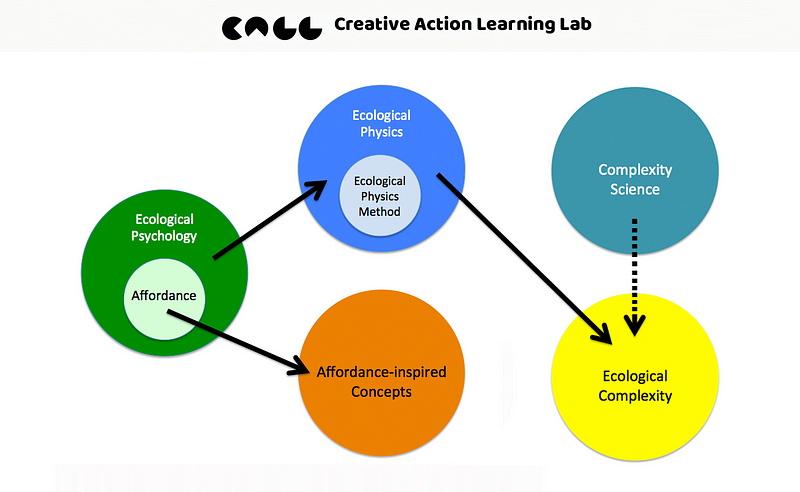
Baggs and Chemero (2020) argued the meaning of “ecological psychology” is not clear, they suggested that ‘“… Gibson’s ecological approach can perhaps be read as an unprecedented account of the conditions of mental life: it is an account of the structure of things ‘out there’ — the structure that an animal can potentially come into contact with. What it generally is not is an account of what animals actually do when they come into contact with their surroundings.”
I hope the concept of ecological complexity can solve this issue. Under the umbrella of “Ecological Complexity”, we can explore the structure of things out there, and more ideas behind the structure. We can also discuss both potentially and actually. We can even study both physical surroundings and digital surroundings with the same approach and method.
4.5 Complexity, Creativity, and Competence
As Baggs and Chemero (2020) pointed out, “The success of a behavioral science research should ultimately be measured by what it can be used for…two ways in which the ecological approach can inform practical interventions in everyday life. First, we can reconfigure the habitat in order to make it easier for actors to carry out some task. Second, we can reconfigure the animal by educating them to attend to their surroundings…”
For practical ecological interventions, we can use 3C to organize our plan:
- Complexity: Understand the ecological complexity with special theoretical concepts and frameworks.
- Creativity: Encourage creative approaches to cope with negative ecological complexity and engage with positive ecological complexity.
- Competence: Educate actors and improve their knowledge and skills for mastering ecological complexity.
One unique aspect of ecological complexity is that it is observable in the daily real-life world. For example, I took many pictures to record real-life situations about affordance. These pictures became my research materials and can be used for educational purposes in the future.
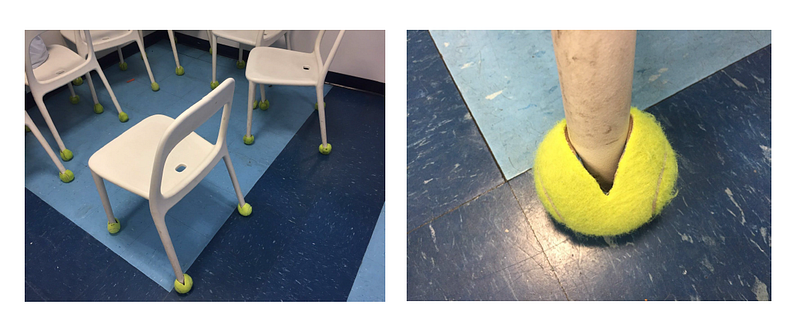
The above picture was taken in a swimming school’s observation room. The owner of the swimming school cut tennis balls and used them for the pads for chairs in order to protect the floor.
No one likes complexity. However, complexity is something we can no longer ignore. Also, it can be positive too. If we can understand the ecological complexity around us, we can turn it into a useful life resource in a creative life way.
4.6 From Existing Practice to Possible Practice
Based on the NICE framework, we can generate a new framework for discussing social practice. The above diagram represents the new framework in which the possible practice is placed in the center. This diagram shows the vision of the Ecological Practice approach.
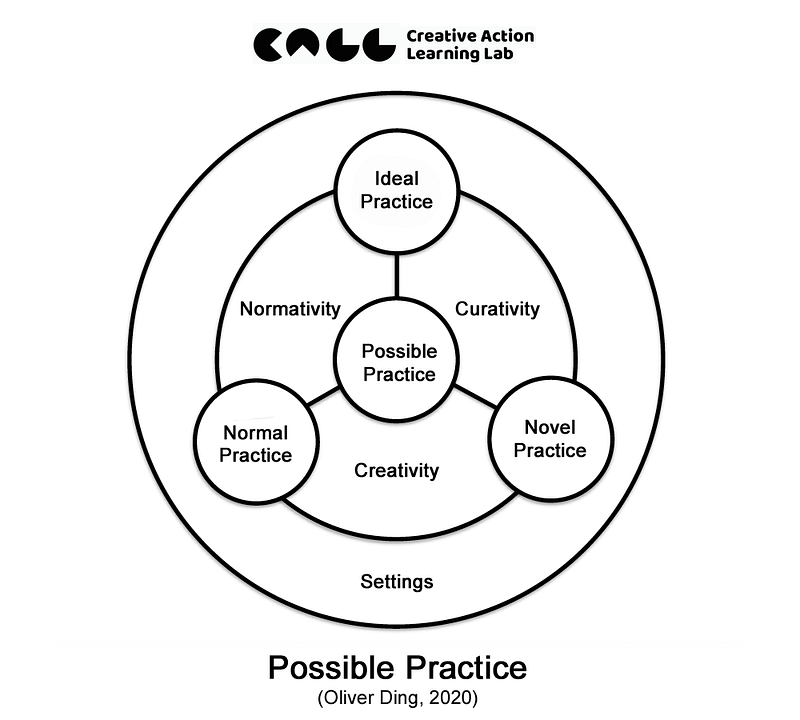
I consider actions at the individual level and practice at the collective level. The four types of actions correspond to four types of social practices.
- Possible Practice — Possible Actions
- Normal Practice — Normal Actions
- Novel Practice — Creative actions
- Ideal Practice — Exemplary Actions
Why do I place Possible Practice at the center of the new framework? I consider the possible practice as the origin of all types of practice. If we trace back the historical development of any social practice, we can always find that their sources are possible actions. I consider affordance and imagination are two sources of possible actions.
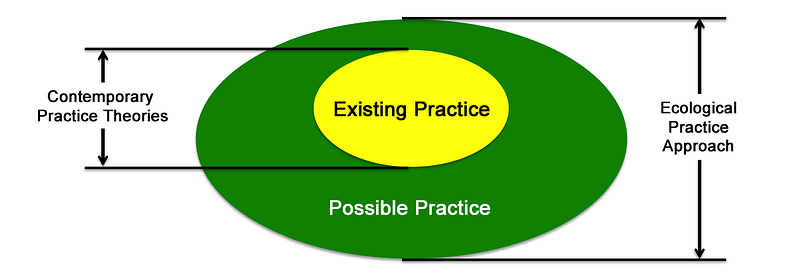
If we put Normal Practice, Novel Practice, and Ideal Practice into one category: Existing Practice, then we can get the diagram below.
Since 2001, a group of philosophers, sociologists, and scientists have rediscovered the practice perspective and used it as a lens to explore and examine the role of practices in human activity. Researchers called it The Practice Turn in Contemporary Theory. As Schatzki pointed out, “there is no unified practice approach”(2001, p.2). Davide Nicolini curated a toolkit to introduce the following six different ways of theorizing practice in his 2012 book Practice Theory, Work, & Organization:
- Praxeology and the Work of Giddens and Bourdieu
- Communities of Practice (Lave & Wenger, 1991)
- Activity Theory / Cultural-historical activity theory (the Marxian/Vygotskian/Leont’evian tradition)
- Ethnomethodology (Harold Garfinkel, 1954)
- The Site of Social (contemporary developments of the Heideggerian/Wittgensteinian traditions, by Theodore R. Schatzki)
- Conversation Analysis / Critical Discourse Analysis (the Foucauldian tradition)
Nicolini also pointed out, “Practice theories are fundamentally ontological projects in the sense that they attempt to provide a new vocabulary to describe the world and to populate the world with specific ‘units of analysis’; that is, practice. How these units are defined, however, is internal to each of the theories, and choosing one of them would thus amount to reducing the richness provided by the different approaches.” (2012, p.9)
I suggest “Possible Practice” as a new term that expands the scope of contemporary practice theories from “actual actions and existing practice” to “possible actions and possible practice.” I consider “Possible Practice” as the special unit of analysis for the Ecological Practice approach. Again, the Ecological Practice approach is not an alternative to contemporary practice theories, but expands their scope and contains more theoretical concepts such as James J. Gibson’s Affordance.
The Ecological Practice approach claims that the original source of all human actions is affordances and imagination. Affordance refers to material engagement while imagination refers to linguistic engagement. If we accept the ideas from cognitive linguistics which claims that the source of linguistic conceptual metaphor is embodied experience, we can reduce the linguistic engagement (imagination) to material engagement (affordance). In fact, we can learn more from philosophists of embodied cognitive science. They consider affordance as an essential concept for rethinking the mind from the perspective of embodied cognitive science.
My focus is action and practice, not mind and cognition. The goal of the Ecological Practice approach is to build a new unit of analysis for discussing action and practice. The “Possible Practice” is just the beginning.
You are most welcome to connect via the following social platforms:
Twitter: https://twitter.com/oliverding Doowit: https://doowit.co/profile/gm0k2ax9 Linkedin: https://www.linkedin.com/in/oliverding
License
This work is licensed under the Creative Commons Attribution-NonCommercial-ShareAlike 4.0 International (CC BY-NC-SA 4.0) License. Please click on the link for details.
References
Baggs, E., & Chemero, A. (2018/2020). The third sense of environment. https://doi.org/10.31234/osf.io/sxmrz also in Jeffrey B. Wagman & Julia J. C. Blau (Eds.), Perception as Information Detection: Reflections on Gibson’s ecological approach to visual perception (pp. 5–20). New York: Routledge.
Barker, Roger (1968, 1989). Behavior settings: A revision and extension of Roger G. Barker’s ‘ecological psychology’. Stanford University Press.
Chemero, Anthony (2009). Radical embodied cognitive science. The MIT Press.
Lakoff, George & Johnson, Mark (1999). Philosophy in the flesh: The embodied mind and its challenge to western thought. Basics Books.
Gibson, J.J. (1979/2015). The ecological approach to visual perception: classic edition. New York: Psychology Press. (originally published in 1979).
Gladwin, T. (1947). Morris E. Opler’s Concept of “Themes”. American Anthropologist. N.S., 49, 1947.
Heft, Harry (2001). Ecological psychology in context: James Gibson, Roger Barker, and the legacy of William James ’s radical empiricism. New York: Psychology Press.
Heft, Harry (2012) Foundations of an ecological approach to psychology. In Susan D. Clayton (eds.), The Oxford handbook of environmental and conservation psychology. Oxford University Press.
Johnson, Mark (1987). The body in the mind: The bodily basis of meaning, imagination, and reason. The University of Chicago Press.
Lakoff, George & Johnson, Mark (1980). Metaphors we live by. The University of Chicago Press.
Lakoff, George (1987). Women, fire, and dangerous things: What categories reveal about the mind. The University of Chicago Press.
Nicolini, D. (2012). Practice theory, work, & organization: An Introduction. Oxford University Press.
Pepper, Stephen (1942). World hypotheses: A study in evidence. University of California Press.
Reed, E.S. (1988). James J. Gibson and the psychology of perception. Yale University Press.
Reed, E.S. (1996). Encountering the world: toward an ecological psychology. Oxford University Press.


