
The Development of Ecological Practice Approach
Three versions of the Ecological Practice Approach
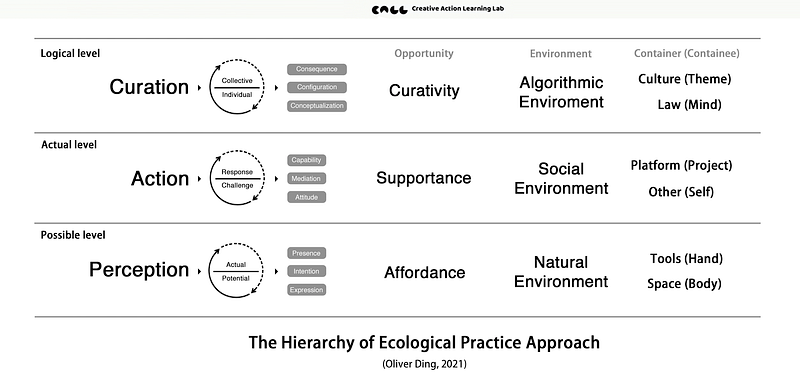
The above diagram is the newest version of the Ecological Practice approach. This article aims to review the historical development of the approach.
Contents
1. A Brief 2. The “Toolkit” version (2019) 3. The “Germ-cell” version (2020) 4. The “Hierarchy” version (2021) 5. Three books (2018–2021) 6. Ecological Psychology v.s. Activity Theory 7. Curating Network of Enterprise 8. Knowledge Curation 9. Possible Practice
1. A Brief
In Oct 2020, I wrote an article titled The Ecological Practice Approach Toolkit and shared my work on a new approach for practice studies. This approach was originally called the Gibson — Lakoff — Schön approach because I adopted theoretical concepts from James J. Gibson, George Lakoff, and Donald Schön.
From Sept 2018 to March 2019, I wrote a book titled Curativity: The Ecological Approach to Curatorial Practice in order to reflect on one of my life themes: Curation. The Ecological Practice Approach was born from the process of writing Curativity.
After March 2019, I continuously worked on revising Curativity and developing the Ecological Practice Approach as a new project. In May 2020, I wrote another book titled After Affordance: The Ecological Approach to Human Action in which I proposed several new theoretical ideas for expanding ecological psychology to the modern digital environment.
A major development of the Ecological Practice approach is the concept of Supportance. I have been searching for a concept for expanding Ecological Psychology from perception-centered psychological analysis to social practice analysis for about two years after I finished the draft of Curativity.
It takes about five months to develop the concept of Supportance. The concept of Supportance was born on Oct 27, 2020, after I wrote the Ecological Practice Approach Toolkit on Oct 19, 2020. I had several round private discussions with my friends during the past several months. On Dec 13, 2020, I published the Platform for Development (P4D) Framework (1.0), I applied the concept of Supportance to develop the framework. This is also a test of the concept of Supportance. From Dec 26, 2020, to Feb 3, 2021, I worked on Project-oriented Activity Theory. I returned to the P4D project on Feb 9, 2021. On Mar 12, 2021, I wrote a long article about the concept of Supportance.
The concept of Supportance means the Ecological Practice approach has transformed from a curated toolkit to an original theoretical framework. This is a major milestone of the approach.
2. The “Toolkit” version (2019)
This 2019 version is a curated toolkit version. In a broad sense, the Ecological Practice approach has its philosophical roots in traditional Pragmatism and contemporary embodied cognitive science. Inspired by practice studies theorist Davide Nicolini (2013)’s “tool-kit approach” which curates various concepts from different theoretical accounts based on a family relationship, allowing a network of dissimilarities and similarities, I consider the Ecological Practice approach a toolkit.
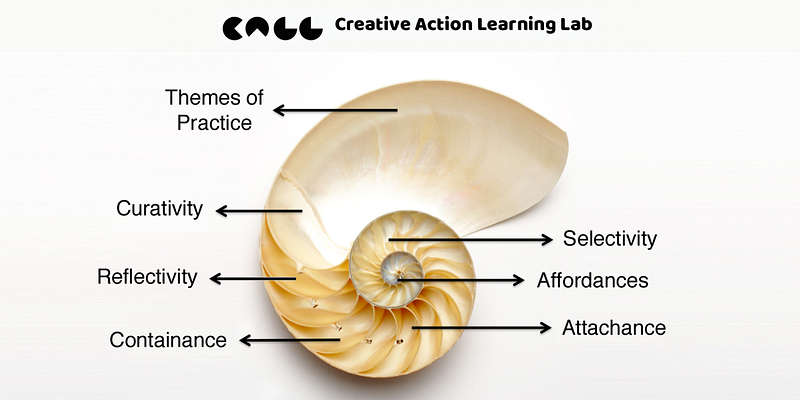
The above diagram shows several theoretical concepts. Some concepts are adopted from theoretical resources. The concept of Selectivity is adopted from William James’ Radical Empiricism. The concept of Affordance is adopted from Ecological psychologist James J. Gibson. The concept of Reflectivity is adopted from Donald Schön. I also developed several original concepts such as Attachance, Containance, Curativity, and Themes of Practice.
3. The “Germ-cell” version (2020)
In 2020, I developed a new diagram to represent the germ-cell of the Ecological Practice approach.
According to Andy Blunden (2017), “The idea of the ‘cell’ originates with the philosopher of history, Johann Gottfried Herder (1744–1803). In his effort to understand the differences between peoples, Herder introduced the idea of a Schwerpunkt (‘strong point’)…Herder’s friend, Johann Wolfgang von Goethe (1749–1832), sought to utilize this idea in his study of botany during his Italian journey in 1786, to understand the continuity and differences between the plants found in different parts of the country. Goethe came to the idea of an Urphänomen ‒ not a law or principle, but a simple, archetypal phenomenon in which all the essential features of a whole complex process are manifested.”
A Germ Cell of a theoretical approach is its smallest entity which can represent the whole of thinking in different levels of analysis. The diagram below shows the germ cell of the Ecological Practice approach.
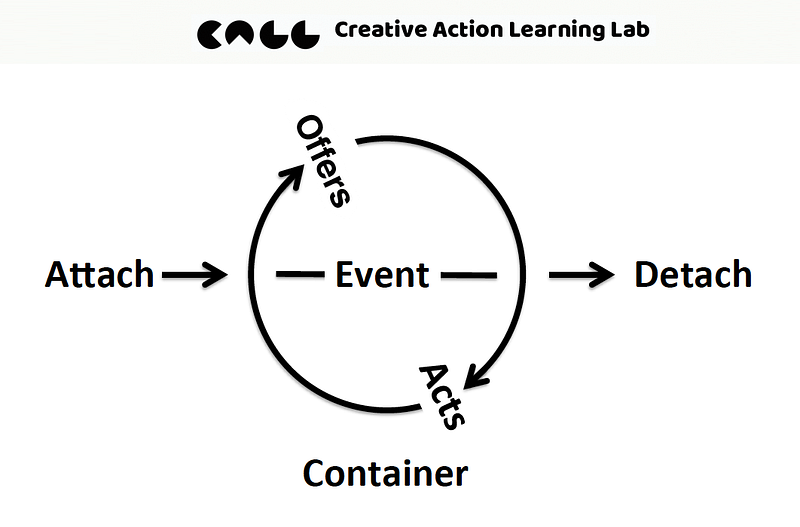
The above diagram combines three core concepts of the Ecological Practice approach together: Affordance, Attachance, and Containance. The term “Offers” is an affordance-inspired concept, it refers to opportunities afforded by the Container. The group of “Offer — Act” forms “Event” which changes the status of the Container. The new status of the Container affords new opportunities which guide the new acts and events. In a broad sense, the Ecological Practice approach has its philosophical roots in traditional Pragmatism.
4. The “Hierarchy” version (2021)
On Sep 29, 2020, I published an article titled Activity U (VI): The Hierarchy of Human Activity and Social Practice. The article is part of the Activity U project. A side-product of the article is a universal hierarchy of activity and practice.
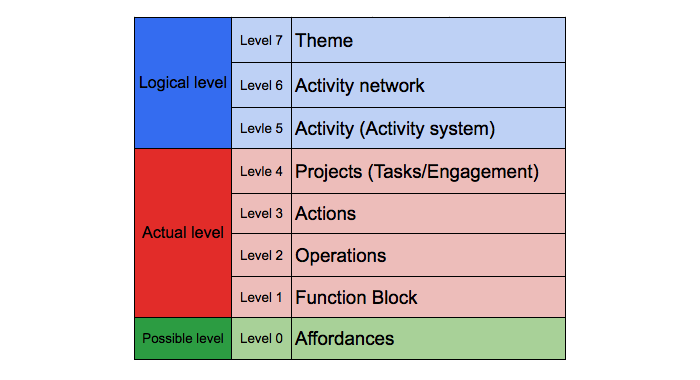
Human activity and social practice are extremely complex, the hierarchy is a great thinking tool for understanding them. Based on perspectives from activity theorists and other researchers, I found there is an eight-level hierarchy of activity and practice. The six mid-levels are adopted from activity theorists. The top-level is adopted from anthropologist Morris Opler (1945). The low level is adopted from ecological psychologist James J. Gibson (1979).
I also classify these eight levels into three types: “logical level”, “actual level”, and “possible level”. We can call the logical level as ideal level too. I don’t have perfect terms to name these types.
On Mar 12, 2021, I published an article to introduce the concept of Supportance. I used the diagram below to discuss the actualization of supportances.
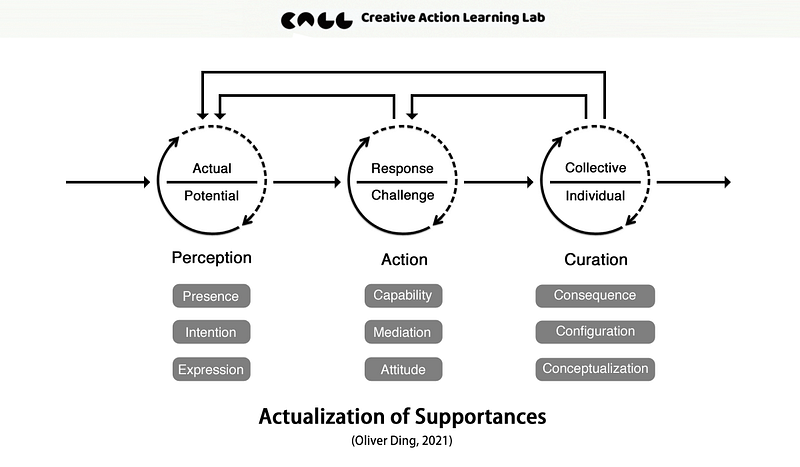
On April 2, 2021, I combined the above two diagrams and made a new diagram for the Ecological Practice approach.
The above diagram summarizes the core concepts of the Ecological Practice Approach. It is an expansive version of the Germ-cell version.
5. Three books (2018–2021)
During the process of developing the Ecological Practice Approach, I have written three books which are still drafts.
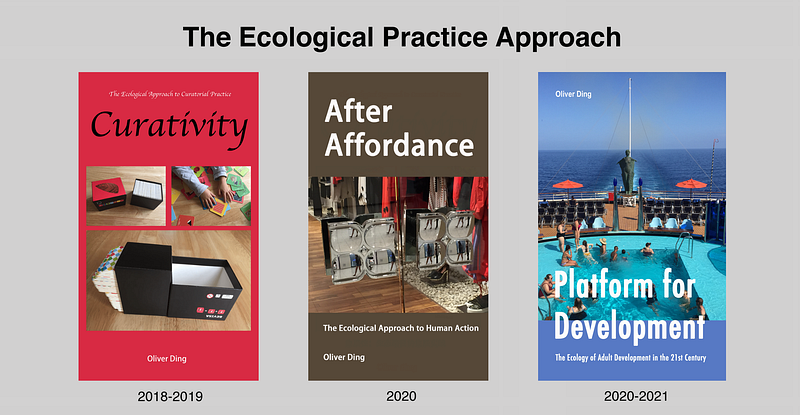
- Curativity: The Ecological Approach to Curatorial Practice
- After Affordance: The Ecological Approach to Human Action
- Platform for Development: The Ecology of Adult Development in the 21st Century
Each year I write a book and each book establishes an important theoretical concept for the Ecological Practice approach. Curativity introduces the concept of Curativity and develops the toolkit version of the approach. After Affordance introduces the concept of Attachance and develops the germ-cell version of the approach. Platform for Development introduces the concept of Supportance.
Both Curativity and After Affordance were written in Chinese. In fact, they are still unpublished drafts. Curativity is a 615-page Google Doc file while After Affordance is a 371-page file. Platform for Development is written in English, I am currently working on editing the draft of Platform for Development. If you want to know more details about Platform for Development, you can click here to see the contents of the book.
6. Ecological Psychology v.s. Activity Theory
I am also working on Activity Theory as a knowledge curator. I’d like to point out similarities and differences between Ecological Psychology and Activity Theory.
At the general philosophical level, both Ecological Psychology and Activity Theory share the same view of the inseparability of human beings and the world. Victor Kaptelinin and Bonnie A. Nardi claimed, “In Western thought the fundamental insight of the inseparability of subjects and objects is expressed, for instance, in the philosophical views of Hegel and Marx, Goethe’s poetry, Brentano’s ‘act psychology’, and the ecological psychology of Gibson.” (2012, p.13)
However, there is an important theoretical difference between Ecological Psychology and Activity Theory. Activity theorists define the “activity” as “object-oriented”, according to Leontiev, “Any activity of an organism is directed at a certain object; an ‘objectless’ activity is impossible” (Leontiev, 1981).
Ecological psychologists don’t use “activity” as a theoretical concept, they use “action” and “activity” interchangeably. Ecological psychologist Edward S. Reed (1996) pointed out there are two kinds of actions, “We should thus differentiate between two kinds of activity, performatory and exploratory — because the selective contingencies are very different for the two cases. Exploratory activity, as I call the scanning for and use of information (following James Gibson; see Reed, 1988a) typically does not require the expenditure of a significant amount of force to alter the substances or surfaces of the environment. Instead, it involves the adjustment of the head and sensory organs to the ambient energy fields. These adjustments are typically embodied in cyclic, low-energy and low-impact movements of the sense organs or the head. The selective advantage thus obtainable is that of having information useful for regulating one’s activity pattern. These latter performatory activities are precisely those cases in which the animal does use significant amounts of force to alter the substances and surfaces of its environment. It is one thing to see or to smell a piece of food, it is quite another thing to obtain it, masticate it, and eat it — and this applies whether one is a dragonfly or a mammalian carnivore.”(1996, pp. 80–81)
One of the important concepts of Ecological Psychology is the concept of Affordance. What’s Affordance? Let’s have a look at the original definition made by Gibson: “The affordances of the environment are what it offers the animal, what it provides or furnishes, either for good or ill. The verb to afford is found in the dictionary, but the noun affordance is not. I have made it up. I mean by it something that refers to both the environment and the animal in a way that no existing term does. It implies the complementarity of the animal and the environment. (p.119)”
Activity theorists tend to adopt the idea of affordance at the operation level. Victor Kaptelinin and Bonnie A. Nardi pointed out, “Affordances are typically interpreted in terms of low-level manipulation with physical artifacts. Therefore, the concept is limited to the level of operations.” (2006, p.81) Bærentsen & Trettvik’s (2002) provided a framework of Affordance levels which suggested the concept of affordance can be extended to levels of actions and activities.
Activity theorists use “activity — action — operation” as a three-level hierarchy of activity theory. I personally suggested another way to adopt the concept of affordance to Activity Theory. Instead of matching the existing three levels of the hierarchy of activity, the concept of affordance can be considered as a new level for extending the scope of the hierarchy of activity. The operation level can’t cover the meaning of the concept of exploratory action. The exploratory action goes beyond the scope of activity theory. Thus, the “possible level — affordances — exploratory action” combination is a heterogeneous theoretical resource to activity theory.
Why do I add the idea of affordance to the hierarchy of activity and practice? I think the value is it could expand the scope of hierarchy from “actual” to “possible” because affordance refers to “action possibilities.” Eventually, I develop “logical — actual — possible” as three levels of hierarchy for the Ecological Practice approach.
7. Curating Network of Enterprise
As a knowledge curator and maker, I adopt some theories of creativity to guide my creative works. One of these theories is Howard E. Gruber’s evolving systems approach to the study of creative work (1974,1989).
One of the core concepts of Gruber’s approach is Networks of Enterprise which refers to the pattern of work in the life of a creative individual. Gruber said, “We use the term enterprise to stand for a group of related projects and activities broadly enough defined so that (1) the enterprise may continue when the creative person finds one path blocked but another open toward the same goal and (2) when success is achieved the enterprise does not come to an end but generates new tasks and projects that continue it.” (1989, p.11)
According to Gruber, the enterprise has some characteristics such as variety, longevity and durability, and tradeoffs (1989, p.11–12). First, “Enterprises rarely come singly. The creative person often differentiates a number of main lines of activity…The person has an agenda, some measure of control over the rhythm and sequence with which different enterprises are activated.” This is also the outstanding characteristic of contemporary knowledge workers. Second, an enterprise takes a long time. For example, “Milton began the work that led to Paradise Lost in 1640 but did not complete it until 1667.” For contemporary knowledge workers, this depends on their purpose on ambitious goals. Third, “In constructing the network of enterprise the individual faces a tradeoff between density and breadth…The fact that different kinds of activity entail different sorts of risk adds to the usefulness of a diversified network of enterprise, allowing the creator to be by turns daring and secure, as emotional needs wax and wane.” This is also significant to contemporary knowledge workers.
In Nov 2020, I developed a new approach called Life-as-Activity which aims to connect Activity Theory and Biographical Study. I adopted Gruber’s idea for the approach. However, Gruber didn’t provide a schema for analyzing networks of enterprises. In order to incorporate the concept into the Life-as-Activity, I create the diagram below as a tool for mapping the networks of enterprises. I highlight several possible operations within organizing various enterprises: open, close, suspense, activate, re-open, ongoing, merge, and branch.
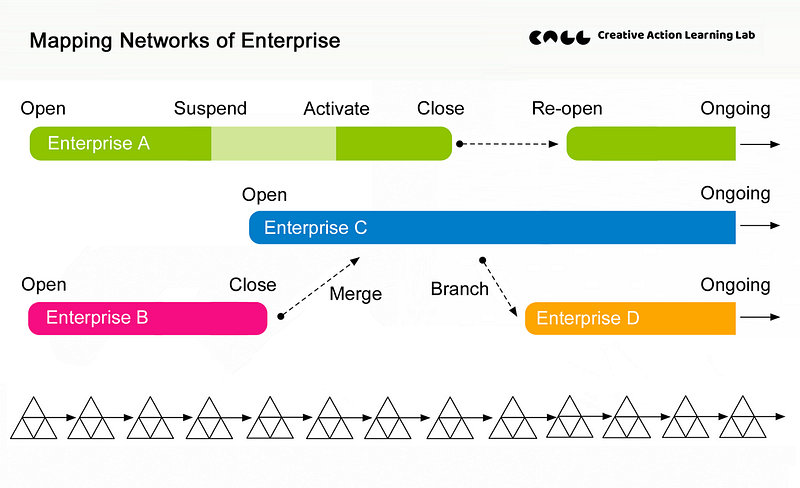
I also shared my own experience in discussing the above diagram. For example, the Enterprise A can refer to my identity as a digital activist in virtual community building. I started this enterprise in 2008 when I co-founded a nonprofit online project with a friend. In 2010, my first son was born. Thus I suspended it around 2010 and activated it around 2012 when I co-founded another nonprofit project focusing on social learning. In 2013, my second son was born. Later, I decided to close the enterprise around 2014. I recently reopened this enterprise by founding CALL (Creative Action Learning Lab) in 2019.
The Enterprise B can refer to my activities in creating digital curation tools. The Enterprise C can refer to my activities in building a theory about curation. After the team decided to close the digital curation tool project, I merged my activity on this project into building a theory about curation. I adopted theories from Ecological Psychology and other fields and used them to reflect on my practice in building digital curation tools and other activities. One of the major projects of enterprise C is writing a book titled Curativity. One of the by-products of writing the book is the Ecological Practice approach. I started writing the book in Sept 2018 and finished its draft in March 2019. In May 2019, I branched the Ecological Practice approach from Enterprise C and created a new room for it: Enterprise D.
8. Knowledge Curation
The Ecological Practice approach was born from the process of developing Curativity Theory.
An interesting thing is one of the applications of Curativity Theory is Knowledge Curation which can be used to guide the development of Curativity Theory. Thus, it roughly looks like I make a theoretical self-reference.
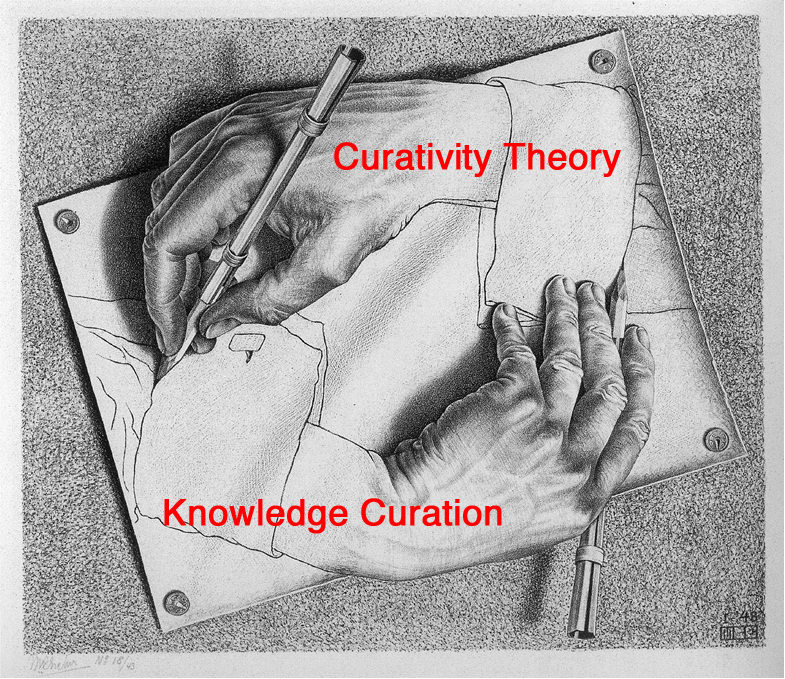
From the perspective of Curativity Theory, it is too naive to claim that the pieces and parts are determined by the whole. In fact, Curativity Theory embraces the dialectical hierarchy of the pieces-whole relationship. For example, as an application of Curativity Theory, Knowledge Curation is a piece while the whole is the Curativity Theory. The outcome of Knowledge Curation can be returned to guide the development of Curativity Theory.
Moreover, the dialectical hierarchy is one specific type of dialectical boundary of Container. Since this notion is not a part of George Lakoff and Mark Johnson’s conceptual metaphor Container and image schema Containment, I coined a new term Containance which refers to the dialectical boundary of Container and my other ideas about “Container — Containee” in general.
The concept of Containance is a key concept of the Ecological Practice approach. It also applies to the development of the approach itself. My recent knowledge curation projects such as the Activity U project and Project-oriented Activity Theory are guided by a framework called HERO U and the When X Meets Y diagram. These two ideas are guided by the concept of Container which is a key concept of the approach.
A Germ Cell of a theoretical approach is the starting point of any creative thinking project. By adjusting the quality and quantity of the Container, we can create advanced frameworks for discussing complex phenomena. The quality of the Container can be potential and actual, and the quantity of the Container can be one or two. Now let’s develop a new framework with one potential container and two actual containers, the outcome is the following diagram.
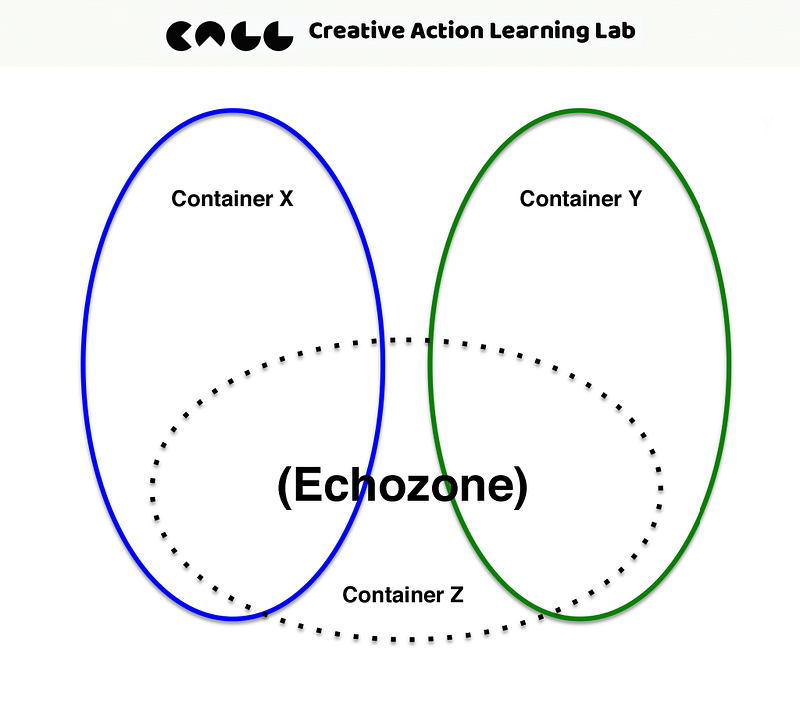
If you have read my previous articles, you know this diagram is the basis of When X Meets Y (WXMY) and HERO U. I named the potential container (Container Z) as Echozone which refers to a creative space containing echoes between Container X and the Container Y.
I use the HERO U framework to guide the Activity U project. The by-product of the project is the universal hierarchy of activity and practice. This leads to the “hierarchy” version of the Ecological Practice approach.
9. Possible Practice
The mission of the Ecological Practice Approach is to explore Possible Practices. On Sept 20, 2020, I published an article titled The NICE Way and Creative Actions. This article introduces my ideas on creativity and daily life activity. By connecting the NICE framework and Curativity Theory, we can generate a new framework for discussing social practice. The above diagram represents the new framework in which the possible practice is placed in the center. This diagram shows the vision of the Ecological Practice approach.
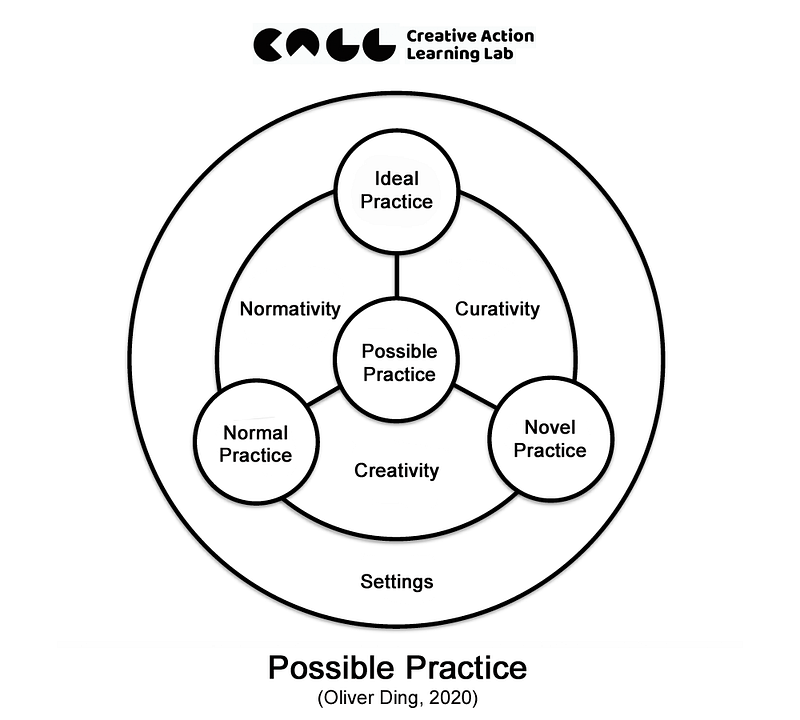
I consider actions at the individual level and practice at the collective level. The four types of actions correspond to four types of social practices.
- Possible Practice — Possible Actions
- Normal Practice — Normal Actions
- Novel Practice — Creative actions
- Ideal Practice — Exemplary Actions
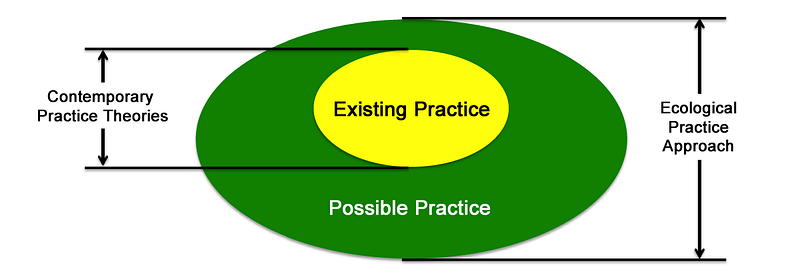
Why do I place Possible Practice at the center of the new framework? I consider the possible practice as the origin of all types of practice. If we put Normal Practice, Novel Practice, and Ideal Practice into one category: Existing Practice, then we can get the diagram below.
Since 2001, a group of philosophers, sociologists, and scientists have rediscovered the practice perspective and used it as a lens to explore and examine the role of practices in human activity. Researchers called it The Practice Turn in Contemporary Theory. As Schatzki pointed out, “there is no unified practice approach”(2001, p.2). Davide Nicolini curated a toolkit to introduce the following six different ways of theorizing practice in his 2012 book Practice Theory, Work, & Organization:
- Praxeology and the Work of Giddens and Bourdieu
- Communities of Practice (Lave & Wenger, 1991)
- Activity Theory / Cultural-historical activity theory (the Marxian/Vygotskian/Leont’evian tradition)
- Ethnomethodology (Harold Garfinkel, 1954)
- The Site of Social (contemporary developments of the Heideggerian/Wittgensteinian traditions, by Theodore R. Schatzki)
- Conversation Analysis / Critical Discourse Analysis (the Foucauldian tradition)
Nicolini also pointed out, “Practice theories are fundamentally ontological projects in the sense that they attempt to provide a new vocabulary to describe the world and to populate the world with specific ‘units of analysis’; that is, practice. How these units are defined, however, is internal to each of the theories, and choosing one of them would thus amount to reducing the richness provided by the different approaches.” (2012, p.9)
I suggest “Possible Practice” as a new term that expands the scope of contemporary practice theories from “actual actions and existing practice” to “possible actions and possible practice.” I consider “Possible Practice” as the special unit of analysis for the Ecological Practice approach. Again, the Ecological Practice approach is not an alternative to contemporary practice theories, but expands their scope and contains more theoretical concepts such as James J. Gibson’s Affordance.
This is the future of the Ecological Practice approach.
You are most welcome to connect via the following social platforms:
Twitter: https://twitter.com/oliverding Doowit: https://doowit.co/profile/gm0k2ax9 Linkedin: https://www.linkedin.com/in/oliverding
License
This work is licensed under the Creative Commons Attribution-NonCommercial-ShareAlike 4.0 International (CC BY-NC-SA 4.0) License. Please click on the link for details.


