
The NICE Way and Creative Actions
A New Approach for Studying Action-based Creativity in the Age of Platform

Two months ago, I found an interesting video on my Linkedin homepage. The video has a brand name called BED Talks. Since I was familiar with TED Talks (TED, for those who haven’t opted in, stands for Technology, Entertainment, Design, and refers to TED conferences and related programs), I was curious about the idea of BED Talks. I searched and found more BED talk videos on Linkedin and figured out the story behind them.
The BED Talk challenge was initiated by the speaker and author David Rendall and Stan Phelps. The idea behind a BED Talk is to share a short, unscripted video sharing something helpful…recorded from your bed since you’re (hopefully) at home.
In the above video, Rosaria Cirillo Louwman shared the guidelines for BEDTalks: no prep necessary, record in bed, keep it short (under five minutes), make it fun, no selling, and be helpful. The BED talks community is still small, if you want to find more BED talks, you can check these places: YouTube (#bedtalkchallenge), Linkedin (#bedtalkchallenge), and Twitter (#BEDTalk).
This article focuses on Creative Actions such as BED Talks and other stay-at-home challenges. I will give a rough literature review of creativity research and propose a new approach “Process as Product”. The second part of the article will develop two modes for the new approach: the 3I model and the NICE framework.
Contents
1. Is BED Talks Creative or Not? 2. Originality, Usefulness, and the Thirdness 3. The Four-C model of Creativity 4. The Five A’s Framework 5. TED talks, BED talks, and Soccer Distancing 6. The New Approach: Process as Product 7. Idea, Initiator, and Initiatee 8. Initiation, Variation, and Curation 8.1 Initiation: perceiving and conceptualizing 8.2 Variation: the balance of imitation and innovation 8.3 Curation: human opinions and machine algorithms 9. Domain, Field, and Platform 10. The NICE Way 10.1 Variate 10.2 Inspire 10.3 Actualize 10.4 Curate 11. Action-based Creativity 12. What’s Next?
1. Is BED Talks Creative or Not?
Yes!
I consider the BED Talks challenge a great case for studying Creative Actions and Action-based Creativity. On Feb 25, I shared a practical framework called The Pinwheel Framework for planning programs for my personal studio CALL (Creative Action Learning Lab). Since then, I have been collecting many cases and trying my own cases in the manner of “action research (learning by doing)”.
After reviewing many cases, I ask the following question again:
What’s Creative Action?
If we ask our friends on Twitter or Facebook, usually most people will think about “original” and “useful” for evaluating creativity. But ask creativity researchers and they will tell us this is just the beginning of the whole story. Following these two core elements, academics have been developing many models of creativity.
Today, creativity researchers tend to talk about “Social Systems Model”, “4Cs” and “5As”. The following sections will go through these terms and brief the historical development of creativity research.
2. Originality, Usefulness, and the Thirdness
From the basic two elements, scholars have been debating the definition of creativity for more than 60 years, especially the third element and even the fourth element.
Theoretical models always are represented by concepts, diagrams, and formulas. In order to understand these models effectively, we have to differentiate the word and its meaning. For the first element, people tend to use “newness”, “novelty”, “original”, “originality” or other similar words, we just see them as a family for one concept. Different theorists and researchers would like to use their own words to describe the same concept, in order to learn the landscape of the domain, we should ignore these trivial variations at the surface of language. In this way, we find another family of words for the second element: “task appropriateness”, “usefulness”, “useful”, “utility”, “meaningfulness”, “value”, etc.
Though researchers have a consensus on these two core elements of creativity, they still debate on the third element, even the fourth element. Dean Keith Simonton (2012) argued that we should adopt a three-criterion framework that is based on the U.S. Patent Office evaluation standard. Simonton suggested using “Novelty”, “Utility” and “Surprise” to define Creativity and develop empirical research projects. In 2017, researchers adopted the fourth element called “aesthetics” and challenged the standard definition of creativity, the USP Patent Office definition, and the Creativity Product Analysis Model (Acar, Burnett, and Cabra, 2017). Their study drew a conclusion that aesthetics was significantly related to creativity in all types of outputs but was mostly unrelated to innovation.
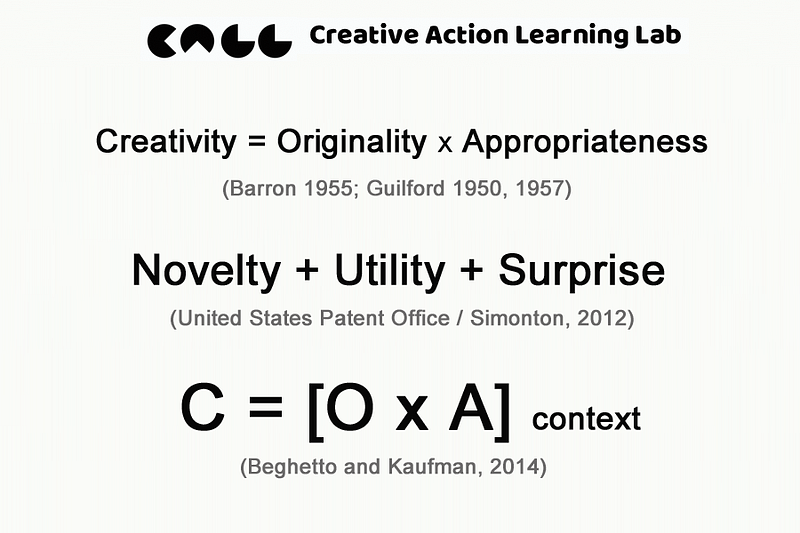
The limitation of two-element and three-element approaches are obvious because they only consider a small range of creative behaviors such as scientists, innovators, and artists. For example, how to think about creativity in educational settings? In 2014, Ronald A. Beghetto and James C. Connecticut published a paper titled Classroom Contexts for Creativity, they suggested, “when it comes to nurturing creativity in the classroom, however, the learning environment is one of the most important factors — determining, in large part, whether creative potential will be supported. In short, classroom context matters.”(Beghetto & Connecticut, 2014) They argued that considering original or appropriate is determined by a particular social, cultural, and historical context. In this way, creativity and context are inseparable.
I created the below figure as a knowledge curation tool for discussing Categories of Creativity. There are two layers of categories, the foundational layer is subjective creativity, intersubjective creativity, and objective creativity. The phenomenological layer lists many concepts which are open to adding or removing. For example, the concept of “Improvisation” is an important idea for researching performance creativity(Sawyer, 1992).
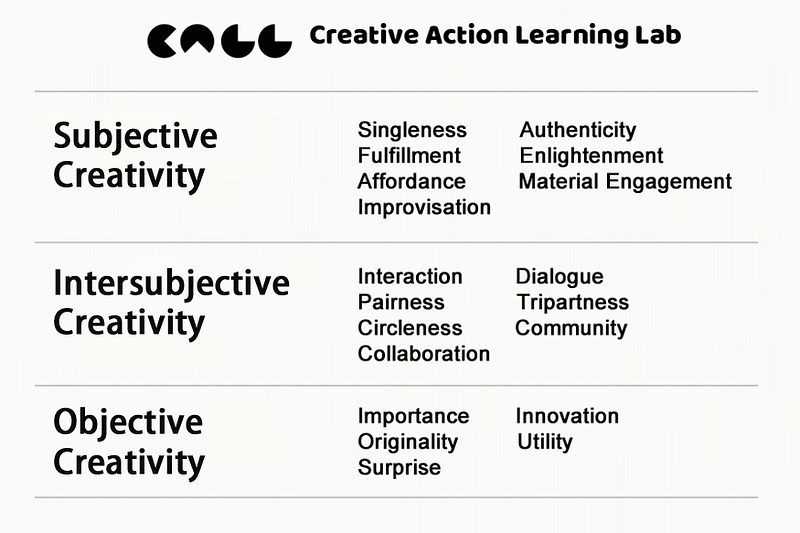
Let’s explore its potential later and return to the historical development of theoretical models of creativity.
3. The Four-C model of Creativity
There are other traditional pair ideas called “Big-C” and “little-c” in the field of creativity research. “Big-C creativity” refers to what people call “Genius” who create famous creative achievements such as music, paints, inventions, theories, etc. On the other side, “little-c creativity” pays attention to creative behavior in everyday life. For example, making waffle art, using cardboard boxes for sliding, decorating a place for a birthday party, etc.
One, Two, Three… Two is always not enough for understanding a complex thing. In 2009, James C. Kaufman and Ronald A. Beghetto proposed two additional categories: “Pro-c” and “mini-c” (Kaufman & Beghetto, 2009). Now, we have the following Four-C model of creativity.
Beghetto and Kaufman defined the Mini-c as the novel and personally meaningful interpretation of experience, actions, and events. Since we have the little-c idea, why do we need a similar concept? Researchers argued there is a gap between creative insights experiences in the learning context and little-c situation. For example, a child who learns how to draw 3D shapes in his art class and uses the skill to create drawings of buildings in new ways or a student who discovers that he can use his love of history books to improve her vocabulary on tests. The most important point of Mini-c creativity is it focuses on the process without outside judgment. We can put Mini-c into the firstness category because it does not need to be shared or acknowledged by anyone but the creator.
The aim of “Pro-c” is to give credit to “amateur” creators and professional creators who are successful but have not reached a level of prominence as eminent creators achieved. This category is a wide spectrum. On the one side, most professional workers can be classified as Pro-c. On the other side, we see many “amateur” creators have the potential to be more creative than some of their “professional” counterparts. We should give these “amateur” creators credit based on their products and not judge them by their main source of income.
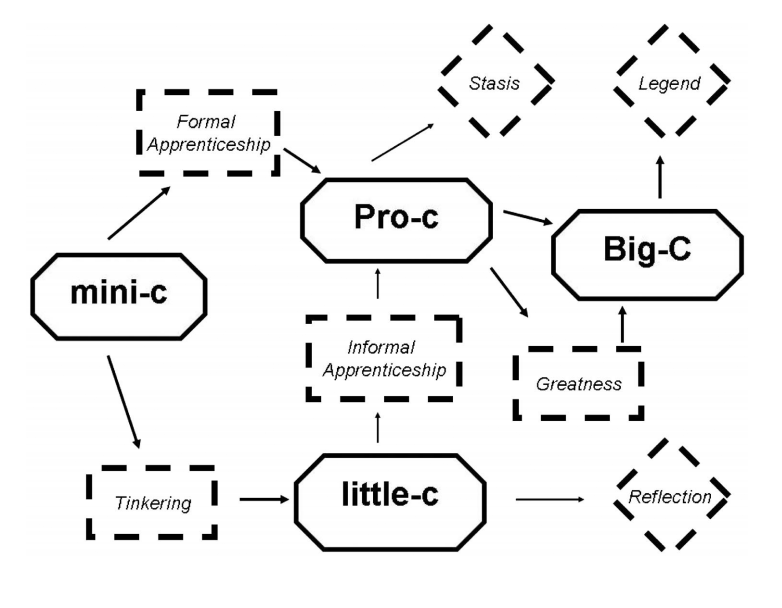
The Four C model is not a simple typology of creativity. Instead, Beghetto and Kaufman offered a framework for conceptualizing and classifying various levels of creative expression and pointed to potential paths of creative maturation. The above diagram presents detailed relations between different development levels. Beghetto and Kaufman described a creative landscape of daily life: “As part of this process of enjoying creativity in everyday life, the creator may stumble upon the domain that he or she feels an initial pull of passion. With years of acquired expertise and advanced schooling, the creator may move onto the stage of Pro-c. Although he or she will still have mini-c insights, the creator has now achieved professional-level status and is capable of working on problems, projects, and ideas that affect the field as a whole. The creator may continue to create at the Pro-c level throughout her or his entire life, with specific peaks occurring at different ages based on the domain. After many years have come and gone, the creator may achieve a lasting Big-C contribution to a field or the creator may have passed away, and history will make the final judgment as to whether he or she has entered the pantheon of Big-C or is long-forgotten.”
Does it mean that everyone is a creator? Yes! The authors said the model reflects their belief that nearly all aspects of creativity can be experienced by nearly everyone.
I really like the Four-C model and I suggest everyone read the original paper since there is no book on the topic. If you have read Creativity: Flow and the Psychology of Discovery and Invention (Csikszentmihalyi, 1996), you would know the Flow theory and the Four-C model adopt different timescales. The former chooses immediate experience as a unit of analysis while the latter is about lifelong activities.
4. The Five A’s Framework
Traditionally, researchers of creativity use the term “4P” to describe the landscape of creativity study. The 4P stands for Person, Process, Product, and Press. This framework was originally proposed by Rhodes in 1961 and became very popular for overviewing the academic discipline. Since the rise of sociocultural and ecological psychology as well as theories of the distributed mind, some scholars challenged this framework.
In 2013, Vlad Petre Glaveanu proposed a more systemic, contextual, and dynamic approach called the 5A framework in his paper: Rewriting the Language of Creativity: The Five A’s Framework. The author said, “this is more than a change of terminology but a fundamental change of epistemological position. In light of sociocultural sources, the actor exists only in relation to an audience, action cannot take place outside of interactions with a social and material world, and artifacts embody the cultural traditions of different communities” (Glaveanu, 2013).
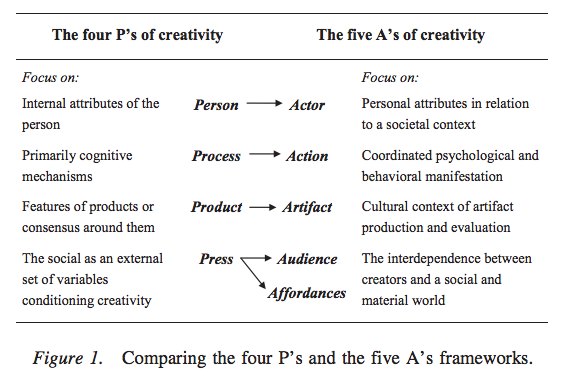
I called this switch from 4P to 5A The Action Turn in Creativity research. However, I found the 5A framework’s “Action” still means the creative process. In 2013, Vlad Petre Glaveanu and his colleagues published a paper titled Creative as action: findings from five creative domains (Glaveanu et al, 2013). Based on the work of Dewey (1934) on arts as experience, they developed a framework about “Creative in and as Action” and challenged the traditional view of “creative process” which was considered to be mental/cognitive in nature and individual in manifestation. They pointed out that early concerns with the creative process resulted primarily in stage models, but more recent theories shifted the focus to sub-processes and the micro-level dynamic of creativity. Thus, they adopted Dewey’s terms such as “impulsion”, “doing” and “undergoing” and used these ideas to investigate creative expression in five different domains: art, design, science, scriptwriting, and music.
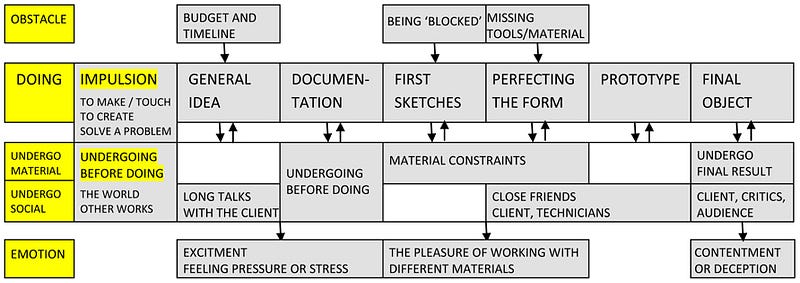
The above chart is one schematic representation of creative activity in five domains. We can see authors focus on the creative process.
5. TED talks, BED talks, and Soccer Distancing
So far, we have learned many ideas, concepts, models, frameworks, and theories about creativity in a rough literature review. If we see this new knowledge as a seed of knowing, it’s time to plant them in the field.
Let’s ask the below question and answer it again:
Is BED Talks Creative or Not?
In order to inspire deep thinking, I added two videos below to form a meaningful context for our discussion on creative actions. The first video is Matt Cutts’ short TED talk: Try something new for 30 days. This is a very short TED talk, it takes less than four minutes. Inspired by the great American philosopher Morgan Spurlock, Matt Cutts tried the 30-day challenge several times and shared his experience on the TED stage in 2011. This mini-talk is very popular and earned over 13 million views (1, 2).
The second video is about playing soccer at home with a toilet roll. Due to the global public health crisis of COVID-19, people have to stay at home to learn and teach, work and talk, read and write, etc. Some people recorded themselves taking creative actions and shared the resulting videos on social media platforms. Then, other people get inspired by these actions and do it themself. Eventually, these creative actions became popular challenges and produced viral cultural memes. The toilet paper challenge is one of these stay-at-home creative actions, other example includes “Pair play tennis between rooftop during coronavirus lockdown in Italy”, “Supergran goes viral after jaw-dropping footballing trick shots”, “Art-at-floor”, and “Pan-ping-pong”.
From the perspective of the Four C model, we can consider TED Talks as Big-C and BED Talks as Mini-C or Pro-C. TED Talks is an established brand with over 36 years of history. According to Wikipedia, TED Talks had been watched over one billion times worldwide by November 2012. Based on TED conferences and TED Talks, the non-profit TED Foundation has created many innovative programs such as TEDx, TED Fellows, TED-Ed, TED Prize (now the Audacious Project), TED Circles, TED Connect, etc. John Butman described TED as an “ideaplex” in his book Breaking Out (2013), “The growing popularity of the TED talks made it obvious that the phenomenon of idea development and distribution was changing…Today, as then, the ideaplex and the idea entrepreneur exist in a complementary relationship, each one feeding and feeding off the other. The ideaplex of today is such a vast phenomenon that we accept it like the air around us and can scarcely see how well developed and fundamental it is to our society.” (pp.16–17)
Following Butman’s term, we can say TED is a Big-ideaplex and BED talks is a mini-ideaplex. Since the BED talks project was born two months ago, it is not fair to compare it with TED. What we can compare is the form of expression, the format of TED talks is about 18 minutes, public space, and deliberate preparation. In contrast, the format of BED talks is about 5 minutes, record in bed, and improvisation.
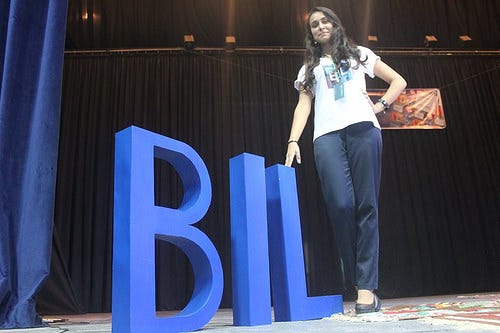
We can also compare them with BIL Conference and Pecha Kucha. BIL Conference was founded in 2007 by Cody Marx Bailey, Todd Huffman, Bill Erickson, and others and adopted a format of unconference which was organized and observed by the participants. The name BIL refers to the 1989 film Bill & TED’s Excellent Adventure. Now we see a deep similar structure between BED Talks and BIL Conference. First, they are both related to an existing brand in the same domain. Second, they both made some structured variations due to the changed context. Third, they both named their new format a new brand in a creative way that associates with the existing brand.
Pecha Kucha was created by Astrid Klein and Mark Dytham of Tokyo’s Klein-Dytham Architecture (KDa) in February 2003. As a storytelling format, it requires speakers to show 20 slides for 20 seconds of commentary. Based on the unique format of sharing, they also designed a format of activity called Pecha Kucha Night (PKN). A typical PechaKucha Night (PKN) includes 8 to 14 presentations. Organizers in some cities have customized their own format. Like TED’s open brand program TEDx, the PKN adopted the same open brand approach. As of June 2020, more than 10K PKNs had been held in more than 1,200 cities worldwide. More than 3 million people have attended a PKN event.
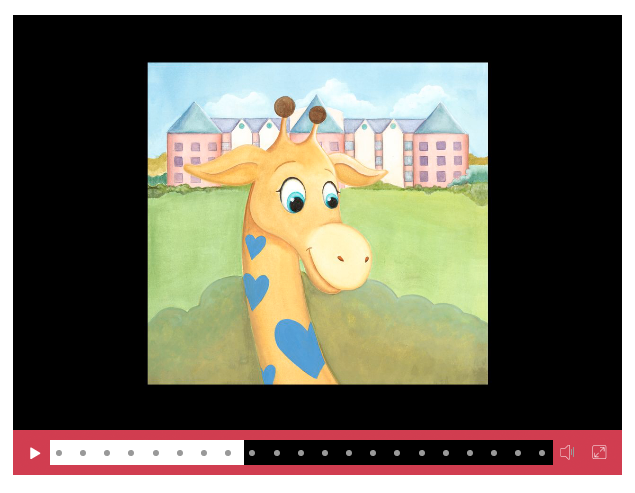
Pecha Kucha also has a great online website for sharing presentations made by their global community members. We have to pay attention to the unique design of their video page. The below picture is a screenshot of their website. Instead of showing a speaker within his talk video in a normal way, Pecha Kucha only displays 20 slides and the speaker’s voice. This design matches their offline format.
We have talked about brand name and format of sharing, let’s look at the content level. TED started from three sections (Technology, Entertainment, Design) and expanded to science, culture, politics, psychology, and more. BIL Conference didn’t have a clear niche. Pecha Kucha focused on creative work-related fields such as design, architecture, photography, art, etc. Does BED Talks have its own unique niche? Yes. The two co-founders of BED Talks are speakers and authors, they invited their friends who are authors, speakers, and coaches to join the campaign. We see the seed of the BED Talks community has a clear unique niche.
Now let’s compare BED Talks with “Soccer Distancing” and other creative stay-at-home challenges.
They both have three common elements: unique action, open to everyone, and brand name as a hashtag. First, BED Talks and other stay-at-home challenges both have a creative action format. Second, they allow other people to take the challenge. The detailed difference is that BED Talks adopts a public inviting style, one participant takes the challenge and invites his friends to take the challenge too. Some other stay-at-home challenges don’t have this mechanism. Third, BED Talks has a unique brand name while some other stay-at-home challenges don’t have a brand name but only hashtags. The major difference between BED Talks and other stay-at-home challenges is the founders of BED Talks tend to develop and maintain a sustained community while most other stay-at-home challenges are just viewed as short-term popular memes.
The above discussion points to two critical theoretical issues of creativity research.
First, we need a theoretical approach that puts action first and doesn’t consider actions as the “creating process” of a “creative product”. In other words, what I called Action-based Creativity can be seen as a “Process as Product” approach.
Second, there is a need to develop a new framework that can help us connect the individual daily experiences of Action-based Creativity at the micro level with the dynamic historical development of collective culture at the macro level.
The rest of the article will turn to address these two issues and try to develop theoretical frameworks as a solution for reflecting both practice and theory.
6. The New Approach: Process as Product
The concern on the relation between Process and Product has been already discussed by researchers, especially Keith Sawyer’s work. Sawyer was not a normal scholar, he had various experiences in practical fields before joining the psychology study. He has been a jazz pianist for over 40 years and spent several years playing piano with Chicago improv theater groups. From 1984 to 1990 he worked as a management consultant on innovation technologies. In 1990, he began his doctoral studies in psychology, where he studied creativity with Mihaly Csikszentmihalyi (author of best-selling books such as Flow and Creativity).
Sawyer chose super-creative groups like jazz bands and improv theater ensembles as his research objective. By combining a long-time experience, academic training, and innovative research method, Sawyer considered performance to be central to our explanation of creativity and challenged the traditional view of creativity. He argued in his book Explaining Creativity (2012), “Explaining performance creativity has changed the way scientists think about all creativity because we now know that all creativity includes improvisation, collaboration, and communication.” (p.7)
Sawyer pointed out the major difference between high art and performance. He said, “…I consider performance creativity to be one of the most important examples of human innovation. High art usually is a created product that can be displayed, sold, or reproduced: a painting, a sculpture, or a musical score. But performance creativity is ephemeral; there is no product that remains. The audience participates during the creation and watches the creative process in action; when the performance is over, it’s gone, remaining only in the memories of the participants.” (p.7)
Following Sawyer’s argument, I consider performance as one type of creative action and realize that it represents a new approach to studying creativity: Process as Product. From the perspective of the “Process as Product” approach, the above examples such as BED Talks and stay-at-home challenges can be seen as creative actions. Obviously, it is reasonable to categorize TED talks as performances. But in other cases, it’s not easy to consider all of them as performance. Maybe we can see Pecha Kucha as performance too because their format is unique, but for BED Talks and BIL conference, I am not sure if we can claim them as performance since BED Talks requires “no prep necessary” and BIL conference adopts the “unconference” format. Moreover, there are significant differences between performance and stay-at-home challenges. For example, performance creativity doesn’t care about if the audience can do the same performance while the stay-at-home challenges always intend to encourage the audience to do it.
Though Sawyer highlighted the positive role of the audience within the performance. He still limited it at the stage of performance. He said, “And in performance, the audience is present and interacting with the creators during the creative process itself. This leads to the importance of communication; communication with an audience is more central in performance creativity than in the high arts.” (p.7) This conceptualization doesn’t see the audience as creators or co-creators, thus it is not appropriate for studying stay-at-home challenges.
In order to explain general creative actions, there is a need to develop a new framework for the Process as Product approach. The next section presents my solution: the 3I Model.
7. Idea, Initiator, and Initiatee
As the diagram below shows, the 3I model has three core entities which are idea, initiator, and initiatee. It also considers two types of events: act by the initiator and react by the initiatee. Finally, the model considers the platform as the context of entities and events.
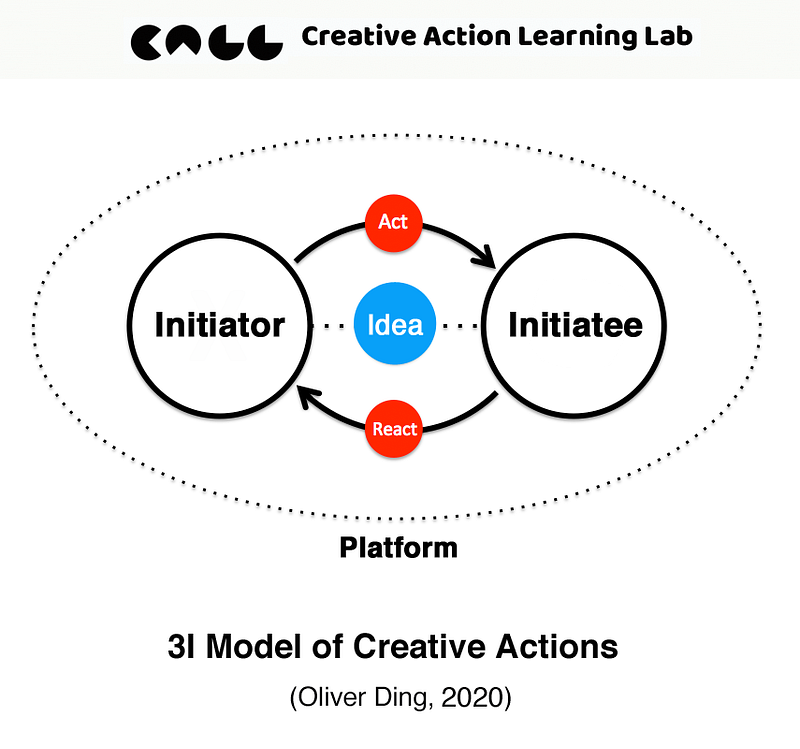
As the above discussion mentioned, acting refers to the process and there is no product that remains after acting. In order to make the “Process as Product” approach possible, I use the term “Idea” to refer to the product aspect of creative actions and use the term “Act/React” to refer to the process aspect. This pair of concepts solve the problem of disappearing of immediate experience. I further consider the “Idea” has three elements including name, form, and content. For example, the name of BED Talks is “BED Talks”, its form is “recording a short talk in bed”, and each BED talk has its own unique content. The name part is very important for communication and distribution. A name can generate a hashtag for people to follow on social media platforms, a name can help people mention a creative action in words, and a name can be a keyword for searching and finding. Most intended creation actions have a short name and hashtag, sometimes unintended creation actions don’t have a name. The screenshot below shows an example of an unintended creation action.
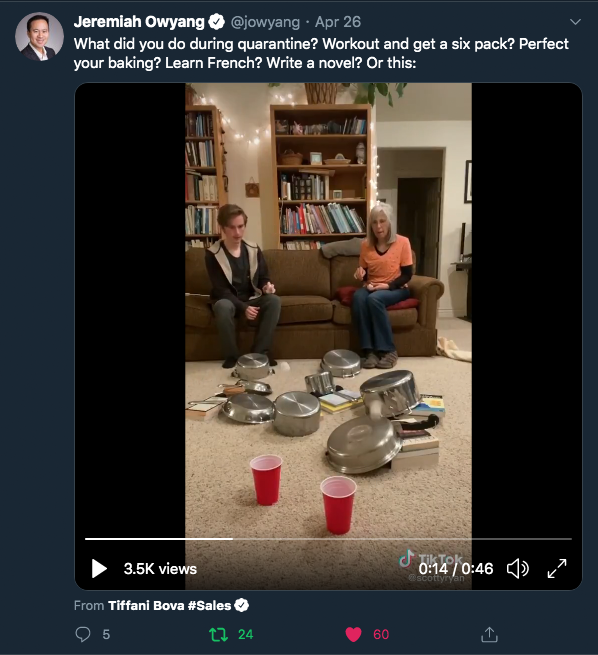
The second pair of concepts are “Initiator” and “Initiatee”. Initiator refers to a person who initiates an act that makes “a grand opening” of a creative action. Initiatee refers to a person who responds to the initiator’s “call-to-action”. For most intended creation actions, it is easy to identify the Initiator and the Initiatee behind a creative action. However, it is not easy to do the same analysis on unintended cases. We leave this challenge for the next section.
The third pair of concepts is “Act” and “React”. It can apply to both Sawyer’s performance creativity and stay-at-home challenges. For performance, the “Act” is performing and the “React” is feedback from the audience. For stay-at-home challenges, the “Act” is the original action and the “React” is the following action. For intended creation actions, the initiator might specify what initiatees should do while untended creation actions don’t have such strong intentions.
The sociocultural approach to creativity research highlights the importance of context. Researchers have been studying various contexts of creativity such as classrooms, the local cultural traditions, the performance stages, etc. I suggest “platform” as a new type of context for studying creativity, especially creative actions.
8. Initiation, Variation, and Curation
Based on the 3I model, I’d like to highlight three key issues for further discussion: Initiation, Variation, and Curation.
8.1 Initiation: perceiving and conceptualizing
The last section initiated the challenge of analyzing unintended creative actions. The solution is we can differentiate two types of initiators, one is unintended initiators and another is intended initiators.
The former perceives unique affordances between himself and his environment and takes novel actions. The latter goes further than the former and conceptualizes their experience of taking novel actions as “Idea” which includes three elements. The former stays at the experience level. The latter does more work on the reflection level such as giving it a name, identifying its form, and selecting an example of content.
Perceiving and conceptualizing require different skills. Barbara Tversky (2019) talked about “naming” in her book Mind in Motion, “There are so many more things than names for things. The basic level is about naming things in the world, though referring to things that way undoubtedly helps learning to discriminate them in the world. We can distinguish far more things than we can name or describe. Those names are usually sufficient for ordinary conversation, but it is clear that the eye takes in much more. The eye can tell how ripe the banana is and if the fabric of the sweater is soft or harsh and whether the seat of the chair is the right height and if the table is well constructed. The eye can tell if the screwdriver will fit the screw or the shirt fit the baby. The eye recognizes thousands of properties of countless numbers of objects, properties that have significance but that can’t easily be named, and even if they can, the knowing comes before the names.” (pp.38–39)
Clearly, we don’t have to name every piece of the stream of real-life experience. However, for intended initiators, there is a need to convert “experience” to “idea” in order to make an intended creative action. Based on my study, I’d like to point out there is a trick that you can convert “Other’s experience” into “Your idea” if you are a talent for both perceiving and conceptualizing.
8.2 Variation: the balance of imitation and innovation
As I mentioned above, there is a creative space between “Act” and “React”. This space refers to many deep issues such as constraint, imitation, and variation.
Sawyer once pointed out many creativity myths and one of them is “creativity is the same thing as originality”. The scientific explanation of creativity has found that many of our beliefs about creativity are inaccurate or misleading. For example, Sawyer mentioned that Western conceptions of creativity tend to equate creativity with novelty and originally. However, the high value that people place on novelty is not shared universally in all cultures (p.21). Other scholars also mentioned a similar notion, “…Western creativity tends to value the creative product more than the creative process, whereas Eastern creativity focuses on the process, personal fulfillment, and enlightenment. Additionally, although both perspectives started historically with a belief in goodness as a quality of creativity, only Eastern culture still values morality as a part of the process.” (Helfand, Kaufman & Beghetto, 2016).
Since we have learned the Four-C model, it is easy to accept the diversity of creativity. The “Act” and “React” of creative actions can be “Mini-c”, “Little-c” and “Pro-c”. For most stay-at-home challenges, we see most “React” are imitations. However, as I mentioned above, “Other’s experience” can be “Your idea”. Thus, a person can start by imitating and modifying other’s “Idea” and move to innovation. Sawyer suggested, “The sociocultural approach shows that all creativity includes elements of imitation and tradition. There is no such thing as a completely novel work. To explain creativity, we have to examine the balance of imitation and innovation, and the key role played by convention and tradition.” (2012, pp.24–25)
8.3 Curation: human opinions and machine algorithms
The issue of curation points to the appropriateness of creativity. Sawyer mentioned, “There’s a problem with including appropriateness as a criterion for creativity: because a work’s appropriateness can only be defined by a society at a given historical moment, it becomes hard to distinguish creativity from worldly success and power. In fact, the influential creativity researcher Dean Keith Simonton, a professor at the University of California at Davis, accepted the appropriateness criterion and then argued that only eminent people can be said to be creative. Due to the power of our creativity myths, many of my readers are likely to prefer a definition that allows us to incorporate unrecognized genius, people who are ahead of their time, or works that are simply so innovative that they are rejected as bizarre by the society, and thus do not meet the appropriateness criterion.” (2012, p.28)
As we discussed early, the sociocultural approach to creativity research highlights the issue of cultural context. Appropriateness is defined by social groups, and it’s culturally and historically determined. In order to understand the impact of social context, Mihaly Csikszentmihalyi and other researchers developed the Social Systems Model of creativity during the 1980s and 1990s. The diagram below shows the model contains three components: person, domain, and field. Csikszentmihalyi said, “Creativity occurs at the interface of three subsystems: An Individual who absorbs information from the culture and changes it in a way that will be selected by the relevant Field of gatekeepers for inclusion into the Domain, from whence the novelty will be accessible to the next generation.” (2014, p.166)
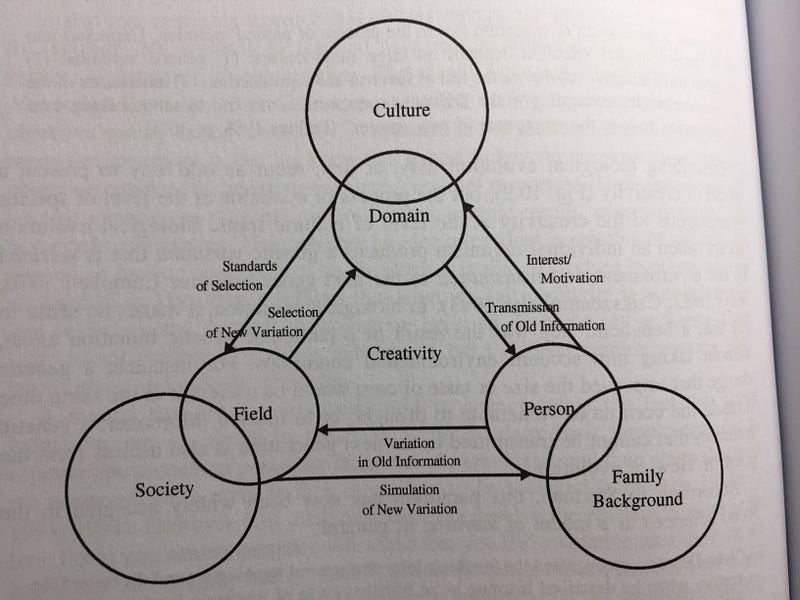
The Systems Model of creativity is suitable for traditional domains such as art, science, film, performance, etc. However, the model is reliant on a stable set of gatekeepers as a Field and a bounded Domain which requires a stabilized social structure. For BED Talks and other stay-at-home challenges, it is hard to find Field and Domain for these creative actions. Also, it is obvious that emergent digital platforms are the key contexts for these creative actions. The Field and Domain can’t explain digital Platforms.
9. Domain, Field, and Platform
The Systems Model of creativity adopts the sociocultural approach which pays attention to culture. We have to notice that Csikszentmihalyi defined the Domain as a symbolic aspect of the environment while the Field is a social aspect of the environment. He didn’t include the material aspect into the concept of Domain. Thus, he defined culture as symbolic domains, “It is useful in this context to think about cultures as systems of interrelated domains … The claim is simply that in order to understand creativity, it is useful to think of culture in this way.” (2014, pp.105–106) In other words, we have to notice Csikszentmihalyi’s “sociocultural approach” is a purely symbolic approach that doesn’t consider the material aspect as part of the culture.
Moreover, he adopted Dawkins’s idea of “Memes” as a foundational concept to explain Domain. He said, “Typically, the memes and rules that define a domain tend to remain stable over time. It takes psychic energy to learn new terms and new concepts, and in so far as psychic energy is a very scarce and necessary resource, and provided that the old terms and rules are adequate to the task, it makes sense for domains to remain stable.” (2014, p.106)
I have to point out the similarities and differences between “Memes” and “Ideas” which I used for the 3I model. Csikszentmihalyi claimed, “Memes are similar to genes in that they carry instructions for action. The notes of a song tell us what to sing; the recipes for a cake tells us what ingredients to mix and how to bake. But whereas genetic instructions are transmitted in the chemical codes we inherit on our chromosomes, the instructions contained in memes are transmitted through learning. By and large we learn memes and reproduce them without change; when a new song or a new recipe is invented, then we have creativity.” (2014, p.105) Though “Ideas” carry instructions for action too, they can be expressed in a symbolic way and a non-symbolic way. For example, if a person is doing a creative action, another person sees it. Then, the other person can learn the creative action by directly perceiving without any symbolic mediation. Also, the 3I model claims the creative process is a collaboration between the initiator and the initiatee. The initiator may define the name and form of a creative action, but the content part should be contributed by the initiatee. Thus, there is a creative space for the initiatee. The 3I model refused the view of “learn memes and reproduce them without change”. Furthermore, some “Ideas” may contain multiple layers and each layer is a creative space. For example, the “idea” behind “Try Something new for 30 days” refers to multiple layers. I adopted this idea and created a sub creative action: Meet Muse for 30 Days. I asked people to find a free academic chapter or book on the Project MUSE website for 30 days (1, 2).

Csikszentmihalyi’s view of Domain can be seen as a pure ideal frame. The view of Field also claimed that only established organizations and professional experts can evaluate creativity. This leads to two issues. First, at the practical level, it’s hard to only talk about “memes and rules” for a domain without discussing its material, technolocial, geographic, political aspects. Second, it only considers experts inside the domain for evaluating creativity and ignores the creator-consumer relationship.
Sawyer pointed out that many scientific books about creativity have been limited to those expressions of creativity that are highly valued in Western culture. For example, “Csikszentmihalyi’s 1996 book Creativity is based on interviews with approximately 100 highly creative individuals; all of these individuals create in areas highly valued in dominant cultural groups in Western, European cultures: the sciences, the fine arts.”(2012, p.6, p.8) From the Four-C model’s perspective, the Systems Model is perfect for “Big-C”, but it is hard to apply the concept of Field and Domain to “mini-c ” and “little-c”.
Though we can apply Field and Domain to “Pro-c”, we still can argue that professional domains (Pro-c domains) are not stable as Big-C domains. The reason is Pro-c domains change fast and can’t maintain a clear boundary. Also, the competition between similar domains is dynamic and it became the new normal. Thus, it is hard to only use “memes, rules, and system of notation” to identify a professional domain.
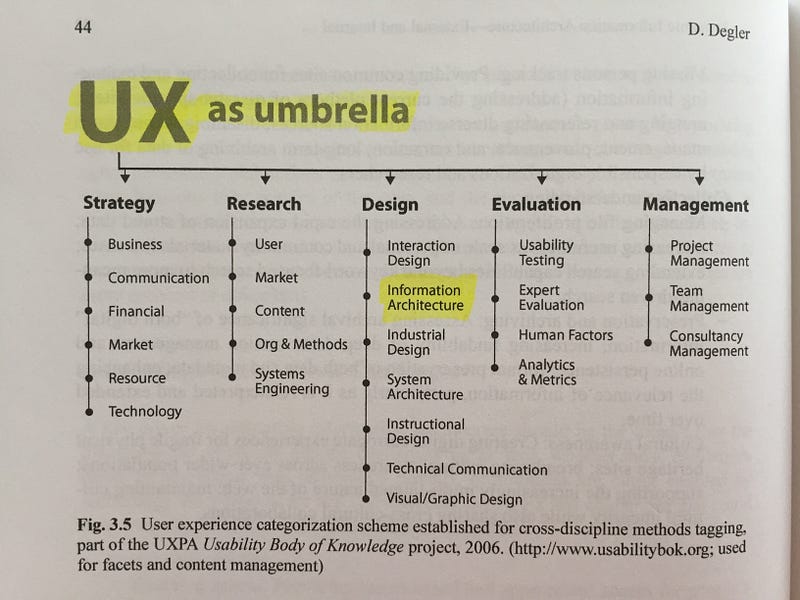
Let’s look at an example of the dynamics of professional domains. In recent years, new professional domains emerged and grew fast and also disappeared quickly, especially web/mobile practice-related domains. Information Architecture (IA) as a professional practice went popular in the mid-1990s and changed in the mid-2020s. In 2002, the Information Architecture Institute was registered as a nonprofit (501c6) organization. In 2019, their board of directors decided to dissolve the IA Institute as a legal business entity. Before the final announcement, insiders discussed reframing the domain of Information Architecture in order to adopt to the change of context. In 2013, 42 researchers, educators, and practitioners attended a workshop called “Reframing Information Architecture” at ASIS&T Information Architecture Summit in Baltimore, Maryland. Later, they collected papers and published a book for pushing the conversation further. One author suggested reframing Information Architecture as a sub-section under the User Experience umbrella. Then, we see another professional organization: User Experience Professionals Association.
Though Csikszentmihalyi talked about the change in Domains, he suggested that the change is caused by the long-term cultural evolution. For example, he identified “the game of marbles played by Swiss children” as an informal Domain. He said, “For instance Piaget gave a very detailed description of how rules are transmitted in a very informal domain: that of the game of marbles played by Swiss children. This domain is relatively enduring over several generations of children, and it consists in specific names of marbles of different sizes, colour, and composition. Furthermore, it consists in a variety of arcane rules that children learn from each other in the course of play. So even without a notation system, domains can transmitted from one generation to the next through imitation and instruction.” (2014, p.106)
Csikszentmihalyi also mentioned the example of ancient Greece. He said, “Domains tend to change when one culture is exposed to the memes of another, usually equally advanced but different culture. Thus ancient Greece, being at the cross-roads of trade between the North and the South, and between the East and the West, was influenced by ideas and practices converging from the Asiatic steppers and from Egypt, and from Europe as well as Persia and the Middle East. In Europe, similar melting pots for ideas arose later in Venice, Florence, Burgundy, the Hanseatic ports and the great sea-faring nations such as Portugal, Spain, England, and the Netherlands.” (2014, p.107)
If we pay attention to professional domains such as IA and UX, the perspective of long-term cultural evolution is too restrictive. It’s better to include the short-term cultural dynamics for considering the change of Domain in order to maintain the social system model of creativity. The short-term cultural dynamics are not only about memes and rules but also related to material, technological, geographic, and political aspects.
The second issue is about the relationship between “Person — Field” and “Creator — Customer”. Csikszentmihalyi defined “Field” as a group of gatekeepers such as teachers, critics, journal editors, museum curators, agency directors, and foundation officers who decide what belongs to a domain and what does not. (2014, p.104) For the high art and other Big-C domains, the relationship between “Person-Field” are important for creativity as the social system model claimed. However, for “Pro-c”, “mini-c” and “little-c”, we have to consider the relationship of “Creator — Customer” too.
Today, most creators can share their creative ideas and products on digital platforms and gain feedback and support from their customers directly. For example, Kickstarter and other crowdfunding platforms allow various types of creators to get funded by potential customers directly. Patreon and other membership platforms make it easy for artists and creators to get paid by their customers. Musicoin built a blockchain platform for music creators directly connecting their customers.
The Platform also brings us a new issue for discussing the evaluation of creativity: machine algorithms. In 2016, Michael Bhaskar suggested a hybrid model in his book Curation. He said, “Selection is about finding the right things. Defining what is ‘right’ in any given context can’t be boiled down to the information analysed by a machine. Which is not to say machines aren’t valuable — they are, and will be a massive part of curatorial business over the next century. But we will see a balance. Human and algorithmic curation working together, complementing each other.” (p.115)
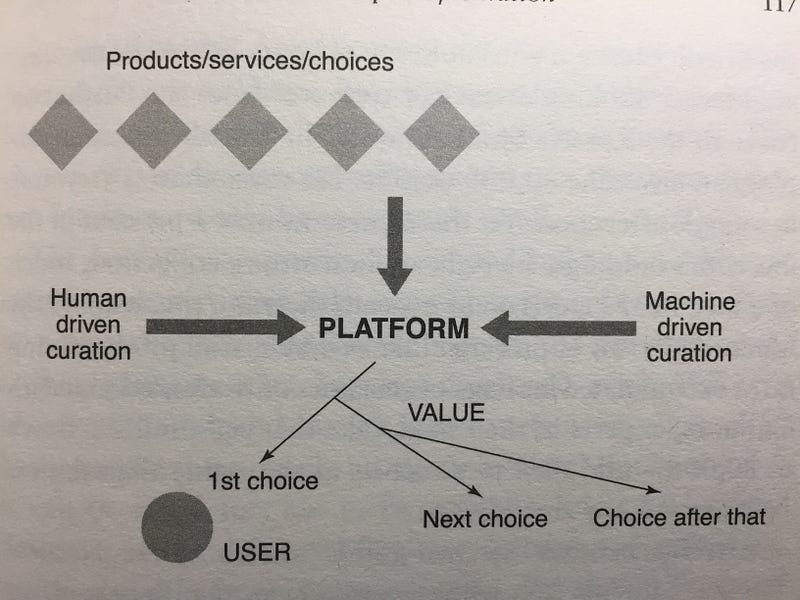
Though Bhaskar talked about business curation, his insight on the complementation between human-driven curation and machine-driven curation can be applied to discussing creative actions. For BED Talks and other stay-at-home challenges, the appropriateness is defined by both human opinions and machine algorithms.
The next section will summarize our discussion and provide a new framework for explaining creative actions and culture.
10. The NICE Way
The “Process as Product” approach has a theoretical assumption that creative action is an ongoing and unfolding event with a reciprocal relationship between initiator and initiatee in the context of a dynamic platform and other social contexts.
The 3I model describes the system of creative actions at the micro level, we still need another model for explaining the dynamic historical development of collective culture at the macro level. The above discussion about the social system model of creativity points to some limits of the model. It’s time to expand the model in order to cover more types of creative behaviors.
We also have to notice the deep assumption behind the social system model of creativity. According to Csikszentmihalyi, the model was inspired by the model of biological evolution, “The systems model of creativity is formally analogous to the model of evolution based on natural selection. The variation which occurs at the individual level of biological evolution corresponds to the contribution that the person makes to creativity; the selection is the contribution of the field, and the transmission is the contribution of the domain to the creative process. Operating within a specific cultural framework, a person makes a variation on what is known, and if the change is judged to be valuable by the field, it will be incorporated into the domain, thus providing a new cultural framework for the next generation of person. Thus, creativity can be seen as a special case of evolution. ” (2014, p.167)
Csikszentmihalyi initially developed the social model of creativity in the 1980s. In the past several decades, evolutionary biologists have developed new theories for expanding evolution by natural selection and Modern Synthesis which combines Charles Darwin’s theory of evolution and Gregor Mendel’s idea on heredity. One promising theory is niche construction theory (NCT) and its core term was coined by Oxford biologist John Odling-Smee in 1988. Odling-Smee argued that ‘niche construction’ and ‘ecological inheritance’ should be recognized as evolutionary processes. In 2011, Jeremy Kendal, Jamshid J. Tehrani, and Odling-Smee published a paper titled Human niche construction in interdisciplinary focus. They claimed, “NCT differs from standard evolutionary theory (SET) in recognizing that the evolution of organisms is co-directed by both natural selection and niche construction…NCT is put to better use when formulating new hypotheses, or building a more general evolutionary framework within which other theories can be subsumed. NCT provides mechanisms by which currently disconnected bodies of theory, such as evolutionary and developmental biology, or human cultural evolution and structuration theory can be united.”
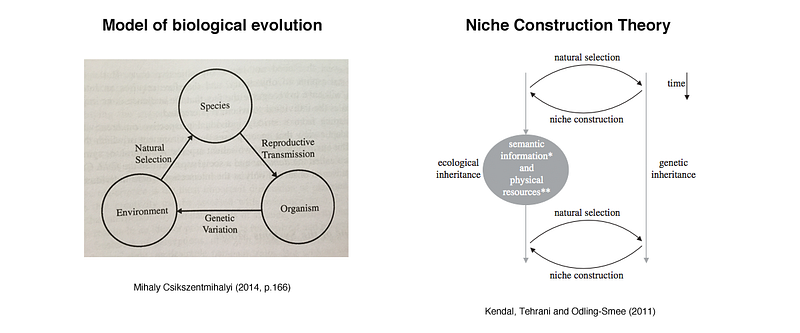
If we adopt NCT to creativity research, then we can modify the original analogy behind the social system model of creativity. The new analogy considers both natural selection and niche construction, therefore, creativity is to cultural evolution as the hybrid process of adaptation and construction. Creators don’t only submit their creations for selection by the Field and the Domain, they also can construct their environment to support their creative activities. This new perspective doesn’t propose an oppositional approach to the Systems Model of creativity, but expands its scope and amplifies its effectiveness.
In order to explain Action-based Creativity, I developed the following framework to connect individual daily experience at the micro level and collective culture at the macro level. I call it the N.I.C.E. framework. N stands for normal actions, I stands for Imagined actions, C stands for creative actions, and E stands for exemplary actions.
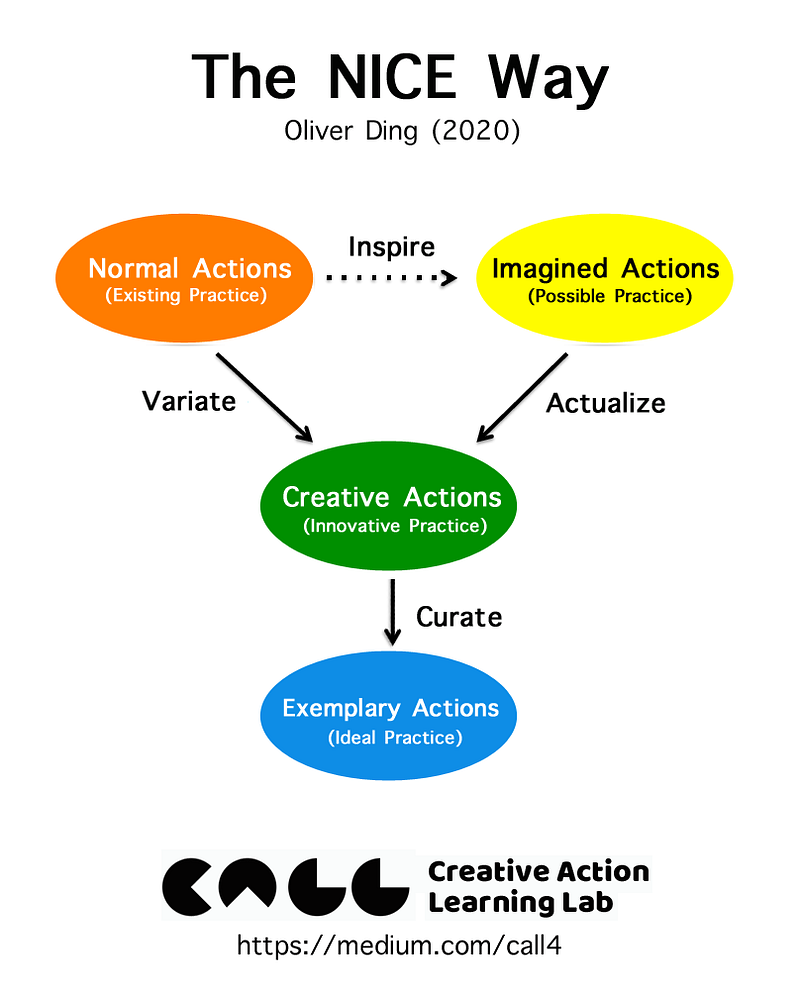
I also identified four types of transformation processes within Action-based creativity.
- Variate: from normal actions to creative actions
- Inspire: from normal actions to imagined actions
- Actualize: from imagined actions to creative actions
- Curate: from creative actions to exemplary actions
The NICE Way adoptes many theoretical concepts from the tradition of creativity research.
10.1 Variate
As we discussed early, “Variation” is a key issue of creativity research. For example, Dean Keith Simonton developed a theory called chance-configuration theory by adopting Donald Campbell’s (1960) blind-variation and selective-retention model (BVSR) of creative thought. (1988, p.3)
For Action-based Creativity, the focus is on the transformation between existing practice and innovative practice. As I mentioned before, “Other’s experience” can be transformed into “Your idea”. We see the variation from the above discussion about TED, BED, BIL, and many stay-at-home challenges.

In the age of the platform, we can see more actions online (‘other’s experience’) since the rise of video sharing technologies. We have more opportunities to see records of real-life shared by people around the world.
10.2 Inspire
The difference between imitation and innovation is imagination which is a classic issue of traditional creativity research approach: individual approach and cognitive cognition. From the perspective of cognitive psychology, researchers focus on several topics such as Conceptual Combination, Conceptual Expansion, Metaphor, Analogy, and Mental Models (Ward, Smith & Vaid, 1997).
Outside the domain of psychology, cognitive linguists developed another approach for understanding Conceptual Metaphors and Conceptual Blending. I personally like the Conceptual Blending theory developed by Gilles Fauconnier and Mark Turner (2002, 2014).
The picture below shows a 32,000-year-old ivory figurine called lionman. Mark Turner used it as an example to introduce the Blending theory in his book The Origin of Ideas (2014, p.11).
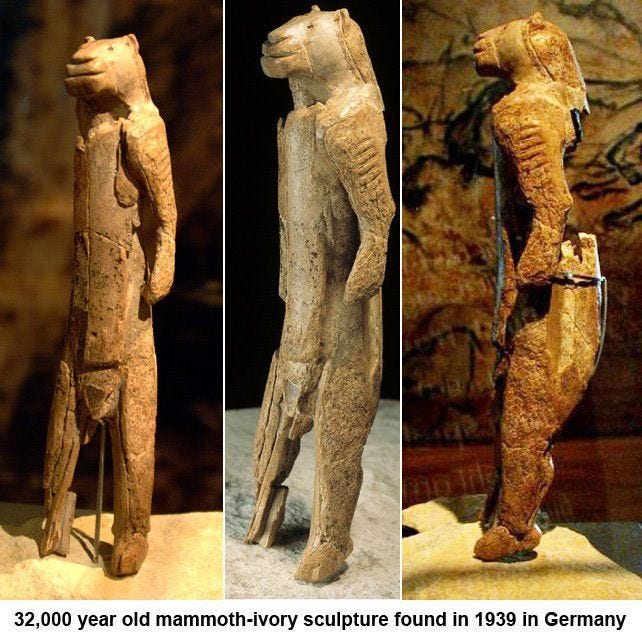
Mark Turner said, “…what the figurine of the lionman most clearly shows us is the mental ability to blend different concepts: Lion and man are not merely held in mind at the same time; they also used to create a new, blended concept, a lionman, which is neither a lion nor a man, exactly.”(2014, pp.11–12). The blending theory was based on Gilles Fauconnier’s Mental Spaces theory (Mental Spaces, 1985). Turner commented on the lionman case, “The mental web for this thinking contains a mental space for lion, a mental space for man, and a mental space for their blend, the lionman. The lionman has elements that belong to neither lion nor man. We can carry that blend with us, hold it in mind, and use it to think about our identity and our place in the world.” (2014, p.13)
It is a challenge to apply blending theory to creative actions because the theory is based on “concept”. As we learned from Barbara Tversky, “there are so many things than names for things.” As Tversky argued in her book Mind in Motion (2019), spatial thinking enables us to draw meaning from our bodies and their actions in the world; from shape, size, and relation; from transformation, trajectory, and speed.
10.3 Actualize
The “actualize” refers to two ideas, one is “Prototyping” which means making an early model for testing an idea, and another is “actualization of affordances”. The former is popular in design thinking, engineering, software programming, and other domains. Since many people are familiar with the concept of “Prototyping”, I’d like to focus on the latter idea “actualization of affordances” which is a concept of Affordance Theory from ecological psychology.
What’s Affordance? Let’s have a look at the original definition made by ecological psychologist James J. Gibson, “The affordances of the environment are what it offers the animal, what it provides or furnishes, either for good or ill. The verb to afford is found in the dictionary, but the noun affordance is not. I have made it up. I mean by it something that refers to both the environment and the animal in a way that no existing term does. It implies the complementarity of the animal and the environment.” (1979, p.119)
The affordance concept describes the possibilities for action that the environment including objects and other people offer for specified persons. The theory is complex, we only need to focus on the “potential” and “real”. Affordance is potential and Action is real, thus, there is a transformation process between “affordance” and “action”, ecological psychologists call this process “actualization of affordances”. Since the environment offers so many affordances, any person has to pick up one or some of affordances from many affordances and actualize them in a particular situation.
In studying creative actions, we pay attention to what kind of affordances can lead to “Novelty” and “Surprise”. The picture below shows an example of “actualization of affordances”.
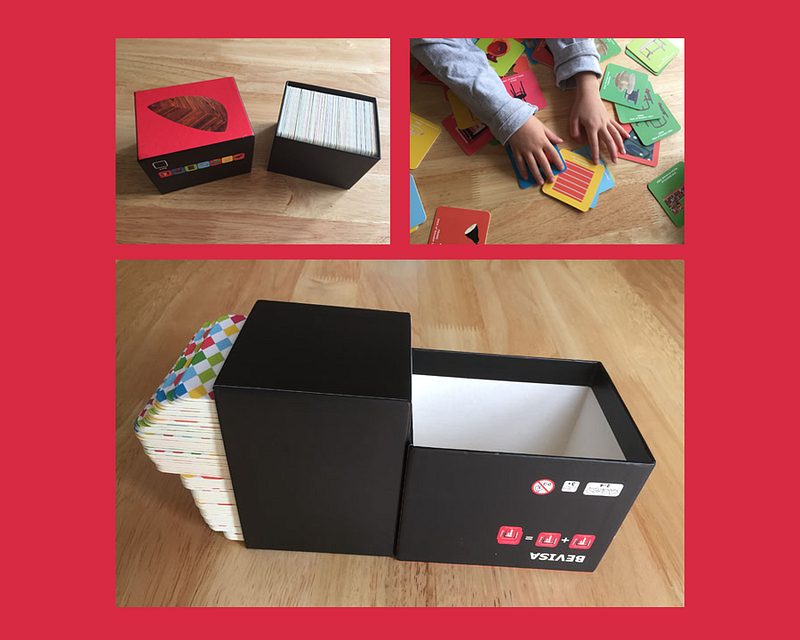
Two years ago, my son came to my office and I gave him IKEA Bevisa memory cards. Usually, people play the memory card for training memory. You turn over any two cards. If the two cards match, then keep them. If they don’t match, turn them back over. If you can remember what was on each card and where it was, you can quickly match many cards and win the game. However, what my son played is not the normal way. He just randomly played these cards as “cards” instead of “memory cards” and turned them into a “truck”.
The side of these cards offers an affordance for shaping, my son actualized this affordance and surprised me. He didn’t know the term affordance but the theory exactly explained his behavior.
10.4 Curate
Inspired by Csikszentmihalyi’s social system model, I consider a new type of action called Exemplary Actions which represents Ideal Practice and highlights the morality and ethics of studying creative actions.
The transformation process between Creative Actions (Innovative Practice) and Exemplary Actions (Ideal Practice) refers to Curate, Curation, Curator, and Curativity. In the age of platforms, the curation issue has become more complex than before. Individuals, organizations, and platforms have their own agency of curativity and may compete with each other.
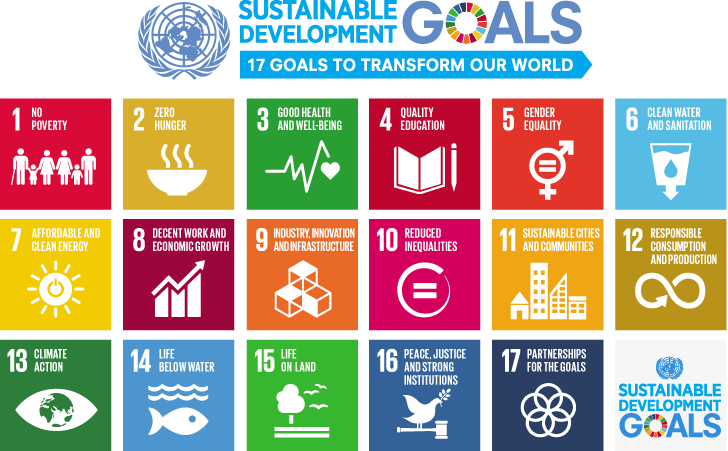
While the Exemplary Actions (Ideal Practice) respects cultural tradition, it also pays attention to the sustainable future of our world. For example, if a creative action can directly or indirectly contribute to one or more of 17 sustainable development goals, we can definitely claim it as an exemplary action.
In 1975, Charles A. Lave and James G. March published a book titled An Introduction To Models in The Social Sciences. They suggested an interpretation of the evaluation of models, “What we present here are some rather simple points of view about truth, beauty, and justice that we, and others, have found helpful in heightening the pleasures and usefulness of model building in social science.” Though they talked about building models in social science, I suggest that we can adopt this simple way to evaluate Exemplary Actions (Ideal Practice).
According to Hans Ulrich Obrist (2014), “curating” means “caretaking”. Obrist reviewed the history of “curate” in his book Ways of Curating, “In ancient Rome, curatores were civil servants who took care of some rather prosaic, if necessary, functions: they were responsible for overseeing public works, including the empire’s aqueducts, bathhouses and sewers. In the medieval period, the focus shifted to a more metaphysical aspect of human life; the curatus was a priest who took care of the souls of a parish. By the late eighteenth century, curator came to signify the task of looking after a museum’s collection. Different kinds of caretaking have sprung from this root word over the centuries, but the work of the contemporary curator remains surprisingly close to the sense in curare of cultivating, growing, pruning and trying to help people and their shared contexts to thrive.” (p.25)
In the age of platforms, some creative actions could spread quickly around the world. It is necessary to consider Curativity as an important issue for the practice and theory of creative actions. Though the “Creative Actions — Exemplary Actions” part doesn’t use “Field” and “Domain” terms, I believe it still remains the spirit of Curativity which is behind the social systems model of creativity. Thus, I believe the NICE framework can work together with the social systems model of creativity.
The curating of Exemplary Actions (Ideal Practice) is about maintaining and growing both creativity and greatness. In this way, the NICE framework aims to balance the past and the future, the short-term influence and the long-term influence, the local impact and the global impact.
11. Action-based Creativity
Sawyer argued, “Everybody in a culture participates in its reproduction and its evolution — not only special figures like musicians or storytellers but everyone. Cultural creativity is found in the practices of everyday life — eating, sleeping, everyday conversation — not only in a ritual or shamanic performance. Creativity is a common part of everyday life; culture can’t survive without continued improvisation and embellishment.” (2012, p.138–139)
Creative Actions are an essential part of cultural creativity. I also use another term called Action-based Creativity which is similar to Creative Actions, but it goes beyond the Creativity Actions because it also considers Action-based Creative Content. In other words, Creative Actions are a piece of creativity research, but Action-based Creativity is a new perspective for rethinking creativity. These two terms are not two sides of the same coin.
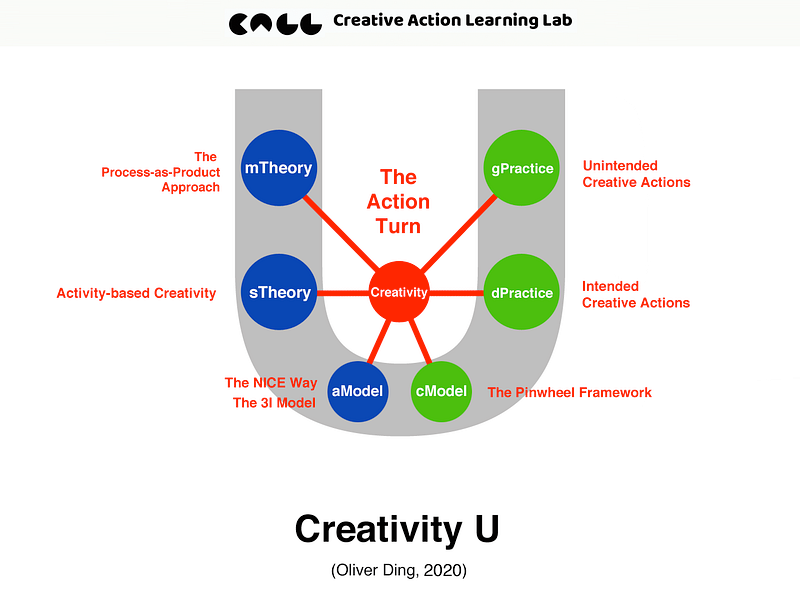
Let’s use the HERO U diagram to visualize these intertwined ideas. Unintended Creative Actions are general practice (gPractice) and Intended Creative Actions are domain practice (dPractice). The Pinwheel framework is a concrete model (cModel) while the 3I model and the NICE way are abstract models (aModel). Action-based Creativity can be seen as a specific theory (sTheory) and the Process as Product approach is a meta-theory (mTheory).
In recent years, Vlad Petre Glaveanu has developed a similar account of an action-centered approach to creativity research. Following the Five A’s framework I mentioned above, Glaveanu (2016) went further to propose “a cultural-developmental psychology of creating” with a radical argument, “Creativity, will be argued here, is not a thing but a quality of human action. It is not static, but unfolds in irreversible time. Finally, it is not singular but plural and relational, cultivated within interaction and communication.” (p.206)
The Process-as-Product approach and 3I model have a weak ontological claim on “Creator” since they shift the focus from Creative Individuals to Creative Actions. This view echoes a statement by Glaveanu (2016), “Creativity is not a personality trait, a cognitive process, a feature of objects or ideas, a neural or social structure for as much as it relates to the activity of brains, individuals, groups, and society; creativity is, first and foremost, a quality of human action. To create means to act in a flexible, novel, and meaningful way in a given context. If we take this short definition seriously, then talking about the creativity of a person or object doesn’t make sense. It is the doing of persons and making of objects that should be called creative; creators and their resulting creations are merely demonstrating or bearing the mark of creativity, respectively.”(p.210)
We have to notice that Glaveanu’s “cultural-developmental psychology of creating” is a meta-theory level argument. He is challenging the foundation of the psychology of creativity by adopting cultural psychology developed by Michael Cole and some radical ideas from contemporary cognitive science. At the lower level, there is an obvious difference between his Five A’ framework and the 3I model, and the NICE framework. I call Glaveanu’s approach “Action-centered Creativity” in order to compare his view and my view on “Action-based Creativity”. I started from real cases of Creative Actions and developed an approach for studying this type of creative behavior while Glaveanu started from philosophical thinking on Creative Actions.
At the methodological level, Glaveanu suggested a turn from traditional “an individual, static, a developmental view of creativity specific for analytical-positivist approaches” to “a holistic-constructionist paradigm”. Inspired by Michael Cole, Glaveanu also considered development at a historical level (sociogenesis), at a personal level (ontogenesis), and in the moment-to-moment interactions between a person and the world (microgenesis) (2106, pp.206–207). According to Michael Cole (1996), the cultural psychology or the cultural-historical approach has several unique characteristics on the analysis level. For example, it “seeks to ground its analysis in everyday life events”, “draws upon methodologies from the humanities as well as from the social and biological sciences” and “insists on the importance of the ‘genetic method’ understood broadly to include historical, ontogenetic, and micro genetic levels of analysis.” (p.104)
I adopt several methods for studying Action-based Creativity. For example, the Action Research method. I was initially influenced by Chris Argyris’ philosophical thinking through reading his book Action Science which is a method for studying organizational learning. According to Rory O’Brien, “Action research is known by many other names, including participatory research, collaborative inquiry, emancipatory research, action learning, and contextual action research, but all are variations on a theme…Several attributes separate action research from other types of research. Primary is its focus on turning the people involved into researchers, too — people learn best, and more willingly apply what they have learned, when they do it themselves. It also has a social dimension — the research takes place in real-world situations, and aims to solve real problems.” Another method is Ecological Physics Method which is inspired by ecological psychology. Though these methods are different from Glaveanu’s cultural-developmental approach, both approaches respect non-experimental methods and prefer ecological or contextual methods.
Sawyer said, “In everyday creativity, the process is the product.” (2012, p.296) From the perspective of Action-based Creativity, everyday life is the domain.
12. What’s Next?
I will move to empirical research and collect more examples of creative actions in order to test the 3I model and the NICE way.
I am also working on connecting these models with my other ideas such as Curativity Theory, Social Platform Experience Design (#SocialPxD), and HERO U — A New Framework for Knowledge Heroes. Maybe it is time to coin a new term called “Platform Creativity” for curating related ideas together.
If you like Action-based Creativity, you are welcome to join CALL (Creative Action Learning Lab).
You are most welcome to connect via the following social platforms:
Twitter: https://twitter.com/oliverding Doowit: https://doowit.co/profile/gm0k2ax9 Linkedin: https://www.linkedin.com/in/oliverding
Citation
For attribution in academic contexts, please cite this work as:
Oliver Ding, “The NICE Way and Creative Actions”, https://readmedium.com/cf4c79ef19b2, Houston (2020).
License
This work is licensed under the Creative Commons Attribution-NonCommercial-ShareAlike 4.0 International (CC BY-NC-SA 4.0) License. Please click on the link for details.
References
O’Brien, R. (2001). An overview of the methodological approach of action research. In Roberto Richardson (Ed.), Theory and practice of action research. João Pessoa, Brazil: Universidade Federal da Paraíba. (English version) Available: http://www.web.ca/~robrien/papers/arfinal.html (Accessed 7/7/2020)
Simonton, D. K. (2012) Taking the u.s. patent office criteria seriously: A quantitative three-criterion creativity definition and its implications, Creativity Research Journal, 24:2–3, 97–106, DOI: 10.1080/10400419.2012.676974
Acar,D., Burnett, C., & Cabra, J. F. (2017) Ingredients of creativity: Originality and more, Creativity Research Journal, 29:2, 133–144, DOI: 10.1080/10400419.2017.1302776
Beghetto, R.A. & Kaufman, J.C. (2014). Classroom contexts for creativity. High Ability Studies. 25.10.1080/13598139.2014.905247.
Peirce, C.S. (1885) One, two, three: Fundamental categories of thought and of nature. In Hoopes, James (Ed.), Peirce on signs: Writings on semiotic by Charles Sanders Peirce (1991, p.183). NC: University of North Carolina Press.
Sawyer, R. K. (1992) Improvisational creativity: An analysis of jazz performance, Creativity Research Journal, 5:3, 253–263, DOI: 10.1080/10400419209534439
Kaufman, J.C., & Beghetto, R.A. (2009). Beyond big and little: The four c model of creativity. Review of General Psychology, 13, 1–12.
Csikszentmihalyi, M. (1996). Creativity: Flow and the psychology of discovery and invention. New York: Harper/Collins.
Glaveanu V.P. (2013). Rewriting the Language of Creativity: The five A’s framework. Review of General Psychology , 17(1), 69–81,doi: 10.1037/a0029528.
Glaveanu V, Lubart T, Bonnardel N, Botella M, de Biaisi P-M, Desainte-Catherine M, Georgsdottir A, Guillou K, Kurtag G, Mouchiroud C, Storme M, Wojtczuk A and Zenasni F (2013) Creativity as action: findings from five creative domains. Front. Psychol. 4:176. doi: 10.3389/fpsyg.2013.00176
Butman, J. (2013). Breaking out: How to build influence in a world of competing ideas. Boston: Harvard Business Review Press.
Sawyer, R.K. (2012). Explaining creativity: The science of human innovation. Oxford: Oxford University Press.
Tversky, B. (2019). Mind in motion: How action shapes thought. New York: Basic Books.
Helfand M., Kaufman J. C., & Beghetto R. A. (2016) The four-C model of creativity: Culture and context. In Glaveanu, V.P. (Ed.), The Palgrave Handbook of Creativity and Culture Research (2016, p.15). Landon: Palgrave Macmillan.
Csikszentmihalyi, M. (2014). The systems model of creativity: The collected works of Mihaly Csikszentmihalyi. New York: Springer.
Bhaskar M. (2016). Curation: The power of selection in a world of excess. London: Piatkus.
Kendal J., Tehrani J. J. & Odling-Smee J. (2011) Human niche construction in interdisciplinary focus. Phil. Trans. R. Soc. B 366: 785–792, doi: 10.1098/rstb.2010.0306.
Simonton, D. K. (1988) Scientific genius: A psychology of science. New York: Cambridge University Press.
Ward T. B., Smith S. M., & Vaid J. (1997) Creative thought: An investigation of conceptual structures and processes. DC: American Psychological Association.
Fauconnier G. & Turner M. (2002) The way we think: Conceptual blending and the mind’s hidden complexities. New York: Basic Books
Turner M. (2014) The origin of ideas: Blending, creativity, & the human spark. New York: Oxford University Press.
Gibson, J.J. (1979/2015). The ecological approach to visual perception: classic edition. New York: Psychology Press. (originally published in 1979).
Lave C. A. & March J. G. (1975). An introduction to models in the social sciences. Lanham: University Press of America, Inc.
Obrist, H. U. (2014). Ways of curating. New York: Farrar, Straus and Giroux.
Glaveanu V.P. (2016) The psychology of creating: A cultural-developmental approach to key dichotomies within creativity studies. In Glaveanu, V.P. (Ed.), The Palgrave Handbook of Creativity and Culture Research (2016). Landon: Palgrave Macmillan.
Michael Cole (1996). Cultural psychology: A once and future discipline. Cambridge, Massachusetts: The Belknap Press of Harvard University Press.
Argyris, Chris; Putnam, Robert; Smith, Diana McLain (1985). Action science: Concepts, methods and skills for research and intervention. San Francisco, CA: Jossey-Bass.


