
The Knowledge Curation Toolkit #2: WXMY for Interdisciplinary Curation
The advanced version of Theme U
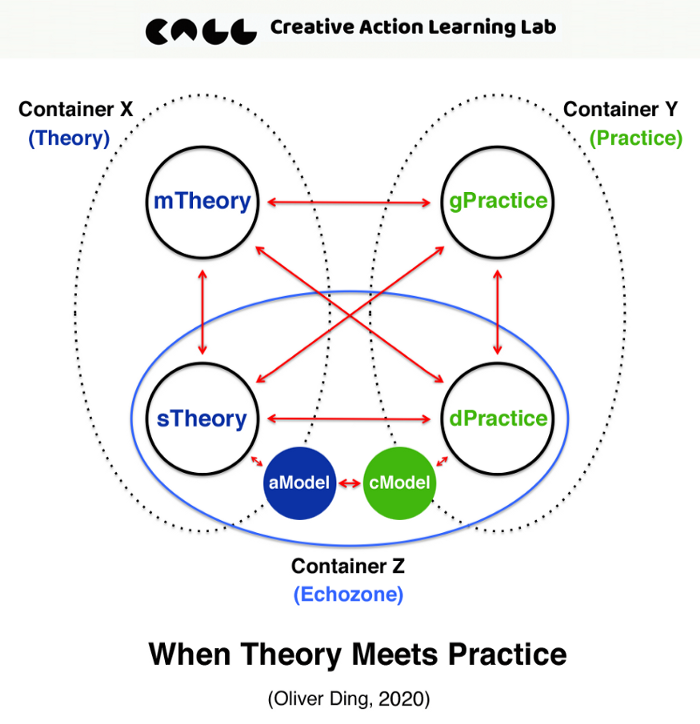
Several days ago, I introduced the Theme U diagram and the HERO U diagram for Single-theory Curation.
In fact, the Theme U diagram is a simple version of the WXMY diagram. See the HERO U diagram below.
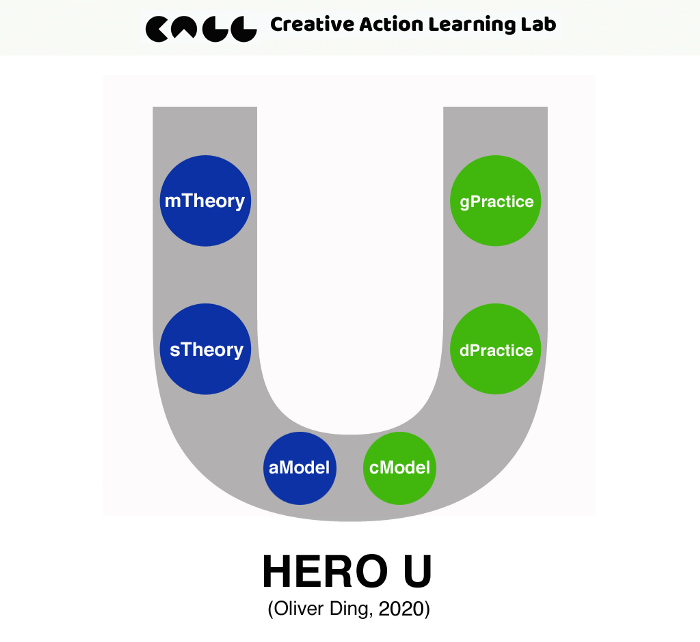
What’s the difference between the HERO U diagram and the above “When Theory Meets Practice” diagram since both two diagrams use six types of “objects of knowing”?
- They use different backgrounds.
- The HERO U diagram uses the simple U shape as background while the “When Theory Meets Practice” diagram uses three containers as background.
- The HERO U diagram doesn’t use lines to connect six types of “objects of knowing”.
- The “When Theory Meets Practice” diagram uses lines to connect six types of “objects of knowing”.
This article will focus on the WXMY diagram which is a meta-diagram for making the “When Theory Meets Practice” diagram.
Contents
1. Interdisciplinary Curation 2. The “WXMY” Diagram 3. Spatial Structures of WXMY 4. The Echozone 5. Case Study: Personal Innovation 6. Case Study: Knowing-for-Us 7. Case Study: The Double Gird-Group Framework 8. Using WXMY to expand Interactive Zone 9. Summary 10. CALL for NEXT: The “Life Strategy” Project
1. Interdisciplinary Curation
Single-theory Curation is about understanding the landscape of a theory, a theoretical concept, or a theory/concept-related practice such as learning, teaching, creating, etc.
The “When Theory Meets Practice” diagram is perfect for Single-theory Curation. But the WXMY diagram can be used for other purposes such as Interdisciplinary Curation.
Interdisciplinary Curation is about discovering new creative spaces by connecting ideas from two or more disciplines together. For example, the diagram below is an example of developing a new theoretical concept in the interdisciplinary approach.
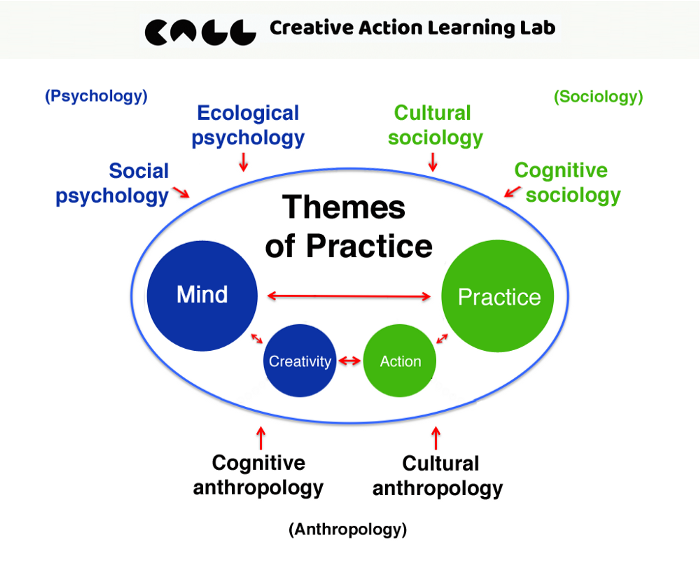
In 2019, I developed the idea of “Themes of Practice” in order to discuss the “meaning” of the meaningful whole for my book Curativity: The Ecological Approach to Curatorial Practice. I realized the notion of “Theme” is a great tool for curating experiences and actions.
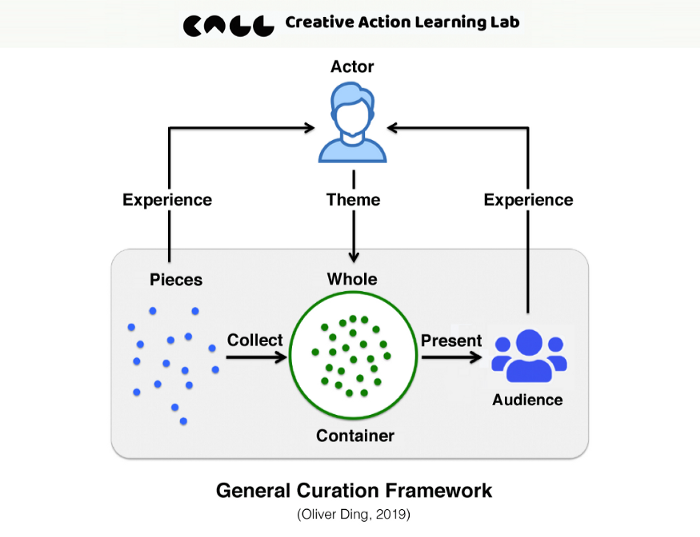
As an application of Curativity Theory, the above General Curation Framework represents the structure and dynamics of curatorial practice. The activity of curatorial practice aims to collect pieces of things into a meaningful whole in order to present a theme to a group audience. There are three immanent contradictions within the activity of curating: “pieces — whole”, “things — themes” and “curator — audience”. For the first dichotomy, I use the concept of “Container” to balance the pieces and whole. For the last dichotomy, I use the notion of “Everyone A Curator” to deconstruct the concept of “Curator” because I want to claim that the activity of curating is a general social practice.
The dichotomy of “things — themes” refers to two classical great debates of social science: “mind-matter” and “individual — collective”. After reviewing the concept of “theme” in various disciplines such as Cultural Anthropology, Counseling Psychology, Cognitive Psychology, and the Philosophy of Science, I developed a new concept “Themes of Practice” to propose a process view of “Theme”.
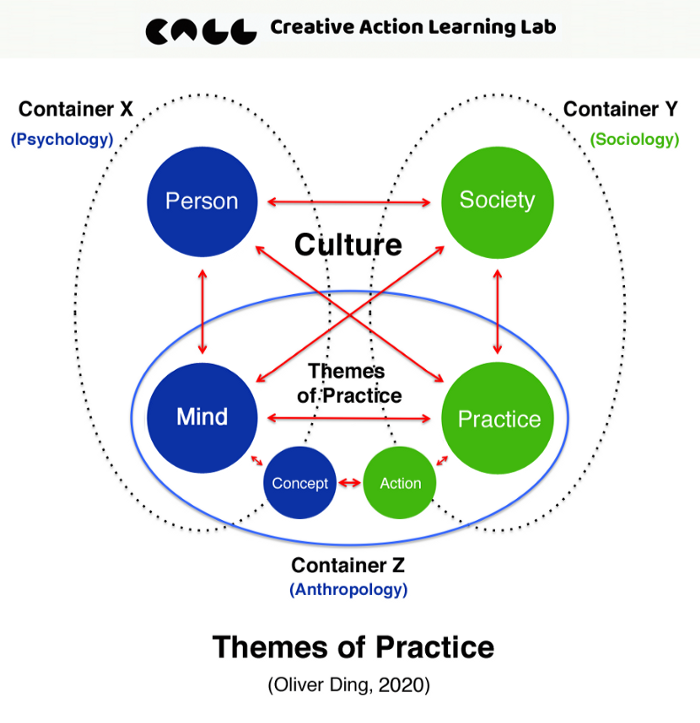
Anthropologist Morris Opler (1945) developed a theoretical “theme” for studying culture. Career counseling therapists and psychologists also developed a theoretical concept called “life theme.” If we put culture themes and life themes together, we see a “great debate” of social science: “individual — collective.” The above diagram visualizes the “concept network” or “idea ecology” of “Themes of Practice”.
We can also use the WXMY diagram for similar purposes such as connecting two domains or two sides.
2. The “WXMY” Diagram
In August 2019, I read several academic papers about a debate between Jim Garrison who is a philosopher and Dewey scholar, and Reijo Miettinen who is an Activity theorist and Vygotsky scholar. They discussed the relationship between Deweyan pragmatism and Cultural-historical activity theory which was founded by Soviet psychologist Lev Vygotsky.
Garrison argued that Activity theory adopted a dualist approach because IT has an internal/external notion. He suggested that Dewey’s transactional theory of action is a better solution for understanding human activity. Reijo Miettinen disagreed with Garrison, he said that Activity theory is just as committed to anti-Cartesian monism as Dewey’s conception and he believed that Activity theory can supply useful conceptual tools for transcending the dualism of the internal and the external.
This reading experience inspired me to create the WXMY diagram. The embedded file below is the 1.0 version which uses “Camp X”, “Camp Y” and “Camp Z” because the 1.0 version focuses on social groups. Now, I expanded it to any kind of entity, so I changed “Camp” to “Container”.
For the academic debate between Jim Garrison and Reijo Miettinen, X means John Dewey and X’ means Jim Garrison, Y means Lev Vygotsky, and Y’ means Reijo Miettinen. The debate means Camp Z.
Later, I created the diagram below and named it “When X Meets Y” (WXMY).
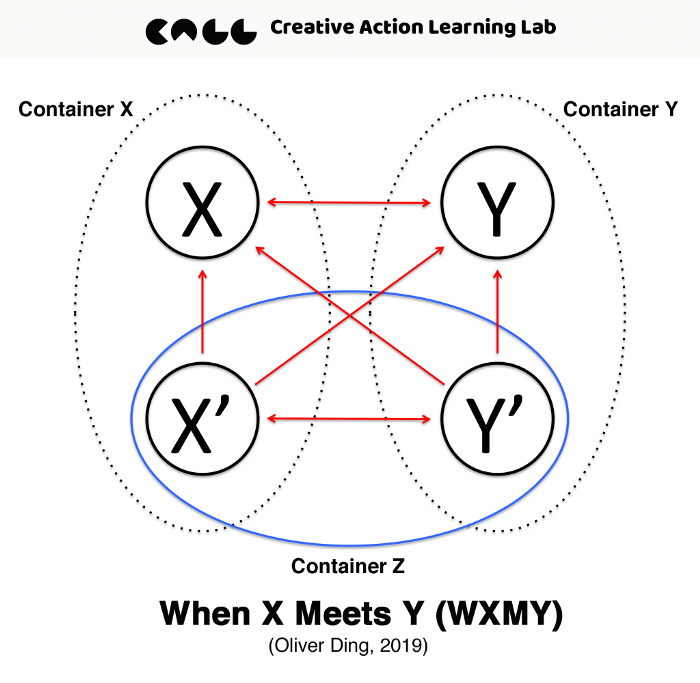
The WXMY diagram says nothing about practical issues, but pure abstract relations between two groups of entities. Container X means one group which contains entity X and its related entity X’. Y and its related entity Y’ form another group Container Y in the same way. When X meets Y, there is a new group called Container Z which emerges from the process of coupling, connecting, competing, cooperating, and interacting between X and Y.
The WXMY diagram is not a practical framework for directly solving a domain problem, but it can generate domain diagrams if you use it to visualize your ideas about a particular issue in a special context. By using the WXMY diagram, you can create your framework. The WXMY diagram is a meta-diagram and you can use it to create as many domain-specific diagrams as you want.
I also compared the WXMY diagram with Semiotic Square and Conceptual Blending. You can find more details in When X Meets Y (WXMY): A diagram for visualizing boundary innovation and beyond.
3. Spatial Structures of WXMY
Why do we need to pay attention to the spatial structure of a meta-diagram?
The notion of “meta-diagram” considers a special type of diagram as an independent thing that doesn’t have to be a representation of an existing theory or model. For example, the 2x2 matrix diagram is a meta-diagram that doesn’t refer to any concrete theory or model such as BCG’s Growth-share matrix.
A meta-diagram is for making domain-specific diagrams or knowledge frameworks. The uniqueness of a meta-diagram is defined by its unique spatial structure which offers unique Graphic Space Affordances.
In order to discuss diagramming, I coined the term “Graphical Space Affordances” for the integrated framework for studying knowledge diagrams. Originally, I only used it to discuss the affordances of white space in a graphic. Now I expand the concept from white space to all spatial structures of a graphic.
The perspective of “Graphical Space Affordances” encourages people to Use a meta-diagram in an innovative way for creative thinking.
The basic spatial structure of the WXMY diagram is the following three-container model:
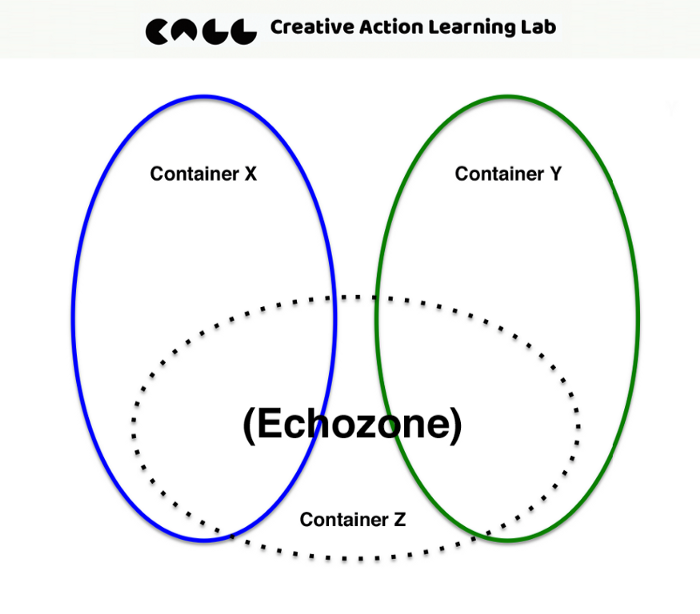
The above model shows three containers and the middle container is also called Echozone which is the first aspect of the WXMY diagram.
The concept of Container is the core of the Ecological Practice approach. By adjusting the quality and quantity of the Container, we can create advanced frameworks for discussing complex phenomena. The quality of the Container can be potential and actual, and the quantity of the Container can be one or two. If we develop a new framework with one potential container and two actual containers, the outcome is the above diagram.
I named the potential container (Container Z) Echozone which refers to a creative space containing echoes between Container X and Container Y. The term “Echo” of “Echozone” refers to a dialogue between two containers.
We can roughly give a Name to the third container. For example, I named the Echozone of the diagram below “Service Thinking”. The term “Service Thinking” is just a name and it points to a possible meaning. We don’t know the meaning of “Service Thinking”, but we know we can figure out its meaning later.
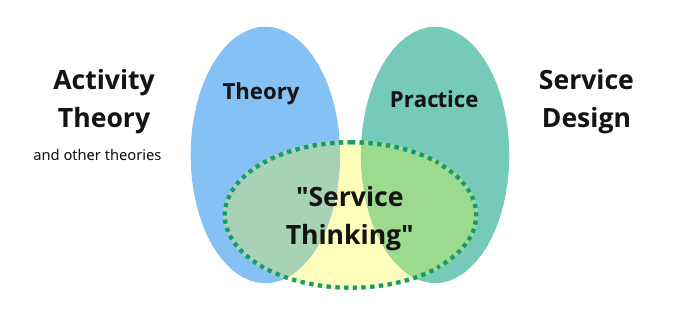
You can also change the name of the Echozone too.
The second aspect of the WXMY diagram is the pairs of concepts of “Figure — Ground”. The space inside the Echozone is “Figure” while the space outside the Echozone is “Ground”. For most cases of using the WXMY diagram, we pay attention to the “Figure” which is the creative space for dialogues. See the example below.
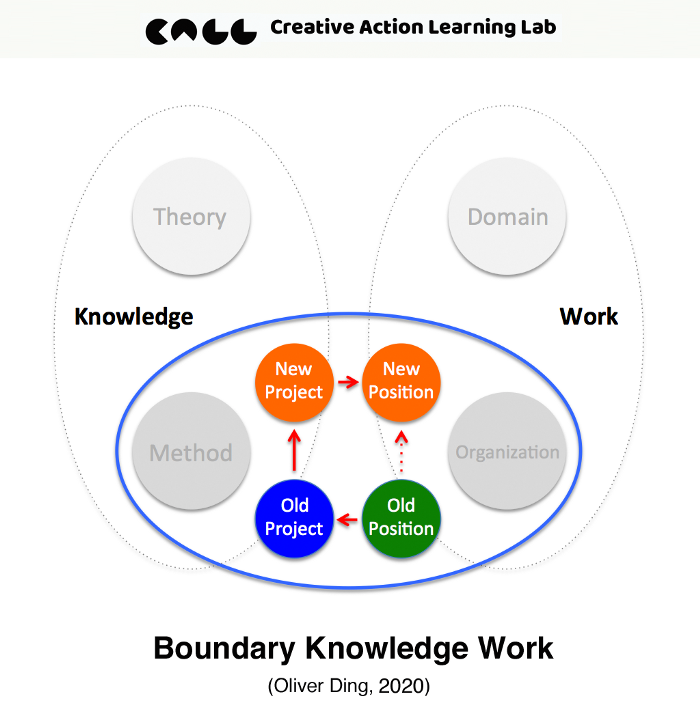
The third aspect of the WXMY diagram is Symmetry. You can define the relationship between two items inside Container X, and you have to apply the same or similar type of relationship to Container Y in order to keep symmetry.
For example, the above diagram uses “Knowledge” to refer to Container X, two items are “Theory” and “Method”. Container Y is called “Work” and two items are “Domain” and “Organization”. Now we see a similar relationship between items: high-level item v.s. low-level item.
The relationship between two items can be two categories such as people and objects. See the diagram below.
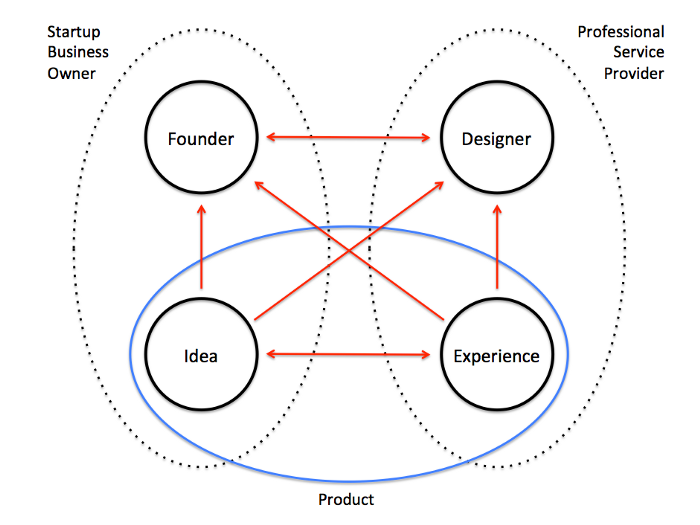
In the above diagram, “Idea” belong to “Founder” while “Experience” belongs to “Designer”.
The fourth aspect of the WXMY diagram is White Space. While the standard model of the WXMY diagram only displays six items and several red lines, you can 1) remove Red Lines, and 2) add items in White Space.
For example, the diagram below is the full version of the above “Boundary Knowledge Work” diagram. I added the word “Culture” in the “Ground” and the “Figure” was labeled with the concept of “Themes of Practice”.
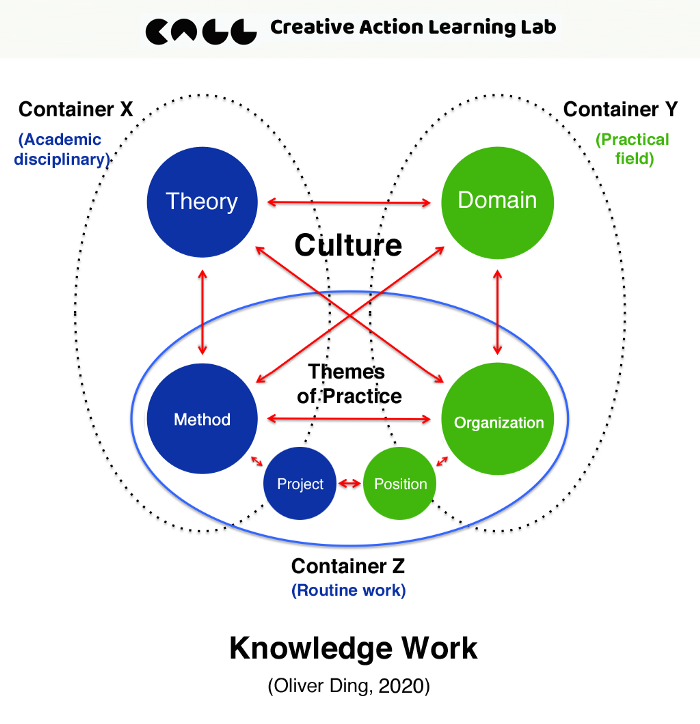
I also added two new elements to the Knowledge Work diagram: Culture and Themes of Practice. Culture refers to general ideas, values, and social norms at the macro level. In order to connect the collective culture themes and personal life themes, I coined the term Themes of Practice to describe the mechanism of transformation of social themes: One of a person’s personal life themes can be adopted by others and becomes a member of the collective culture themes. On the other side, a cultural theme can be adopted by a person in her daily life and becomes her personal life theme.
I used the above Knowledge Work diagram to discuss the HCI researcher /Activity Theorist Bonnie A. Nardi’s career development. You can find more details in Activity U (III): Bonnie Nardi’s Choices and Boundary Knowledge Work.
You can also use White Space to highlight more details of a container. See the diagram below.
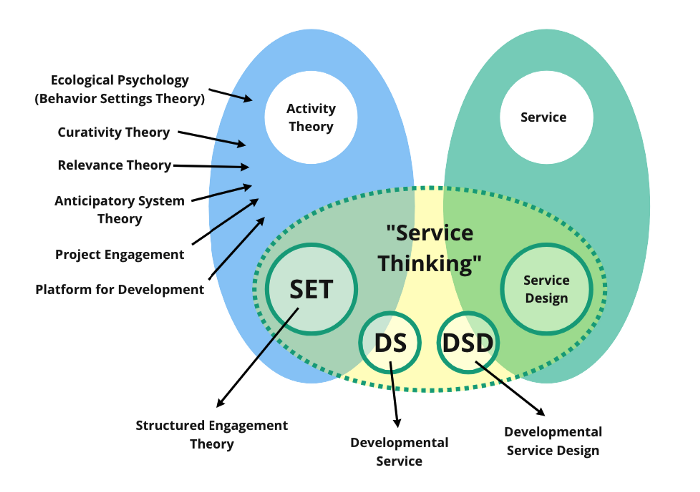
Usually, I put four items inside the Echozone. However, I also add six items inside there. See the example below.
If you use a large paper or a digital whiteboard, you can add as many as you want inside the Echozone.
4. The Echozone
Since the Echozone is the primary thing of the WXMY diagram, we should pay attention to the power of the Echozone.
One way of using the Echozone is to expand it with a new diagram. Let’s use the “Founder — Designer” diagram as an example. After reading several articles about communication between startup teams and professional designers, I made the diagram below.
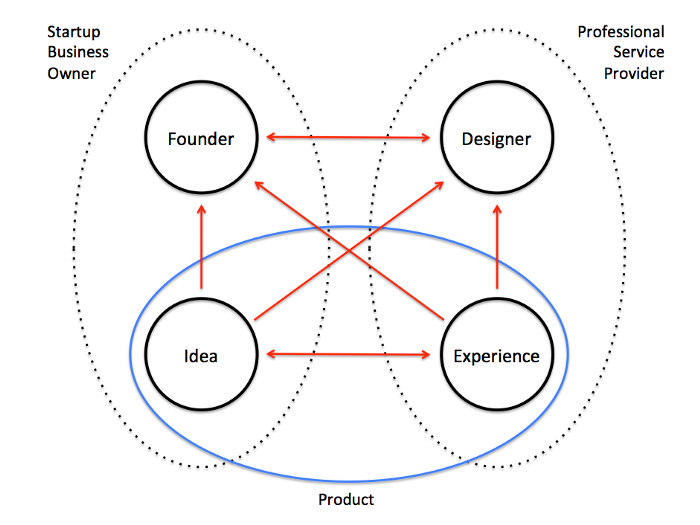
When the Founder meets the Designer, their shared space is the Product. Founders want to create a product based on their own idea while designers want to create a product that can offer a great user experience. Thus, these two camps always debate on what the product should be.
The above diagram guided me to think deeper. Why do these two camps hold different views on the same thing? I expanded the Camp Z (product) into the following diagram. I realized there is not one product, but three products: Imagined Product, Simulated Product, and Actualized Product.
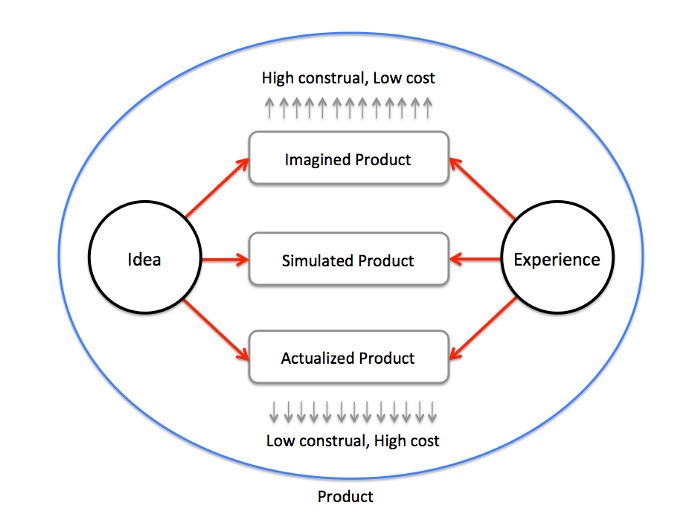
According to Construal level theory (CLT), a social psychology theory that describes the relationship between psychological distance and the extent to which people’s thinking is abstract or concrete, I think these three types of products require different construal levels. The Imagined Product needs higher level construal which means high-level abstract thinking. At this level, founders and designers should work on unique creative insight and product direction. Usually, it is easy to get people on the same page at this level. The Actualized Product is the real product that requires low-level construal because it shouldn’t ask users to think too much. The Simulated Product, its other name is prototype or beta product, is a bridge between high-level construal and low-level construal.
Is abstract thinking for products always bad and concrete thinking for products always good? No, it is not the case. We need to consider another important fact: Cost! Turning an idea into a real thing costs a lot of money! Thus, there are two ways to save money.
- First, making correct decisions on the high-level construal. This way requires complex higher cognitive skills and knowledge.
- Second, keep the transforming process from Imagined Product to Actualized Product simple, fast, and right. This way is about getting ideal communication between founder and designer.
The purpose of the WXMY diagram is to discover new ideas for cross-boundary innovation. We can use more diagrams to expand the Echozone.
The key of the WXMY diagram is the Container Z which is named Echozone too. By focusing on the Echozone, the WXMY diagram is perceived as two parts:
- Figure: It means the main object that we are looking for. It is the inner space of the Echozone.
- Ground: It means the background of the main object. It is the outer space of the Echozone.
If we connect the aspect of “Figure — Ground” with the aspect of Symmetry, we can make many creative frameworks. For example, the DEEP Framework is about the “Self—Environment” engagement process.
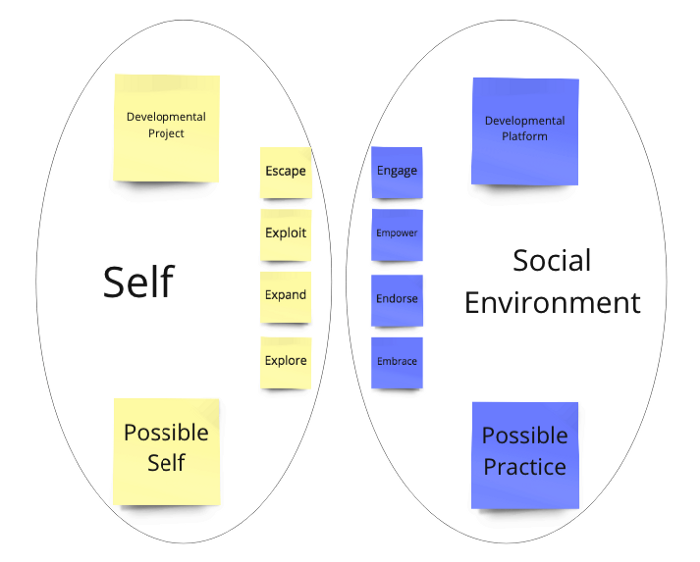
- Container X: Self, a person wants to actualize a Possible Self with a Developmental Project.
- Container Y: Social Environment, a platform that wants to actualize a Possible Practice with projects initiated by its members.
The third container is Container Z. I define it as Future. For Self, the Future means Possible Selves. For Social Environment, the Future means Possible Practice.
- Container Z: Future, means a connection between a person’s Possible Selves and a platform’s Possible Practice.
Development is all about the Future.
The second step is about language engagement. In other words, I play a language game with the creative trigger “DEEP”. Now I have two “D” and two “P”:
- D: Developmental Project and Developmental Platform
- P: Possible Selves and Possible Practices
How about the two E? Can I use some words that start with E to describe the Self—Social Environment engagement process? The outcome is the following movements:
- The Exploit — Engage movement
- The Escape — Endorse movement
- The Expand — Empower movement
- The Explore — Embrace movement
Here I use “movement” to refer to an ideal social interactive situation between Self and Social Environment. Each movement is formed with a Challenge and a Response. For example, a person takes a step to escape from a task on the platform or leaves the platform. For the platform, this action means a Challenge. Ideally, the person expects a supportive response from the platform. For example, the platform responds to the Challenge with an endorsement that highlights the person’s contribution and achievement.
I roughly listed the above four ideal movements. It’s possible to discover more than four movements. Of course, a person can’t always receive supportive responses from his social environment. I just select the ideal situation for our discussion.
The diagram below is the final verson of the DEEP framework:
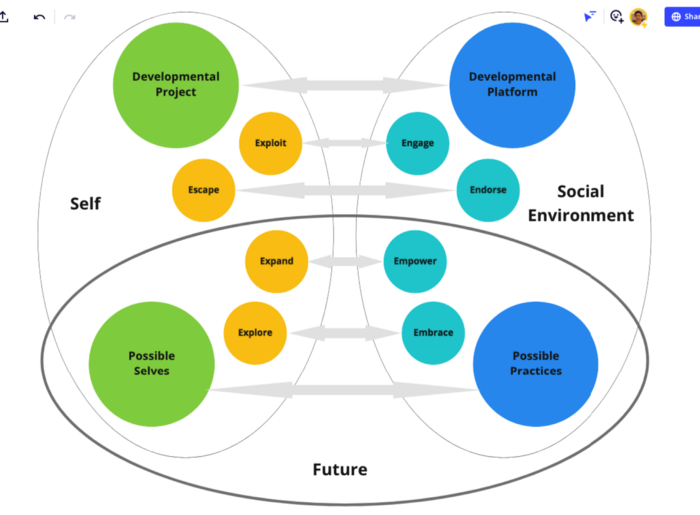
Inside the Echozone, we see six things:
- Possible Selves
- Explore
- Expand
- Possible Practices
- Empower
- Embrace
I consider the successful connection between Possible Selves and Possible Practices are based on the following two important movements:
- The Expand — Empower movement
- The Explore — Embrace movement
These two movements lead us to a shared Future! The initial work is done! Though it is a rough inspiration, it made a good discovery for the Future.
Another way of using the Echozone is Diagram Blending which refers to using multiple diagrams together. For example, the ECHO Way uses Theme U, Project I, and Container Z together. See the diagram below.
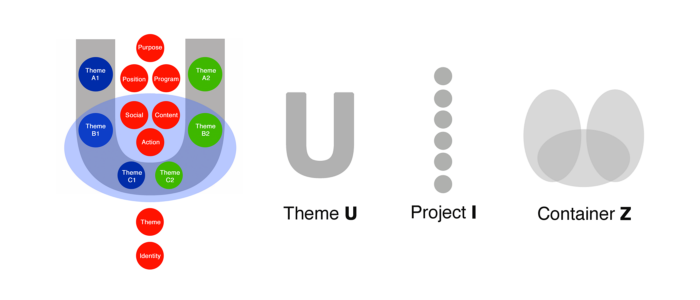
The Project I diagram is used to describe a model of a Developmental Project. By curating Project I and WXMY together, we see something new inside the Echozone.
5. Case Study: Personal Innovation
I started the Activity U project on August 19, 2020. Initially, I just made a diagram called “Activity U” which is a test of the “HERO U” framework. I wrote a post to explain the diagram “Activity U”. The original title of the post is Activity U: The Landscape of Activity Theory. Later, I added “(Part I)” to the end of the title. It expanded from one post to a series of articles.
Finally, the Activity U project produced two books. It also led to the Activity Analysis project. For me, this is an example of Personal Innovation.
On May 25, 2021, I made the following diagram for discussing Personal Innovation.
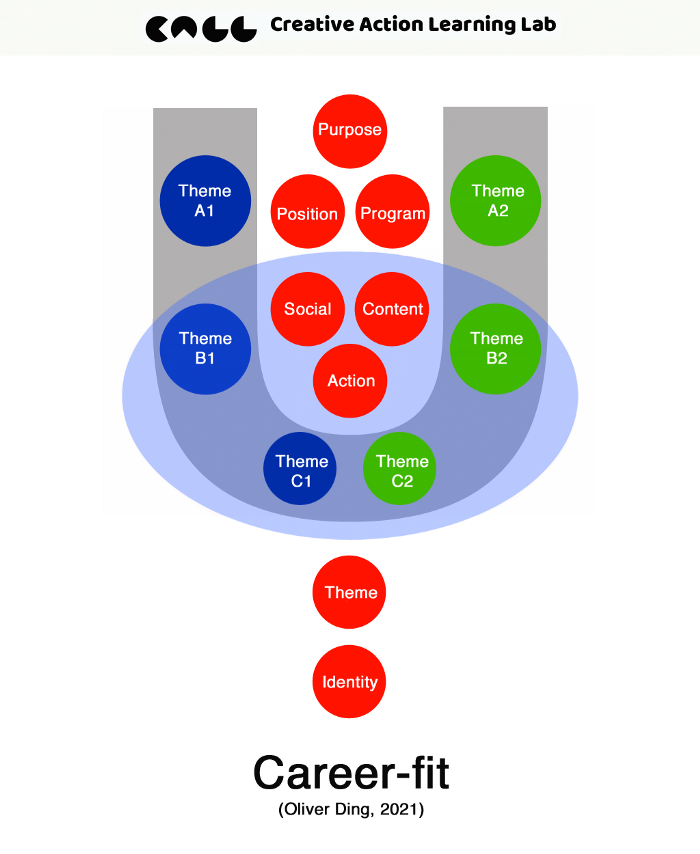
I found three major Pairs of Opposite Themes from my past over twenty years of work experience. The First Pair of Opposite Themes “China v.s. America” refers to cross-cultural work & life experience. There are significant differences between China and America. The Second Pair of Opposite Themes “Theory v.s. Practice” refers to cross-discipline knowledge experience. There is a huge gap between academic knowledge and practical work activities. The third Pair of Opposite Themes “Concept v.s. Diagram” refers to cross-domain cognitive experience. According to Cognitive scientist and psychologist Barbara Tversky, Concept is about linguistic thought while Diagram is about spatial thought.
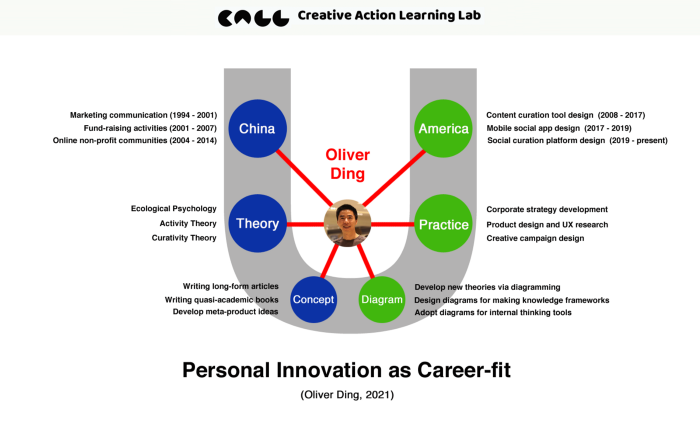
The above Career-fit framework can be considered as “an ecological approach” to career development because it refers to the structure of “organism (personal themes of career) — action (fitting) — environment(impact projects)”.
The eight elements of Impact Projects form three groups as a process of transformation. The first group is defined as Situational Context which highlights three important aspects of Developmental Projects: Purpose, Position, and Program. The second group is defined as Developmental Resources which highlights three types of potential opportunities for Developmental Projects: Social, Content, and Action. The third group is defined as Impact by Projects which considers personal development caused by joining Developmental Projects from two dimensions: Theme and Identity.
I started the Activity U project in August 2020. The diagram below uses the Developmental Project Model to reflect on my experience with the project.
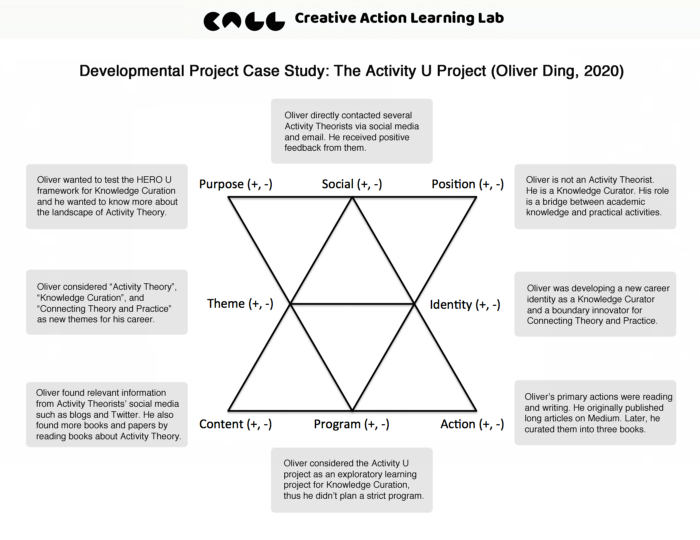
Now let’s focus on the Echozone of the Activity U project. The diagram below only shows the Echozone with some notes for discussing the process of fit between career themes and developmental projects.
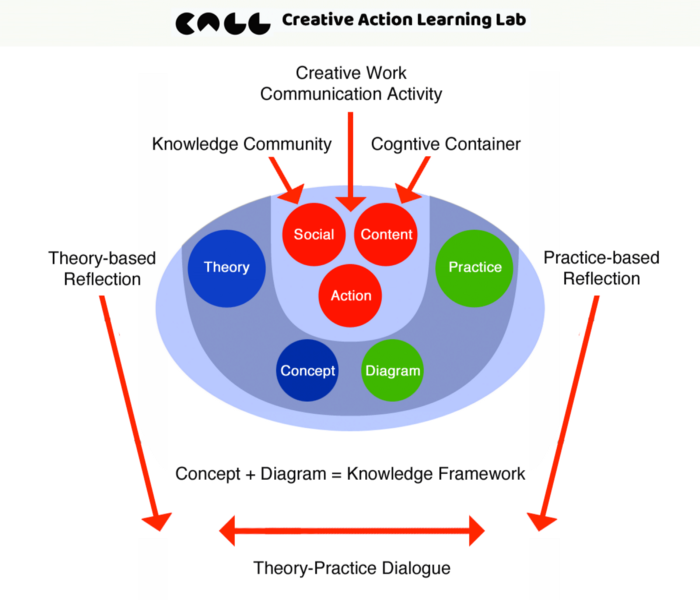
The above diagram presents fits of two pairs of opposite themes. The above diagram presents fits of two pairs of opposite themes. The “Theory v.s. Practice” fit is described with three movements:
- Practice-based Reflection: building rough models with intuition.
- Theory-based Reflection: improving models with theoretical resources.
- Theory-Practice Dialogue: turn models into frameworks and test them with case studies.
The article Platform Innovation as Concept-fit offers a real example of these three steps. The Concept-fit framework was developed within three months.
The “Concept v.s. Diagram” fit is described with one formula:
- Concept + Diagram = Knowledge Framework
This formula is defined by the HERO U framework. I used the formula to guide my creative works in developing theoretical frameworks.
The above diagram of Echozone also presents three inspirations that are triggered by the Activity U project.
- Social > Knowledge Community
- Action > Creative Work Communication Activity
- Content > Cognitive Container
The red ball “Social” means connecting to someone due to joining or initiating development projects. In order to run the Activity U project, I directly contacted several Activity Theorists via social media and email. I received positive feedback from them. Since Activity Theory is an established theoretical tradition, there is a knowledge community around the theory. By connecting to one or several members of the community, I could build a connection between the Activity U project and the community.
The red ball “Action” means my real actions and possible actions. During the past months, my primary actions were reading and writing. I originally published long articles on Medium. Later, I curated them into three books. However, I found Activity Theory also offers me a new perspective on understanding “Action” and related topics. I started looking for and defining a new form of Activity for my work and research. Also, I adopted the concept of “Mediation” from Activity Theory and used it to rethink the Knowledge Activity, especially the activity of using concepts, diagrams, and knowledge frameworks in practical workplaces. Eventually, I coined a new term called “Creative Work Communication Activity” for my further research.
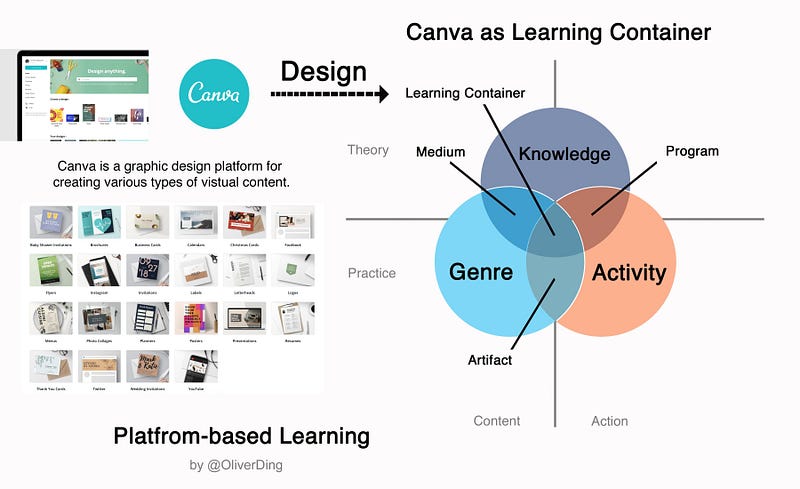
The red ball “Content” means information offered by Developmental Projects. For the Activity U project, I found relevant information from Activity Theorists’ social media such as blogs and Twitter. I also found more books and papers by reading books about the theory. I also searched videos about Activity Theory on YouTube and diagrams about the theory on Google Images. These experiences offer me an opportunity to test my idea of “Cognitive Container” which is part of my theoretical framework: Curativity Theory. For knowledge curation, the Cognitive Containers are Genre, Framework, Model, Concept, Papers, Conference, Workshop, Genre, Media, etc.
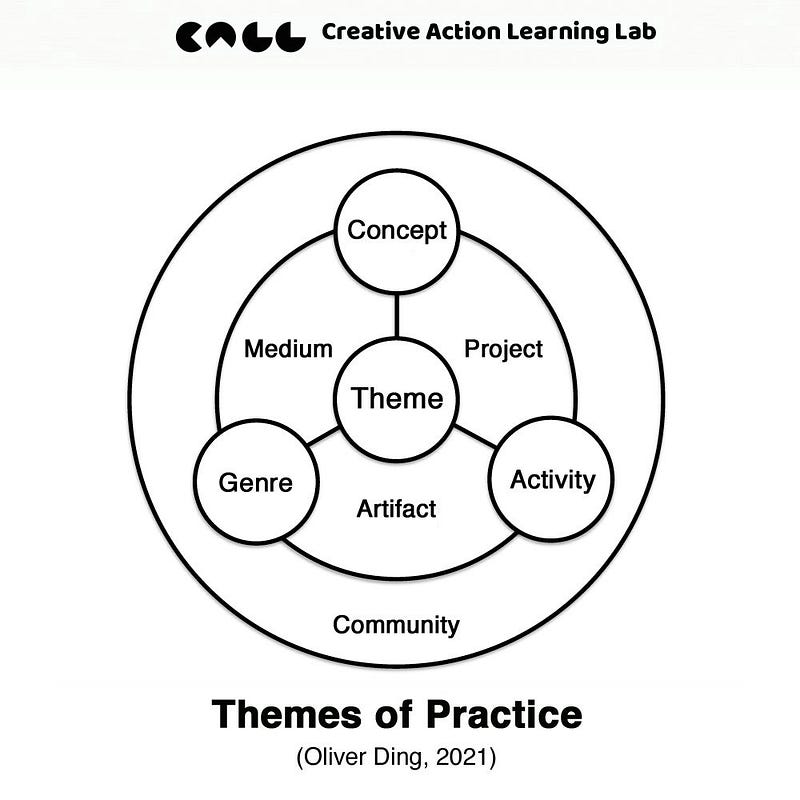
These three ideas are emergent career themes. I used them to guide exploratory learning activities. For example, I started learning Genre Theory and curated the idea of Genre with other ideas. On April 8, 2021, I designed the diagram below to rethink my idea of “Themes of Practice”.
Later, these ideas led to the “Themes of Practice” framework.
In April 2021, I started a project called Once Upon A Whiteboard which focuses on virtual whiteboard platforms and related practices. By adopting Activity Theory and Ecological Psychology, I defined the whiteboard-based practice as Creative Work Communication Activity (CWCA).
My story tells us that the Echozone is not a simple graphic area, it is also a real-life creative space for the long-term development of thoughts.
6. Case Study: Knowing-for-Us
The HERO U Framework is developed for connecting THEORY and PRACTICE with Theme U and Project I.
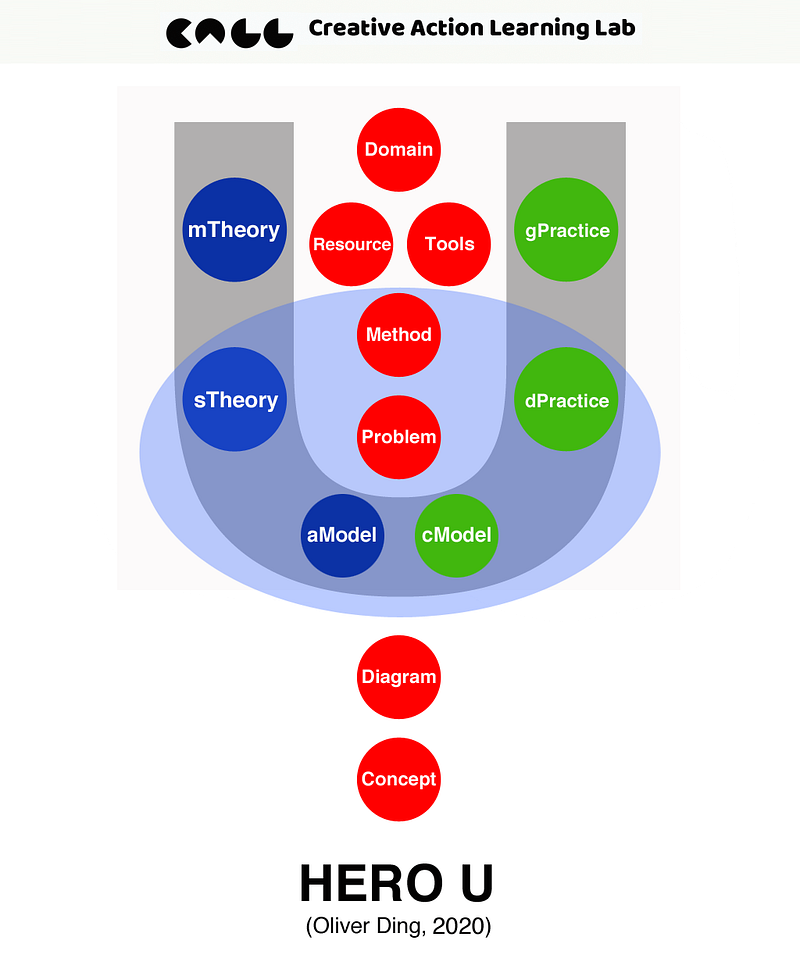
The seven red balls refer to Personal Conditions of Knowing. The first group is Domain, Resource, and Tools, they define the outside setting of the knowing activity. The second group is Method and Problem, they define the source of competence and solution. The third group is Diagram and Concept, they define the representation format of the outcome of knowing. These three groups form a process of knowing.
We can also consider these seven red balls as Project I of the single-theory curation activity.
For the HERO U framework, there are three kinds of knowing: Knowing-for-all, Knowing-for-us, and Knowing-for-me.
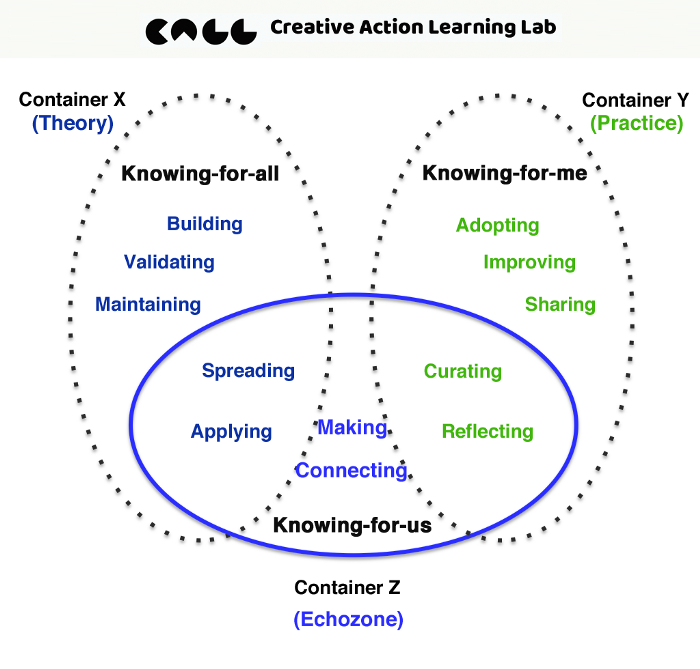
The Knowing-for-all activity is located in the Theory container. The outcome and motivation are about building, validating, maintaining, applying, and spreading public knowledge. The corresponding Objects of Knowing are Meta-theory, Specific Theory, and Abstract Model.
The Knowing-for-me activity is located in the Practice container. The outcome and motivation are about adopting and sharing reliable and accessible knowledge for improving individual or collective professional work and daily life practice without commitment to contributing to the progress of public knowledge. The corresponding Objects of Knowing are the Concrete Model, Domain Practice, and General Practice.
The Knowing-for-us activity is located in the Echozone container. The outcome and motivation are about spreading and applying public knowledge to professional domain practice, curating and reflecting on personal practical experience, and connecting different domains in order to make new shared knowledge for participants. The corresponding Objects of Knowing are Specific Theory, Abstract Model, Concrete Model, and Domain Practice.
These three types of knowing are not separate but intertwined. The above diagram shows that they share some activities.
7. Case Study: The Double Gird-Group Framework
On Jan 2, 2020, I reviewed my notes on Personal Information Architecture from the perspective of my own idea Curativity Theory. I realized there are three types of Curativity in the context of information architecture: Platform Curativity, Institution Curativiety, and Individual Curativity. There are different agencies, motivations, and goals behind these Curativity and sometimes they contradict each other.
On March 22, 2020, I had a discussion about the WXMY diagram and “Ecological Structure” with a friend. After the discussion, I realized I can apply the WXMY diagram to the Double Gird-group framework. Douglas’s original model was represented with a 2x2 matrix.
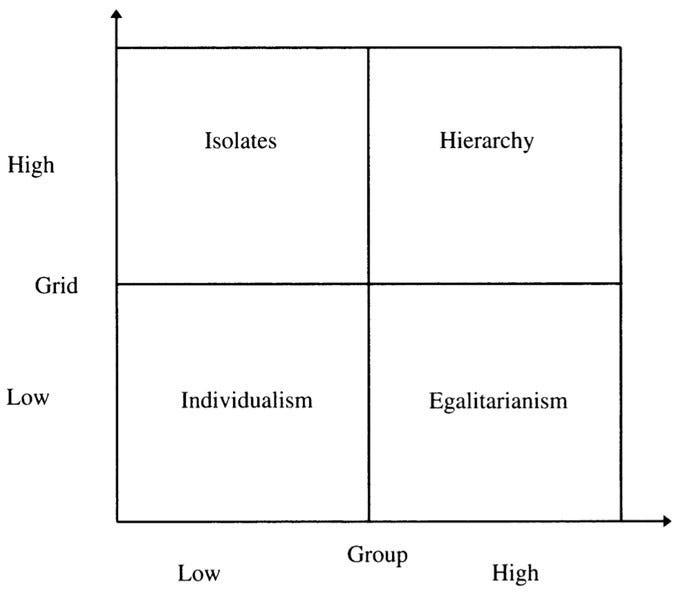
There is an important distinction between offline environments and online environments. So, I doubled Douglas’ Gird-Group model, and the Traditional type of Group and Grid is considered to be distinguished from the Digital type of Group and Grid.
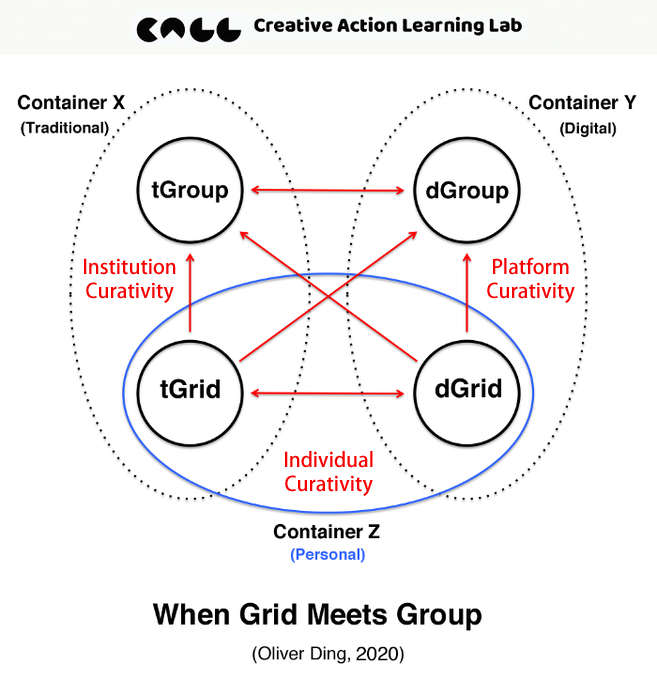
For my version, it’s hard to double the 2x2 matrix. The WXMY diagram not only solved this problem but also generated an extra benefit. It has a Container Z which makes tGrid and dGrid as a whole. I believe the essential point of Personal Information Architecture is life as a whole while the environment is disturbed.
The final Double Gird-group framework uses four special signs: tGroup, dGroup, tGird, and dGird. The “t” stands for “traditional” and the “d” stands for “digital”.
For example, Institution Curativity refers to traditional Group (tGroup) and Platform Curativity is about digital Group (dGroup). Following this logic, the Individual Curativity within Institution is traditional Gird (tGird) and the Indivisual Curavitiy within Platform is digital Grid (dGrid).
Later, I expanded this model to discuss digital transformation and added “tAction” and “dAction” to the Echozone.
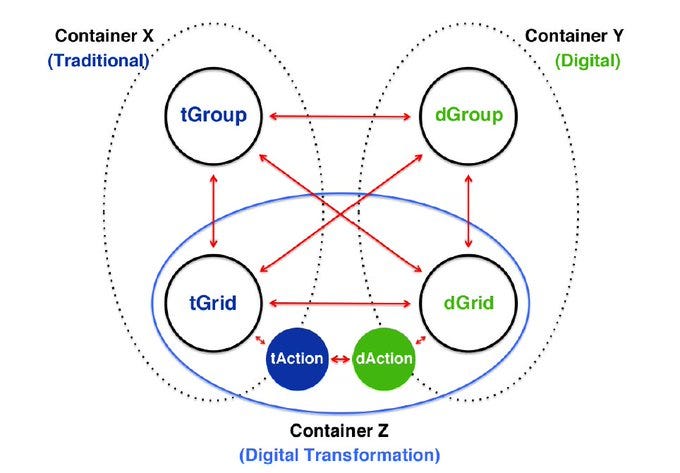
I used “Digital Transformation” to name the Echozone. I also found there are seven stages of “digital transformation”. See the diagram below.
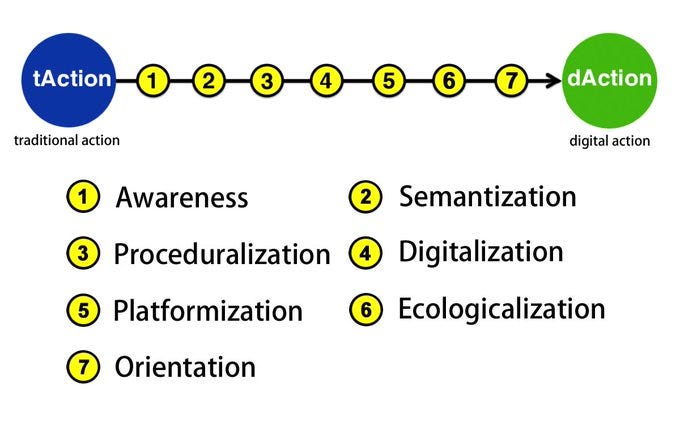
- Awareness: you notice an action
- Semantization: you use a word to name the action
- Proceduralization: you construct sequences of the action
- Digitalization: you use some online tools to take the action
- Platformization: you use one particular online tool to take the action
- Ecologicalization: you use one particular online tool and its associate tools to take the action
- Orientation: the action is dAction!
In this case, the Echozone was originally called “Individual Curativity”, but it transformed to “Digital Transformation”. This is the creative power of Echozone!
8. Using WXMY to expand Interactive Zone
This section introduces a specific usage of the WXMY diagram. We are going to use it to expand the Interactive Zone diagram.
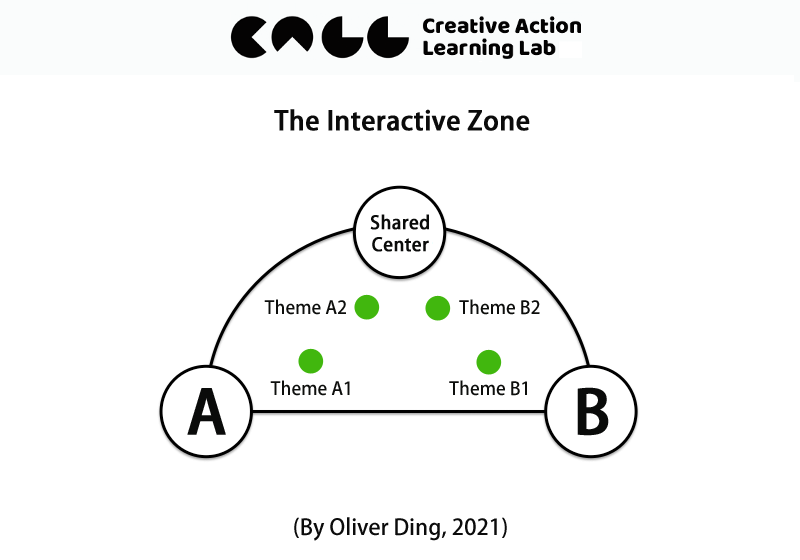
The above diagram is called Interactive Zone which presents a space that contains many possible themes between two Corners A and B around one Shared Center.
Some themes are close to one corner while other themes are close to the other corner. For example, Theme A1 and Theme A2 are close to Corner A while Theme B1 and Theme B2 are close to corner B.
In Oct 2021, I made a framework called Value-fit with the Interactive Zone diagram and the WXMY diagram. It was a three-step project.
First, I made the following diagram by using the Tripatrness meta-diagram.
Tripartness is one of a set of meta-diagrams I designed in past years. The Tripartness meta-diagram can be expanded to a Diagram Network. Or, we can say that it is an outcome of a process of Diagram Blending.
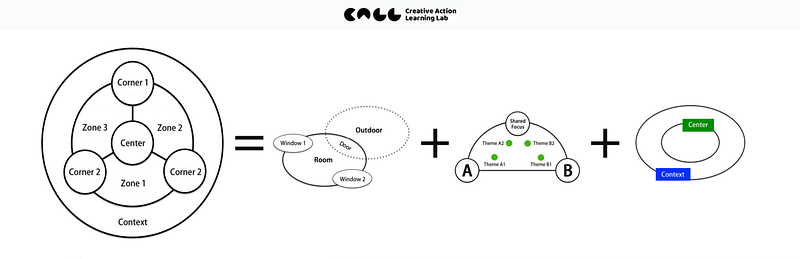
The above picture shows the process of diagram blending. The Tripartness diagram has two pairs of concepts:
- Corner and Zone
- Center and Context
In order to understand these concepts, we can use the following three diagrams:
- Corner: The Dialectic Room
- Zone: The Interactive Zone
- Center and Context: The Hierarchical Loops
We will use the Interest—Exchange Zone as an example for the present discussion.
The second step is selecting two corners in order to define an interactive zone.
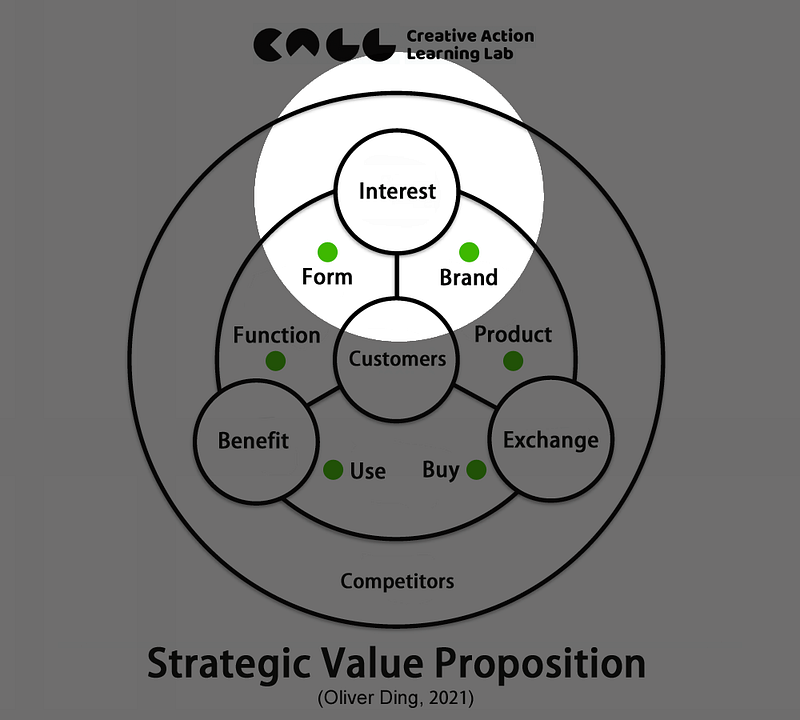
For the Interest Corner, I highlight the following several concepts:
- Self and Other
- Similarities and Differences
- Storytelling
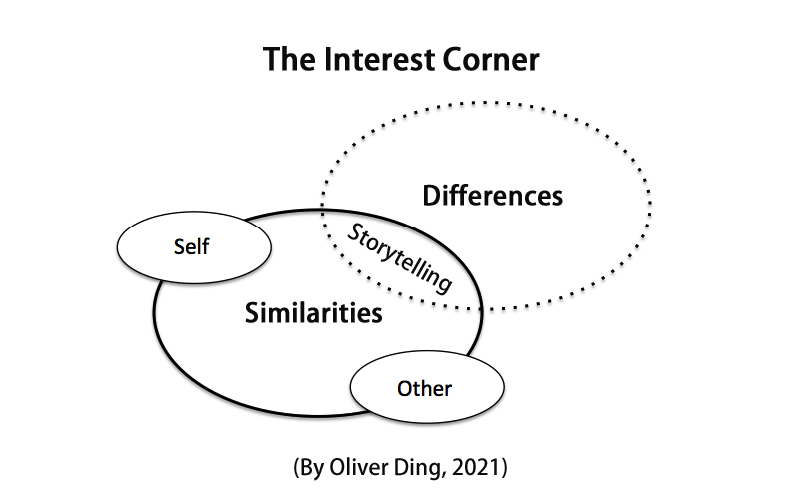
The diagram can be applied to discuss Customers and Competitors. I will talk about Customers, readers can apply the same method to think about Competitors.
For Customers, the room is their present life which is full of similarities. Self refers to a potential customer while Other refers to people from the customer’s surrounding environment. Self only can receive the above two types of information from Other, either the firm or other people. If the information is similar to the customer’s present life, then he won’t be interested in the product. The firm has to make a difference in order to bring the customer from his present life to a new life world. The strategy of storytelling could focus on Form, Brand, or Both. If the firm can’t offer a different form, then they could offer a different brand with a different cultural value or others.
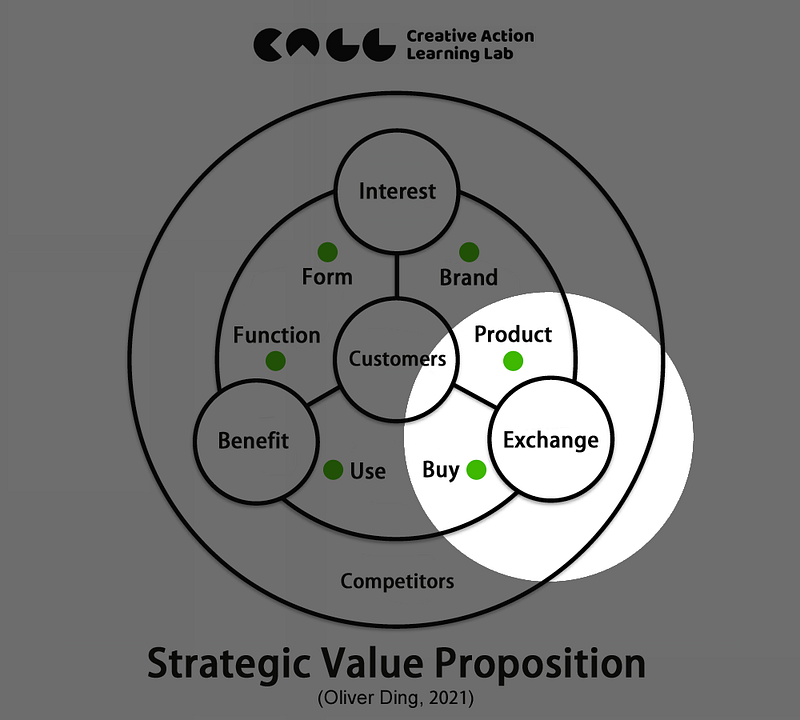
For the Exchange Corner, I consider the following concepts:
- Decision and Context
- Emotion and Reason
- Negotiating
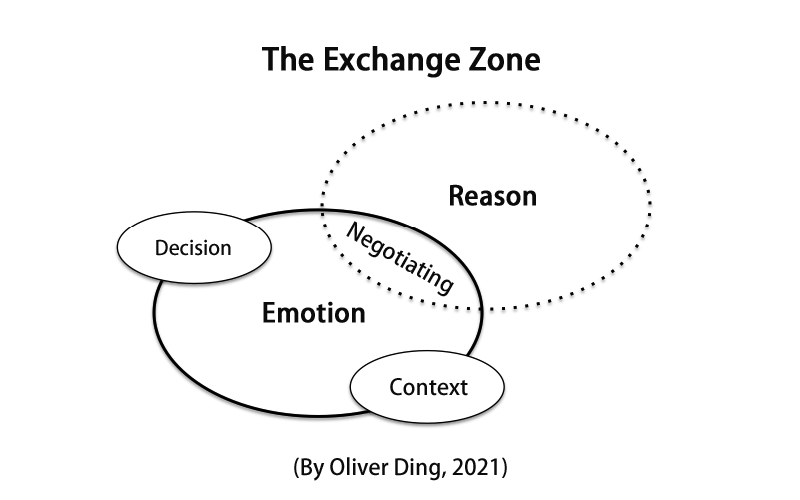
Decision refers to what a consumer decides to do while Context refers to the consumer’s life situation.
After deciding to buy a product, the consumer should decide on more details such as:
- When: buy it today, buy it next weekend, or three months later…
- Where: buy it from a particular local store, or buy it from a particular online store…
- Who: buy it alone, buy it with friends, or buy it with a group of others…
- How many: buy one, buy a particular one, buy an amount of the product…
In fact, the above details are related to Context which is the life situation of the consumer.
Third, we can use the WXMY diagram to curate the above concepts together. The above discussion discovers the following pairs of themes:
- Difference v.s. Similarity
- Reason v.s. Emotion
- Brand v.s. Product
Now let’s consider the Interest Corner as Container X and the Exchange Corner as Container Y. These two containers are connected by Container Z. For the present case, the Interest — Exchange Zone means Container Z.
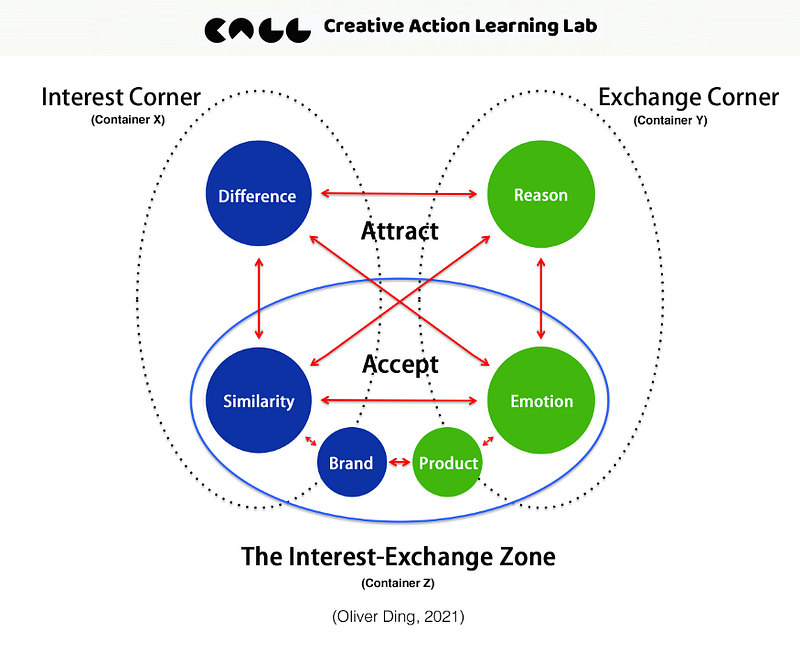
Now we can generate emergent themes from the WXMY diagram. I asked the following question:
What’s the major difference between inside Container Z and outside Container Z?
I used two terms to answer this question. The term “Accept” refers to consumers’ attitude inside Container Z while the term “Attract” refers to consumers’ attitude outside Container Z. These two terms point out a spatial distance between two life moments.
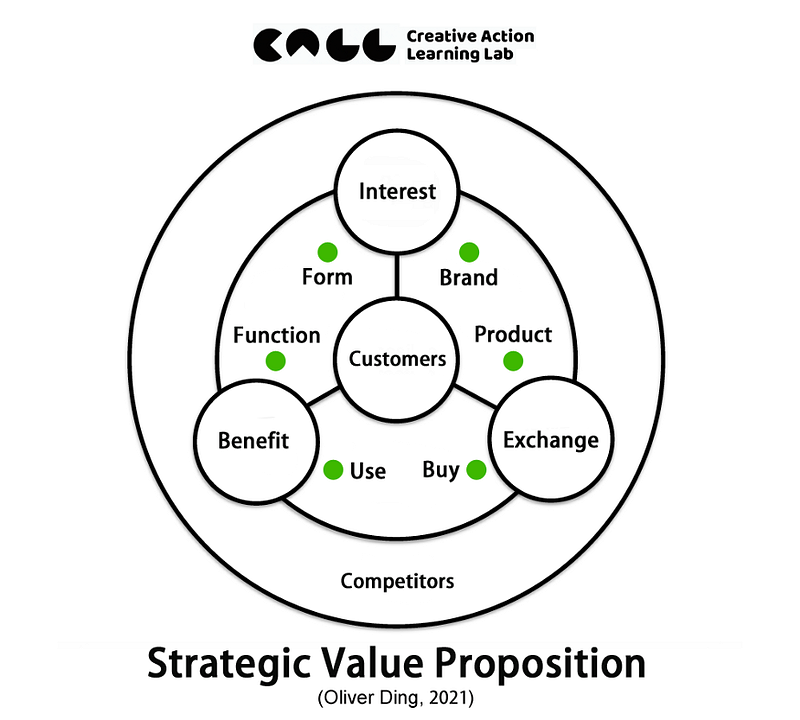
I applied the same method to three zones of the original Strategic Value Proposition and developed the following diagram:
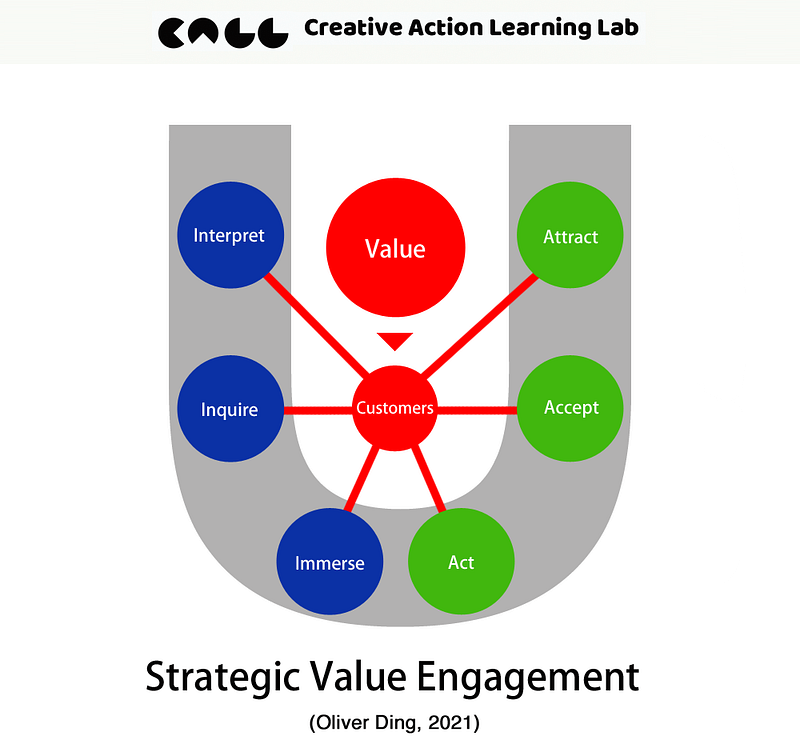
The above diagram describes five types of spatial distances between six types of life moments.
From the perspective of customers, the process of Value Engagement means both Material Engagement (what customers actually do and say) and Mental Engagement (what customers actually feel and think).
The final version of the Value-fit Framework combines two perspectives of Value, one is Strategic Value Engagement which empathizes with the perspective of customers while the other one is Strategic Value Proposition which represents the perspective of firms.
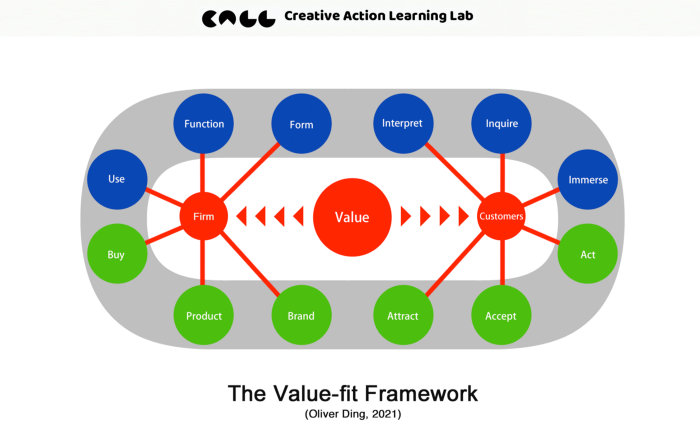
You can find more details about this case from the following links:
- The Dialectical Room and Value Engagement (Oct 12, 2021)
- The Interactive Zone and Value Engagement (Oct 14, 2021)
- The Value-fit Framework and Canvas (Oct 19, 2021)
This case is quite complex because it adopts the diagram blending method. In this way, the WXMY diagram is part of a network of diagrams. If we return to the WXMY diagram, this case is a great example of using White Space to discover potential themes.
9. Summary
Interdisciplinary Curation is about discovering new creative spaces by connecting ideas from two or more disciplines together. We can also use the WXMY diagram for similar purposes such as connecting two domains or two sides.
The WXMY (When X Meets Y) diagram is a meta-diagram that is formed with three containers.
- Container X
- Container Y
- Container Z: this is also called Echozone
The uniqueness of WXMY is defined by the following spatial structures:
- Three Containers
- Echozone
- Figure and Ground
- Symmetry
- White Space
The above discussion shares three examples of using the WXMY diagram:
- Case study: Personal Innovation
- Case study: Knowing-for-us
- Case study: The Double Gird-Group Framework
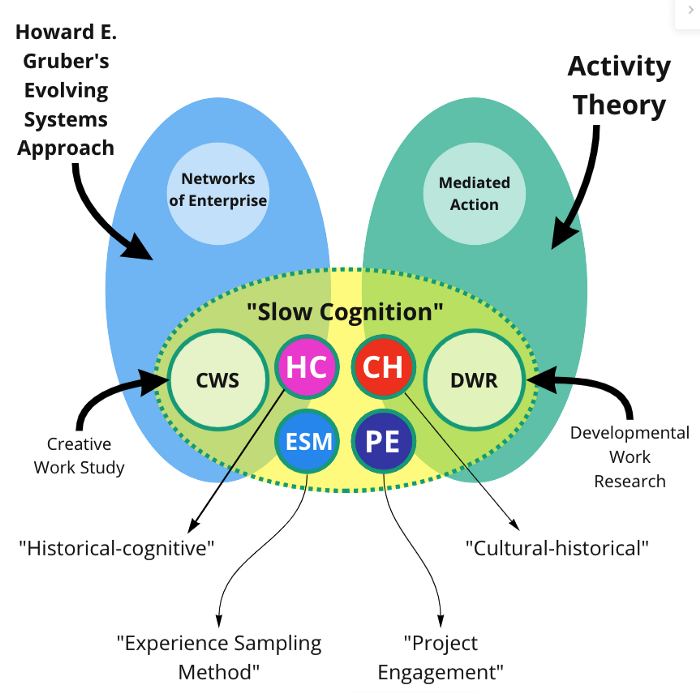
Both three examples are all about using the WXMY diagram with other diagrams together and developing ideas in the “Slow Cognition” way which means the long-term development of thoughts.
We also deal with a specific case about applying the WXMY diagram to expand the Interactive Zone. This case is a great example of using White Space to discover potential themes.
10. CALL for NEXT: The “Life Strategy” Project
Now it’s your turn to make a project. Life is short. You can transform yourself one project at a time.
In Feb 2022, I started the “Life Strategy” project. I wrote two articles to review my thematic space of “Life” and my thematic space of “Strategy”. See the following links:
- Mapping Thematic Space #6: The “Life” thematic space
- Mapping Thematic Space: The “Strategy” thematic space
- Thematic Space: A “Strategy-as-Curation” Weekend
- The Sailor’s Mandala: A Life Discovery Framework
However, I have not yet made a framework for the concept of “Life Strategy”.
You can use the WXMY diagram to make a diagram about “Life Strategy”.
1+1 is a simple strategy to inspire new knowledge sparks for discovering potential themes.
Related Articles:
- The Knowledge Curation Project
- The Knowledge Curation Toolkit #1: Theme U for Single-theory Curation
- Activity U — A Knowledge Curation Project
- HERO U — A New Framework for Knowledge Heroes
- Activity U: The Landscape of Activity Theory (Part I)
- Activity U (III): Bonnie Nardi’s Choices and Boundary Knowledge Work.
- D as Diagramming: Challenge as Opportunity
- D as Diagramming: From Sandwich to Containers
- Platform Innovation as Concept-fit
- Personal Innovation as Career-fit
- The ECHO Way (v2.0)
- #TalkThree 05: How to Connect X and Y?
- D as Diagramming: Meta-theory and General Practice
- Knowledge Discovery: The “Double Theme” Strategy
- Diagram Blending: Building Diagram Networks (Introduction)
- Diagram Blending: Building Diagram Networks (Table of Contents)
You are most welcome to connect via the following social platforms:
Linkedin: https://www.linkedin.com/in/oliverding Twitter: https://twitter.com/oliverding Polywork: https://www.polywork.com/oliverding Boardle: https://www.boardle.io/users/oliver-ding


