
Activity U : The Landscape of Activity Theory (Part I)
A Case Study for “HERO U”, a framework for closing the gap between “Theory” and “Practice”.

HERO U is a new framework for knowledge heroes who want to make unique epistemic impaces. I have introduced the framework and its diagram in HERO U — A New Framework for Knowledge Heroes.
At the section 9 of the article, I distinguish three kinds of knowing: Knowing-for-all, Knowing-for-us and Knowing-for-me. This article will focus on expanding the Knowing-for-all.
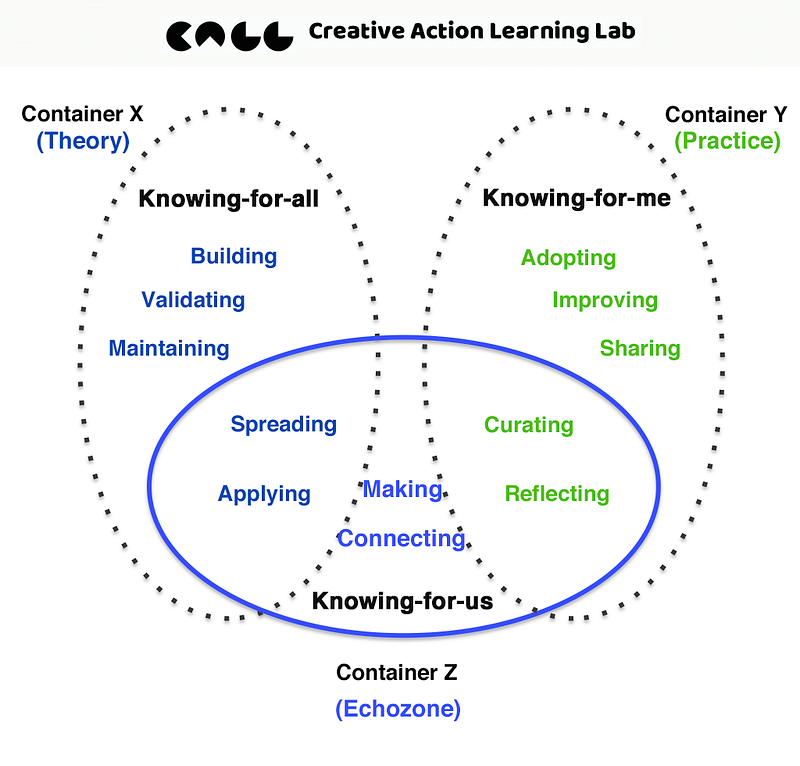
The HERO U framework uses three containers to connect “theory” and “practice”: Container X (Theory), Container Y (Practice), and Container Z (Echozone). The Knowing-for-all activity is located in the Theory container. The outcome and motivation is about building, validating, maintaining, applying and spreading public knowledge. The corresponding Objective of Knowing are Meta-theory, Specific Theory and Abstract Model.
This case study aims to use the HERO U framework and the Diagram U to represent the theoretical development of Activity Theory or Cultural-historical activity theory (CHAT).
As the part I of the case study, this article focuses on curating paradigmatic research works from activity theorists as examples of six types of “Objective of Knowing”.
The Part II will go further in a discussion with the perspective of “knowing-for-all”: What can the younger generations of knowledge heroes learn from these outstanding predecessors and their creative works?
Activity U: The Landscape of Activity Theory
Activity Theory or the “Cultural-historical activity theory (CHAT)” is an interdisciplinary philosophical framework for studying both individual and social aspects of human behavior. According to Kaptelinin & Nardi (2012), “The immediate conceptual origins of activity can be found in Russian/Soviet psychology of the 1920s and 1930s. During that time theoretical explorations in Russian psychology were heavily influenced by Marxist philosophy… Leontiev’s activity theory emerged as an outgrowth of the sociocultural perspective. The theory employs a number of ideas developed by Lev Vygotsky, Leontiev’s mentor and friend. It is also strongly influenced by the work of Sergei Rubinshtein, a major figure in Russian psychology and a long-time colleague of Leontiev.”(p.13–14)
The figure below (Roth and Lee, 2007) shows a growth between 1975 and 2005 in the frequency of journal citations to the term “activity theory” and three books and one article about activity theory.
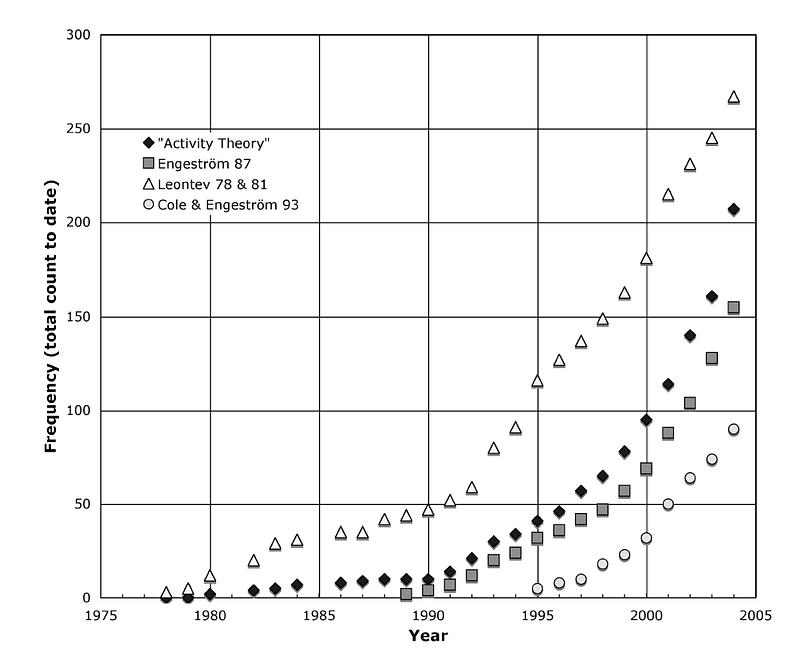
In the beginning, activity theory is a psychological theory about the mind and it focused on the development of individual psychological functions. Leontiev used “Activity, Consciousness, and Personality” as the title for his book. Later, activity theory became a what Michael Cole called “monolithic enterprise” with several sub-traditions and local thought of schools such as German tradition, a Scandinavian/Nordic tradition, an American tradition (Cole, 1996. p.139).
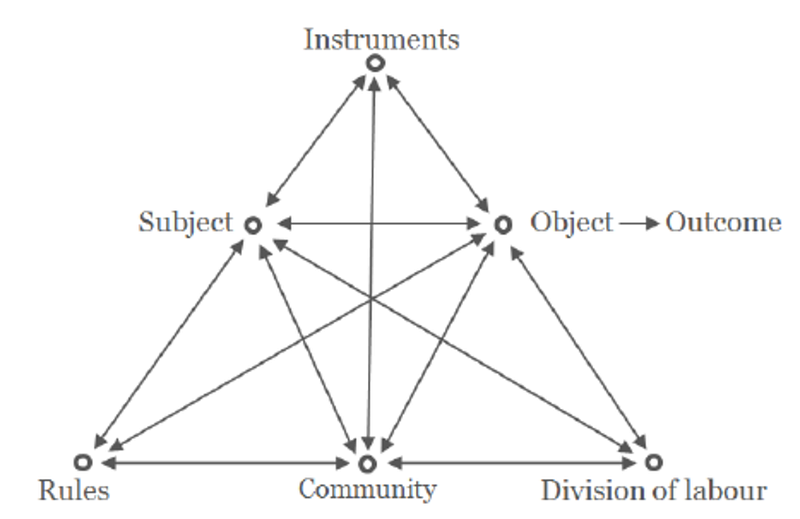
A major development of activity theory was contributed by Finnish educational researcher Yrjö Engeström who upgraded the activity theory from the individual activity level to collective activity level with a conceptual model of “activity system” in order to apply activity theory to educational settings, organizational development and other fields (Engeström,1987). The Engeström’s triangle below is based on the cultural-historical psychologists’ notions of mediation as individual action (subject — instruments — object) at the top of the diagram. Engeström (1987) considered “a human activity system always contains the subsystems of production, distribution, exchange, and consumption.”(p.67), thus, he added the bottom of the triangle to the original individual triangle in order to include other people (community), social rules (rules), and the division of labor between the subject and others.
Activity Theory is a perfect case for making use of HERO U’s framework and the Diagram U because we can find various usages of activity theory. I selected some examples and placed them on the Diagram U and made the below Activity U.
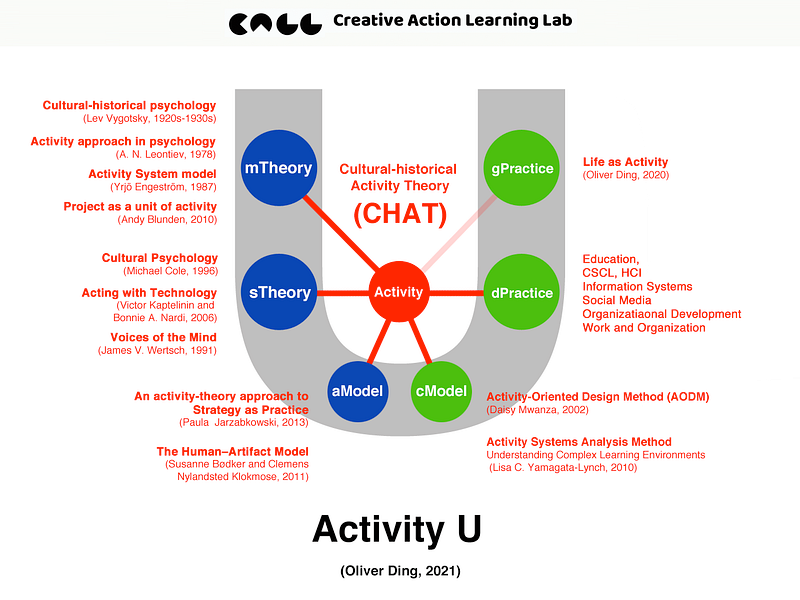
The Diagram U presents six types of “Objective of Knowing”:
- mTheory: Meta-theory
- sTheory: Specific Theory
- aModel: Abstract Model
- cModel: Concrete Model
- dPractice: Domain Practice
- gPractice: General Practice
The following sections shall explain these terms with real examples from the enterprise of activity theory. Though I use “Activity U: The Landscape of Activity Theory” for the title of this section and the above diagram, I have to point out this is just a case study for discussing “knowing-for-all” and testing “HERO U”. I am not going to deliberately review the development of activity theory. Thus, I just select works of activity theorists based on my personal reading history.
Activity as Meta-theory
Meta-theory (mTheory) means philosophical approaches or theoretical perspectives which can guide researchers to develop their own theory in a special domain. I selected four works as Meta-theory.
- Cultural-historical psychology (Lev Vygotsky, 1920s-1930s)
- Activity approach in psychology (A. N. Leontiev, 1978)
- Activity System model (Yrjö Engeström, 1987)
- Project as a unit of activity (Andy Blunden, 2010)
The relationship between Lev Vygotsky’s account and A.N. Leontiev’ s account is quite complex. According to Victor Kaptelinin and Bonnie Nardi, “Leontiev’s activity theory emerged as an outgrowth of the sociocultural perspective. The theory employs a number of ideas developed by Vygotsky, Leontiev’s mentor and friend. It is also strongly influenced by the work of Rubinshtein, a major figure in Russian psychology and a long-time colleague of Leontiev’s… At the same time, Leontiev’s activity theory was not a simple imprint of all these influences. As discussed below, while the framework incorporates a variety of ideas developed by Vygotsky, Rubinshtein, and other ideas, these ideas were revised and elaborated upon by Leontiev to from his own distinct and consistent conceptual framework.”(2012, p.14)
We also should notice on the name of Activity Theory and CHAT. According to Mescherijakov and Zinchenko, “Leontiev himself referred to his framework as ‘activity approach’ (‘dejatelnostnyj podhod’), or ‘activity approach in psychology,’ rather than ‘activity theory’.” (cited in Kaptelinin and Nardi, 2012, p.14)
The term CHAT stands for Cultural-historical activity theory. It was coined by Michael Cole and popularized by Yrjö Engeström to promote the unity of Vygotsky’s work and Leontiev’s work. One historical narrative of theoretical development was told by Engeström (2001). It presents a simple linear development process including the first generation (Vygotsky), a second generation (Leontiev, Luria, Ilyenkov), and a third generation (Engeström and colleagues).
Some researchers argued this story is not ture, for example, Manolis Dafermos (2015) pointed out, “The scheme of three generations of Cultural-historical activity theory offers a linear,continuous, presents, decontextualized account and obscures the gaps, tensions, and inconsistencies in the history of cultural-historical psychology and activity theory. From the perspective of the idea of three generations of Cultural historical activity theory, it is hard to explain the tension between Vygotsky and Leontiev in the early 1930s.”
Dafermos also mentioned several versions of CHAT, “Engeström’s theory of activity systems tends to be among the most powerful versions of CHAT (Engeström, 2001; Engeström, Miettinen & Punamaki, 1999; Engeström, Lompscher & Rückriem, 2005). Sawchuk, Duarte & Elhammoumi attempt to develop a critically oriented version of Cultural historical activity theory on the basis of Marxist dialectics (Sawchuk, Duarte & Elhammoumi, 2006). Stetsenko & Arievitch consider Cultural historical activity theory as a project able to explain human subjectivity and promote social transformation (Stetsenko & Arievitch, 2004a, 2004b).” Toomela even argued that activity theory is a dead end for cultural historical psychology (Toomela, 2000. cited in Dafermos, 2015).
If you are interested in the historical development of activity theory, I’d like to recommend Clay Spinuzzi’s paper: “Trying to predict the future”: third-generation activity theory’s codesign orientation (2020). Spinuzzi suggested a “codesign orientation” framework for understanding the development of activity theory. He highlights two routines, while Bødker (1987) took up activity theory as a framework for studying participatory design in the field of HCI (human-computer interaction), Engeström (1987) took up activity theory as a way to study expertise in the field of learning and education. Later, these two lines synthesized together as an interdisciplinary framework. We have to notice the “codesign orientation” doesn’t mean codesigning of the third generation of activity theory by Bødker and Engeström. In fact, it refers to the similarity between Bødker’s participatory design and Engeström’s developmental work research at the methodology level.
A recent major development of CHAT is Andy Blunden’s approach: Project as a unit of activity. In order to develop the notion of “Project as a unit of Activity” as a theoretical foundation of the new interdisciplinary theory of Activity, Blunden adopts Hegel’s logic and Vygotsky’s theory about “Unit of Analysis” and “Concept” as theoretical resources. The process is documented in four books: An Interdisciplinary Theory of Activity (2010), Concepts: A Critical Approach (2012), Collaborative Projects: An Interdisciplinary Study (2014), and Hegel for Social Movements (2019). Readers can find details here.
Activity as Specific theory
Specific Theory (sTheory) refers to discipline-dependent theories. This type theory only applies to a particular domain or field. I chose three works from activity theorists as examples of specific theory.
- James V. Wertsch: Voices of the Mind (1991)
- Michael Cole: Cultural Psychology (1996)
- Victor Kaptelinin and Bonnie A. Nardi: Acting with Technology (2006)

James Wertsch is a student of Alexander R. Luria who is one of the founders of Cultural-historical Psychology and a leader of the Vygotsky Circle also known as “Vygotsky-Luria Circle”. In 1991, Wertsch published a book titled Voices of the Mind: A Sociocultural Approach to Mediated Action. At that time, the mainstream of American psychology focused on the individual organism in isolation, Wertsch’s background was developmental psychology and semiotics. In order to avoid the pitfalls of psychological research that focuses narrowly on the individual or on specific mental processes in vacuo, Wertsch proposed a new approach to mind by adopting some of Bakhtin’s ideas such as utterance, voice, social language, and dialogue, to extend Vygotsky’s claims on the mediation of human activity by signs.
Michael Cole is a student of Alexander R. Luria too. He focused on the study of the culture’s role in the mental life of human beings. By bridging the Cultural-historical Psychology and American Anthropology, Cole developed a new approach called Cultural Psychology. This looks undoubtedly an obvious journey, however, it took Cole more than a decade to find a possible way to adopt Luria’s ideas for his own thinking. Cole (1996) said, “Initially I interpreted cultural-historical psychology as the rough equivalent to American neobehaviorism of the 1960s…A crucial next step in my education in cultural-historical thinking came from editing four texts, the first by Vygotsky, the others by Luria. Coming back to Vygotsky’s ideas after a decade of research on culture and cognitive development, I still found him very difficult to read…I had allowed Luria to talk me into taking responsibility for publishing a book by Vygotsky, so I had to learn to understand Vygotsky’s idea well enough to make a case that they were worth reading…(we)…eventually coedited a volume of Vygotsky’s essays called Mind in Society (1978)…To the surprise of everyone involved, this book sparked a very broad interest in Vygotsky’s works.”(p.105–106)
Cole didn’t copy all ideas of Vygotsky and others, he developed his own approach. He said, “I could not simply embrace the form of cultural psychology that the Russians offered. On the basis of my own research. I rejected their inferences about cultural differences and was skeptical of their broad conclusions concerning the cognitive impact of writing and schooling. Over time, however, I began to see ways to combine key insights and methods of the cultural-historical approach with equally important insights and methods from American approaches.”(p.107)
In fact, the foundational theoretical concept of Cole’s cultural psychology is “Artifacts” which is based more on Marx Wartofsky’s conceptions of “three levels of artifacts” (Cole, 1996. p.121) According to Dafermos, “There was no conception of artefact in Vygotsky’s theory. Vygotsky rejected the ‘subsumption of tools and signs under the concept of ‘artifact’ (Rückriem, 2009, p.100). ‘Phenomena that have their own psychological aspect, but in essence do not belong wholly to, psychology, such as technology, are completely illegitimately psychologized. The basis for this identification is ignoring the essence of both forms, of activity and the differences in their historical role and nature. Tools as devices of work, devices for mastering the processes of nature, and language as a device for social contact and communication, dissolve in the general concept of artefacts or artificial devices’ (Vygotsky, 1997c, p.61).” The other important difference between Vygotsky’s cultural-historical and Cole’s sociocultural approach is they have different concept of “culture”, Ageyev pointed out, “…any time Vygotsky uses the word culture or cultural, we have to keep in mind that he, generally,means its generic, universal connotation, not its specifics and particulars.”(Ageyev, 2003, p.441. cited in Dafermos, 2015).
Victor Kaptelinin and Bonnie A. Nardi’s book Acting with Technology (2006) and their works are unique because they introduce Activity Theory to the field of HCI (human-computer interaction). I am influenced by Bonnie A. Nardi’s works, books, and her autobiography Appropriating Theory. Nardi was a trained anthropologist, but she was disgruntled with anthropology’s total lack of interest in digital technology in the 1980s. She said, “In the mid-80s, I left a tenure-track job in anthropology to follow my bliss and began working in the high tech industry in Silicon Valley. In 1993, when I reached the point of encounter with activity theory, it was a transformative moment of discovery revealing a whole group of scientists, who, although far away in Scandinavia, thought digital technology was as interesting as I did. Even better, they were working within a mature social scientific theoretical tradition. This tradition took culture seriously, but also had a set of shared, well-developed concepts with which to theorize human activity (something I felt anthropology lacked). Discovering activity theory was wickedly empowering: I was, unexpectedly, going to have my cake and eat it too!”
Nardi’s journey of appropriating activity theory started a paper shared by her colleague in HP in 1993. She said, “In 1993 I was working at Hewlett-Packard Labs in Palo Alto, California, conducting ethnographic studies in the human-computer interaction research group….The only other anthropologist in our building (who was in a product group) told me she had an article I would like, and handed me a copy of Kari Kuutti’s ‘Activity theory and its applications to information systems research and development’ (1991). I began to read the text in the ordinary desultory way one does with random articles, but I soon snapped to attention, the words jumping off the page. I was astonished to find that someone had theorized information systems as activity systems wherein the technical system was conceived as part of object-oriented human activity. The clarity and good sense in Kuutti’s argument — that we should study what people are doing with technical systems and why! — set me off on a crash course in activity theory to determine whether my enthusiasm would withstand further exposure to the ideas.”
Nardi’s second step was building personal contact with the Scandinavians and editing a book about activity theory and HCI. She said, “I decided if I were to penetrate the core activity theory circle — centered in what Don Norman once called “that hardy band of Scandinavians” — I would have to make personal contact with the illustrious natives. I emailed Kari Kuutti and Susanne Bødker, and they very kindly helped me build up a network of people to contribute to an edited volume on activity theory and HCI published by MIT Press (Nardi 1996)…In the best tradition of snow ball sampling, Victor Kaptelinin further aided me in reaching out to Russian activity theory scholars for the book. I ended up with a nice array of contemporary work in activity theory and digital technology, including American authors such as Rachel Bellamy and Dorothy Holland, as well as Scandinavian and Russian authors. Editing the book was a rewarding labor, and some of the contributors continue to be friends and colleagues. Victor Kaptelinin, in particular, has been my collaborator for going on twenty years, and I have come to know much about Scandinavia from Ellen Christiansen. Many of the contributors to the volume such as Bødker, Kaptelinin, Yrjö Engeström, Vladimir Zinchenko, and Kari Kuutti are key figures in activity theory. I was privileged to have the opportunity to produce their work, and help bring it to more prominence in HCI.”
What the most important thing I learned from Nardi is her attitude to theory. If you want to read more about her story, click here (Appropriating Theory) to download the chapter.
Activity as Abstract Models
Abstract Models (aModel) are high level models which connect theoretical approaches with special domains. I will talk about three examples of abstract models made by activity theorists.
- Activity Theory to Strategy as Practice (Paula Jarzabkowski, 2015)
For example, Paula Jarzabkowski (2015) introduced Activity Theory to Strategy as Practice in a paper, he explained some specific concepts associated with Activity Theory and indicated its value for studying Strategy as Practice. He presented an activity system framework with a new diagram.
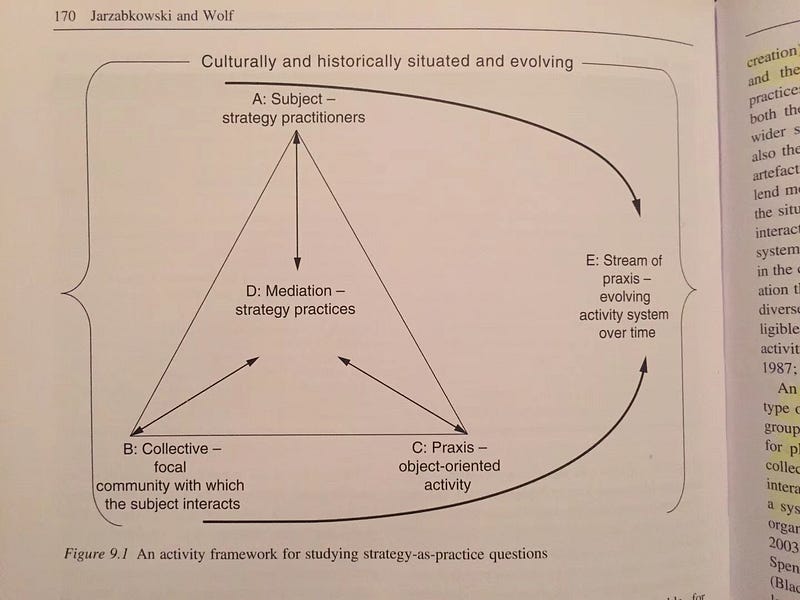
Strategy-as-Practice (SAP) is an emergent approach for studying organization strategy management. Researchers have identified three core issues for the Strategy-as-Practice approach: strategy practitioners, strategy praxis and strategy practices. Jarzabkowski adopted the activity system for understanding these three core issues. The strategy practitioners (A) was conceptualized as the subject, the subject’s “doing” of strategy was understood in relation to the collective (B), the strategy praxis was conceptualized as the object-oriented activity (C), the mediation (D) of interactions between subjects, the collective and their shared activity. Jarzabkowski also considered activity is a long-duration concept: a flow of activity over time (E).
- Human-Artifact Model (Bødker & Klokmose, 2011)
Another example of Abstract Models is Susanne Bødker & Clemens Nylandsted Klokmose’s Human-Artifact Model (2011) which addressed the emergent issue of larger ecology of artifacts while traditional HCI research focused on individual interactive artifact. They adopted activity theory as a framework and developed a model including four interconnected levels of analysis for discussing possibilities and problems.
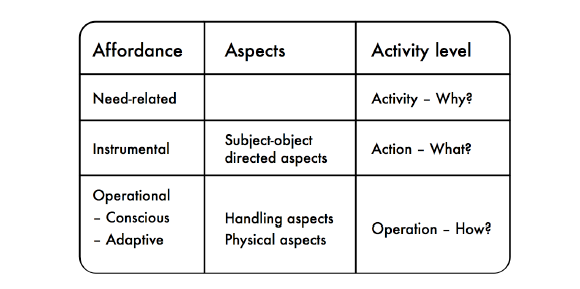
The core of Bødker & Klokmose’s work is the above summary of affordances, aspects and activity levels. The early work of Bødker (1991) was adopting three levels of activity for HCI research, she proposes the analysis of interactive artifacts through three kinds of aspects to match the three levels of activity: The physical aspects, the handling aspects and the subject/object aspects. Another conceptual source was from Bærentsen & Trettvik (2002) ’s work on affordances levels. They identify three types of affordances to match the levels of activity, action and operation: Need-related, instrumental and operational affordances. Bødker & Klokmose combined two lines together as a foundation for the Human-Artifact Model.
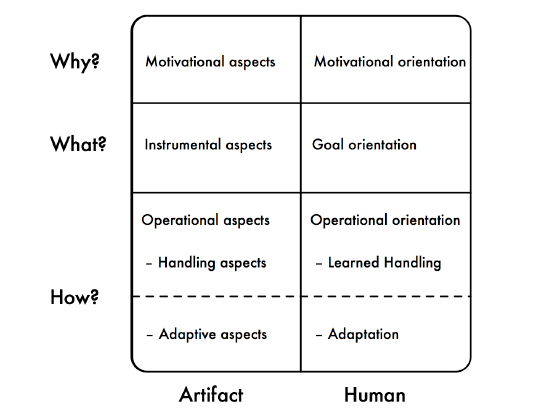
The final model is the above diagram. The left hand side of the figure ties to the artifact; the aspects. The right hand side is the human side, and ties to the user’s orientation. Both sides are expressed vertically through the levels of activity.
- Instrumental Genesis Theory (Rabardel, 1995)
One other notable Abstract Model I want to mention is Instrumental Genesis theory developed by Pierre Rabardel who is a French teacher-researcher specialising in psychology and ergonomics. The terms “object, artefacts, instruments tools” are used by many researchers with various meanings. Rabardel (1995) went back to Vygotsky’s ideas and made a distinction between the “physical object” and the “physical object which in used” by introducing a new concept called Instrument. He suggested that the instrument has two components, one is utilization schemes which refer to psychological structures for organizing the activity, the other one is produced artifacts which may be material or symbolic.
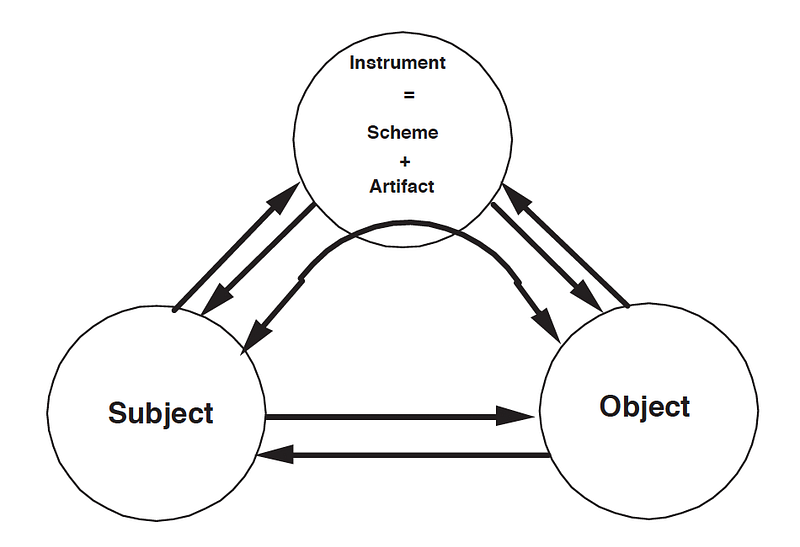
By redefining the concept of Instrument, Rabardel further pointed out different dimensions of mediation which is also a core concept of activity theory. He used design activity as an example (subject=designer, object=the objective of design activity) to describe three types of mediation at different phases of the design activity. At the production phase, there is “pragmatic mediation” between the subject and the object of the activity. At the draft phase, the instrument performs “epistemic mediation” between the subject and the object of the activity. At the review phase, there is “heuristic mediation”: the subject orients and controls his/her activity in line with the progress of his ongoing activity. (Béguin & Rabardel, 2000).
Rabardel also developed CIAS (Collective Instrumented Activities and Situations) model for the analysis of the appropriation processes involved in group activities mediated by artifacts. The diagram below is one type of diagrams of the CIAS model.
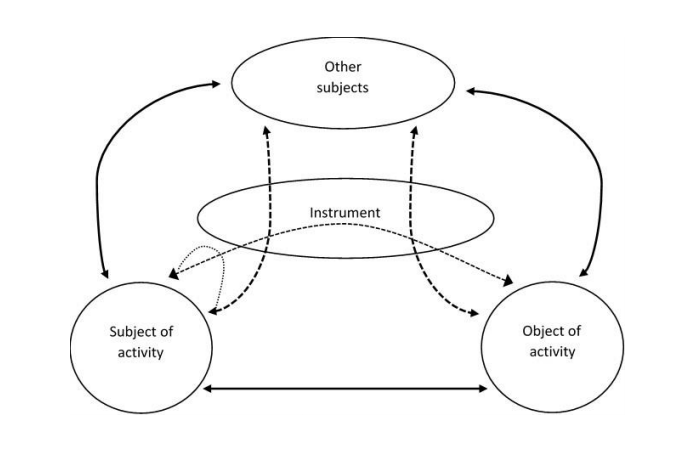
The CIAS Model of Instrumented Activity added “Other subjects” to the original diagram of instrumented activity and presents represents three types of mediation in the instrumented activity:
- object mediations: directed towards the object of the activity
- interpersonal mediations: directed towards the other subjects
- reflexive mediations: towards the subject itself
Based on the concept of Instrumented Activity, Rabardel coined a new term called instrumental genesis for discussing developmental transformation which is also an important agenda of activity theory. The instrumental genesis has two sub-processes, the first is artifact-oriented instrumentalization process which refers to the evolution of the material side of the instrument, and the second is subject-oriented instrumentation process which refers to the emergence and evolution of the subject’s utilization schemes.
Activity as Concrete Models
Concrete Models (cModel) are lower level models with details for directly guiding domain research and practice. I select two examples from works of activity theorists.
- Activity-Oriented Design Method (AODM) (Daisy Mwanza, 2002)
For example, researchers of the HCI (Human-Computer Interaction) discipline found Activity Theory conceptual approach highlights the importance of computer users’ social and cultural behavior in context and helps designers and developers understand complex and intertwining issues that impact on the usefulness of objects. However, there is no established standard method for connecting Activity Theory concepts with HCI practice. Activity Theory doesn’t provide ready-made techniques and procedures for research and design.
Noticing the lack of a standard and specified method for applying Activity Theory within HCI, Daisy Mwanza (2002) developed an Activity-Oriented Design Method (AODM) with four methodological tools. Mwanza highlighted the benefits of AODM for HCI researchers and designers: 1). AODM provides a structured and grounded approach for operationalising Engestrom’s (1987) activity triangle model; 2). The AODM approach can easily be integrated with other design methods; 3). AODM can be successfully applied to the analysis of real world settings; 4). AODM produces data that can be meaningfully interpreted and usefully incorporated in system design; 5). AODM can be easily used by designers and other users with little knowledge of Activity Theory (p.198).
- Activity Systems Analysis Methods (Lisa C. Yamagata-Lynch, 2010)
In North America, educational researchers and practitioners started adopting activity theory in the late 1980s. However, much of the discussion dwells on the theoretical background of CHAT and the description and interpretation of human interactions from this perspective. Lisa Yamagata-Lynch noticed there is a lack of discussion on methodological guidance for researchers and practitioners on how to engage in investigations of complex learning environments from this perspective. Thus, she adopted Engeström’s activity systems and developed a method for applying it to the context of complex learning environments. In 2010, she published a book titled Activity Systems Analysis Methods: Understanding Complex Learning Environments.
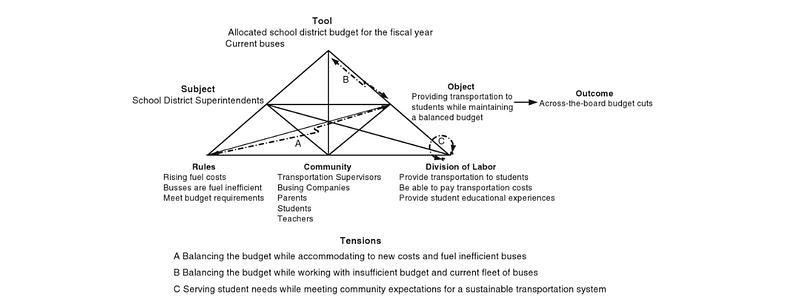
One important aspect of Engeström’s activity systems is that activity systems are constantly developing and there are contradictions or tensions behind the development of activity systems. The original Engeström’s triangle does directly display these complex interactive relations on the diagram. Thus, learners have to read the theoretical documents carefully. The above diagram is an activity systems triangle-in-use from Lisa Yamagata-Lynch’s book. On September 7, 2008, Pat Wiedenkeller published an article titled Fuel Price Squeeze School Districts in New York Times. Yamagata-Lynch used Activity Systems as a framework to represent the situation described by Wiedenkeller. She used Engeström’s triangle to describe how changes in a contextual situation that create systemic contradictions can create tensions in individual activities and affect the nature of those activities.
Activity as Domain Practice
Domain Practice (dPractice) points to if a person thinks and reflects on a domain in which he is working within. Most professionals like to think about domain issues and consider it as one important aspect of their career activity. For example, a designer would like to write articles about design, collect things and images about design, and share their insights with peers. These activities generate domain practice knowledge. Sometimes, they also create concrete models (cModel) to represent their personal knowledge without connecting to theoretical concepts or approach.
Activity theory has been widely used in various fields, for example:
- Education
- HCI / CSCL
- Information Systems
- Organizational Development
- Work and Organization
Lisa Yamagata-Lynch had summarized a representative collection of works published in English during the 1990s. The table below is quoted from her book (2010).
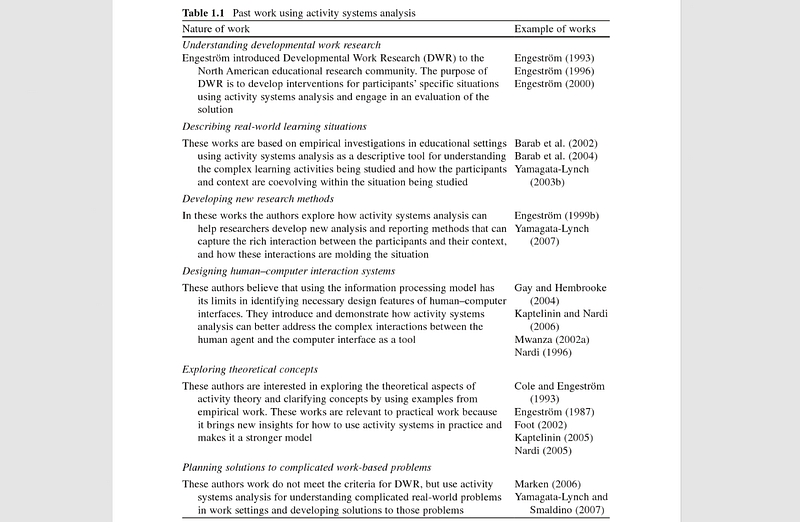
For most researchers and practitioners in professional domains, activity theory can be used as a theoretical lens for their inquiry and reflection. According to Kaptelinin, “Activity theory is not a ‘theory’ in the traditional sense in which ‘theory’ is understood in natural sciences. Activity theory does not support creating and running predictive models which would only need to be ‘fed’ with appropriate data. Instead, it aims to help researchers and practitioners to orientate themselves in complex real-life problems, identify key issues which need to be dealt with, and direct the search for relevant evidence and suitable solutions.”
Activity as General Practice
General Practice (gPractice) means daily life as a general context of knowing. For example, personal growth, productivity, mental health, career value, life meaning are typical issues for most adults.
Though activity theory is a theory for professional research, I do believe it is useful for ordinary people to reflect their daily life. I suggest the following approach:
Life as Activity
We can see our daily life and the whole life as an activity. In fact, the founder of activity theory once considered using Life Theory to name his theory. According to Kaptelinin and Nardi (2006), “Leontiev’s ambition was to translate this general statement into a concrete description of how the first phenomena that can be called “psyche” emerged in history, and how they developed into the current variety of mental phenomena. To accomplish this goal Leontiev needed a special kind of analytical tool, a concept more general than psyche, that would make it possible to define the context in which the psyche emerges and develops. An obvious candidate for such a concept is ‘Life’, since ultimately this is what undergoes evolutionary change. However, this concept is too general and too vague. ‘Activity,’ as we will see below, was chosen by Leontiev as a concept that can provide a more concrete insight into what ‘Life’ is.”(pp.51–52)
Life is a wonderful activity!
Update April 10, 2021
I have developed an approach called Life-as-Activity. You can find details here.
What’s Next?
This is Part I of Activity U: The Landscape of Activity Theory. The Part II will review these various knowledge developmental activities from the perspective of Knowing-for-all.
You are most welcome to connect via the following social platforms:
Twitter: https://twitter.com/oliverding Doowit: https://doowit.co/profile/gm0k2ax9 Linkedin: https://www.linkedin.com/in/oliverding
License
This work is licensed under the Creative Commons Attribution-NonCommercial-ShareAlike 4.0 International (CC BY-NC-SA 4.0) License. Please click on the link for details.
References
Béguin, P. & Rabardel, P. (2000) Designing for Instrument-mediated activity. In Scandinavian Journal of Information Systems, 2000, 12: 173.
Bødker, S. & Klokmose, C. N. (2011) The human-artifact model — an activity theoretical approach to artifact ecologies. Human–Computer Interaction Vol. 26, Iss. 4, 2011.
Clay Spinuzzi (2020) “Trying to predict the future”: third-generation activity theory’s codesign orientation, Mind, Culture, and Activity, 27:1, 4–18, DOI: 10.1080/10749039.2019.1660790
Cole, M. (1996). Cultural psychology: a once and future discipline. The Belknap Press of Harvard University Press.
Dafermos, M. (2015) Critical Reflection on the reception of Vygotsky’s theory in the international academic communities. In Chernish, A., et al. (Eds.) Cultural-historical approach: educational research in different contexts. Edipucrs.
Engeström, Y. (1987). Learning by expanding: an activity-theoretical approach to developmental research. Orienta-Konsultit.
Engeström, Y. (2001) Expansive learning at work: toward an activity theoretical reconceptualization, Journal of Education and Work, 14:1, 133–156, DOI: 10.1080/13639080020028747
Engeström, Y. (2008). The future of activity theory. Keynote lecture presented at the ISCAR Conference in San Diego, Sept. 8–13, 2008
Jarzabkowski, P. & Wolf, C. (2015) An activity theory approach to strategy as practice In Golsorkhi, D. (Eds.) Cambridge handbook of Strategy as practice. Cambridge University Press.
Kaptelinin V., & Nardi B. (2006). Acting with technology: activity theory and interaction design. The MIT Press.
Kaptelinin V., & Nardi B. (2012). Activity theory in HCI: fundamentals and reflections. Morgan & Claypool Publishers.
Kaptelinin, Victor (2014): Activity theory. In: Soegaard, Mads and Dam, Rikke Friis (eds.). “The encyclopedia of human-computer interaction, 2nd Ed.”. Aarhus, Denmark: The Interaction Design Foundation. Available online at https://www.interaction-design.org/encyclopedia/activity_theory.html
Mwanza, D. (2002) Towards an activity-oriented design method for HCI research and practice. PhD thesis The Open University.
Nardi, B. (2016). Appropriating theory. In Sonnenwald,D.(ed.) Theory development in Information: reflecting on the process. University of Texas Press.
Rabardel, P. (1995) Les hommes et les technologies; approche cognitive des instruments contemporains. Armand Colin, pp.239. hal-01017462
Wertsch, J. V. (1991) Voices of the mind: a sociocultural approach to mediated action. Harvard University Press.


