
When X Meets Y (WXMY)
A diagram for visualizing boundary innovation and beyond
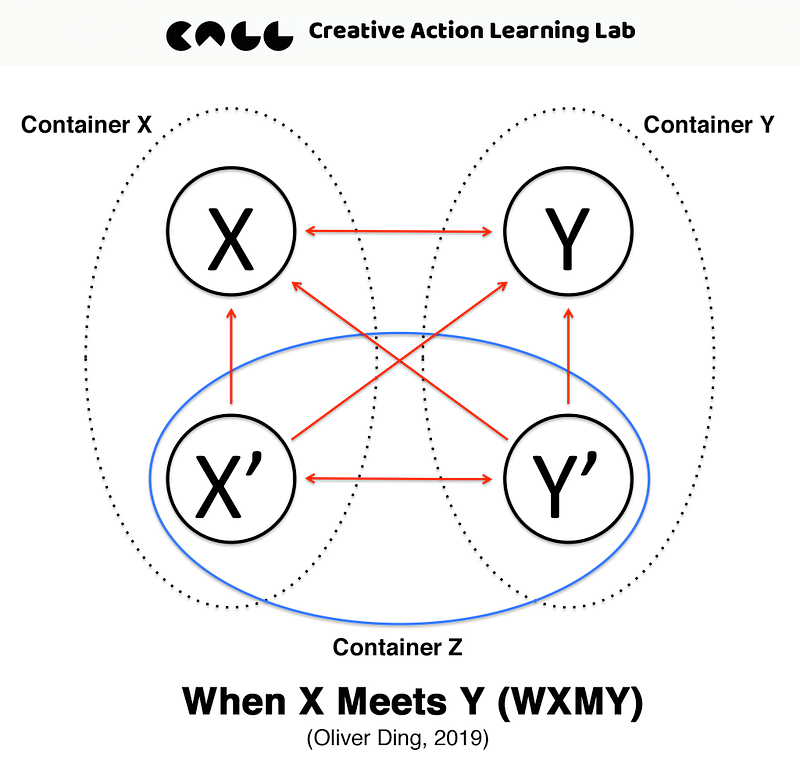
Last year, I created the above diagram and named it “When X Meets Y” (WXMY). This week, I applied it to several issues and generated some domain specific diagrams!
The WXMY diagram says nothing about practical issues, but pure abstract relations between two groups of entities. Container X means one group which contains entity X and its related entity X’. Y and its related entity Y’ form another group Container Y in the same way. When X meets Y, there is a new group called Container Z which emerges from the process of coupling, connecting, competing, cooperating and more interacting between X and Y.
The WXMY diagram is not a practical framework for directly solving a domain problem, but it can generate domain diagrams if you use it to visualize your ideas about a particular issue in a special context. By using the WXMY diagram, you can create your framework.
I have mentioned an idea called Avocado Effect which describes an essential structure called “meta-product / product”. If we apply the Avocado Effect to diagramming, we can see the same structure: “meta-diagram / diagram”. The WXMY diagram is a meta-diagram and you can use it to create as many domain specific diagrams as you want.
This article has three main parts and ten sections. The first part describes my original insight and motivation. The second part tells my own experience of using the WXMY diagram. The third part compares it with other diagrams.
Part 1: The Origin
1. When Vygotsky Meets Dewey 2. The #Non2x2Matrix Challenge
Part 2: The Use
3. When Founder Meets Designer 4. When Creative Action Meets Curator 5. When 2019 Meets 2020 6. The WXMY Week 7. When Grid Meets Group
Part 3: The Test
8. Comparing as Testing 9. WXMY v.s. Semiotic Square 10. WXMY v.s. Conceptual Blending
I consider the WXMY diagram as a tool for visualizing boundary innovation. This article also adopts boundary writing style, it touches various domains. If you want to focus on one thing, you can just quickly look at different versions of the WXMY diagram and ignore the rest part.
1. When Vygotsky Meets Dewey
Last August, I read several academic papers around a debate between Jim Garrison who is a philosopher and Dewey scholar and Reijo Miettinen who is an Activity theorist and Vygotsky scholar. They discussed the relationship between Deweyan pragmatism and Cultural-historical activity theory which was founded by Soviet psychologist Lev Vygotsky.
Garrison argued that Activity theory adopted a dualist approach because IT has an internal/external notion. He suggested that Dewey’s transactional theory of action is a better solution for understanding human activity. Reijo Miettinen disagreed with Garrison, he said that Activity theory is just as committed to anti-Cartesian monism as Dewey’s conception and he believed that Activity theory can supply useful conceptual tools for transcending the dualism of the internal and the external.
This reading experience inspired me to create the WXMY diagram. The embedded file below is the 1.0 version which uses “Camp X”, “Camp Y” and “Camp Z” because the 1.0 version focuses on social groups. Now, I expanded it to any kind of entity, so I changed “Camp” to “Container”.
For the academic debate between Jim Garrison and Reijo Miettinen, X means John Dewey and X’ means Jim Garrison, Y means Lev Vygotsky and Y’ means Reijo Miettinen. The debate means Camp Z.
2. The #Non2x2Matrix Challenge
Why did I create the WXMY diagram? It was just for fun. I did not have any problem to be solved with the diagram. But I do believe good diagrams can help people think better.
In 2018, I wrote a 81-page personal thesis about diagram and diagramming. I found many management and business thinkers like using a 2x2 matrix to represent their ideas. And, it is really bad! Two months ago, I read a paper titled The technology-mindset interactions: Leading to incremental, radical or revolutionary innovations. The authors used a 2x2 matrix to generate three types of innovation model. I believe this matrix is too simple because it only considers two dimensions: the technological transformation and mindset transformation. I’d like to add the third dimension: culture transformation.
This reading experience inspired me to initiate the following challenge: The #Non2x2Matrix Challenge.
Today I realize the WXMY diagram is an alternative to the 2x2 matrix. If you are looking for something beyond the 2x2 matrix, you can try the WXMY diagram.
3. When Founder Meets Designer
In 2019, I didn’t frequently use the WXMY diagram. I just tried it a few times. One example is about Founder, Designer and Product. After reading several articles about communication between startup teams and professional designers, I created the following diagram based on the WXMY diagram.
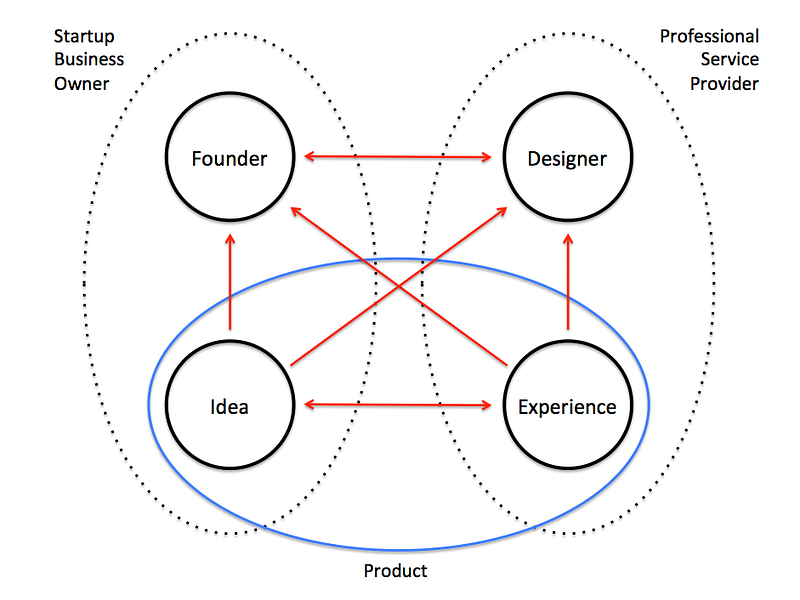
When the Founder meets the Designer, their shared space is Product. Founders want to create a product based on their own idea while designers want to create a product which can offer great user experience. Thus, these two camps always debate on what the product should be.
The above diagram guided me to think deeper. Why do these two camps hold different views on the same thing? I expanded the Camp Z (product) into the following diagram. I realized there is not one product, but three products: Imagined Product, Simulated Product and Actualized Product.
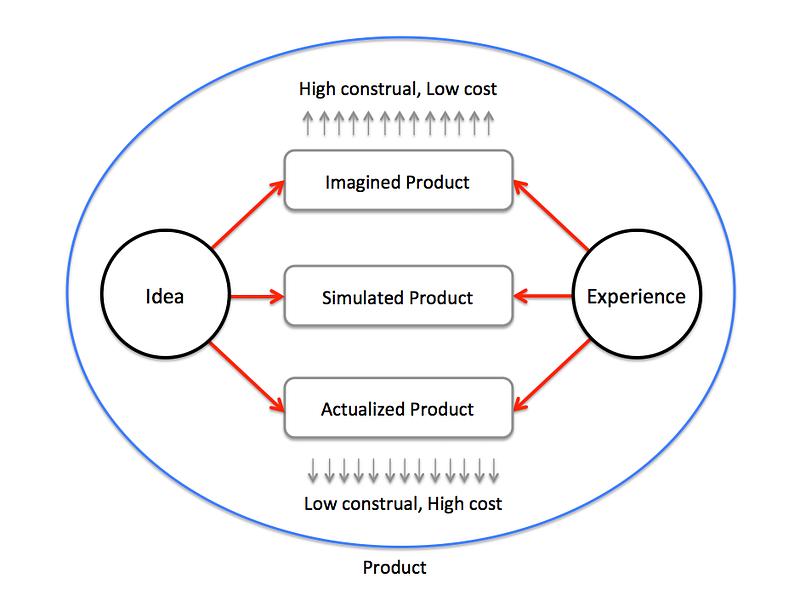
According to Construal level theory (CLT), a social psychology theory that describes the relation between psychological distance and the extent to which people’s thinking is abstract or concrete, I think these three types of products require different construal levels. The Imagined Product needs higher level construal which means high level abstract thinking. At this level, founders and designers should work on unique creative insight and product direction. Usually, it is easy to get people on the same page at this level. The Actualized Product is the real product which requires low level construal because it shouldn’t ask users to think too much. The Simulated Product, its other name is prototype or beta product, is a bridge between high level construal and low level construal.
Is abstract thinking for products always bad and concrete thinking for products always good? No, it is not the case. We need to consider another important fact: Cost! Turning an idea into a real thing costs a lot of money! Thus, there are two ways to save money. First, making correct decisions on the high level construal. This way requires complex higher cognitive skills and knowledge. Second, keep the transforming process from Imagined Product to Actualized Product simple, fast and right. This way is about getting ideal communication between founder and designer.
4. When Creative Action Meets Curator
On Sept 23, 2019, I wrote a post about the vision of CALL. After one month, I got a plan for CALL and made the following diagram for describing Creative Container.
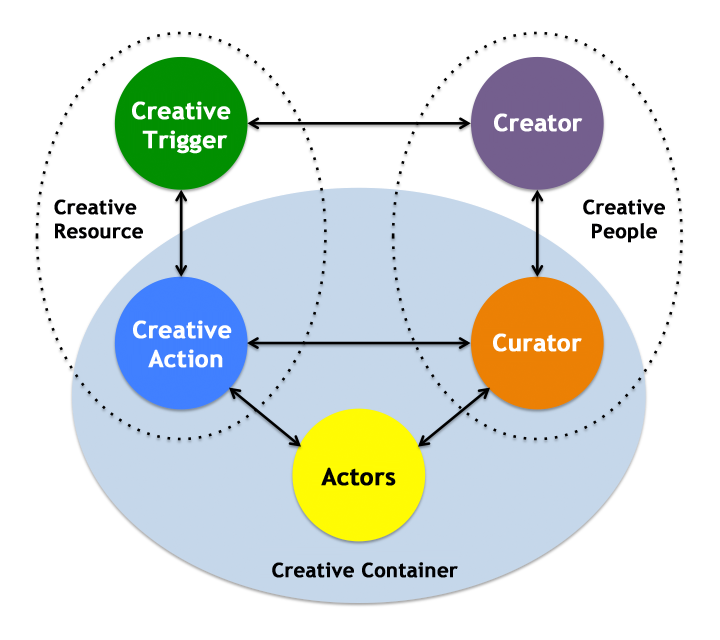
Once a creator makes a brand new Creative Action, CALL will work with the creator to build a Creative Container for growing a community around the Creative Action.
Each Creative Container will be led by a creator and a curator. They will work together to spread the message and pattern of the Creative Action and attract people to join them as actors.
5. When 2019 Meets 2020
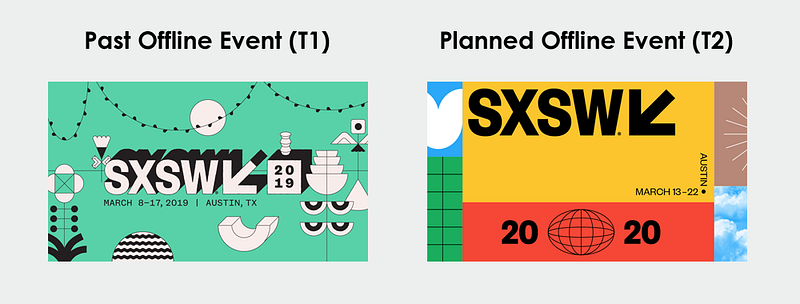
In early this month, SXSW, a 34-year annual tech, music and film festival held in downtown Austin, was canceled due to the coronavirus outbreak. The SXSW 2020 was scheduled to take place from March 13th to March 22nd, Austin Mayor Steve Adler announced the cancellation of the festival on Mar 6, just one week before it.
This inspired me to propose an alternative category of event called Re-Engagement. When offline events are canceled around the world, the obvious Plan B is running online real time conferences and virtual meetings with conferencing software such as Zoom, Google Hangouts and Jitsi. I think we can go further and I consider Re-Engagement as Plan C.
In order to describe my proposal, I created the following Re-Engagement framework with the WXMY diagram.
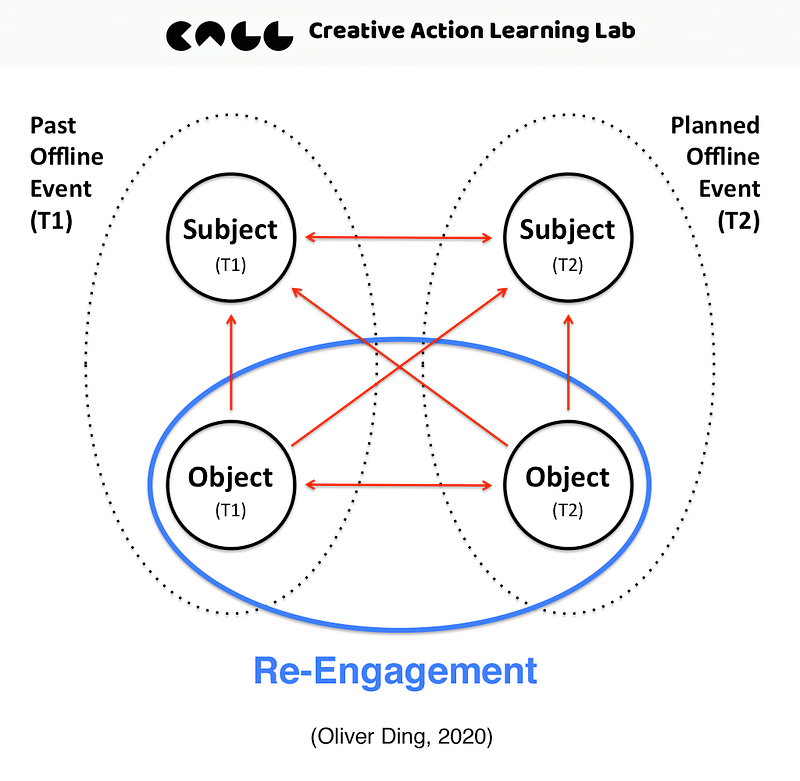
The framework was created with three ideas. The first idea is the diachrony of community. I borrowed the term diachrony from Saussure’s theory of linguistics. For Saussure, it means development and evolution of a language through history. I applied the idea to researching community. While the real time face-to-face offline event focuses on the synchrony of community, the Re-Engagement is designed about the diachrony of community. For offline events, there are past events (T1) and planned events (T2), the Re-Engagement connects T1 and T2 together.
The second idea is the notion of Subject-Object. I learned the idea from Activity Theory. In Activity Theory, the relationship between Subject (human actor) and Object (the objective) forms the core of an activity. The Object leads to Outcomes. For offline events, the Subject are event curators, speakers and attendees while the Object are various themes for discussing and potential collaboration opportunities. The Outcomes are new insights inspired by discussions and new collaboration emerging from the socialized events.
The third idea is the WXMY diagram. By combining the diachrony of community and Subject-Object together and placed them within the WXMY diagram, I realized the Container Z can transform to a new category: Re-Engagement.
6. The WXMY Week
I got the idea of Re-Engagement on March 7 and developed the Re-Engagement framework on March 18. I was surprised by the process and outcomes. Thus, the next following days became the WXMY week and I applied the WXMY diagram to several ideas.
March 22: I applied it to “Ecological Structure”. March 22: I applied it to “Double Grid-Group” March 23: I applied it to “Boundary Innovation” March 26: I applied it to “Platform Container” March 26: I applied it to “Theory — Practice Coupling” March 27: I applied it to “Life Container”
What an amazing experience! I was highly engaged with the process of visualizing various complex and abstract ideas by the WXMY diagram during this week. It seems this week is a tipping point of the diagram.
Some of these ideas are just insights such as “WXMY for Ecological Structure”, I just got it but without any further work. One idea led to a 80-slide document such as “Platform Container”. I can’t share all details of these ideas within this article.
Let’s just look at one of these ideas: WXMY for Double Gird-Group.
7. When Grid Meets Group
The “Double Gird-Group” was inspired by British anthropologist Mary Douglas’s Gird-Group cultural theory.
On Jan 2, 2020, I reviewed my notes on Personal Information Architecture from the perspective of my own idea Curativity Theory. I realized there are three types of Curativity in the context of information architecture: Platform Curativity, Institution Curativiety and Individual Curativity. There are different agencies, motivation and goals behind these Curativity and sometimes they contradict each other.
In order to understand the mechanism of contradiction and coordination of multi-curatiivty, I adopted Mary Douglas’s Gird-Group model and expanded it to Double Gird-Group. Douglas’s original model considered two dimensions: Group (the boundary of a community) and Gird (the structure of regulation). The Group dimension measures how much of people’s lives is controlled by the group they live in. The Gird dimension describes how different people are in the group and how they take on different roles.
In the context of information architecture, there is an important distinction between offline environment and online environment. So, I doubled Douglas’ Gird-Group model and the Traditional type of Group and Grid is considered to be distinguished from the Digital type of Group and Grid.
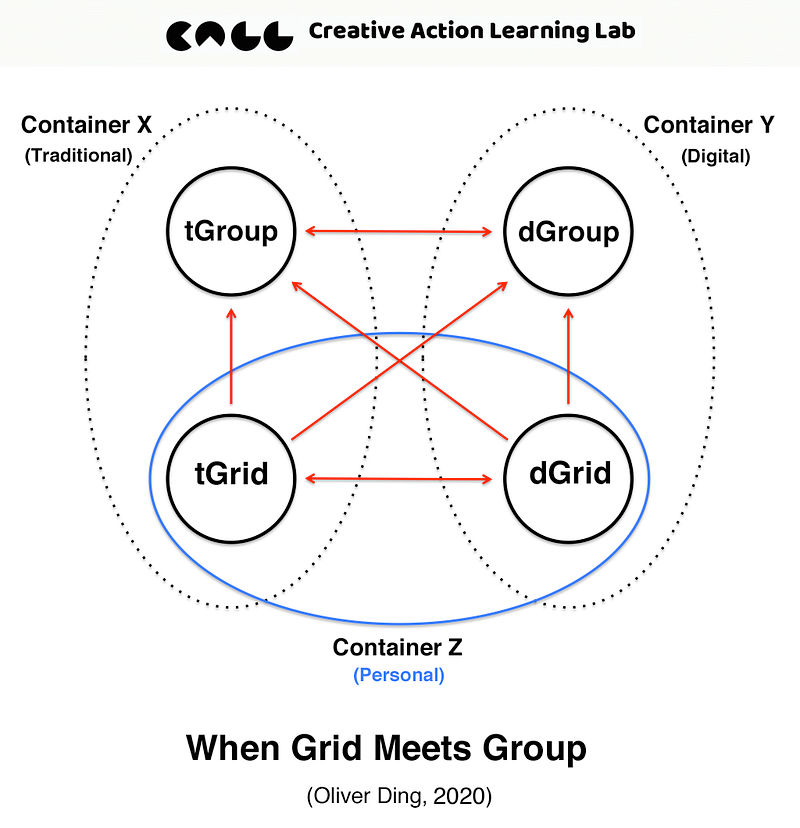
On March 22, I had a discussion about the WXMY diagram and “Ecological Structure” with a friend. After the discussion, I realized I can apply the WXMY diagram to the Double Gird-group framework. Douglas’s original model was represented with a 2x2 matrix. For my version, it’s hard to double the 2x2 matrix. The WXMY diagram not only solved this problem, but also generated an extra benefit. It has a Container Z which makes tGrid and dGrid as a whole. I believe the essential point of Personal Information Architecture is life as a whole while the environment is disturbed.
The final Double Gird-group framework uses four special signs: tGroup, dGroup, tGird and dGird. The “t” stands for “traditional” and the “d” stands for “digital”. For example, Institution Curativity is traditional Group (tGroup) and Platform Curativity is digital Group (dGroup). Following this logic, the Individual Curativity within Institution is traditional Gird (tGird) and the Indivisual Curavitiy within Platform is digital Grid (dGrid).
8. Comparing as Testing
The outcomes of the WXMY week encourage me to publish the WXMY diagram as the fifth Creative Triggers of CALL (Creative Action Learning Lab).
Now the WXMY diagram is a public thing. I have to take it seriously by running more tests. The next two sections will compare the WXMY diagram with two rough related diagrams.
9. WXMY v.s. Semiotic Square
First, I want to compare the WXMY diagram with Semiotic Square which was developed by French-Lithuanian linguist and semiotician Algirdas J. Greimas.
The Semiotic Square is a great tool for learning the structural meaning of any pair of concepts. As the diagram below shows, it has three types of relationships:
- Contrary: S1 + S2; ~S2 + ~S1
- Contradiction: S1 + ~S1; S2 + ~S2
- Implication: ~S2 + S1; ~S1 + S2
If you give a pair of opposite concepts, let’s say “masculine-feminine”, you get other four concepts:
- S1: masculine
- S2: feminine
- ~S1: not-masculine
- ~S2: not-feminine
- S1 and S2: masculine and feminine, i.e. hermaphrodite, gender-fluid
- neither S1 or S2: neither masculine or feminine
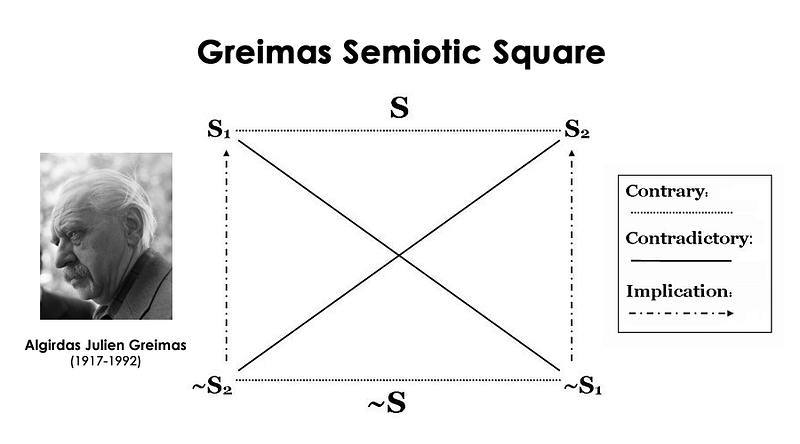
While the WXMY diagram and the Semiotic Square share some similarities they are stylistically very different.
The first similarity is the family of meaning. The Semiotic Square’s Implication relationship ties S1 and -S2 as a family of meaning. We see the WXMY use Container X and Container Y to represent family of meaning too.
The second similarity is the extrinsic connection. The Semiotic Square’s Contrary relationship such as S and -S can be considered as an extrinsic connection between two families of meaning. The WXMY diagram uses Container Z to connect Container X and Container Y.
The differences between the WXMY diagram and Semiotic Square are obvious too. The Semiotic Square is a strict, limited, specific structural analysis tool based on a pair of opposite concepts. In order to use it, you have to start from a pair of opposite concepts such as masculine-feminine. The Semiotic Square only has three types of relationships. The Semiotic Square is for understanding structure of meaning.
Conversely, the WXMY diagram is a rough, loose, general heuristic tool. It isn’t limited to opposite concepts. It allows various types of relationships. It’s for understanding emergent boundary innovation.
10. WXMY v.s. Conceptual Blending
Second, let’s compare the WXMY diagram with Conceptual Blending theory, a powerful theoretical tool from the field of cognitive linguistics.
Gilles Fauconnier and Mark Turner developed the Conceptual Blending theory for researching conceptual integration. According to Fauconnier and Turner, “Building an integration network involves setting up mental spaces, matching across spaces, projecting selectively to a blend, locating shared structures, projecting backward to inputs, recruiting new structure to the inputs or the blend, and running various operations in the blend itself.”
The basic diagram of Conceptual Blending below shows four mental spaces, the solid lines indicate the matching and cross-space mapping between the inputs, the dotted lines indicate connections between inputs and either generic or blended spaces, and the solid square in the blended space represents emergent structure.
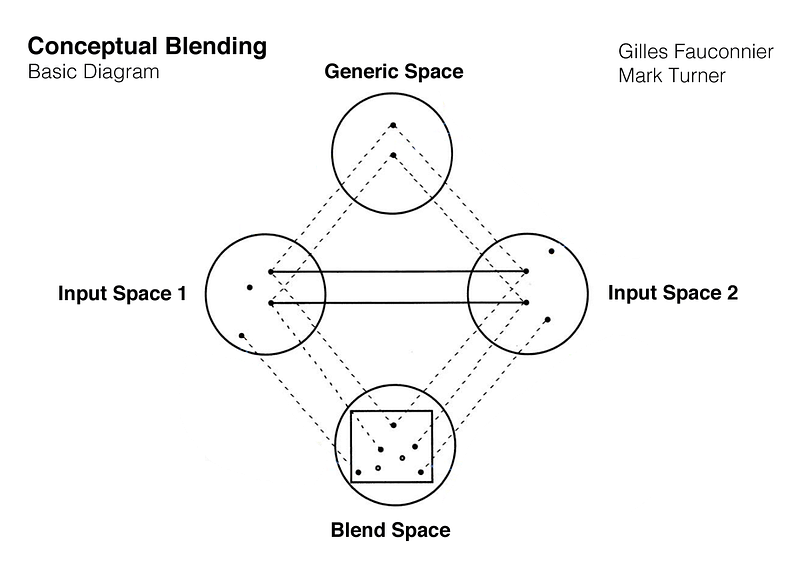
Again, we see two similarities between these two diagrams: the family of meaning and the extrinsic connection.
The Input Space 1 and Input Space 2 can be seen as two families of meaning. For the WXMY diagram, they are Container X and Container Y.
The Blend Space can be seen as an extrinsic connection. It connects Input Space 1 and Input Space 2. For the WXMY diagram, it is Container Z.
The major difference between WXMY and Conceptual Blending is the former is a meta-diagram level heuristic tool while the latter is an established theory in the field of linguistics. As a meta-diagram, WXMY leaves the theoretical exploration space for researchers and thinkers from different domains to build their own theoretical frameworks.
Conceptual Blending has a space called General Space. The WXMY doesn’t have the fourth container.
Conceptual Blending claims that the square in the blended space encompasses the conceptual structures projected in the blend, which are created by means of a) composition, b) completion, c) elaboration. I have not yet discovered such a deep mechanism for WXMY.
11. CALL for Action
Some people like developing frameworks and models as thinking tools for directly solving problems, I do like developing frameworks, models and diagrams as thinking containers for curating practice experience, theoretical knowledge, and peer-to-peer conversation together.
The WXMY diagram is the fifth Creative Triggers presented by CALL (Creative Action Learning Lab). Check out the links below to find more Creative Triggers.
Action-based Creativity #1 The Pinwheel Framework (Feb 25, 2020)
The Avocado Effect #1: Introduction (Feb 28, 2020)
Social Platform Experience Design (#SocialPxD)(Mar 4, 2020)
DEKIN Innovation System (Mar 6, 2020)
Based on the Pinwheel framework, the WXMY diagram is categorized as a Creative Model which aims to impact your mind. Creative Models are theoretical models, frameworks, formulas, diagrams,etc. It changes people’s mind and impacts their epistemic activity.
If you like the WXMY diagram, you can use it for visualizing your ideas. Let’s push the boundary innovation forward together.


