
Platform, Platform-ba, and Platform Ecology
An Ecological Approach to Platform-based Social Practice

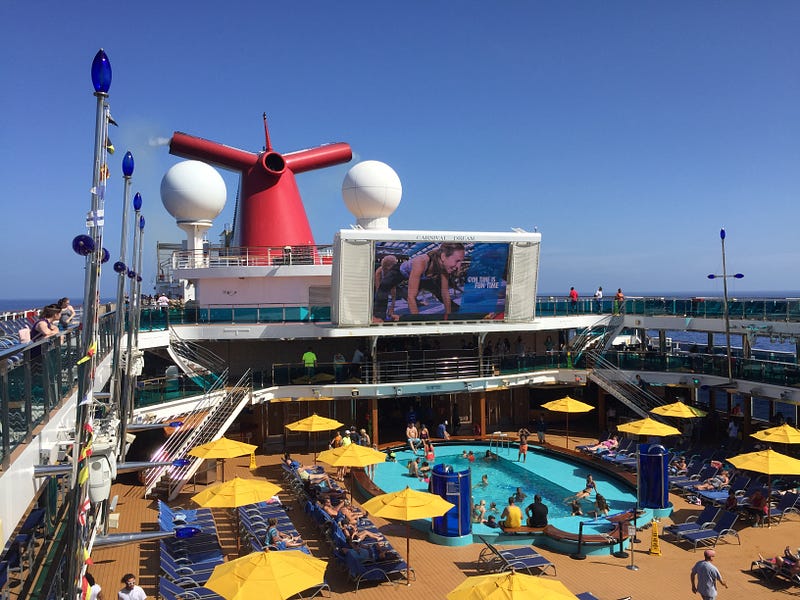
In August 2018, I went on my first cruise trip from Galveston to Cozumel with my family. We sailed on Carnival Dream which is a cruise ship operated by Carnival Cruise Line. At 128,250 GT, the ship is a large cruise ship with various facilities such as a water park with multiple sides, an 18-hole miniature golf course, dining venues, outdoor recreation areas, etc. It can serve 3,646 passengers.
When I took the above picture, I suddenly realized the ship is just a large Platform on the sea. Moreover, I was so excited because I found the cruise trip is a wonderful example of my concept Platform-ba in the real-life world.
In order to describe the platform-based various activities and social practices, I coin the term Platform-ba which means platform-based social field. While a Platform has a solid boundary, its Platform-ba has a soft boundary. For example, platform-based activities can happen inside the platform. While the ship sailed on the sea, we had a fun time with various programs inside the ship.
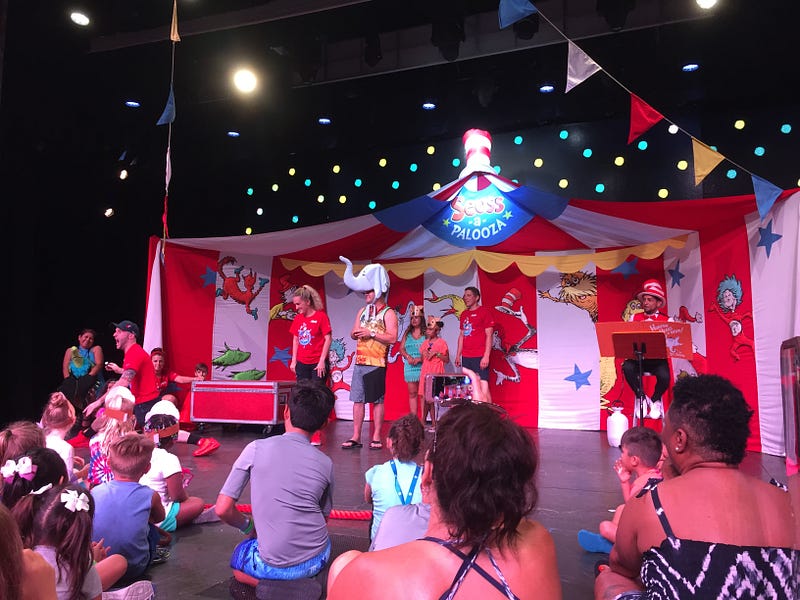
However, platform-based activities can happen outside the platform too. For example, when the ship reached ports, we left the ship and went to visit Maya must-sees like Chichén itzá myriad.
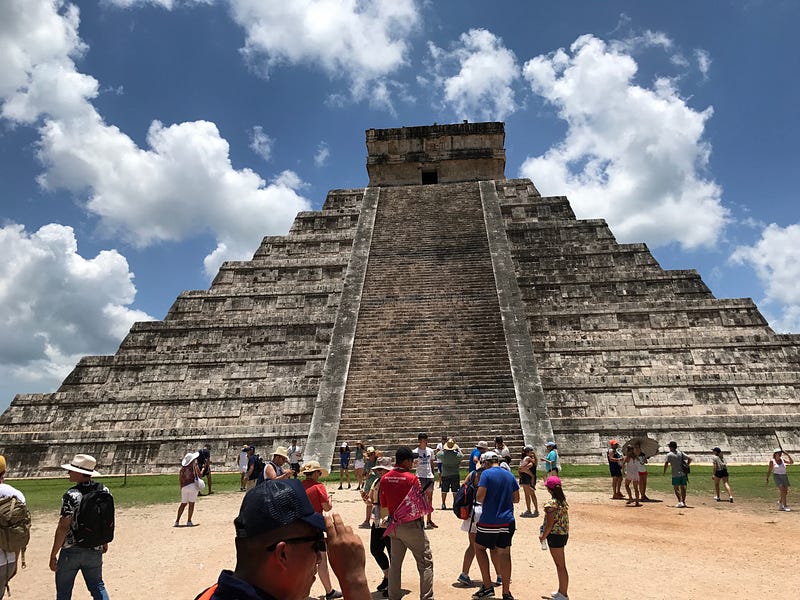
This article aims to introduce the original idea of Platform and Platform-ba from the perspective of the Ecological Practice approach. Since the approach defines the Platform as the post-Container status, I shall start with the Container Thinking and expand to the plan of the Platform Ecology project.
Contents
1. Container Thinking 2. The Landscape of Ecological Practice Approach 3. Platform-ba 4. Platform, Project, and Platform-ba 5. Platform-ba and Supportance 6. Platform-based Social Practice 7. Three Challenges of Platform Ecology 8. The Future of Platform Ecology
1. Container Thinking
One day In 2017, I saw a sideways flower pot in a local supermarket. As a guy who was not familiar with gardening, I was curious about such a container and the plants it contains. I used to think that plants always grow upward. That day, I was surprised that there are some plants that grow horizontally. I feel ashamed of my ignorance of botany.

This dramatic experience inspired me to reflect on the concept of Container. In 2017, I was fascinated with George Lakoff and Mark Johnson’s conceptual metaphor Container and image schema Containment. For Lakoff and Johnson, Container refers to the in-out orientation and boundary of space. After the day, I moved my attention from the boundary of the container to the dynamic relationship between the Container and the Things it contains. For the sake of discussion, I coined a new term called “Containee” in order to simply represent “Things contained by Container”.


The sideways flower pot taught me an invaluable lesson in which I learned the initial idea of the ecological practice approach. Though a plant is held by a container, the living space occupied by the plant in the world is beyond the interior space of the container. Later, I theorized this phenomenon with the following terms and diagrams.
- Inside Space: the interior space of the container.
- Outside Space: the exterior space of the container.
- Spilling Space: the living space occupied by the containee.
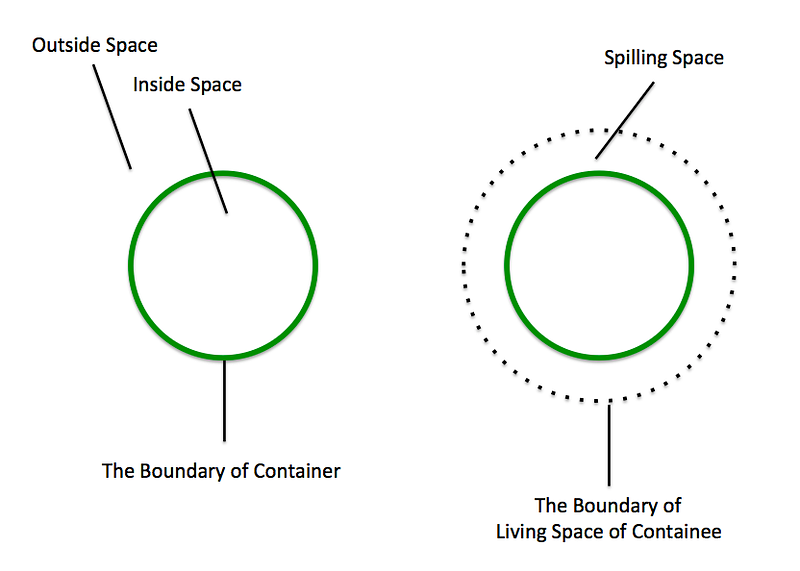
We have to notice that the Spilling Space is a dynamic space because it can be smaller than the inside space or bigger than the outside space. In this way, the spilling space connects the inside space and the outside space.
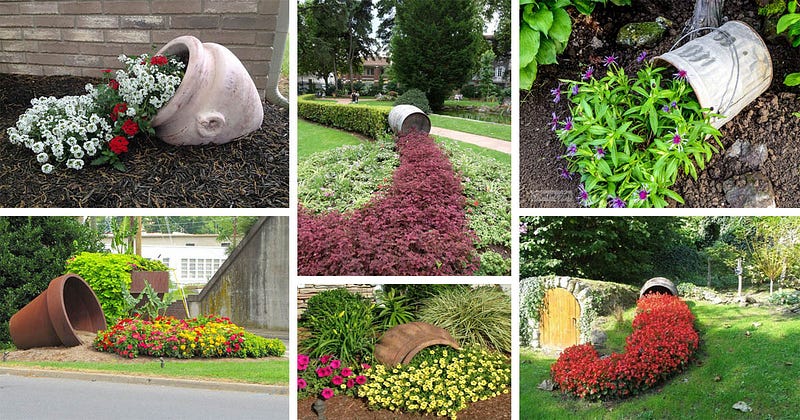
There are various creative forms of spilling flower gardening. The above pictures show some amazing ideas. They also tell us that the relationship between Container — Containee is quite interesting and fascinating.
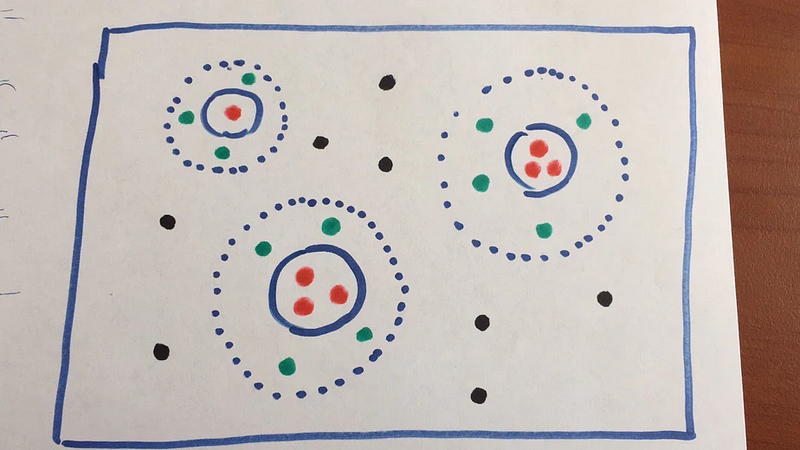
In 2018, I drew the above diagram to present a multiple-container model. I used red dots, green dots, and black dots to represent three types of status:
- Red dots: the entities are located Inside Space.
- Green dots: the entities are located in Spilling Space
- Black dots: the entities are located in Public Space which is outside the Spilling Space.
In 2019, I continuously worked on developing container thinking with the idea of the Container System. Eventually, it became the foundation of my theoretical account: the Ecological Practice approach.
2. The Landscape of Ecological Practice Approach
I have written a brief on the Ecological Practice Approach on Oct 19, 2020. Here we just review the part about Container, Network, and Platform.
Based on the concept of Container, I developed two related ideas: Network and Platform.
- The Network refers to the pre-container status which means pieces loose coupling outside a container.
- The Platform refers to the post-container status which means pieces loose coupling within a super large container.
These three ideas form a triad: Network — Container — Platform. I consider the triad as the basic form of collective context for applying the Ecological Practice approach.
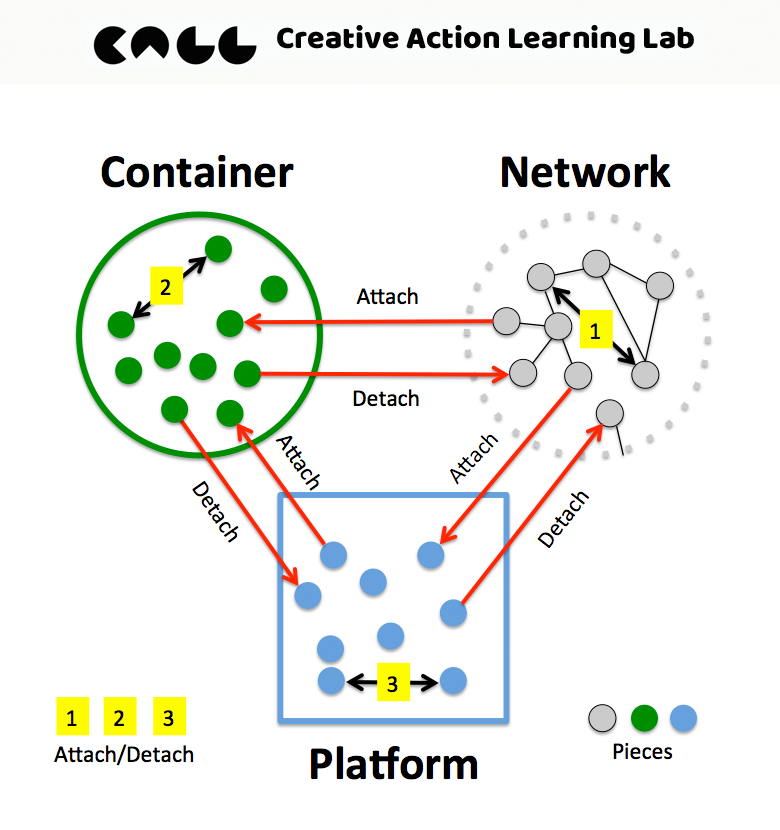
The above diagram represents a large map of the ecological practice approach. Here we see three basic types of collective context and attaching/detaching acts inside contexts and between contexts.
However, this diagram doesn’t highlight the idea of Platform-ba.
3. Platform-ba
The above description has defined the Platform as Super Large Container. Thus, the basic logic of Container can be applied to Platform.
- Platform: a super large container
- Participants: the containee of the platform
- Inside Space: the interior space of the platform.
- Outside Space: the exterior space of the platform.
- Spilling Space: the living space occupied by the Participants of a Platform
To facilitate discussion, I coined the term Platform-ba (or Platformba) to describe the sum of Containee and Spilling Space for the Platform Ecology project.
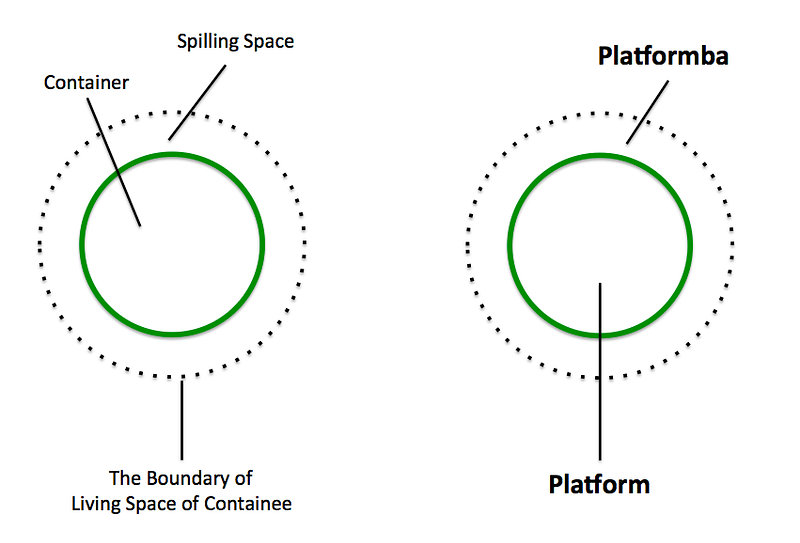
For the Platform-for-Development framework and the Supportive Cycle model, I defined Platform-ba as a platform-based sociocultural field.
The “ba” is originally found in Japanese. The concept of “ba” has been used extensively by Japanese management researcher Ikujiro Nonaka in his SECI model of knowledge creation. The platform-ba is an emergent social substance that is formed by people who have relations to a platform. While a platform is designed, managed, and controlled by its owner, its platform-ba is determined by people, the users, and stakeholders of the platform. By using the new term Platform-ba, I can highlight the active aspect of platform practice which refers to people’s activity.
4. Platform, Project, and Platform-ba
The Platform-for-Development framework and the Supportive Cycle model also adopt the concept of “Project” from Project-oriented Activity Theory and other theoretical resources.
If we go back to the Ecological Practice approach, what does the concept of Project mean?
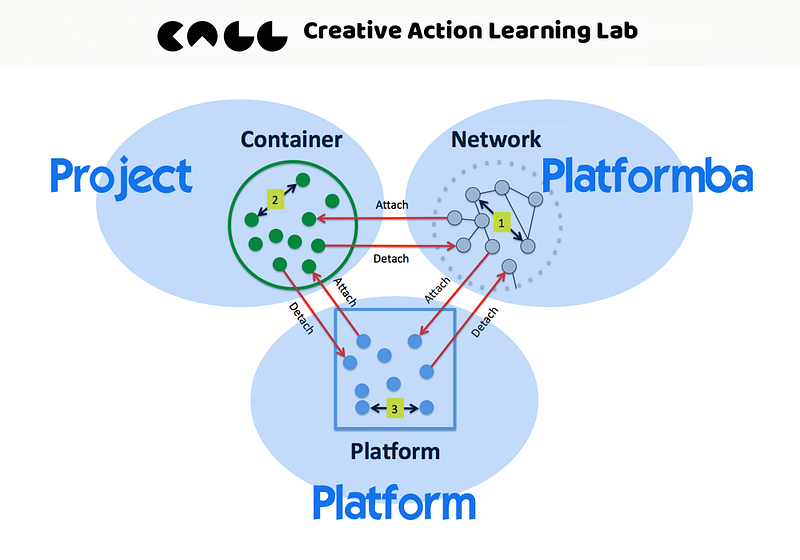
The Ecological Practice approach doesn’t have a concept of a Project. However, we can consider a Project as a Container at the concrete practical level because Project is a social container that has a clear boundary. We can deal with the concept of Platform-ba in the same way. The Platform-ba can be considered a Network because the human activities of a group of people can be understood from the perspective of the social network and the network of activity.
Thus, we can reduce the triad of Platform — Project — Platformba to the triad of Platform — Container — Network.
If we only develop a concrete framework or model, then we don’t have to consider the above issue. However, my goal is to apply the Ecological Practice approach to Platform Ecology. The former is a meta-theory and the latter is a concrete framework. I have to maintain the internal consistency of a brand-new theoretical account.
5. Platform-ba and Supportance
In fact, the pair concept of “Platform — Platformba” was initiated in 2019. As mentioned early, I was looking for a new concept to explain the relationship between Platform and Platformba.
One day in 2020, I got an idea for a new concept when I was reading James J. Gibson’s book The Ecological Approach To Visual Perception. I have been reading the book many times. The book has a chapter that presents the theory of Affordance. On that day, I found the classical example of Affordance Gibson offered had a new meaning for me. Let’s read the example:
If a terrestrial surface is nearly horizontal (instead of slanted), nearly flat (instead of convex or concave), and sufficiently extended (relative to the size of the animal) and if its substance is rigid (relative to the weight of the animal), then the surface affords support. It is a surface of support, and we call it a substratum, ground, or floor. It is stand-on-able, permitting an upright posture for quadrupeds and bipeds. It is therefore walk-on-able and run-over-able. It is not sink-into-able like a surface of water or a swamp, that is, not for heavy terrestrial animals. Support for water bugs is different. (1979/2015, p.119)
Usually, people use this example for understanding the concept of Affordance. Since I had read the book many times, I didn’t have to do it in this way. I paid attention to one sentence “…the surface affords support…” and one word “support.” Then, I realized that I can coin a new term Supportance and develop it as a new theoretical concept.
Furthermore, what the example described is just the concept of a Platform that could be defined as 1) nearly horizontal, 2) nearly flat, 3) sufficiently extended, and 4) its substance is rigid.
From the perspective of Ecological Psychology, the term Supportance can be understood as Supportive Affordance. This means the term can’t be developed as a new theoretical concept because we can directly adopt the concept of Affordance. However, from the perspective of the Ecological Practice approach, I want to develop the term Supportance as a new theoretical concept for discussing social activities and human practice.
The concept of Supportance highlights the potential social support offered by social context. For Platform Ecology, the social context is Platformba. Now, we can build a new layer of ecological analysis by assigning Supportance to Platform-ba.
Moreover, we have to notice the complex relationship between Affordance and Supportance. At the first layer of ecological analysis, Affordance is assigned to Platform. As the basic environment, a platform offers ecological affordances to its users and stakeholders. By actualizing the platform’s affordances, people take real actions which form activities. People and their activities form a platform-ba. Then, some people and their activities offer Supportances to other people. In order to simplify the discussion, we can say that the platform-ba offers Supportances to people.
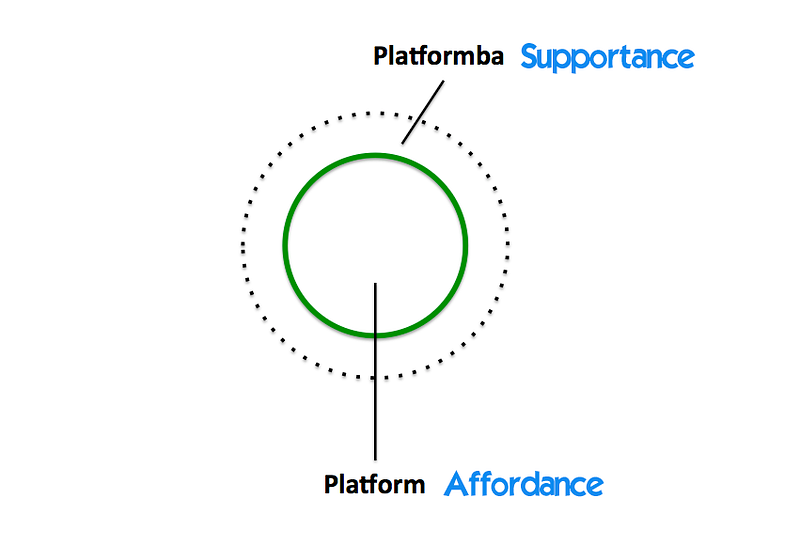
The concept of Supportance is similar to Affordance, both of which point to the potential action possibilities. However, the concept of Affordance only applies to the natural environment and material environment, it only discusses the perception from the psychological perspective. Some scholars have coined a new term called Social Affordance. I don’t like this approach very much because I think it is better to develop a new concept for discussing the potential of support between people. The major reason is the concept of Affordance is about one-side agency because the natural/material environment doesn’t have agency, while Supportance is about two-side agency because the “social environment” has agency. Some social theories such as ANT (Actor-Network Theory) argue that there is no distinction between humans and non-humans, some scholars also talk about material agency. From the perspective of the Ecological Practice approach, I do believe there is a distinction between humans and non-humans and we shouldn’t expand the concept of Agency from human to non-human. In this way, I can keep the concept of Affordance and develop the concept of Supportance.
If we expand the above diagram and incorporate the concept of Activity which means a set of actions, then we get the following complex diagram:
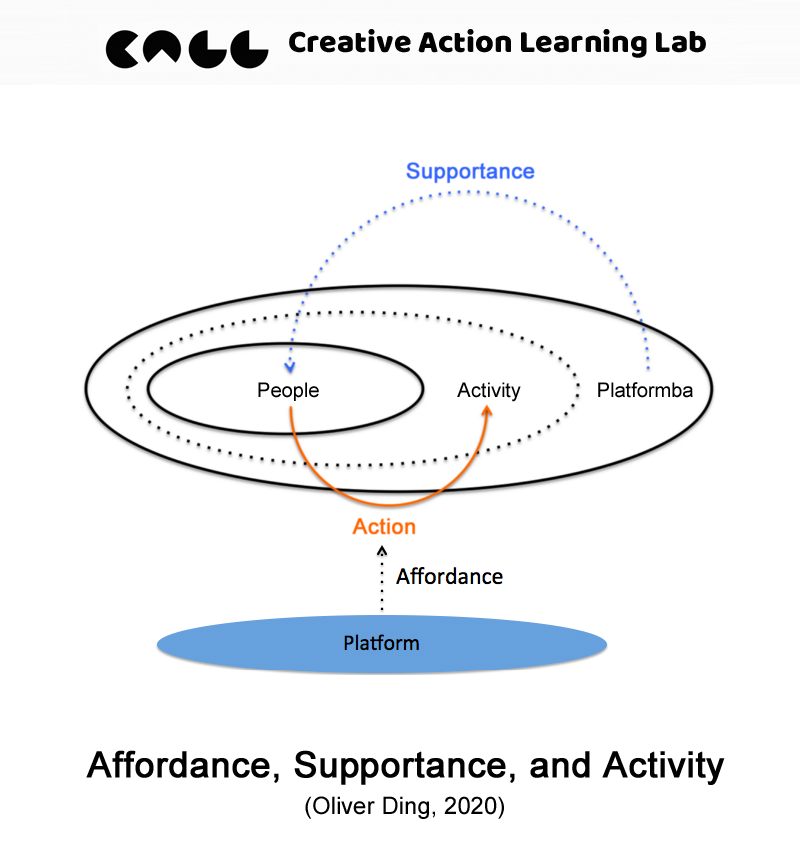
The above diagram represents the complex relationship between Affordance, Supportance, and Activity. It is clear that I want to set two hierarchical loops. First, the Affordance — Supportance loop is located at the potential level. Second, the Action—Activity loop is located at the actual level. Third, The potential hierarchical loop is corresponding to the actual hierarchical loop: Affordance — Action, Supportance — Activity.
By curating Ecological Psychology, the Ecological Practice approach, and Activity Theory together, this model sets the theoretical foundation for the Platform-for-Development framework and Platform Ecology in general.
6. Platform-based Social Practice
The above discussion is all about abstract theoretical concepts and models. Now let’s move to concrete practical phenomena. In the article Social Platform Experience Design (#SocialPxD), I tried to define the concept “Social Platforms” and mentioned the term “Platform Ecology”.
The PxD framework incorporates four perspectives: Digital Technology Perspective, Interaction Design Perspective, Business Ecology Perspective, and Social Practice Perspective.
This time I focus on the social practice perspective. Thus, the new focus is not the Platform itself, but the Platform-based Social Practice. The above discussion has presented several pairs of concepts for this challenge:
- Platform — Platformba
- Affordance — Supportance
- Action — Activity
- People — Project
While most authors use the term Platform as a metaphor to describe large digital websites/apps and the companies behind them. In the 2016 book Platform Revolution, Parker, van Alstyne, and Choudary (2016) define a platform as “a business based on enabling value-creating interactions between external producers and consumers. The platform provides an open, participative infrastructure for these interactions and sets governance conditions for them. The platform’s overarching purpose: to consummate matches among users and facilitate the exchange of goods, services, or social currency, thereby enabling value creation for all participants.”(p.5) In fact, what the authors suggested is not a new theoretical concept, but a new metaphor for an old concept: two-sided markets. In order words, we can reduce the term Platform to the old-fashioned term Market.
Some authors have discussed Platform-based Social Practice. For example, van Dijck, Poell, and DeWaal (2018) published The Platform Society which focuses on public values in a connective world. From a macro perspective, the authors examined three case studies: private & public transport, journalism, and higher education.
I believe it’s possible to claim Platform as a new type of social structure that incorporates the duality of human actions: the material/digital environmental aspect and the sociocultural aspect. Thus, we can build a new concept of Platform at the ontological level. In order words, the Platform is just the Platform. The Platform can’t reduce to Market or other theoretical concepts.
The category of Digital Social Platforms is a great example of this new ontological concept. However, I want to claim that some large organizations and local communities can be understood as Platforms from this new perspective as well. So, Platform-based Social Practice is not only about digital social platforms, but a new type of social reality in the age of the platform.
7. Three Challenges of Platform Ecology
Now we can define Platform Ecology as a brand new research program on Platform-based Social Practice from the ecological practice approach and other theoretical approaches.
There are three theoretical challenges for Platform Ecology: the Nature — Culture relationship, the Individual — Collective relationship, and the technology—society relationship. These are classical issues of social science. By adopting the Ecological Practice approach and the Project-oriented Activity Theory, the Platform Ecology project can provide its own solutions to these challenges.
First, the Environment — Culture relationship is about the duality of human actions. The material environment level refers to the natural/technological attribute of human actions while the sociocultural activity level refers to the societal attribute of human actions. While the concept of Affordance from ecological psychology is perfect for discussing the material environment and natural/technological attributes of human actions, it is overwhelmed in handling the sociocultural level analysis. I believe the concept of Supportance has a certain potential to solve this problem with a commitment to keep the ecological approach.
Second, the Individual — Collective relationship is nothing less than echoing the classical debate on Structure and Agency in theoretical sociology and social theories in general. There are many theoretical accounts we can find in the literature. For instance, Structuration theory (Anthony Giddens, 1984), Critical Realism and Analytical dualism (Margaret Archer, 1995), and Relational Emergence (Dave Elder-vass, 2010), among others.
For the Platform-for-Development framework, I adopt Project-oriented Activity Theory to discuss the Individual-Collective relationship. This is the reason the framework uses the term “Project”. From the perspective of Project-oriented Activity Theory, the best unit of analysis of Activity is “Project”. By adopting the concept of Project, we can identify and watch the structure and dynamics of collective actions. I think it is also possible to apply this approach to Platform Ecology.
Third, the technology—society relationship refers to the debate around Technological Determinism in social science. There are two major accounts of the debate. On the one hand, technological determinism claims that technologies have a strong and defining influence upon whole complexes of cultural shifts that make the problem of locating an agency difficult. Some authors suggest that it is better to place determinism on a spectrum of beliefs about the nature or degree of deterministic possibility. On the other side, social constructionism argues that technology is a social construct and it can be interpreted and reinterpreted depending upon the people involved, the context or situation in which it is designed, developed, or deployed, and the historical moment it resides within. (Robert R. Johnson, 1998. p.87, p.93)
According to Donald Mackenzie and Judy Wajcman, the editors of The Social Shaping of Technology (1999), there are two theoretical approaches, that emerged in the mid-1980s, that have a significant influence on the issue of the technology-society relationship. The first is the “Social Construction of Technological Systems (SCOT)” perspective, developed by Wiebe Bijker and Trevor Pinch. The SCOT approach uses concepts such as relevant social groups, interpretive flexibility, and closure to develop a heuristic method for practical case studies. The second one is ANT which is mentioned above, ANT scholars suggest that both society and technology are made of the same “stuff”: networks linking human beings and non-human entities (“actors” or “actants”). (1999, p.24)
From the perspective of the Ecological Practice approach, I prefer “Possible Practice” rather than “Existing Practice”. Thus, the debate about technological determinism is not very attractive to me. What I really care about is the possibilities offered by technology, culture, or both. By adopting the Affordance — Supportance potential hierarchical loop, we can translate the Technology — Society relationship into the Affordance — Suportance relationship.
The Supportive Cycle model is a test of Platform Ecology. The model curates the above ideas together by adopting concepts such as Platform, Platformba, Project, and Supportance. It also presents a solution for the Technology — Society relationships. By adopting the Project-oriented Activity Theory, we can use the concept of “Project” to balance Technology and Culture. A new project is a new social change that is the outcome of a Concept-fit between technological concepts and sociocultural concepts.
8. The Future of Platform Ecology
I have been thinking about an ideal field for applying the Ecological Practice approach for two years. Last year I mentioned the term “Platform Ecology” in Social Platform Experience Design (#SocialPxD). At that time, I believed that Platform-based Social Practice is an ideal field for applying the Ecological Practice approach. However, I felt that I was not ready to start the job.
During the past months, I developed a new concept called Supportance for the Ecological Practice approach. This concept has been introduced in the Platform-for-Development (P4D) framework (v1.0) and the Supportive Cycle (v1.0). After the concept was born, I felt it was time to start the Platform Ecology project.
I use a framework called HERO U to organize my own knowledge works. The core of the framework is the Diagram U which presents six types of “Objective of Knowing”:
- mTheory: Meta-theory
- sTheory: Specific Theory
- aModel: Abstract Model
- cModel: Concrete Model
- dPractice: Domain Practice
- gPractice: General Practice
I consider these different levels of knowing as a whole. For example, if we want to learn Activity Theory, it is better to learn these six types of knowledge about Activity Theory. This is the reason why I started the Activity U project. If we want to create new knowledge, we can select one level as our starting point and expand to other levels.
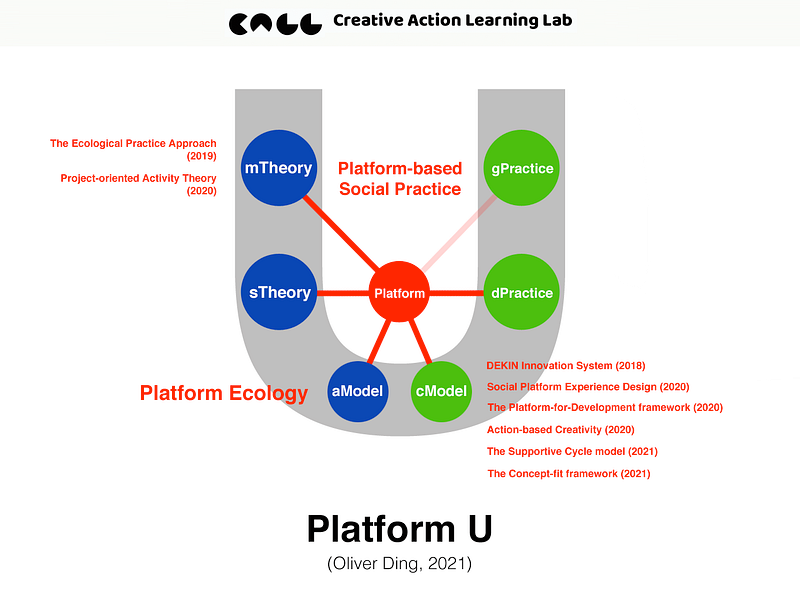
The above diagram presents my work around Platform-based social practice. The earliest work is DEKIN Innovation System (2018) which is a simple framework about social positions behind the innovation ecosystem. The work is located at the cModel (Concrete Model) level. In 2019, I started developing the Ecological Practice approach which is located at the mTheory (Meta-theory) level.
Since then, I have worked on both mTheory level and cModel level. The Platform Ecology project is located at the aModel (Abstract Model) because it is defined by a set of concepts and a domain. I consider the Platform Ecology project as an application of the Ecological Practice approach and a theoretical framework for studying Platform-based Social Practice.
My vision is to connect theory and practice by curating knowledge projects. The goal of Platform Ecology is to develop a series of heuristic models and frameworks for theory-based reflection and practice-based reflection. The above diagram has presented a list of such models:
- DEKIN Innovation System (2018)
- Social Platform Experience Design (2020)
- The Platform-for-Development framework (2020)
- Action-based Creativity (2020)
- The Supportive Cycle model (2021)
- The Concept-fit framework (2021)
From my personal perspective, the Platform Ecology project is a test of the concept of Echozone and the HERO U framework in general. The HERO U framework is originally developed from the following model:
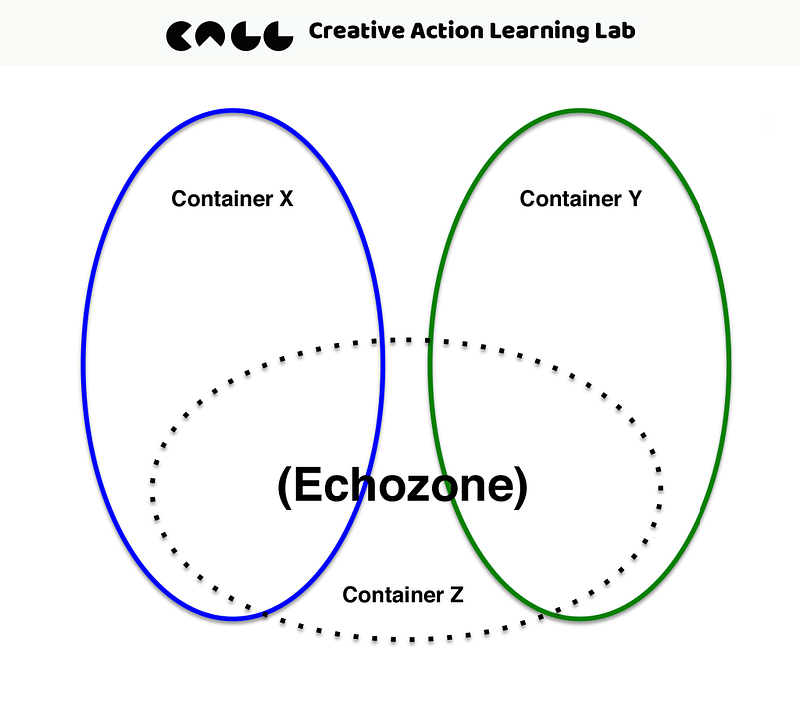
As mentioned early, the concept of Container is the core of the Ecological Practice approach. By adjusting the quality and quantity of the Container, we can create advanced frameworks for discussing complex phenomena. The quality of the Container can be potential and actual, and the quantity of the Container can be one or two. If we develop a new framework with one potential container and two actual containers, the outcome is the above diagram.
I named the potential container (Container Z) Echozone which refers to a creative space containing echoes between Container X and Container Y. For the HERO U framework, aModel (Abstract Model) and cModel(Concrete Model) are located in the Echozone.
The term “Echo” of “Echozone” refers to the dialogue between theory-based reflection and practice-based reflection. Theory-based reflection means adopting theoretical concepts to reflect on practical experience while practice-based reflection means using cases from the real world to reflect on theoretical concepts. Furthermore, the most important movement within the echozone is the dialogue between two types of reflections. In other words, the Echozone is designed as a creative space with a potential hierarchical loop: reflection—dialogue.
From the perspective of public knowledge, it seems Platform Ecology is a promising thread because it offers the ecological theoretical solution to three classical issues of human science within the context of the platform which is one of the critical human-built environments in the 21st century. I also wish the HERO U framework could make a contribution to the development of public knowledge.
You are most welcome to connect via the following social platforms:
Twitter: https://twitter.com/oliverding Doowit: https://doowit.co/profile/gm0k2ax9 Linkedin: https://www.linkedin.com/in/oliverding
License
This work is licensed under the Creative Commons Attribution-NonCommercial-ShareAlike 4.0 International (CC BY-NC-SA 4.0) License. Please click on the link for details.


