
The Supportive Cycle (v1.0)
A model for the Platform-for-Development framework
The Platform-for-Development (P4D) framework starts from a unique theoretical assumption that the ideal unit of analysis for studying adult development in the age of platforms is a nested social structure: Platform[Project(People)].
The major theoretical resources behind the framework are Activity Theory (the project-oriented approach, Andy Blunden, 2014), Social Domains Theory (Derek Layder, 1997), Ecological Psychology (James Gibson, 1979), and Self-Determination Theory (Edward Deci and Richard Ryan, 1971, 2017). I was also inspired by Knud Illeris’ How We Learn (2007) and John Hagel’s The Power of Platform (2015).
This article introduces a new model called the Supportive Cycle for the framework. The model is based on the concept of Supportance.
Contents
1. Platform v.s. Project 2. A Supportance-based Model 3. Case Study: TED(TEDx) 4. The #1 Supportive Movement 5. The #2 Supportive Movement 6. The #3 Supportive Movement 7. The #4 Supportive Movement 8. Toward a Platform Ecology 9. Summary
1. Platform v.s. Project
I have introduced five analysis modules of the Platform-for-Development framework in a previous article. Today I am going to share a model for understanding the complex relationship between Platform and Project. This issue is critical for the P4D framework since its foundation is the nested structure of Platform and Project.
Basically, what we need is a process view of the dynamic relationship between Platform and Project. This issue is nothing less than echoing the classical debate on Structure and Agency in theoretical sociology and social theories in general. There are many theoretical accounts we can find in the literature. For instance, Structuration theory (Anthony Giddens, 1984), Critical Realism and Analytical dualism (Margaret Archer, 1995), and Relational Emergence (Dave Elder-vass, 2010), among others.
However, the goal of P4D is neither developing a new theoretical account nor adopting an existing theoretical account. What I am looking for is a practical solution.
2. A Supportance-based Model
In particular, I propose a new model called the Supportive Cycle as a heuristic practical tool for the P4D framework. The model considers four types of entities and four movements of their interactions.
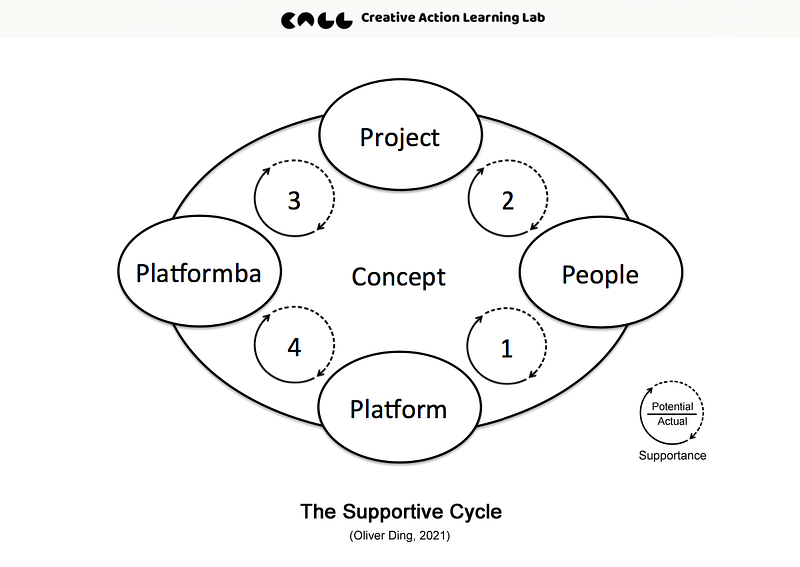
The above diagram represents the model of the Supportive Cycle. The four types of entities are Platform, People, Project, and Platformba. The four movements are labeled as 1, 2, 3, and 4 in the diagram. However, these numbers don’t refer to steps or stages. I consider these interactions are parallel development. The focus of P4D is not studying the development of individual entities such as the development of digital platforms, but the relationship between people and the whole of Platform(Project) from the perspective of adult development.
The Supportive Movement is defined by the concept of Supportance which refers to the potential supportive possibilities for actions. Each movement is divided into two states: the Potential status and the Actual status. The relationship between two entities is roughly considered as “environment” and “organism” from the ecological perspective. One side (as the “environment”) offers Supportances to the other side (as the “organism”).
- Environments: Platform, Project
- Organisms: People, Platformba
There are several possible situations within a supportive movement. For example, we must consider the following states:
- The “organism” side may perceive some Supportances and take it as real actions in some particular situations.
- The “environment” side may not offer some Supportances which are benefits for the development of the “organism” side.
- The “organism” side may not take some Supportances offered by the “environment” because they don’t have some corresponding capabilities.
- The “organism” side may not take some Supportances offered by the “environment” because they don’t have such intentions even if they have capabilities.
A most critical type of Supportances is that the “environment” side may offer some Supportances which enables the “organism” side to Construct the “environment” side. This idea is inspired by Niche Construction Theory which emphasizes that an organism alters its own (or another species’) local environment. I consider some social environments allow their members to change themselves for further development.
The term Platformba has been introduced in the previous article. It refers to a platform-based sociocultural field. The “ba” is originally found in Japanese. The concept of “ba” has been used extensively by Japanese management researcher Ikujiro Nonaka in his SECI model of knowledge creation. The platformba is an emergent social substance that is formed by people who have relations to a platform. While a platform is designed, managed, and controlled by its owner, its platformba is determined by people, the users, and stakeholders of the platform. By using the new term Platformba, I can highlight the active aspect of platform practice which refers to people’s activity.
Finally, there is a term Concept at the center of the above diagram. This term is adopted from Project-oriented Activity Theory which considers an activity as a process of formation of a brand new concept. From the perspective of the theory, the term “project” refers to such a process. The P4D framework is inspired by Project-oriented Activity Theory, it would be great to incorporate Concept into the Supportive Cycle since a Concept can be considered as the Curator of the whole activity. By adopting a Concept, the four supportive movements become a meaningful whole process.
3. Case Study: TED(TEDx)
In a previous article Activity U (VIIII): Project-oriented Activity Theory, I used the TEDx program as an example of a Project for discussing the “formation of concept” and “the Objectification of Concept”.
By considering TED as a Platform and TEDx as a Project, we can build an exemplar of the Supportive Cycle.
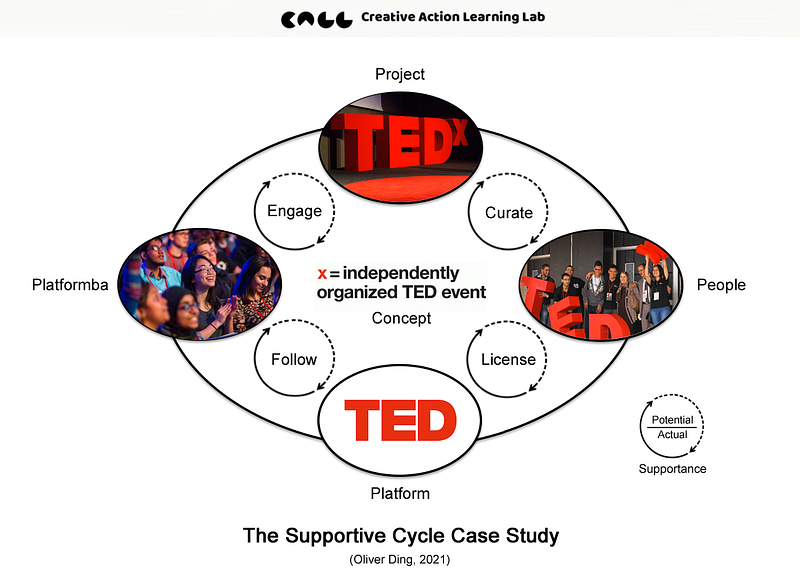
The above diagram highlights the structure and dynamics of the TED(TEDx) case.
- Platform: TED
- People: local TEDx event organizer and volunteers
- Project: the TEDx program and local TEDx events
- Platformba: the global TED/TEDx community
We can also identify four primary themes of supportive movements:
- License: TED offers the TEDx open brand license for local social change-makers who want to organize a local TEDx event.
- Curate: A local TEDx event offers action opportunities for curating a TEDx event for local volunteers.
- Engage: A local TEDx event offers participatory opportunities for local speakers and audiences.
- Follow: TED offers free TED talks and TED-related information to local TEDx organizers, volunteers, speakers and audiences through multiple channels.
This case is an ideal case of the Platform-for-Development framework. We have to pay attention to a special issue that the TEDx program is initiated and managed by TED. In other words, there is a strong tie between Project and Platform. However, the original motivation of the Platform-for-Development framework is studying digital social platforms which refers to the weak tie between Project and Platform.
Furthermore, it is possible to escape from the dichotomy of strong ties and weak ties. We may find more types of relationships between Projects and Platforms. This is an open issue for the Platform-for-Development framework.
4. The #1 Supportive Movement
The first supportive movement considers the Platform as Environment and People as Organisms. For the Platform-for-Development framework, we need at least one supportance from the Platform.
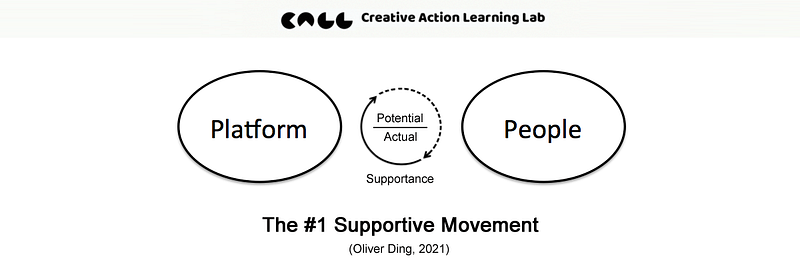
This special type of supportance is Primary Projectivity which is introduced in a previous article Activity U (X): Projecting, Projectivity, and Cultural Projection. The term Primary Projectivity refers to potential action opportunities for initiating a brand-new Project. For the above TED(TEDx) example, the primary projectivity is the TEDx open brand license. Without this open brand license, there is no opportunity of organizing local TEDx events.
Of course, we don’t have to limit ourselves to open brand programs. Digital platforms offer many features which enable people to launch their projects. Let’s have look at the following example:
The Notionable project is launched by David Kiriakidis who is a writer, designer, and digital creator based in the UK. Notion is a digital platform for writing notes and organizing files. As an expert user of Notion, Kiriakidis designs a series of toolkits for other Notion users. For this case, the supportance refers to the features of Notion and the user base of Notion.
The Design System in Figma project is similar to the Notionable project. Figma is a digital design platform for collective design activities. The Design System in Figma project is an online course for learning design systems. The course is developed by the Design+Code team. For this case, the supportance refers to the features of Figma and the user base of Figma.

The BED Talk challenge was initiated by the speaker and author David Rendall and Stan Phelps. The idea behind a BED Talk is to share a short, unscripted video sharing something helpful…recorded from your bed since you’re (hopefully) at home. The BED talks community is still small, if you want to find more BED talks, you can check these places: YouTube (#bedtalkchallenge), Linkedin (#bedtalkchallenge), and Twitter (#BEDTalk). For this case, I consider Linkedin and other social media platforms as “Platforms”.
5. The #2 Supportive Movement
The second supportive movement considers Project as Environment and People as Organisms. One special type of supportance offered by Project is Secondary Projectivity. Once a project is initiated, it offers Secondary Projectivity for other people to recognize the potential action opportunities of participating in the project.
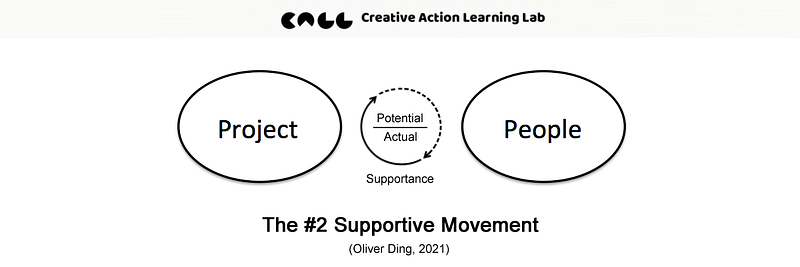
For the TED(TEDx) case, the Secondary Projectivity of a particular TEDx event project means various types of voluntary actions such as organizing, curating, hosting, designing, speaking, sponsoring, photographing, videoing, lighting, translating, listening, watching, sharing, etc.
The #2 supportive movement also includes one special type of Supportance: Tertiary Projectivity. The term is about initiating a new project which is inspired by an established project. I’d like to share my own story as an example of Tertiary Projectivity:
- Twitter [Project MUSE +Meet MUSE for 30 Days]
- Project MUSE (Meet MUSE for 30 Days)
- Twitter (Project MUSE)
- Twitter (Meet MUSE for 30 Days)
Project MUSE is an academic platform that has over 700 journals from 125 publishers and offers over 60,000 books from more than 100 presses. In response to the COVID-19 crisis, Project MUSE provides free scholarly content temporarily. Inspired by their action, I launched a project called Meet MUSE for 30 Days in order to spread their message and encourage people to download and read academic books on their website.
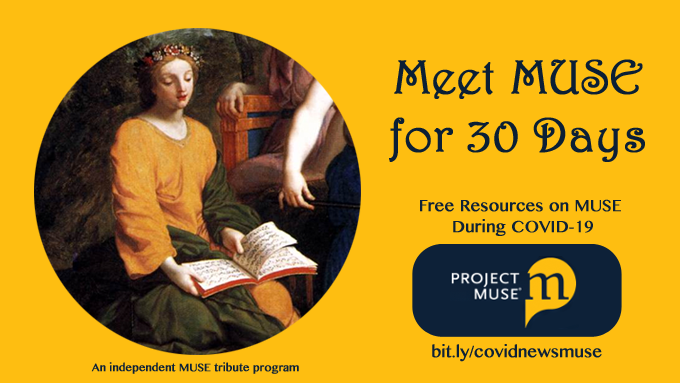
In this case, Project MUSE can be considered as a Platform or Project. If we consider Project MUSE as Platform, then we can use Project MUSE (Meet Muse for 30 Days) to name this case. However, it only needs the #1 Supportive movement.
If we consider Twitter as a Platform and Project MUSE as a Project, then we can use it to discuss Tertiary Projectivity. Now we see two projects on one platform (Twitter), the first project (Project MUSE) inspires the second project (Meet MUSE for 30 Days).
Readers can find more details about Projectivity from a previous article Activity U (X): Projecting, Projectivity, and Cultural Projection.
6. The #3 Supportive Movement
The third supportive movement considers Project as Environment and Platformba as Organism. This is similar to the second supportive movement since Platformba is the sum of individual people, so we can apply Secondary Projectivity and Tertiary Projectivity to the third supportive movement.
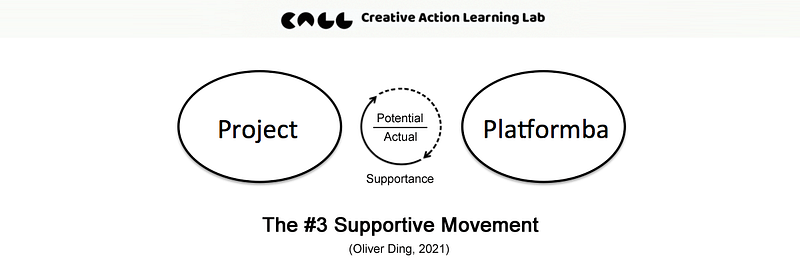
However, Platfromba is bigger than individual people. So, it is perfect to discuss the Constructive type of Supportance with the third supportive movement. In other words, we can pay attention to how the project is constructed by the platformba.
Let’s have look at three cases:
- Kickstarter (Walli)
- Change (Burger King, Popeyes, & Tim Hortons: Stop Supporting Chicken Abuse!)
- Twitter (#PhDChat)
- Notion (Notionable)
Kickstarter is a well-known digital platform for crowdfunding. The Walli project aims to produce a new wooden toy that combines puzzles, art, and decoration together. 108 users support the Walli project with a total of $5,834 funds raised. These 108 people who back the Walli project come from the pool of the Platformba of Kickstarter.
Change.org is a digital petition platform that has over 400 million users who are active on petitions about economic and criminal justice, human rights, education, environmental protection, animal rights, health, sustainable food, etc. The petition “Burger King, Popeyes, & Tim Hortons: Stop Supporting Chicken Abuse!” was started by The Humane League and supported by 263,692 people which are part of the platformba of Change.org (a total of 400 million users).
Twitter is a popular social media platform that highlights two signs for ordinary people: @ and #. The @ sign means mentioning or replying to other users while the # sign means hashtags which are used for grouping tweets from various users together by topics. The #PhDChat hashtag was initiated by a group of UK doctoral students in 2010. Since then, the network around #PhDChat has evolved and grown. Obviously, the development of the #PhDChat project is supported by the platformba of Twitter.
The above cases are all about Inside Construction which means a Platformba’s activities happen inside its Platform. However, a Platformba’s activities can happen outside its Platform too. In order to discuss such Outside Construction, let’s use the case of Notion (Notionable) as an example.
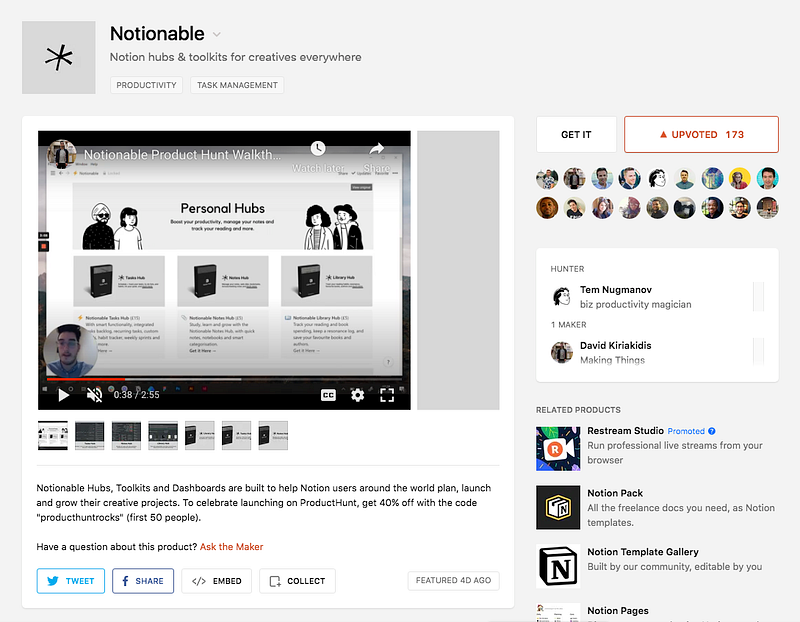
Product Hunt (ProductHunt.com) is a platform for recommending innovative products. Makers of products can recommend their own products to Product Hunt too. Each product has an independent post page on Product Hunt. Users of Product Hunt can vote, comment, and discuss a particular product on its post page. The above picture is a screenshot of the posting page of Notionable.
As mentioned above, the Notionable project is produced by an expert user of Notion: David Kiriakidis. The project aims to help Notion users plan, launch and grow their creative works with specially customized hubs, toolkits, and dashboards.
For this case, we focus on the Product Hunt post page of Notionable. This post page is a concrete example of the Platformba of Notion. What we can learn from this example is that a Platformba may be bigger than its Platform because the activities of a Platformba contain inside activities and outside activities. The Notion’s users can do something about Notion in Product Hunt which is a place outside of Notion.
7. The #4 Supportive Movement
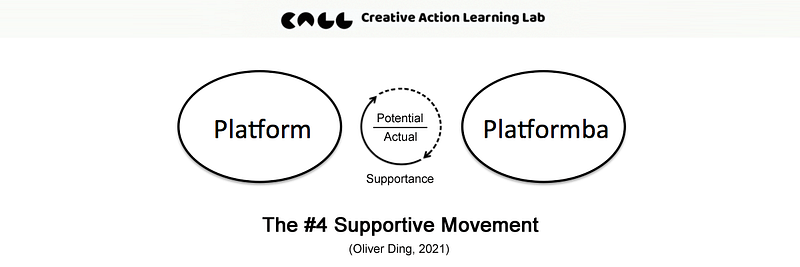
The fourth supportive movement considers Platform as an environment and Platformba as an organism. The discussion is similar to the third supportive movement because we will discuss the Constructive type of Supportance too.
However, a Platform is different from a Project since we consider both material aspects and sociocultural aspects of the Platform. For Project, we only talk about its social aspect. From the perspective of the ecological practice approach, the concept of Affordance corresponds to the material aspect of the Platform while the concept of Supportance corresponds to the sociocultural aspect of the Platform.
For a digital platform, its Affordances mean action possibilities based on its technological capabilities and functional characteristics. For example, the # and @ are functional characteristics of Twitter. How people can use Twitter with # and @ are Affordances of Twitter. For an organization, its Affordances are based on its physical environments such as office space and furniture, technological tools and equipment, and other material things.
Supportance refers to sociocultural aspects of the platform. For a digital platform, Supportance means action possibilities based on rules, norms, policies, rewards, events, and resources from owners of the digital platform. For example, Twitter’s policy about third-party app development is related to its supportances for outside developers. For an organization, its supportances are based on its rules, norms, policies, rewards, events, resources, etc.
Though some scholars suggest the term “social affordance”, I do think it is better to limit the application of Affordance to only physical and material analysis. A critical issue about the sociocultural analysis of action possibilities is its two-sided agency. For Affordance, the environmental/material side doesn’t have its agency. For Supportance, the two sides both have their agency.
Furthermore, I distinguish between the supportance of the platform and the supportance of platformba. The former is about the relationship between individual people and a platform. However, the latter is about the relationship between individual people and a collective group since platformba is the collective formation of people. For instance, the size of platformba really matters for its supportance. If Notion’s user base is small, then its platformba doesn’t have enough people to support a project such as Notionable. We have to notice that there are many types of supportance of platformba. For example, the emergent relationship between members of platformba offers a new action possibility for people because a new relationship can lead to a new social need.
Now let’s move to the Constructive type of Supportance. For the fourth supportive movement, we care about how a platformba constructs its platform. For Outside Construction, it is obvious that a platformba is an influence on the external growth of a platform. The above Notion(Notionable) case is a good example, the more outside positive activities happen, the more people are attracted by the platform. For marketing expect, they call this word-of-mouth marketing.
For Inside Construction, the development and dynamics of a platformba always lead to the change of features and policies of a platform. A radical example is Wikipedia, a large open online free-content encyclopedia. Wikipedia is written collaboratively by largely anonymous volunteers around the world. In other words, the platform of Wikipedia is constructed by the Platfromba of Wikipedia.
8. Toward a Platform Ecology
Though the supportive cycle model aims on discussing the complex relationship between Platform and Project, it is also useful for thinking Platform Ecology which is mentioned in Social Platform Experience Design (#SocialPxD).
Platform Ecology adopts an ecology view for discussing platform practice. This view focuses on the landscape at one particular time from the perspective of the “organism-environment” relationship. It suggests each and every living organism has its specific surrounding medium of environment called niche. An organism is also part of other organisms’ environment.
For the #SocialPxD framework, I consider five components: People, Practice, Software, Product, and Platform. Each component can be considered as Organism and Environment as well. The result is a list including 25 types of O-E relationships. However, it’s not possible to develop 25 frameworks for understanding these relationships.
Now we have the following three pairs of concepts:
- Affordance/Supportance: come from the Ecological Practice approach.
- Project/People: come from the Project-oriented Activity Theory.
- Platform/Platformba: come from the Ecological Practice approach too.
While the Platform-for-Development framework focuses on adult development, the Supportive Cycle is also suitable for discussing platform ecology because it incorporates the pair concept of Platform/Platformba. In other words, the Supportive Cycle can support both the Platform-for-Development framework and Platform Ecology.
Here we need a trick. We can consider a Product (or small platforms) within the #SocialPxD framework as a Project within the Supportive Cycle model.
Let’s use YouTube (Platform) and Patreon (Project) as an example for further discussion.
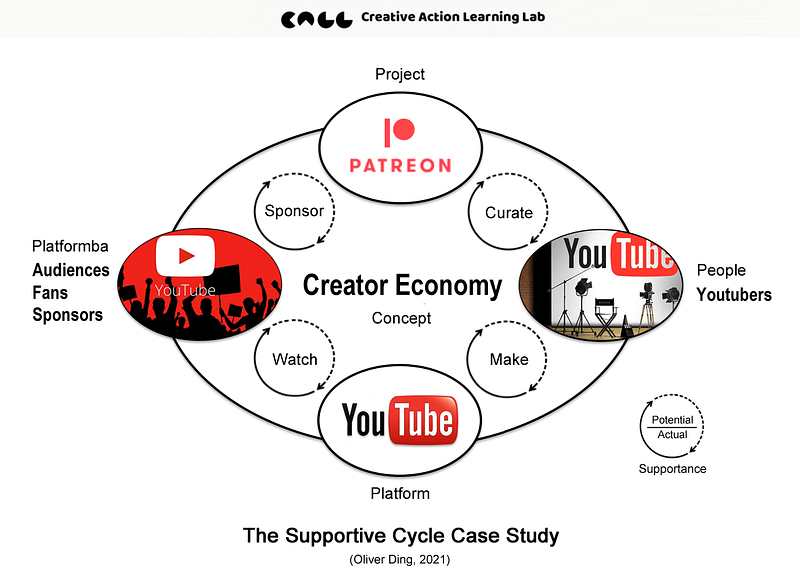
YouTube is the largest online video-sharing platform that allows people to publish their videos. Each YouTube user account has a video channel that allows audiences to subscribe in order to receive the newest update from the channel. Patreon is a membership platform that allows artists and creators to launch and maintain their subscription programs for earning a monthly income from their fans by offering rewards and perks.
The above diagram highlights the structure and dynamics of the YouTube(Patreon) case.
- Platform: YouTube
- People: YouTubers
- Project: Patreon
- Platformba: All users of YouTube, such as YouTubers, audiences, fans, and sponsors.
We can also identify four primary themes of supportive movements within this case:
- Make: YouTubers make videos and publish these videos on their YouTube channels.
- Curate: YouTubers create accounts on Patreon and design, maintain and update membership programs with their Patreon accounts.
- Sponsor: Fans join membership programs and support YouTubers on Patreon.
- Watch: Audiences and fans watch videos on YouTube.
This case is an ideal case for both the Platform-for-Development framework and Platform Ecology.
According to Wikipedia, “Patreon was co-founded in May 2013 by Sam Yam and musician Jack Conte, who was looking for a way to make a living from his YouTube videos. Together with Sam Yam, he developed a platform that allows ‘patrons’ to pay a set amount of money every time an artist creates a work of art.” Four years later, YouTube launched Twitch-like sponsorships for all YouTubers in September 2017. The YouTube channel memberships feature was announced in June 2018.
For the Platform-for-Development framework, we adopt the Supportive Cycle from the perspective of YouTubers who want to earn enough income to sustainably support their YouTube video-making activities. Though YouTubers successfully build trust relationships with their fans, YouTube didn’t provide sponsorship and membership features for YouTubers before 2017.
In 2013, Patreon’s founders perceived a specific supportance within the platformba of YouTube: fans could support YouTubers by becoming their sponsors. However, YouTubers need a way to turn this supportance into real support. Patreon provided a tool for actualizing this supportance. Thus, we can claim that Patreon was born from the platformba of YouTube.
Let’s summarize the story by using our concepts: a member of the platformba of YouTube initiated a project which helps one group of the platformba actualize one supportance offered by another group of the platformba.
For discussing Platform Ecology, we adopt the Supportive Cycle from the perspective of Patreon which is considered a product or a small platform. The growth of Patreon is a great exemplar of Outside Construction and Inside Construction.
As mentioned above, a Platformba could be bigger than its platform. So, activities of a platformba can happen inside and outside of its platform. Now, we see two platforms within the platformba of YouTube. For YouTubers who adopt Patreon, it is natural to add links to their Patreom profile in the bio area of their YouTube channels and the description area of video pages. For Patreon, these behaviors are Outside Construction. For YouTube, these behaviors are Inside Construction.
The above discussion is only for testing the supportive cycle model. For a real case study, we can take multiple cycles to describe a case from several perspectives. The most interesting about platformba are Creativity, Emergence, and Curativity, a deep discussion of these topics is beyond the scope of this article.
9. Summary
In order to find out the relationship between Platform and Project, I adopt the concept of Supportance as a foundation and develop a new model called the supportive cycle which considers four entities including Platform, People, Project, and Platformba, and four supportive movements.
The Supportive Movement is defined by the concept of Supportance which refers to the potential supportive possibilities for action. Each movement is divided into two states: the Potential status and the Actual status. The relationship between two entities is roughly considered as “environment” and “organism” from the ecological perspective. One side (as the “environment”) offers Supportances to the other side (as the “organism”).
I have discussed each supportive movement with some examples. From the above discussion, it is clear that the relationship between a Platform and a Project still remains an open issue for further study. The Supportance is only one dimension and it connects to other dimensions such as the following issues:
- Ownership: Does the platform create and manage the project?
- Brand: Does the project use a brand owned by the platform?
- Design: Does the platform design a feature called “project” for its users? (e.g. Scratch and Kickstarter use “projects” to name their core feature.)
- Material: Does the platform only provide physical or material support to the operation of the project?
- Concept: Is there a concept or a theme shared by the platform and the project?
- Competition: Does the project directly or indirectly compete with the platform?
I’d like to leave these questions for readers. Since this article is about the Supportive Cycle, we can discuss these topics about Platform Ecology in the future.
You are most welcome to connect via the following social platforms:
Twitter: https://twitter.com/oliverding Doowit: https://doowit.co/profile/gm0k2ax9 Linkedin: https://www.linkedin.com/in/oliverding
License
This work is licensed under the Creative Commons Attribution-NonCommercial-ShareAlike 4.0 International (CC BY-NC-SA 4.0) License. Please click on the link for details.


