HERO U — A New Framework for Knowledge Heroes

Knowing is a hard thing. Getting significant outcomes from knowing is a challenge. It is like climbing mountains. Once you reach the top of the mountain, the world unfolds in a different view.
This article introduces a concept called Knowledge Heroes and provides Knowledge Heroes a framework for closing the gap between “Theory” and “Practice”.
Contents
1 Becoming A Knowledge Hero 2 When Theory Meets Practice 3 The HERO U Framework 4 Objects of Knowing 5 Construal Level: Abstract and Concrete 6 Concept: Semiotic Potentials 7 The Curse of Concept 8 Personal Conditions of Knowing 9 Kinds of Knowing 10 Boundary as Opportunity 11 CALL for Action
1. Becoming A Knowledge Hero
Five years ago, I worked on a project called Knowledge Brand and my client is an innovative psychologist who is an expert on ecological psychology, personality psychology, and innovation psychology. He is not a normal scholar because he developed several theories and used these as guides to invent many patented tools and methods, instead of writing papers. His inventions are powerful and attractive to many people.
At that time, his biggest challenge was to organize many different theories, methods, and products in a simple and clear structure for his potential customers. As his friend, I offered my help to him since I have worked on a long-term project called Knowledge Brand System. First, I did research on his intellectual network and figured out an approach to organizing them with a suitable framework. Then, I suggested that he design a master brand for building a learning community. After that, I developed a knowledge certification program for him.
The process was a good learning experience for me. When I researched the global knowledge certification cases, I selected three examples for the final report.
- FranklinCovey Co.
- Wenger Trayner Partnership
- Tiny Habits Academy
FranklinCovey Co. is a publicly listed company (NYSE: FC). A part of the company’s name “Covey” represents Stephen R. Covey who is the author of the famous book The 7 Habits of Highly Effective People. Wenger Trayner Partnership was founded by Etienne Wenger who is a social learning theorist and the author of “community of practice”. Tiny Habits Academy was founded by Dr. BJ Fogg and his sister Linda Fogg Phillips. The academy teaches people the Tiny Habits method for making good habits.
I called Stephen R. Covey, Etienne Wenger, and BJ Fogg as Knowledge Heroes which is one of three types of heroes who changed the world in their unique way.
- Business Leaders: Founders, entrepreneurs, and managers who make great market impacts.
- Social Changemakers: Non-profit founders, activists, and social workers who make positive social impacts.
- Knowledge Heroes: Scholars, authors, and artists who make unique epistemic impacts.
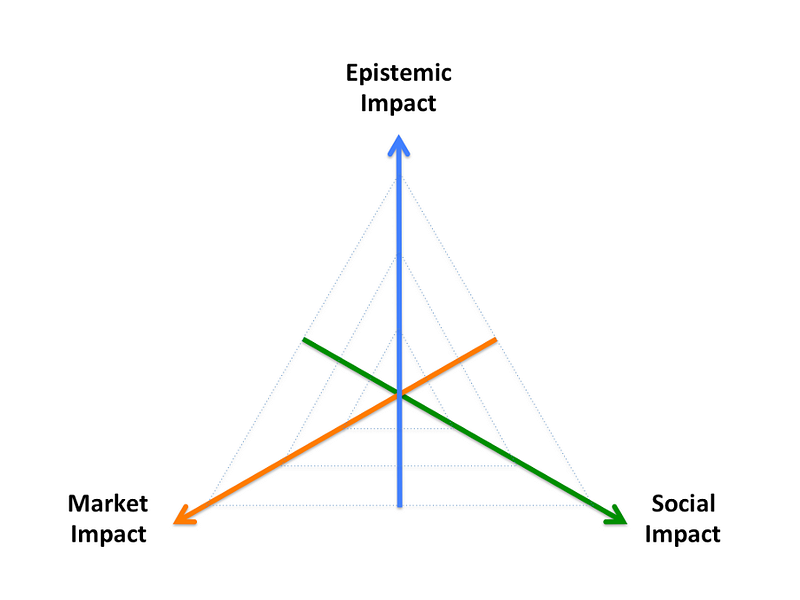
The article focuses on the epistemic impact section and provides a framework for people who want to become knowledge heroes.
I call this framework HERO U.
2. When Theory Meets Practice
One of my Knowledge Heroes is Donald Alan Schön who was a philosopher, education theorist, and pioneer of practice theory. In 1974, he worked with Chris Argyris and published a book titled Theory in Practice which describes two types of theories of action: theories-in-use and espoused theories. In 1983, he published The Reflective Practitioner and shared his notion of reflective practice with professional workers. Since then, the ‘action research’ method and the notion of ‘critical reflection’ became a formal research method for education, health, social work, architectural design, and more professional practices.
Last year, I read a paper titled The end of the curator: on curatorial acts as collective production of knowledge. Corina Oprea, the author of the paper, adopted Schön’s reflection as a research method for his project.
At the start of the research, I considered a method of gathering and decoding interviews from other curators and, thus, generated an area of common values between curators working with research and politics. Throughout the progression of the research, the attention altered towards the understanding of my own practice. Two further methodological strands have served as guidance for my study: ‘action research’ and ‘critical reflection’. These strands intersect throughout the experiments and the discourse development. The critical reflection thread outlines the course taken by the research, analysing decisions regarding approach and context (Corina Oprea, 2017).
Inspired by Corina Oprea, I tried this method in April and wrote a 108-page case study thesis. I reflected on my learning journey on several theories such as Activity Theory and Ecological Psychology, I tracked the way of using these theories to guide my digital product practice. One of the outcomes of this case study is the following diagram: When Theory Meets Practice.
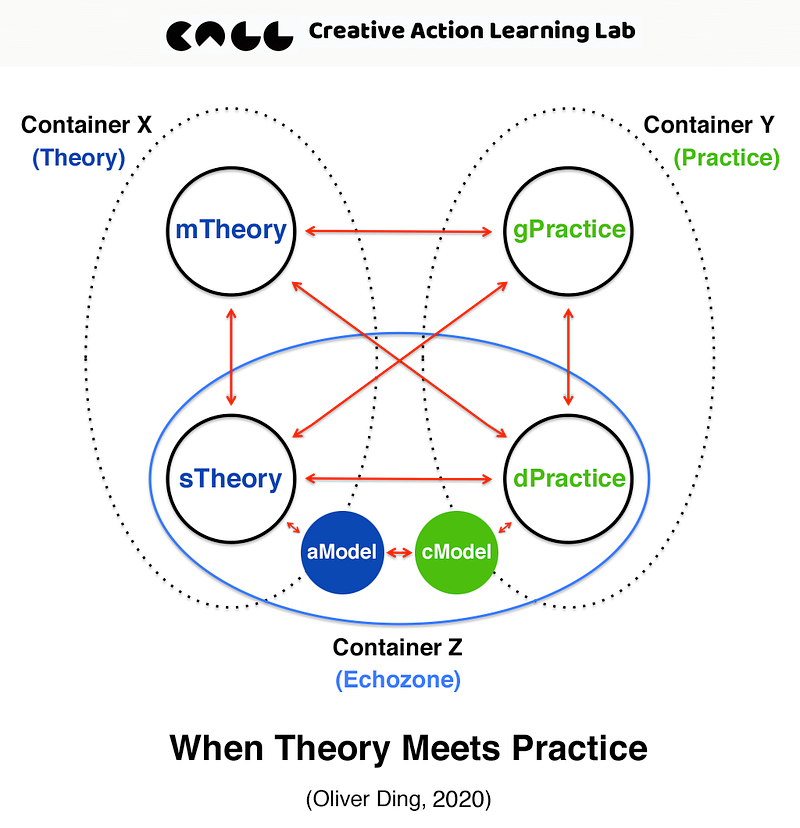
The diagram is based on a meta-diagram called WXMY (When X Meets Y) which was developed for visualizing boundary innovation.
3. The HERO U Framework
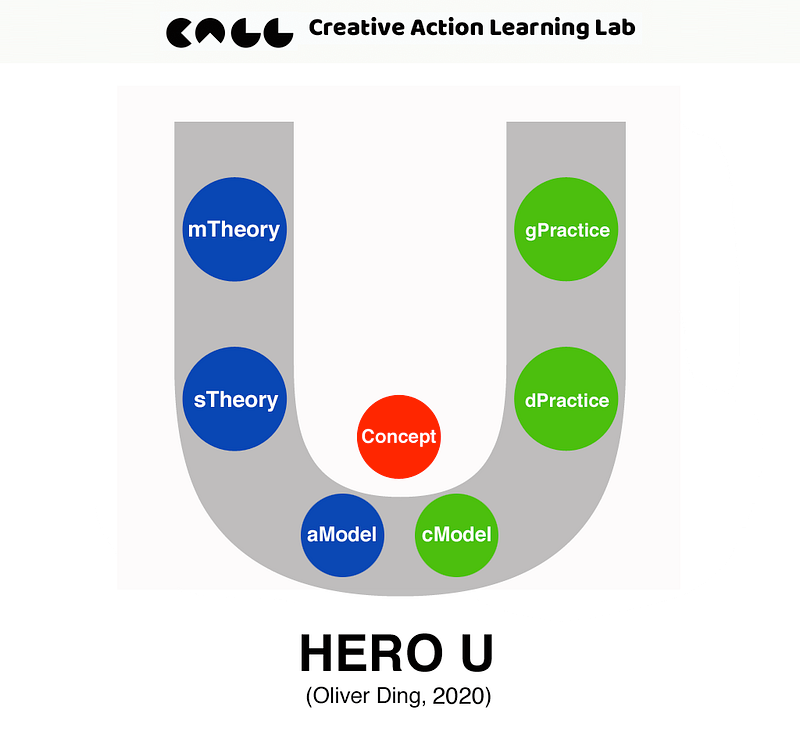
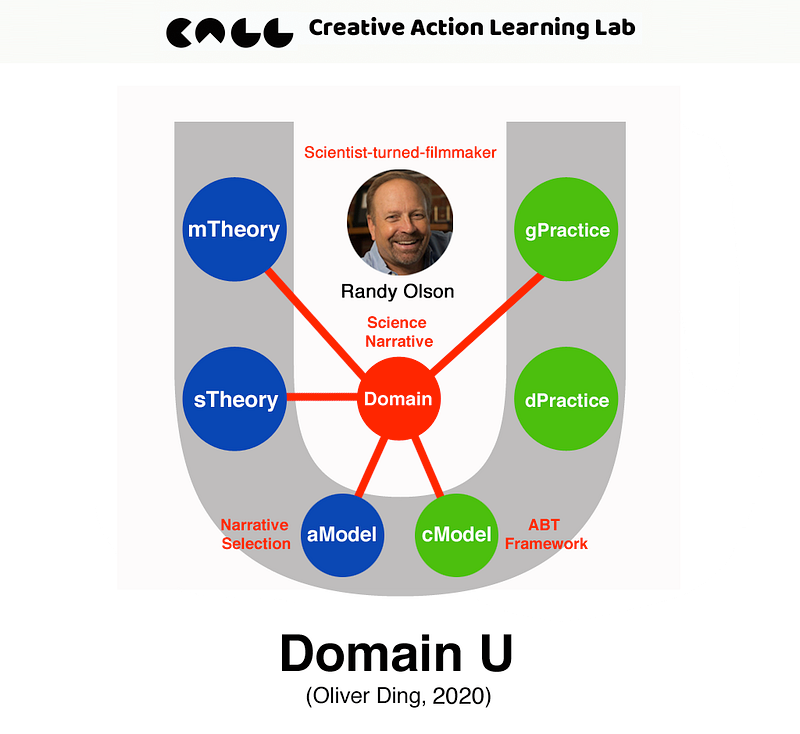
Last month, I removed three containers from the diagram and added the letter U as the new background. Since the new diagram is about knowledge making, so I named it HERO U. The first part “HERO” points to Knowledge Heroes and the second part “U” means the diagram U and “YOU”.
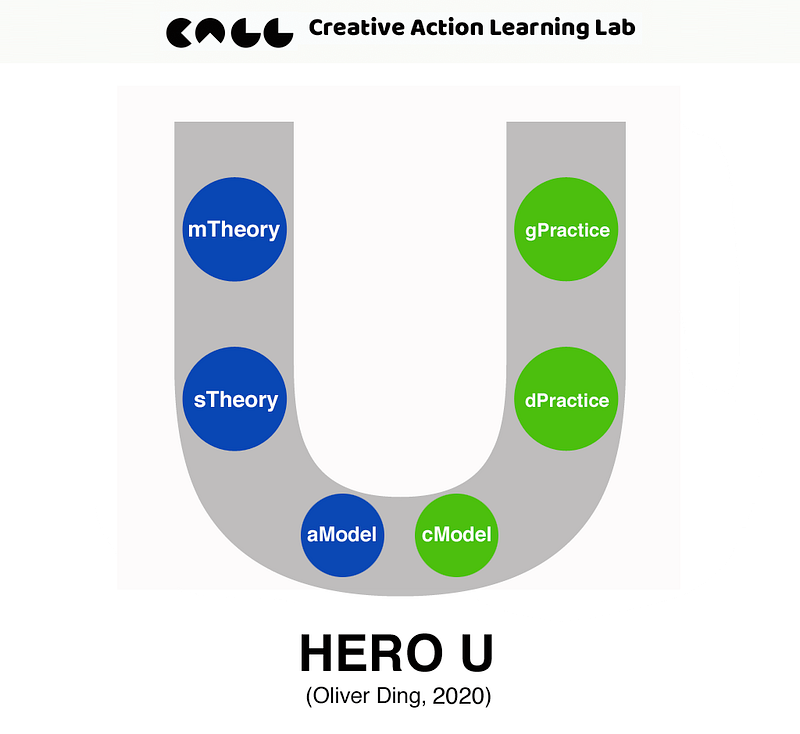
The above “U” diagram looks like a pipeline and balls. It represents six types of “Objects of Knowing”. Let’s look at the terms I used for the diagram.
mTheory: Meta-theory sTheory: Specific Theory aModel: Abstract Model cModel: Concrete Model dPractice: Domain Practice gPractice: General Practice
Based on the above diagram, I add the second dimension which represents a set of “Personal Conditions of Knowing”. The final version diagram is a brand new framework that describes the structure and dynamics of knowing.
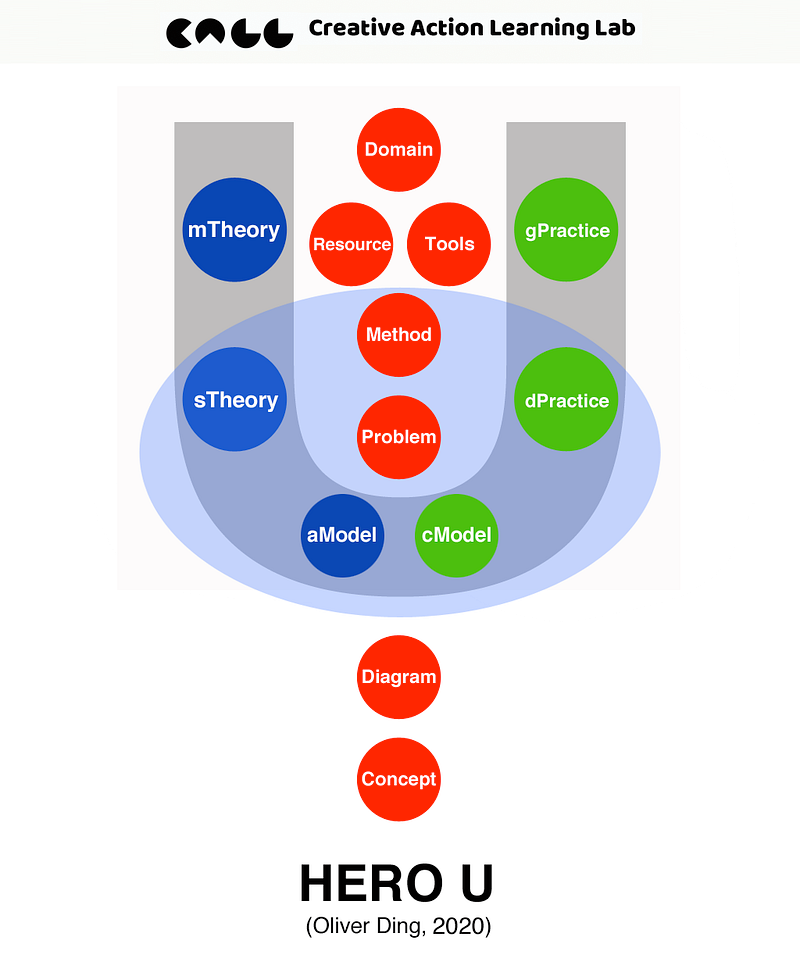
I consider this framework as “an ecological approach” to knowing because it refers to the structure of “organism (personal conditions of knowing) — action (knowing) — environment(objects of knowing)”.
4. Objects of Knowing
Meta-theory (mTheory) means philosophical approaches or theoretical perspectives which can guide researchers to develop their own theory in a special domain. For example, Activity Theory or the “Cultural-historical theory of activity (CHAT)” is an interdisciplinary philosophical framework for studying both individual and social aspects of human behavior. Sociologists and social theorists also use “Grand Theory” to describe highly abstract theoretical frameworks such as Talcott Parsons’ Structural functionalism, Anthony Giddens’ Structuration theory, Niklas Luhmann’s Systems theory, etc. These Grand theories definitely are meta-theory.
I also consider some established theories in special domains as meta-theory. For example, Self-Determination Theory (SDT) is a type of psychological motivation theory. As a meta-theory, SDT represents a broad framework for the study of human motivation and personality with six mini-theories.
Specific Theory (sTheory) refers to discipline-dependent theories. This type of theory only applies to a particular domain or field. For example, Event System Theory is an event-oriented approach to the organizational sciences.
Specific theory can be guided by meta-theory. For example, Job Crafting Theory is a theory about career and it is based on Self-Determination Theory. Expansive Learning Theory is developed within the framework of Activity Theory.
The bridge between theory and practice is models. I define two types of models, Abstract Model (aModel) and Concrete Model (cModel). While theories are represented with theoretical concepts without diagrams, models usually rely on diagrams for visual representation. People also called these models frameworks.
Abstract Models (aModel) are high-level models which connect theoretical approaches with special domains. For example, Paula Jarzabkowski introduced Activity Theory to Strategy as Practice in a paper, she explained some specific concepts associated with Activity Theory and indicated its value for studying Strategy as Practice. She presented an activity system framework with a new diagram.
Concrete Models (cModel) are lower-level models with details for directly guiding domain practices. For example, researchers of the HCI (Human-Computer Interaction) discipline found Activity Theory conceptual approach highlights the importance of computer users’ social and cultural behavior in context and helps designers and developers understand complex and intertwining issues that impact on the usefulness of objects. However, there is no established standard method for connecting Activity Theory concepts with HCI practice. Activity Theory doesn’t provide ready-made techniques and procedures for research and design.
Noticing the lack of a standard and specified method for applying Activity Theory within HCI, Daisy Mwanza developed an Activity-Oriented Design Method (AODM) with four methodological tools. Mwanza highlighted the benefits of AODM for HCI researchers and designers: 1). AODM provides a structured and grounded approach for operationalizing Engestrom’s (1987) activity triangle model; 2). The AODM approach can easily be integrated with other design methods; 3). AODM can be successfully applied to the analysis of real-world settings; 4). AODM produces data that can be meaningfully interpreted and usefully incorporated in system design; 5). AODM can be easily used by designers and other users with little knowledge of Activity Theory (p.198).
Domain Practice (dPractice) points to if a person thinks and reflects on a domain he is working within. Most professionals like to think about domain issues and consider them as one important aspect of their careers. For example, a designer would like to write articles about design, collect things and images about design, and share their insights with peers. These activities generate domain practice knowledge. Sometimes, they also create concrete models (cModel) to represent their personal knowledge without connecting to theoretical concepts or approaches.
General Practice (gPractice) means daily life as a general context of knowing. For example, personal growth, productivity, mental health, career value, and life meaning are typical issues for most adults.
5. Construal Level: Abstract and Concrete
Domain Practice (dPractice) and General Practice (gPractice) don’t refer to knowledge, but “Objects of Knowing”. The HERO U highlights six types of objects of knowing.
There is an assumption behind the framework. According to Construal level theory (CLT), a social psychology theory that describes the relationship between psychological distance and the extent to which people’s thinking is abstract or concrete.
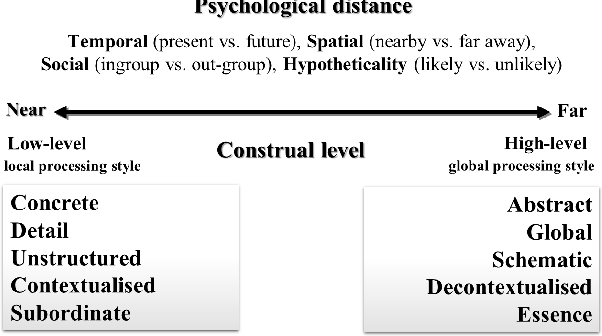
Yaacov Trope and Nira Liberman pointed out in their article Construal-Level Theory of Psychological Distance, “According to CLT, then, people traverse different psychological distances by using similar mental construal processes. Because the various distances have the same egocentric reference point, they should all be cognitively related to each other and similarly affect and be affected by level of construal. As psychological distance increases, construals would become more abstract, and as level of abstraction increases, so too would the psychological distances people envisage. Construal levels thus expand and contract one’s mental horizon.”
I think the six types of “Objective of Knowing” of the HERO U framework requires different construal levels. Meta-theory (mTheory) is at high-level construal while General Practice (gPractice) is at low-level construal.
There are many multi-level knowledge models. For example, Gowin’s Vee diagram, Meta-modeling Methodology (M3), diSessa ’s Knowledge in Pieces (KiP), etc. While HERO U shares the notion of construal level with these models on the cognitive dimension, HERO U has another dimension: personal conditions.
Let’s look at one element of personal conditions: Concept.
6. Concept: Semiotic Potentials
I place the Concept outside the U because it can point to any type of Objective of Knowing. For example, the concept “Activity” can link to meta-theory, special theory, abstract model, concrete model, domain practice, and general practice.
As a personal condition, the connection between the Concept of “Activity” and Objects of Knowing depends on a person’s knowledge. If the person doesn’t know any theory and model about “Activity”, then he only uses “activity” as a normal word as a linguistic concept.
James V. Wertsch mentioned Vygotsky’s notion of semiotic potentials in language, “In the case of concept development, Vygotsky was concerned with a semiotic potential that is realized in the ‘decontextualizaiton of mediational means’ (Wertsch, 1985c)…One of Vygotsky’s major concerns was the ‘scientific’ or ‘academic’ concepts that are grounded in particular sorts of semiotic activity (for example, making definitions) as opposed to the ‘everyday’ concepts grounded in children’s concrete experience. In the former, the focus is on ways in which words and other linguistic units are related to one another independent of their concepts, the focus is on the relationship between linguistic unit and concrete, extra-linguistic experience.”(James V. Wertsch, 1991. p.39)
The following Activity U diagram uses the HERO U framework to visualize “Objects of Knowing” around the concept of “Activity”. There are many kinds of “Activity”, I chose Cultural-historical Activity Theory (CHAT) as my object.
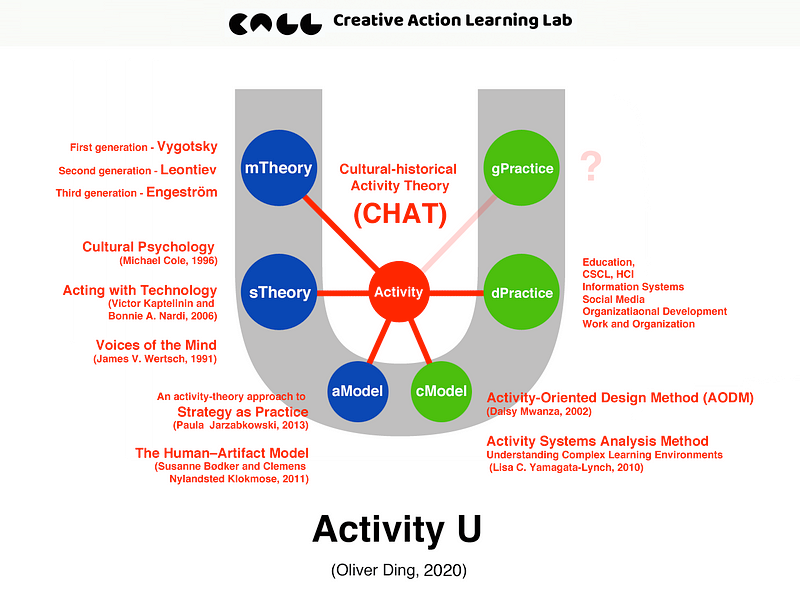
Activity Theory or CHAT is an interdisciplinary theoretical framework for studying different forms of human practices as developmental processes, with both individual and social levels interlinked at the same time. From the perspective of Activity Theory, human activity or ‘what people do’ represents the basic unit of analysis when studying human behavior. The most important aspect of Activity Theory is understanding both individual and collective aspects of human practices from a cultural and historical perspective.
Concepts associated with theories and models are decontextualized because they focus on abstract definitions, forms, and meanings that remain constant across speech event contexts. On the other side, concepts associated with practices are contextualized because they focus on particular situations with special conditions and settings.
The Activity U diagram presents several research outcomes by various scholars from different domains. If we choose “Activity Theory” as a learning objective, then the Activity U diagram is great for mapping the whole landscape and different types of sub-objectives.
7. The Curse of Concept
The challenge is the middle part which bridges the theory side and the practice side. Let’s look at two examples, the first one is humor I found in Daniel Newman’s tweets.
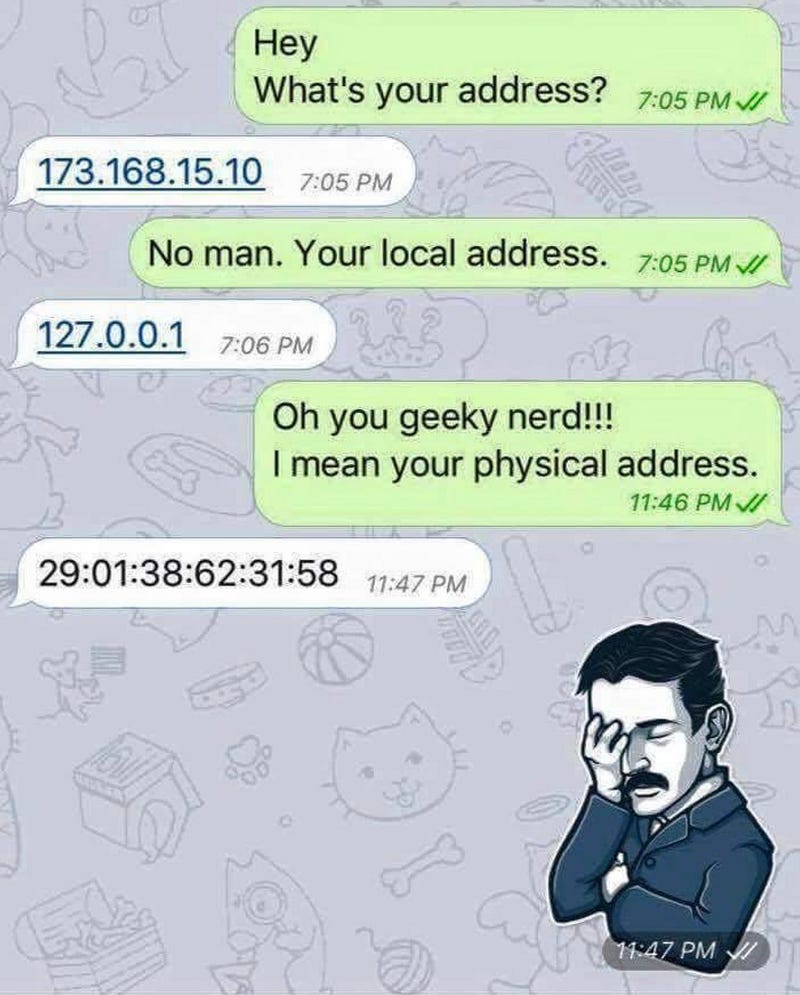
Obviously, we know this is a joke about language and daily communication. Human communication is highly contextualized, if a person doesn’t pay attention to the background of the conversation, he won’t get a great benefit from talking with others.
The second one is a litter harder than the above humor. The TEDx talk below is about “Comfort Zone”. Does the speaker use the concept as a normal word or an academic concept? Not all TEDx/TED ideas are worth spreading. Sometimes, we need to press the pause button and keep the idea for tweaking for a while.
In the age of ideas overload, we have to identify the context of ideas and determine their value for our knowing activity. One effective way of avoiding the curse of concept is searching for a concept on Google Scholar. For example, if you type “Comfort zone” on Google Scholar, the first search result is Mike Brown’s paper “Comfort zone: Model or metaphor?”. I read the paper and highlight a key piece below:
The term ‘comfort zone’ is not only readily referred to in the literature but it is also prevalent in the discourse of adventure education practitioners. But what is a comfort zone? How do you know if it is growing? Is there one ‘universal’ comfort zone that defines or limits my behaviour across all activities or are comfort zones task/context specific? Do my actions indicate that my comfort zone has increased or am I merely performing to complete the task so I can ‘get out of here’? Can my comfort zone shrink?…Searches in main educational and psychological journal databases make no reference to the ‘comfort zone’ as a theory or model. The term appears as a metaphor in the title in a number of publications (for example, see Eccelstone, 2004) but it does not appear as an educational theory, as for example, experiential learning does.(Mike Brown, 2008)
For daily communication, it is fine to use ‘comfort zone’ as a metaphor. However, if you want to adopt it as a conceptual tool for your knowing and guide your learning and personal development, I suggest you read Mike Brown’s paper.
Another example is the concept of “Mediation” which is a core idea of Activity Theory. I found Jonte Bernhard’s paper Thinking and Learning through Technology — Mediating Tools in Science and Engineering Education very helpful for me.
Thinking is hard work, meaningful concepts help us think effectively. However, as Sonke Ahrens mentioned in his book How to Take Smart Notes, “A scientific term or concept only becomes meaningful within the context of a theory — otherwise it would just be a word.”(pp.117–118)
8. Personal Conditions of Knowing
Now let’s look at more personal conditions of knowing. Following the Concept, I added more elements to HERO U. For example,
- Diagram is a way of representing the outcomes of knowing
- Problem is one type of target of knowing
- Method is the way of operations of knowing
- Domain is the context of knowing
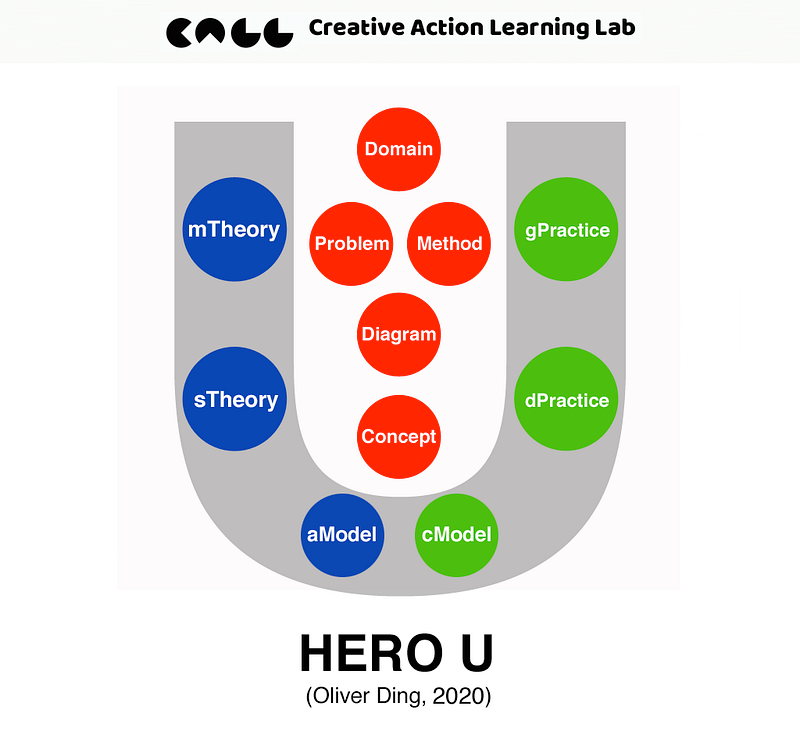
I also added Resource and Tools to the diagram and added the Container Z back. Then, I realized I can reorganize these personal conditions of knowing as a process.
The seven red balls refer to Personal Conditions of Knowing.
- The first group is Domain, Resource, and Tools, they define the outside setting of the knowing activity.
- The second group is Method and Problem, they define the source of competence and solution.
- The third group is Diagram and Concept, they define the representation format of the outcome of knowing.
These three groups form a process of knowing.
In 2016, Information Science scholar Diane H. Sonnenwald edited a book titled Theory Development in the Information Sciences, she presented a three-stage framework for understanding the theory development process. At the center of the diagram she drew, Resource is the core of theory development.
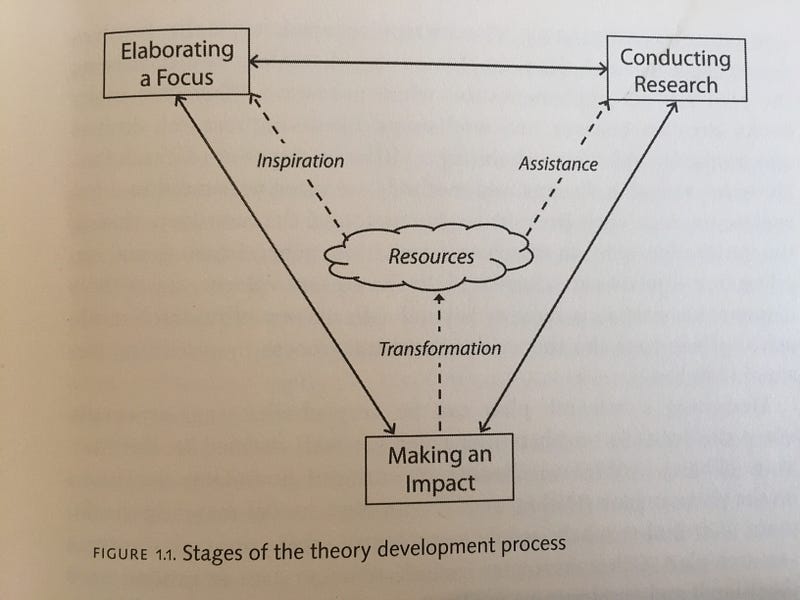
According to Sonnenwald, the Resources mentioned by chapter authors are literature, personal experiences, their own research, colleagues, technology, institutions, and societal issues.
- Literature: read literature deeply, dissatisfaction and disagreement, etc.
- Personal experiences: observations, work experiences, personal challenges, etc.
- Own research: positive and negative results, tests, real-world applications, etc.
- Colleagues: inspiration, valuable feedback, disseminate and apply, etc.
- Technology: new behavior and phenomena, new types of data, etc.
- Institutions: guide of research focus, funding, expert network, etc.
- Societal issues: social problems, funding, evaluation, impact, etc.
We have to notice that these personal conditions of knowing are not separate, but intertwined. Let’s look at HCI scholar Bonnie Nardi’s personal experience, “…At the time, I was experiencing some frustrations with my home discipline (note: she was trained in anthropology). The 1980s were a period of turmoil in anthropology, and certain disciplinary moves were made that I believe have continued to stymie anthropology’s influence. I was disgruntled with anthropology’s total lack of interest in digital technology, its insular jargon, and its somewhat negative attitude. During anthropology’s relentless critique of issues of race-class-gender, my head was in a different space — I was energized and excited about what I perceived to be the development of rapidly changing, life-altering digital technologies…”
Here we see a conflict between Old Domain and New Domain. Nardi was trained in anthropology and had an academic job in anthropology. At that time, she was interested in emergent digital technologies. She had to make a choice between the old domain and the new domain.
She said, “In the mid-1980s, I left a tenure-track job in anthropology to follow my bliss and began working in the high-tech industry in Silicon Valley. My initial encounter with activity theory, in 1993, was a transformative moment of discovery revealing a whole group of scientists who, although far away in Northern Europe, thought digital technology was as interesting as I did. Even better, they were working within a mature social scientific theoretical tradition. This tradition took culture seriously but also had a set shared, well-developed concepts with which to theorize human activity (something I felt anthropology lacked). Discovering activity theory was wickedly empowering: I was, unexpectedly, going to have my cake and eat it too!”
As an established theoretical tradition, Activity Theory brought new Meta-theory, new Domains, new Methods, new Tools, and new Resources to Nardi. She embraced the opportunity and made a significant contribution to the development of Activity Theory in the HCI field and in North America.
9. Kinds of Knowing
From the perspective of outcome and motivation, I distinguish three kinds of knowing: Knowing-for-all, Knowing-for-us, and Knowing-for-me.
Theory container: Knowing-for-all
The Knowing-for-all activity is located in the Theory container. The outcome and motivation are about building, validating, maintaining, applying, and spreading public knowledge.
The corresponding Objects of Knowing are Meta-theory, Specific Theory, and Abstract Model.
Practice container: Knowing-for-me
The Knowing-for-me activity is located in the Practice container. The outcome and motivation are about adopting and sharing reliable and accessible knowledge for improving individual or collective professional work and daily life practice without commitment to contributing to the progress of public knowledge.
The corresponding Objects of Knowing are Concrete Model, Domain Practice, and General Practice.
Echozone container: Knowing-for-us
The Knowing-for-us activity is located in the Echozone container. The outcome and motivation are about spreading and applying public knowledge to professional domain practice, curating and reflecting on personal practical experience, and connecting different domains in order to make new shared knowledge for participants.
The corresponding Objective of Knowing are Specific Theory, Abstract Model, Concrete Model, and Domain Practice.
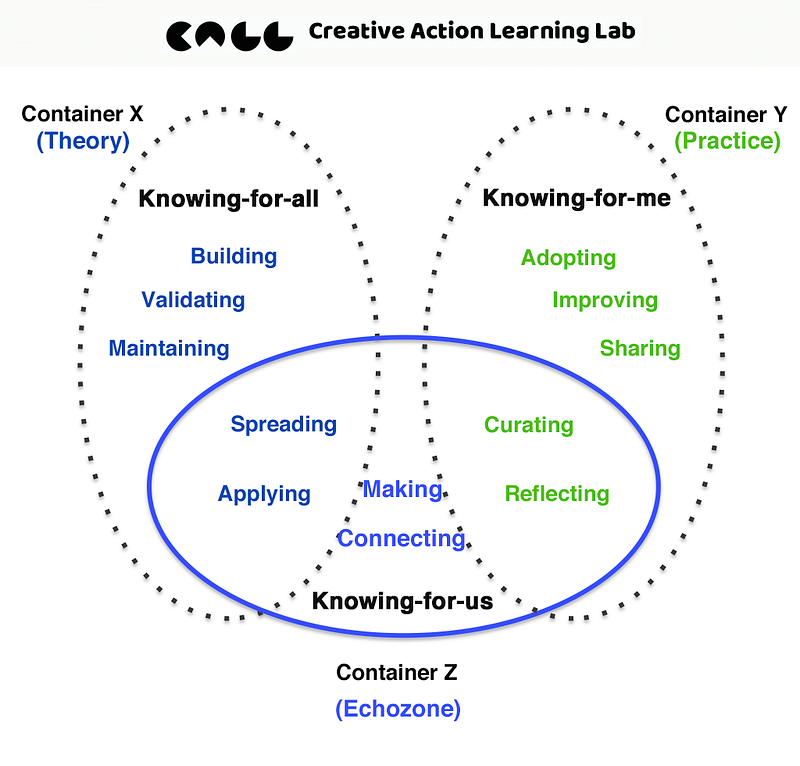
These three types of knowing are not separate but intertwined. The above diagram shows that they share some activities. The next following articles will discuss this section further.
10. Boundary as Opportunity
The HERO U framework is designed for boundary creators. The boundary can be seen as a challenge or opportunity. For knowledge workers, I hope the HERO U framework can contribute to your journey of finding new opportunities.
The above diagram is an example of using the HERO U framework to connect Personal l Conditions and Objects of Knowing. This process is called Mapping An Opportunity.
The next article will introduce the mapping method of the HERO U framework and share case studies, strategies, and techniques.
11. CALL for Action
Some people like developing frameworks and models as thinking tools for directly solving problems, I do like developing frameworks, models, and diagrams as thinking containers for curating practice experience, theoretical knowledge, and peer-to-peer conversation together.
The HERO U framework is the 8th Creative Triggers presented by CALL (Creative Action Learning Lab). Check out the links below to find more Creative Triggers.
Action-based Creativity #1 The Pinwheel Framework (Feb 25, 2020)
The Avocado Effect #1: Introduction (Feb 28, 2020)
Social Platform Experience Design (#SocialPxD)(Mar 4, 2020)
DEKIN Innovation System (Mar 6, 2020)
When X Meets Y (WXMY) (Mar 31, 2020)
The Action After Talk Project (April 7, 2020)
Twitterville / Ecological Physical Method (June 19, 2020)
Based on the Pinwheel framework, the HERO U framework is categorized as a Creative Model which aims to impact your mind. Creative Models are theoretical models, frameworks, formulas, diagrams, etc. It changes people’s minds and impacts their epistemic activity.
If you like the HERO U framework, you can use it for visualizing your ideas. Let’s push the boundary of innovation forward together.
Related Articles
- The Knowledge Curation Toolkit #1: Theme U for Single-theory Curation — June 19, 2022
- The Knowledge Curation Toolkit #2: WXMY for Interdisciplinary Curation — June 24, 2022
- The Knowledge Curation Toolkit #4: Project I and The HERO I Canvas — July 23, 2022
- Activity U : The Landscape of Activity Theory (Part I) — August 10, 2020
- Activity U — A Knowledge Curation Project — Dec 8, 2020
- The Affordance U — August 30, 2022
- Theme U: The AAS Framework and its applications — August 26, 2022
- The ECHO Way (v2.0) — June 30, 2021
- Life Discovery: The “Present — Future” Fit and The ECHO Way — Feb 20, 2022
You are most welcome to connect via the following social platforms:
Twitter: https://twitter.com/oliverding Doowit: https://doowit.co/profile/gm0k2ax9 Linkedin: https://www.linkedin.com/in/oliverding