The Knowledge Curation Toolkit #1: Theme U for Single-theory Curation
The first tool of the Knowledge Curation Project
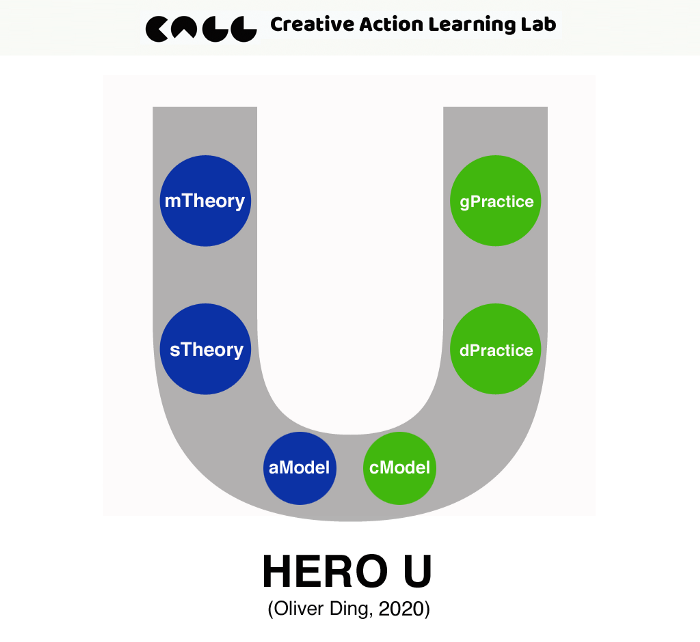
The above HERO U diagram is part of the HERO U framework which is a tool I made for the Knowledge Curation project.
From Sept 2018 to March 2019, I wrote a book titled Curativity: The Ecological Approach to Curatorial Practice. The book presents the Curativity Theory with a theoretical foundation Ecological Practice approach. In 2020, I decided to apply Curativity Theory to Knowledge Building and I started working on the Knowledge Curation project which led to several books later.
The mission behind the Knowledge Curation project is Connecting Theory and Practice.
In the past three years, I developed a series of frameworks, models, diagrams, canvases, and methods for the Knowledge Curation Project.
- The HERO U Framework
- The HERO U Canvas
- The Model of Knowledge Curation
- The Knowledge Curation Canvas
- The Thematic Space Canvas
- The Slow Cognition Method
- A Set of Meta-diagrams
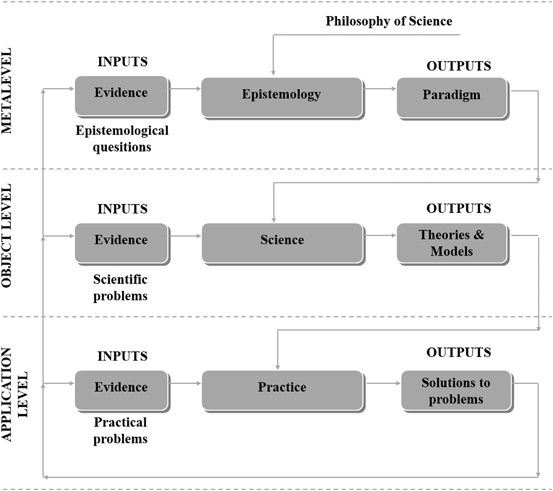
The HERO U diagram is a part of the HERO U framework. It is a simple version of the above “When Theory Meets Practice” diagram. The second part of the HERO U diagram is Project I which refers to a set of “Personal Conditions of Knowing”. You can find more details about the HERO U framework in the following article.
The HERO U diagram is made with the Theme U meta-diagram. This article focuses on the Theme U diagram for the Single-theory Curation activity.
Contents
- Single-theory Curation
- The “Theme U” Diagram
- Spatial Structures of Theme U
- The HERO U Diagram
- Case Study: Activity U
- Case Study: Affordance U
- Case Study: Domain U
- Epistemic U
- Summary
- CALL for NEXT: The “System U” Project
1. Single-theory Curation
Single-theory Curation is defined as a special type of activity that aims to understand the landscape of a theory, a theoretical concept, or a theory/concept-related practice such as learning, teaching, creating, etc. It is different from Multiple-theory Curation.
The Knowledge Curation project started from Single-theory Curation because it is a simple version of Multiple-theory Curation. If we can’t understand Single-theory Curation, we definitely can’t understand Multiple-theory Curation.
An academic/scientific theory is a high-level abstract knowledge system that contains a set of connected theoretical concepts and the complex relationship between these concepts. An established theory or theoretical tradition may have various applications at different levels of abstraction. A theory also has to establish its own identity by building its uniqueness that is different from other theories.
Thus, we have at least three ways to conduct a Single-theory Curation project.
- Depth: The concept dynamics of a theory
- Width: The applicational practices of a theory
- Height: The uniqueness of a theory
The Depth way focuses on understanding the internal structure and complexity of a network of concepts of a theory. You can trace the historical development of each theoretical concept and the relationship between a theoretical concept and other concepts. For example, Clay Spinuzzi’s 2019 paper “Trying to predict the future”: third-generation activity theory’s codesign orientation is a good example of the Depth way.
The Height way is about comparing one theory with other similar theories in order to discover the uniqueness of a theory by identifying differences and similarities. You can compare several theories around a particular theme or compare two theories in multiple aspects. For example, Reijo Miettinen often writes papers on comparing Activity Theory with other theories. His 2016 paper Four theories of networks: from interconnectedness to object-oriented collaboration focuses on the theme of networks. Reijo Miettinen also wrote papers about the relationship between Deweyan pragmatism and Cultural-historical activity theory in order to respond to Jim Garrison who is a philosopher and Dewey scholar.
The Width way aims to review various applications of a theory or a particular theoretical concept and present a landscape view of a knowledge enterprise. For example, In an analysis of the use of activity theory in HCI research, Bonnie Nardi (2016) and her colleagues collected 109 HCI activity theory papers and found scholars use five strategies in their research work to make use of activity theory: 1) an object of analysis, 2) a conceptual tool for design, 3) a meta-tool for developing new analytical tools, 4) a tool for conceptual analysis, and 5) a tool for empirical analysis.
We can apply the above one way or more ways to one project together. We can also use this 3D approach to watch the development of our thematic space about a particular theory.
2. The “Theme U” Diagram
The “Theme U” diagram is a simple meta-diagram that displays six themes in a U shape. It can be used for the Single-theory Curation activity.
The simple way of using the Theme U diagram is 1) defining six themes, and 2) displaying them on the U shape randomly.
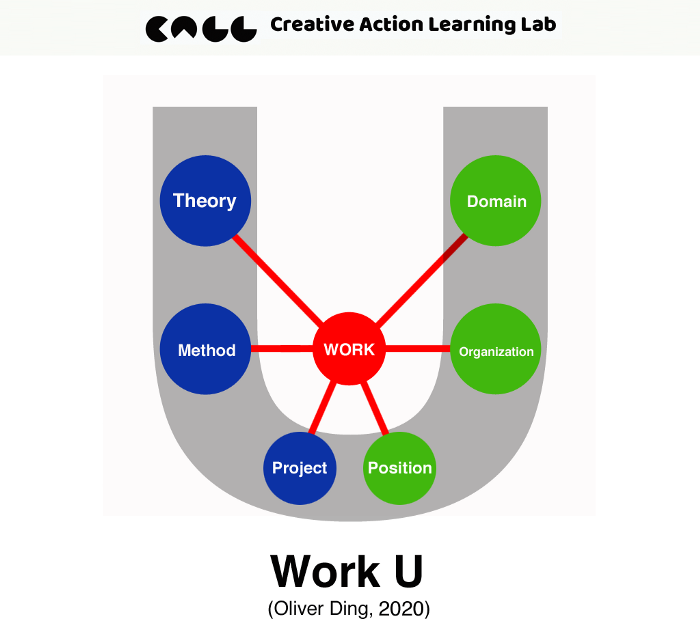
For example, I made the following diagram called Work U in 2020. I selected six themes about Work. Three blue themes are about knowledge while the other three green themes are about practice.
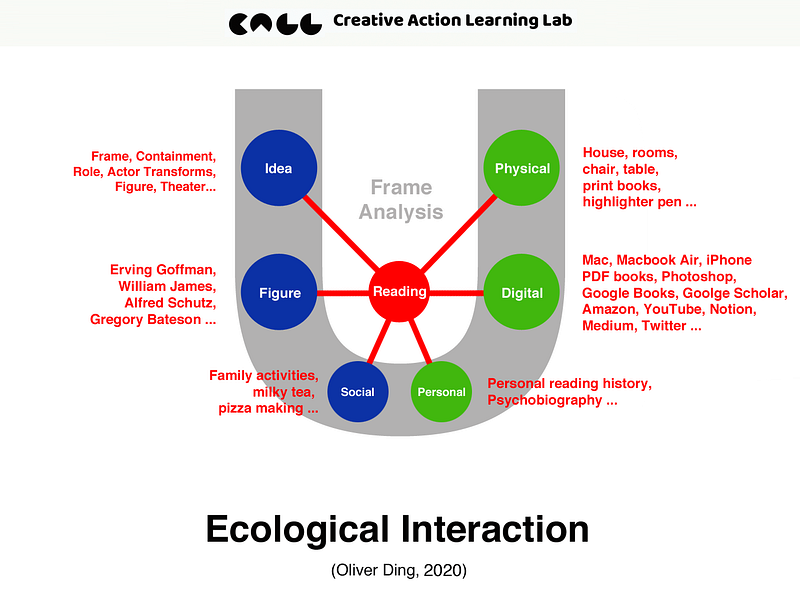
The diagram below is another example. I selected six themes for the case study of “Reading a book titled Frame Analysis”.
However, the benefit of Theme U is its unique spatial structure. We can take the Graphical Space Affordance of the Theme U diagram for our thematic space development. For example, the Theme U diagram uses Blue and Green to highlight two groups of themes and three levels of themes.
3. Spatial Structures of Theme U
Why do we need to pay attention to the spatial structure of a meta-diagram?
The notion of “meta-diagram” considers a special type of diagram as an independent thing that doesn’t have to be a representation of an existing theory or model. For example, the 2x2 matrix diagram is a meta-diagram that doesn’t refer to any concrete theory or model such as BCG’s Growth-share matrix.
A meta-diagram is for making domain-specific diagrams or knowledge frameworks. The uniqueness of a meta-diagram is defined by its unique spatial structure which offers unique Graphic Space Affordances.
Three levels can be used to define three Dimensions. For example, the diagram below shows an example of using Theme U to display Pairs of Opposite Themes. For each dimension, you can select two themes that form a pair. For example, Theme A1 and Theme A2 are a pair of opposite themes which share Dimension A.
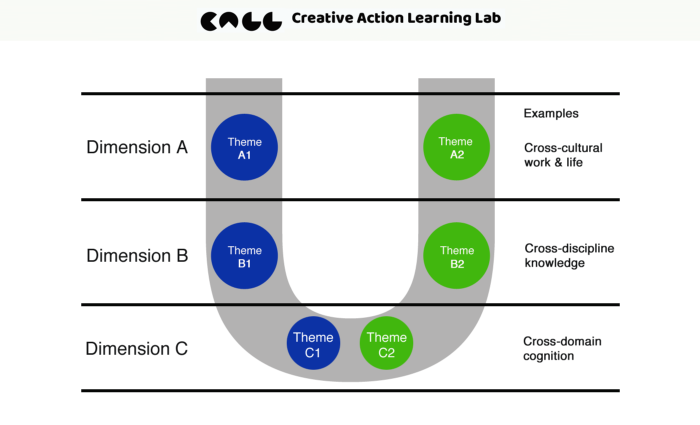
I use the above diagram to discuss my personal innovation. I defined the following dimensions for curating three pairs of opposite themes of my career experience.
- Dimension A: Cross-cultural work & life
- Dimension B: Cross-discipline knowledge
- Dimension C: Cross-domain cognition
You don’t have to use these examples of dimensions since you have your unique career experience.
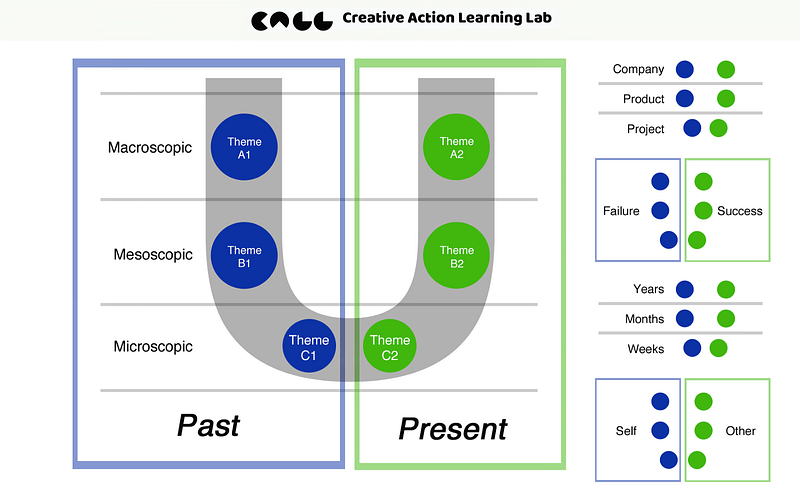
In addition to three dimensions, the Theme U diagram also uses Left Field and Right Field to group themes.
By combining Dimensions and Fields, you can make a configuration of your themes with the Theme U diagram. The about diagram shows some examples of dimensions and fields. You can define your own dimensions and fields too.
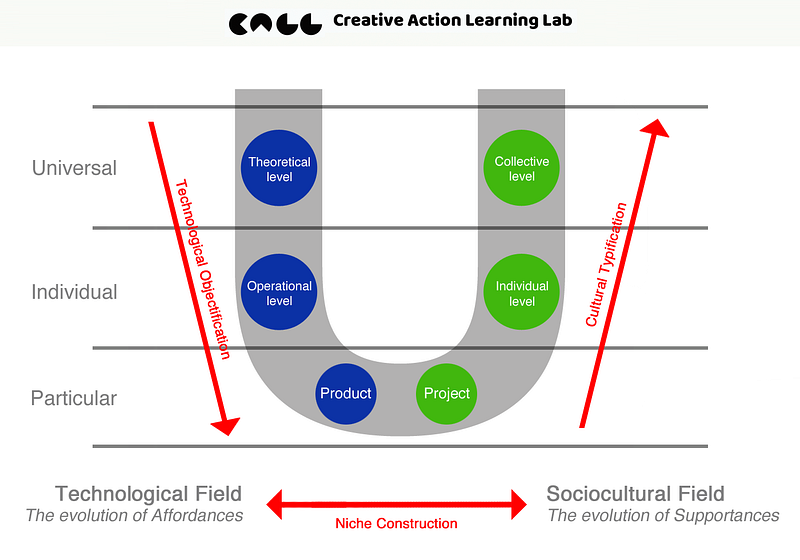
You also connect themes to define Paths. The above diagram shows an example of using Paths for conceptual development. See more details about this case in Platform Innovation as Concept-fit.
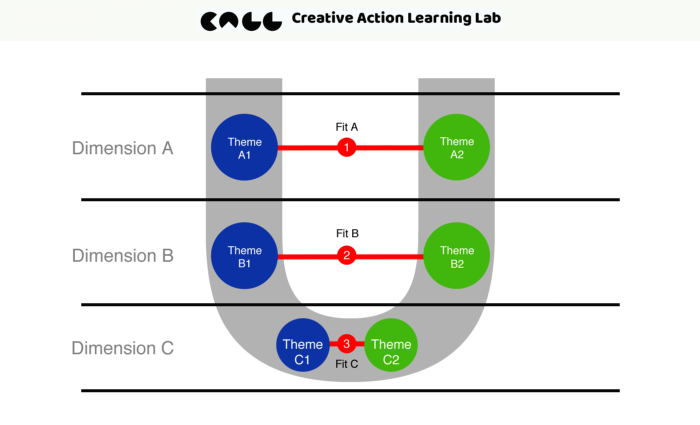
You can also define Fits between pair of themes. There are two types of Fits, the first one is Single-dimension Fit and the second one is Multiple-dimension Fit. See the above diagram. Fit A means a fit between Theme A1 and Theme A2 under the same dimension A. Based on the Single-dimension Fit, you can challenge Multiple-dimension Fit which means cross-dimension fit. For example, the above diagram shows three Single-dimension Fits: Fit A, Fit B, and Fit C. The Multiple-dimension Fit asks you to fit “Fit A + Fit B + Fit C” together.
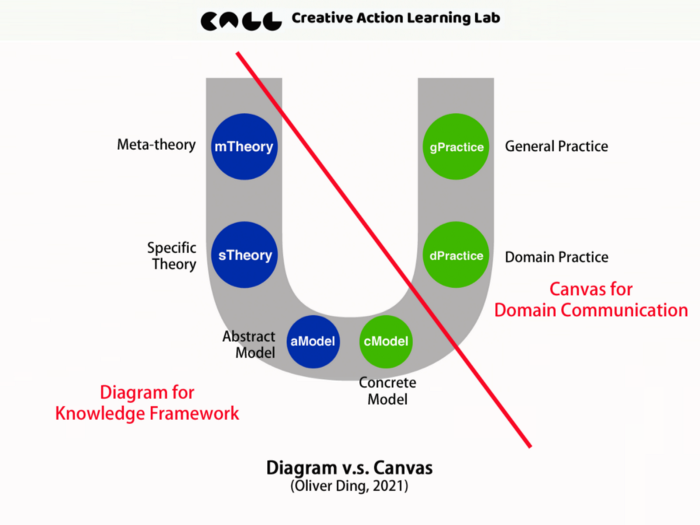
You can also define Areas. For example, the above diagram uses two Areas to discuss the difference between Diagram and Canvas. There is a difference between knowledge diagrams and knowledge canvas. A knowledge diagram is a representation of conceptualized knowledge while a canvas is an instrument of practical communication. The primary goal of diagrams is visually expressing knowledge frameworks while the primary goal of canvases is enabling situational interaction around data and concepts.
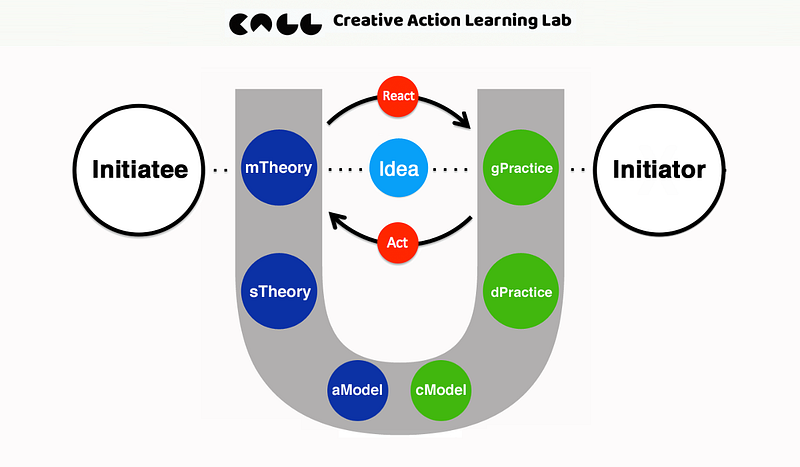
You can also discover Creative Connections between Theme A1 and Theme A2. For example, the above diagram is an application of the HERO U diagram (see below). Theme A1 refers to mTheory (Meta-theory) and Theme A2 refers to gPractice (General Practice).
How can we connect Meta-theory and General Practice since these two are located at two different levels of abstraction? You can find my solution in D as Diagramming: Meta-theory and General Practice.
The above spatial structures offer unique Graphical Space Affordances for using the Theme U meta-diagram in various applications. In order to discuss diagramming, I coined the term “Graphical Space Affordances” for the integrated framework for studying knowledge diagrams. Originally, I only used it to discuss the affordances of white space in a graphic. Now I expand the concept from white space to all spatial structures of a graphic.
The following sections will focus on one application of the Theme U meta-diagram.
4. The HERO U Diagram
The HERO U Diagram is an application of the Theme U meta-diagram.
What’s the difference between HERO U and Theme U?
The HERO U diagram adopts the Width way and defines six types of objects of knowing:
- mTheory: Meta-theory
- sTheory: Specific Theory
- aModel: Abstract Model
- cModel: Concrete Model
- dPractice: Domain Practice
- gPractice: General Practice
Meta-theory (mTheory) means philosophical approaches or theoretical perspectives which can guide researchers to develop their own theory in a special domain. Specific Theory (sTheory) refers to discipline-dependent theories. This type of theory only applies to a particular domain or field. Abstract Models (aModel) are high-level models which connect theoretical approaches with special domains. Concrete Models (cModel) are lower-level models with details for directly guiding domain practice. Domain Practice (dPractice) points to a professional community of practice and its activities. General Practice (gPractice) means daily life as a general context of knowing. For example, personal growth, productivity, mental health, career value, and life meaning are typical issues for most adults.
There is an assumption behind the HERO U diagram. According to Construal level theory (CLT), a social psychology theory that describes the relationship between psychological distance and the extent to which people’s thinking is abstract or concrete.
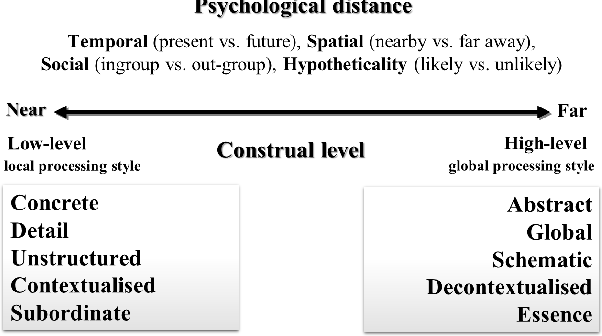
Yaacov Trope and Nira Liberman pointed out in their article Construal-Level Theory of Psychological Distance, “According to CLT, then, people traverse different psychological distances by using similar mental construal processes. Because the various distances have the same egocentric reference point, they should all be cognitively related to each other and similarly affect and be affected by level of construal. As psychological distance increases, construals would become more abstract, and as level of abstraction increases, so too would the psychological distances people envisage. Construal levels thus expand and contract one’s mental horizon.”
I think the six types of “Objective of Knowing” of the HERO U diagram requires different construal levels. Meta-theory (mTheory) is at high-level construal while General Practice (gPractice) is at low-level construal.
There are many multi-level knowledge models such as Gowin’s Vee diagram, Meta-modeling Methodology (M3), diSessa ’s Knowledge in Pieces (KiP), etc. The HERO U diagram shares the notion of construal level with these models on the cognitive dimension.
5. Case Study: Activity U
One year ago, I published an article titled HERO U — A New Framework for Knowledge Heroes on June 26, 2020. Two months later, I started testing the HERO framework by writing a series of articles about Activity Theory. I called this project the Activity U project which is considered a knowledge curation project.
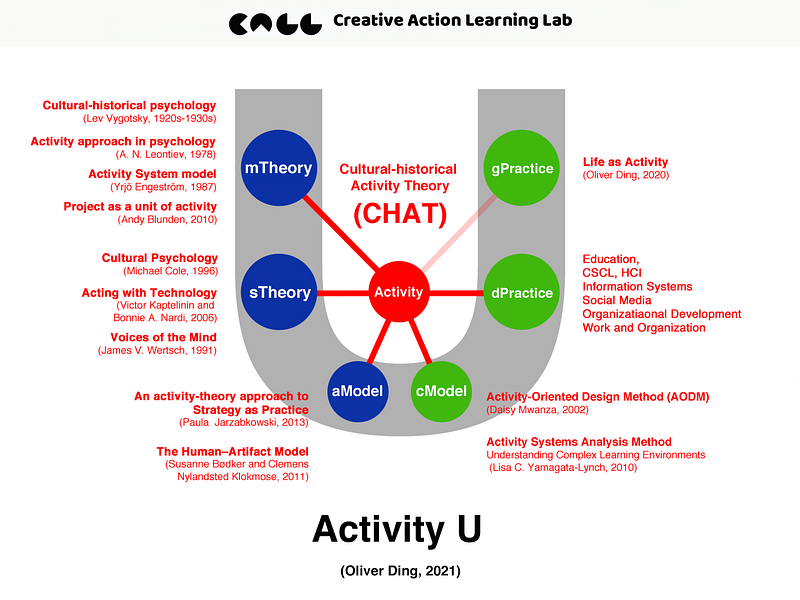
The above Activity U diagram is an application of the HERO U diagram. It’s a case study of Single-theory Curation. I didn’t deliberately review the development of activity theory, but selected works of activity theorists based on my personal reading history.
Meta-theory (mTheory) means philosophical approaches or theoretical perspectives which can guide researchers to develop their own theory in a special domain. I selected four works as Meta-theory.
- Cultural-historical psychology (Lev Vygotsky, 1920s-1930s)
- Activity approach in psychology (A. N. Leontiev, 1978)
- Activity System model (Yrjö Engeström, 1987)
- Project as a unit of activity (Andy Blunden, 2010)
Specific Theory (sTheory) refers to discipline-dependent theories. This type of theory only applies to a particular domain or field. I chose three works from activity theorists as examples of specific theories.
- James V. Wertsch: Voices of the Mind (1991)
- Michael Cole: Cultural Psychology (1996)
- Victor Kaptelinin and Bonnie A. Nardi: Acting with Technology (2006)
Abstract Models (aModel) are high-level models which connect theoretical approaches with special domains. I talked about three examples of abstract models made by activity theorists.
- Activity Theory to Strategy as Practice (Paula Jarzabkowski, 2015)
- Human-Artifact Model (Bødker & Klokmose, 2011)
- Instrumental Genesis Theory (Rabardel, 1995)
Concrete Models (cModel) are lower-level models with details for directly guiding domain research and practice. I select two examples from works of activity theorists.
- Activity-Oriented Design Method (AODM) (Daisy Mwanza, 2002)
- Activity Systems Analysis Methods (Lisa C. Yamagata-Lynch, 2010)
Domain Practice (dPractice) points to if a person thinks and reflects on a domain in which he is working within. Most professionals like to think about domain issues and consider it as one important aspect of their career activity. For example, a designer would like to write articles about design, collect things and images about design, and share their insights with peers. These activities generate domain practice knowledge. Sometimes, they also create concrete models (cModel) to represent their personal knowledge without connecting to theoretical concepts or approaches.
Activity theory has been widely used in various fields, for example:
- Education
- HCI / CSCL
- Information Systems
- Organizational Development
- Work and Organization
General Practice (gPractice) means daily life as a general context of knowing. For example, personal growth, productivity, mental health, career value, and life meaning are typical issues for most adults.
Though activity theory is a theory for professional research, I do believe it is useful for ordinary people to reflect on their daily life. In Nov 2020, I developed the Life-as-Activity framework (v0.3).
You can find more details in the following article.
This article led to the Activity U project. I wrote more than one article about Activity Theory. From August 2020 to March 2021, I wrote the following three books (drafts). This was an amazing experience!
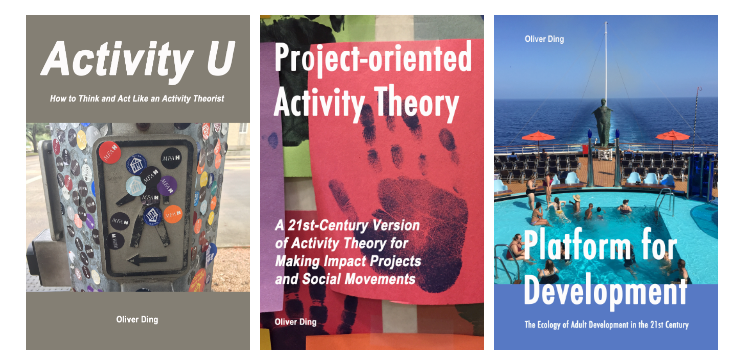
In April 2021, I joined an online program and shared my reflection about the HERO U framework and the above works. Eventually, I wrote a new book called THE ECHO WAY: Echozone and Boundary Knowledge Work. It is a 312-page draft.
The book has three parts. The first part introduces the Theme U diagram for connecting Theory and Practice with three examples:
- Activity U
- Affordance U
- Knowledge U
The next section will introduce the Affordance U case study.
6. Case Study: Affordance U
From 2014 to 2017, I often read academic papers about the concept of Affordance. In the beginning, I read papers in the field of ecological psychology. Then, Cognitive Science, Creativity Research, Design, HCI, Social Media, Information Systems, etc.
How many academic papers about the concept of Affordance did I read in the past years?
I didn’t count the number because it became one of my habits. I guess that the number should be more than 300.
This experience inspired me to plan the Conceptual Analysis part of the Affordance Analysis project. I made several diagrams to visualize my thoughts. One of the diagrams is called Affordance U, see the picture below.
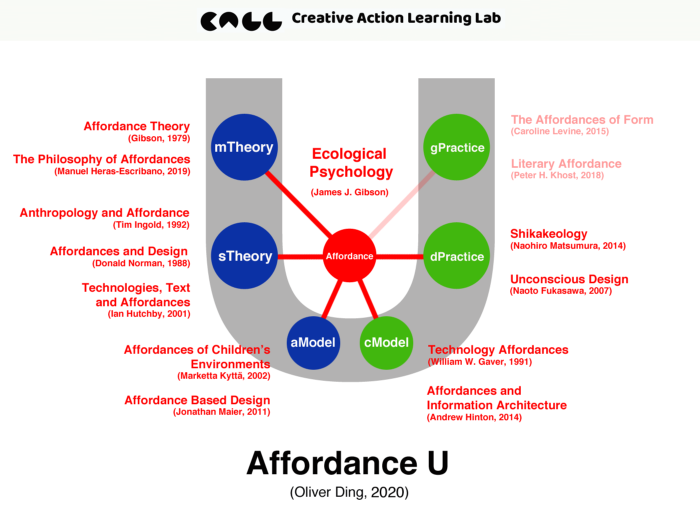
The above diagram is based on the HERO U diagram. I have used the same diagram for the Activity U project. The Affordance U diagram and the Activity U diagram adopt the same meta-diagram, but they present two types of the landscape of concept ecology.
The Activity U diagram presents a larger knowledge enterprise which can be considered a giant tree while the Affordance U presents a loose web of concepts that can be considered a garden where you can see many small trees.
Moreover, there are two key facts during the development of Activity Theory. The first thing is Yrjö Engeström’s contribution. He developed the activity triangle model or activity system which is very popular in various domains such as learning and education, HCI (human-computer interaction) research and design, information science, organization, management, etc. The second thing is cross-location communication and collaboration. Yrjö Engeström is based in Northern Europe, he built a community called the Scandinavian AT school. In the West, Michael Cole built cultural psychology, Bonnie A. Nardi brought AT to HCI research. These new generation researchers form CHAT as a whole for Activity Theory. It is a wonderful collective intellectual work.
For the concept of Affordance, there is another kind of landscape. Though William M. Mace mentioned the cross-discipline influence of Affordance in the classic edition of Gibson’s book, I see there are more radical variations than systematic development. Researchers from different fields adopted the concept of Affordance and modified its definition to fit their own contexts. Eventually, the concept of Affordance became a buzzword. The original theoretical value behind the word was lost in the process.
I am so sad to see this situation. This also means an opportunity for theory building. There is a need to build an affordance-based ecological approach for interdisciplinary research.
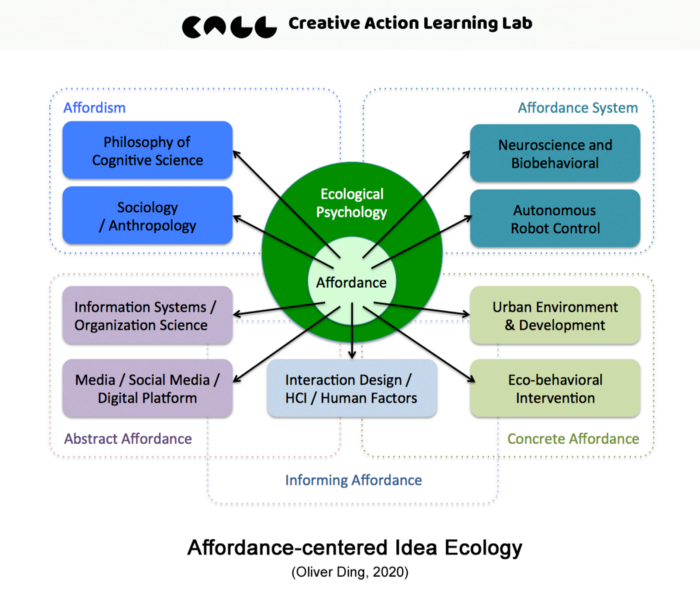
After roughly reviewing some papers about the concept of Affordance from several fields, I made the above diagram and summarized five ways of appropriating the concept of Affordance:
- Informing Affordance: This way focuses on telling users Affordances of objects. Designers tend to adopt this way because they want users to understand designed features.
- Concrete Affordance: This way is also called the Ecological approach, they deal with physical environments and adopt Gibson’s concept of Affordance without modifications. This way pays attention to concrete situations.
- Abstract Affordance: This way is very popular in the field of digital environments such as Information systems, Social Media, Digital platforms, Organization Science, etc. Scholars from these fields want to use the concept of Affordance, but they find it is so hard to define Environments for them. Thus, they move to use the concept of Affordance at the abstract level without considering concrete situations.
- Affordance System: This way expands the theoretical model of affordance from the original “environment — organism” relationship to a multiple-part system such as the “human — robot — object — environment” system.
- Affordism: This way adopts the concept of Affordance as a philosophical idea to support theoretical debates and theoretical building.
My own approach is to return to Gibson’s ecological approach and adopt its core: the Ecological Physics Method. You can find more details here.
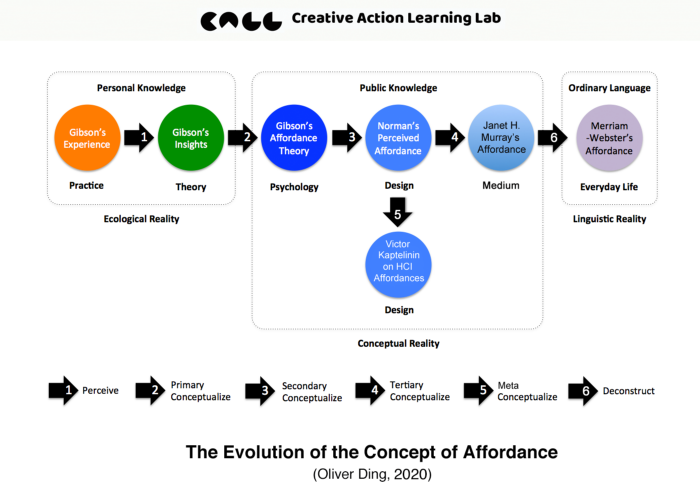
I also conducted a genetic analysis of the development of the “Affordance” Concept Ecology. See the above diagram. I found there are six moments of the development process:
- Perceive: A person perceives a brand new reality in the real-life world and discovers its theoretical value.
- Primary Conceptualize: The person conceptualizes his insights and develops a brand new theoretical concept.
- Secondary Conceptualize: The original theoretical concept is adopted and modified by others. This moment generates first-order variation and second-hand concepts.
- Tertiary Conceptualize: A second-hand concept is adopted and modified by others without returning to the original theoretical concept. This moment generates second-order variation and third-hand concepts.
- Meta Conceptualize: This moment is about reflecting and reviewing the developmental process of a concept ecology.
- Deconstruct: People use the word part of the concept without deeply considering its theoretical meaning and value. An awesome theoretical concept became a buzzword.
This model is pretty interesting because it clearly describes the source of the complexity of a concept ecology. It also points out a possible solution to solve the problem of knowledge overload.
7. Case Study: Domain U
While the Activity U diagram is about the landscape of a theory, the Affordance U diagram is about the ecology of a theoretical concept.
The third case study is about an intellectual choice about career development. It offers a new perspective on Single-theory Curation: we can use the Theme U diagram to visualize the “Creative Person — Domain — Theory” relationship.
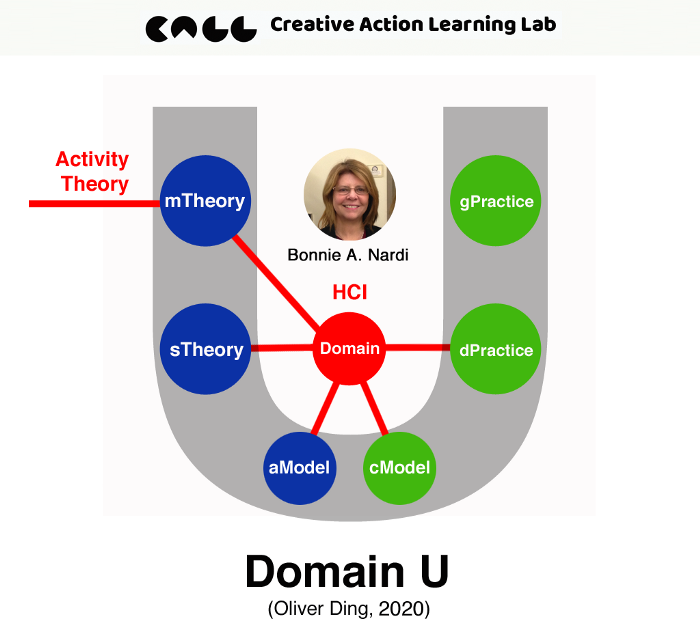
The above Domain U diagram uses Bonnie A. Nardi’s story as an example.
Bonnie A. Nardi is an activity theorist, HCI researcher, and anthropologist. She is well known for her work on activity theory, interaction design, games, social media, and society and technology.
HCI stands for “Human-computer interaction” which refers to a field of research with a focus on the design and use of computer technology. HCI is also sometimes termed human-machine interaction (HMI), man-machine interaction (MMI), or computer-human interaction (CHI).
HCI researchers use “first wave HCI”, “second wave HCI”, and “third wave HCI” to describe the development of the field. Around the late 1980s — early 1990s, the focus of HCI research shifted from the “cognitivist perspective (human factors)” to the “post-cognitivist perspective (human actors)”. Researchers started to pay attention to the context of human-computer interaction such as social practices, work settings, communities, and everyday life environments.
Nardi was a trained anthropologist, but she was disgruntled with anthropology’s total lack of interest in digital technology in the 1980s. She said, “The 80s were a period of turmoil in anthropology, and certain disciplinary moves were made that I believe have continued to stymy anthropology’s influence (a story for another time). I was disgruntled with anthropology’s total lack of interest in digital technology, its insular jargon, and its somewhat negative attitude. During anthropology’s relentless critique of issues of race-class-gender, my head was in a different space — I was energized and excited about what I perceived to be the development of rapidly changing life-altering digital technologies…I found digital technology liberating, compelling, and so impactful on a global culture that I could scarcely believe it remained outside anthropology’s sights.”
Here we see a conflict between Old Domain (academic job in anthropology) and New Domain (high-tech research). Nardi was trained in anthropology and had an academic job in anthropology. At that time, she was interested in emergent digital technologies. She had to make a choice between the old domain and the new domain.
Finally, in the mid-80s, she left a tenure-track job in anthropology and moved to the high-tech industry in Silicon Valley.
As an HCI researcher, Nardi met her challenge again. The second wave of HCI was emergent around the late 1980s to early 1990s. In order to overcome the limitations of information processing psychology as a theoretical foundation for HCI, some researchers proposed several other theoretical approaches as alternative frameworks. In 1987, Susanne Bødker argued that activity theory could form a strong theoretical basis for HCI. Other options are phenomenology, the situated action perspective, and distributed cognition.
This time, Nardi’s choice was activity theory because her preference is a systematic theoretical framework. She shared an example, “One of the key points Kaptelinin makes about a strength of activity theory is the importance of its integrating framework linking a set of theoretical principles — rather than what we often get in HCI, which is an insight here and an insight there. Kaptelinin provides an example of the power of a larger theoretical framework, comparing Norman’s (1991) notion of “cognitive artifacts” and activity theory’s notion of tools. Cognitive artifacts are on one level almost identical to tools, but in activity theory, the notion of tools draws on principles of mediation, internalization, and functional organs, leading to very different conclusions about the nature of tools, as Kaptelinin details. Finally, Kaptelinin discusses some of the limitations of activity theory.” (1996)
Nardi’s journey of appropriating activity theory started with a paper shared by her colleague in HP in 1993. She said, “In 1993 I was working at Hewlett-Packard Labs in Palo Alto, California, conducting ethnographic studies in the human-computer interaction research group….The only other anthropologist in our building (who was in a product group) told me she had an article I would like, and handed me a copy of Kari Kuutti’s Activity theory and its applications to information systems research and development (1991). I began to read the text in the ordinary desultory way one does with random articles, but I soon snapped to attention, the words jumping off the page. I was astonished to find that someone had theorized information systems as activity systems wherein the technical system was conceived as part of object-oriented human activity. The clarity and good sense in Kuutti’s argument — that we should study what people are doing with technical systems and why! — set me off on a crash course in activity theory to determine whether my enthusiasm would withstand further exposure to the ideas.”
Nardi’s second step was building personal contact with the Scandinavians and editing a book about activity theory and HCI. She said, “I decided if I were to penetrate the core activity theory circle — centered in what Don Norman once called “that hardy band of Scandinavians” — I would have to make personal contact with the illustrious natives. I emailed Kari Kuutti and Susanne Bødker, and they very kindly helped me build up a network of people to contribute to an edited volume on activity theory and HCI published by MIT Press (Nardi 1996)…”
We have to notice Nardi’s work status at that time. In 1993, She worked for HP. In 1996, She worked for Apple. During these three years, Nardi invested her time in “appropriating activity theory”. What we can learn from this lesson is that we need both the attitude to theory and routine work for adopting theory. I drew the diagram below to explain Nardi’s career transformation. I named this new diagram “Boundary Knowledge Work”.
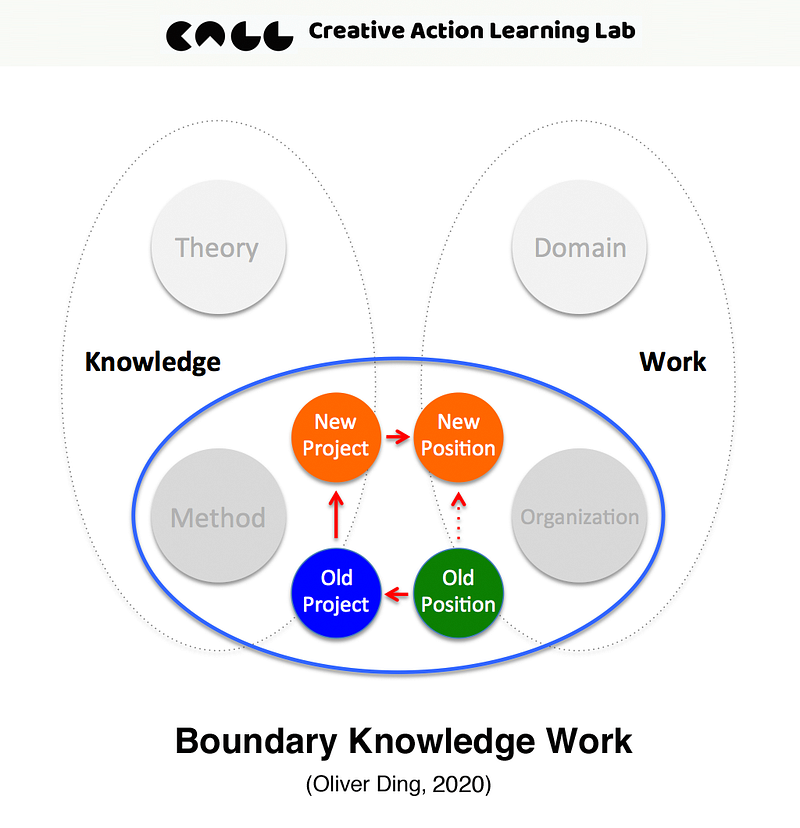
In 1993, Nardi was an HCI researcher at HP. From 1994 to 1996, she worked as an HCI researcher at Apple. We can claim “An Industry HCI researcher” as her “old position”. If we review her publications on her personal website, we can find her “old projects” are almost under the category of “Interaction Design”. For example, A Small Matter of Programming: Perspectives on End User Computing. MIT Press (1993), User Preferences for Task-specific vs. Generic Application Software (1994), Finding and Reminding: File Organization from the Desktop (1995), Creating Presentation Slides: A Study of User Preferences for Task-Specific versus Generic Application Software (1996).
For an industry HCI researcher, editing a book about a theory is not part of her job description. For Nardi, editing a book is a “new project” that detaches from the “old position” and attaches to the “new position”. In a short term (three years), the “new position” is “an editor”. Later, it transformed into “an activity theorist”.
People always have knowledge beyond the job description of their existing work (job). In order to move to an “ideal position” from an “existing position”, we need some strategies if we can’t directly move. I hope the “Boundary Knowledge Work” diagram and the whole HERO U framework can be considered as a thinking tool for career transition.
Nardi suggested that leading an editorial project is a great work for researchers. She said, “I reasoned that if I had a bunch of papers written by activity theorists in front of me to edit, it would be a good way to imbibe its principles and concerns. (I recommend editorial work such as special issues or edited collections as a general recipe for plunging into a field or deepening knowledge of a field in which a researcher seeks to gain more understanding.)” In fact, she did many editorial projects and made huge contributions to the HCI domain and activity theory domain. For example, she co-edited the MIT Press Acting with Technology Series which has many award-winning titles. She is a Senior Editor for Mind, Culture, and Activity, a journal devoted to activity theory.
As an established theoretical tradition, Activity Theory brought a new meta-theory, a new domain, a new method, new tools, and new resources to Nardi. She embraced the opportunity and made a significant contribution to the development of Activity Theory in the HCI field and in North America.
You can find more details about this story in Activity U (III): Bonnie Nardi’s Choices and Boundary Knowledge Work.
8. Epistemic U
As mentioned above, the HERO U diagram is part of the HERO U framework. The diagram below is the full version of the HERO U framework.
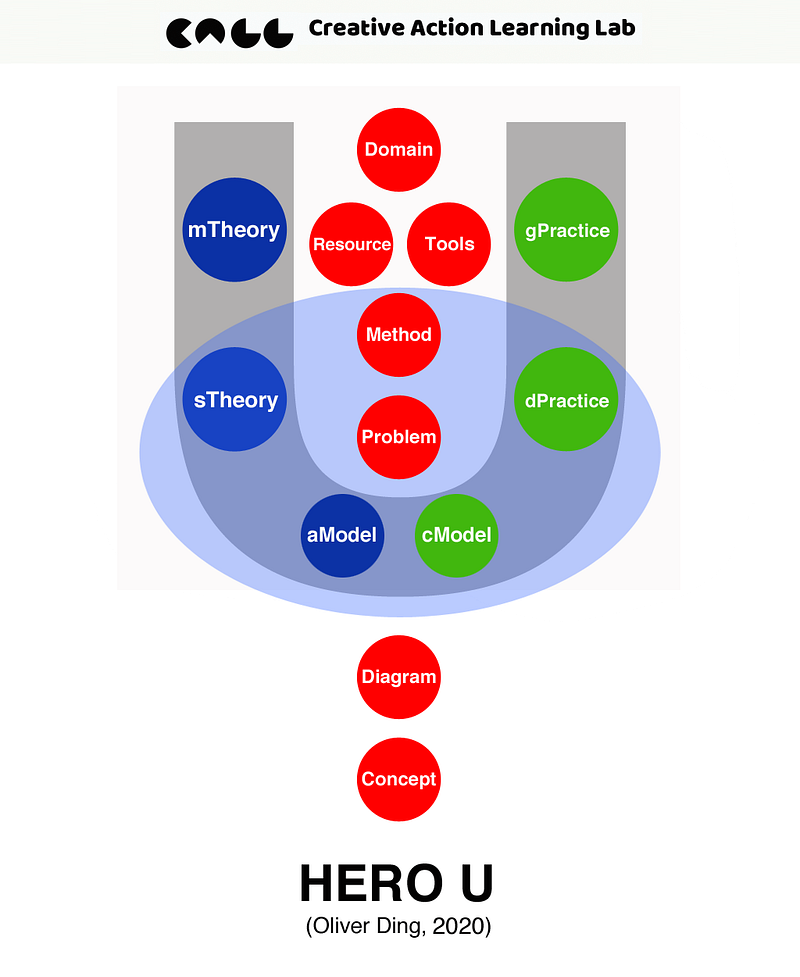
The seven red dots refer to the second part of the framework: Project I. For the Knowledge Curation, the Project I model focuses on seven “personal conditions of knowing”.
I consider the HERO U framework as “an ecological approach” to knowing because it refers to the structure of “organism (personal conditions of knowing) — action (knowing) — environment(objects of knowing)”.
In the 2021 book The ECHO Way (v1.0, draft), I used the ECHO Way to rename the HERO U framework. The last chapter of the book is titled Ecological Epistemology. Based on the HERO U/ECHO framework, I developed a new model of knowing.
First, I consider a triad of “Object of knowing — Actions of knowing — Subject of knowing” as a whole and I see Knowing as a dynamic process.
Second, I select Domain as the Primary Object of Knowing and make the Epistemic U diagram. For each domain, we can understand it from six types of objects of knowing.
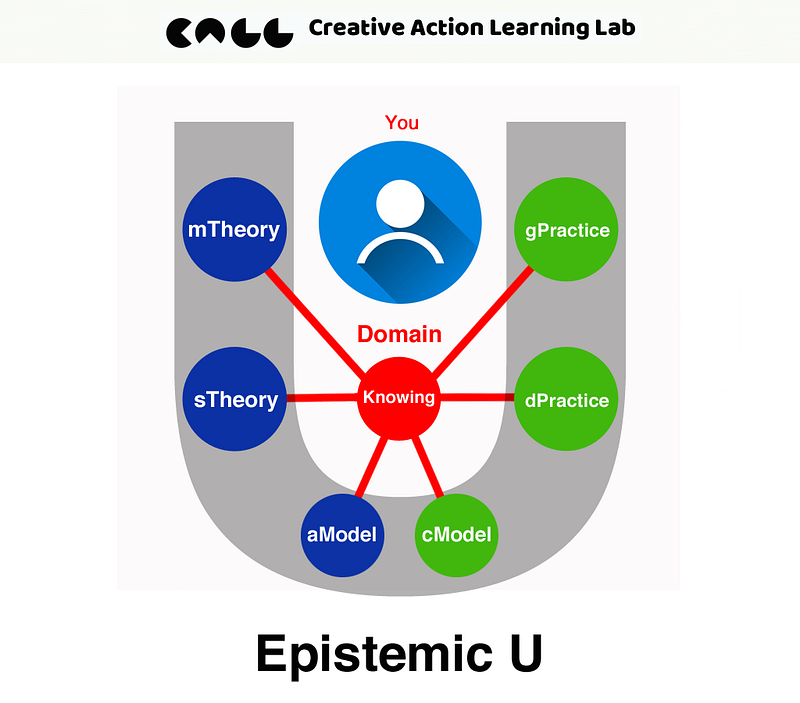
Third, I consider an advanced model of boundary knowing. If we consider two domains as two containers, the boundary knowing project is the third container: the Echozone.
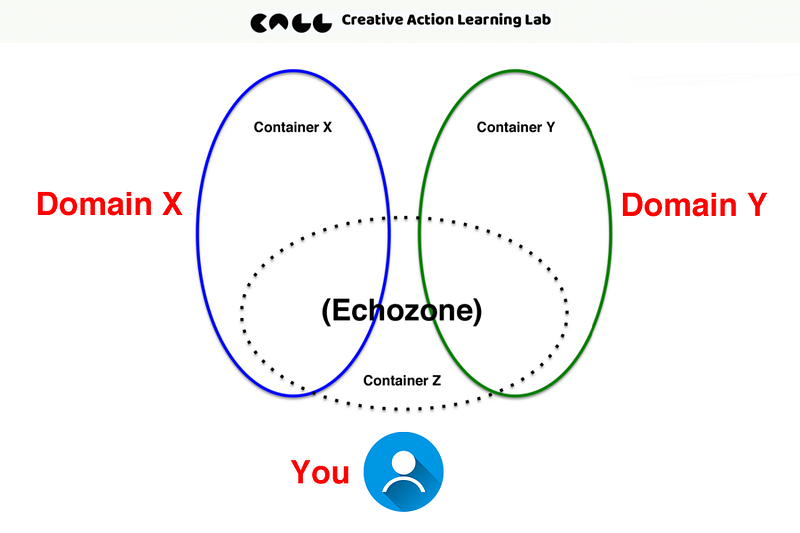
In fact, the above diagram can be seen as an example of the ECHO Way (v2.0). You can also find some similar examples of using the three-container model in #TalkThree 05: How to Connect X and Y?
9. Summary
Single-theory Curation is defined as a special type of activity that aims to understand the landscape of a theory. We have at least three ways to conduct a Single-theory Curation project.
- Depth: The concept dynamics of a theory
- Width: The applicational practices of a theory
- Height: The uniqueness of a theory
Theme U is a meta-diagram and its uniqueness is defined by the following spatial structures:
- Dimensions
- Fields
- Paths
- Fits
- Areas
- Connections
The HERO U diagram is an application of Theme U. The HERO U diagram adopts the Width way and defines six types of objects of knowing:
- mTheory: Meta-theory
- sTheory: Specific Theory
- aModel: Abstract Model
- cModel: Concrete Model
- dPractice: Domain Practice
- gPractice: General Practice
The above three case studies show three ways of using the HERO U diagram.
- The Activity U diagram is about the landscape of a theory,
- The Affordance U diagram is about the ecology of a theoretical concept.
- The Domain U/Epistemic U diagram is about an intellectual choice about career development.
How to conduct a Single-theory Curation project with Theme U and HERO U?
You can just write one article about a theory with the HERO U diagram. For example, I used the Domain U diagram to write an article about Nardi’s story.
You can spend several months writing a book about a theory with the HERO U diagram. Originally, I only wrote an article titled Activity U: The Landscape of Activity Theory. Later, the article expanded to the Activity U project which led to two books (drafts): Activity U and Project-oriented Activity Theory.
You can just host a workshop to discuss a theoretical topic with your friends.
You can make a diagram and share it on Twitter, Linkedin, and other social media platforms. It may lead to a project too.
10. CALL for NEXT: The “System U” Project
I have made a tool.
I have run a project: the Activity U project.
Now it is your turn to run the “System U” project.

Life is short. You can transform yourself one project at a time.
Related Articles:
- The Knowledge Curation Project
- Activity U — A Knowledge Curation Project
- HERO U — A New Framework for Knowledge Heroes
- Activity U: The Landscape of Activity Theory (Part I)
- Activity U (III): Bonnie Nardi’s Choices and Boundary Knowledge Work.
- D as Diagramming: Challenge as Opportunity
- D as Diagramming: From Sandwich to Containers
- Platform Innovation as Concept-fit
- Personal Innovation as Career-fit
- The ECHO Way (v2.0)
- #TalkThree 05: How to Connect X and Y?
- D as Diagramming: Meta-theory and General Practice
- The Affordance Analysis Project (The Concept Dynamics Framework)
- D as Diagramming: An Integrated Framework for Studying Knowledge Diagrams (Part 4A) — Physical Space Affordances and Graphic Space Affordances
- Diagram Blending: Building Diagram Networks (Introduction)
- Diagram Blending: Building Diagram Networks (Table of Contents)
- Life Discovery: Running A Developmental Project
You are most welcome to connect via the following social platforms:
Linkedin: https://www.linkedin.com/in/oliverding Twitter: https://twitter.com/oliverding Polywork: https://www.polywork.com/oliverding Boardle: https://www.boardle.io/users/oliver-ding