
Personal Innovation as Career-fit
Discover Pairs of Opposite Themes of career experience and beyond
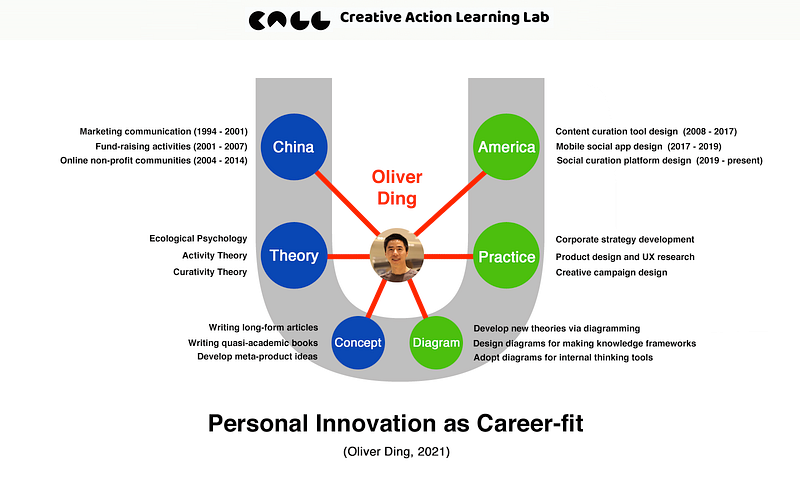
There are many ways for achieving personal innovation. One way is reflecting on your career experience. Inspired by a previous article Platform Innovation as Concept-fit, I created the above diagram for my own personal innovation.
I use Career-fit to name this new framework. The Career-fit framework has four key words: Experience > Themes > Projects > Opportunities. It roughly suggests the following five steps for personal innovation:
- Reflect on career experience
- Discover pairs of opposite themes
- Fit all pairs of opposite themes
- Join or initiate relevant projects
- Fit career themes with career opportunity
The above diagram shows three Pairs of Opposite Themes of my career experience.
- China v.s. America
- Theory v.s. Practice
- Concept v.s. Diagram
If you read my previous articles, you probably know a term called Themes of Practice. The term refers to a bridge between individual life themes and collective cultural themes. Anthropologist Morris Opler (1945) developed a theoretical “themes” for studying culture. Career counseling therapists and psychologists also developed a theoretical concept called “life themes.” If we adopt it for discussing career development and personal innovation, we can consider Career Themes as a special type of life themes and culture themes too.
The core of the Career-fit framework is Structure and Dynamics of career themes. The idea of Pairs of Opposite Themes refers to significant differences between career themes. The idea of Meta-themes refers to using one high level theme to curate similar career themes. The idea of Development of Themes refers to the transformation of career themes.
If we want to explore personal innovation, the great starting point is Pairs of Opposite Themes because they could lead to Structural Tensions such as boundary, distance, difference, heterogeneity, contradiction, and complementation. If we can turn one or more structural tensions into creative opportunities, then we could find the way of personal innovation.
Contents
Part 1: The Career-fit Framework for Me
1.1 When China meets America 1.2 When Theory meets Practice 1.3 When Concept meets Diagram 1.4 Other Pairs of Opposite Themes
Part 2: The Career-fit Framework for you
2.1 Step one: Reflect on career experience 2.2 Step two: Discover Pairs of Opposite Themes 2.3 Step three: Fit all Pairs of Opposite Themes 2.4 Step four: Join or initiate Developmental Projects 2.5 Step five: Fit career themes with career opportunities
Part 3: Career Themes and Career Practice
3.1 The old diagram of Themes of Practice 3.2 A new diagram of Themes of Practice 3.3 Career theme case study: UX (User Experience)
Part 1: The Career-fit Framework for Me
Last weekend I used the framework to reflect on my career experience. I’d like to share my story as an example of the framework.
I found three major Pairs of Opposite Themes from my past over twenty years of work experience. The first Pair of Opposite Themes “China v.s. America” refers to cross-cultural work & life experience. There are significant differences between China and America. The second Pair of Opposite Themes “Theory v.s. Practice” refers to cross-discipline knowledge experience. There is a huge gap between academic knowledge and practical work activities. The third Pair of Opposite Theme “Concept v.s. Diagram” refers to cross-domain cognitive experience. According to Cognitive scientist and psychologist Barbara Tversky, Concept is about linguistic thought while Diagram is about spatial thought.
Career Themes are abstract concepts for curating various career activities. It’s hard to understand my career themes without knowing my work stories. The following sections share relevant details from my career experience. Readers can skip these details and directly jump to Part 2.
1.1 When China meets America
I was born in Jianyang which is a small town in China. My two sons were born in Houston which is a large city in America. We are a born global family.
I have over twenty years of work experience which can be divided into three stages: creative stage, strategic stage and innovative stage. At the creative stage, I worked for the advertising and media industry as a creative copywriter and designer. At the strategic state, I worked for pre-IPO stage enterprises as a business strategist and fundraising consultant. At the innovative stage, I worked on making brand new digital tools and platforms as a researcher and designer.
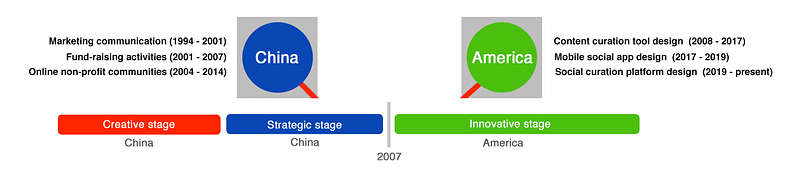
My first stage of career (1994–2001) was about advertising, marketing, and communication. At that stage, I worked on creative advertising campaigns, corporate visual identity design, brand management consulting, and marketing communication activities.
From 2001 to 2007, I worked for several private investors who are active in investing in mainland China, Hong Kong, and the United States. Following first-round investments, I helped start-ups raise successive rounds of funds from venture capital firms and then raised funds from public markets through IPOs. As an authorized representative of the start-ups, I was a principal channel of communication with professionals, including sponsors, financial advisors, local and overseas lawyers, auditors, and surveyors. I also assisted presidents of start-ups in strategic planning, brand management, and investor relations.
At the end of 2007, I moved to the U.S. and joined the world of web/mobile startups and became a product strategist and an interaction designer.
As a product strategist, I used to work with founders and CEOs on product concept development including idea generation, market research, competitor analysis, and users research. As an interaction designer, I work with software programmers to turn product concepts into real web/mobile applications. At this stage, I work on product development plans, user interface design, visual brand identity system, test, etc. After product launch, I work on product growth, user research, new feature development and product redesign.
I was the Chief Information Architect and lead UX designer of BagTheWeb.com which is an early web content curation tool. We launched the site in 2010. I was responsible for the information architect design and the user interface design. BagTheWeb services global users from various domains such as content curation, educational teaching, personal study, etc. This project inspired me to research the general approach of curation and the outcome is a book titled Curativity and a framework for Knowledge Curation.
After 2017, I moved the direction of social apps and social curation. I tried to apply my theoretical frameworks to digital work activity and structured engagement activity. The Social Platform Experience Design (#SocialPxD) framework is one of these frameworks.
1.2 When Theory meets Practice
My major practical work activities are 1) Corporate Strategy Development, 2) Product Design and UX Research, and 3) Creative Campaign Design. My major theoretical interests are 1) Ecological Psychology, 2) Activity Theory, and 3) Curativity Theory.
Before 2014, I spent most of my spare time on digital non-profit communities as a digital activist. During the 2014 to 2015, I transformed my focus from nonprofit activities to theoretical learning. Since then, I have been spending most of my spare time on learning Ecological Psychology, Creativity Research and other related subjects.
2014–2020: Ecological Psychology and Creativity Research 2014–2018: Action Science, Activity Theory, and Cognitive Science 2018–2019: Practice Theory, HCI, Strategy, and Work 2020: Social Theory, Social Media, Information Systems, and Platform
After learning Ecological Psychology for five years, I wrote a book titled Curativity during Sept 2018 to March 2019. During the process of writing, I developed a new theoretical approach called the Ecological Practice Approach which aims to build an Affordance-based theory of action and adopt ideas of Ecological Psychology for analyzing various social practices.
Since then, I have written six quasi-academic books as unpublished drafts.
- Curativity: The Ecological Approach to General Curation Practice (2018–2019, Chinese)
- After Affordance: The Ecological Approach to Human Action (2020, Chinese)
- Platform for Development: The Ecology of Adult Development in 21st Century (2020–2021, English)
- Activity U: How to Think and Act Like an Activity Theorist (2020, English)
- Project-oriented Activity Theory (2020–2021, English)
- The ECHO Way: The Journey of Becoming A Knowledge Hero (2021, Chinese)
One insight I learned from the journey is a huge gap between academic knowledge and practical work activities. There are various theoretical concepts and theoretical frameworks that could help practitioners think. I think the way of combining theory-based reflection and practice-based reflection is better than the way of relying entirely on popular heuristics.
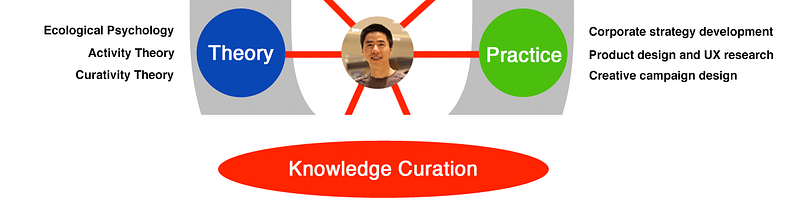
This insight leads me to the direction of closing the gap between Theory and Practice via Knowledge Curation.
1.3 When Concept meets Diagram
My work experience covers designing and writing. I can switch between verbal thinking and visual thinking. I like to develop brand new abstract concepts and design brand new concrete diagrams. I can switch between high level strategic ideas and pixel-level interface design.
Knowledge frameworks are formed with concepts and diagrams. Eventually, I move to the direction of Knowledge Curation and consider Knowledge frameworks as my creative products.
The diagram of the Career-fit framework is an application of the HERO U diagram which is generated by the WXMY diagram. For me, these diagrams are only one thing because they share one special type of spatial structure. I can create various frameworks by assembling different concepts with one diagram.
In 2018, I wrote a 108-page personal thesis titled Diagram Explained which offers a theoretical model about diagram and diagramming. I also collected over 80 cases for writing the thesis.
In fact, my recent book draft The ECHO Way also spends several chapters on discussing concepts, diagrams, and knowledge curation.
1.4 Other Pairs of Opposite Themes
You don’t have to limit to three pairs, you can use more dimensions to find more than three pairs of opposite themes. For example, the following pairs of opposite themes are discovered from my career experience too:
- Public v.s. Private
- Community v.s. Family
- Non-profit v.s. Profit
- Media v.s. Action
- Creativity v.s. Curativity
The “Public v.s. Private” refers to my public blogging before 2014 and my interest in personal private notes after 2014. I started paying attention to biography studies and I found many biography studies are based on personal private notebooks. This dimension also led to personal knowledge and private learning groups.
The “Community v.s. Family” refers to my active online communities activities before 2014 and complexity of my family activities after 2014. This dimension is about work/life balance.
The “Non-profit v.s. Profit” refers to my non-profit projects which are online communities and my works on web/mobile app development and design.
The “Media v.s. Action” refers to my early career in media business and creative marketing communication and recent action-centered product design and theoretical approach development.
The “Creativity v.s. Curativity” refers to my learning on Creativity studies and my own theoretical approach about Curativity.
Part 2: The Career-fit framework for You
The above diagram only presents my personal career stories. This part offers a general framework for you with several suggestions.
2.1 Step one: Reflect on career experience
The goal of step one is curating your career experience for generating themes of career. It has three sub-steps: 1) listing major career events, 2) sorting them into several groups, and 3) naming these groups. These names are themes of your career.
A simple way of career reflection is just listing your major career events and writing notes while rethinking these events.
A more advanced way of career reflection is using some tools and methods. For example, you can use a list of keywords or questions as triggers to help you go through your career.
If you want to make a really serious reflection, you can use Linkedin’s profile editors to write your career experience one by one and make a huge profile. Linkedin also offers a section called “Project” which doesn’t require the information of “Company”.
You can also use Open Card Sorting with Trello. Open Card Sorting is a research method for designing or evaluating the information architecture of websites or apps. It is also used for other purposes. By using the method, you can create a list of cards which contain your career events and group them into different groups. The final step of the method is giving names to these groups. Trello is a great digital tool for Open Card Sorting. You can also find details on Niaw de Leon’s blog.
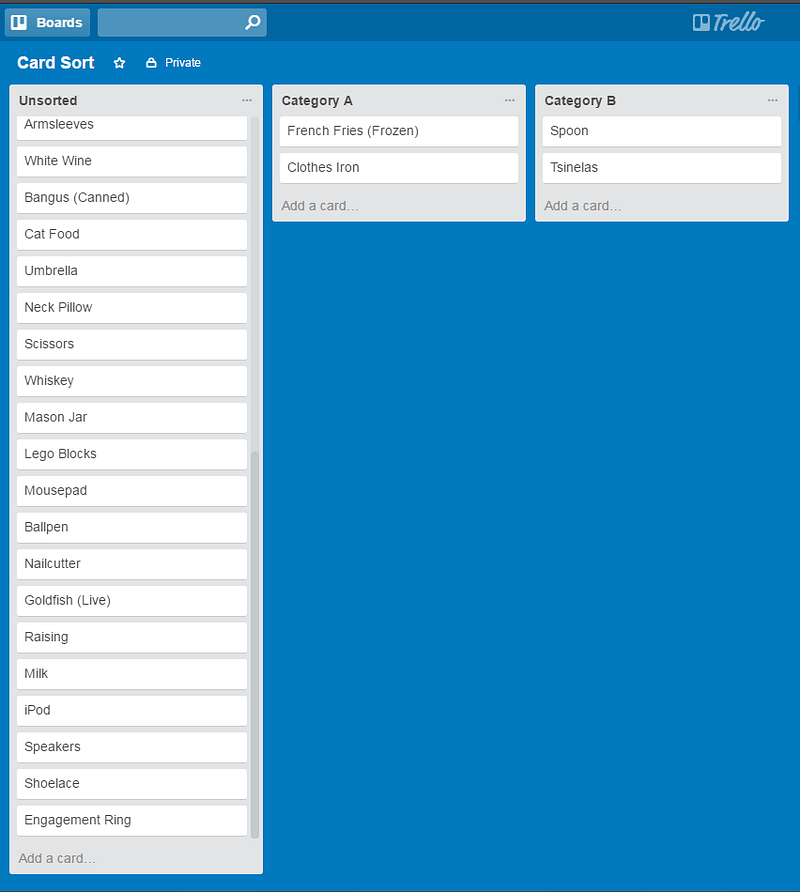
If you like Notion or Miro, you can use these tools for Open Card Sorting too. You can find Miro’s Card Sorting Template here.
2.2 Step two: Discover pairs of opposite themes
At step one, you could find several themes of your career. Now you can use some dimensions to guide the process of finding pairs of opposite themes from the list of career themes.
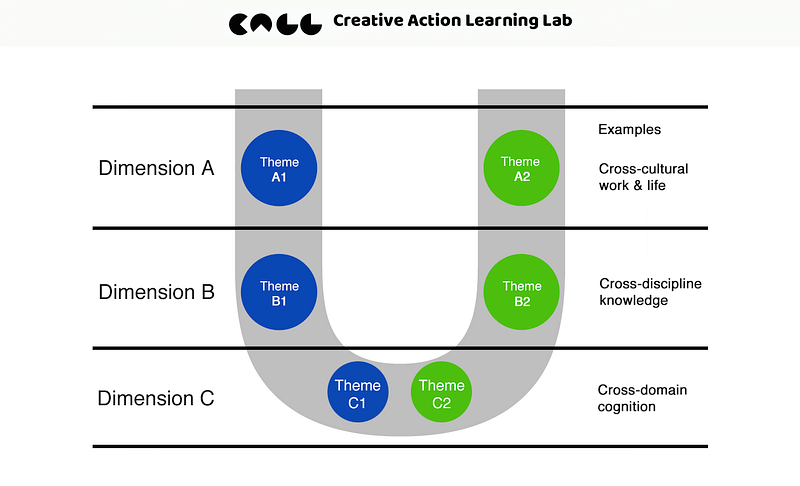
The above diagram is an abstract version diagram of the Career-fit framework. You can use three dimensions to organize your Pairs of Opposite Themes. For each dimension, you can select two themes which form a pair. For example, Theme A1 and Theme A2 are a pair of opposite themes which share the Dimension A.
If we return to me case, then we can see the above examples of dimensions:
- Dimension A: Cross-cultural work & life
- Dimension B: Cross-discipline knowledge
- Dimension C: Cross-domain cognition
You don’t have to use these examples of dimensions since you have your unique career experience.
In addition to dimensions, the U diagram also uses Left Field and Right Field to group themes.
By combining dimensions and fields, you can make a configuration of your career themes with the U diagram. The diagram below shows some examples of dimensions and fields. You can define your own dimensions and fields too.
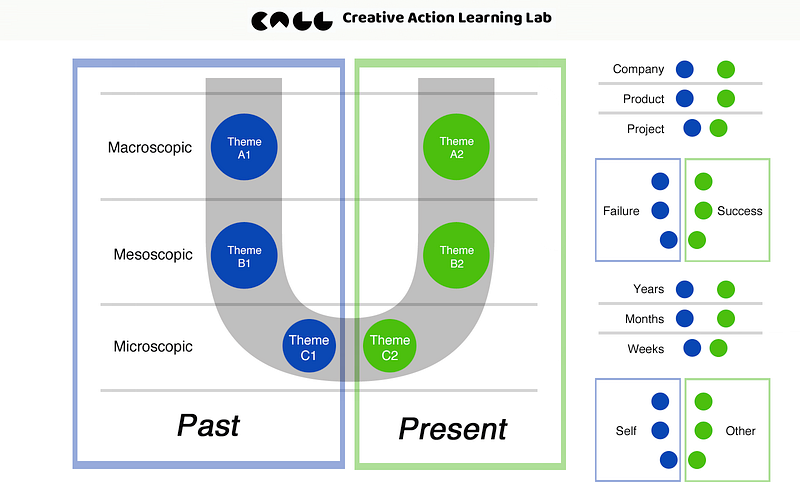
I want to point out a small trick. Please pay attention to the top dimension : Theme A1 and Theme A2. Don’t place important themes at the dimension. For the Career-fit framework, the top dimension themes are considered as background. You can find the reason in the following sections.
2.3 Step three: Fit all pairs of opposite themes
The word “Fit” of Career-fit means trying to connect all opposite themes together and curating them into a meaning whole in order to guide the direction of personal innovation.
You can roughly fit them with your intuitive feelings or use some methods.
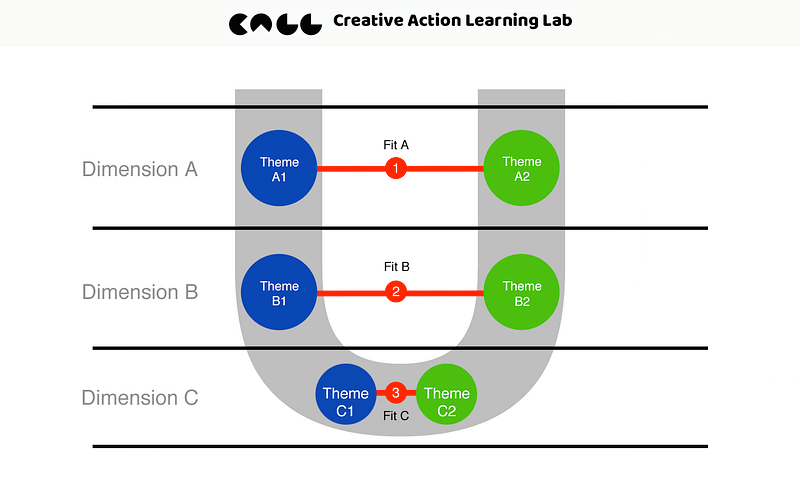
The above diagram suggests a way to fit career themes together. It focuses on Single Dimension Fitting. Fit A means a fit between Theme A1 and Theme A2 under the same dimension A. Based on the Single Dimension Fitting, you can challenge Multiple Dimensions Fitting which means cross-dimension fit. For example, the above diagram shows three Single Dimension Fits: Fit A, Fit B, and Fit C. The Multiple Dimensions Fit asks you to fit “Fit A + Fit B + Fit C” together.
A more advanced way of Single Dimension Fitting is inspired by Hegel’s Dialectic which is presented by the diagram below. We can consider Theme A1 as Thesis and Theme A2 as Antithesis. By adopting Hegel’s Dialectic, the Fit between Theme A1 and Theme A2 means finding the Synthesis between Thesis and Antithesis.
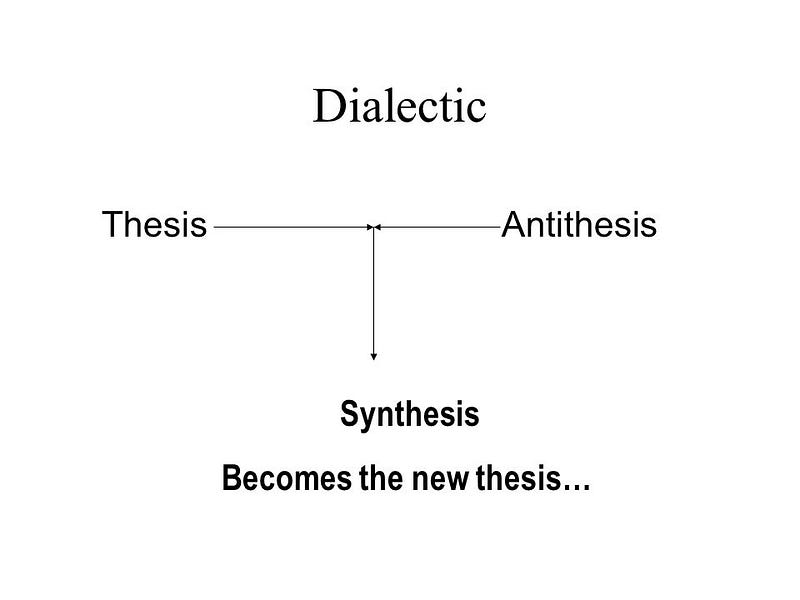
Usually, it is hard to find a way to make Synthesis happen if we stay at the original dimension. It means the solution is adopting a new dimension and using the dimension to connect Thesis and Antithesis together.
Also, I think it is possible to use sub-dimension to make a small fit. This solution doesn’t require adopting a new dimension, but changing the scope from a level to another level. This method is inspired by Hegel’s theory of Concept. As I mentioned in the Concept-fit framework, every concept can be understood as three movements. According to Andy Blunden, “As Hegel explained, every concept exists as Individual, Particular and Universal. These three moments of the concept are never completely in accord. There is always a measure of dissonance between them, and this is manifested in the dynamics of the concept. What an individual means when they use the word is never quite the same as the meaning produced in any other context.” (2012, p.295)
Career themes are Concepts too. If we want to fit a pair of opposite themes, we can fit them in three sub-dimensions: individual dimension, particular dimension, and Universal dimension.
For example, if we want to fit “China v.s. America”, we can adopt a new dimension “Startup” to connect “China” and “America”. Or, we can consider a sub-dimension such as City. For example, my wife’s hometown Fuzhou is a city in China while our sons’ hometown is a city in America. Thus, we can see the “Fuzhou v.s. Houston” fit under the Pair of Opposite Themes “China v.s. America”.
I’d like to share a real story of my life as an example of career-fit. In Nov 2019, I did a career reflection and discovered a new career theme by fitting a pair of opposite themes together. The career reflection focused on my internet activities over from 2004 to 2014. I found there is a Pair of Opposite Themes there. My daily job was working on a web/mobile startup which is a profit business. However, I spent most of my spare time on non-profit online communities for social learning, open education, free culture, etc.
I didn’t pay attention to the contrast of this pair of opposite themes. I considered them as “daily work/spare time work”. For example, I developed some themes from my non-profit online activities. In 2014, I used the theme of Internet for GOOD to highlight the social impact of my internet activities during 2004 to 2014. In Dec 2017, I used the theme of Nomad of Community to highlight the constancy of my activities of community building because I always joined a community or started a community.
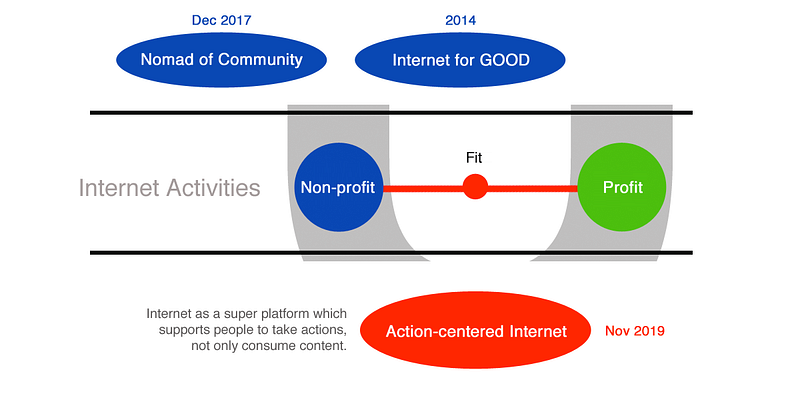
In Nov 2019, I realized that I could fit the theme of Non-profit and the theme of Profit together. I coined a term Action-centered Internet to highlight the commonness of them. I found my daily job was making products and tools which enable people to take actions. Obviously, I want to work on something which could support people’s actions. My preference on the Internet is not consuming content, or entertainment.
If we use Hegel’s terms, then the theme Profit is a Thesis while the theme Non-profit is the Antithesis. The theme Action-centered Internet is the Synthesis. We have to note that Action-centered Internet is a new Thesis because it points to a new Pair of Opposite Themes: “Action|Content”.
Since a new career theme breaks the old frame of our career experience, it could lead to personal innovation. The theme Action-centered Internet guided me to explore more pentional directions of Internet-based innovation.
The Career-fit framework is inspired by the Concept-fit framework which is based on Hegel’s theory of Concept. Readers can find more inspirations from the original article about Concept-fit.
2.4 Step four: Join or initiate Developmental Projects
The concept of Career is both subjective and objective. The subjective side refers to individual life themes while the objective side refers to collective culture themes. Thus, the Step four turns to search and find a fit between life theme and culture theme.
As the author of Project-oriented Activity Theory, I suggest “Join or initiate relevant projects” as a way of making a fit between life themes and culture themes. In particular, I adopt the Developmental Project Model as a resource.
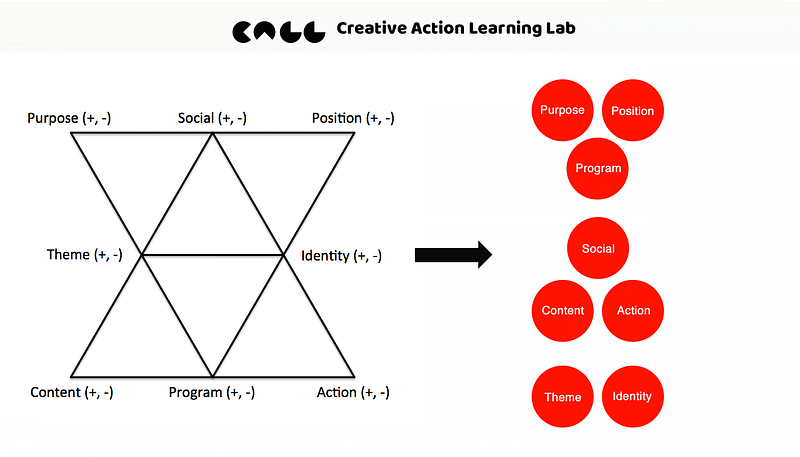
The above diagram highlights eight elements of the Developmental Project Model. You can find details about these elements from this article.
Combine the general Career-fit framework and the eight elements of the Developmental Project Model, we get a new diagram which is inspired by the HERO U diagram.
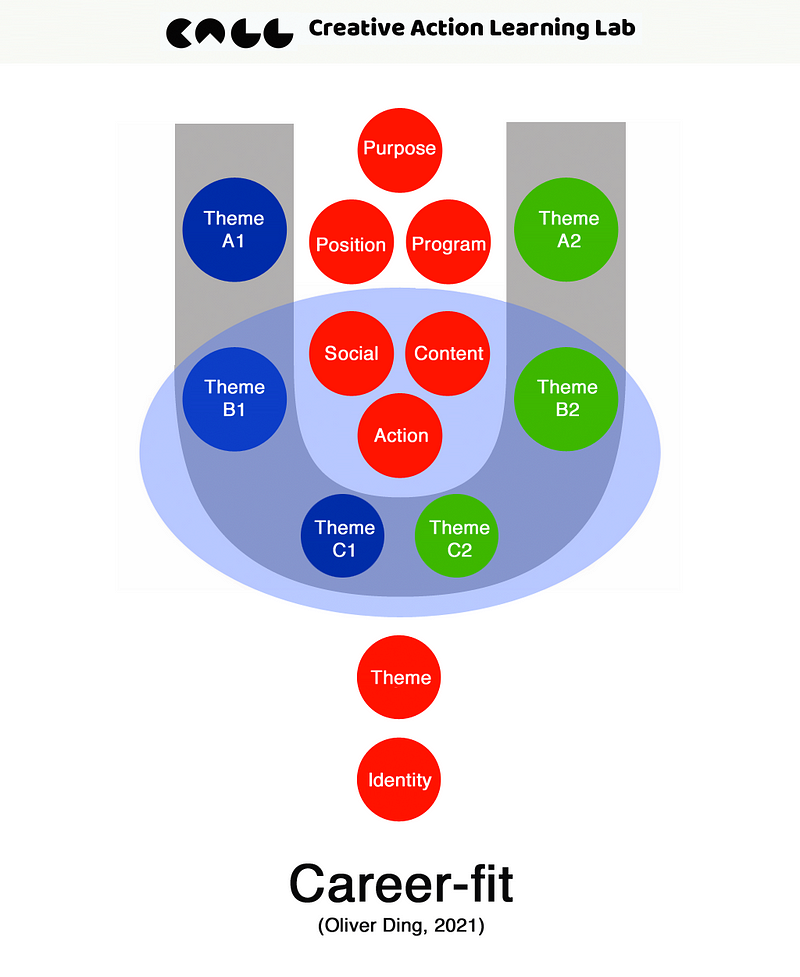
The final diagram can be considered as “an ecological approach” of career development because it refers to the structure of “organism (personal themes of career) — action (fitting) — environment(impact projects)”.
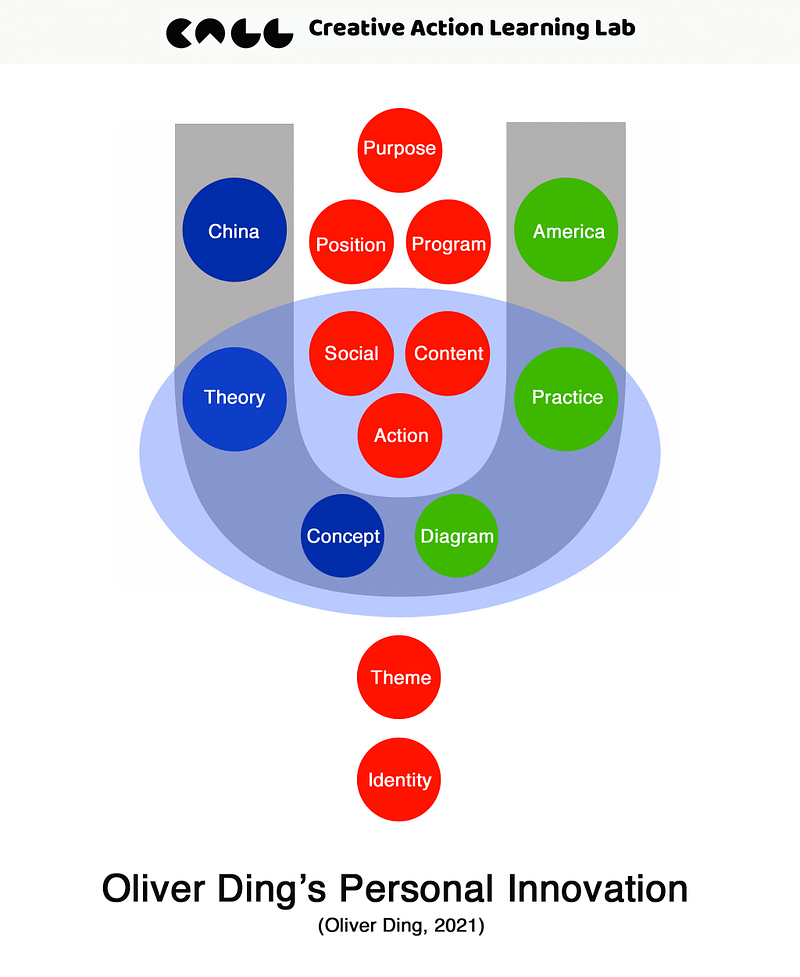
The eight elements of Impact Projects form three groups as a process of transformation. The first group is defined as Situational Context which highlights three important aspects of Developmental Projects: Purpose, Position, and Program. The second group is defined as Developmental Resources which highlights three types of potential opportunities of Developmental Projects: Social, Content, and Action. The third group is defined as Impact by Projects which considers personal development caused by joining Developmental Projects from two dimensions: Theme and Identity.
I started the Activity U project in August 2020. The diagram below uses the Developmental Project Model to reflect on my experience of the project.
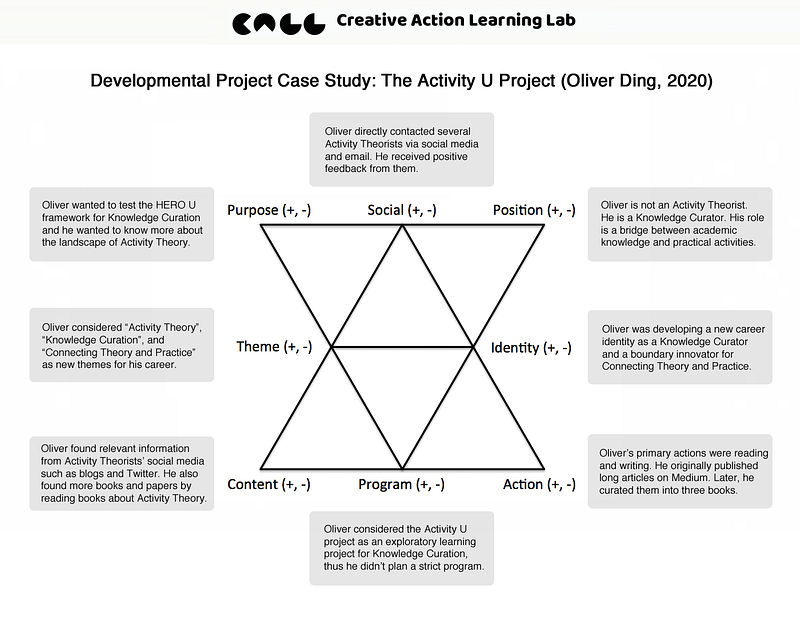
Now let’s use the Career-fit framework to discuss my personal innovation behind the Activity U project. I started the Activity U project on August 19, 2020. Initially, I just made a diagram called “Activity U” which is a test of the “HERO U” framework. I wrote a post to explain the diagram “Activity U”. The original title of the post is Activity U: The Landscape of Activity Theory. Later, I added “(Part I)” to the end of the title. It expanded from one post to a series of articles.
On October 1, I wrote a post to review the first year of CALL (Creative Action Learning Lab) and claimed that Activity Theory as a learning object for Transdisciplinary Thinking which means the knowing between academic domains and non-academic domains. I pointed out four reasons of selecting Activity Theory for Transdisciplinary Thinking:
- It is an established theoretical tradition.
- It is an interdisciplinary philosophical framework for studying both individual and social aspects of human behavior.
- It has inspired many empirical studies in various domains.
- Its root is in a culture background and psychological research tradition outside North America.
The last reason is unique. In a general sense, the mainstream of North America psychology is dominated by individual perspectives. In contrast, the psychological root of Activity Theory is social perspective. Thus, I want to bring a new perspective to the next generation of knowledge workers and boundary creators in North America.
2.5 Step five: Fit Career Themes with Career Opportunity
Step five is about fit between individual and environment. Where is the fit? It happens at the “Echozone” which is the third container of the following model.
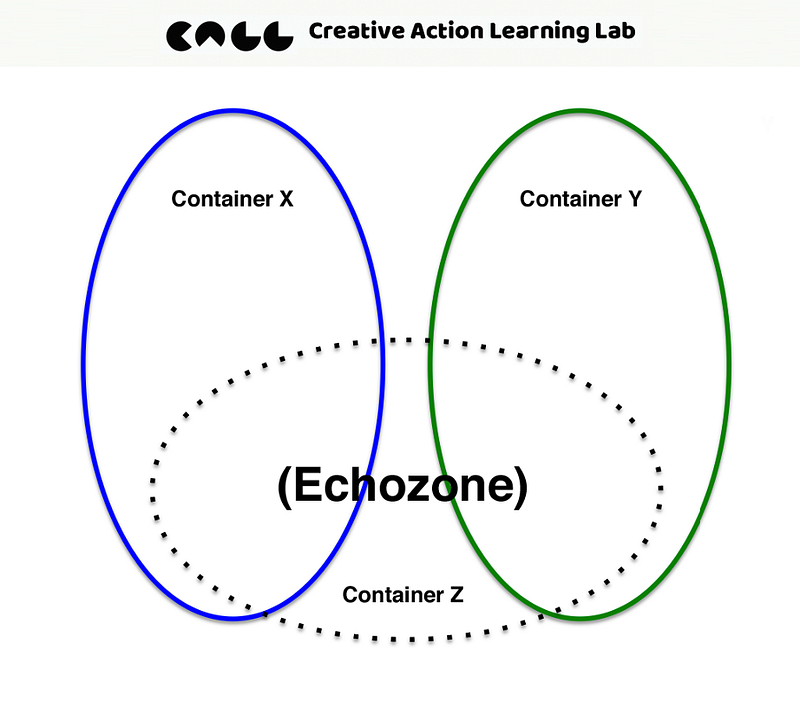
The concept of Container is the core of the Ecological Practice approach. By adjusting the quality and quantity of the Container, we can create advanced frameworks for discussing complex phenomena. The quality of the Container can be potential and actual, the quantity of the Container can be one and two. If we develop a new framework with one potential container and two actual containers, the outcome is the above diagram.
I named the potential container (Container Z) as Echozone which refers to a creative space containing echoes between the Container X and the Container Y. The term “Echo” of “Echozone” refers to a dialogue between two containers. You can find more details at section 3.1 Redesign the diagram from Platform Innovation as Concept-fit.
Now let’s focus on the Echozone of the Activity U project. The diagram below only shows the Echozone with some notes for discussing the process of fit between career themes and developmental projects.
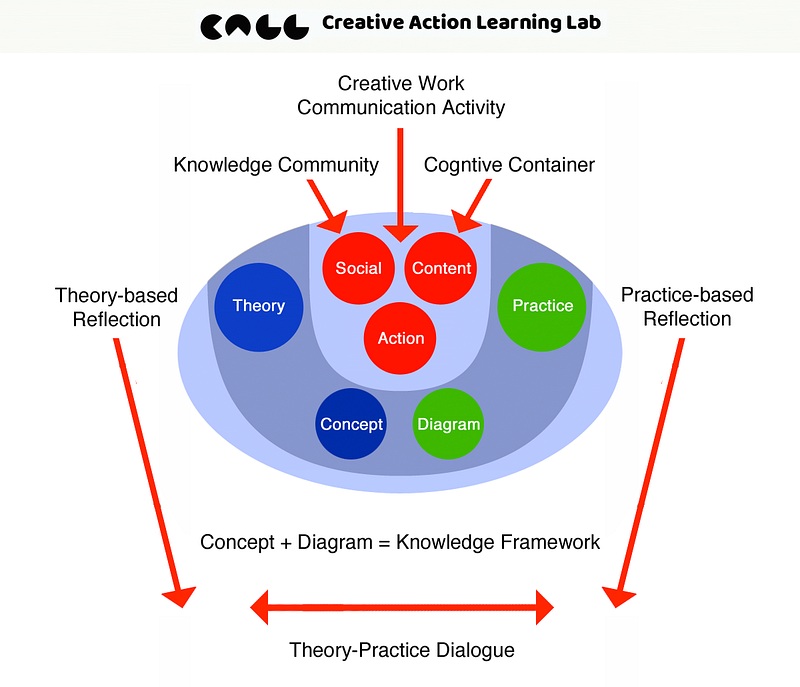
The above diagram presents fits of two pairs of opposite themes. The “Theory v.s. Practice” fit is described with three movements:
- Practice-based Reflection: building rough models with intuition.
- Theory-based Reflection: improving models with theoretical resources.
- Theory-Practice Dialogue: turn models into frameworks and test it with cast studies.
The article Platform Innovation as Concept-fit offers a real example of these three steps. The Concept-fit framework was developed within three months.
The “Concept v.s. Diagram” fit is described with one formula:
- Concept + Diagram = Knowledge Framework
This formula is defined by the HERO U framework. I used the formula to guide my creative works on developing theoretical frameworks.
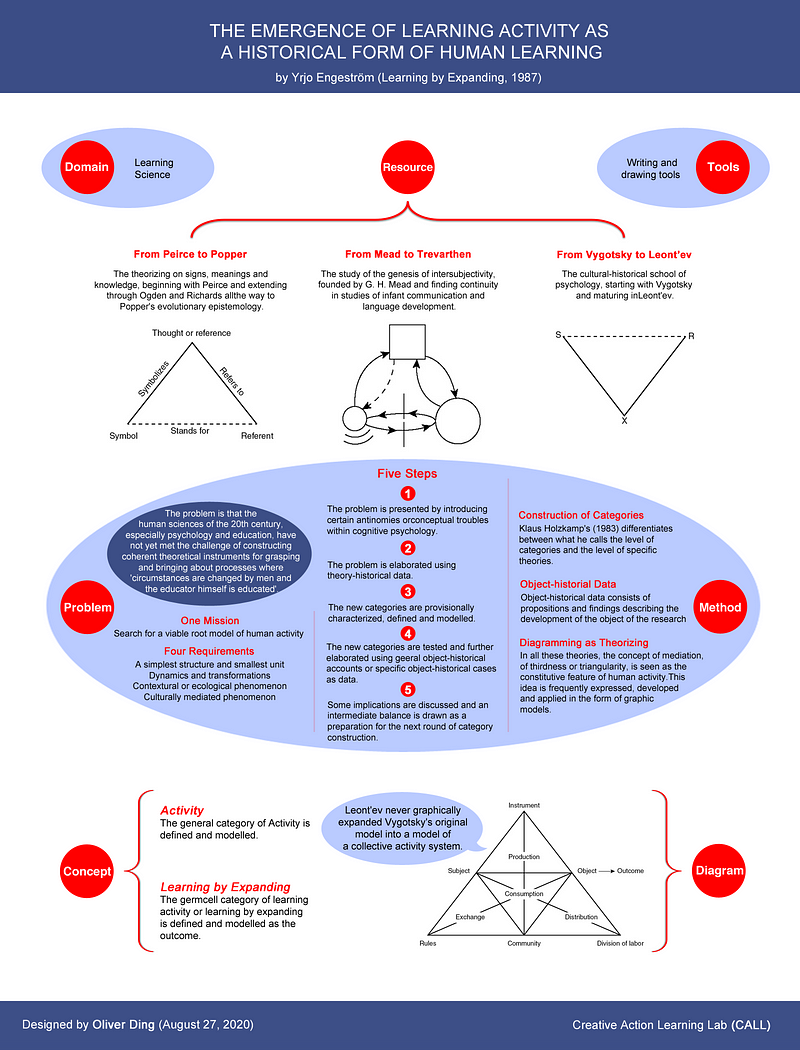
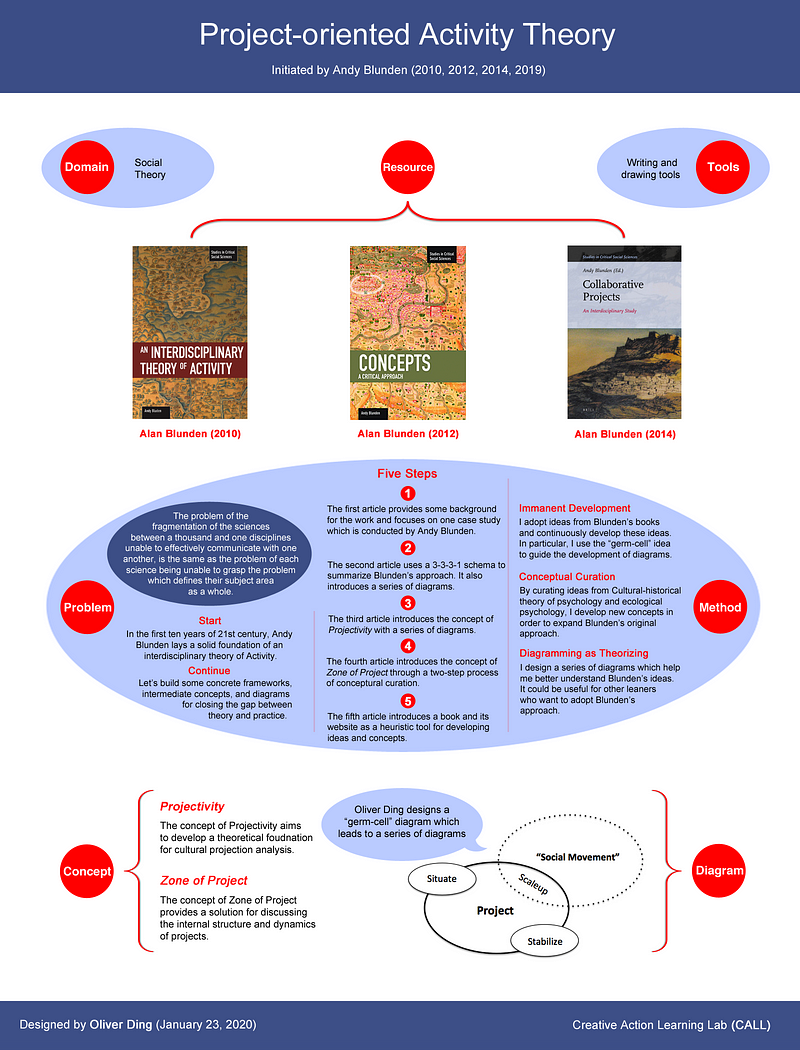
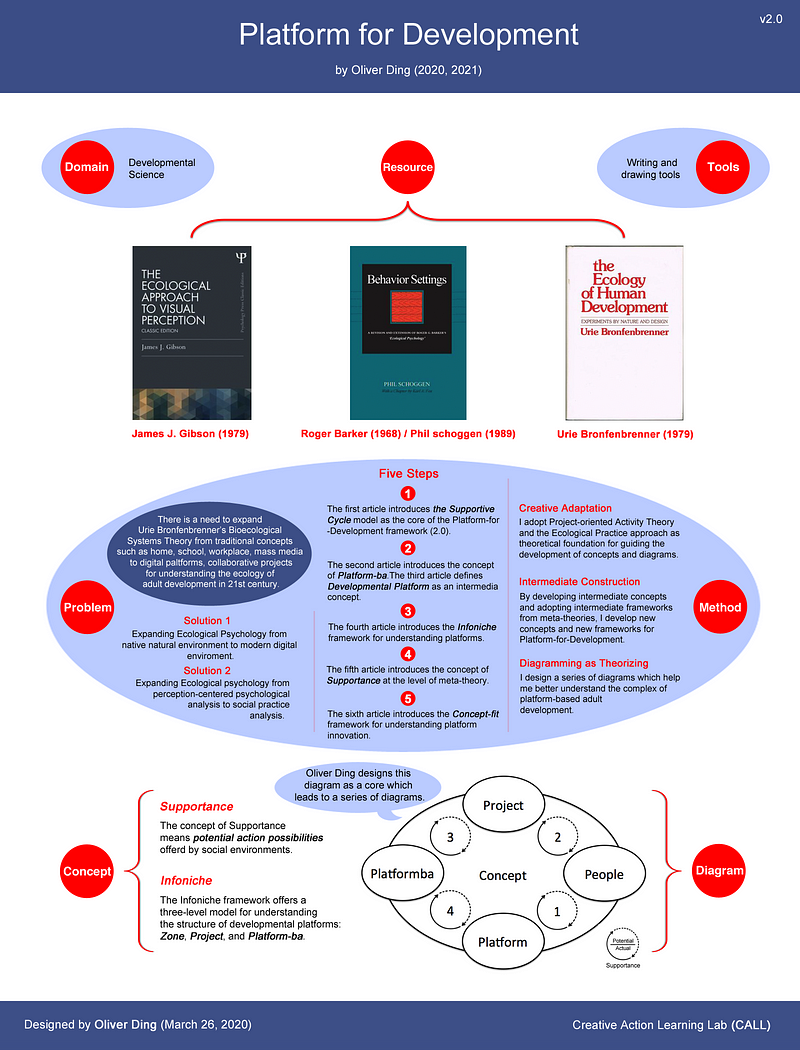
You can find more details from the following links:
- Activity U (IV): The Engeström’s Triangle and the Power of Diagram
- Project-oriented Activity Theory (Book)
- Platform for Development (2.0)
The above diagram of Echozone also presents three inspirations which are triggered by the Activity U project.
- Social > Knowledge Community
- Action > Creative Work Communication Activity
- Content > Cognitive Container
The red ball “Social” means connecting to someone due to joining or initiating development projects. In order to run the Activity U project, I directly contacted several Activity Theorists via social media and email. I received positive feedback from them. Since Activity Theory is an established theoretical tradition, there is a knowledge community around the theory. By connecting to one or several members of the community, I could build a connection between the Activity U project and the community.
The red ball “Action” means my real actions and possible actions. During the past months, my primary actions were reading and writing. I originally published long articles on Medium. Later, I curated them into three books. However, I found Activity Theory also offers me a new perspective on understanding “Action” and related topics. I started looking and defining a new form of Activity for my work and research. Also, I adopted the concept of “Mediation” from Activity Theory and used it to rethink the Knowledge Activity, especially the activity of using concepts, diagrams, and knowledge frameworks in practical workplaces. Eventually, I coined a new trem called “Creative Work Communication Activity” for my further research.
The red ball “Content” means information offered by Developmental Projects. For the Activity U project, I found relevant information from Activity Theorists’ social media such as blogs and Twitter. I also found more books and papers by reading books about the theory. I also searched videos about Activity Theory on YouTube and diagrams about the theory on Google Images. These experiences offer me an opportunity to test my idea of “Cognitive Container” which is part of my theoretical framework: Curativity Theory. For knowledge curation, the Cognitive Containers are Genre, Framework, Model, Concept, Papers, Conference, Workshop, Genre, Media, etc.
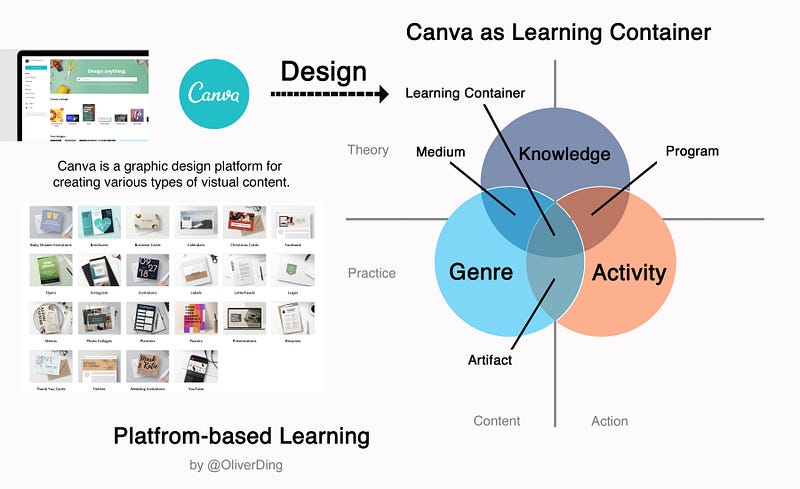
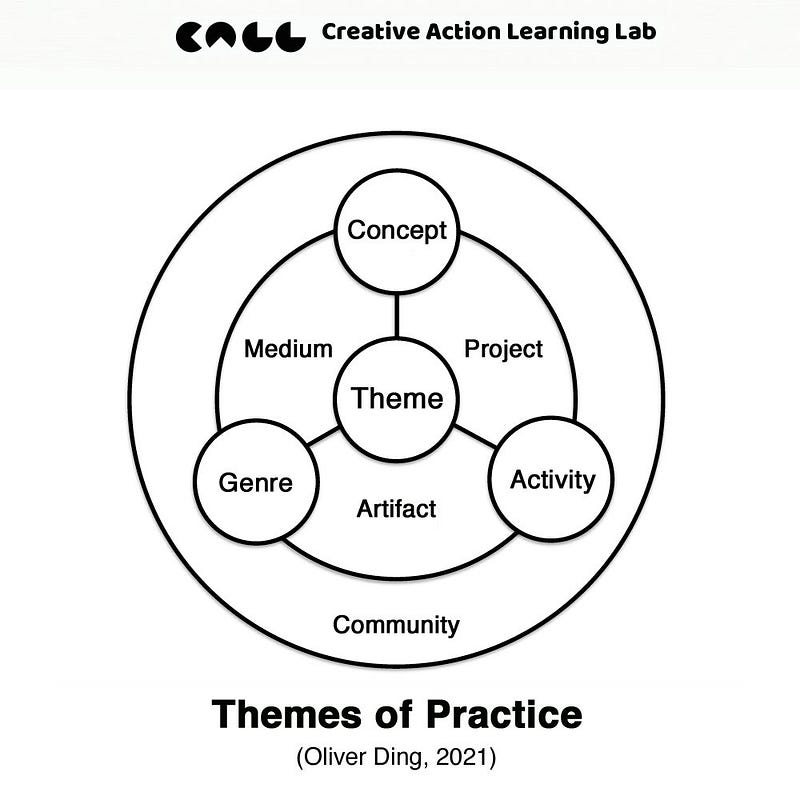
These three ideas are emergent career themes. I use it to guide recent exploratory learning activities. For example, I started learning Genre Theory and curated the idea of Genre with other ideas. On April 8, I designed the diagram below to rethink my idea of “Themes of Practice”. By curating Genre, Activity and Knowledge together, I developed a new idea called Learning Container and I used it to support the idea of Platform-based Learning and used Canva as an example of the idea. Later, I used “Concept” to replace “Knowledge” and designed a new diagram for “Themes of Practice”.
Last month, I started a new project called Once Upon A Whiteboard which focuses on virtual whiteboard and related practice. By adopting Activity Theory and Ecological Psychology, I defined whiteboard-based practice as Creative Work Communication Activity (CWCA).
Part 3: Career Themes and Career Practice
I started developing the concept of Themes of Practice in 2019 for the Curativity Theory. I have mentioned the concept in my previous articles many times. The purpose of the concept is connecting “life theme” and “culture theme”.
Anthropologist Morris Opler (1945) developed a theoretical “themes” for studying culture. Career counseling therapists and psychologists also developed a theoretical concept called “life theme.” If we put culture themes and life themes together, we see a great debate of social science: “individual — collective”.
3.1 The old diagram of Themes of Practice
I consider Themes of Practice as a process type of concept, not a substance type of concept. Thus, it is not a new category of themes, but a transformational process between individual life themes and collective culture themes. It refers to both concept and action. It connects mind and practice. It indicates the transformation of both person and society.
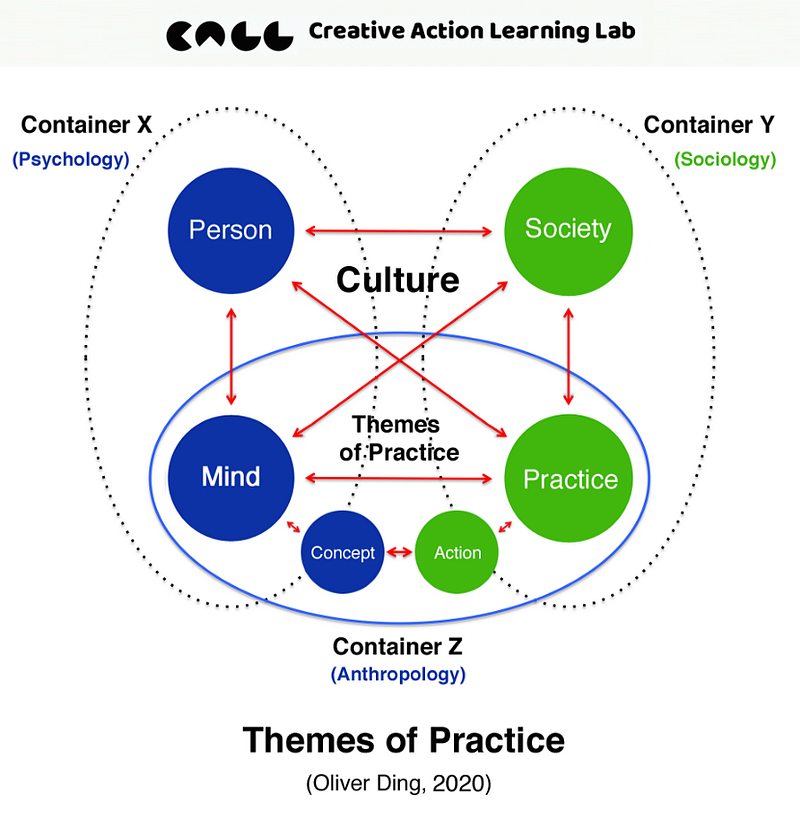
The above diagram is based on the WXMY diagram because it is great for visualizing cross-boundary connections. However, it is a highly abstract model for explaining the concept of Themes of Practice.
3.2 A new diagram of Themes of Practice
In April 2021, I designed a new diagram for Themes of Practice. As I mentioned above, it was shared on Twitter for discussing Genre Theory. At that time, I didn’t realize that the new diagram offers me a concrete framework for analysis.
This time, I focus on discussing career themes which is an application of Themes of Practice. It means that I move from an abstract level to a concrete level. After mentioning the new diagram at the end of Part 2, I realized I can use it for career theme case study because it offers a structure for observing and evaluating the “Practice” part of “Themes of Practice”.
3.3 Career Theme Case Study: UX (User Experience)
Thus, I chose UX (User Experience) as an example of Career Theme and made a simple case study with the new diagram. See the diagram below.
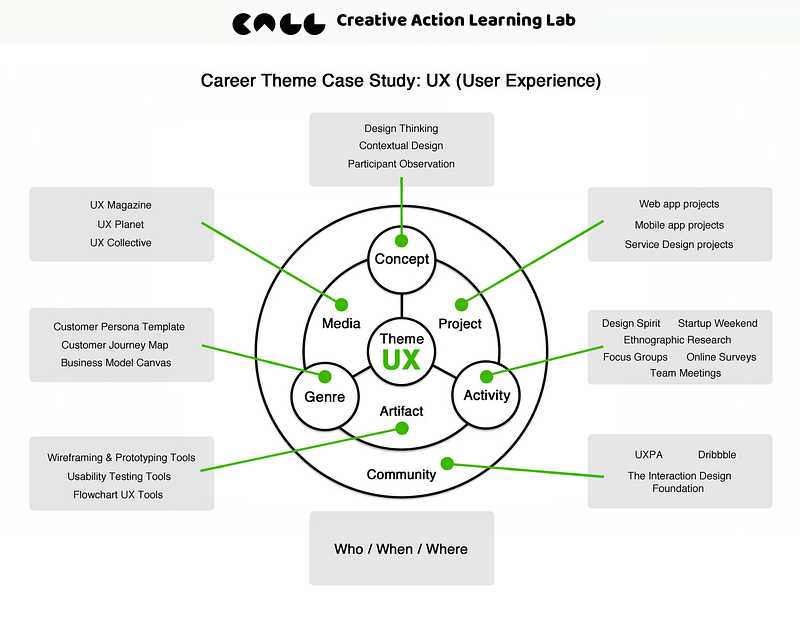
UX (User Experience) is not a job title, but a concept. UX designer and UX researcher are two related job titles. As a concept, UX (User Experience) can be seen as a career theme of UX designers and UX researchers. However, job titles are not the primary factor for discussing career themes. The concept of Career Themes pays attention to real world practice. It’s reasonable to claim that UX is shared by Product Designer, Usability Testing Expert, Human Factor Researchers, Brand Manager, and Community Manager as a career theme.
The new diagram of Themes of Practice uses the following ten dimensions for case study:
- Concept: What are related concepts for this career theme?
- Project: What are related projects for this career theme?
- Genre: What are related Genres for this career theme?
- Media: What are related media for this career theme?
- Activity: What are related activities for this career theme?
- Artifact: What are related artifacts for this career theme?
- Community: What are related communities for this career theme?
- Who: who is the person behind this case study?
- When: when is the career duration behind this case study?
- Where: Where did these career events of this case study happen?
The above diagram only presents the general information for UX. It doesn’t offer information of “who/when/where”.
For real case study, we need to collect personal information from the above ten dimensions.
I consider Career Theme Case Study as a component of the Career-fit framework because it offers deep information for each career theme. By understanding this deep information, we can make reasonable Career-fits.
For personal innovation, we can think about possible actions from the above ten dimensions.
You are most welcome to connect via the following social platforms:
Twitter: https://twitter.com/oliverding Doowit: https://doowit.co/profile/gm0k2ax9 Linkedin: https://www.linkedin.com/in/oliverding
License
This work is licensed under the Creative Commons Attribution-NonCommercial-ShareAlike 4.0 International (CC BY-NC-SA 4.0) License. Please click on the link for details.


