
CALL: The House of Boundary Innovation
Transdisciplinary Thinking, Creative Actions, and Platform for Development.
CALL stands for Creative Action Learning Lab. One year ago, I started this publication on Medium as a personal journey: building a learning community about action design, action study, and action theory. Six months ago, I used Action-based creativity as CALL’s slogan. I recently changed it to the house of boundary innovation.
This article will review the past one year journey of CALL and talk about its future. Though CALL is a publication on Medium, I see it as a container which contains my knowing activities. Thus, instead of talking about published articles, I will focus on my thoughts and acts.
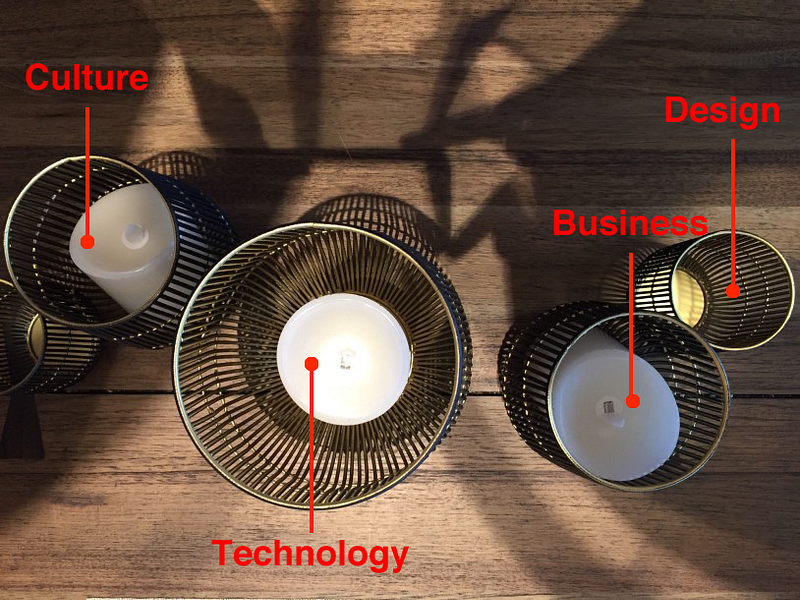
CALL will focus on three themes: Transdisciplinary Thinking (mind), Creative Actions (action), and Platform for Development (ecology). Also, CALL adopts a multi-perspective approach which incorporates four perspectives: Digital technology perspective (technology), interaction design perspective (design), business ecology perspective (business), and social practice perspective (culture).
Contents
Part 1: CALL: 2019–2020
Part 2: Boundary Innovation
2.1 What’s Boundary Innovation? 2.2 Transdisciplinary Thinking 2.3 HERO U as a learning framework 2.4 Activity Theory as a learning object 2.5 Improving Meta-cognition and construal level 2.6 Transformation of self, organization, and society 2.7 More Boundary U…
Part 3: Creative Actions
3.1 Action-based Creativity 3.2 Creativity U 3.3 Boundary Knowledge Work
Part 4: Platform for Development
4.1 Social platform experience design 4.2 Platform ecology 4.3 People (O) — Platform (E) 4.4 Platform for Development (P4D)
Part 5: Personal Psychobiography
5.1 Career 5.2 Reading and learning 5.3 The Ecological Practice Approach 5.4 Themes of Practice

PART 1: CALL: 2019–2020
One year ago, I mentioned several threads behind the CALL:
- First, I want to bridge my past with my future. There are various and miscellaneous work and learning experiences within my past career. After learning some theories, I realized my chaotic experience suddenly became invaluable asset for my future career.
- Second, there is a huge opportunity of transformation between scientific knowledge creation and everyday life creation.
- Third, an interesting thing is that two theories I learned highly tie to action. Ecological psychology is about the perception-action loop and Practice Theories are about acts, actions, activities within everyday life.
- Finally, I and my partners decided to work on building a brand new social platform which aims to encourage people to take action last year.
I also mentioned two things I want to explore with CALL:
- Action Patterns
- Brand Commons or Open Brand Method
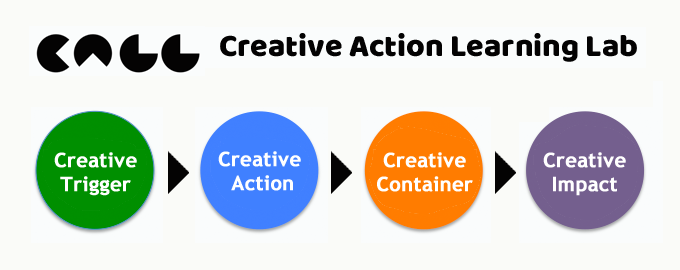
In Feb, I shared a four-step framework for CALL:
- Step 1: Creative Trigger
- Step 2: Creative Action
- Step 3: Creative Container
- Step 4: Creative Impact
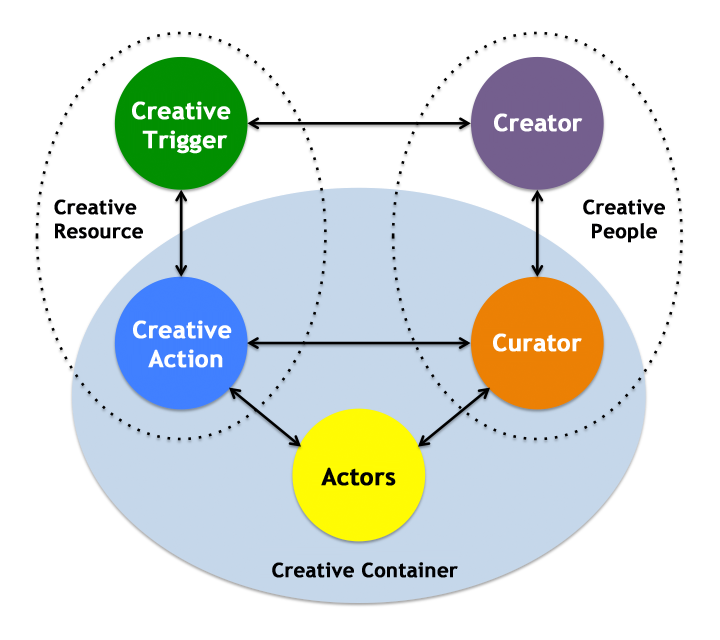
I considered CALL as a Creative Container which focuses on Action-based Creativity. For CALL, its own creative action is “Educating the younger generation on how to make Creative Impacts by building Creative Actions.”
During the first half of 2020 year, I focused on designing and developing ideas for creative actions (making creative triggers) and used these ideas to service the brand new social platform which was co-founded by me with my partners.
In June, I decided to change the focus of CALL from making creative triggers and return to its original vision. I mentioned my vision behind CALL is “Building the Bridge” and “One of most important things I want to do is to bridge theory and practice.”
Thus, I selected one idea from many ideas I created and went further with it.
- This idea is When X Meets Y (WXMY) which is a diagram for visualizing boundary innovation. I wrote an article about it in March.
- In June, I developed a new framework called HERO U based on the diagram. The goal of the framework is closing the gap between “Theory” and “Practice.”
- In August, I started writing a case study for testing the HERO U framework. The case study is called Activity U and focuses on the landscape and development of Activity Theory or Cultural-historical activity theory (CHAT).
During the process of writing Activity U, I realized the original slogan doesn’t match the existing status of CALL. Thus, I changed it from Action-based creativity to the house of boundary innovation at the early of September.
Another inspiration I got from the writing Activity U is Platform for Development. In March, I introduced a new framework called Social Platform Experience Design (PxD) and suggested a multi-perspective framework. One perspective is the social practice perspective. Thus, I reflected on the PxD framework with the perspective of activity theory, I found there is a path in which I can apply activity theory to the PxD framework.
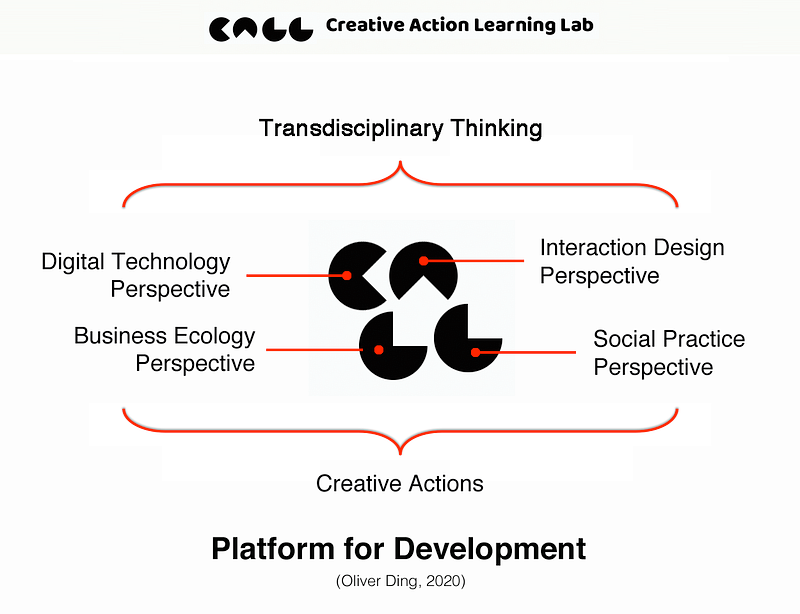
The diagram below represents my newest thoughts about CALL and it will guide the activity of CALL in the coming year.
PART 2: Boundary Innovation
2.1 What’s Boundary Innovation? 2.2 Transdisciplinary Thinking 2.3 HERO U as a learning framework 2.4 Activity Theory as a learning object 2.5 Improving Meta-cognition and construal level 2.6 Transformation of self, organization, and society 2.7 More Boundary U…
2.1 What is Boundary Innovation?
As a slogan of CALL, I define Boundary Innovation as the following formula:
Boundary Innovation = Transdisciplinary Thinking + Creative Actions
Innovation requires both thinking and acting. Boundary Innovation requires a special type of thinking and acting. I believe that the special type of thinking is transdisciplinary thinking and the special type of acting is creative actions. By combining these two ideas together, we can get a simple formula for actually doing boundary innovation.
In 2018, I developed a framework called DEKIN innovation system which identified 12 types of social positions which are embedded in the innovation system. I organized these 12 types of social positions into 3 groups: D-positions, C-Positions and R-positions.
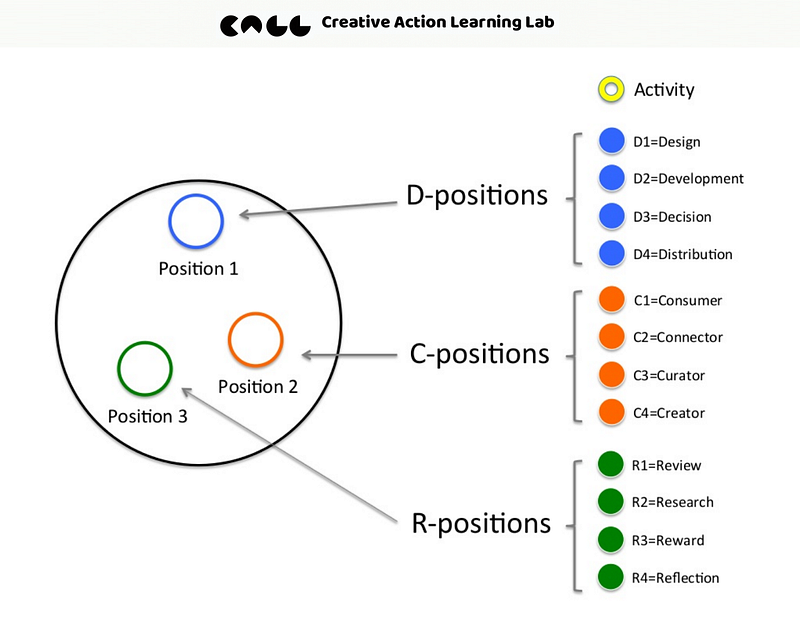
In order to understand innovation related human activity, I developed a typology of activity with three dimensions of complexity: cognitive complexity, interactional complexity and intentional complexity. Based on the typology, I discovered five typical activities: Think, Make, Curate, Say and Play.
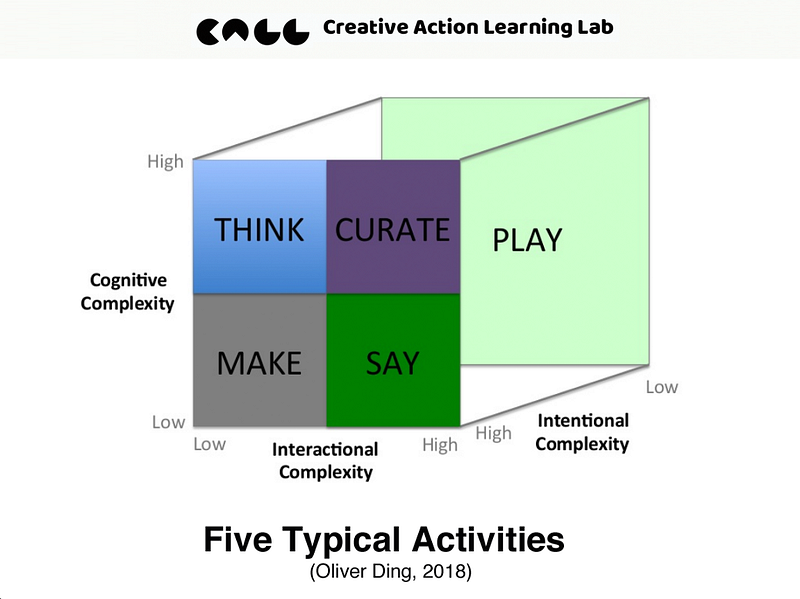
These models represent the landscape of potential innovators and the whole innovation system. The whole DEKIN framework is the foundation and starting point of CALL’s Boundary Innovation. In other words, CALL’s Boundary Innovation will focus on educating the next generation of innovators and accelerating the transformation of the innovation system.
2.2 Transdisciplinary Thinking
According to the editors of The Oxford Handbook of Interdisciplinarity (2010), there are two words about inter- or transdisciplinary knowledge production. The ‘interdisciplinarity’ refers to current efforts of knowledge production that cross or bridge disciplinary boundaries and the ‘transdisciplinarity’ refers to the growing effort to make knowledge products more pertinent to non-academic actors. However, in the US, ‘interdisciplinarity’ covers both the integration of knowledge across disciplines, narrow and wide, and the intercourse between (inter)disciplines and society. The latter often goes by the name of transdisciplinarity, particularly in Europe (p.xxx).
I choose ‘transdisciplinary thinking’ to refer to the knowing between academic domains and non-academic domains.
2.3 HERO U as a learning framework
In order to help the younger generation develop transdisciplinary thinking, I developed the HERO U framework below as a practical tool.
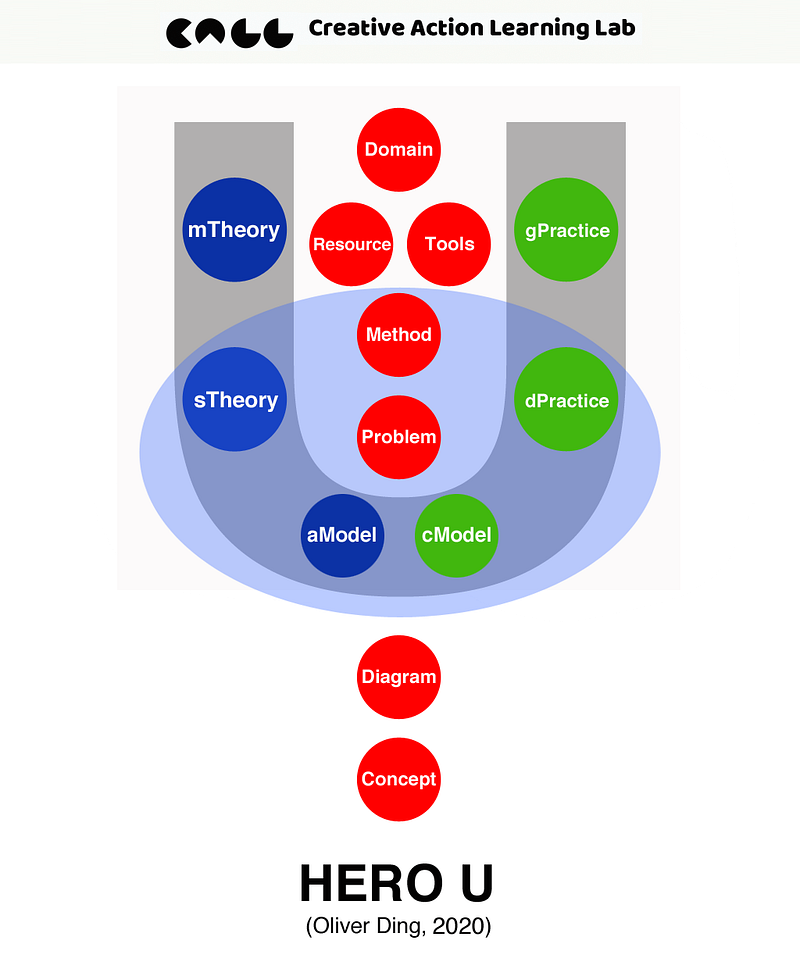
I consider this framework as “an ecological approach” of knowing because it refers to the structure of “organism (personal conditions of knowing) — action (knowing) — environment(objective of knowing)”. The U diagram presents six types of Objective of Knowing: mTheory: Meta-theory, sTheory: Specific Theory, aModel: Abstract Model, cModel: Concrete Model, dPractice: Domain Practice, and gPractice: General Practice. The second dimension (red balls) presents a set of Personal Conditions of Knowing: Concept, Diagram, Problem, Method, Resource, Tools, and Domain.
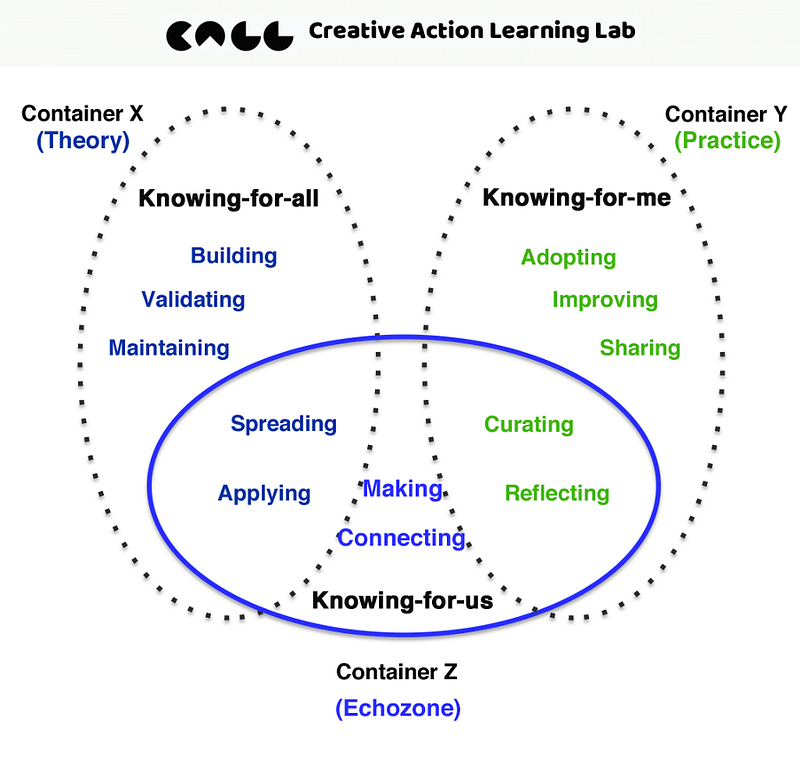
From the perspective of outcome and motivation, I distinguish three kinds of knowing: Knowing-for-all, Knowing-for-us and Knowing-for-me. The above diagram represents these three categories and various subcategories of knowing.
2.4 Activity Theory as a learning object
Then, I choose Activity Theory as a case to test the HERO U framework with the following four reasons:
- It is an established theoretical tradition.
- It is an interdisciplinary philosophical framework for studying both individual and social aspects of human behavior.
- It has inspired many empirical studies in various domains.
- Its root is in a culture background and psychological research tradition outside North America.
In the beginning, activity theory is a psychological theory about the mind and it focused on the development of individual psychological functions. Leontiev used “Activity, Consciousness, and Personality” as the title for his book. Later, activity theory became a what Michael Cole called “monolithic enterprise” with several sub-traditions and local thought of schools such as German tradition, a Scandinavian/Nordic tradition, an American tradition (Cole, 1996. p.139). A major development of activity theory was contributed by Finnish educational researcher Yrjö Engeström who upgraded the activity theory from the individual activity level to collective activity level with a conceptual model of “activity system” in order to apply activity theory to educational settings, organizational development and other fields (Engeström,1987).
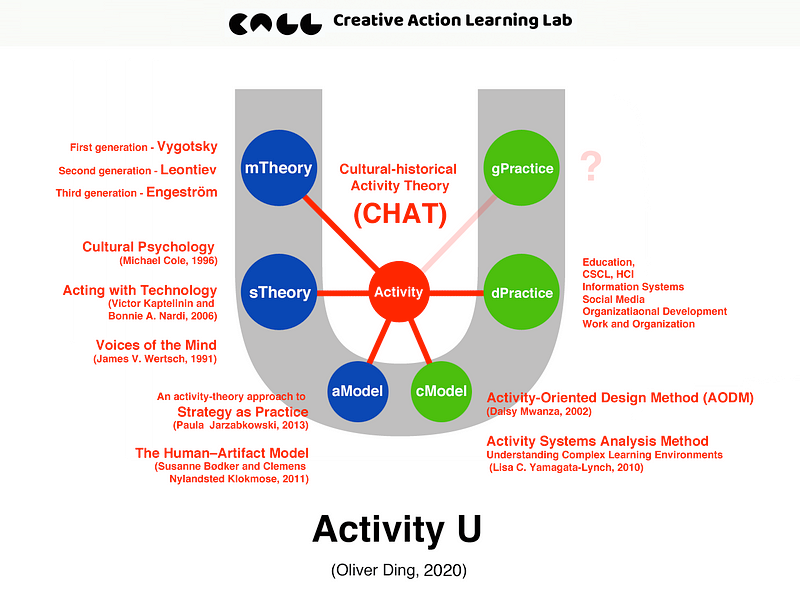
Thus, by using HERO U as a learning framework and adopting Activity Theory as a learning object, CALL could build a real method for ‘cultivating transdisciplinary thinking.’
2.5 Improving Meta-cognition and construal level
At the meta-cognition level, people can improve their metacognitive competency by adopting the HERO U framework. According to Veronica Boix Mansilla (2010), “Researchers studying critical thinking and the development of epistemological beliefs have documented the role of meta-cognition in student learning. The capacity to reflect about the nature of knowledge, learning, and thinking has been associated with more complex understanding of subject matter and growing preparedness for independent learning. In interdisciplinary work, navigating multiple knowledge landscapes demands a meta-cognitive-and often a meta-disciplinary-stance. Students must recognize the preferred units of analysis in different domains or their sometimes conflicting standards of validation.”
The HERO U framework provides a global view of the knowledge landscape and people can start from their proximal field and move between different construal levels. There is an assumption behind the HERO U framework. According to Construal level theory (CLT), a social psychology theory that describes the relation between psychological distance and the extent to which people’s thinking is abstract or concrete.
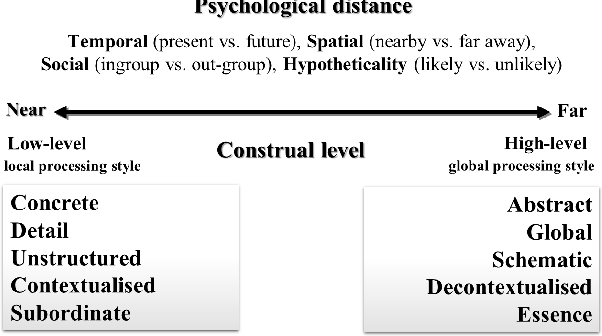
Yaacov Trope and Nira Liberman pointed out in their article Construal-Level Theory of Psychological Distance, “According to CLT, then, people traverse different psychological distances by using similar mental construal processes. Because the various distances have the same egocentric reference point, they should all be cognitively related to each other and similarly affect and be affected by level of construal. As psychological distance increases, construals would become more abstract, and as level of abstraction increases, so too would the psychological distances people envisage. Construal levels thus expand and contract one’s mental horizon.”
The six types of “Objective of Knowing” of the HERO U framework requires different construal levels. Meta-theory (mTheory) is at high-level construal while General Practice (gPractice) is at low-level construal. Thus, the framework can be used to improve people’s construal level competence.
2.6 Transformation of self, organization, and society
At the social-cognition level, Activity Theory can be seen as a theory about transformation of self, organization, and society. Activity theorist and Finnish educational researcher Yrjö Engeström upgraded the activity theory from the individual activity level to collective activity level with a conceptual model of “activity system” in order to apply activity theory to educational settings, organizational development and other fields (Engeström,1987). He also developed a new theoretical framework as Learning by Expanding for studying organizational learning and innovation.
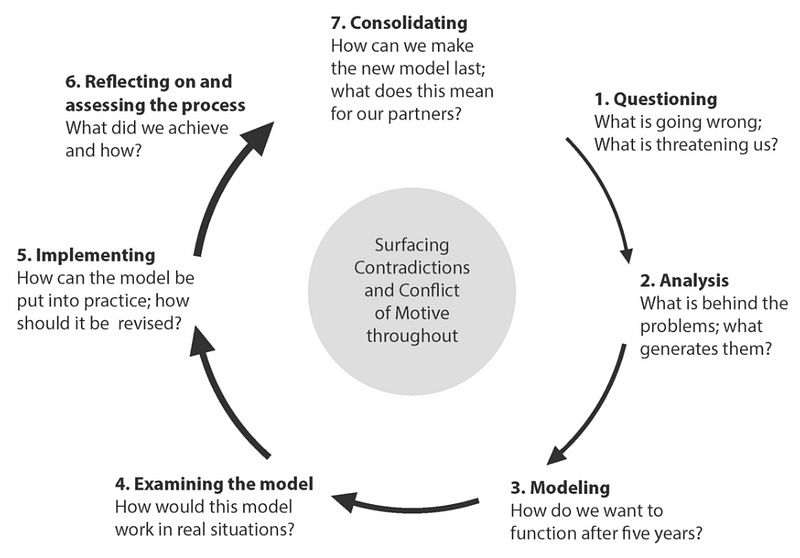
Activity theory has been widely used in various fields, for example:
- Education
- HCI / CSCL
- Information Systems
- Organizational Development
- Work and Organization
By adopting the Activity Theory in general and Learning by Expanding in particular, people can learn a method of transformation of self, organization, and society. They can reflect on their own real experience and problems (contradictions) in their professional settings or daily life settings with the perspective of activity theory.
2.7 More Boundary U…
Activity U is just the first learning object of transdisciplinary thinking. CALL will curate more similar learning objects, I call it as Boundary U. For example:
- Motivation U
- Platform U
- Theme U
- Creativity U
- Affordance U
As an open container, CALL invites you to join the journey. You can be a curator of a new learning object and create your own Boundary U.
PART 3. Creative Actions
3.1 Action-based Creativity 3.2 Creativity U 3.3 Boundary Knowledge Work
3.1 Action-based Creativity
In Feb, I wrote an article and introduced the Pinwheel framework as a practical tool for developing CALL’s program.
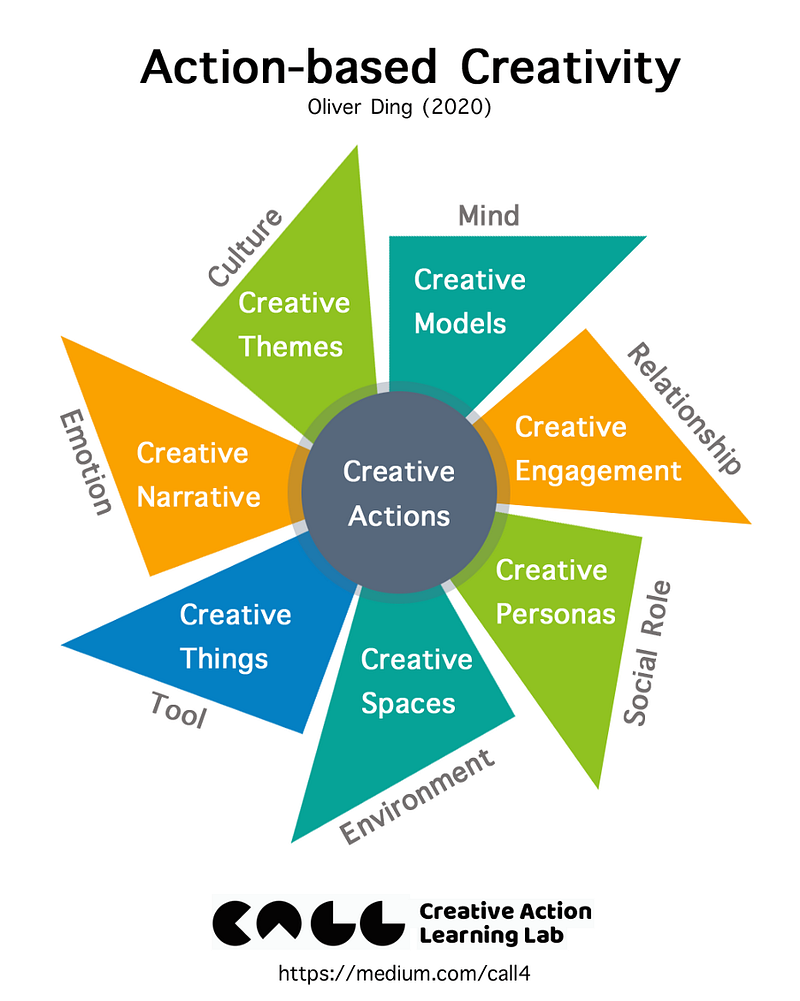
The above pinwheel diagram shows seven dimensions of Action-based Creativity and seven Creative Triggers. The seven creative triggers are placed as wings and the seven dimensions are placed at the edge of wings. Each creative trigger connects to a dimension of creative action. Seven dimensions of Action-based Creativity are Mind, Culture, Emotion, Relationship, Tool, Social Role, and Environment. Seven Creative Triggers are Creative Models, Creative Themes, Creative Narrative, Creative Engagement, Creative Things, Creative Personas, and Creative Spaces.
3.2 Creativity U
In July, I did a rough literature review of creativity studies and proposed a new approach for research creativity: Process as Product. The new approach suggests two frameworks: the 3I model at the micro level and the NICE model at the macro level.
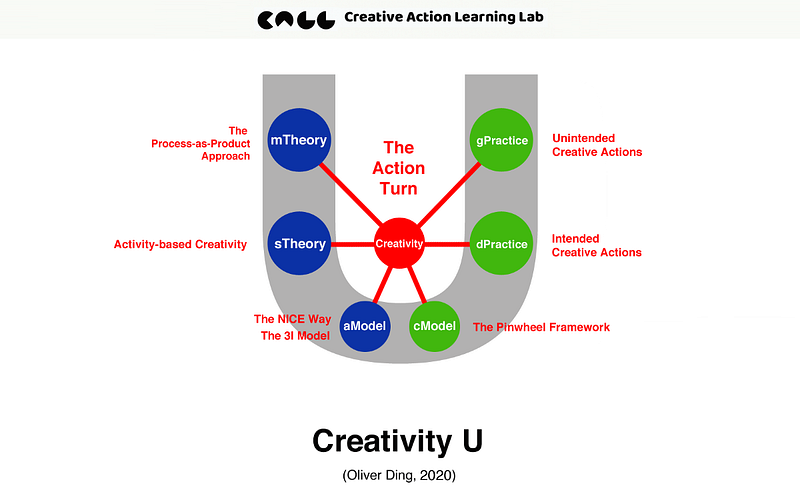
I also use the HERO U diagram to visualize these intertwined ideas (see the above diagram). Unintended Creative Actions are general practice (gPractice) and Intended Creative Actions are domain practice (dPractice). The Pinwheel framework is a concrete model (cModel) while the 3I model and the NICE way are abstract models (aModel). Action-based Creativity can be seen as a specific theory (sTheory) and the Process as Product approach is a meta-theory (mTheory).
3.3 Boundary Knowledge Work
During the process of writing Activity U, I also created the Boundary Knowledge Work framework which focuses on intellectual career transformation. This framework was inspired by HCI Activity Theorist Bonnie Nardi’s career.
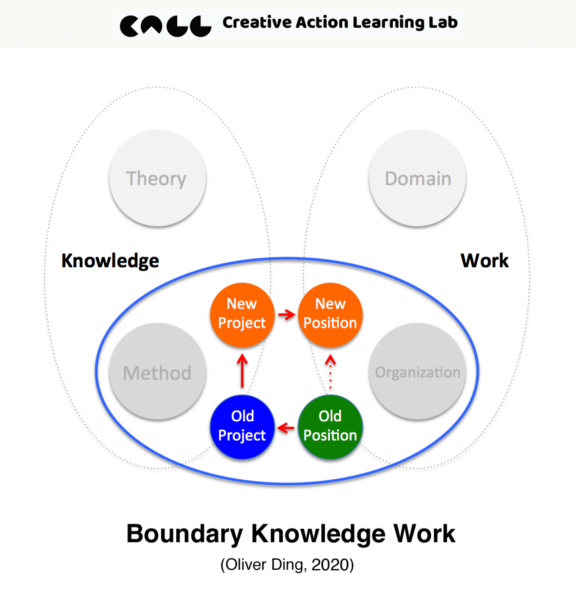
The Boundary Knowledge Work framework also provide a new perspective to think interdisciplinary domains such as HCI. The new perspective sees HCI as an independent interdisciplinary domain, it has three functions, servicing the development of theory, servicing the practical work of designers and its own independent knowledge works. We should include both researcher’s perspective and practitioner’s perspective.
PART 4. Platform for Development
4.1 Social platform experience design 4.2 Platform ecology 4.3 People (O) — Platform (E) 4.4 Platform for Development (P4D)
4.1 Social platform experience design
In March, I introduced the Social Platform Experience Design framework and shared my passion on social platforms, “I really like digital social platforms because they have made a significant impact on my life. I met my wife through joining a local blogger network. I learned knowledge and skills about web technologies and digital business by participating in the early blogosphere. I joined several digital non-profits projects and found my own youth digital communities. Finally, I became a designer and developer of digital products and social platforms.
Social platforms provide me opportunities for learning and creating. Social platforms allow me to build communities as leverage to unite youth people for learning, creating and servicing other people. While most people focus on “Social Media as Entertainment”, I prefer on “social platforms as Creative Spaces”. The term Creative Spaces was from The Power of Pull. According to John Hagel, a co-author of The Power of Pull, social platforms can be push environment or pull environment. It depends on how you engage with them.”
4.2 Platform ecology
I also provided two views of social platform experience design. The zoom in view (lifecycle view) focuses on one particular social platform with a process perspective. I suggested four stages: social practice stage, social software stage, social product stage, social platform stage. The zoom out view (ecology view) focuses on the landscape at one particular time with an ecology perspective which considers the “organism (O)— environment (E)” relationship. I list 25 types of O-E relationships for discussing platform ecology.
4.3 People (O) — Platform (E)
One type of O-E relationship is the “People (O) — Platform(E)” relationship, it is the primary O-E relationship within platform ecology. Inspired by Activity Theory and Derek Layder’s Social Domains Theory, I got an idea for discussing this primary O-E relationship.
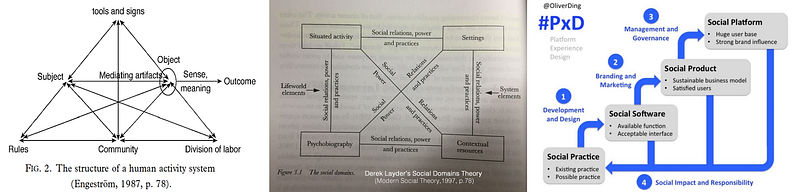
By adopting the concept of “activity”, I turn the O-E relationship to O-A-E relationship (People — Activity — Platform). Also, Inspired by Andy Blunden’s idea “project as a unit of activity”, I use “program” to refer to informal organizing activities on platforms. Thus, I made a new triad: People (O) — Program (A) — Platform (E).
However, activity theory does not pay attention to individual development. So, I select Derek Layder’s Social Domains Theory as another theoretical resource. He suggested four principal social domains: Psychobiography (including self-identity), Situated activity, Social setting (including fields) and Contextual resources. We have to notice these four social domains are “principal” and they can be subdivided into smaller “domains” or even understood as component elements of larger “domains.” Thus, I applied it to expand the People (O) — Program (A) — Platform (E) framework:
- Psychobiography: Purpose (personal motivation on the development of self-identity)
- Situated activity: Program
- Contextual resources: Position
- Settings: Platform
The result is a 5P framework: People (O) — Purpose (M, motivation) —Program (A) — Position (R, resources) —Platform (E). I call this new framework “Platform for Development (P4D).”
4.4 Platform for Development (P4D)
Activity theorist Yrjö Engeström developed a theory called expansive learning and a method called Development Work Research based on the activity system model. His focus is about organizational learning and transformation. The “Platform for Development (P4D)” framework echoes Engeström’s primary notion “activity for development” and places the individual development within the setting of platforms.
Scholars use new terms such as ICT4D and HCI4D to connect technology design and economic development. The ICT4D stands for Information and Communications Technologies for Development and HCI4D is a subfield of ICT4D, some authors defined HCI4D as “A subfield of ICT4D that focuses on understanding how people and computers interact in developing regions and on designing systems and products specifically for these contexts.”
Obviously, the meaning of “development” within “Platform for Development (P4D)” is not the same as it is within ICT4D and HCI4D. However, CALL considers the young generation potential innovators as its target customers. The P4D can service the young generation of potential innovators from developing regions, thus the P4D could indirectly contribute to ICT4D/HCI4D and 17 sustainable development goals in broad sense.
Part 5: Personal Psychobiography
5.1 Career 5.2 Reading and learning 5.3 The Ecological Practice Approach 5.4 Themes of Practice
Finally, I’d like to share my personal psychobiography as a context of activities of CALL. Biography means an account of the series of events making up a person’s life. According to Derek Layder, “…the whole point behind the notion of psychobiography is that it maps the changing contours of self and behavior over time from the point of view of the intersection of psychological and sociological factors. Thus it stresses how the person is individuated within a social context.”(p.49)
By considering psychobiographies as a unit of analysis, sociologists can understand people as real in their unique individualities. Layder said, “Durkheim’s ideas suggest that modern societies provide the social conditions under which individuation flourishes. The notion of psychobiography complements this by adding a psychological dimension. It stresses that individuality is not only a matter of social pressure towards specialization and the expression of differences. It indicates that over their life-careers, individuals have quite different social experiences and are entangled in webs of social relationships that are unique both in terms of their quality and in terms of the personalities and behavioural patterns of those involved in them.”(p.50)
For the CALL case, I considered two issues under the personal psychobiography dimension: my career and my personal reading history.
5.1 Career
I have over twenty years of work experience which can be divided into three stages: creative stage, strategic stage, and innovative stage. At the creative stage, I worked for the advertising and media industry as a creative copywriter and designer. At the strategic state, I worked for pre-IPO stage enterprises as a business strategist and fundraising consultant. At the innovative stage, I worked on making brand new digital tools and platforms as a researcher and designer.
I have worked in the curation field for over ten years. I was the Chief Information Architect of BagTheWeb.com which was an early tool for content curation (We launched the site in 2010). This experience inspired me to make a long term commitment to the Curation theme.
Before 2014, I spent most of my spare time on digital nonprofit communities as a digital activist. In 2008, I co-founded the TEDtoChina project with a student in China while I was living in the US. The project grew from a translation blog to a hub for the Chinese TED/TEDx community and we supported local TEDx curators around the Greater China area and connected them together.
In 2012 May, I was invited to speech in China Education Symposium which is a student-run organization officially recognized by The Harvard Graduate School of Education. At that conference, I met a Chinese graduate in New Work, later we found FOUR Institute to help youth people to learn the power of pull. We called one’s last two years of college and first two years of his/her career as the “new-FOUR-year”. We aimed to inspire youth undergoing the “new-FOUR-year” period to adopt open mindset and raise awareness on their life, work, learning and thinking in order to have more control of their own life and reach a career paths that fit them more. We launched the project under XinSiNian brand which means “new-FOUR-year” in Chinese. The idea and the project grew quickly through Chinese social media.
In 2013, inspired by Dr. Sugata Mitra’s idea SOLE (Self Organized Learning Environment), I developed a concept called OLO (Open Learning Opportunity) and co-founded an open learning website called WEE with a friend.
5.2 Reading and learning
During the 2014 to 2015, I transformed my focus from nonprofit activities to theoretical learning. Since then, I have been spending most of my spare time on learning ecological psychology, creativity research, and other related subjects.
2014–2020: Ecological Psychology and Creativity Research 2014–2018: Action Science, Activity Theory and Cognitive Science 2018–2019: Practice Theory, HCI, Strategy and Work 2020: Social Theory, Social Media, Information Systems and Platform
The above list indicates that social theory is the newest focus of my learning activity. Why did I switch the focus from ecological psychology to social theory in 2019?
5.3 The Ecological Practice Approach
After learning ecological psychology for five years, I wrote a book titled Curativity: The Ecological Approach to Curatorial Practice during Sept 2018 and March 2019. During the process of writing, I developed a new theoretical approach called Ecological Practice Approach which aims to build an Affordance-based theory of action and apply ideas of ecological psychology for analyzing various social practices.
After March 2019, I continuously worked on revising Curativity and developing the Ecological Practice Approach as a new project. During May 2020, I wrote another book titled After Affordance: The Ecological Approach to Human Action in which I proposed several new theoretical ideas for expanding ecological psychology to the modern digital environment.
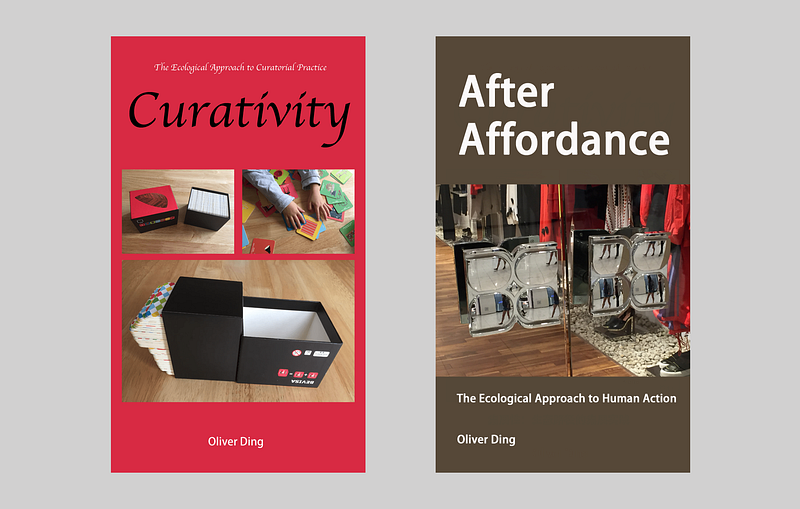
Both two books were written in Chinese. In fact, they are still unpublished drafts. Curativity is a 615-page Google Doc file while After Affordance is a 371-page file.
Now I am working on applying core ideas from Ecological Practice Approach to some practical domains such as Action-based Creativity, social platform design and boundary innovation. One application of Curativity theory is knowledge curation. I consider the above activities of CALL are knowledge curation.
Ecological Physics Method is a piece of After Affordance. In June, I applied the method to Social Platform Experience Design and used Twitter for case study. The core of After Affordance is establishing a new theory: Attachance theory. The eight types of structures of context for Attachance is a piece of After Affordance.
The Ecological Approach is a radical theoretical account. I am still working on improving the whole framework and developing core concepts. I’d like to use CALL’s programs to test some theoretical concepts of the approach.
5.4 Themes of Practice
One core theoretical concept of Curativity theory is Themes of Practice. I recently used the WXMY diagram to represent the idea of Themes of Practice, the result is the diagram below.
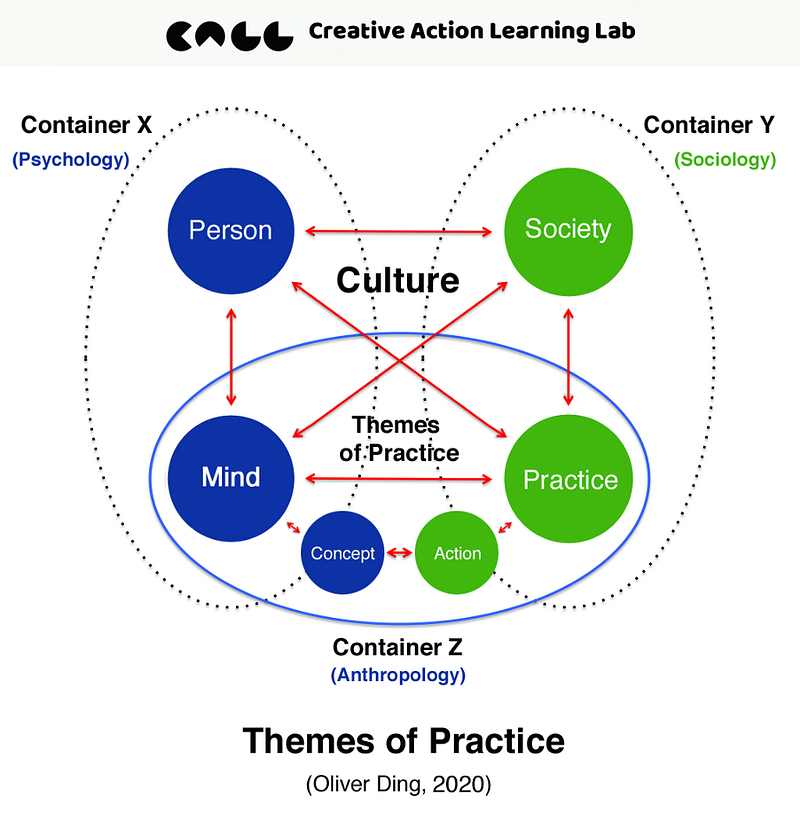
Anthropologist Morris Opler (1945) developed a theoretical “themes” for studying culture. Career counseling therapists and psychologists also developed a theoretical concept called “life theme.” If we put culture themes and life themes together, we see a “great debate” of social science: “individual — collective.”
I consider the notion of Themes of Practice as a “process” type of concept, not a “substance” type of concept. Thus, it is not a new category of themes, but a transformational process between individual life themes and collective culture themes. It refers to both concept and action. It connects mind and practice. It indicates the transformation of both person and society.
If we apply the notion of Themes of Practice to my own life, I’d like to claim Curativity is one of my life themes.
CALL for Action
CALL is an open container, you are welcome to join the journey.
You are most welcome to connect via the following social platforms:
Twitter: https://twitter.com/oliverding Doowit: https://doowit.co/profile/gm0k2ax9 Linkedin: https://www.linkedin.com/in/oliverding
License
This work is licensed under the Creative Commons Attribution-NonCommercial-ShareAlike 4.0 International (CC BY-NC-SA 4.0) License. Please click on the link for details.


