
Activity U (III): Bonnie Nardi’s Choices and Boundary Knowledge Work
How to make intellectual choices in an interdisciplinary domain
This article is part of a case study: Activity U. I apply the HERO U framework and Diagram U to discuss the development of a large knowledge enterprise: Activity Theory or (Cultural-historical activity theory, CHAT).
- Part I: The Landscape of Activity Theory
- Part II: Unit of Analysis, Niches of Analysis, Levels of Analysis
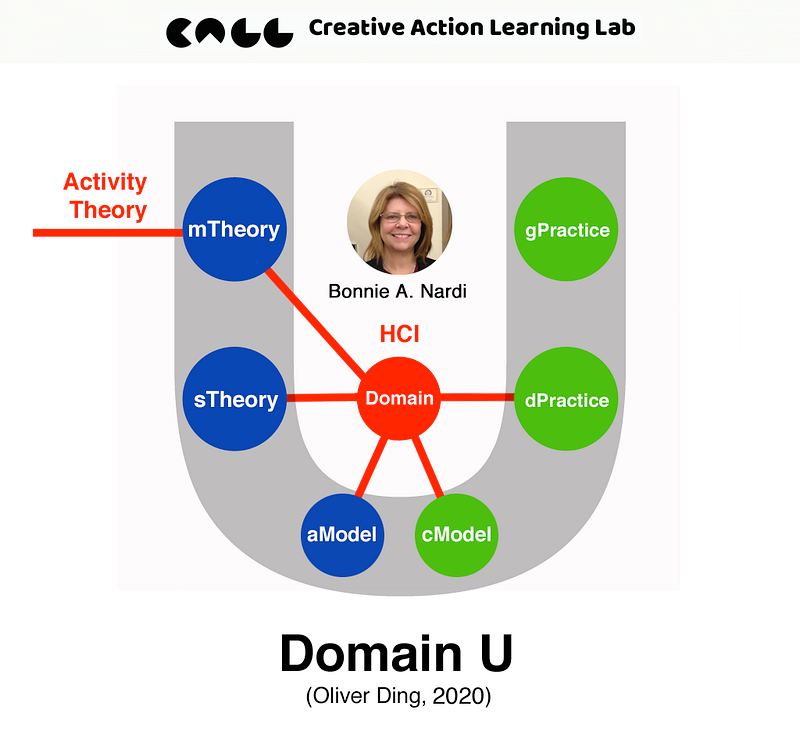
Today we are going to talk about domains, transformation, and opportunity. I will focus on HCI (human-computer interaction) as an example of domains. Though I have mentioned HCI-activity theorist Bonnie A. Nardi many times, I’d like to use her career story as an example for this article too. However, I will provide more background information on the domain of HCI and use Diagram U for discussion.
Nardi’s story inspired me to create a new diagram called Boundary Knowledge Work which can be seen as a new member of the HERO U framework.
The Landscape of Activity Theory
Activity Theory or the “Cultural-historical activity theory (CHAT)” is an interdisciplinary philosophical framework for studying both individual and social aspects of human behavior. From the perspective of Activity Theory, human activity or ‘what people do’ represents the basic unit of analysis when studying human behavior. The most important aspect of Activity Theory is understanding both individual and collective aspects of human practices from a cultural and historical perspective.
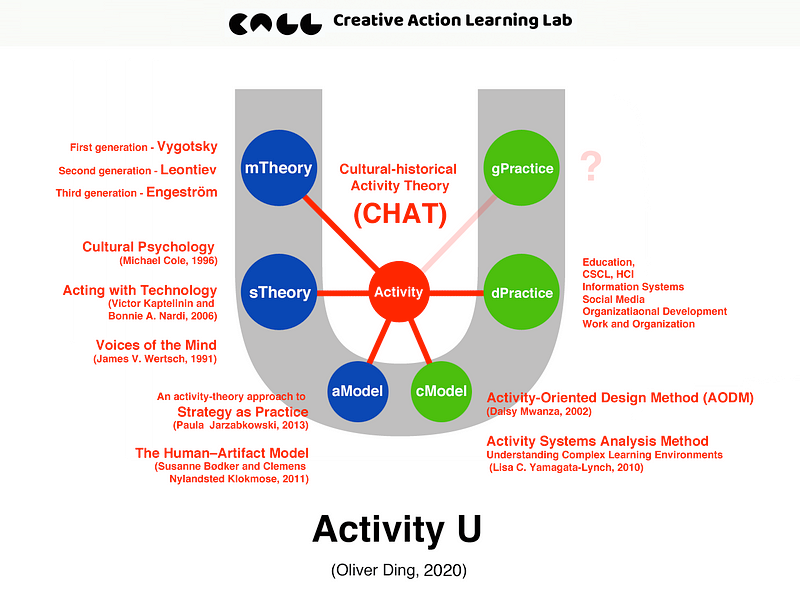
Activity Theory is a perfect case for making use of HERO U’s framework and Diagram U because we can find various usages of activity theory. I selected some examples and placed them on Diagram U and made the above diagram which is the foundation of my case study. Part I has provided more details behind the diagram. If you are not familiar with Activity Theory, you can find relevant information in Part I. If you want to know the HERO U framework and Diagram U, you can read this article: HERO U — A New Framework for Knowledge Heroes.
HCI as an Interdisciplinary Domain
HCI stands for “Human-computer interaction” which refers to a field of research with a focus on design and use of computer technology. HCI is also sometimes termed human–machine interaction (HMI), man-machine interaction (MMI), or computer-human interaction (CHI).
In recent years, some authors suggested that it is better to use Interaction Design (ID) to replace HCI. In 2015, Preece, Sharp, and Rogers published the fourth edition of Interaction Design: Beyond Human-computer Interaction. They shared the diagram below with readers.
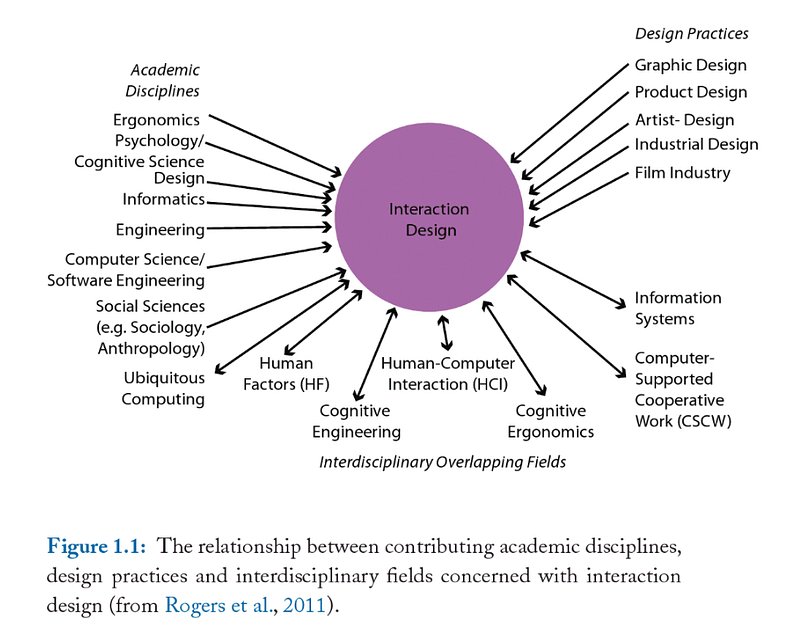
What a wonderful black box behind our daily digital life!
In fact, this is just a piece of a complex landscape. For example, HII, LIS, and HIB, these terms both refer to related fields. Raya Fidel (2012) gave us a clear description of these fields, “Research on human information interaction (HII) focuses on people’s relationship with information, rather than with technology (as in human-computer interaction) or with the information agency (as in librarianship). HII is inherently a multidisciplinary field, encompassing areas ranging from human-computer interaction to computer-supported cooperative work, human factors, social informatics, management, and library and information science (LIS). LIS is the only field that has given HII a significant position among its areas as the field of human information behavior (HIB).”
We might ask some questions such as these authors did, “Why are there so many and what do they all do? Furthermore, how do the various disciplines, fields, and design approaches differ from one another?”. Preece, Sharp, and Rogers said it depends on the scope and problems they address, “For example, Information Systems is concerned with the application of computing technology in domains like business, health, and education, whereas Computer-Supported Cooperative Work (CSCW) is concerned with the need also to support multiple people working together using computer systems (Greif, 1988)”(cited in Prece, J., Sharp, H., and Rogers, Y. 2015).
Peter Burke (2012) used six fifty-year periods to review the transformation of human knowledge systems:
- The Reform of Knowledge, 1750–1800
- The Knowledge Revolution, 1800–1850
- The Rise of Disciplines, 1850–1900
- The Crisis of Knowledge, 1900–1950
- Technologizing Knowledge, 1940–1990
- The Age of Reflexivities, 1990
The name “the Age of Reflexivities” was inspired by Pierre Bourdieu’s term “reflexive sociology”. Burke said, “The technologization of knowledge continues to accelerate, Milestones include 1990 (the Space Telescope), 1994 (Netscape), 1995 (Java), and 1998 (Google)…The everyday working lives of many individual students and scholars have been transformed by the spread of the personal computer and the rise of the Internet, sometimes described as a ‘Fifth Estate’…The management of information for business has itself become a successful business…As for scientists, Tim Berners-Lee has called the rise of information about information ‘the beginning of the new enlightenment’…The organization of knowledge used to be left to librarians (and a few philosophers), but it is increasingly regarded as a discipline in itself…”
We can consider HCI as an example of the movement of tech-inspired interdisciplinary studies. According to Wikipedia, “Researchers in HCI are interested in developing design methodologies, experimenting with devices, prototyping software and hardware systems, exploring interaction paradigms, and developing models and theories of interaction.”
The Transformation of HCI
HCI researchers use “first wave HCI”, “second wave HCI”, and “third wave HCI” to describe the development of the field.
Liam Bannon (1986) suggested the first wave of HCI was model-driven and focused on the human being as a subject to be studied through rigid guidelines, formal methods, and systematic testing. He pointed out the move to the second wave as that “from human factors to human actors.”
Around the late 1980s — early 1990s, the focus of HCI research shifted from the “cognitivist perspective (human factors)” to the “post-cognitivist perspective (human actors)”. Researchers started to pay attention to the context of human-computer interaction such as social practices, work settings, communities, and everyday life environments.
In 2015, Susanne Bødker suggested the third-wave HCI, “In the second wave, and regarding work technologies, research paid a lot of attention to cooperation, learning, and participation, which I predicted would be lost in the third wave with the increase in “rest-of-life technologies.” As a matter of fact, the whole fields of computer-supported cooperative work (CSCW) and participatory design (PD) developed largely as second-wave responses to these challenges. In my keynote, I suggested that in bridging between the second and third waves, there was a need to strike the balance differently between individual experience (third wave), on the one hand, and sharing, learning from each other within communities of practice, and participation in shared development and appropriation of technology (second wave), on the other.”
In order to frame the development of HCI theory, Yvonne Rogers (2012) adopted terms from the History of Art: Classical, Modern, and Contemporary. She said, “The Classical HCI period imported cognitive theory in a rigorous and constrained way; the Modernist HCI period saw a broader and colorful palette of approaches and uses of theory — from social, phenomenological and cognitive science — while the Contemporary period became more value-led, drawing from a range of moralistic and societal-based perspectives.” (p.7)
Victor Kaptelinin and Bonnie Nardi (2012) also suggested a new term called “hn-HCI” which stands for “human needs HCI”. They said, “We use the term hn-HCI not to create dichotomous categories of HCI research, but to bring forward and celebrate research with clear commitments to social justice, equity, and goals beyond profit…hn-HCI research includes (but is not limited to) sustainable HCI, interactive and collaborative technologies for development (ICTD), crisis informatics, comparative informatics, and collapse computing.” (p.65)
Another perspective on the third wave of HCI is focusing on emergent objects such as Brain–computer interfaces, Wearable Interaction, Affective computing, Augmented Reality, Tangible Bits, Human-Robot Interaction, Distributing Interactions, etc.
Bonnie A. Nardi’s Choices
Bonnie A. Nardi is an activity theorist, HCI researcher, and anthropologist. She is well known for her work on activity theory, interaction design, games, social media, and society and technology. She was a professor at the University of California, Irvine. She was elected to the ACM CHI Academy in 2013.
In order to discuss Nardi’s choices, I created a new version of Diagram U: Work U. I identified six elements for understanding the work of a researcher. Theory and Method point to her knowledge which is a personal resource for doing research work. Domain and Organization point to her work environment. Project and Position point to her daily actions and work role.
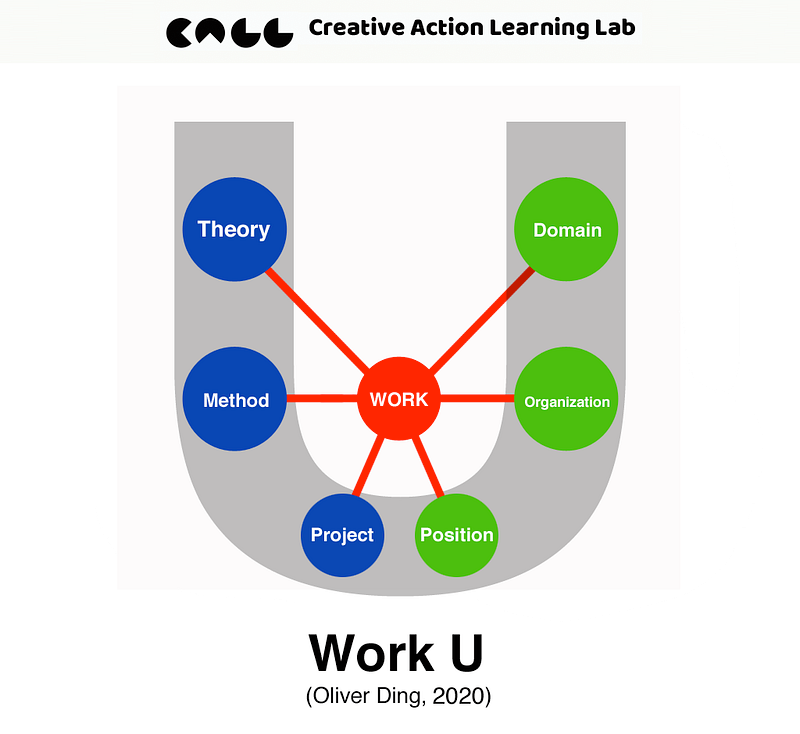
Diagram U is a simple version of the WXMY diagram. Let’s turn Work U to its advanced version: Knowledge Work. The diagram below presents three containers: Academic disciplinary, Practical field, and Routine work.
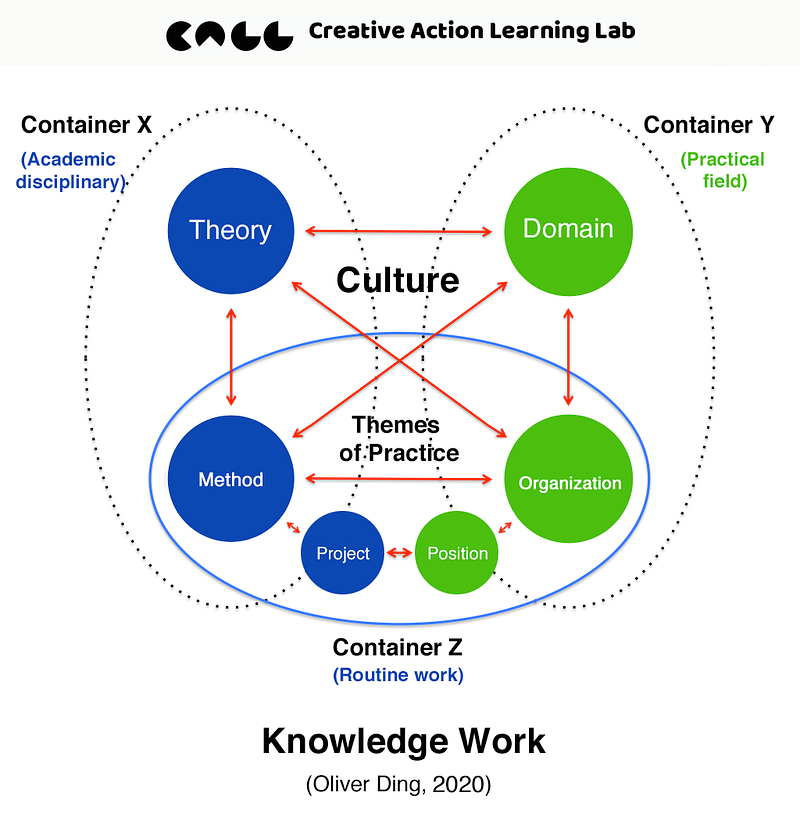
I also added two new elements to the Knowledge Work diagram: Culture and Themes of Practice. Culture refers to general ideas, values, and social norms at the macro level. In order to connect the collective culture themes and personal life themes, I coined the term Themes of Practice to describe the mechanism of transformation of social themes: One of a person’s personal life themes can be adopted by others and becomes a member of the collective culture themes. On the other side, a cultural theme can be adopted by a person in her daily life and becomes her personal life theme.
Now, we can start reading Nardi’s story with the above thinking tools. First, let’s list major resources for Nardi’s story.
- Bonnie Nardi: Appropriating Theory
- Bonnie Nardi at Wikipedia: https://en.wikipedia.org/wiki/Bonnie_Nardi
- Bonnie Nardi’s personal website: https://artifex.org/~bonnie/
- Bonnie Nardi’s faculty profile: https://www.informatics.uci.edu/explore/faculty-profiles/bonnie-nardi/
- Bonnie Nardi’s Google Scholar profile: https://scholar.google.com/citations?user=hwc6A1MAAAAJ&hl=e
Old Domain and New Domain
Nardi was a trained anthropologist, but she was disgruntled with anthropology’s total lack of interest in digital technology in the 1980s. She said, “The 80s were a period of turmoil in anthropology, and certain disciplinary moves were made that I believe have continued to stymy anthropology’s influence (a story for another time). I was disgruntled with anthropology’s total lack of interest in digital technology, its insular jargon, and its somewhat negative attitude. During anthropology’s relentless critique of issues of race-class-gender, my head was in a different space — I was energized and excited about what I perceived to be the development of rapidly changing life-altering digital technologies…I found digital technology liberating, compelling, and so impactful on global culture that I could scarcely believe it remained outside anthropology’s sights.”
Here we see a conflict between Old Domain (academic job in anthropology) and New Domain (high-tech research). Nardi was trained in anthropology and had an academic job in anthropology. At that time, she was interested in emergent digital technologies. She had to make a choice between the old domain and the new domain.
Finally, in the mid-80s, she left a tenure-track job in anthropology and moved to the high-tech industry in Silicon Valley.
Old Theory and New Theory
As an HCI researcher, Nardi met her challenge again. The second wave of HCI was emergent around the late 1980s to early 1990s. In order to overcome the limitations of information processing psychology as a theoretical foundation for HCI, some researchers proposed several other theoretical approaches as alternative frameworks. In 1987, Susanne Bødker argued that activity theory could form a strong theoretical basis for HCI. Other options are phenomenology, the situated action perspective, and distributed cognition.
This time, Nardi’s choice was activity theory because her preference is a systematic theoretical framework. She shared an example, “One of the key points Kaptelinin makes about strength of activity theory is the importance of its integrating framework linking a set of theoretical principles — rather than what we often get in HCI, which is an insight here and an insight there. Kaptelinin provides an example of the power of a larger theoretical framework, comparing Norman’s (1991) notion of “cognitive artifacts” and activity theory’s notion of tools. Cognitive artifacts are on one level almost identical to tools, but in activity theory, the notion of tools draws on principles of mediation, internalization, and functional organs, leading to very different conclusions about the nature of tools, as Kaptelinin details. Finally Kaptelinin discusses some of the limitations of activity theory.” (1996)
Nardi’s journey of appropriating activity theory started with a paper shared by her colleague in HP in 1993. She said, “In 1993 I was working at Hewlett-Packard Labs in Palo Alto, California, conducting ethnographic studies in the human-computer interaction research group….The only other anthropologist in our building (who was in a product group) told me she had an article I would like, and handed me a copy of Kari Kuutti’s ‘Activity theory and its applications to information systems research and development’ (1991). I began to read the text in the ordinary desultory way one does with random articles, but I soon snapped to attention, the words jumping off the page. I was astonished to find that someone had theorized information systems as activity systems wherein the technical system was conceived as part of object-oriented human activity. The clarity and good sense in Kuutti’s argument — that we should study what people are doing with technical systems and why! — set me off on a crash course in activity theory to determine whether my enthusiasm would withstand further exposure to the ideas.”
Old Project and New Project
Nardi’s second step was building personal contact with the Scandinavians and editing a book about activity theory and HCI. She said, “I decided if I were to penetrate the core activity theory circle — centered in what Don Norman once called “that hardy band of Scandinavians” — I would have to make personal contact with the illustrious natives. I emailed Kari Kuutti and Susanne Bødker, and they very kindly helped me build up a network of people to contribute to an edited volume on activity theory and HCI published by MIT Press (Nardi 1996)…”
We have to notice Nardi’s work status at that time. In 1993, She worked for HP. In 1996, She worked for Apple. During these three years, Nardi invested her time in “appropriating activity theory”. What we can learn from this lesson is that we need both the attitude to theory and routine work for adopting theory. I drew the diagram below to explain Nardi’s career transformation. I named this new diagram “Boundary Knowledge Work”.
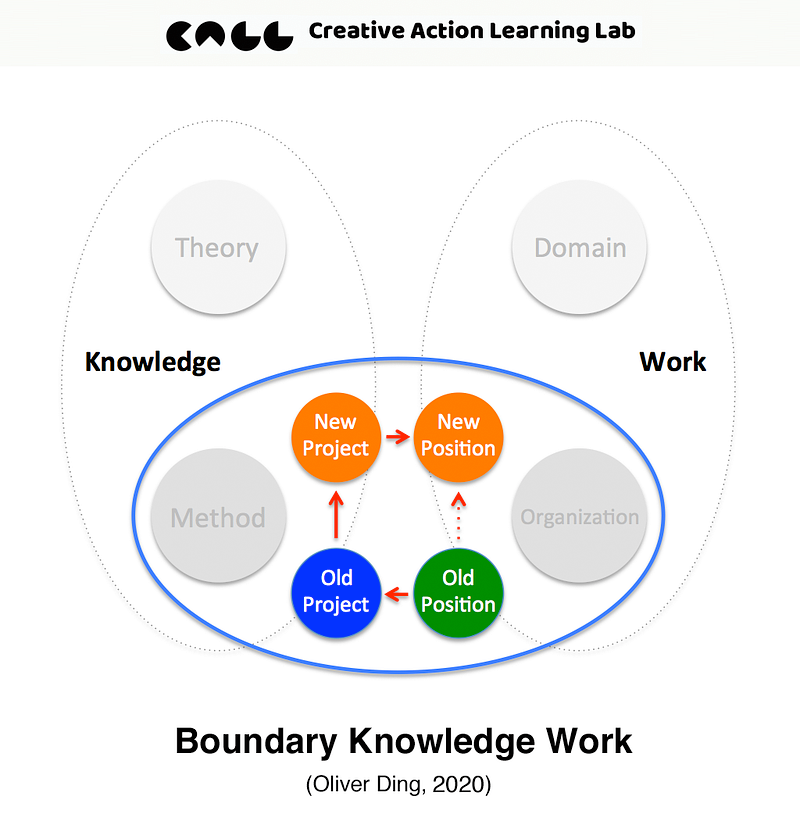
In 1993, Nardi was an HCI researcher at HP. From 1994 to 1996, she worked as an HCI researcher at Apple. We can claim “An Industry HCI researcher” as her “old position”. If we review her publications on her personal website, we can find her “old projects” are almost under the category of “Interaction Design”. For example, A Small Matter of Programming: Perspectives on End User Computing. MIT Press (1993), User Preferences for Task-specific vs. Generic Application Software (1994), Finding and Reminding: File Organization from the Desktop (1995), Creating Presentation Slides: A Study of User Preferences for Task-Specific versus Generic Application Software (1996).
For an industry HCI researcher, editing a book about a theory is not part of her job description. For Nardi, editing a book is a “new project” that detaches from the “old position” and attaches to the “new position”. In a short term (three years), the “new position” is “an editor”. Later, it transformed into “an activity theorist”.
People always have knowledge beyond the job description of their existing work (job). In order to move to an “ideal position” from an “existing position”, we need some strategies if we can’t directly move. I hope the “Boundary Knowledge Work” diagram and the whole HERO U framework can be considered as a thinking tool for career transition.
Nardi suggested that leading an editorial project is great to work for researchers. She said, “I reasoned that if I had a bunch of papers written by activity theorists in front of me to edit, it would be a good way to imbibe its principles and concerns. (I recommend editorial work such as special issues or edited collections as a general recipe for plunging into a field or deepening knowledge of a field in which a researcher seeks to gain more understanding.)” In fact, she did many editorial projects and made huge contributions to the HCI domain and activity theory domain. For example, she co-edited the MIT Press Acting with Technology Series which has many award-winning titles. She is a Senior Editor for Mind, Culture, and Activity, a journal devoted to activity theory.
As an established theoretical tradition, Activity Theory brought a new meta-theory, a new domain, new methods, new tools, and new resources to Nardi. She embraced the opportunity and made a significant contribution to the development of Activity Theory in the HCI field and in North America.
Nardi also explored other theories for her various projects. For example, one of her major projects is researching video gaming through the anthropological study of World of Warcraft. She got the research idea from her student in the spring of 2015 and began the research project in December 2005 and ended in October 2008. During the process, She published several papers. Finally, she published a book titled My Life as a Night Elf Priest: An Anthropological Account of World of Warcraft in 2010. In order to explain what she was seeing in the gaming world, she adopted John Dewey’s idea of “active aesthetic experience” for this project. She said, “Dewey and activity theory are quite compatible in spirit, but Dewey specifically addressed some issues I wanted to explore that are not well developed in activity theory. Recently I discovered the work of Laurent Thévenot and his colleagues, and I see value in their ideas on orders of worth for understanding collective activity at a larger scale than is usual with activity theory.”
Let’s use a metaphor I mentioned in Hammer, Hammering, Affordance, if we see a research project as a nail, then the theory is the hammer. The most important thing is hammering. We will see more examples of using activity theory with other theories in the coming posts.
Themes of Practice
Nardi lists four areas of interest on her personal website. She also uses this list to categorize her publications.
- Activity Theory
- Interaction Design
- Computer-mediated Communication (Games, Social Media)
- Society and Technology
She also pointed out her recent theme is critical analysis, “Over the years I have moved toward more expansively critical analysis (e.g., Nardi 2010; Ekbia and Nardi 2012; Kow and Nardi 2012; Tomlinson et al. 2013), and it is central to my current work. Such analysis is exactly what I was less able to confront in the 1980s and 90s. Part of the change for me is maturity, but part of it is understanding that anthropology’s blistering critiques are not the only way to question and probe, and that more nuanced positions can be developed. Activity theory has helped me in this quest by providing sound concepts such as mediation that enable us to see, for example, how a technology can be eminently useful, but can, at the same time, set in train certain consequences such as loss of privacy, alterations in social relations, degradation of academic skills, or getting stuck in the filter bubble. Such consequences need to be constantly assessed as we evaluate our human relation to digital technologies.”
In 2017, Nardi co-authored a book titled Heteromation, and Other Stories of Computing and Capitalism with Hamid R. Ekbia. This book goes beyond the traditional HCI.
A person can have several “Themes of Practice”. However, if she wants to choose a title for her biography or autobiography, then she needs to decide which one is the primary theme of practice. If I were the editor of Nardi’s biography, I would use “Appropriating Theory” as the title. She already used it for a chapter, I hope she can expand the chapter to a book.
Others’ Choices
HCI is a domain with different scale problem spaces. HCI researchers’ knowledge work is informed by diverse types of knowledge resources such as paradigms, theories, models, frameworks, and approaches. Nardi’s choice is about appropriating theory, what about other HCI researchers?
In an analysis of the use of activity theory in HCI research, Bonnie Nardi (2016) and her colleagues collected 109 HCI activity theory papers and found scholars use five strategies in their research work to make use of activity theory:
(1) an object of analysis, focusing on activity theory per se (5 papers); (2) a conceptual tool for design, applying activity theory to support design (17 papers); (3) a meta-tool, using activity theory as a guide for developing a new analytical tool (16 papers); (4) a tool for conceptual analysis, using activity theory for predominantly conceptual analysis of HCI (30 papers); and (5) a tool for empirical analysis, using activity theory to guide and support empirical analyses of HCI phenomena. (note 3, Making HCI theory work: an analysis of the use of activity theory in HCI research).
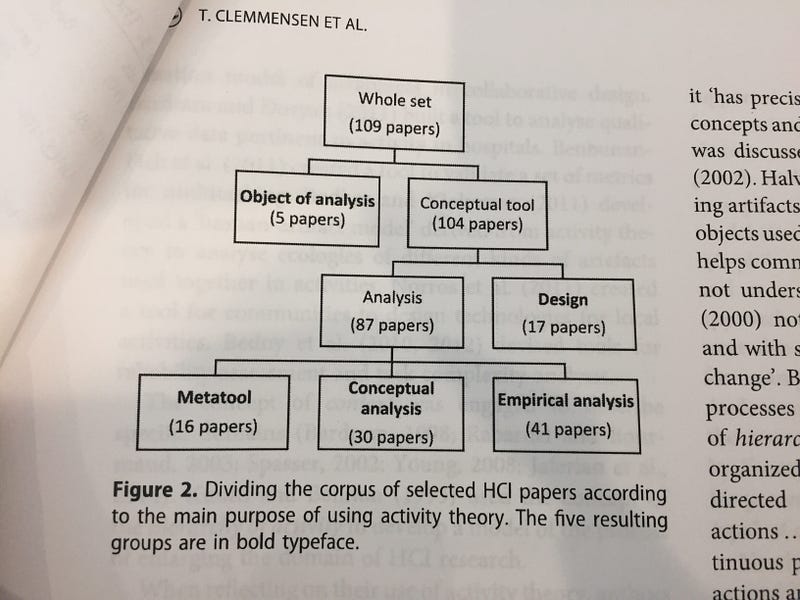
We can use Diagram U to represent the above discovery and adopt it as a part of “Boundary knowledge work” at the macro level.
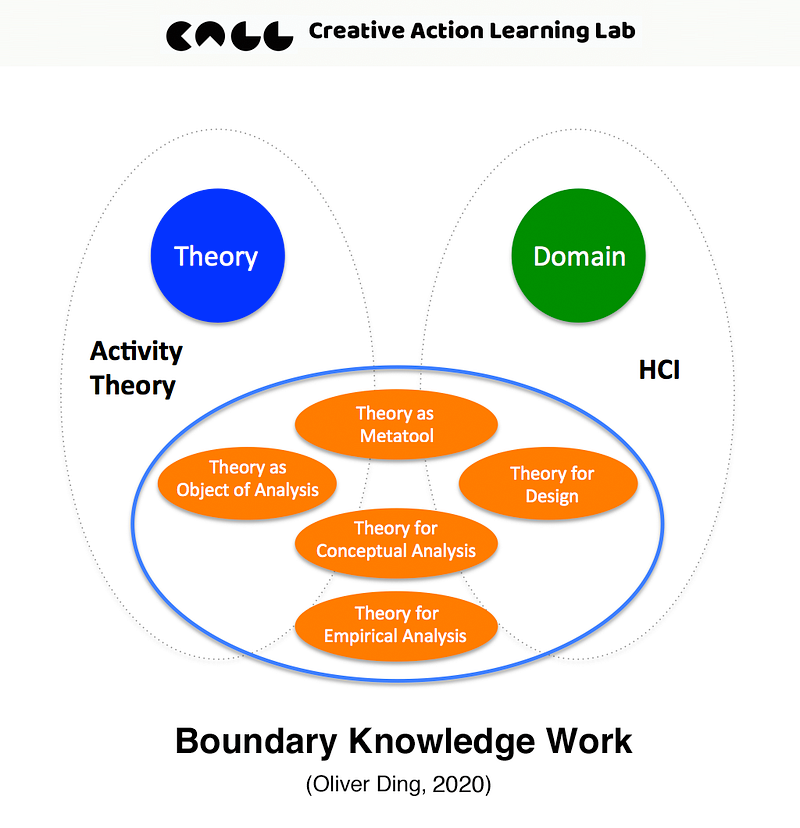
The above diagram shows three categories of these five strategies. It matches the HERO U framework’s three categories of “knowing”.
- Theory container: Knowing-for-all
- Practice container: Knowing-for-me
- Echozone container: Knowing-for-us
The outcome of the “Theory as Object of Analysis” strategy contributes to the development of theory. I claim it as “Knowing-for-all”. The outcome of the “Theory for Design” strategy contributes to the practical work of designers, it doesn’t directly give feedback to the development of the theory. I claim it as “Knowing-for-me”. The outcome of the other three strategies contributes to the development of HCI itself. I claim it as “Knowing-for-us”.
Boundary Knowledge Work v.s. Knowledge Transfer
We can also use these three categories as three perspectives to evaluate the role and status of theory in an interdisciplinary domain such as HCI.
In 2012, Yvonne Rogers published a book titled HCI Theory: Classical, Modern, and Contemporary. She adopted the “Theory for Design” perspective (in my term, Knowing-for-me) and critiqued the seminal theoretical developments of the time, assessing and ruminating more generally on the role of theory in HCI. She said, “A core concern running through the review article was the extent to which theory was used in design practice. I noted how a diversity of new theories had been imported and adopted in the field. A key question I raised was whether these attempts had been productive in terms of knowledge transfer. By knowledge transfer, I was referring to the translation of research finding (e.g., theory, empirical results, descriptive accounts, cognitive models) from one discipline (e.g., cognitive psychology, sociology) into practical concerns that could be applied to another (e.g., HCI, CSCW). An empirical study of designer’s use of theory that I conducted made for rather depressing reading, especially for those championing theory in practice (Rogers, 2004). Despite designers’ perceived need and desire for applying theory, they reported in the survey that they were only able to make use of some it in a limited way. I concluded by proposing new knowledge transfer mechanisms, including a lingua franca that designers and researchers, alike, could use to talk to one another more.”
Rogers’ argument doesn’t only refer to a specific phenomenon in HCI, but also a general phenomenon in all interdisciplinary domains. Based on the notion of “Knowledge Transfer”, Rogers defined the HCI field as a service provider and its clients are practical designers. In an early paper, She (2004)paid attention to the need of designers and even suggested rhetorical devices for knowledge transfer, “So how can theory best inform design? Are there other ways of translating theory-based knowledge, besides turning it into guidelines or analytic frameworks that end up having limited utility? It would seem that quite a different frame of reference is needed — one which focuses more on the process of design and how the different kinds of designers, themselves, want to be supported…Likewise, Rogers (1994) has used rhetorical devices together with various cognitive dimensions to analyze aspects of the design and use of groupware systems. One of the main attractions to these kinds of concept, is that they readily appropriate or map onto everyday terms and concepts that are relatively easy to understand. This allows for analogical reasoning that can be generalized across a range of topics.”
There is another perspective to view the nature of HCI: Boundary Knowledge Work. This perspective sees HCI as an independent interdisciplinary domain, it has three functions, servicing the development of theory, servicing the practical work of designers, and its own independent knowledge works. We should include both researchers’ perspectives and practitioners’ perspectives.
Theory Makers v.s. Theory Users
In fact, Nardi’s discussion also echoes the perspective of Transitory Knowledge Work. In an analysis of the use of activity theory in HCI research, Nardi (2016) asks the following essential question:
Should HCI researchers be considered theory-makers or theory users?
This question can be applied to all “knowing-for-all” situations and “Boundary Knowledge Work” too.
Nardi believes HCI researchers can be both theory-makers and theory-users. She compares the IS (Information Systems) researchers with HCI researchers in the paper: “Kjærgaard and Vendelø (2015) found that IS researchers studying sensemaking theory often used it without explaining it or providing substantial theoretical background or discussion. They concluded that IS research is mainly concerned with empirical phenomena, pays little attention to theory construction and development, and that therefore IS is less likely to gain recognition as a reference discipline for other disciplines. ”
Kjærgaard and Vendelø said in their paper, “…the success and legitimacy of a young academic field depends on its ability to convince more established fields that it has a contribution to make. The reference discipline debate addresses the issue of legitimacy building by a young field, as it examines whether other fields have been convinced that the knowledge it produces is worth referencing.”
Here we see an important structure of “domain-theory-people”. Any domain can be seen as a platform for career development for people. For academic domains, if people take challenges of building high-level theories, then the domain they belong to will become a reference discipline that can influence other domains. As Nardi says, the HCI domain is in this situation:
“In contrast, there are reasons to believe that HCI is in a better situation when it comes to providing theoretical influence on other disciplines. There are indications that HCI acts as a reference discipline; for example, the classic activity theory HCI text Context and Consciousness (Nardi 1996) has been widely cited outside HCI. Instead of theory use as passive consumption of a theory ‘product’, we found numerous cases of theory development. These papers would, for example, alert the reader in the title, abstract, and keywords that the paper is about activity theory; cite the reference HCI activity theory texts; use activity theory deeply and in a substantial way; and reflect core HCI activity theory concerns. We believe that HCI researchers can be described as not only ‘theory users’, but also as ‘theory-makers’.”
Nardi also mentions that “However, not all HCI researchers are (or should be) either theory-makers or theory users. Many HCI papers may be better characterised as experience reports (Newman 1994), or as challenging and provocative texts to jog our imaginations (Blackwell 2015) with little or no trace of theory.”
Kinds of Knowing and Contributions
As I mentioned in the HERO U framework, there are various kinds of knowing. At the micro level, we should pay attention to the acts.
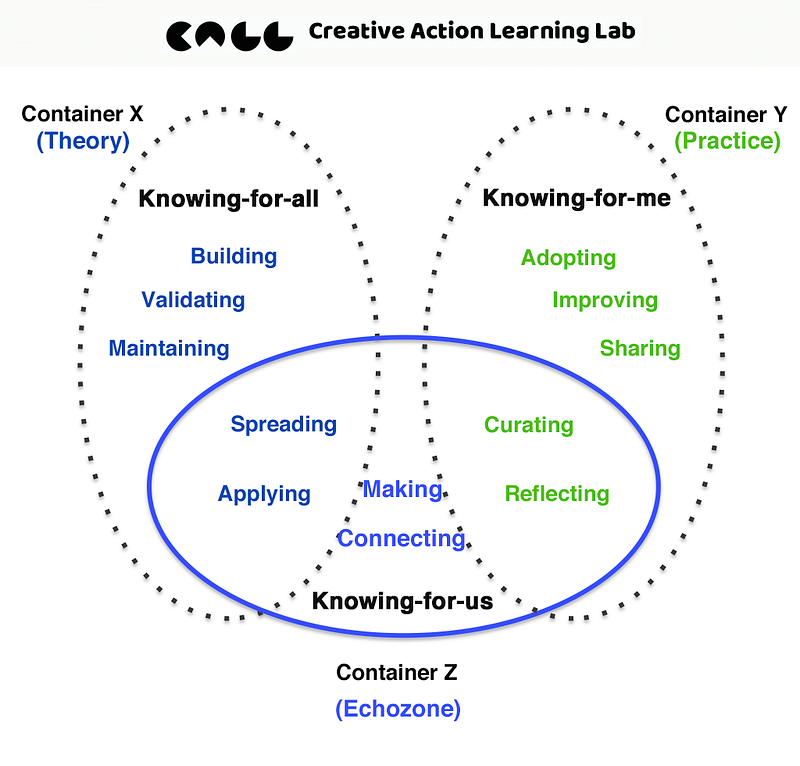
The above diagram shows various types of acts: building a theory, validating a theory, maintaining a theory, spreading a theory, applying a theory, making a theory, connecting a theory to another theory, curating domain knowledge, reflecting domain knowledge and practice, sharing domain knowledge and personal experience, improving personal skill and knowledge, adopting theory and domain knowledge…etc.
These acts don’t tie to particular domains and positions. A designer can learn theory in her spare time. She can join a project of editing a book about a theory and design a cover and diagram for the book. She also can design a website to collect theoretical papers about a special theme. She also can make a speech and introduce a theory to her peers.
If we see life as an activity. Nardi’s successful career gives us a powerful idea: the core of life is the development of activities. In an age of uncertainty, we don’t have to limit our activities to an existing position, an existing organization, an existing domain, an existing project, an existing method, and an existing theory.
You are most welcome to connect via the following social platforms:
Twitter: https://twitter.com/oliverding Doowit: https://doowit.co/profile/gm0k2ax9 Linkedin: https://www.linkedin.com/in/oliverding
License
This work is licensed under the Creative Commons Attribution-NonCommercial-ShareAlike 4.0 International (CC BY-NC-SA 4.0) License. Please click on the link for details.
References
Bannon, L.(1986) From human factors to human actors: the role of psychology and human-computer interaction studies in system design. In J. Greenbaum and M. Kyng (eds.) Design at work: cooperative design of computer systems. (pp.25–44) Erlbaum.
Bødker, S. (1987). Through the interface — a human activity approach to user interface design. DAIMI Report Series, 16(224). https://doi.org/10.7146/dpb.v16i224.7586
Bødker, S. (2015) Third-wave HCI, 10 years later — participation and sharing. In Interactions Sept -Oct 2015.https://dl.acm.org/doi/pdf/10.1145/2804405
Burke, P. (2012) A social history of knowledge Volume II: from the encyclopedie to wikipedia. Polity.
Fidel, R. (2012) Human Information Interaction: An ecological approach to information behavior. The MIT Press.
Hamid R. Ekbia and Bonnie A. Nardi (2017) Heteromation, and other stories of computing and capitalism. The MIT Press.
Kaptelinin V., & Nardi B. (2006). Acting with technology: activity theory and interaction design. The MIT Press.
Kaptelinin V., & Nardi B. (2012). Activity theory in HCI: fundamentals and reflections. Morgan & Claypool Publishers.
Nardi, B. A. (1996) Context and consciousness: activity theory and human-computer Interaction. The MIT Press.
Nardi, B. (2016). Appropriating theory. In Sonnenwald,D.(ed.) Theory development in Information: reflecting on the process. University of Texas Press.
Prece, J., Sharp, H., and Rogers, Y. (2015) Interaction design: beyond human-computer interaction. Wiley.
Rogers, Y (2004) New theoretical approaches for HCI. In Annual review of information science and technology, no 38.
Rogers, Y (2012) HCI theory: classical, modern, and contemporary. Morgan & Claypool
Torkil Clemmensen, Victor Kaptelinin & Bonnie Nardi (2016): Making HCI theory work: an analysis of the use of activity theory in HCI research, Behaviour & Information Technology, DOI: 10.1080/0144929X.2016.1175507


