
Hammer, Hammering, and Affordance
The Materiality Turn and Artifact-centered Interaction
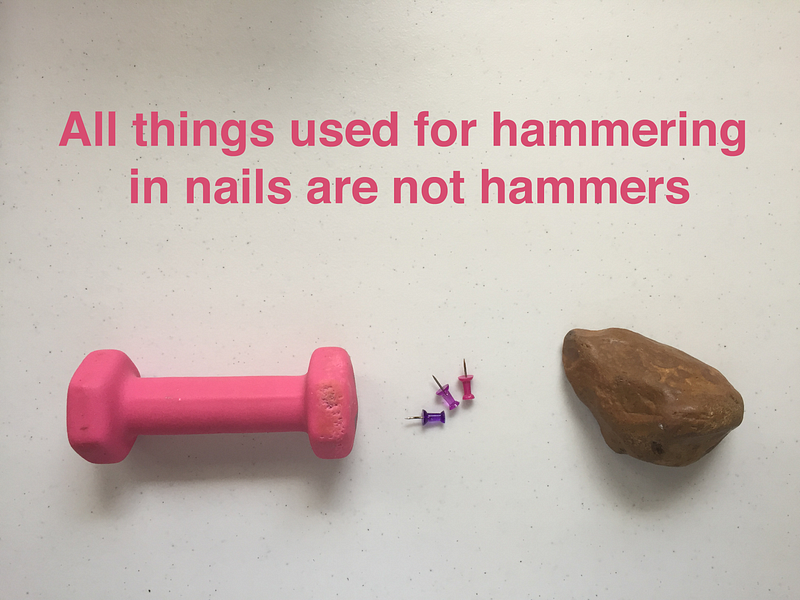
I got the inspiration for the above picture when I was reading Erving Goffman’s book Frame Analysis. He wrote a note about the meaning of an object on p.39, “Here again, I argue that the meaning of an object (or act) is a product of social definition and that this definition emerges from the object’s role in the society at large, which role then become for smaller circles a given, something that can be modified but not totally re-created. The meaning of an object, no doubt, is generated through its use, as pragmatists say, but ordinarily not by particular users. In brief, all things used for hammering in nails are not hammers.”
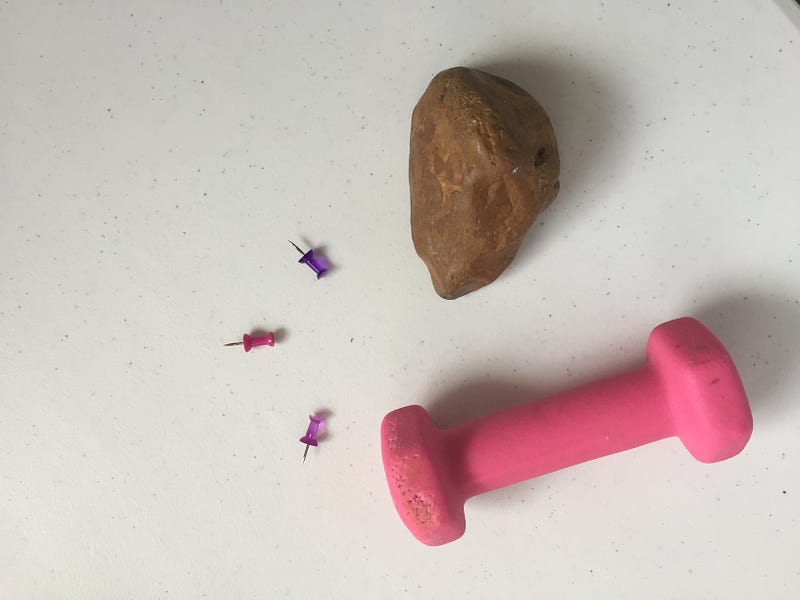
What Goffman talked about is normativity since he paid attention to “ordinarily” not “particular users.” As a particular user, I always use the stone and the small pink dumbbell for hammering. Of course, we don’t call stones and dumbbell hammers.
Goffman didn’t give a specific definition of “object”, but we know he intended to use a general term because he said “an object (or act)”. If we restrict the scope of “object” to concrete physical objects, then we can adopt an innovative view of the meaning of an object from Ecological psychologist James J. Gibson.
Gibson was the first to bring the ecological perspective to psychology, especially in the study of visual perception. He proposed the Affordance theory to describe the mutual relationship between animals and environments in his last book, The Ecological Approach to Visual Perception (Gibson, 1979/2015). He said, “We have thousands of names for such objects, and we classify them in many ways: pliers and wrenches are tools; pots and pans are utensils; swords and pistols are weapons. They can all be said to have properties or qualities: color, texture, composition, size, shape and features of shape, mass, elasticity, rigidity, and mobility. Orthodox psychology asserts that we perceive these objects insofar as we discriminate their properties or qualities. Psychologists carry out elegant experiments in the laboratory to find out how and how well these qualities are discriminated.” (p.125)
Traditionally, psychologists assumed that objects are composed of their qualities. Gibson rejected this view, “…But I now suggest that what we perceive when we look at objects are their affordances, not their qualities…The fact that a stone is a missile does not imply that it cannot be other things as well. It can be a paperweight, a bookend, a hammer, or a pendulum bob. It can be piled on another rock to make a cairn or a stone wall. These affordances are all consistent with one another. The differences between them are not clear-cut, and the arbitrary names by which they are called do not count for perception. If you know what can be done with a graspable detached object, what it can be used for, you can call it whatever you please.”(p.126)
The radical aspect of affordance theory is that it challenges the traditional view on the meaning of objects “concept first” and turns it to “percept first”. Concept is about linguistic meaning and ordinary classes of objects. Gibson argued, “To perceive an affordance is not to classify an object…The theory of affordances rescues us from the philosophical muddle of assuming fixed classes of objects, each defined by its common features and then given a name. As Ludwig Wittgenstein knew, you cannot specify the necessary and sufficient features of the class of things to which a name is given. They have only a ‘family resemblance.’ But this does not mean you cannot learn how to use things and perceive their uses. You do not have to classify and label things in order to perceive what they afford.” (p.126)
In fact, affordance theory doesn’t only consider objects but considers objects as our environment. For Gibson, “objects, other persons and animals, places and hiding places” are our surrounding environment.
This article will use hammer as a metaphor for talking about related topics. Part I will discuss tool-use actions, artifacts, and objects at the micro-level. Part II will highlight the materiality turn and introduce some theoretical ideas from various disciplines. Part III will go further to discuss a possible direction: Artifact-centered Interaction (ACI).
Contents
Part I: Field
- Hammer as Tool
- Found Tools (stone as hammer)
- Artifacts (designed hammer)
- Designed Use v.s. Found Use
- Hammer-and-Nail v.s. Stone-and-Nail
Part II: Landscape
- Hammering as Turn
- Hammer as Concept
- Hammering as Inter(action)
- Hammering as Cultural Activity
- Hammering in Context
Part III: Future
- Hammering as Ecological Reality
- Making a New Nail
- Making a New Hammer
Part I: Field
Part I will discuss tool-use actions, artifacts, and objects at the micro-level.
Hammer as Tool
Many researchers use hammers and chairs as examples for discussing affordance and tool-use actions. This section follows this “micro” tradition and curates several pieces about hammers, hammering, and affordance.
Neurocognitive scholars Osiurak, Rossetti, and Badets (2017) published a paper titled What is an affordance? 40 years later and reviewed various conceptions of affordance in the field of tool use. They defined tools as “…a wide range of objects, whether manufactured or not, manipulable or not…tools can increase not only our physical (e.g., a hammer) but also our cognitive abilities (e.g., a computer, a diary)…we will limit the term of tool to refer to any handheld physical implement that amplifies the user’s sensorimotor capabilities (e.g., a hammer)…”
They distinguished three types of tool-use actions: Familiar tool use (e.g., using a hammer with a nail), unfamiliar tool use (e.g., using a knife to drive a screw), and novel tool use (e.g., using a stick to get a banana out of reach).
This view is a tool-centered perspective, let’s see other views from ecological psychologists and anthropologists.
Found Tools (stone as hammer)
Anthropologist Tim Ingold (1993) argued a distinction between tools and artifacts: “A tool, in the most general sense, is an object that extends the capacity of an agent to operate within a given environment; an artefact is an object shaped to some pre-existent conception of form” (p.433) Ingold’s view focused on “non-designed” or “designed”.
Ecological psychologist Harry Heft (2001) suggested that it’s better to use “Found Tools” to refer to “non-designed” tools. He gave many examples, “…found tools, are identified and selected because of the suitability of their affordance properties in support of some action. Long grasses or stripped branches employed as probes in feeding at insect nests; broad, rigid leaves used to shovel insects into the mouth; stones used as hammers for cracking hard shells of nuts are examples. ” (p.341)
Why can stones be used as hammers for cracking hard shells of nuts?
Because the affordance properties of stones are relative to hammering. Stones are graspable, liftable, and resilient. Heft pointed out, “In short, animals that use materials for a range of purposes, from building materials to sponging liquid, are typically exploiting the affordance properties of these materials (Reed, 1993). These affordances have functional significance in a particular niche, and found tools are one source of meaningful information in the environment for an animal.” (p.341)
Artifacts (designed hammer)
Artifacts — “an object shaped to some pre-existent conception of form” — are ubiquitous in contemporary daily life. Examples of artifacts are endless, hammers, desks, printers, smartphones, cars, clothes, books, lamps, folders…etc.
Heft argued that Ingold’s “tools — artifacts” distinction is fuzzy and it missed an important point that artifacts still have affordances for non-designed use, “Inversely, sometimes because of their specific affordance properties, some designed tools can be used for purposes for which they were not originally intended (i.e., they are treated as found objects). ” (p.342)

The above picture shows one way of using the small pink dumbbell. I have been having trouble with charging my iPhone recently, the only workable way of charging is placing the dumbbell under the charging cable. Obviously, the dumbbell is not designed for this purpose.
Designed Use v.s. Found Use
I have mentioned a typology of tool-use actions suggested by Osiurak, Rossetti, and Badets: Familiar tool use, unfamiliar tool use, novel tool use. This typology doesn’t consider the designer—user relationship behind artifacts.
It seems the better categorical distinction is “designed use” and “found use”. This idea moves to action from tools. I personally like this view because it connects Object, Affordance, and Creative Action together since my focus is Action-based Creativity.
Another distinction is between “Immediate use” and “Conventional use” suggested by Heft, “…in addition to learning about how to use an object, the individual learns the meaning of the object itself within the practices of the culture. To the extent that this possibility has merit, it is an important step in understanding how objects take on conventional or culturally prescribed meaning beyond their immediate use functions.”(p.345)
“Immediate use” can be “designed use” or “found use”. I think the most important idea behind “immediate use” is resourcefulness or everyday creativity while Heft used the distinction to highlight the aspect of social learning. A designer can get an insight from his own creative “immediate use” or observe others’ creative “immediate use” and turn the insight into a “designed use” which could be turned into a “conventional use” by the distribution of a newly designed artifact.
For example, the following photos are about a carpool hang tag.

From the perspective of affordance, the part of the mirror (not the mirror) affords hanging something.

I don’t know the first person who found this “found use” and made a carpool hang tag.

Now it is a “conventional use” by many of us. For some people, it is a meaningful business.
Hammer-and-Nail v.s. Stone-and-Nail
Researchers also debated the correspondence between contextually related objects (for example, the hammer-and-nail relationship). British cognitive neuropsychologist Glyn W. Humphreys called it paired object affordance, however, Osiurak, Rossetti, and Badets (2017) argued that it should be called a tool-centered contextual relationship.
Humphreys (2001) suggests there are two routes to action. First is an indirect route between the structural description system and the semantic system. For example, “…using a tool (e.g., hammer) requires the extraction of sensory information about its properties (heavy, rigid, elongated), which can be translated into specific knowledge in order to retrieve information about the conventional use (hammer is commonly used with a nail). Then, appropriate motor outputs (also called action knowledge) stored within the action selection system are activated (grasping, hammering).” The second is the direct route between the structural description system and the action selection system, this route is also called an affordance route and it is the basis for using novel tools. As Humphreys (2010) suggested, “the repetitive use of tools and objects together can modify the connections between the structural description system and the action selection system. For instance, when preparing a meal, a right-handed observer repetitively experiences the use of the spatula with the right hand — so the spatula is located to the right from his viewpoint — and the use of the frying pan with the left hand (located to the left from his viewpoint). As a result, the structural description system would form a single representation of this pair of objects located in these specific positions via a reinforcement based on action knowledge during the activity.”(cited in Osiurak, Rossetti, and Badets, 2017)
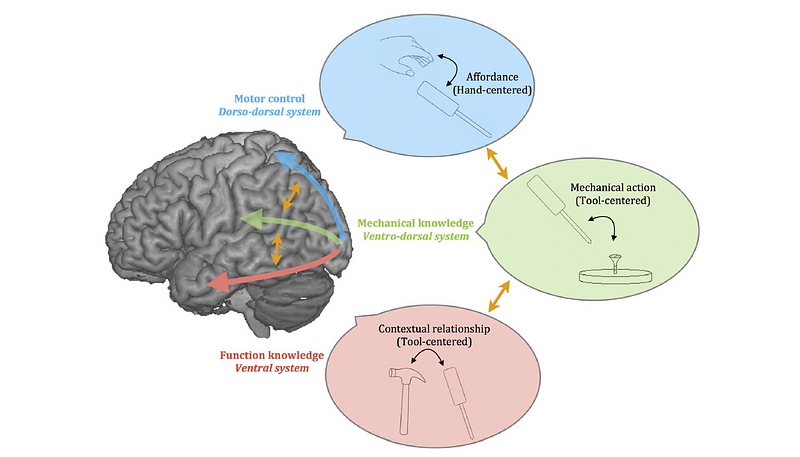
Osiurak, Rossetti, and Badets (2017) suggested a 3AS model for understanding tool-use action, “This model posits the existence of three neurocognitive systems, each concerned by the processing of a specific relationship. The motor control system (dorso-dorsal system) is in charge of processing the perception and actualization of affordances, irrespective of whether the individual grasps and moves tools and objects in a context of tool use or object transport. Mechanical knowledge (ventro-dorsal system) is involved in the processing of mechanical actions to determine how tools and objects can be used together mechanically. The output is the mental simulation of the tool-use action, and this mental simulation can then guide the perception of the corresponding affordances. This explains why there is a double arrow between the motor control system and mechanical knowledge. Function knowledge (ventral system) is useful for specifying potential contextual relationships between tools and objects. This can be helpful to know where to go get tools or objects when they are not immediately available, in function of the mechanical action generated by mechanical knowledge. This explains why there is a double arrow between mechanical knowledge and function knowledge.”
Based on the 3AS model, Osiurak, Rossetti, and Badets argued that the paired object affordance suggested by Humphreys should not be considered as affordance, but a tool-centered contextual relationship.
The most important aspect of Gibson’s ecological psychology and affordance theory is that affordance doesn’t require representations. The 3AS model kept this aspect and criticized non-ecological affordance approaches. Osiurak, Rossetti, and Badets said, “This theoretical framework diverges considerably from several aforementioned conceptions, where affordances are conceived as learned motor representations (e.g., micro-affordances; stable affordance). Not only do we not conceive affordances as representations, but we also do not assume the existence of motor representations, particularly for tool use — as notably proposed by the two action-system model by Buxbaum and Kalénine (2010). According to 3AS, once the intention of action is formed (i.e., the mental simulation of the object’s motion), affordances can be perceived in order to reify this intention into the physical world and the motor control of the implemented action is only an encapsulated sub-routine of the motor control system (Rossetti et al., 2003).”
In fact, the debate about the hammer-and-nail relationship draws our attention to the action system in which affordance is a part of the system.
Part II: Landscape
Part II will highlight the materiality turn and introduce some theoretical ideas from various disciplines.
Hammering as Turn
In the context of organization studies, researchers have been moving to the ‘materiality’ and ‘matter-iality’ of practices and processes at stake in organizations, organizing, and management. They call this movement a “materiality turn”.
According to Faraj and Azad (2012), the materiality turn has three characteristics, “First, they focus on the materiality aspect of technology in an attempt to highlight the objective, realist, and non-mentalist nature of technology. Second, they invariably opine that current ways of representing and studying technology-organizational change, via lenses such as structuration, practices, or emergent views have not offered sufficient theoretical depth or empirical richness regarding the technology appropriation process. Third, they identify technology affordances as a promising means of analyzing and researching the technology appropriation process — especially as a way to rectify the shortcomings of the earlier approaches.”
In a broader sense, the materiality turn echoes the practice turn in social theory (Schatzki, 2001) and the embodied turn in the philosophy of mind and cognitive science.
The following sections shall curate some theoretical ideas about tool-use actions, artifacts, and objects from various disciplines.
Hammer as Concept
As an artifact, Hammer can be used for both “designed use” and “found use”, how about its impact on the human mind?
Hauser and Santos (2007) wrote an essay titled The Evolutionary Ancestry of Our Knowledge of Tools: From Percepts to Concepts and discussed the concept of tools. They identified three groups of conceptual theories of tools and offered the diagram below which presents five theoretical hypotheses.
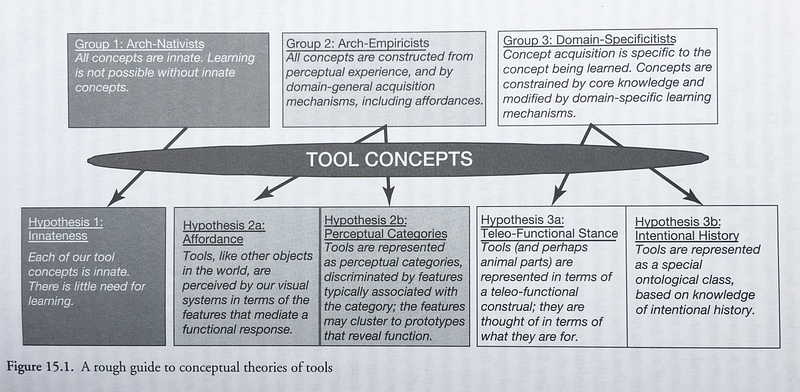
Affordance is one of five theoretical hypotheses with a weak ontological structure. In other words, we probably don’t need the concept of HAMMER. Hauser and Laurie said, “Under this theoretical stance (the affordance perspective), human represent artifacts only on the basis of their physical features. The properties of a hammer, its graspable shape, and hard pounding edge, are taken in by our perceptual systems and simply cry out for the action of hammering. Under this view, however, there is no HAMMER representation, no ontological category of an object with a particular shape that is used for a particular function that tends to be found in a toolbox, and certainly no organizing theoretical framework for organizing HAMMER into the more general concept of ARTIFACT. Our representation of a hammer-like object simply consists of a mapping between certain perceptual features (e.g. smoothness, hardness) and certain functional possibilities (e.g. graspability, poundability).” (p.271)
The hypothesis of Perceptual Category holds a richer ontological stance. Hauser and Laurie pointed out, “Under this view, we possess ontological categories like HAMMER, CHAIR, and CLOCK that are distinguished from each other on the basis of different features. A HAMMER is distinguished from a CHAIR because the former has particular articulated parts (a rigid handle, a hard flat striking edge, etc.), whereas the latter does not. However, this difference is not definitional. Clearly, a hammer with a folding handle that locks into position before you strike something would still be a HAMMER. The prototype view, one variant of the Perceptual Category perspective, suggests that organisms represent different kinds of artifacts as constellations of features; an object with more hammer-like features will be considered a better HAMMER than objects with less hammer-like features. What is important about features from the perspective of distinguishing one object kind from another, however, is that some features are more salient when categorizing artifacts than others. For example, artifacts can readily change some of their perceptible properties without changing kind; the hammer maintains its hammer-ness whether it is blue, red, green, or rainbow-colored. It can, however, lose its hammer-ness if it is a different shape.” (p.273)
The hypothesis of Intentional History highlights the designer behind the artifact. Hauser and Laurie said, “…we call something a HAMMER if its creator designed it with the intention of hammering things. An important consequence of this view is that even if the end-product fails to satisfy the designer’s original intent (e.g. a broken hammer), we can nonetheless call it a HAMMER, albeit a bad one. Importantly for this view, one should not only be able to extract the intentional history of an artifact by seeing the artifact made or being told about it with language, but also by inferring intent from design. Thus, it is not the case that surface design is irrelevant in distinguishing hammers from screwdrivers. Rather, what their design invokes in human minds (at least adults)” is an inference about what an intentional designer initially created them for.” (p.274)
It seems the Intentional History view competes with the Affordance view. One is from the perspective of designers, another is from the perspective of users.
Hammering as Inter(action)
Hammering can be seen as an interaction between man, hammer and nail, or man’s action. From a strict and literal stance, ecological psychologist Edward S. Reed (1996) argued that the behavior between an organism with its environment is not interaction. He said, “I am convinced that the term interaction has lost whatever meaning it used to possess…Interaction as I use the term thus occurs when and only two actors come into some sort of relationship. The environment cannot act on an organism, so one cannot properly speak of an organism interacting with its environment (To repeat, one can and does act within and even on one’s environment.) One can only interact with another animal or person. Interaction in this meaning of the term is, of course, where most of the “action” is in psychology-it is interaction most of us care about and with to understand.” (p.88)
In fact, Reed raised an important issue he didn’t recognize: material agency. For contemporary theorists of social theory, HCI (human-computer interaction) and IS (information system), the meaning and definition of “Social” and “Human” is a critical challenge since the rise of AI and Robot technology. They have been debating on similar topics such as “agency” for many years. For example, Rose and Jones suggested a binary of human-machine agency (2005). HCI scholars Victor Kaptelinin and Bonnie Nardi (2012) also developed a typology of agents to describe different kinds of agency.
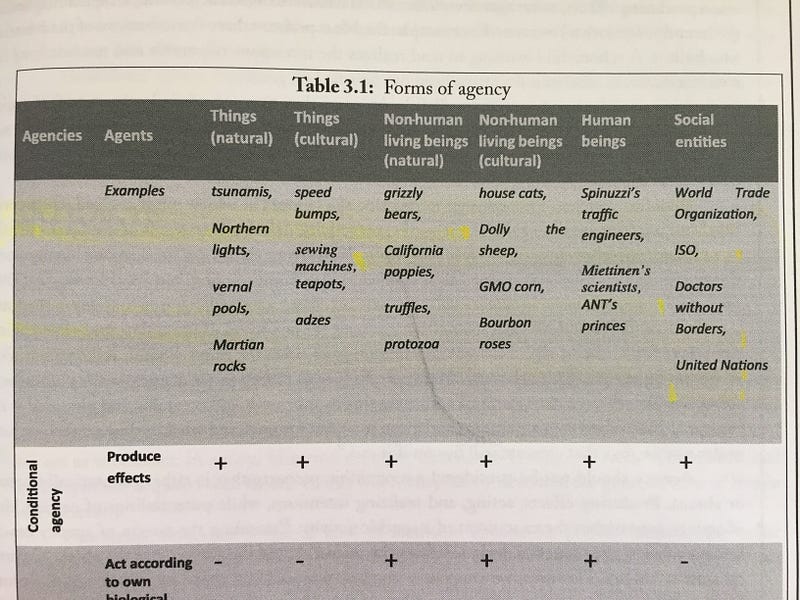
It seems Reed defined “Interaction” as social interaction and “action” as a behavioral event between “actor — non actor”. I coined a new term called Quasi-social Interaction for bypassing this complex philosophical debate.
Hammering as Cultural Activity
What’s a tool? From the perspective of cultural-historical theory of activity, Yrjö Engeström (1990) placed artifacts in the context of human activity and argued that we have to consider multiple meanings of artifacts within a system framework.
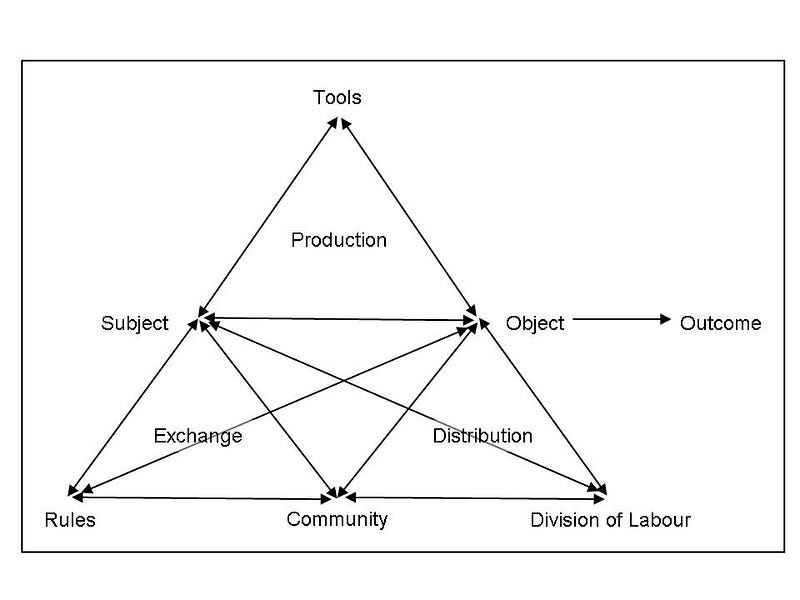
The above diagram is the framework for understanding human activity. Engeström (1990) pointed out, “We may see…individual actions…are the visible tip of the iceberg of collective activity…the activity system consists of (a) the community sharing the same general object, (b) the division of labor between the members of this community, and (c) the rules regulating the actions legitimately taken by the actors.”
Engeström didn’t use a hammer as an example for his argument. Following his diagram, we can test his point by borrowing the example of “Clown and hammer” mentioned by Hauser and Santos (2007), “Similarly, a hammer must at least be harder than the object one wishes to strike, usually a nail. Clown in a slapstick routine will, of course, use foam-rubber hammers in order to hit someone over the head. But this routine makes our point: it is because we expect a hammer to be harder than the object it strike that we find humor in a clown striking a human over the head.” (p.273) From the perspective of activity theory, the slapstick routine is the “activity” as a whole. The clown is the “subject”, the someone is the “object”. The foam-rubber hammer is the “tools”. The “outcome” is the humor performance. The major part of the “community” is the audience. The framework of performance is the “rules”, for example, the clown can’t use a real hammer to strike someone. The “division of labour” is the performance of the clown and someone.
Activity theory also has another useful theoretical aspect which is the hierarchical nature of the human activity and the representational function of artifacts. Engeström (1990) said, “Leont’ev (1978;1981) distinguishes between three levels in human activity. Activity is the molar unit, collective in nature and driven by a complex motive of which the individual actors are seldom aware. Activity manifests itself in the form of goal-oriented individual actions in which the subject is consciously aware of what he or she is trying to accomplish. Actions in turn rely on automatic operations, dependent on the conditions at hand. There are continuous two-way transformations between these levels. Actions are internalized and become automatic operations through repeated practice. On the other hand, actions may also be expanded into novel collective activities.” For the case of clown and hammer, the activity is the slapstick routine, the action is using foam-rubber hammer to hit someone on the stage, the operations may be a) inviting an audience as “someone” to the stage, b) showing the foam-rubber hammer to the audience, c) hit “someone” with the hammer, etc.
The three-level hierarchy of artifacts (including tools and language) was suggested by Marx Wartofsky (1973). According to cultural psychologist Michael Cole (1996), “The first level of Wartofsky’s framework consists of primary artifacts, those directly used in production. As examples, he gives ‘axes, clubs, needles, bowls’.” Obviously, we can claim a real hammer as a primary artifact.
“Second artifacts consist of representations of primary artifacts and of modes of action using primary artifacts. Second artifacts play a central role in preserving and transmitting models of action and belief. They include recipes, traditional beliefs, norms, constitutions, and the like.”(Cole, 1996) For the real hammer, it seems we don’t need the second artifact for helping us to use it. For the case of clown and hammer, we can claim that the foam-rubber hammer and the rules of slapstick routine are second artifacts.
According to Wartofsky, the tertiary artifacts “which can come to constitute a relatively autonomous ‘world,’ in which the rules, conventions and outcomes no longer appear directly practical, or which, indeed, seem to constitute an arena of non-practical, or ‘free’ play or game activity” (1979, p.208, cited in Cole, 1996). We can call tertiary artifacts as imaginative artifacts. According to Engeström (1990), “…novel works of art, socio-political visions, scientific paradigms, religious creeds — typically artifacts that give identity and overarching perspective to collective activity formations.” We may consider the slapstick routine as a tertiary artifact too.
Hammering in Context
The meaning of objects/artifacts/tools is essential for understanding the human mind and action with tools and technology, especially emergent smart objects and robots. Many disciplines have been developing their theoretical concepts and models for addressing this issue. This section recommends more approaches for discussing the relationship between an agent and its environment, especially objects and tools.
- Theoretical biology: Functional tone (Jakob von Uexküll, 1957)
- Activity theory: Functional Organs (Leont’ev, 1981)
- Phenomenology: present-at-hand / ready-to-hand (Martin Heidegger, 1927)
- Sociology (STS): Actant (Latour, 2005)
- Sociology (STS): Boundary Objects (Susan Leigh Star, 1989)
- Anthropology: Bricolage (Claude Lévi-Strauss, 1962)
Jakob von Uexküll (1864–1944) was a German biologist who holds a strong view of subjective ways of perceiving and conceiving. Susi and Ziemke (2005) pointed out, “A central point in his work is the idea that each animal ascribes meaning to the physical objects it encounters, and thereby fits the world to itself, constructing its own subjective universe, or Umwelt. The Umwelt is a closed unit consisting of the subject’s perceptual world (Merkwelt, everything that the subject perceives) and his effector world (Wirkwelt, everything it does). But how do we come to see what things are for, for instance, that a chair is for sitting, or that a cup is for drinking? In the closed unit of subject-object interaction, the objects acquire what von Uexküll (1957, 1982) termed functional tone.”
The concept of Function tone is similar to Affordance, but they hold different theoretical stances, “…according to von Uexküll, each subject lives in its own subjective universe, in which subject and object form a closed unit. Initially objects are neutral, but as a subject enters into a relationship with an object, the latter becomes meaningful. Subjects imprint meaning upon the objects and transform them into meaning-carriers. As an object becomes a meaning-carrier it assumes a certain functional tone. Which functional tone it assumes depends on the subject’s prevailing mood and, consequently, one and the same object may acquire different meanings in different Umwelts.” (Susi and Ziemke, 2005)
For Gibson, the affordance theory doesn’t need a subjective umwelt since the environment is one environment. He said, "the niche for a certain species should not be confused with what some animal psychologists have called the phenomenal environment of the species. This can be taken erroneously to be the 'private world' in which the species is supposed to live, the 'subjective world,' or the world of 'consciousness.' The behavior of observers depends on their perception of the environment, surely enough, but this does not mean that their behavior depends on a so-called private or subjective or conscious environment. The organism depends on its environment for its life, but the environment does not depend on the organism for its existence." (1979/2015, p.121).
The last section has mentioned activity theory. Functional organs is a member of several theoretical concepts of activity theory developed by (Leont’ev 1981). According to Victor Kaptelinin (1995), “Functional organs are functionally integrated, goal-oriented configurations of internal and external resources. External tools support and complement natural human abilities in building up a more efficient system that can lead to higher accomplishments. For example, scissors elevate the human hand to an efficient cutting organ, eyeglasses improve human vision, and notebooks enhance memory. The external tools integrated into functional organs are experienced as a property of the individual, while the same things not integrated into the structure of a functional organ (for example, during the early phases of learning how to use the tool) are conceived of as belonging to the outer world.” While functional organs considers the social and cultural contexts, Gibson’s affordance theory only focuses on natural and physical environments.
Martin Heidegger (1889–1976) was a German philosopher whose work is most readily associated with phenomenology and existentialism. His theoretical concept “present-at-hand” and “ready-to-hand” is similar to Gibson’s affordance too. According to Heidegger (1927), “the present-at-hand way of being in which entities are encountered as objects with properties is a derivative way that humans can relate to the world (for example to reflect mindful) that is grounded ultimately in our practical understanding of the work (for example through using equipment)…all entities oscillate between these two separate modes: the cryptic withdrawal of readiness-to-hand and the explicit accessibility of present-at-hand.” (cited in Lanamaki, Thapa and Stendal, 2015)
Lanamaki, Thapa, and Stendal (2015) review papers about affordance from the Heideggerian perspective. They said, “Looking at the properties of chair and then actualizing the affordances in Heideggerian term is to go from present-at-hand mode to ready-to-hand mode. However, Heidegger said in everydayness we do not observe properties, but just use it (e.g.. we just sit on the chair and do not care about the properties of the chair). Having said that the properties of chair are important to provide functional affordances, but in everyday practice we never reflect on the properties, but put the chair into referential totality, for example in an office or in a dining room or in a theatre.” This view doesn’t accurately understand Gibson’s affordance theory which doesn’t require “reflect on the properties”. In fact, Gibson argued that we just directly perceive affordances of the environment including objects such as chairs. Thus, we should consider affordance which is a scientific concept as a solid foundation for supporting Heidegger’s philosophical concepts.
STS stands for Science & Technology Studies, two major ideas of the field of STS are Bruno Latour’s ANT (Actor-network theory) and Susan Leigh Star’s Boundary Object. While traditional sociology theory sees non-human as resources, constraints, or objective realities, ANT considers humans and non-humans as actants which highlight the agency of non-human. One example of actants is speed bump, according to Davis and Chouinard (2017), “…speed bumps request that drivers slow down (Latour, 1994), creating discomfort, fear, and possibly vehicular damage should a driver maintain constant road speeds. However, the speed bump does not make high speeds impossible. Rather the speed bump makes one way of driving (slow) more seamless than another (fast).” David and Chouinard claimed that this “request” is a special type of mechanism of affordance. We have to notice that they adopted a conceptual definition of affordance from Evans et al. (2017) as “the ‘multifaceted relational structure’(Faraj & Azad, 2012, p.254) between an object/technology and the user that enables or constrains potential behavioral outcomes in a particular context” (p.36).
Boundary Objects is a concept coined by Susan Leigh Star for studying institutional ecology which includes different types of actors such as amateurs, professionals, and administrators. Leigh challenged Latour-Callon’s view of ANT and expanded it to two activities: standardization of methods and the development of “boundary objects”. According to Leigh (1989), “Boundary objects are objects which are both plastic enough to adapt to local needs and the constraints of the several parties employing them, yet robust enough to maintain a common identity across sites. They are weakly structured in common use, and become strongly structured in individual use. These objects may be abstract or concrete. They have different meanings in different social worlds but their structure is common enough to more than one world to make them recognizable, a means of translation. The creation and management of boundary objects is a key process in developing and maintaining coherence across interesting social worlds.”
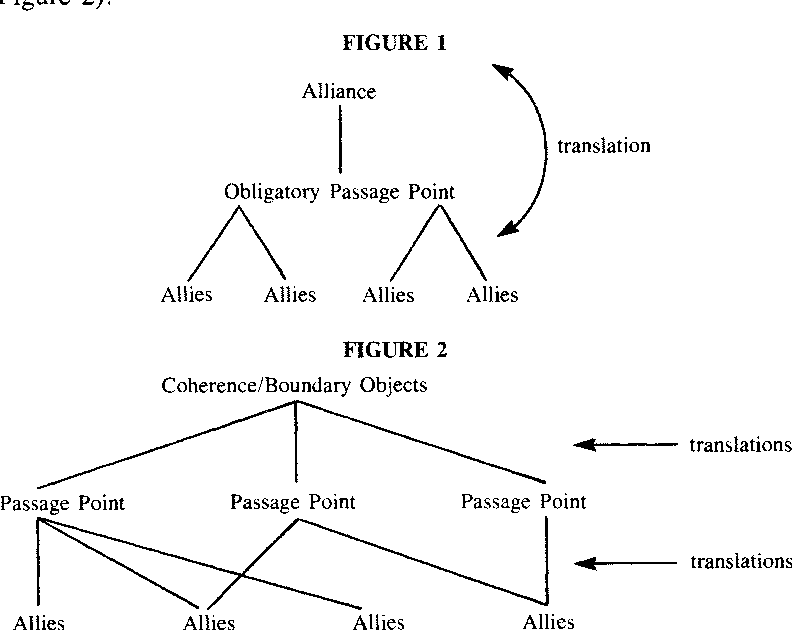
The above figure 1 shows translation in ANT (actor-network theory), figure 2 shows an expanded model of ANT which includes boundary objects. Leigh (1989) also suggested four types of boundary objects: repositories, ideal type, coincident boundaries, and standardized forms. Repositories are ordered “piles” of objects that are indexed in a standardized fashion, such as a library or museum. An ideal type is an object such as a diagram, atlas, or other description that in fact does not accurately describe the details of any one locality or thing. Coincident boundaries are common objects that have the same boundaries but different internal contents. Standardized forms are boundary objects devised as methods of common communication across dispersed work groups.
It seems that the concept of boundary objects is similar to affordance. In a general sense, both two ideas adopt ecological approaches. However, boundary objects are for studying social worlds while affordance is for studying natural and physical environments. The most important issue is they pay attention to two different things, boundary objects focus on heterogeneity and cooperation in social activity level while Gibson’s affordance is all about individual visual perception.
Bricolage was introduced by cultural anthropologist Claude Lévi-Strauss (1962) in his book The Savage Mind which describes two kinds of minds: the savage mind and the scientific mind. The bricoleur holds the “savage mind” while the engineer holds the “scientific mind”. Levi-Strauss argued that mythological thought is more like the bricoleur and modern western science works more like an engineer. Bricolage refers to the skill of using whatever is at hand and recombining them to create something new. Though Lévi-Strauss used Bricolage for discussing mythology, the idea is very popular in modern entrepreneurship research. I personally like to connect it with affordance and other related ideas such as resourcefulness and creative actions.
Part III: Future
Part III will go further to discuss a possible direction: Artifact-centered Interaction (ACI).
Hammering as Ecological Reality
The above discussion mentions many versions of affordance. According to Davis and Chouinard (2017), the concept of affordance is integral to scholarly analysis across multiple fields, “Affordance has emerged as a central analytic tool within science and technology studies, ecological psychology, communication studies, and design fields… As an interdisciplinary construct, affordance is both persistent and pervasive across literatures. The term’s development and diffusion has generated both keen analytic insight and also, dense theoretical and philosophical debate.”
I’d like to suggest three views on the concept of affordance:
- Ecological affordance: this is the original version offered by Gibson.
- Universal affordance: this is an interdisciplinary construct for analysis.
- Affordism: this is a philosophical view inspired by Gibson’s ideas.
Since many authors coined their own version of affordance, I use Ecological Affordance to refer to Gibson’ original version. For Gibson, an affordance is a statement about the mutuality of the animal and environment, it is “…an affordance is neither an objective property nor a subjeceive property; or it is both if you like. An affordance cuts across the dichotomy of subjective-objective and help us to understand its inadequacy. It is equally a fact of the environment and a fact of behavior. It is both physical and psychical, yet neither. An affordance points both ways, to the environment and to the observer.” (Gibson, 1979, p.121). Psychologists usually place their theoretical concepts either in the environment (objective) or the mind (subjective). Gibson didn’t agree with both sides. In other words, Gibson was against the Cartesian dualism (Mind-body dualism). This is the core of Gibson’s ecological approach.
In other words, ecological affordance is about Ecological Reality. Gibson said, “The world of physical reality does not consist of meaningful things. The world of ecological reality, as I have been trying to describe it, does. If what we perceived were the entities of physics and mathematics, meanings would have to be imposed on them. But if what we perceive are the entities of environmental science, their meanings can be discovered. (1979, p.28) If we want to keep using Gibson’s original version of affordance for the modern technological environment, we need to consider human acting in the digital environment as an ecological reality. This is why I adopted the whole Ecological Physics Method for studying Twitterville.
Making a New Nail
Obviously, there is a need to develop a construct such as Universal Affordance which can refer to the interactive relationship between humans and various forms of objects and different contexts.
The term “intersubjectively” is for describing the relationship between people. The term “interobjectivity” is not a solid concept yet, according to some authors, it at least has two meanings, “(a) inter-objectivity as a description of object-relations; (b) interobjectivity as a description of a representation spanning different objectifications, and that permits diverse inter-objective relations” (Sammut, Daanen and Sartawi, 2010).
It seems we need a similar term to describe the “the inter subject-object/artifact relationship”. Can Universal Affordance service this need? I think the term “affordance” has a weakness from a linguistic perspective. According to Gibson (1979), “The affordance of the environment are what it offers the animal, what it provides or furnishes, either for good or ill. The verb to afford is found in the dictionary, but the noun affordance is not. I have made it up.”(p.119)
We have to notice the “afford” part of “affordance” has its special meaning which refers to Gibson’s philosophical stance behind the affordance theory. For Universal Affordance or “the inter subject-object/artifact relationship”, the term “Affordance” limits its potential of encouraging diverse theoretical approaches. In other words, we can’t use a word strongly tied to the ecological approach to describe a general ontology.
If Gibson’s ecological affordance is a hammer, then Gibson’s nail is visual perception. Now, we are making a new nail that refers to “the inter subject-object/artifact relationship”, can we use universal affordance to name this new nail?
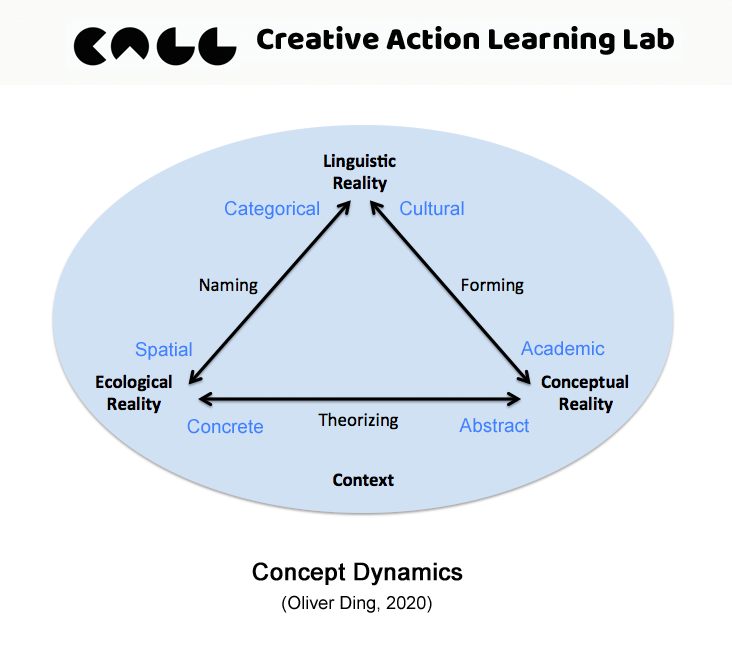
As Berger et al. (1972) argue, “it is difficult to build meaningful theoretical research programs without concepts that are internally consistent and clearly defined in relation to other existing concepts.” (cited in Kallinikos, Leonardi, and Nardi, 2012). In order to discuss the complexity of theoretical concepts, I created the above diagram which suggests every theoretical concept has three basic aspects: ecological reality, conceptual reality, and linguistic reality.
- Ecological reality refers to the real experience of discovery in the real world from the perspective of researchers.
- Conceptual reality refers to the outcome of the creative conceptualization process.
- Linguistic reality refers to expressional form with verbal and rhetorical effects.
Based on the framework, I believe that an ideal theoretical concept should not have intrinsic contradictions between these three aspects and extrinsic contradictions between these aspects and context which means the dynamic background of concepts. Thus, it is hard work to create an ideal theoretical concept. The more harder work is detaching an existing concept from its original context and attaching it to a new context by reconceptualizing it with new meaning.
For example, Davis and Chouinard (2017) published a paper titled Theorizing Affordances: From Request to Refuse. They argued “…the following shortcomings: definitional confusion, a false binary in which artifacts either afford or do not, and failure to account for diverse subject-artifact relations. ” From this argument, we know what they want is a concept for understanding “diverse subject-artifact relations.” But Gibson’s affordance theory only offers one approach (“afford”) for explaining this relation. Thus, they adopted the reconceptualization of affordance from Evans et al (2017) and Faraj & Azad (2012) as a working foundation and identified six mechanisms of “new affordance”: request, demand, allow, encourage, discourage, and refuse. Furthermore, they also suggested three interrelated conditions of “new affordance”: perception, dexterity, and cultural and institutional legitimacy.
If we only consider its ecological reality and conceptual reality, this research is excellent. The authors found several real examples from real lifeworld (ecological reality) and discovered several mechanisms and conditions of subject-artifact relations (conceptual reality). However, if we look at its linguistic reality, there is a bug we can’t ignore. The “afford” is competing with “request, demand, allow, encourage, discourage, and refuse.” Instead of accepting the “tradition”, they should coin a new term to frame their creative insights and establish a new theory.
Making a New Hammer
Finally, I’d like to suggest a framework for discussing Universal affordance or “diverse subject-artifact relations.”
First, I coin a new term called “Artifact-centered Interaction (ACI)” to refer to “diverse subject-artifact relations.” Thus, we don’t need Universal Affordance anymore. The ACI has three parts: artifact—human interaction, artifact—artifact interaction, and artifact—natural object interaction. Let’s use the hammer-hammering case again, a stone is a natural object, and a nail and a small pink dumbbell are artifacts. If I use a dumbbell for hammering, then we see two types of ACI acts, “I — dumbbell” is artifact — human interaction, and “dumbbell — nail” is an artifact — natural object interaction. If I use a stone for hammering, then we see the third type of ACI act, “stone — nail” is artifact—natural object interaction.
If the HCI (Human-computer interaction) is an old nail, then the ACI (Artifact-centered Interaction) is a new nail. Now we need to make a new hammer too.
Second, I apply four dimensions to two components (artifact and human) and make the following chart titled the landscape of Artifact-centered Interaction.
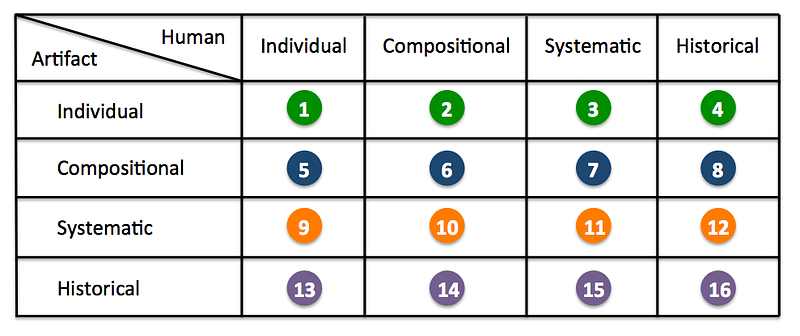
The four dimensions are individual, compositional, systematic, and historical. I don’t consider the imaginative and fictional dimensions, you can add them to the chart if you need it. The idea behind these four dimensions is ecological complexity such as quantity (quantitative complexity), space (spatial complexity), and time (temporal complexity). The individual dimension only considers one entity such as one artifact and one person. The compositional dimension and systematic dimension both consider multiple entities, but the former refers to a loose relationship within a group of entities while the latter refers to a group of entities with a stable structure. The historical dimension considers non-existing entities and cultural-historical development of entities.
As a heuristic tool for theoretical thinking, this chart identifies 16 niches which mean creative spaces of theory-building. For example, we can place Gibson’s affordance at the nice #1. My own idea Curativity theory is about curating pieces into a meaningful whole, thus I can place it in niche #5. My other idea Social Platform Design is about one artifact with many people, and it locates in niche #2. Most researchers of IS (information systems) and communication, they pay attention to the context of organizations, thus their ideas belong to niches #3, #7, #11, and #15. For some archaeologists, their theories can be placed in niche #16. For example, Ian Hodder’s entanglement theory (Entangled, Hodder 2012) can be seen in niche #16 but his other idea assemblage (Assembling catalhoyuk, Hodder and Marciniak 2015) should be placed in niche #7.
Third, I select seven pairs of theoretical themes for studying Artifact-centered Interaction. Each pair of themes has one normal theme and one radical theme, thus they form two groups of themes.
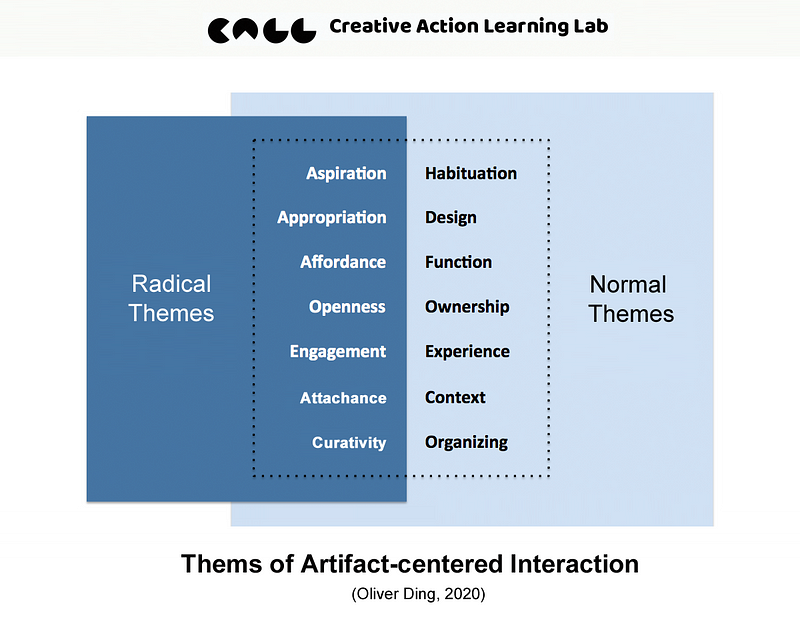
Some themes are adopted from Design scholars and HCI researchers. For example, the pair of “Affordance — Function” is adopted from Jonathan Maier who is the author of Affordance Based Design: Theoretical Foundations and Practical Applications (2011). He combined Gibson’s affordance theory and the complexity of science together and developed a new framework for engineering design. He compared the relational nature of affordances and the transformative nature of function and suggested, “…if interactions (between designers, artifacts, and users) are not important, then the mechanistic paradigm is all we need, but if such interactions are important, then an affordance based paradigm is supported. How can we tell such interactions are important? One way is by comparing affordance based versus functional descriptions of artifacts. If interactions of the type under question are not important, then an affordance based description should be no better than a functional one, but if the affordance based description is indeed more powerful, i.e., it describes more (qualitatively and/or quantitatively) about artifacts, then this validates the affordance based paradigm from which it came.” (p.59)
Faraj and Azad (2012) also highlighted the difference between technology-in-design and technology-in-use, “Designers typically work with a typical user or a class of users in mind. They often do not see a wide variability among users and emphasize the goal of ‘good’ as opposed to ‘bad’ design. A good technology design is one that makes the majority of users effortlessly aware of the usability of the device in question…This perspective underlies the success of Apple inc. designed computer and devices where the products function seamlessly and intuitively as long as users follow the pre-established use pattern. ” Though design researchers have adopted Gibson’s affordance for “technology-in-design” such as intuitive design, Faraj and Azad argued that “the affordance perspective is less about intuitive design and more about recognizing the unexpected, situated, and emergent actions that actors may want to engage in with their devices.”
Scholars also used other words such as “appropriation” to describe the difference between “design” and “use” (Jennie Carroll, 2004; Wakkary & Maestri, 2008). According to Carroll, “Appropriation describes the way that users ‘take possession’ of a technology innovation over time. This is more fundamental than configuring a packaged system prior to implementation or tailoring it to individual users’ needs. Appropriation involves mutual adaptation: users reshape the features of an ICT (information and communication technologies), they may use it for unanticipated purposes and at the same time their practices are shaped by the ICT.” Wakkary & Maestri argued that the traditional understandings of use and design are too limited, and they suggested adopting the notion of Design-in-use which is understood as the ongoing design and change through the use of artifacts and surroundings.
User Experience (UX) is a popular term for designers and researchers. In 2020, HCI scholar Nelson Zagalo published a book titled Engagement Design and proposed to move the discussion from Experience to Engagement. He argued, “Experience has become a complex buzzword, which is more about the subject’s experience than the product, and this is why it’s difficult, or even impossible, to define it in a concise manner.” You can follow Zagalo on Medium and read this article about his approach.
I put my two ideas into the radical group, one is Attachance and another one is Curativity. For ACI, Attachance can be understood as the meaning and value of detaching an artifact from one context and attaching it to another context. Curativity refers to curating pieces into a meaningful whole.
If You Have A Hammer…
There is a popular idea called the law of the instrument or Maslow’s hammer. It has several versions. One of them is:
If all you have is a hammer, everything looks like a nail.
I’d like to reverse this law, let’s say “If you have a nail, everything could look like a hammer.”
You are most welcome to connect via the following social platforms:
Twitter: https://twitter.com/oliverding Doowit: https://doowit.co/profile/gm0k2ax9 Linkedin: https://www.linkedin.com/in/oliverding
License
This work is licensed under the Creative Commons Attribution-NonCommercial-ShareAlike 4.0 International (CC BY-NC-SA 4.0) License. Please click on the link for details.
References
Carroll, J. (2004). Completing design in use: closing the appropriation cycle. 337–347.
Cole, M. (1996). Cultural psychology: a once and future discipline. The Belknap Press of Harvard University Press.
Davis, J. L., & Chouinard, J. B. (2017). Theorizing affordances: from request to refuse. Bulletin of Science, Technology & Society, 36(4), 241–248. https://doi.org/10.1177/0270467617714944
Engeström Y (1990). What is a tool? multiple meanings of artifacts in human activity.
Faraj, Samer & Azad, Bijan. (2013). The materiality of technology: an affordance perspective. 10.1093/acprof:oso/9780199664054.003.0012.
Gibson, J.J. (1979/2015). The ecological approach to visual perception: classic edition. New York: Psychology Press. (originally published in 1979).
Goffman, E. (1974). Frame analysis: an essay on the organization of experience. Harper & Row.
Hauser, M. D., and Santos L. D. (2007). The evolutionary ancestry of our knowledge of tools: from percepts to concepts In E. Margolis & S. Laurence (Eds.) Creations of the mind: theories of artifacts and their representation (p.267–288). Oxford University Press.
Heft, Harry (2001). Ecological psychology in context: James Gibson, Roger Barker, and the Legacy of William James ’s radical empiricism. New York: Psychology Press.
Ingold, T. (1993). Tool-use, sociality, and intelligence. In K.R. Gibson & T. Ingold (Eds.) Tools, language and cognition in human evolution (pp.429–445). Cambridge University Press.
Kallinikos J., Leonardi, P. M., & Nardi, B.A.(2012). The challenge of materiality: origins, scope, and prospects. In P. M.Leonardi, B. A. Nardi, & J. Kallinikos (Eds.) Materiality and organizing: social interaction in a technological world. (p.5). Oxford University Press.
Kaptelinin V., & Nardi B. (2012). Activity theory in HCI: fundamentals and reflections. Morgan & Claypool Publishers.
Kaptelinin, V. (1995). Computer-mediated activity: functional organs in social and developmental contexts.
Lanamaki, A. & Thapa, D. & Stendal, K. (2015) What does a chair afford? a heideggerian perspective of affordances.
Maier, J. (2011). Affordance based design: theoretical foundations and practical applications. VDM Verlag Dr. Müller.
Osiurak, François & Rossetti, Yves & Badets, Arnaud. (2017). What is an affordance? 40 years later. Neuroscience & Biobehavioral Reviews. 77. 10.1016/j.neubiorev.2017.04.014.
Reed, E.S. (1996). Encountering the world: toward an ecological psychology. Oxford University Press.
Star, S.L., & Griesemer, J.R. (1989). Institutional ecology, `Translations’ and boundary objects: amateurs and professionals in Berkeley’s Museum of Vertebrate Zoology, 1907–39. Social Studies of Science, 19, 387–420.
Susi, T., & Ziemke, T. (2005). On the subject of objects: four views on object perception and tool use.
Ron Wakkary & Leah Maestri (2008) Aspects of everyday design: resourcefulness, adaptation, and emergence, International Journal of Human–Computer Interaction, 24:5, 478–491, DOI: 10.1080/10447310802142276
Zagalo, N. (2020). Engagement Design: designing for interaction motivations. Springer.


