
D as Diagramming: Meta-theory and General Practice
On August 7, 2021, I shared the Activity U project on Twitter and King Soma asked a question about the Theme U. You can find details of the conversation here.
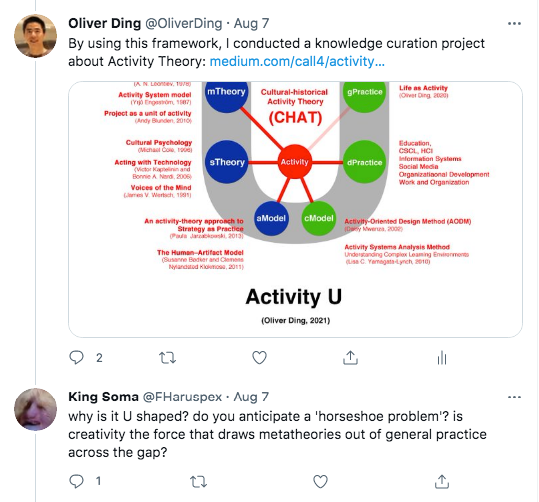
King Soma’s question inspired me to reflect on the connection between metatheories and general practice. Though I have highlighted it in the original diagram of the shape U, I didn’t pay attention to it.
The reflection led to a diagram blending work. On August 8, 2021, I put the Theme U diagram and the 3I model together and designed a new diagram below.
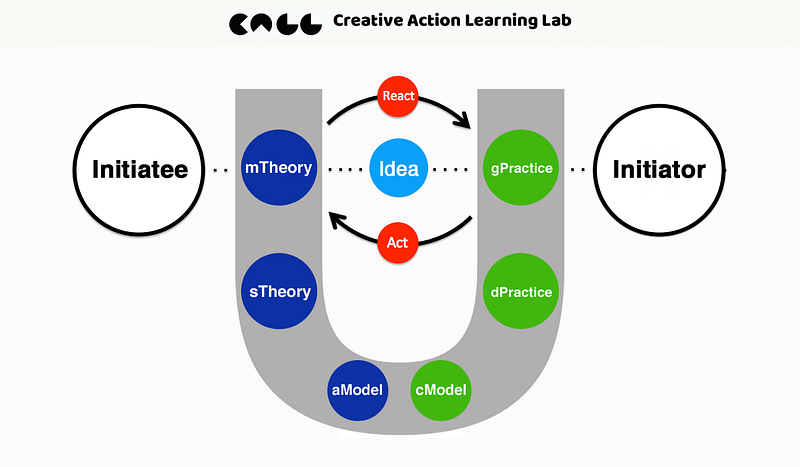
This post provided more details about this diagram blending work. Part 1 is about the background of the conversation. Part 2 focuses on the diagram blending work and related discussion. Part 3 offers a conclusion.
Contents
Part 1: Background
Part 2: A Diagram Blending Work
2.1 The 3I model 2.2 Creative Writing as a Creative Action 2.3 From Percepts to Concepts 2.4 The case of Supportance Theory 2.5 The Concept Dynamics framework
Part 3: Conclusion
Part 1: Background
The Theme U diagram is a simple version of the WXMY diagram. For example, the diagram below (the HERO U diagram) is a Theme U diagram for connecting Theory and Practice.
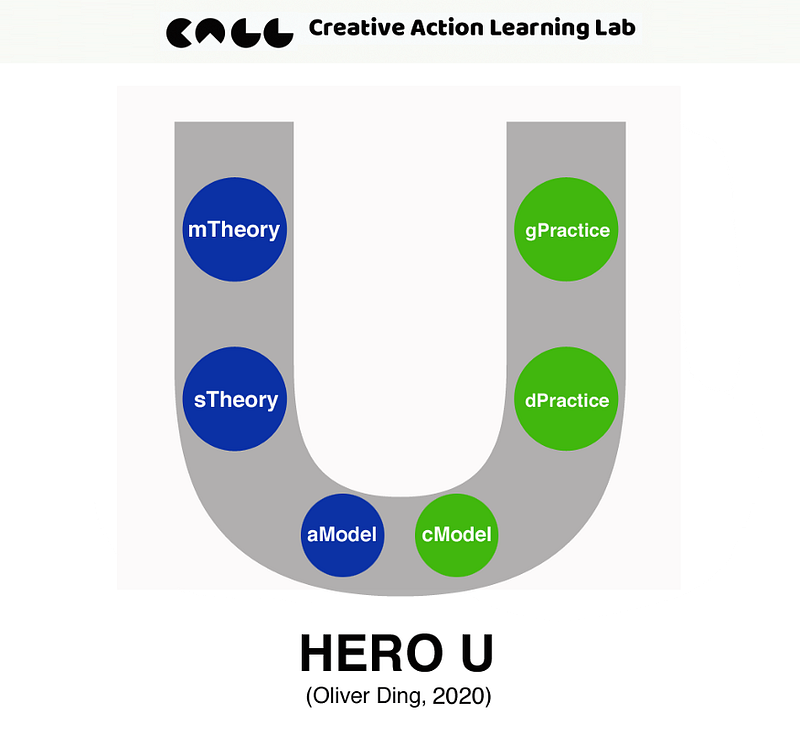
The HERO U diagram looks like a pipeline and balls. It presents six types of “Objective of Knowing”. Let’s look at the terms I used for the diagram.
mTheory: Meta-theory sTheory: Specific Theory aModel: Abstract Model cModel: Concrete Model dPractice: Domain Practice gPractice: General Practice
Its advanced version is the diagram below. There is a connection between mTheory (meta-theory) and gPractice (General Practice).
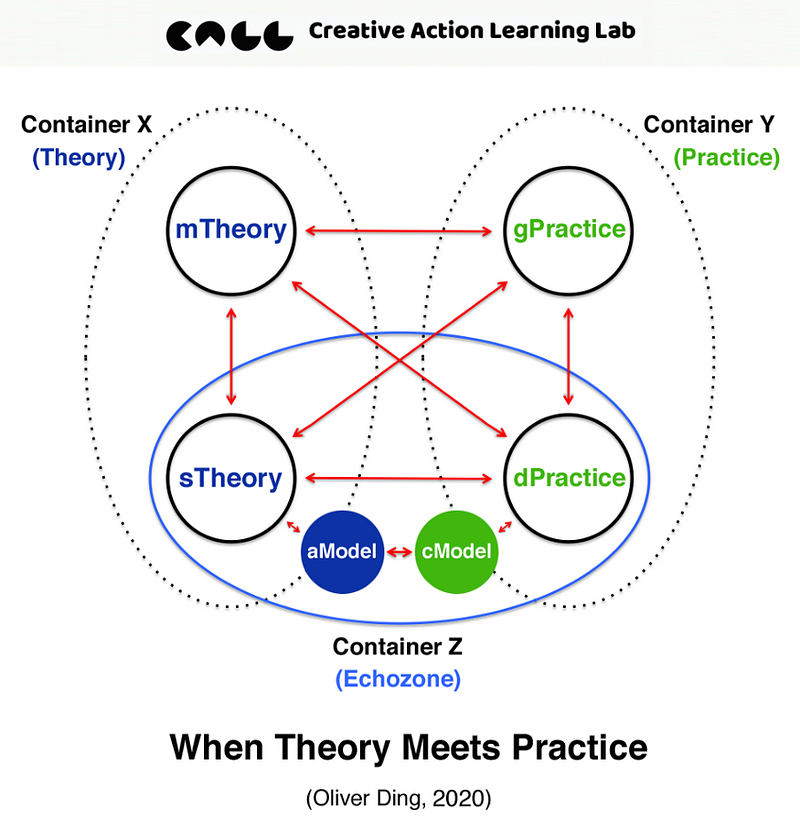
Theme U is not only about six themes, but about representing complex thematic relationships with spatial mediation. For example, I used the following diagram to explain representing Pairs of Opposite Themes with the Theme U diagram.
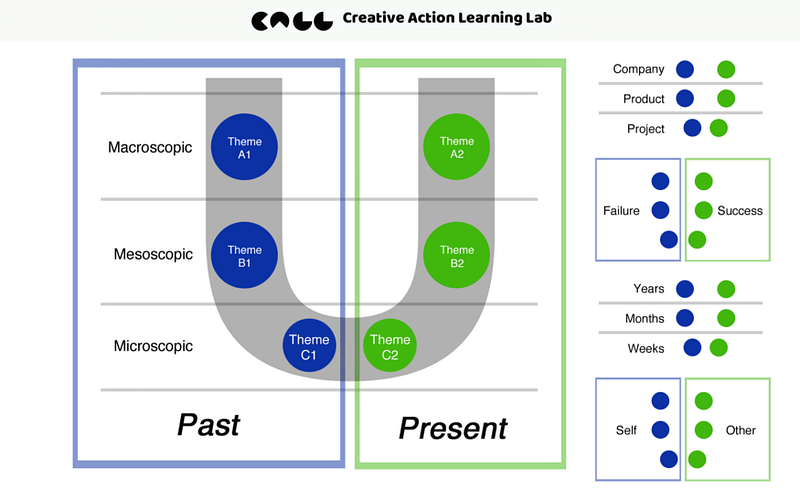
The meta-diagram of the WXMY diagram is a three-container diagram. There is a clear boundary between Container X and Container Y. Container Z connects to both X and Y, thus the Z is a creative space which is named ECHOZONE.
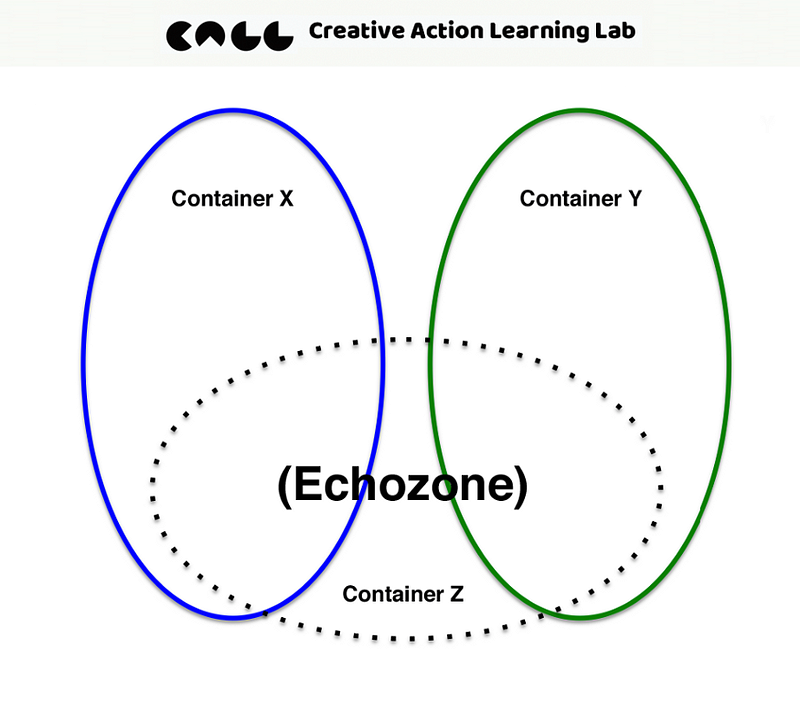
To be honest, I only pay attention to the third container ECHOZONE, and consider it as “Figure” and the space outside the ECHOZONE as “Ground”.
I have shared my real experience of ECHOZONE from the Activity U project in a previous article Personal Innovation as Career-fit. I also wrote a book titled THE ECHO WAY: Echozone and Boundary Knowledge Work in April. The book introduces the “When Theory Meets Practice” diagram and what I learned from the Activity U project.
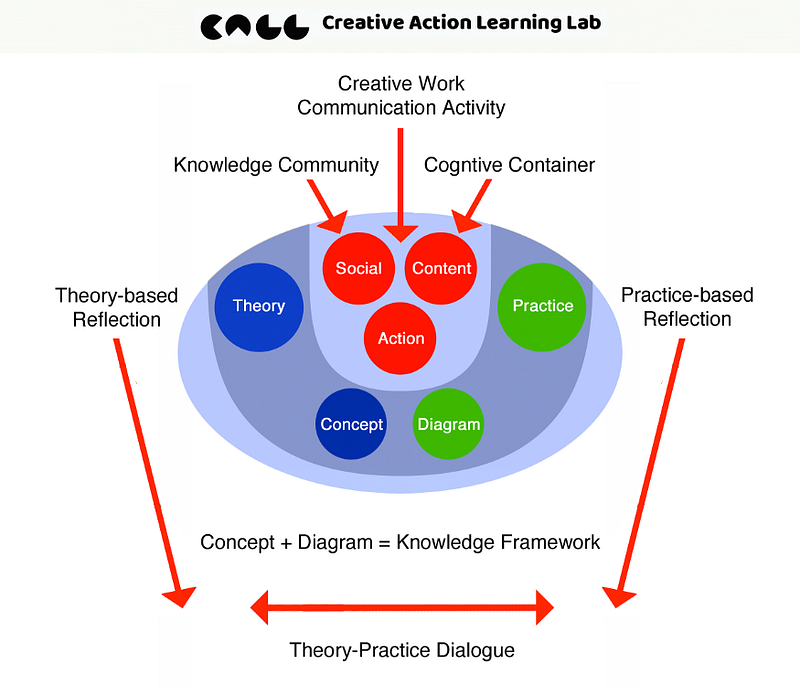
King Soma’s question guides me to think outside the Echozone. This is an amazing unframe journey. I have to detach from the ECHO Way framework and think about the relationship between Meta-theory and General Practice from different perspectives.
Part 2: A Diagram Blending Work
Though I put a link to connect Meta-theory and General Practice, I have not figured out the real meaning of the connection yet. In order to reply to King Soma’s question, I thought about the issue for a while and adopted the 3I model to help me answer this question. The diagram below is the outcome of the thinking process.
What does the above diagram mean?
Let’s unpack the diagram from the perspective of the 3I model:
- There is an “idea” behind a “creative action”.
- There are two types of roles: “Initiator” and “Initiatee”.
- An Initiator initiates an act which is a creative action.
- An Initiatee responds to the Act initiated by the Initiator.
Let’s apply the 3I model to understand the connection between Meta-theory and General Practice.
- Idea = Meta-theory
- Actors = Initiator
- Theorists = Initiatee
It means meta-theories are discovered by theorists from real creative actions initiated by actors.
If an actor discovers a meta-theory behind a creative action in his real life. That means the actor becomes a theorist.
Of course, this is a super simple basic model. In real life, the theorist and the actor may work together on several rounds of “act-react” in order to turn a rough idea into a well-crafted theory.
2.1 The 3I model
As the diagram below shows, the 3I model has three core entities which are idea, initiator, and initiatee. It also considers two types of events: act by the initiator and react by the initiatee. Finally, the model considers the platform as the context of entities and events.
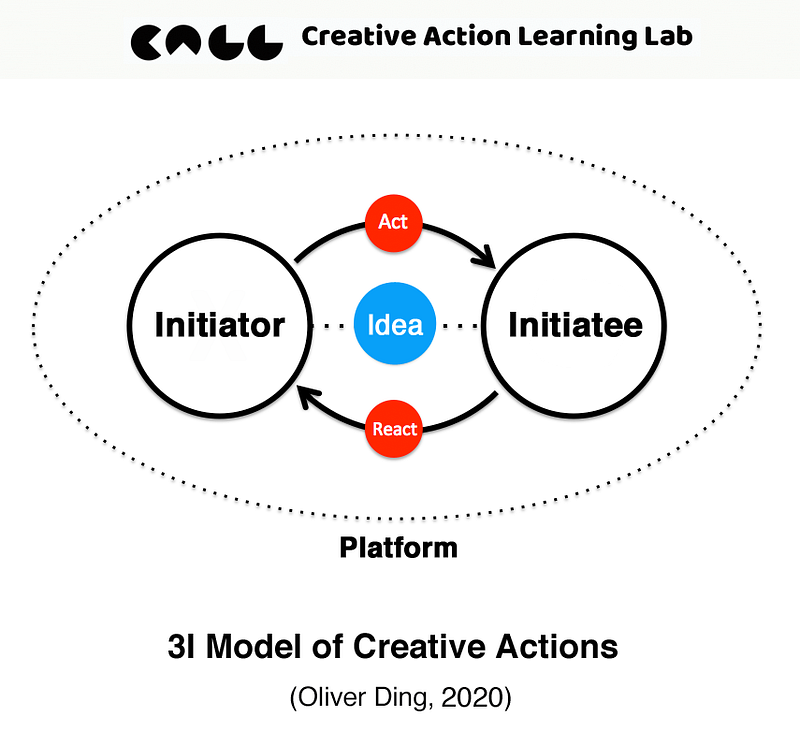
The 31 model is part of my thoughts about the “Process as Product” view on Creativity. A problem with theorizing creative actions is there is no product that remains after acting. In order to make the “Process as Product” approach possible, I use the term “Idea” to refer to the product aspect of creative actions and use the term “Act/React” to refer to the process aspect. This pair of concepts solve the problem of disappearing immediate experience. I further consider the “Idea” has three elements including name, form, and content.
Most intended creative actions have a short name and hashtag, sometimes unintended creative actions don’t have a name. The screenshot below shows an example of unintended creative actions.
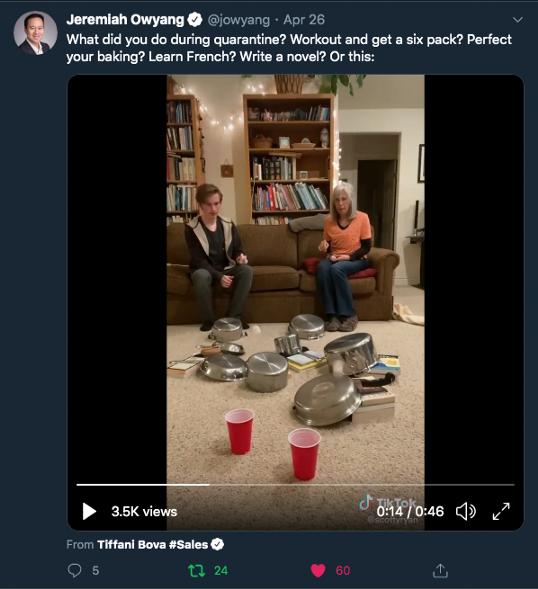
The second pair of concepts are “Initiator” and “Initiatee”.
Initiator refers to a person who initiates an act that makes “a grand opening” of a creative action. Initiatee refers to a person who responds to the initiator’s “call-to-action”.
For most intended creative actions, it is easy to identify the Initiator and the Initiatee behind a creative action. However, it is not easy to do the same analysis on unintended creative actions.
The third pair of concepts is Act and React. We apply it to both Sawyer’s performance creativity and stay-at-home challenges. For performance, the “Act” is performing and the “React” is feedback from the audience. For stay-at-home challenges, the “Act” is the original action and the “React” is the following actions. For intended creative actions, the initiator might specify what initiatees should do while untended creative actions don’t have such strong intentions.
2.2 Creative Writing as a Creative Action
How about reading-based theory development? Can we apply the above diagram for academic theory building? I think we can apply the 3I model to such cases as well if we consider creative writing as a creative action.
On July 21, 2020, I wrote an article titled Frame Analysis in Context which recorded my experience of reading Erving Goffman’s book Frame Analysis. I considered Erving Goffman’s creative wiring as a creative action and applied the 3I model to my reading case.
Initiator
Erving Goffman
Initiatee
Oliver Ding
Act:
Erving Goffman wrote the sentence “I try to follow a tradition established by William James in his famous chapter ‘The Perception of Reality,’ first published as an article in Mind in 1869” in 1974.
React:
I found several books about William James at home and found the article and took pictures in 2020.
Idea:
William James on Reality.
Platform:
Harvard University Press can be seen as the platform for Erving Goffman’s creative writing for Frame Analysis.
Initiator refers to a person who initiates an act that makes “a grand opening” of a creative action. Initiatee refers to a person who responds to the initiator’s “call-to-action.” For my reading case, I consider Goffman as an unintended initiator who didn’t have a strong intention on what initiatees should do.
The “Act” is the original action and the “React” is the following actions. The 3I model doesn’t require Act and React should be real-time.
For intended action, the “Idea” has three elements including name, form, and content. For unintended actions, these three elements are not required.
I also mentioned some “Ideas” may contain multiple layers and each layer is a creative space. This means we can also understand creative writing in multiple layers. The above example is writing a sentence which is a sub-creative action of writing a whole book.
Though the 3I model was developed for discussing non-content creative action, the above test tells us it can be used as a general model for interpreting creative content with the perspective of Action-based Creativity. I have pointed out that Action-based Creativity goes beyond creative actions because it also considers Action-based creative content.
2.3 From Percepts to Concepts
General Practice is about the daily experience while Meta-theory is about the concept. The process of “React” is about turning daily experience into theoretical concepts.
My approach is inspired by James J. Gibson’s ecological psychology. According to Harry Heft, the theoretical root of Gibson’s ecological psychology is William James’ Radical Empiricism. Inspired by Heft, I adopted the concept of Selectivity from Radical Empiricism.
Heft (2012) pointed out, “…in radical empiricism, knowing refers most fundamentally to a functional relation in experience between a knower and an object known. The defining characteristic of knowing is selectivity. Through knowing processes, structure is selected out of, or differentiated from, immediate experience. It is now time to consider the products of selective processes. To use James’s terminology, two products of the selectivity of knowing processes are percepts and concepts.”(p.37)
In order to develop Curativity Theory, I used “Double Selectivity” to describe the foundation of curating. Now, I will expand it to describe two sub-processes of “React”.
- First sub-process: the Selectivity of Perceiving
- Second sub-process: the Selectivity of Thinking
According to Heft, “Perceiving is an action that entails selection of a flow of immediate experience out of the potential ground that is pure experience. Thinking or conceiving entails, in turn, selecting and fixing particular parts of this perceptual flow. Through this process, concepts are carved out of immediate perceptual experience at a remove from action and are abstracted from it. Abstracting from the immediate flow of experience makes it possible for the knower to isolate, and then to classify or otherwise manipulate, these extracted ‘moments.’ This cognitive capability enlarges the knower’s epistemic potential in incalculable ways. ”(pp.39–40)
For Curativity theory, the orientation of selection is turning pieces into a whole. It requires perceiving and thinking of something as a container for things-in-pieces. For the 3I model, the orientation of selection is turning daily experience into theoretical concepts for developing metatheories.
2.4 The case of Supportance Theory
Last year I coined a term called Supportance and developed it as a new theory in the past several months. I’d like to claim Supportance Theory is a great example for the present discussion.
In a previous article The Concept of Supportance, I introduced the concept of Supportance as a meta-concept that offers a new perspective on social support and other social phenomena. I considered it as a starting point for a new theory of social action.
To be honest, I have been searching for such a concept for about two years after I finished the draft of Curativity: The Ecological Approach to Curatorial Practice in March 2019.
The Ecological Practice approach is inspired by James J. Gibson’s Ecological Psychology. There are two goals behind the Ecological Practice approach:
- 1) Expanding Ecological Psychology from the native natural environment to modern digital environment.
- 2) Expanding Ecological Psychology from perception-centered psychological analysis to social practice analysis.
In May 2020, I wrote the draft of After Affordance: The Ecological Approach to Human Action in which I proposed several new theoretical ideas for the above task #1. However, I think it still doesn’t provide an ideal solution for task #2. That is the reason I use ‘human action’ for the subtitle of the draft.
Eventually, I realized that it is better to escape from Ecological Psychology and find a brand new concept as a theoretical foundation if I want to develop a new social theory.
From the perspective of the 3I model, I was building Supportance Theory by reacting to two creative actions.
- Gibson’s creative writing
- My kids’ creative play
First, I got an idea for the new concept when I was reading Gibson’s book The Ecological Approach to Visual Perception in Oct 2020. I have been reading the book many times. The book has a chapter that presents the theory of Affordance. One day, I found the classical example of Affordance Gibson offered had a new meaning for me.
Initiator
James J. Gibson
Initiatee
Oliver Ding
Act:
Gibson wrote a classical example of Affordance in 1979.
If a terrestrial surface is nearly horizontal (instead of slanted), nearly flat (instead of convex or concave), and sufficiently extended (relative to the size of the animal) and if its substance is rigid (relative to the weight of the animal), then the surface affords support. It is a surface of support, and we call it a substratum, ground, or floor. It is stand-on-able, permitting an upright posture for quadrupeds and bipeds. It is therefore walk-on-able and run-over-able. It is not sink-into-able like a surface of water or a swamp, that is, not for heavy terrestrial animals. Support for water bugs is different. (1979/2015, p.119)
Idea
The Surface affords support.
React
Inspired by Gibson’s writing, I coined a new term: Supportance.
The Selectivity of Perceiving
Usually, people use this example for understanding the concept of Affordance. Since I had read the book many times, I didn’t have to do it in this way. I paid attention to one sentence “…the surface affords support…” and the word “support.”
The Selectivity of Thinking
I realized that I could coin a new term Supportance and develop it as a new theoretical concept.
As James G. March mentioned, the evocation of meaning is a natural product of crossing disciplinary, cultural, national, and linguistic boundaries. He says, “Nevertheless, for those who see the creative beauty generated by the wanderings of ideas, the magic and mystery of language is a wonder of intellectual discourse. Scholars celebrate the evocation of new meanings that arise when others discover, not exactly what they thought they meant when they wrote their words or characters but rather what the words or characters themselves might be imagined to mean.” (2008, p.140)
However, the new term is not a real concept even though it has its own word meaning. I need to find its concept from the real-life world. I was lucky because I quickly solved it by reacting to a second creative action initiated by my two sons.
Last year, I often went to a nearby museum with my two sons. They loved playing a creative game called “Jump-Jump-Jump” in the courtyard of the museum. See the picture below. The ground of the courtyard is covered with gravel, and there are many large stone slabs well-spaced on it.
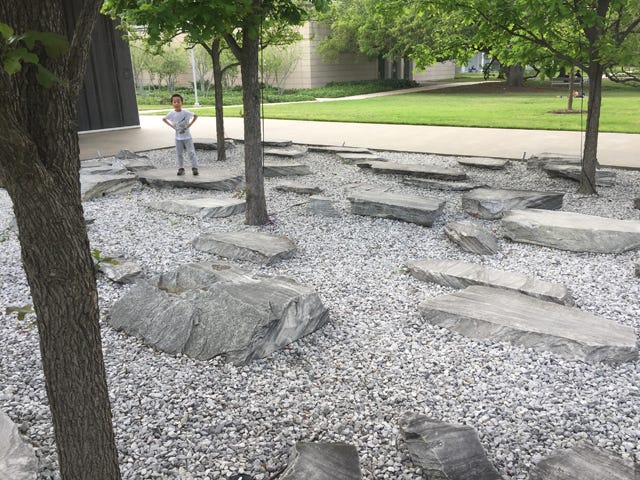
My two sons loved jumping from one stone slab to another one. Eventually, they invented the game “Jump-Jump-Jump”.
The rule of the game is 1) Player A has to jump from one stone slab to another one; 2) Player B has to follow the first player and try to catch him; 3) if Player A is caught by Player B, or steps onto the gravel, he fails. Player B must also be careful not to step onto the gravel; 4) If one play fails, both players have to go to a rock in the corner of the courtyard and restart the game.
Sometimes I joined the game and played with them. They really wanted to play with me. Sometimes, I refused to join the game in order to walk around.
From the perspective of Affordance Theory, these stone slabs (as a physical environment) offer jumping for my sons and me. However, Affordance Theory doesn’t apply to the game of “Jump-Jump-Jump” because it is about social actions.
How about the concept of Supportance? I realized it is suitable to explain the game “Jump-Jump-Jump” because I (as a social environment) offer support for my sons to play the game. The Supportance of support-for-playing “Jump-jump-jump” is offered by me.
Moreover, the combination of “Affordance — Supportane” is a perfect framework for explaining the game of “Jump-Jump-Jump” and similar social actions because we have to pay attention to both physical environments and social environments.
Now let’s apply the 3I model to this case.
Initiator
My two sons and me
Initiatee
Oliver Ding
Act:
We play the game “Jump-Jump-Jump”.
Idea
While stone slabs afford to jump, I offer support-for-playing for my sons.
React
I use this creative play to test the concept of Supportance.
The Selectivity of Perceiving
I noticed that my behavior has two states: play with them, or not play with them.
The Selectivity of Thinking
I realized that these two states of my behavior mean there is a transformation between potential and actual. Thus, I confirmed the concept of Supportance because it shares the same logic as the concept of Affordance.
2.5 The Concept Dynamics framework
The present discussion is also related to concept development. Last year I learned the “Hegel-Vygotsky” approach to Concepts by reading Andy Blunden’s book Concepts: A Critical Approach.
According to Andy Blunden, “…we must always remember that a word meaning is only the realisation of a concept, not a concept in itself. The human mind is an indivisible whole. A concept is the sum of all the meanings it produces, but these meanings have to be taken in the context in which they are produced. A concept may be realised in quite different meanings according to whether a person has to give an instant definition, recognise an object, use the concept to complete a categorisation task, write an extended essay on the concept, evoke the concept in an intellectual action of some other kind or is simply mistaken…In short, it is only possible to say what a concept is, even in terms of its realisation in word meanings, in the context of the activity in which the concept is to be realised. A word is meaningful only within the context of the relevant project. One and the same concept will be realised differently in different projects.” (2012, pp. 292–293)
Blunden’s view on ‘concept’ is inspired by Hegel and Lev Vygotsky. His suggestion points out that concepts are equally subjective and objective, they are units both of consciousness and of the cultural formation of which one’s consciousness is part.
I have been working on idea generation which can be considered a practice of conceptual development for many years. Last year I developed a tool called the Concept Dynamics framework for my own work. The framework echoes Blunden’s view to a certain extent. I agree that a word doesn’t equal a concept. I also consider the dynamic development process of a concept and its social context. However, my framework primarily pays attention to the structure of a theoretical concept.
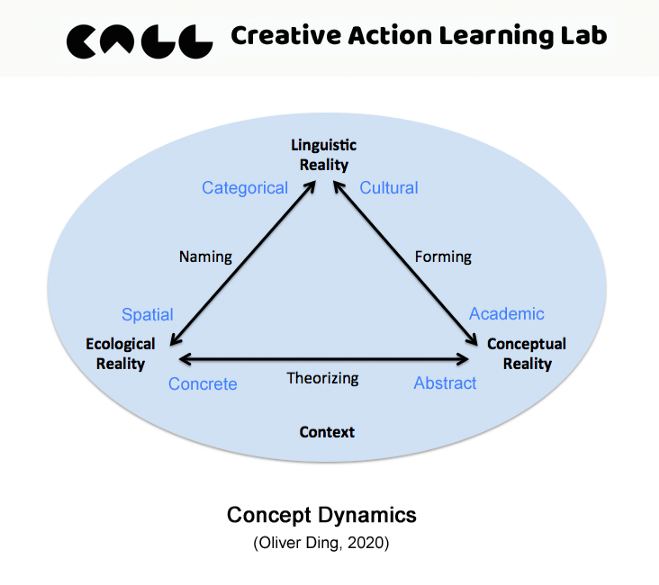
As Berger et al. (1972) argue, “it is difficult to build meaningful theoretical research programs without concepts that are internally consistent and clearly defined in relation to other existing concepts.” (cited in Kallinikos, Leonardi, and Nardi, 2012). In order to discuss the complexity of theoretical concepts, I created the above diagram which suggests every theoretical concept has three basic aspects: ecological reality, conceptual reality, and linguistic reality.
- The ecological reality refers to the real experience of discovery in the real world from the perspective of researchers.
- The conceptual reality refers to the outcome of the creative conceptualization process.
- The linguistic reality refers to expressional form with verbal and rhetorical effects.
Based on the framework, I believe that an ideal theoretical concept should not have intrinsic contradictions between these three aspects and extrinsic contradictions between these aspects and context which means the dynamic background of the concept. Thus, it is a hard task to create an ideal theoretical concept. The harder work is detaching an existing concept from its original context and attaching it to a new context by reconceptualizing it with new meaning.
Back to the case of Supportance, it has a name (linguistic reality) and a primary definition (conceptual reality) in the beginning. Later, I validated it with the game “Jump-Jump-Jump” (ecological reality). With this triangular test, I gained confidence in the concept of Supportance. This is the initial step of developing the Supportance Theory.
Part 3: Conclusion
King Soma’s question inspired me to reflect on the connection between metatheories and general practice. The reflection led to a diagram blending work which connects the following of my works together:
- The HERO U framework and The Theme U diagram
- The 3I model for Creative Actions
- The Concept Dynamics framework
- Curativity Theory
- Supportance Theory
The final outcome is unexpected! Now the expanded HERO U framework offers a new framework for understanding the connection between metatheories and general practice. This would inspire the ECHO Way (v2.0) to pay attention to the creative space outside the Echozone.
In addition, the 3I model is expanded by adding “Double Selectivity” for understanding the “React” process.
The HERO U framework was developed on June 26, 2020. The 3i model was developed on July 8, 2020. It is about the creative study. The Concept Dynamics framework was developed on July 31, 2020.
Early this year, I once worried about the 3I model and the Creative Actions approach in general. I didn’t know how to connect it with the Ecological Practice approach which is my main work.
The present diagram blending work suddenly connects these dots! What a wonderful experience!


