
The Sailor’s Mandala: A Life Discovery Framework
Modeling A Life Development Program with a meta-diagram

I have mentioned an Online Adult Development program in CALL: Annual Review (2020–2021).
In June, one friend of mine started an online adult development program. The program was designed with three components: 1) Life Purpose Awareness, 2) Personal OKR Practice, 3) Peer Review and Feedback. The major part of the program is a monthly peer-support group on several social media platforms.
She worked for two startups in the past six years. The first one is an educational company which focuses on psychology and cognitive science related online courses. The second one is a consumer mobile app company. As a new product designer and founder, my friend used the Lean Startup method and the OKRs method to manage her program. She also adopted the Building In Public mindset to share her goals, challenges, progresses, and discussions with others on social media platforms.
One month ago, she launched the Phase II of the program and the new program focuses on the issue of Life Transition. Last week, she closed the first monthly group of Master Life Transition and shared some feedback from participants and her review report with me. Then, we started a conversation about the program work.
This morning, I adopted the hubhood meta-diagram to design a diagram in order to summarize our discussion about the program. In order to explain the diagram, I sent her a long email.
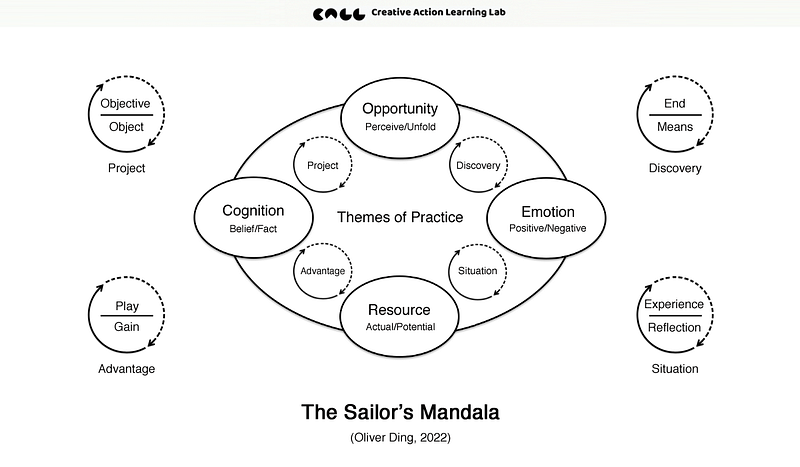
I’d like to highlight some key points of my long email in order to help readers understand the above diagram.
A metaphor: Life as Sailing
The name of the diagram is The Sailor’s Mandala which refers to a metaphor: Life as Sailing.
- Life: it is a journey such as sailing at sea.
- Boat: social container such as family, team, group, project, company, community, etc.
- Sea: social context and social environment.
Two dimensions
The diagram was designed with the following two dimensions:
- Individual Psychological Intervention
- Social Practice Acceleration
From the feedback and our discussion, we learned a lesson that Life Transition is not only about individual psychological situations, but also about a person’s social practice and work activities. So, I suggested that the program should expand its service to consider social practice acceleration.
Four Thematic Spaces
Based on the above two dimensions, I identified four thematic spaces:
- Psychological: Cognition and Emotion
- Social Practice: Opportunity and Resource
The program is successful on Individual Psychological Intervention. We found the feedback is pretty positive.
Cognition: Belief/Fact
We found some participants hold some beliefs about their existing situations. In fact, these beliefs block their actions of life change. The program offers a peer-support environment which supports the reframing of beliefs. Once they establish a new belief, they move to new directions quickly.
Emotion: Positive/Negative
There are two types of emotion: positive and negative. As a life development program, she doesn’t want to solve the mental health issue. For example, if the negative emotion leads to a mental health problem for a particular, she’d like to suggest the participant to find a psychotherapy program.
The program is about coping with negative emotion and guiding participants to start a developmental project.
The program only accepts young professional workers, the Individual Psychological Intervention is inspired by Cognitive behavioral therapy (CBT).
Opportunity: Perceive/Unfold
As mentioned above, the program adopted the OKRs method as a core to develop the process of Social Practice Acceleration. I have observed the process and reviewed some documents during the past several months. There is a big issue for participants to define an objective for their life change. Though the clarifying of life meaning and life vision is very helpful for orientation, it is so hard for many people to transform abstract life meaning into a short term project. Thus, I suggested that the program could consider Opportunity as an important issue for Social Practice Acceleration.
Resource: Actual/Potential
While Opportunity is about clues from environments, Resource is about internal support for taking opportunities.
Opportunity and Resource are two common concepts about social practices. However, I recommend my own work the Ecological Practice approach as a new theoretical perspective to explain these two concepts. The Ecological Practice approach is an action-oriented approach, it doesn’t pay attention to the ideal definition of a concept. The approach emphasizes the dynamics of opportunity and the diversity of resources.
Four Connected Hubs
A unique part of the Hubhood diagram is four connected hubs. Each connected hub connects two Thematic Spaces together. In fact, a connected hub is a thematic space too.
I consider the following four connected hubs for the Sailor’s Mandala diagram:
- Project: Objective/Object
- Advantage: Play/Gain
- Discovery: End/Means
- Situation: Experience/Reflection
We mentioned these topics in our conversation. So, this is curated from the feedback and our analysis.
One Primary Theme
Originally, I put “Life Themes” at the center. However, I realized the term “Themes of Practice” is perfect for this diagram because it considers both individual life themes and collective cultural themes. It matches the two dimensions.
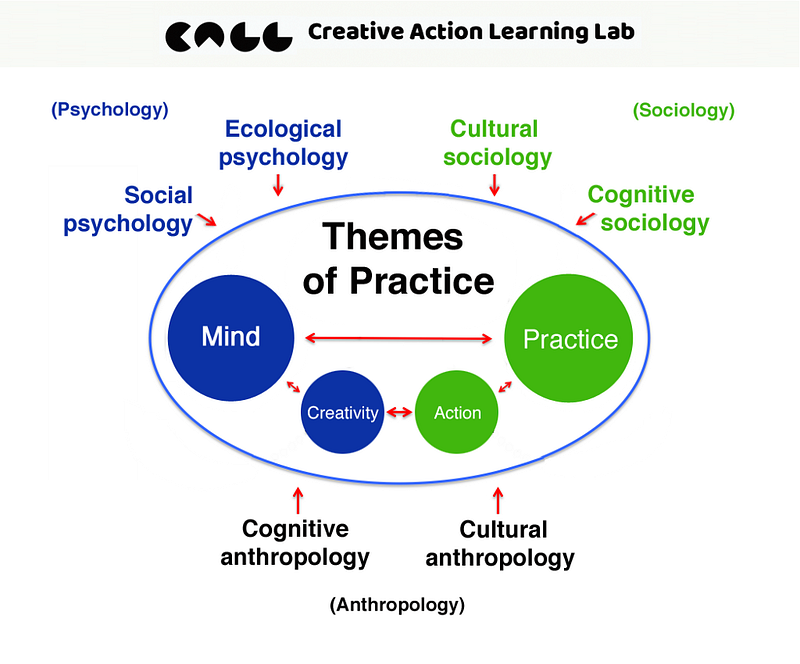
In 2019, I developed the idea “Themes of Practice” in order to discuss the “meaning” of the meaningful whole for my book Curativity: The Ecological Approach to Curatorial Practice. I realized the notion of “Theme” is a great tool for curating experience and actions.
The dichotomy of “things — themes” refers to two classical great debate of social science: “mind — matter” and “individual — collective”. After reviewing the concept of “theme” in various disciplines such as Cultural Anthropology, Counseling Psychology, Cognitive Psychology and the Philosophy of Science, I developed a new concept “Themes of Practice” to propose a process view of “Theme”.
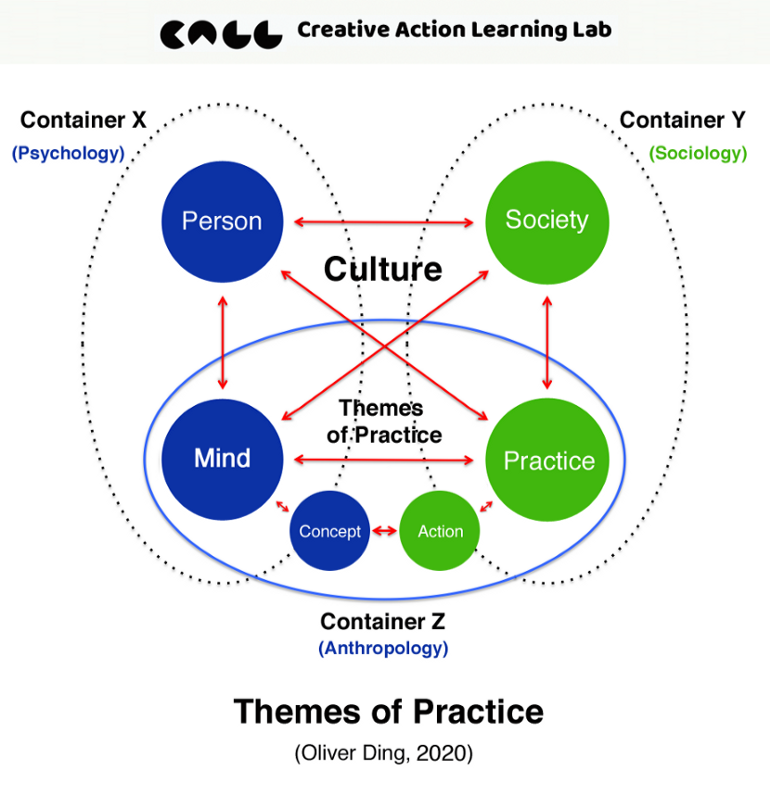
Anthropologist Morris Opler (1945) developed a theoretical “themes” for studying culture. Career counseling therapists and psychologists also developed a theoretical concept called “life theme.” If we put culture themes and life themes together, we see a “great debate” of social science: “individual — collective.” The above diagram visualizes the “concept network” or “idea ecology” of “Themes of Practice”.
You can find more details about Themes of Practice here.
You are most welcome to connect via the following social platforms:
Linkedin: https://www.linkedin.com/in/oliverding Twitter: https://twitter.com/oliverding Polywork: https://www.polywork.com/oliverding Boardle: https://www.boardle.io/users/oliver-ding
License
This work is licensed under the Creative Commons Attribution-NonCommercial-ShareAlike 4.0 International (CC BY-NC-SA 4.0) License. Please click on the link for details.


