
Knowledge Discovery: The “Double Theme” Strategy
1+1 =?

This article is part of the Slow Cognition Project which focuses on Developing Tacit Knowledge with Thematic Space Canvas. The Knowledge Discovery Canvas is an application of the Thematic Space Canvas.
In Jan 2022, I started the Slow Cognition project which is designed with the following ideas:
- Theory: Curativity Theory
- Sub-theory: Themes of Practice
- Framework: Knowledge Curation
- Method: Slow Cognition
- Instrument: Thematic Space Canvas
- Phenomenon: Developing Tacit Knowledge
See the diagram below. The essential parts of the project are Thematic Space Canvas and Developing Tacit Knowledge.
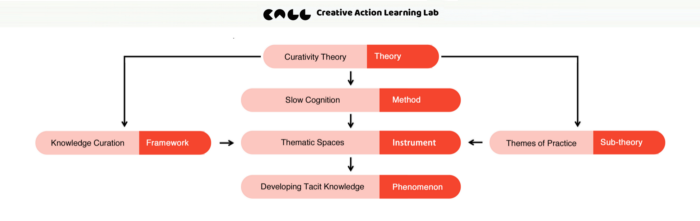
My idea is very simple. I focus on the long-term development of a theme. If we use Andy Blunden’s term, then the long-term development of a theme is the germ-cell of Slow Cognition.
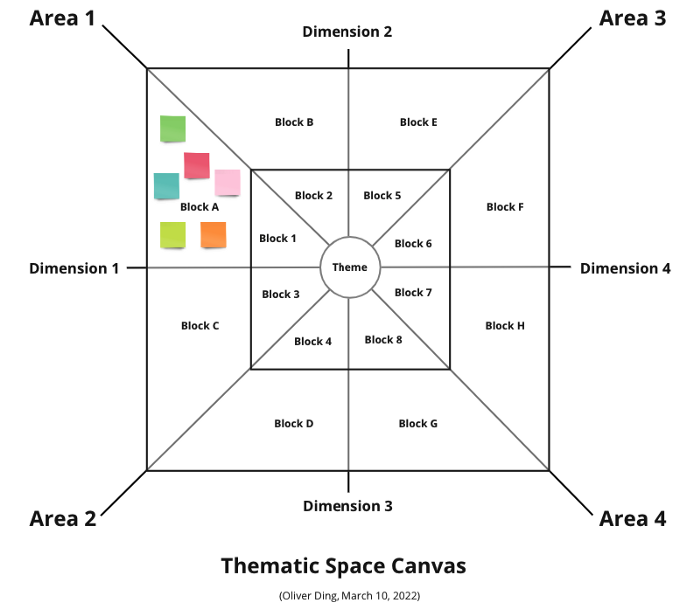
In the past three months, I designed the Thematic Space Canvas and used it to design other canvases. The above canvas is the newest design of the Thematic Space Canvas. I use general abstract terms for the above meta-canvas which is only about a special type of Spatial Structure without using any domain-special terms. In other words, this is a meta-canvas. You can find more details in Slow Cognition: A Meta-canvas for Developing Tacit Knowledge.
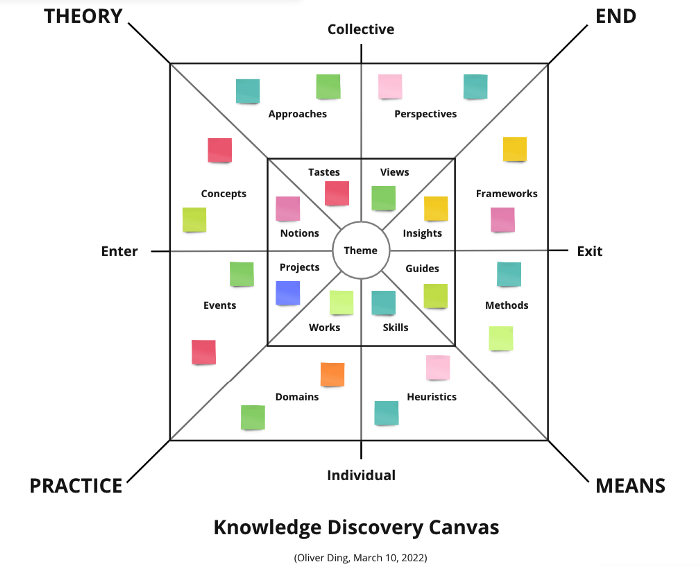
The above canvas is called Knowledge Discovery Canvas which focuses on theme-based knowledge discovery activity. Each time, we only focus on one particular theme and its related knowledge. The original name of the canvas is “Thematic Space Canvas”. You can find some articles about it with the old name.
I am going to discuss the advanced usage of the Knowledge Discovery Canvas for the Slow Cognition project. If you are a new reader of my writings, you can find the following articles about Knowledge Discovery Canvas which is previously named Thematic Space Canvas.
- 1. The Notion of Thematic Spaces
- 2. Mapping Thematic Spaces #1: OS Card and Mapping Clues
- 3. Mapping Thematic Spaces #2: The “Activity” Thematic Space
- 4. Thematic Space: Flow, Film, and Floor Plan
- 5. Thematic Space: Project as Story
- 6. Thematic Space: Place as Container
- 7. Thematic Space: Sparks In, Statue Out
- 8. Thematic Space: The Art of Continuous Discovery
- 9. Thematic Space: The Project Engagement Toolkit for Creators
- 10. Thematic Space: How to Record a Spark?
- 11. Mapping Thematic Space #3: The “Platform” Thematic Space
- 12. Thematic Space: A “Strategy-as-Curation” Weekend
- 13. Slow Cognition: Three Canvases for Developing Tacit Knowledge
- 14. Thematic Space: The “Strategy” thematic space
- 15. Thematic Space: Some Sparks for the “Infoniche” thematic space
- 16. Slow Cognition: The Spark Space Canvas
- 17. Thematic Space: The Connected Hub and “Service Thinking”
- 18. Mapping Thematic Space #4: The “Center” Thematic Space
- 19. Mapping Thematic Space #5: The “Relevance” Thematic Space
- 20. Mapping Thematic Space #6: The “Life” thematic space
- 21. Slow Cognition: Three Canvases for Developing Tacit Knowledge
The above articles are all about the basic foundation of the Knowledge Discovery Canvas and a single theme. The more advanced usage of the Thematic Space Canvas / Knowledge Discovery Canvas is curating two and more themes together.
I’d like to call these advanced ways “Strategies”. The first strategy is the “Double Theme” Strategy. Today I am going to dive into this topic.
An Example of Double Theme
The “Double Theme” Strategy means connecting two Knowledge Discovery Canvases together and forming a new process of developing tacit knowledge.
For example, the attached diagram shows the following two thematic spaces:
1. My “Activity” thematic space 2. My “Project” thematic space
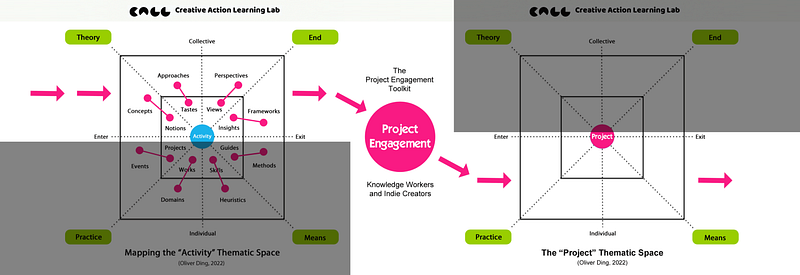
The basic form of the Knowledge Discovery Canvas is a matrix. There are two dimensions:
1. The Enter—Exit dimension 2. The Individual — Collective dimension
For a Knowledge Curation project, the Enter is related to Resources and the Exit is related to Results. That means we consider two types of resources for Developing Tacit Knowledge: Theory and Practice. There are two types of Results for Developing Tacit Knowledge: End and Means. The End refers to “Knowing for Me” while the Means refers to “Knowing for All”.
If we connect two thematic spaces together, then we can expand the Enter — Exit Trajectory as an Attach — Detach Flow.
Now we can connect the “Activity” thematic space and the “Project” thematic space together. For the “Activity” thematic space, the Project Engagement toolkit is a result. For the “Project” thematic space, the Project Engagement toolkit is a resource.
The diagram below also highlights a path of Developing Tacit Knowledge. We can adopt a result of theoretical work and apply it to a theme of practice.
Originally, the Project Engagement toolkit was born from the work of Project-oriented Activity Theory. Now, it is an instrument for practitioners.
You can find more details about the “Activity — Project” example in Thematic Space: The Project Engagement Toolkit for Creators and Life Discovery: The Life-as-Project Approach.
A List of Pairs of Themes
The “Double Theme” Strategy echoes my notion of “Pairs of Themes” which is part of my book “Themes of Practice” and the Theme U meta-diagram.
Originally, I used “Pairs of Opposite Themes” for the ECHO Way (2.0) which is A practical framework for Knowledge Curation and Boundary Innovation.
The most important step of the ECHO way is the Theme U mapping process. You are required to discover several Pairs of Opposite Themes and place three of them on Theme U.
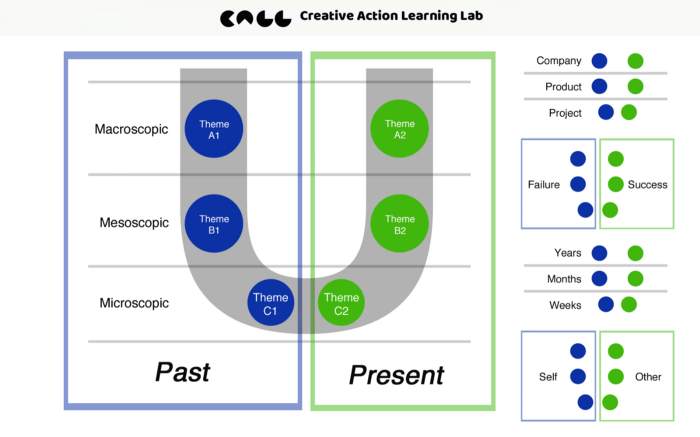
This process is a challenge because it guides you to understand thematic relationships deeply. You also need to think about it with Theme U which is a spatial representation framework with three layers and two sides. You should pick a logical method to make sense of these spatial structures and place six themes on the U shape.
I used the notion of “Pairs of Opposite Themes” to develop a framework for personal innovation. If we want to explore personal innovation, the great starting point is Pairs of Opposite Themes because they could lead to Structural Tensions such as boundary, distance, difference, heterogeneity, contradiction, and complementation. If we can turn one or more structural tensions into creative opportunities, then we could find a way of personal innovation. You can find more details in an old article: Personal Innovation as Career-fit: Discover Pairs of Opposite Themes of career experience and beyond.
In Jan 2022, I moved to discover Pairs of Themes from professional mental models and use them to design knowledge diagrams such as the series of Mandala diagrams. You can find more details in Thematic Space: A “Strategy-as-Curation” Weekend.
I also made a list of Pairs of Themes in Thematic Space: A “Strategy-as-Curation” Weekend. I’d like to share the list again. You only have to pay attention to the bold text. Other parts are my personal notes. These pairs of themes are discovered from my Mandala diagrams and my other articles. The Hint offers a clue for thinking about a pair of themes from my perspective. I can’t offer more details for each hint in this article.
- 01. The “Self — Other” Relevance (hint: find a good partner)
- 02. The “Explore — Exploit” Cycle (hint: manage the Resource and Result)
- 03. The “Future — Present” Dynamic (hint: reduce the Complexity between Anticipation and Performance)
- 04. The “Control — Support” Tension (hint: perceive the Unintended Supportance)
- 05. The “Found — Designed” Scope (hint: taking Affordances means Material Freedom)
- 06. The “Means — End” Spectrum (hint: all things can be Mediating Instruments)
- 07. The “Enter — Exit” Trajectory (hint: Sparks In, Statue Out)
- 08. The “Story — Model” Switch (hint: master the Degrees of Abstraction)
- 09. The “Part — Whole” Curativity (hint: discover Double Containers)
- 10. The “Attach — Detach” Flow (hint: know when to leave and join)
- 11. The “Potential — Capability” Opportunity (hint: get it done)
- 12. The “Object — Objective” Activity (hint: knowing the future by seeing changes in objects)
- 13. The “Problem — Solution” Space (hint: you can design a solution or discover a new space)
- 14. The “Challenge — Response” Ladder (hint: possible challenges lead to possible selves)
- 15. The “Past — Present” Evolution (hint: respect the history, don’t hate your past self)
- 16. The “Idea — Concept” Upgrade (hint: every moment starts from a clap)
- 17. The “Experience — Theme” Mirror (hint: keep your uniqueness)
- 18. The “Structure — Tendency” Landscape (hint: understand deep changes)
- 19. The “Ambiguity — Precision” Clarification (hint: clarify your ideas)
- 20. The “System — Empathy” Collaboration (hint: shapers need supporters, and vice versa)
- 21. The “Analysis — Synthesis” Loop (hint: see variant and invariant via mediating instruments)
- 22. The “Perception — Action” Awareness (hint: discover differences from similarities)
If you want to develop your tacit knowledge about some topics at the abstract level, you can follow this format to curate your own list of pairs of themes.
The Double Theme Strategy for Writing
The above list of Pairs of Themes was published on Jan 25, 2022. Later, I adopted some pairs of themes to write some articles for the Life Discovery Project. See the following list:
- Feb 18, 2022 — Life Discovery: The “Result — Reward” Gap and Achievement
- Feb 20, 2022 — Life Discovery: The “Present — Future” Fit and The ECHO Way
- Feb 22, 2022 — Life Discovery: The “Object — Objective” Gap and Attachment
- Feb 23, 2022 — Life Discovery: The “Means — End” Spectrum and Becoming
- Feb 24, 2022— Life Discovery: The “Problem — Solution” Challenge and Response
- Feb 25, 2022 — Life Discovery: The “Experience — Theme” Ladder and Meaning
There is a pattern behind the above six articles. I use the Nested Double Theme Structure to design these articles:
[(A1+A2)+B] =C
Let’s use Life Discovery: The “Result — Reward” Gap and Achievement as an example to understand this structure:
- A1=Result
- A2=Reward
- (A1+A2)=The “Result — Reward” Gap
- B=Achievement
- C=The Relevance of Achievement
The article has the following 11 sections:
- 1. The Anticipatory Activity System Framework
- 2. The Result — Reward Gap
- 3. Result as First-order Outcome
- 4. Reward as Second-order Outcome
- 5. The “Self — Other” Relevance
- 6. Self-Reward: Enjoyment, Affirmation, and Reflection
- 7. Interpersonal Reward: Perception, Conception, and Curation
- 8. Transactional Reward: Emotional Support
- 9. Collective Reward: Public Recognition
- 10. The Time Distance between Result and Reward
- 11. The Relevance of Achievement
I started defining A1 and A2 and moved to (A1+A2), then connected it with B. In order to understand the whole of [(A1+A2)+B], I adopted the “Self — Other” Relevance as a thinking tool, the final outcome is a new typology of Achievement.
In fact, the “Self — Other” Relevance is the other one (A1+A2). You can find more details about it in Mapping Thematic Space #5: The “Relevance” Thematic Space.
The #TalkThree Challenge (2019)
There are many ways to develop Double Thematic Thinking. I’d like to share some heuristics in the rest of the article.
In 2019, I designed a game called TalkThree Challenge for improving double thematic thinking. The first version of TalkThree Challenge uses a simple card. See the example below.
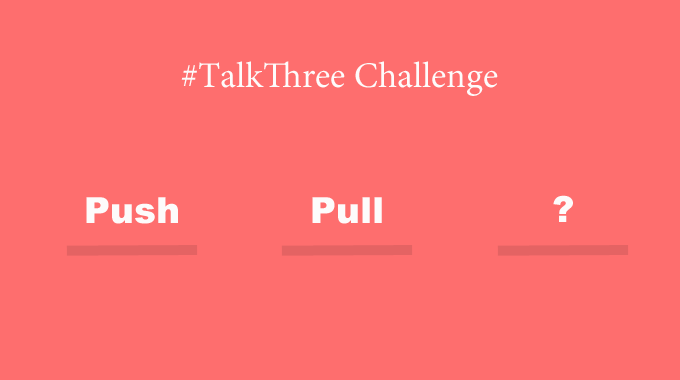
If you want to run it as an intellectual exercise as I did, you have to put these two words into your own context. What are you thinking about recently? Is there a puzzle in your real life? Have you debated some issues with a friend last week? Did any book inspire you this month? Connect the TalkThree challenge with your life, it will make the challenge hard and fun.
The second version of TalkThree Challenge expands to a typology of double themes. The diagram below offers some ideas from the typology.
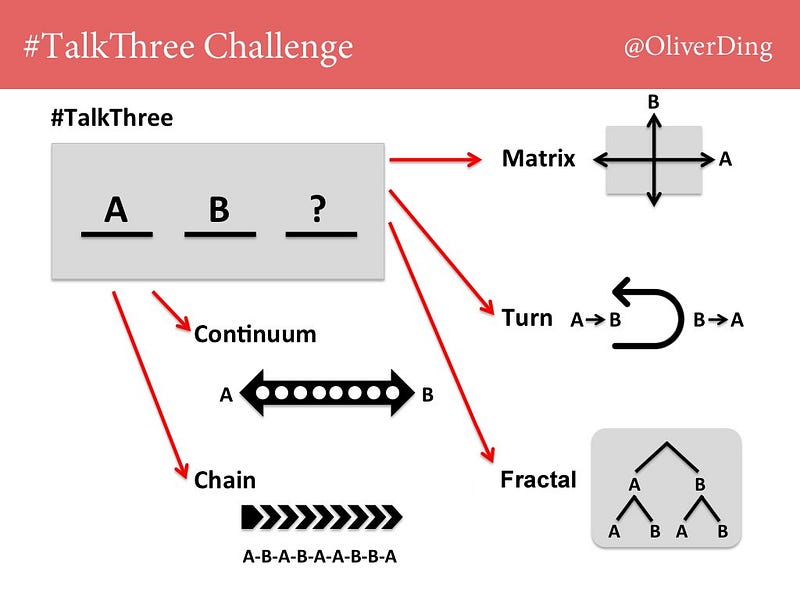
The Fractal is a unique heuristic. It was found in American sociologist Andrew Abbott’s 2001 book Chaos of Disciplines.
Kant’s Fractal Tree
In a 2001 book Chaos of Disciplines, Andrew Abbott started an insight that claims many social structures look the same on large scale and in a small scale. He called this insight “Self-similar social structure.” and applied it to discuss academic social science in general and sociology in particular. He also found there is a classical example from Kant, “…Kant obviously does not think there is an infinite gradation from absolute pure reason through some proportionately mixed varieties of reason to absolute practice reason. He has done something else. He has created what I shall call a ‘fractal distinction.’ The name captures the fact that such a distinction repeats a pattern within itself, as geometric fractals do…There are, of course, dozens of general sources on fractals…I have tended to focus on fractals that are nested dichotomies. There is no necessary restriction to this case; it is simply the most familiar and hence makes for the easiest exposition.”(p.9)
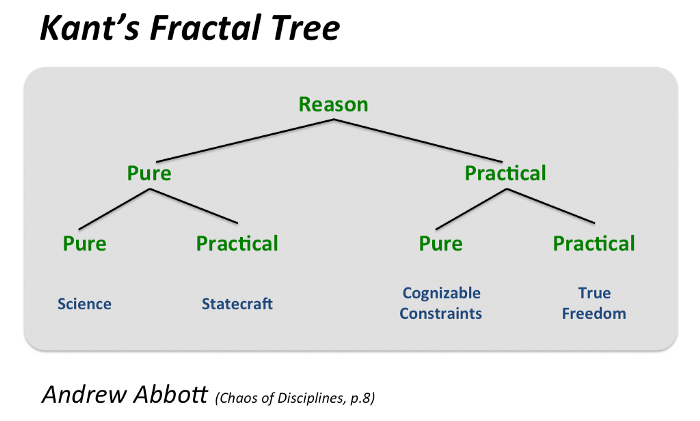
The above diagram is adopted from Andrew Abbott and it represents Kant’s fractal tree. After reviewing Kant’s writing, Abbott summarized that “Kan has first split pure and practical reason and then, under each of those headings, has split pure and practical reason once again.” (p.8)
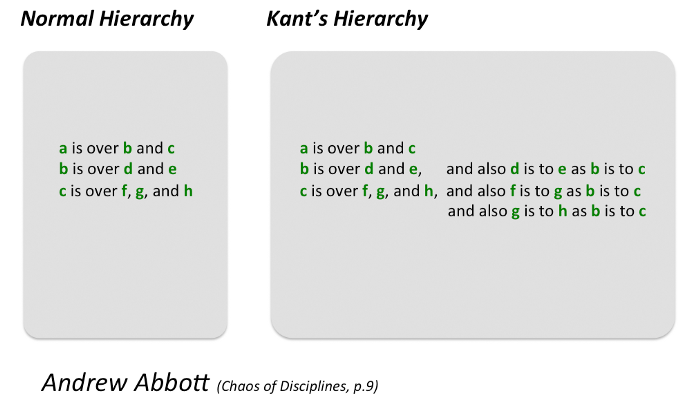
Abbott also pointed out Kant’s approach is not a normal hierarchy, “…Kant has made a relational judgment at one level and then repeated it at the next…the relation of the general terms is recapitulated in the specific ones…This is not a simple hierarchy.” (p.9) Further, Abbott claimed that the power of fractal distinction, “The concept of fractal distinctions not only proves useful in understanding the external location of the social sciences generally. It also provides an essential tool for understanding relations within them. Indeed, as I shall show, both the external and the internal structures are produced by the same mechanism.”(p.10)
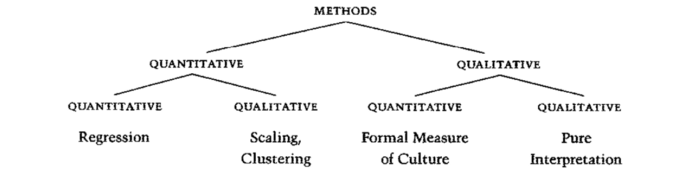
The above diagram shows an example of the fractal distinction of the methodological approaches. Abbott said, “For about sixty years, sociology has been divided into two broad methodological strands, usually called quantitative and qualitative. Put starkly, the quantitative position recognizes only those social phenomena measurable on univocal scales. The qualitative side attributes multivocality to all social phenomena and therefore denies strong measurability. This sounds like a simple opposition. But within each one of these strands can be distinguished ‘quantitative’ and ‘qualitative’ positions. On the quantitative side, for example, the admired ‘causal’ methods like regression contrast with the denigrated ‘descriptive’ methods like scaling and clustering. On the qualitative side, there are relatively formalized measurement procedures that are used by some sociologists of culture and by most practitioners of conversational analysis, while strongly interpretive strategies characterize much of the new sociology of science.” (p.10)
What a simple but powerful heuristic tool! Abbott focused on academic activity, we can apply it to non-academic activities. We can check if we can find the same fractal distinction in our domain, or use it to guide our journey of making innovation and finding new niches. We even can think about if there are other heuristic tools that present special comment patterns of hierarchy.
The ECHO Way
The ECHO Way is a practical framework for Knowledge Curation and Boundary Innovation. I have been using the ECHO Way for several projects. The core of the framework is the following three-container diagram.
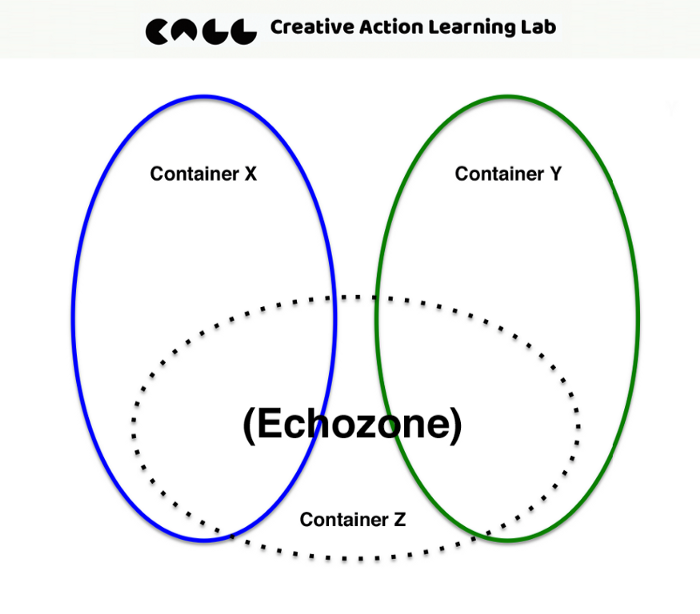
The concept of Container is the core of the Ecological Practice approach. By adjusting the quality and quantity of the Container, we can create advanced frameworks for discussing complex phenomena. The quality of the Container can be potential and actual, the quantity of the Container can be one or two. If we develop a new framework with one potential container and two actual containers, the outcome is the above diagram.
I named the potential container (Container Z) Echozone which refers to a creative space containing echoes between Container X and Container Y. The term “Echo” of “Echozone” refers to a dialogue between two containers. You can find more details about the ECHO Way here.
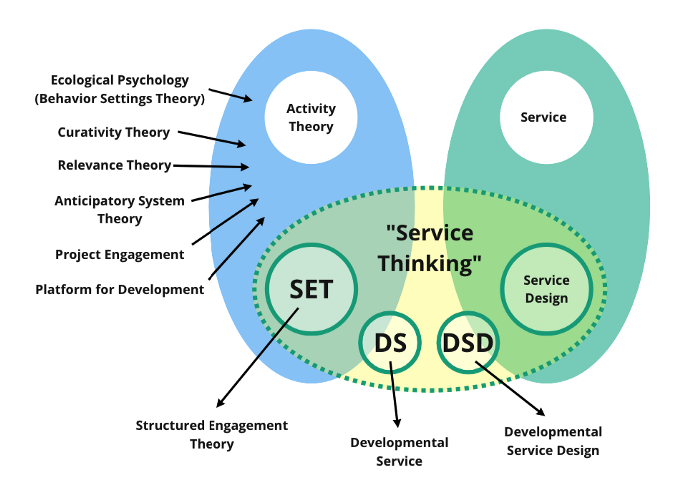
The above diagram is an application of the ECHO Way diagram. I used the above diagram to make a new thematic space called “Service Thinking”. My goal is not to define a new concept called “Service Thinking” for others. The “Service Thinking” thematic space is a connected hub that aims to connect Activity Theory and Service Design. You can find more details about this case in Thematic Space: The Connected Hub and “Service Thinking” and The SET Framework.
The Dialectic Room
Finally, I’d like to recommend a meta-diagram for playing with Pairs of Opposite Themes: The Dialectic Room. The original source of the dialectic room is the “germ-cell” diagram for Project-oriented Activity Theory. You can find more details here.
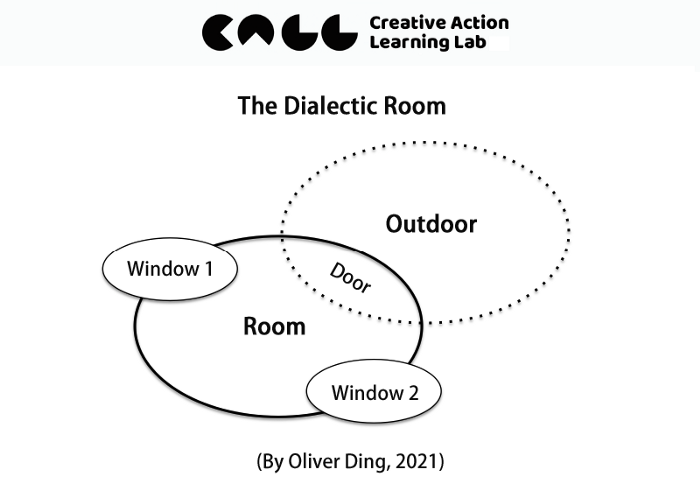
The Dialectic Room is a metaphor. We can consider a tough situation with structural tension as a room with two windows and one door.
- a tough situation = a room
- a structural tension = a pair of Opposite Themes = two windows
- a final action = a door
A room is a container that separates inside space and outside space. There are some actions people can do within a room. I pay attention to one special type of action: connecting to the outside space from the inside space. Let’s call it “Process”.
The two windows are interfaces that refer to two “Tendencies”, Window1 refers to “Tendency 1” while Window 2 refers to “Tendency 2”. Each window has its own view of the outside space.
Finally, there is a door that allows people to actually go out of the room. The door refers to “Orientation” which represents a direction of a real action of going out of the inside space.
Once you get into the outside space, you can consider the new space as a new room and repeat the diagram.
This is a special type of spatial logic. The terms such as “Process”, “Tendency” and “Orientation” are placeholders of texts for describing the spatial logic. From the perspective of my diagram theory, the pure meta-diagram doesn’t need texts. For instance, the Yin-yang symbol or Taijitu is a meta-diagram, can you find one text from it? However, we can add some texts as placeholders to a pure meta-diagram in order to better describe it.
1+1=?
It all depends on our strategies for connecting two themes.
You don’t have to develop Double Thematic Thinking with Thematic Space Canvas.
The notion of “Thematic Space” refers to a large cognitive space around particular themes. One Thematic Space is only about one particular theme. In fact, the concept of “Thematic Space” is the outcome of connecting the following two themes:
- Thematic Cognition
- Spatial Cognition
A theme is similar to a concept. Originally, I adopted the term “Conceptual Spaces” from Peter Gardenfors’ 2004 book Conceptual Space: The Geometry of Thought. Later, I realized what I am talking about is not the original meaning of Peter Gardenfors’ concept of Conceptual Spaces.
For the Slow Cognition Project, the notion of Thematic Spaces is both objective and subjective. An important feature of Thematic Spaces is connecting objective theoretical resources and subjective work experience.
The term Space can be understood as a Container. In Thematic Space: Place as Container, I point out that there are two types of environments for developing tacit knowledge: physical environments and social environments.
The Thematic Space Canvas is a cognitive artifact for visualizing Thematic Spaces. However, we can live with Thematic Spaces without using the Thematic Space Canvas.
1+1 is a simple strategy to inspire new knowledge sparks for discovering potential themes.
You are most welcome to connect via the following social platforms:
Linkedin: https://www.linkedin.com/in/oliverding Twitter: https://twitter.com/oliverding Polywork: https://www.polywork.com/oliverding Boardle: https://www.boardle.io/users/oliver-ding


