
Activity U (VIIII): Project-oriented Activity Theory
Introduce a brand new approach to Activity Theory with a series of diagrams
The previous article Activity U (VIII): Project as a Unit of Activity introduces Andy Blunden’s Project-oriented theoretical approach of Activity with a case study and background. I also shared a diagram I made for the approach. In fact, I designed a series of diagrams. This article aims to dig deep into Project-oriented Activity Theory with these diagrams.
In addition, I also review the value of the new approach from two sides: theoretical contributions and practical heuristic functions.
Contents
Part 1: A Brief of Andy Blunden’s Approach
1.1 A 3–3–3–1 schema 1.2 A minimal review
Part 2: Diagrams
2.1 Diagramming as Thinking 2.2 A “germ-cell” diagram 2.3 Project as “Social Movement”
Part 3: Activity as Formation of Concept (diagram)
3.1 Hegel’s four developmental stages of Projects 3.2 Conception, Misconception and Proliferate 3.3 Initialization, Objectification, and Institutionalization 3.4 Individual, Particular and Universal 3.5 Unreal concept and real concept
Part 4: The Objectification of Concept (diagram)
4.1 Symbolic objectification 4.2 Instrumental objectification 4.3 Practical objectification 4.4 Embed and Situate 4.5 Branded, Shared, and Recognize 4.6 Interene, Interpret and Recognize 4.7 Low cost and high cost
Part 5: The Landscape of Culture (diagram)
5.1 Idea and Concept 5.2 Concept Ecology as Zeitgeist 5.3 Creativity, Normativity, and Curativity
Part 6: The Source of Activity
6.1 Three statements of “The Source of Activity” 6.2 “Object-orientedness” v.s. “Formation of Concept” 6.3 “Development by Contradictions” v.s. “Formation of Concept” 6.4 “Dynamics of Social Practice” v.s. “Formation of Concept” 6.5 Against the Dichotomy of Social Formation
Part 7: A Theory of Radical Innovation
7.1 Radical innovation v.s. Incremental innovation 7.2 Micro Movements as Cultural Innovations 7.3 Brand Commons for Social Change 7.4 Concept Competition and Career Development 7.5 Knowledge Development and Domain Formation 7.6 Digital Technology and Business Development 7.7 The Method of Study
Part 1: A Brief of Andy Blunden’s Approach
In order to develop the theoretical foundation of “Project as a unit of Activity”, Blunden adopts Hegel’s Logic and Vygotsky’s theory about Concepts as theoretical resources. The process is documented in three books: An Interdisciplinary Theory of Activity (2010), Concepts: A Critical Approach (2012), and Collaborative Projects: An Interdisciplinary Study (2014).
1.1 A 3–3–3–1 schema
In my opinion, Andy Blunden’s approach can be summarized in a 3–3–3–1 schema.
3: Three keywords 3: Three theoretical statements 3: Three significant notions 1: One unique contribution
Three keywords
- Project
- Concept
- Activity
Three theoretical statements
- Project as a “Unit of Analysis” of Activity Theory
- Activity as “Formation of Concept”
- Project as “Social Movement”
Three significant notions
- Goethe’s “germ-cell”
- Hegel’s “dialectical logic”
- Vygotsky’s “word meaning”
One unique contribution
- It is a Meta-theory about the Source of Activity
These ideas should be considered as a Whole of a new theoretical approach to Activity. Elsewise we could make a mistake of reductionism which focuses on the value of parts and ignores the value of the whole.
1.2 A minimal review
How does Andy Blunden integrate these ideas as pieces into a consistent theoretical approach as a meaningful unity? How does he connect “Project”, “Concept” and “Activity” together?
A simple way to answer these questions is by reading the Conclusion of his 2012 book Concepts: A Critical Approach (p.291–299). I’d like to quote his original statements with my notes as a minimal review.
Let’s start with the following statement:
In short, it is only possible to say what a concept is, even in terms of its realisation in word meanings, in the context of the activity in which the concept is to be realised. A word is meaningful only within the context of the relevant project. One and the same concept will be realised differently in different projects. (2012, p.293)
Here we see core keywords such as “concept”, “word meanings”, “activity” and “projects” are united organically with an intrinsic logic. First, we have to notice the difference between “concept” and “word meanings”. Blunden says, “…we must always remember that a word meaning is only the realisation of a concept, not a concept in itself.”(p.292) Second, let’s look at “the context of the activity”. Blunden points out, “A concept is the sum of all the meanings it produces, but these meanings have to be taken in the context in which they are produced. A concept may be realised in quite different meanings according to whether a person has to give an instant definition, recognise an object, use the concept to complete a categorisation task, write an extended essay on the concept, evoke the concept in an intellectual action of some other kind or is simply mistaken.” (pp.292–293)
Second, let’s go deep into the idea of “concept” from Hegel’s perspective.
As Hegel explained, every concept exists as Individual, Particular and Universal. These three moments of the concept are never completely in accord. There is always a measure of dissonance between them, and this is manifested in the dynamics of the concept. What an individual means when they use the word is never quite the same as the meaning produced in any other context. (2012, p.295)
Usually, we consider a concept as a mental object which refers to a bundle of attributes or features. This view is influenced by contemporary psychology and formal logic. We have to notice that Blunden adopts a different view of Concept which is based on Hegel’s philosophy and dialectical logic. According to Blunden (2012, pp.156–157), Hegel uses the following three movements to describe the internal development of the Concept:
- Universal: the Universal Concept is what is represented by a word (or in general, the sign for a concept) taken alone, outside of any determination or context of use. The meaning is entirely ‘in itself’, waiting to be developed, but at the same time is ‘pure’, in that every utterance is identical…Hegel links the Universal Concept to Identity because it is taken to be self-identical.
- Particular: the Particular Concept is a practice which differentiates one kind of the Concept, one genus of the species from another through its inclusion and differentiation in a system of social practice. The Universal Concept can only come to reality through particularity, by determining the Universal…While it is an error to represent the Concept by means of some finite collection of exemplars, the Universal can exist only in and through some exemplars.
- Individual: the Individual Concept is the sole ground of the concept, in and through which alone the Concept can exist. The Individual Concept is the limit case of the Particular Concept, where it is not just some things, but this thing which is the Concept, the ground of all generalisation…Individual reduces the Concept to a common element linking the individuals. This is an extremely poor representation of a Concept…
Third, we have to pay attention to the connection between “concept/word meanings” and “actions/projects(activity)”. Blunden says, “So I have dealt with individual actions (word meanings) and particular projects, which are activities, made up of artefact-mediated actions including word-meaning, and finally I come to the universal. By universal, I refer to the words and other artefacts which give unity to all the individual actions and particular projects as evocations of one and the same concept.” (2012. p.294) Thus, he connects Concept and Activity together by adopting Vygotsky’s theory on concepts.
Vygotsky correctly observed that in its psychological development a concept becomes independent of the word with which it was learnt. However, because a project can only exist and realise a concept by means of collaboration between people, the word can never be dispensed with. Words change, get translated into different languages and so on, but never without some modification of the concept. Words as signs for concepts are essential for the existence of a concept. It should be clear from the above that a concept not only represents its object, but along with the activity it mobilises, it equally constitutes and even produces the object. In fact, the functions of representing, constituting and producing are inseparable. (2012, p.295)
Finally, he concludes that a concept means a change in social practice. In this manner, a project which refers to the formation of a concept is a social movement.
A concept is the nearest thing human beings have to eternal life. To realise a concept and nurse it into the world is the best we can do. A concept means a change in social practice. Isn’t everything that happens in history, and goes on to become more than a footnote, marked by the launching of a new concept? And creating a concept is something any one of us can do. But not every concept survives its birth, and outlives the day funding is withdrawn or its founder dies. A concept has to put roots down in fertile soil if it is to realise itself. This is the challenge for those of us who want to make a difference: work out how to make something which is but a twinkle in your eye into a sustainable project that outlives its creators because it meets a real social need. As much, people will go on talking about it for a long time to come, and their lives will have been changed as a result. (2012, p.299)
So, what does Blunden present to us? It is a theory of Radical Innovation!
Part 2: Diagrams
Part 1 is an abstract discussion. Part 2 to Part 5 move to a concrete approach with the way of diagraming. I will repeat the above discussion again with diagrams.
2.1 Diagramming as Thinking
To be honest, it is a dangerous task to develop a series of diagrams for a philosophical theory. First, I may misunderstand Blunden’s ideas. Second, my diagrams may not completely represent my understanding of Blunden’s ideas. Third, the visual power of diagrams may lead readers to an illusion of understanding: I don’t have to read Blunden’s original writings and books since I have understood Blunden’s ideas by reading Oliver’s diagrams.
The diagram is one of my essential three knowledge units. I like thinking with diagramming. I even wrote a 108-page thesis that develops a theory about diagrams and diagramming in 2018. I consider two groups of ideas for my theory about diagrams. The first group is “meta-diagram, diagram, and diagram system” and the second group is “diagramming as an activity of knowing, theorizing, and reflecting”.
The notion of “meta-diagram” considers a special type of diagram as an independent thing that doesn’t have to be a representation of an existing theory or model. For example, the 2x2 matrix diagram is a meta-diagram that doesn’t refer to any concrete theory or model such as BCG’s Growth-share matrix. A diagram system is a series of diagrams that share an intrinsic spatial logic and a visual identity.
The notion of “diagramming as an activity of knowing, theorizing and reflecting” adopts a process view to understand Diagrams. In other words, it is “becoming”.
So, I ask readers to consider the following diagrams as a temporary tool for understanding Blunden’s ideas. I hope my writings and diagrams could encourage you to read Blunden’s original books and articles.
2.2 A “germ-cell” diagram
As mentioned early, one of three significant notions of Blunden’s approach is Goethe’s “germ-cell”. In fact, I should say Goethe’s “Urphänomen”. It is just the same concept with different words. However, Goethe’s word is “Urphänomen”.
Blunden has written many articles about the notion of “germ-cell”. You can start with this one: The Unit of Analysis and Germ Cell in Hegel, Marx, and Vygotsky (2020).
Activity theorists often talked about the “Unit of Analysis”. According to Andy Blunden (2017), “Vygotsky appropriated the term ‘unit of analysis’ from social science, in which it meant the ‘resolution of the analytical microscope’, so to speak, the smallest entity which is taken account of in a given theory. In mainstream social science the unit of analysis is usually taken to be individuals, sometimes groups, classes or even nations. The difference between how Vygotsky uses the term is that for him, the unit of analysis already represents a concept of the whole. That is, he merged this analytical concept with Goethe’s idea of the Urphänomen as a representation of a Gestalt.”
Since there are two views of “Unit of Analysis”, I personally use two terms to represent these two views. The “germ-cell” refers to the Goethe-Hegel-Marx-Vygotsky approach to the “Unit of Analysis”. The “levels of analysis” refers to the mainstream view of the “Unit of analysis” in social science. I am not going to destroy the concept of “Unit of Analysis”. I just want to make our discussion smooth.
Blunden points out, “What Vygotsky did was to produce one study which would function as an exemplar for research in Psychology; that one study addressed the age-old problem of the relation between thinking and speech, and by solving this one problem in an exemplary fashion, he created a paradigm for research in all domains of Psychology, and as a matter of fact, in all the sciences. Vygotsky in fact left us as many as five different exemplars of analysis by units.”
Each year, I always pick one idea I learned within one year as the idea of the year. The notion of “germ-cell” is so powerful, that I just pick it as my idea for 2020. According to Blunden, “…in order to understand a complex process as an integral whole or gestalt, we have to identify and understand just its simplest immediately given part — a radical departure from the ‘Newtonian’ approach to science based on discovering intangible forces and hidden laws” (2020)

Is it similar to “Fractal” mathematics? According to Wikipedia, “a fractal is a self-similar subset of Euclidean space whose fractal dimension strictly exceeds its topological dimension. Fractals appear the same at different levels, as illustrated in successive magnifications of the Mandelbrot set.”
Now, let’s move from biology and mathematics to social science. In particular, the diagramming for social science. Blunden has given us several successful examples of applying the idea of “germ-cell” for social science, such as Hegel’s formulation of the idea, Marx’s Capital, and Vygotsky’s five ideas.
Can we apply the idea of “germ-cell” to diagramming for social science?
I’d like to accept this challenge with a concrete task: designing a series of diagrams for Blunden’s Project-oriented Activity Theory with a germ-cell diagram. This task echoes my ideas about “meta-diagram, diagram, and diagram system”. A germ-cell diagram is a special type of meta-diagram that can easily generate a diagram system with the same intrinsic spatial logic. A typical structure of a diagram system is a multiple-level analysis system. The first challenge of adopting a germ-cell diagram is to design a spatial logic that can apply to different levels of a multiple-level diagram system. In other words, we only need one spatial logic for the whole system since the one spatial logic is a whole.
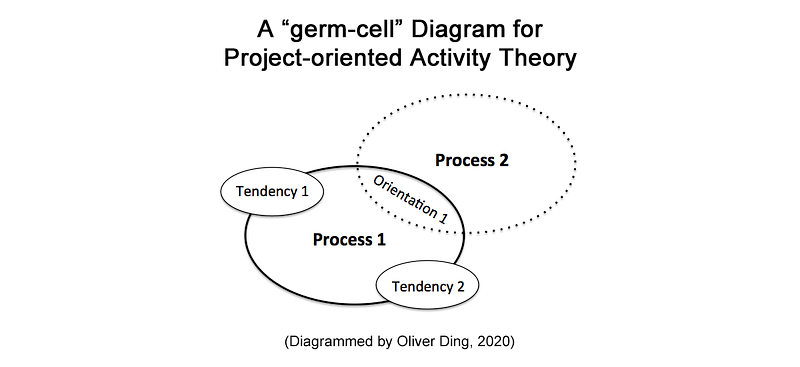
The above diagram is a “germ-cell” diagram for Project-oriented Activity Theory. It is better to think about this diagram as a room with two windows and one door.
A room is a container that separates inside space and outside space. There are some actions people can do within a room. I pay attention to one special type of action: connecting to the outside space from the inside space. Let’s call it “Process”. The two windows are interfaces that refer to two “Tendencies”, Window1 refers to “Tendency 1” while Window 2 refers to “Tendency 2”. Each window has its own view of the outside space. Finally, there is a door that allows people to actually go out of the room. The door refers to “Orientation” which represents a direction of a real action of going out of the inside space. Once you get into the outside space, you can consider the new space as a new room and repeat the diagram.
This is a special type of spatial logic. The terms such as “Process”, “Tendency” and “Orientation” are placeholders of texts for describing the spatial logic. From the perspective of my diagram theory, the pure meta-diagram doesn’t need texts. For instance, the Yin-yang symbol or Taijitu is a meta-diagram, can you find one text from it? However, we can add some texts as placeholders to a pure meta-diagram in order to better describe it.
2.3 Project as “Social Movement”
Now let’s test the germ-cell diagram with the concept of “Project” within Blunden’s approach.
I have mentioned there are two ways of understanding the concept of Project in the previous article Activity U (VIII): Project as a Unit of Activity. You can use it at the theoretical approach level, or the practical phenomena level. How can we develop a theoretical concept of Project to explain various types of practical Projects?
The article also mentioned two types of projects from Clay Spinuzzi’s research insights which are recorded in his book All Edge (2015, p.69):
- Project I: “…networks are well suited to unique projects that require innovation, flexibility, and creativity, particularly if these projects involve the inexpensive, rapid communication that is necessary for supporting constant mutual adjustment.”
- Project II: “But they’re not well suited for projects that require repeatability, operating efficiency, or control; those requirements are better fulfilled by an institutional hierarchy.”
For Blunden, the concept of Project is close to “Social Movements (in the broadest sense)” (2014, p.9) He emphasizes, “The project inheres in the artifact-mediated actions, norms, rules and symbols flowing form the project’s self-concept and underlying the actions which constitute the project. In my Concepts, A Critical Approach (Blunden, 2012) I examined these relations in some detail, but what is important here is how projects manifest themselves as social movements (in the broadest sense), before becoming, fully or partly, institutionalized as part of a social formation which is itself nothing but the product of many such social movements in the past.” (2014, p.9)
Blunden also says, “The projects I have in mind here might be a social movement, such as the women’s health movement, or a campaign against asbestos production, or it might be a capitalist firm promoting a new product under its own brand name, or a fashion or youth trend, a government program, or a branch of science. But in every case, it is an evolving and expanding social practice which arises as a protest against and remedy for some problem. A project begins with a break from the former practices of the community. In particular, projects generally arise within some definite form of practice or institution which is sensitive and resistant to contradiction, so that overcoming a problem necessitates a self-conscious break, which is nonetheless eventually incorporated into the normal life of a community.” (2014, p.10)
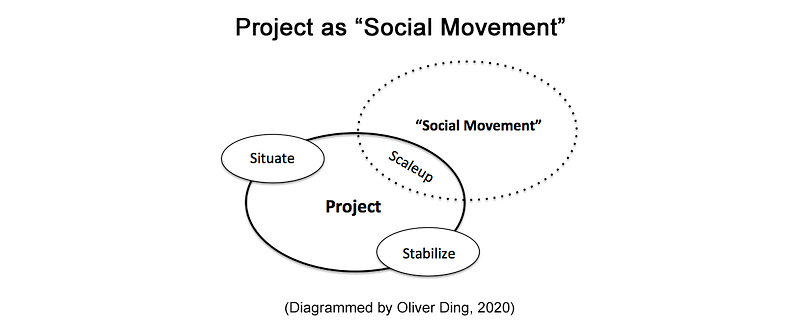
Here we see the third view of Project: a social movement (in the broadest sense) as a change of social practice (Project III).
From the perspective of empirical research, we face a challenge. How to select a project as a suitable objective for Project-oriented Activity Theory? Can we apply Project-oriented Activity Theory to research Project I and Project II as mentioned above?
My solution is not to develop a classification of the project, but adopting the germ-cell diagram with its spatial logic.
- Process 1: Project
- Tendency 1: Situate
- Tendency 2: Stabilize
- Orientation 1: Scaleup
- Process 2: Social Movement
This germ-cell diagram claims that every project has the potential to become a social movement. This claim echoes Blunden’s notion of “a social movement (in the broadest sense)”. The tendency 1 “Situate” echoes Project I and the tendency 2 “Stabilize” echoes Project II. If a project doesn’t reach the orientation “Scaleup”, then it can’t grow into a real social movement.
I think this solution keeps the concept of Project as a whole at the ontological level and adopts the process view of Project at the epistemological level. From the perspective of Project-oriented Activity Theory, normal work projects can be seen as actions of objectification of an existing concept if these projects don’t propose to brand new concepts. For example, an independent professional knowledge worker works on an SEO project in order to service a need of clients in a co-work space. Since the concept of SEO (Search Engine Optimization) is not coined by the worker, his project should be considered an objectification of the concept of SEO. However, the worker could invent a new concept such as “Platform Engagement” during the work process of the SEO project. He realizes that there is a need to find a better way than SEO to connect clients and their consumers. Thus, he coins a new term “Platform Engagement” to highlight the way of clients and their consumers directly engage each other through specially designed programs on social platforms. Then, he starts running a new work project to test the concept of “Platform Engagement”. From the perspective of Project-oriented Activity Theory, the second project can be seen as actions of Initialization of the concept of Platform Engagement which is a brand new concept.
I will come back to this issue in Part 6.
Part 3: Activity as Formation of Concept
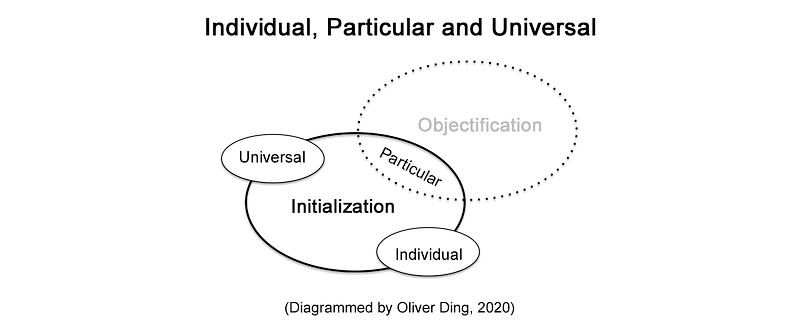
I have mentioned there are three phases of the formation of a concept in Activity U (VIII): Project as a Unit of Activity: Phase 1: Initialization; Phase 2: Objectification; Phase 3: Institutionalization. The article also presents the diagram below.
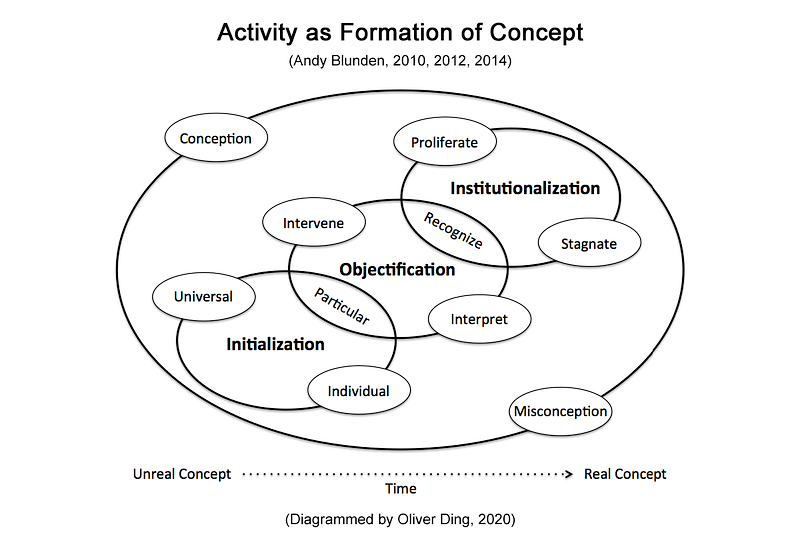
The notion of three phases is inspired by Blunden’s case study “Collaborative Learning Space”, you can find details from the previous article Activity U (VIII): Project as a Unit of Activity. I have to point out that Blunden is relatively unconcerned with demarcating the boundaries between the successive phases of a project. We should consider the above diagram as a rough representation. Blunden definitely uses “Objectification” and “Institutionalization” in his writings. However, he doesn’t obviously use the term “Initialization”.
3.1 Hegel’s four developmental stages of Projects
According to Blunden, Hegel mentioned four developmental stages of projects, “(1) Firstly there will be some group of people who by virtue of their social position are subject to some taken-for-granted or impending problem or constraint on their freedom. These are the conditions for a project to exist, but the project has not yet come into being. (2) On becoming aware of the problem there will be a series of failed projects arising from misconceptions of the situation, until, at a certain point: (3) An adequate concept of the situation is formulated and named and a social movement is launched to change social practices so as to resolve the problem or injustice. As the project unfolds and interacts with the social environment, its object becomes clearer and more concrete. (4) Eventually, the new form of practice becomes ‘mainstreamed’ as part of the social practices of the wider community. That is, it is institutionalized and its concept enters into the language and culture of the community. These stages are to be seen as ideal-typical, nor proscriptive.” (2014, p.8)
3.2 Conception, Misconception and Proliferate
The large oval represents Hegel’s stage 1 and stage 2. The below diagram is the zoom-out view of the oval. Here we see the germ-cell diagram again.
- Process 1: Concept (or Formation of Concept)
- Tendency 1: Conception
- Tendency 2: Misconception
- Orientation 1: Proliferate
- Process 2: Zeitgeist
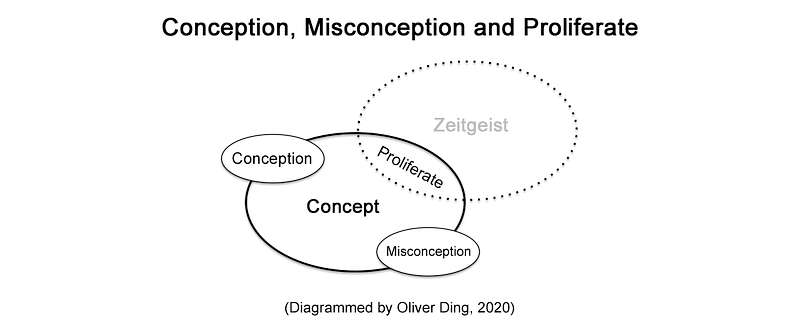
The orientation “Proliferate” refers to the Proliferation of concepts. Blunden mentions Proliferation several times. For instance, he reviews his own case study “Collaborative Learning Space” with the term Proliferation, “…a concept is most easily maintained and proliferated if it is promoted as the exclusive product of a distinct organization or project which promotes it, or, is adopted by a prestigious institution which others are inclined to emulate.” (2014, p.174) He also emphasizes the proliferation of concepts in an article that reviews Yrjö Engeström’s Activity System model, “…(e) The proliferation to different organisations is, like objectification, not only an essential part of consolidating a new social practice, but turns out to be a difficult, rich and important phase of innovation, as the idea which was implemented in one set of circumstance fails in others and has to be modified, bringing out successively what was essential and what was contingent in the original idea, contributing to the formation of a new concrete concept.”
Inside the large oval of the diagram “Activity as Formation of Concept”, we see three phases. Phase 1: Initialization; Phase 2: Objectification; Phase 3: Institutionalization. These three phases correspond to Hegel’s phase 3 and phase 4.
3.3 Initialization, Objectification, and Institutionalization
Let’s go deep into Hegel’s phase 3: “An adequate concept of the situation is formulated and named and a social movement is launched to change social practices so as to resolve the problem or injustice. As the project unfolds and interacts with the social environment, its object becomes clearer and more concrete.”
Here we can divide this phase into two sub-phases.
The first sub-phase “An adequate concept of the situation is formulated and named and a social movement is launched to change social practices so as to resolve the problem or injustice…” is just what I called “Initialization”.
The second sub-phase “…As the project unfolds and interacts with the social environment, its object becomes clearer and more concrete.” is just what Blunden called “Objectification”.
Finally, there is no doubt that we can claim Hegel’s phase 4 is just our phase 3 “Institutionalization”.
3.4 Individual, Particular, and Universal
I also have to mention that Blunden doesn’t tie Hegel’s three movements (Universal, Individual and Particular) with “Initialization” since he doesn’t use the term “Initialization”. Blunden says, “A concept originates in a problem or in an opportunity which arises within the social practices of some institution, positing a new need, designating either the problem or a solution. But such a concept will remain ‘unreal’ unless it is objectified.”(2014, p.172) In fact, the Particular leads to the objectification.
Blunden uses “Tree” and “Freeway” as two examples for explaining these three movements. Since two examples are existing concepts. Let’s use “TEDx” as an example for our discussion.
TEDx is an open brand program which is hosted by the non-profit TED Foundation. The “x” of TEDx means independently organized TED event. The TEDx program allows local volunteers who obtain a free license from TED to organize independent events similar to TED’s 18 minutes format. TED officially launched the TEDx program in 2009. The first TEDx event is TEDxUSC 2009 which was hosted at the University of Southern California. Local TEDx event teams only can use their local TEDx logo as the brand identity for their events.
Let’s apply our diagram and three movements to this case.
- Universal: “ TEDx” is a word that refers to a new concept of an open brand of events.
- Individual: The TEDxUSC 2009 is an individual local TEDx event. It uses its own logo “TEDxUSC”.
- Particular: It refers to particular activities of hosting and organizing local TEDx events around the world.
I consider Universal and Individual as two tendencies and Particular as Orientation because Particular refers to participation in social practice behind the new concept. The orientation of Particular leads to Objectification which is the following phase of Initialization.
3.5 Unreal concept and real concept
We should notice that the process of “formation of concept” is a dynamic process. Blunden points out, “A concept is a unit of a social formation and cannot be said to exist until it has achieved a degree of stability and interconnectedness within that form of life. Further, a concept is subject to modification in the course of its objectification which must be taken as part of the concept formation, and not simply the ‘registration’ of the concept.” (2014, p.171) In order words, the key is formation. We should adopt a process view of Concept. The process of “formation of concept” is a process of an idea transforming from an “unreal concept” into a “real concept” through various objectification in the real-life world.
The process is not simple and linear. There are possible misconceptions within different phases. It is possible to enter the initialization phase with a misconception of the situation and start a project with the wrong idea.
Part 4: The Objectification of Concept
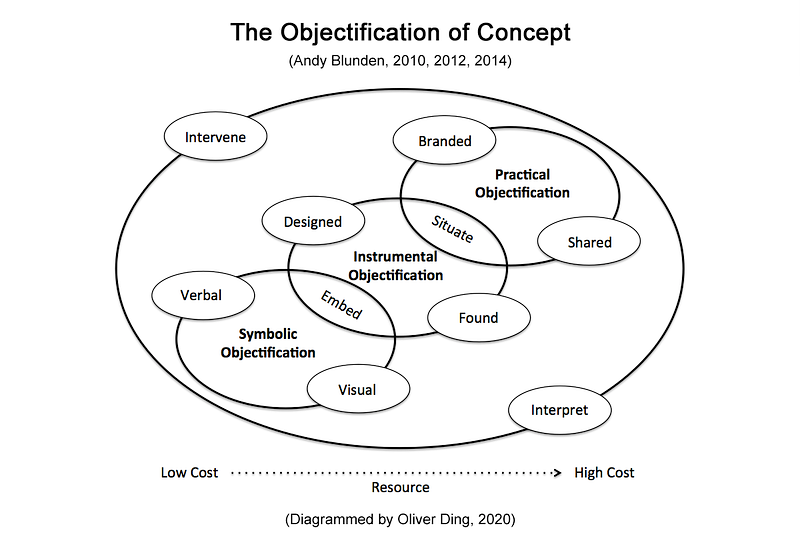
Blunden clearly claims that there are three aspects of objectification of concept: symbolic, instrumental, and practical. By adopting the germ-cell diagram, we can present these ideas with the diagram below.
4.1 Symbolic objectification
According to Blunden, “Firstly, the moment someone first communicates the concept of the project it is given a name or symbolically represented in some other way, after which the word or symbol functions as a focus for actions. The word eventually enters the language and acquires nuances and meaning through the development of the project and its interaction with other projects and institutions.” (2014, p.9)
This is symbolic objectification. I highlight “Verbal” and “Visual” as two tendencies of symbolic objectification. Its orientation is “Embed” which means the name will be used within the language of the community and the logo or other symbols will be used with materials.
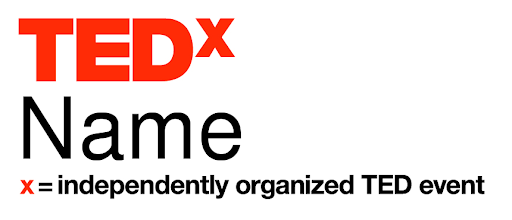
For the case of TEDx, the below picture represents the symbolic objectification of the TEDx project. The name of the project is “TEDx”, the concept of “TEDx” refers to “independently organized TED event”. The whole design is a meta-logo of the TEDx brand's visual identity. The “Name” is a placeholder for local TEDx events teams to place their local place’s name.
4.2 Instrumental objectification
The second aspect of objectification is instrumental objectification. According to Blunden, “Secondly, the project may be objectified by the invention and production of some new instrument or by the construction of material artifacts which facilitate or constrain actions in line with the project and facilitate its integration into the life of a community. The word in which the project is symbolically objectified may then be taken as referencing this artifact, reifying the concept as if it were an independently existing object, rather than an ideal functioning as the focus of a new form of social practice which constitutes it.” (2014, p.9)
Here we see Blunden clearly points out there are two ways of adopting instruments. I use the term “designed” to refer to “by the invention and production of some new instrument” and the term “found” to refer to “by the construction of material artifacts which facilitate or constrain actions in line with the project and facilitate its integration into the life of a community”. You can find details about “Designed/Found” in my article about artifacts and the materiality turn: Hammer, Hammering, and Affordance.

Look at the above picture, do you find there is a red circular carpet on the stage? This is a great example of instrumental objectification of the concept of TEDx and “independently organized TED event”.
Now let’s visit a webpage on the TED official site: TEDx Organizer Guide > Design the experience. The guide gives suggestions on using the full official TEDx logo, “Every stage is required to include your official TEDx logo with your full event name. So make sure you create a large logo and place it in a visible space on the stage. If you can’t get a stand-up, 3D logo, a projection screen could also work.” The guide also considers how to make a good view, “Position your speakers, the screen and any props carefully so that there’s a good view for the audience. For example, you’ll want to give your speakers a specific place to stand for their talk. (A red circular carpet, perhaps?)” Thus, the red circular carpet is not an official rule or requirement. The room of instrumental objectification is open with potential opportunities for creativity.
4.3 Practical objectification
The most important is practical objectification. According to Blunden, “…once the project achieves relatively permanent changes in the social practices of a community, the project transforms from a social movement into customary and routinized practices — an institution. In this instance, the word may be taken as referencing the form of practice in which the project has been given practical objectification and normalized.” (2014p.9) Practical objectification refers to participants, participatory, and community. That is the connection between concept and activity.

According to the official website of TED, as of December 31, 2020, there are 35,713 local TEDx events that were held in more than 130 countries. The TEDx Talks library contained over 30,000 videos from these local TEDx events. There are various ways of participating in the TEDx community, such as organizing, curating, hosting, designing, speaking, sponsoring, photographing, videoing, lighting, translating, listening, watching, sharing, etc. It’s not the word “TEDx” and the slogan “independently organized TED event” that define the movement, but the real actions of thousands upon thousands of volunteers define the movement.
As Blunden emphasizes, “…it is only possible to say what a concept is, even in terms of its realisation in word meanings, in the context of the activity in which the concept is to be realised. A word is meaningful only within the context of the relevant project.” (2012, p.293) If you want to understand the concept of “TEDx” and “independently organized TED event”, do stop at the word meaning level. You have to get involved in the community and be part of the practical objectification of TEDx.
4.4 Embed and Situate
The diagram of “the Objectification of Concept” presents two orientations between three aspects of objectification.
Symbolic > Embed > Instrumental > Situate > Practical
I have to mention that Blunden doesn’t originally highlight such a sequence. He considers these as “three aspects”. Thus, we shouldn’t see these as three phases with temporal boundaries. However, I want to emphasize the spatial boundaries between these three aspects. The orientation “Embed” refers to the boundary between language and material. The orientation “Situate” refers to the boundary between material and place or environment.
4.5 Branded, Shared, and Recognize
The above TEDx case has its limitations because it only refers to a Branded concept. The diagram below shows two tendencies: Branded and Shared. In the previous article Activity U (VIII): Project as a Unit of Activity, I have introduced Andy Blunden’s own case study the Collaborative Learning Space project which is a great case of a Shared concept.
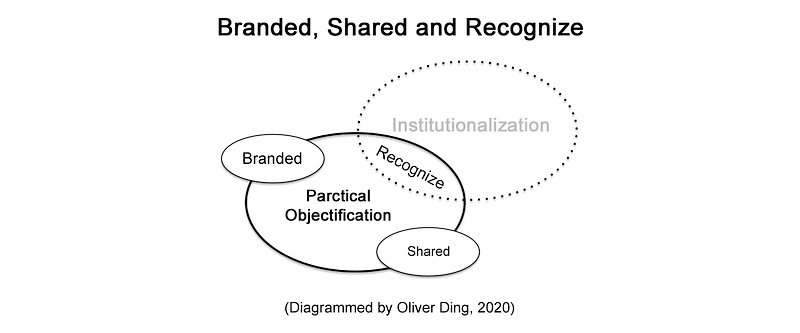
Blunden mentioned a dramatic phenomenon in the phase of Institutionalization. Once the concept of a project becomes a popular idea, some institutions would adopt the concept with their own words in order to brand their activity and property. For the Collaborative Learning Space project, Blunden points out, “This also raises the questions of the role and power of prestige in the institutionalization of a concept. Not all universities in Australia have adopted the term ‘Collaborative Learning Space.’ Every University that has gone through the same process of inventing new designs of classroom to meet their pedagogical needs, or to meet their need to position themselves favorably in the education market, has branded their infrastructure with a new name: ‘Advanced Concept Teaching Space,’ ‘eLearning Studio,’ ‘Flexible Teaching Space,’ ‘Digital Classroom’ and so on. Every institution highlights its innovation with its own brand name.”(2014, p.170)
We can also consider the concept of “Open Access” as an example of a Shared concept. The picture below is a screenshot of a webpage on the Wikipedia website. It presents various projects under the concept of “Open Access”.
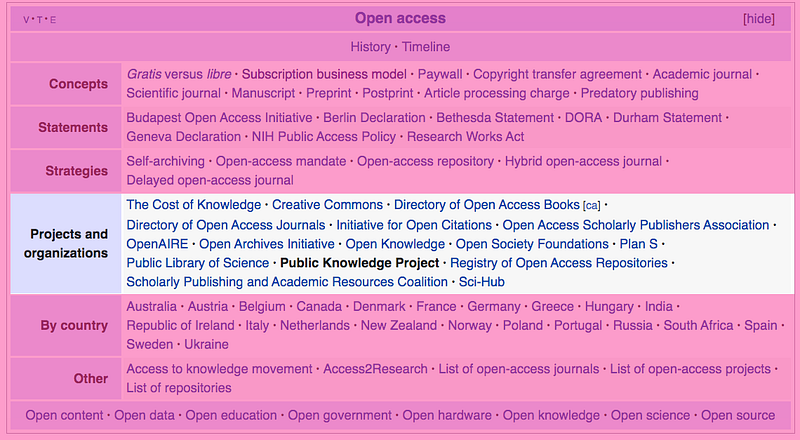
According to Wikipedia, “Open access (OA) is a set of principles and a range of practices through which research outputs are distributed online, free of cost or other access barriers. With open access strictly defined (according to the 2001 definition), or libre open access, barriers to copying or reuse are also reduced or removed by applying an open license for copyright.”
4.6 Intervene, Interpret, and Recognize
Now let’s zoom out to see the germ-cell diagram version of Objectification.
- Process 1: Objectification
- Tendency 1: Intervene
- Tendency 2: Interpret
- Orientation 1: Recognize
- Process 2: Institutionalization
Blunden doesn’t use “Intervene” and “Interpret” to describe the objectification of concepts. Since objectification is a complex process, I think it is valuable to highlight these two types of practice within objectification. The “Intervene” refers to Intervention that pays attention to “doing” while the “Interpret” refers to Interpretation that pays attention to “saying”.
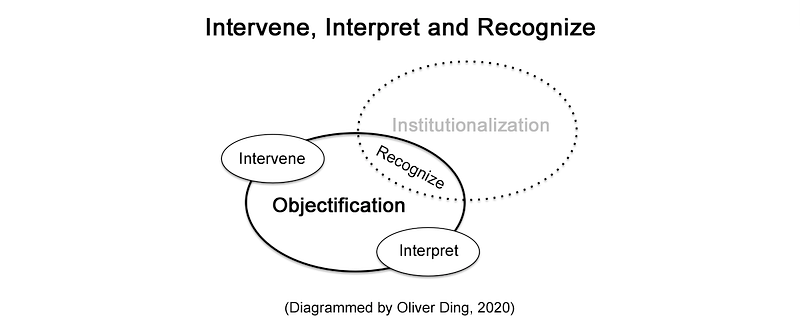
The orientation “Recognize” refers to Recognition which is related to “curating” by other institutions.
4.7 Low cost and high cost
I also consider there is a need for a dimension of resource for discussing objectification.
Low cost — — (Resource) — — High cost
From language to material, from material to environment. It is clear there is a tendency to increase resource consumption. I think this dimension is useful for empirical research and practical works.
Besides, the social change about supportive resources is a promising direction for applying Project-oriented Activity Theory. For instance, the concept of “Crowdfunding” and the concept of “Micro-Sponsorship” represent emergent digital practices. According to Wikipedia, “Crowdfunding is the practice of funding a project or venture by raising small amounts of money from a large number of people, typically via the Internet. Crowdfunding is a form of crowdsourcing and alternative finance. In 2015, over US$34 billion was raised worldwide by crowdfunding.” Kickstarter is a digital platform that is based on the concept of Crowdfunding. Traditionally, sponsorship is adopted by institutions. Patreon creates a digital platform that allows fans to sponsor individual artists and creators through a monthly membership.
Part 5: The Landscape of Culture
The last diagram zooms out to a large view that connects Individual mind (Idea) and Collective theme (Zeitgeist) through Collective Projects (Concept). This view also suggests a new way of understanding “Culture”.
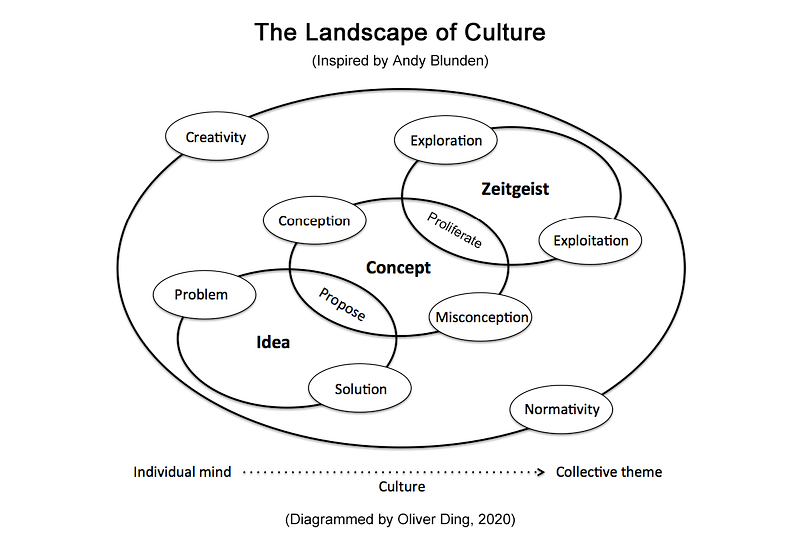
5.1 Idea and Concept
I have to point out that Blunden doesn’t obviously give this picture to us. However, he mentions related ideas in his books. According to Blunden, “The project arises in response to some contradiction or problem within a social situation. However, the object cannot simply be conceived of as ‘to solve problem X’. The problem stimulates efforts to find a solution but it is not in itself sufficient to form a concept (Vygotsky, 1934/1987, p.126). Quite different, even mutually hostile projects may be directed at one and the same situation and solve one and the same problem. The formation of a project with a concept of the problem is an original and creative social act. ”(2014, p.25)
It is clear that Blunden distinguishes between the pre-concept status and the concept status. In order to better present his statement, I define the pre-concept as the “Idea” process. Let’s apply the germ-cell diagram to discuss this process.
- Process 1: Idea
- Tendency 1: Problem
- Tendency 2: Solution
- Orientation 1: Propose
- Process 2: Concept
There are many ideas for “problem-solution”, but not all ideas can generate a proposal of a new concept.
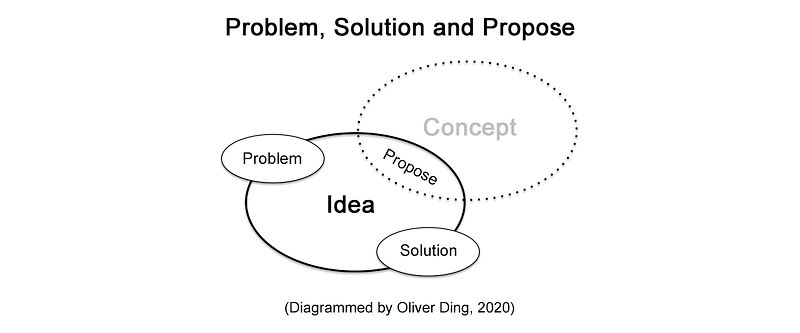
I have shared my own case about the Re-Engagement Project in the previous article Activity U (VIII): Project as a Unit of Activity, this case is a good example of discussing the distinction between idea and concept. When offline events are canceled around the world, the obvious Plan B is running online real-time conferences and virtual meetings with conferencing software such as Zoom, Google Hangouts, and Jitsi. This is an “idea”. However, I think we can go further and I consider Re-Engagement as Plan C. I propose the idea of “Re-Engagement” as a new concept because it presents a new form of events.
While the pre-concept status (Idea) associates with the individual mind, the Concept status associates with collective collaboration. For example, the idea of Re-Engagement is public now and everyone can take action with the idea. Blunden uses “Immanence” to emphasize this characteristic of project/concept, “From that time forward the project, with its object, continues to develop according to its own logic, so to speak. Where a project may ‘end up’ cannot be determined in advance. The plot unfolds according to its own dynamic and through interaction with the wider community. This is what is meant by immanence.” Here we have to think of the “project” as the “formation of concept”, not a regular project such as work. The “its own logic” of the project is the logic of “formation of concept”. For example, the development of the concept “Re-Engagement” is a project, however, this project is not decided by myself.
5.2 Concept Ecology as Zeitgeist
In the conclusion of the case study of ‘Collaborative Learning Space’, Blunden mentioned “Zeitgeist” for discussing the historical background of the case. He says, “The neo-liberal model of student-as-customer did not favor collaborative learning in and of itself, but its critique of teacher-centered pedagogy provided an opening in which collaborative learning could occupy an attractive third position. In the ‘real world’ of 1990s private enterprise, hierarchical chains of line management and sharp divisions between decision making and labor were out of favor, and firms were devolving authority and responsibility for outcomes from middle-management to self-managed teams of multi-skilled front-line workers. In this Zeitgeist, devolving responsibility for learning from teacher to students made perfect sense.” (2014, p.174)
To be honest, I have not read Blunden’s Hegel for Social Movements (2019). I read a book review written by Mahdi Ganjavi and indirectly know Blunden’s view on “Zeitgeist”. Ganjavi says, “The understanding of Blunden of the zeitgeist of the time is reflected in his description of the scope and demands of the social movements as well as his analysis of the methods for connecting “collaborative projects.” Blunden argues, “The left itself now already looks like so many independent projects” (p. 273). Contending that the time of coordinated activity of millions of people have long gone, the author claims that ‘projects’ (i.e., collaborated actions) have become the unit of social change, both in theory and in social reality. According to this formulation, what remains crucial for social movements is to learn how to collaborate with other projects; this is where Blunden expands on the need for solidarity. According to him, the principle of solidarity demands for any project to participate in the struggle of other projects under their direction.”(2020)
So, I think it is possible to safely use “Concept Ecology” to re-conceptualize the notion of “Zeitgeist” for Project-oriented Activity Theory. In other words, the “Zeitgeist” is an ecosystem in which various concepts form a whole. Thus, we can use the term “Zeitgeist” to build a higher-level process than the individual Concept process.
Blunden uses “system of concepts” to describe the connected concepts, “In fact, every concept is a family of concepts, because the original social context passes and the concept takes on a life in other contexts and other projects. But viewed from the standpoint of other projects, the concept is only a shadow of its original self. Concepts exist only within whole systems of concepts. A concept is indigenous to one particular system of concepts, but still exists in other systems of concepts according to its practical relation to other projects. A ‘freeway’ might be discussed in the context of finding one’s way home, situating a restaurant, choosing an automobile, … What we have here is an infinite variety of particular concepts, each of them representing a particular solution to a particular problem…Where I have referred to ‘system of concepts’ above, what is meant is a project. A project, such as represented by ‘freeway’ brings along with it a range of subordinate concepts, such as ‘on ramp’, ‘lane’, ‘flyover’, ‘verge’ and so on, but also absorbs all the other concepts of the community in a modified form, from the point of view of ‘freeway’.”(2012, pp.293–294)
The “system of concepts” is a project. “Concept Ecology” is formed by various “systems of concepts”. Thus, we can understand the “Concept Ecology” as a “project network” too. It doesn’t matter what the term we use. What I want to present is a high level of form of concepts.
Let’s apply the germ-cell diagram to the “Zeitgeist” level.
- Process 1: Zeitgeist
- Tendency 1: Exploration
- Tendency 2: Exploitation
- Orientation 1: Curativity
- Process 2: History
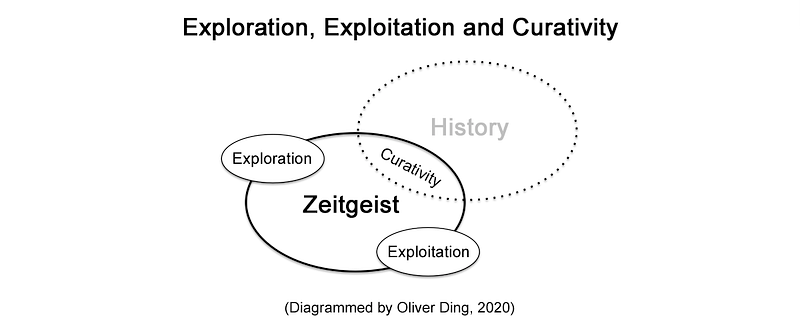
I don’t have confidence in claiming these terms as the final solution. I think Blunden should have some better words for this diagram. I’d like to share ideas behind these placeholders.
- Exploration: Creativity, active, “unsettled lives”, “enabling”, etc.
- Exploitation: Normativity, passive, “settled lives”, “constraining”, etc.
“Exploration” and “Exploitation” are inspired by James G. March’s 1991 paper Exploration and Exploitation in Organizational Learning. According to March, “Exploration includes things captured by terms such as search, variation, risk-taking, experimentation, play, flexibility, discovery, innovation. Exploitation includes such things as refinement, choice, production, efficiency, selection, implementation, execution.” I think this pair of terms is great for the “Zeitgeist” level of Project-oriented Activity Theory.
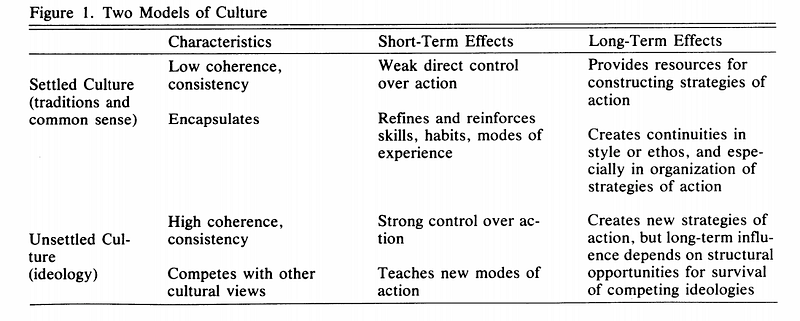
Contemporary cultural sociologists also use “unsettled lives/settled lives”, and “enabling/constraining” to describe the culture and its meaning for ordinary people. In a 1986 paper Culture in Action: Symbols and Strategies, Ann Swidler suggests two models of Culture: Settled Culture (traditions and common sense) and Unsettled Culture (ideology). It roughly echoes Exploitation and Exploration.
Finally, the term “Curatvity” is adopted from my own idea of Curativity Theory. The term Curativity refers to “curating pieces into a meaningful whole” which means general curatorial practice. Here I use “Curativity” to refer to curating of concept ecology. At the “Zeitgeist” level, we face the challenge of dealing with numerous, diverse, plural value orientation concepts. In order to reduce the overload of concepts, people tend to curate concepts with similarity/difference, network/hierarchy, time/space, resources/results, and other cognitive tools. The outcome is Collective Themes that represent the aboutness of concept ecology.
5.3 Creativity, Normativity, and Curativity
If we zoom out from the diagram of “The Landscape of Culture”, we can see a new diagram that places Culture as process 1 and History as process 2.
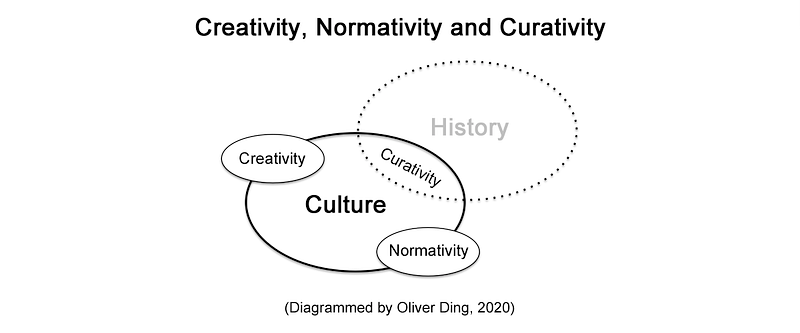
The last section has discussed Exploration, Exploitation, and Curativity. Here I use Creativity/Normativity as a pair of tendencies for Culture.
Part 6: The Source of Activity
The above discussions translate Blunden’s Project-oriented Activity Theory into the diagram version. Now let’s ask a critical question:
What’s the value of Project-oriented Activity Theory? What’s its theoretical conbrituations to the development of Activity Theory and Practice Studies in general? What’s its practical heuristic functions for empirical research and general practice?
Part 6 focuses on the side of theoretical contributions. I have mentioned the ambitious goal of Blunden’s approach is solving the dichotomy of methodological individualism and collectivism in the social sciences in the previous article Activity U (VIII): Project as a Unit of Activity. His solution is adopting “Project” as a unit of Activity and developing the new version of Activity Theory as a shared conceptual language for closing the gap between personal actions and social life, and the gap between various separated disciplines. Thus, we can evaluate the approach from three aspects:
- Contribution to the development of Activity Theory
- Contribution to connecting Person Actions and Social Life
- Contribution to the fragmented human science with an interdisciplinary solution
6.1 Three statements of “The Source of Activity”
I’d like to use the following message to describe the real innovation of Blunden’s approach. The message can support the above three aspects at the foundational level.
It is a Meta-theory about the Source of Activity and Social Practice in general.
The core of the above message is “The Source of Activity”. For the development of Activity Theory, we know there are some existing statements about this issue. Let’s highlight two accounts for our discussion. Based on Karl Marx and Lev Vygotsky’s ideas, A. N. Leontiev first set out a framework for Activity Theory and coined the statement of “Object-orientedness” which is a famous basic principle in the mainstream Activity Theory literature. According to Leontiev, “Separate concrete types of activity may differ among themselves according to various characteristics: according to their form, according to the methods of carrying them out, according to their emotional intensity, according to their time and space requirements, according to their physiological mechanisms, etc. The main thing that distinguishes one activity from another, however, is the difference of their objects. It is exactly the object of an activity that gives it a determined direction.” (1978, p.98)
So, what’s the object of activity?
The answer from Leontiev is the motive of activity. Leontiev claimed, “According to the terminology I have proposed, the object of an activity is its true motive. It is understood that the motive may be either material or ideal, either present in perception or exclusively in the imagination or in thought. The main thing is that behind activity there should always be a need, that it should always answer one need or another.” He also added a note about the term motive, “Such restricted understanding of motive as that object (material or ideal) that evokes and directs activity toward itself differs from the generally accepted understanding”.(1978, p.98)
After defining the “activity — motive” level, Leontiev moved to its sub-level: the “action — purpose” level. He said, “We call a process an action if it is subordinated to the representation of the result that must be attained, that is, if it is subordinated to a conscious purpose. Similarly, just as the concept of motive is related to the concept of activity, the concept of purpose is related to the concept of action.” (1978, p.99)
In other words, Leontiev develops a hierarchy of human activity and uses this structure to discuss the development of the personal psychological function. Readers can find details in Activity U (VI): The Hierarchy of Human Activity and Social Practice.
We have to notice that what Blunden wants to develop is not a psychological theory, but an interdisciplinary social theory including individual psychological development as a part. Though the “Object-orientedness” principle is great for an activity-theoretical approach to psychological development, there is room for developing a new statement of “the Source of Activity” in order to establish an activity-theoretical approach to social theory.
Leontiev’s approach is further developed by Yrjö Engeström and others. Engeström upgraded the activity theory from the individual activity level to the collective activity level with a conceptual model of “activity system” in order to apply activity theory to educational settings, organizational development, and other fields (Engeström,1987). Readers can find details in Activity U (IV): The Engeström’s Triangle and the Power of Diagram.
Engeström embraces the “Object-orientedness” principle and keeps the “Object” as a key concept of his “Activity System” model (the Engeström’s Triangle). Moreover, he adopts the concept of “contradiction” for explaining the development of Activity Systems. In other words, the “Development by Contradictions” principle is Engeström’s statement to “the Source of Activity”. Engeström also used this concept of “contradictions” to guide the notion of “expansion”. He said, “Within the structure of any specific productive activity, the contradiction is renewed as the clash between individual actions and the total activity system…The fundamental contradiction arises out of the division of labor…The two directions or ‘opposite starting points’, from within an activity and from between two activities, are essential for the emerging concept of expansion…”(1987, p.98–99)
I have pointed out that the motivation of Engeström is developing an activity-theoretical organizational learning theory and social learning theory in general in the previous article Activity U (VIII): Project as a Unit of Activity. In order to develop a model of learning in the work setting, Engeström decided to develop a model of “learning activity”. In order to understand the “learning activity”, he chose to trace back to two lines. One line is about “activity” while another line is about “learning”. During the process, he had to develop a collective level version of “activity theory” for his research. This process is clearly displayed in Chapter 2 of Learning by Expanding is An Activity-theoretical Approach to Developmental Research. Thus, we can consider the “activity system” model as a by-product of developing a new theory of learning in the work setting.
The limitation of the “Development by Contradictions” offered by Engeström is that he only considers the internal contradictions within the Activity System. He doesn’t explain the concept of “system” in his writings. There are no explicit theoretical statements about the relationship between “system” and “environment” within the approach of “Activity System”.
Now I want to claim that Blunden establishes a new approach to Activity Theory by developing the concept of “Project” as a unit of Activity. The new approach is supported by the notion of “Activity as Formation of Concept” which is a brand new statement to “The Source of Activity”. We can call this statement the “Formation of Concept” principle.
6.2 “Object-orientedness” v.s. “Formation of Concept”
Now we have three statements about “the Source of Activity”. What’s the intrinsic relationship between these statements? Let’s start with the first statement “Object-orientedness”. According to Leontiev, an Activity is defined by its Object and an Object is defined by Motive. So, what’s the concrete process of defining an object by a motive? This is a highly complex issue within the Activity Theory literature. Readers can find related details in Activity U (V): Typology of Activities and Other Practical Tools.
As discussed above, I made a distinction between Idea and Concept from the perspective of Project-oriented Activity Theory. We can use this notion to connect the statement “Object-orientedness” and the statement “Formation of Concept”. The diagram below represents the notion visually.
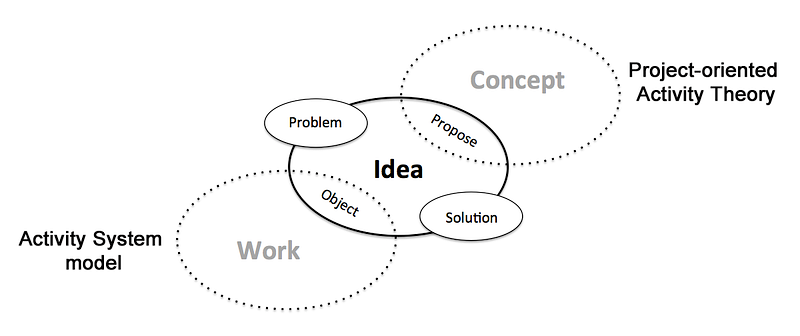
The above 5.1 section has talked about this notion with a concrete example. Here we just repeat Blunden’s message, “The project arises in response to some contradiction or problem within a social situation. However, the object cannot simply be conceived of as ‘to solve problem X’. The problem stimulates efforts to find a solution but it is not in itself sufficient to form a concept (Vygotsky, 1934/1987, p.126). Quite different, even mutually hostile projects may be directed at one and the same situation and solve one and the same problem. The formation of a project with a concept of the problem is an original and creative social act. ”(2014, p.25)
I have emphasized that we have to think of the “project” as the “formation of concept”, not a regular project such as work. The above diagram represents a path in which the idea defines an object and the object defines the work or regular activity. This path is covered by the statement of “Object-orientedness” which is initiated by Leontiev’s approach and supported by Engeström’s Activity System model. On the other side, the “Idea” is a pre-concept process that can lead to the “Concept” and the “Project”. This path is the focus of Blunden’s approach.
It is clear that the statement of “Object-orientedness” is a sub-statement of the statement of “Formation of Concept” because the “Idea” process which leads to the object-defined regular works or activities is the pre-Concept process.
6.3 “Development by Contradictions” v.s. “Formation of Concept”
For Engeström, the statement “Development by Contradictions” refers to the Expansive Learning model in which Concept Formation is a key step. Engeström develops a schema that considers seven epistemic actions in an expansive learning cycle: 1) questioning, 2) historical analysis/actual-empirical analysis, 3) modeling the new solution, 4) examining the new model, 5) implementing the new model, 6) reflection on the process, 7) consolidating the new practice. The keyword of this schema is “model”. According to Engeström, “the third action is that of modeling the newly found explanatory relationship in some publicly observable and transmittable medium. This means constructing an explicit, simplified model of the new idea that explains and offers a solution to the problematic situation.” (1990, p.383)
Here we can consider Engeström’s modeling process connects to both the “Idea” process and the “Concept” process. In some cases, it might stay in the “Idea” process and lead to a change in regular work or activities. It is also possible the modeling process leads to a new Concept from the perspective of Project-oriented Activity Theory.
There is a significant difference between Engeström’s Expansive Learning model and Blunden’s approach. The former is an interventional approach while the latter is an explanatory approach. What Engeström developed is a method for practical intervention in the context of organizational works while what Blunden developed is a general theory about the formation of concepts within social society.
The most important thing is that Blunden emphasizes the immanence of the formation of concepts. He says, “From that time forward the project (formation of concept), with its object, continues to develop according to its own logic, so to speak. Where a project may ‘end up’ cannot be determined in advance. The plot unfolds according to its own dynamic and through interaction with the wider community. This is what is meant by immanence.”(2014, p.25)
Again, if we accept the “Idea/Concept” distinction, we can solve this “Intervention/Explanation” dichotomy. Thus, we can consider the statement “Development by Contradictions” as a substatement of “Formation of Concept”.
In this manner, we can claim that the Project-oriented Activity Theory is the newest development of Activity Theory. Blunden doesn’t develop an alternative to Activity Theory, but an expansive version of Activity Theory.
6.4 “Dynamics of Social Practice” v.s. “Formation of Concept”
Outside of the literature on Activity Theory, there are various theoretical approaches to Practice Studies in general. I’d like to select one most relevant approach and contrast it with Blunden’s approach.
In a 2012 book titled The Dynamics of Social Practice: Everyday Life and how it changes, Elizabeth Shove, Mika Pantzar, and Matt Watson present an account of the dynamic aspects of social practice. The authors explore five related questions: 1) How do practices emerge, exist, and die? 2) What are the elements of which practices are made? 3) How do practices recruit practitioners? 4) How do bundles and complexes of practice form, persist, and disappear? 5) How are elements, practices, and links between them generated, renewed, and reproduced?
The authors suggest that in doing things like driving, walking, or cooking, people (as practitioners) actively combine the elements of which these practices are made. By elements they mean, 1) Materials — including things, technologies, tangible physical entities, and the stuff of which objects are made; 2) Competences — which encompasses skill, know-how, and techniques; and 3) Meanings — in which they include symbolic meanings, ideas, and aspirations. (2012, p.14)
The authors claim a statement about the source and dynamics of practice, “practices emerge, persist, shift and disappear when connections between elements of these three types are made, sustained or broken.” (2012, p.14) This theoretical statement is supported by their study of the history of automobility. They take the practice of driving rather than the car itself as the central topic. The authors point out, “…it provides an important reminder of the fact that the history of car-driving is a history in which previously established technologies, competences and meanings disintegrate and crumble, and in which practices that were once normal disappear.” (2012, p.15)
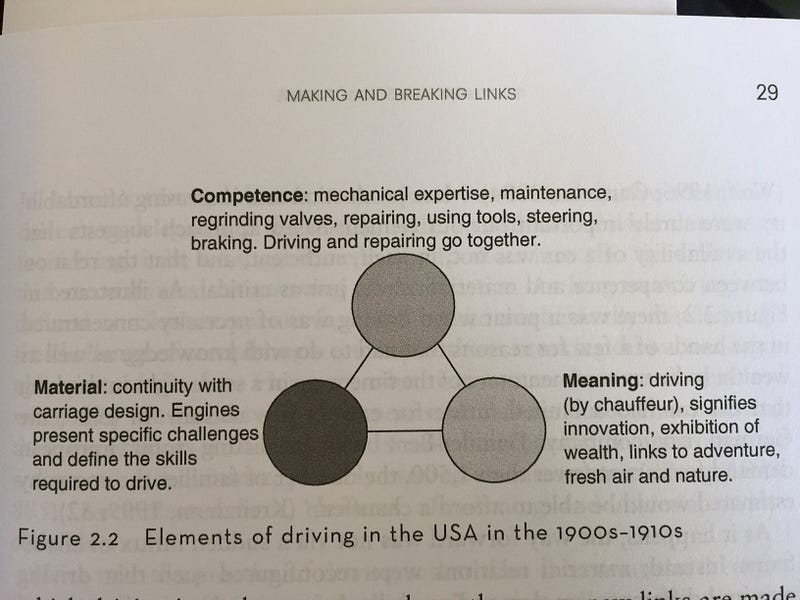
The above diagram represents the framework developed by the authors. Based on this basic diagram, the authors also suggest some new concepts such as “proto-practices” which means links between three elements not yet made, “practices” which means the links being made, and “ex-practices” which means the links no longer being made. They also discuss ideas such as “pre-formation”, “formation” and “de-formation” of connections between practices.
It seems this is a simple and useful framework for some kinds of practical studies. However, it is hard to accept it as a general social theory that can help us understand social life deeply. The authors use “connections between three elements” to explain the complexity of social practices. However, the three elements they present are too loose. Each element refers to a set of theoretical concepts in social sciences. In this manner, it’s not possible to accurately confirm a connection between two elements.
In contrast, Project-oriented Activity Theory starts from a germ-cell idea “Concept” and develops a systematic theoretical approach which is also simple but powerful. It seems the “Dynamics of Social Practice” framework doesn’t answer the authors’ original questions deeply. The framework can be considered as some explanation of the Objectification of Concept from the perspective of Project-oriented Activity Theory.
6.5 Against the Dichotomy of Social Formation
The theoretical roots of Blunden’s approach are Hegel’s conception of a “formation of consciousness”, Marx’s “social formation” and Vygotsky and subsequent Activity Theorists’ same conception of Concepts as both units of consciousness and the units of a social formation, and in their understanding of the genesis of projects (2014, p.9)
These theoretical resources enable Blunden to against the dichotomy of the social formation such as “subject — object” and “individual — collective”. Blunden says, “The apparent dualism of a concept, as a unit of mind and what the concept represents in the world, is overcome because it turns out that a concept is the self-consciousness of a real project. So there is no dualism. It can be seen that any community is made up of a tangle of projects, each of them being the subject of a concept in the sense of a representation of the situation from which the project originated, and concretises in the process of the realisation of its ideal. Every project is motivated by some ideal realised as the negation of some problem. Every project has its ‘particularism’, a point of view which all the other various concepts can be evaluated, and integrated into a whole.” (2012, p. 294)
Hegel’s three movements of concept (universal, particular, and individual) also can help us solve the problem of “individualism — collectivism”. Blunden points out, “It is the failure to grasp this conception which has meant that interactionist discourse fails to see the forest in their fascination with the trees. Attempts to replace the individual/universal relation with the categorization of individuals according to contingent attributes leads away from Activity Theory and projects to the theorization of society in terms of social groups made up of like individuals — a truly postmodern, fragmented view of the world. Activity Theory with Project as a unit of activity can, on the contrary, grasp the real participation of the individual in the universal and the universal in the individual. But any research, not just Activity Theory, which sheds light on the dynamics of collaborative projects will contribute to the understanding of social cohesion and social change, and facilitate interdisciplinary research.” (2014, p.26)
What a wonderful project!
Part 7: A Theory of Radical Innovation
The final part aims to highlight some directions of appreciating Project-oriented Activity Theory’s practical heuristic functions for empirical research and general practice.
Obviously, the starting point is “Project” because it functions explicitly to theorize the connection between human actions and the societal context in which individual actions are meaningful. Blunden emphasizes, “Since no social phenomena are possible other than through the actions of individuals, and no meaningful individual action is possible other than in and through the larger cultural and historical context of action — the concept of ‘project’ is applicable in all the human sciences.” (2014, p.23)Thus, it is clear that the empirical research and general practice study should focus on “Project” itself.
However, we have to avoid the misconception of the word “Project”. As discussed above, the concept of “Project” should be understood as “Activity as Formation of Concept” within Blunden’s approach. This first lesson requires us to see the difference between the “Project” as a normal word and the “Project” as a theoretical concept.
7.1 Radical innovation v.s. Incremental innovation
In my opinion, Project-oriented Activity Theory can be adopted as a theory of radical innovation since the approach covers the whole developmental process of a brand new concept. Organizational scholars use “Radical innovation — Incremental innovation” to discuss organizational innovation, “While incremental innovations are typically extensions to current product offerings or logical and relatively minor extensions to existing processes, radical product innovations involve the development or application of significantly new technologies or ideas into markets that are either nonexistent or require dramatic behavior changes to existing markets.” (McDermott and O’Connor, 2002)
I’d like to use “Radical innovation — Incremental Innovation” in a broader sense. Let’s use the “Idea/Concept” diagram again. From the perspective of Project-oriented Activity Theory, a “Radical Innovation” can be definitely defined as a project with a brand new concept while an “Incremental Innovation” can be understood as a project with a good idea that is not ready for proposing as a brand new concept.
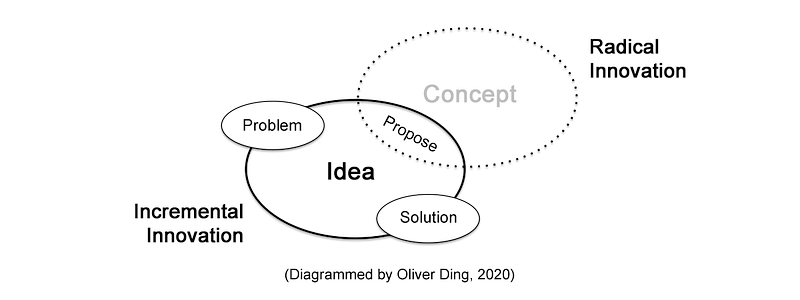
Since Blunden’s approach focuses on “the formation of a project with a concept of the problem is an original and creative social act”, applying it to only the “Idea” process without considering other processes is just using a sledgehammer to crack a nut.
Finally, I’d like to suggest some concrete directions for further study and discussion:
- Micro Movements as Cultural Innovations
- Brand Commons for Social Change
- Concept Competition and Career Development
- Knowledge Development and Domain Formation
- Digital Technology and Business Development
7.2 Micro Movements as Cultural Innovations
Social movements can be macro movements or micro-movements. While the macro movements contribute to the major social changes such as revolutions, the micro-movements can be considered minor cultural innovations which are similar to Cultural Invention including sets of behavior adopted by groups of people.
For example, let’s look at the Bullet Journal project. According to Wikipedia, “A bullet journal is a method of personal organization developed by designer Ryder Carroll. The system organizes scheduling, reminders, to-do lists, brainstorming, and other organizational tasks into a single notebook. The name ‘bullet journal’ comes from the use of abbreviated bullet points to log information, but it also partially comes from the use of dot journals, which are gridded using dots rather than lines. First shared with the public in 2013, it has become a popular method, garnering significant attention on Kickstarter, Instagram, Facebook, YouTube, and Pinterest.”
7.3 Brand Commons for Social Change
As mentioned above, the TEDx program is an exemplar of the concept of the open brand. In 2011, I coined a term named “Brand Commons” which is inspired by “Creative Commons”. While the concept of “Creative Commons” refers to the movement of open content, the concept of “Brand Commons” refers to the movement of open brand programs. I have been collecting over 50 cases of Brand Commons.
For instance, Pecha Kucha is an excellent case of Brand Commons. Pecha Kucha was created by Astrid Klein and Mark Dytham of Tokyo’s Klein-Dytham Architecture (KDa) in February 2003. As a storytelling format, it requires speakers to show 20 slides for 20 seconds of commentary. Based on the unique format of sharing, they also designed a format of activity called Pecha Kucha Night (PKN). A typical PechaKucha Night (PKN) includes 8 to 14 presentations. Organizers in some cities have customized their own format. Like TED’s open brand program TEDx, the PKN adopts the same open brand approach. As of June 2020, more than 10K PKNs had been held in more than 1,200 cities worldwide. More than 3 million people have attended a PKN event.
In addition, I have designed and launched my own open brand programs as experiments. In 2013, I developed a concept called “Open Learning Opportunity (OLO)” which was inspired by Dr.Sugata Mitra’s Self Organized Learning Environments (SOLE). Based on the concept of OLO, I designed and launched an open brand program called “WEEx” under the WEE project which is an open learning community. While the “x” of TEDx refers to “independently organized TED events”, the “x” of WEEx means “Independently organized Open Learning Opportunities”.
7.4 Concept Competition and Career Development
Concept Competition and Career Development are related to the dynamics of professional domains. In recent years, new professional domains emerged and grew fast and also disappeared quickly, especially web/mobile practice-related domains. For example, Information Architecture (IA) as a professional practice went popular in the mid-1990s and changed in the mid-2020s.
In 2002, the Information Architecture Institute was registered as a nonprofit (501c6) organization. In 2019, their board of directors decided to dissolve the IA Institute as a legal business entity. Before the final announcement, insiders have discussed reframing the domain of Information Architecture in order to adopt the change of context. In 2013, 42 researchers, educators, and practitioners attended a workshop called “Reframing Information Architecture” at ASIS&T Information Architecture Summit in Baltimore, Maryland. Later, they collected papers and published a book for pushing the conversation further. One author suggested reframing Information Architecture as a sub-section under the User Experience umbrella. Then, we see another professional organization: User Experience Professionals Association.
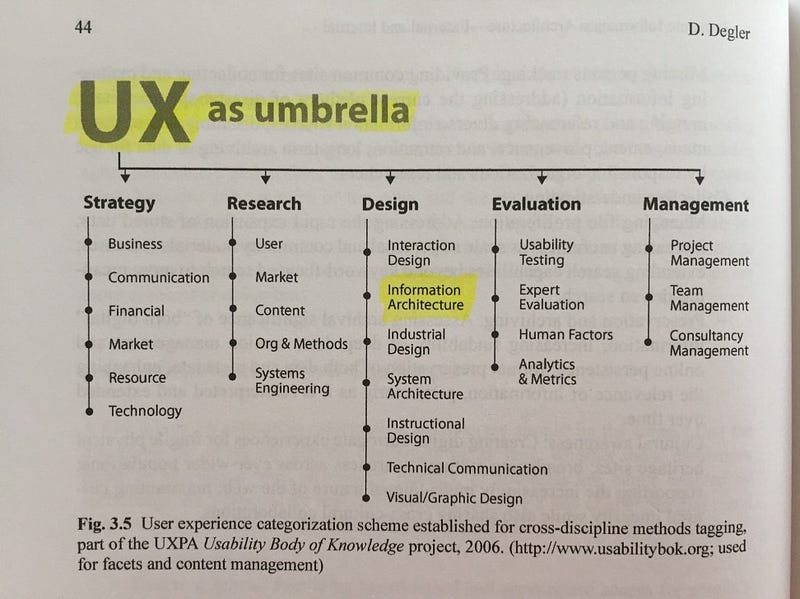
From the perspective of Project-oriented Activity Theory, the dynamics of professional domains can be seen as a process of Concept Competition.
7.5 Knowledge Development and Domain Formation
Knowledge Development and Domain Formation refer to scientific or academic discipline and professional domains. The former focuses on knowledge production while the latter focuses on knowledge-based practice. The dynamics of discipline and domains connect to the formation of new knowledge concepts.
In a 2018 autobiography The Hope Circuit: A psychologist’s journey from helplessness to optimism, Martin E. P. Seligman shared the story of the development of “positive psychology” and the founding process of the International Positive Psychology Association. Thus, we can use the method of biographical study with the help of Project-oriented Activity Theory to understand knowledge development and domain formation.
In fact, Collaborative Projects have collected several knowledge-development projects such as the 5th Dimension Project (p.125) which is hosted by the Laboratory for Comparative Human Cognition (LCHC), and the Vygotskian Collaborative Project (p.217) which refers to the historical development of knowledge construction based on Vygotsky’s works.
7.6 Digital Technology and Business Development
In Social Platform Experience Design (#SocialPxD), I have argued that there is a need to develop a multi-perspective framework for understanding the development of social digital platforms. The PxD framework I suggested incorporates four perspectives: Digital technology perspective, Interaction design perspective, Business ecology perspective, and Social practice perspective. The direction of “Digital Technology and Business Development” echoes the PxD framework.
From the perspective of Project-oriented Activity Theory, there is a possible starting point from the above diagram “the Landscape of Culture”. I’d like to suggest a “Hypeword — Concept — Idea” triad for further study. Inspired by the Hype Cycle from Gartner, I coined a new term “Hypeword” which means popular buzzwords about technological development. Thus, the “Hypeword” refers to the level of “Zeitgeist” in the technological business field.
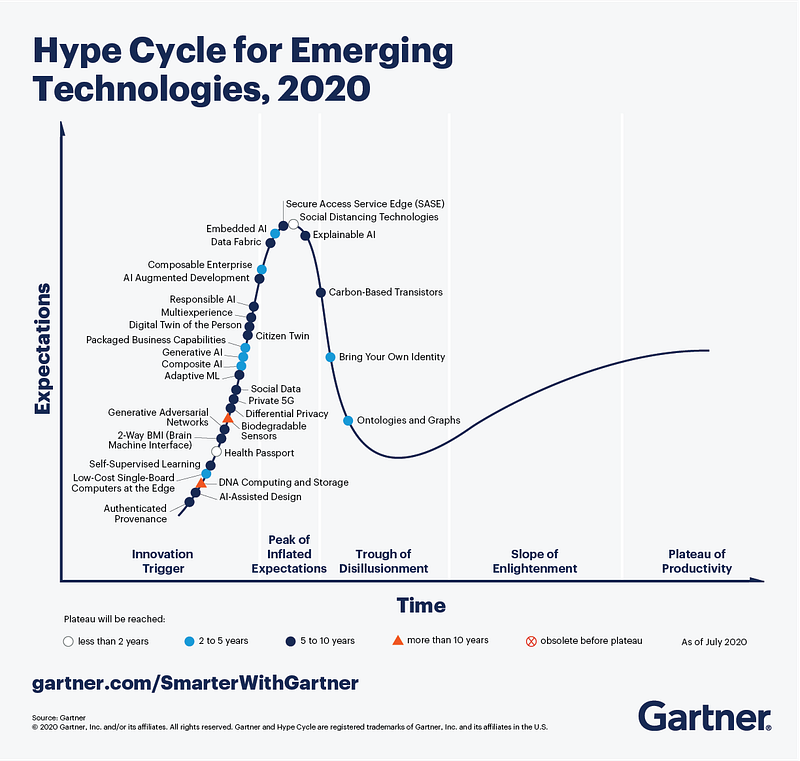
We can find more hypewords outside of the above Hype Cycle, for example, “No Code”. According to Wikipedia, “No-code development platform allows programmers and non-programmers to create application software through graphical user interfaces and configuration instead of traditional computer programming. No-code development platforms are closely related to low-code development platforms as both are designed to expedite the application development process. These platforms have both increased in popularity as companies deal with the parallel trends of an increasingly mobile workforce and a limited supply of competent software developers.”
I am not going to claim that “Hypeword” is a derogatory term. For instance, “Mobile Responsive” or “Responsive Design” refers to a website design trend which means the layout and/or content responses or adapts based on the size of the screen they are presented on. I’d like to consider it as a hypeword.
The value of the new term “Hypeword” is using it within the “Hypeword — Concept — Idea” triad. The above discussion has pointed out that not all Ideas are Concepts. Now I want to claim that not all Hypewords are Concepts too. However, some Hypewords are real Concepts. Thus, the empirical research direction should focus on a particular project and work on an inquiry into the development of the “idea/concept” behind the project. How does the founder of the project develop his ideas? Is the idea inspired by some hypewords or not? Does the founder promote his idea as a hypeword?
7.7 The Method of Study
The last message is about the method of study. Blunden does restrict his approach to one particular research method. He says, “The study of collaborative projects is open to any method of analysis, be it discourse analysis, behaviorism, rational choice theory or whatever. The are not axioms for projects; the insights from any of the approaches to understanding social action can contribute to the study of projects. In this way, the wall between the various analytical approaches can be broken down, by shedding light on the nature of a formation of human action which in turn can function as a unit at the micro-, meso- and macro-levels of the human sciences.” (2014, p.15)
Blunden also emphasizes that the method of narration is acceptable for his approach. He points out, “As Lyotard (1979, p.28–29) was the first to point out, we believe in concepts only insofar as they figure in convincing narratives, and narratives are intelligible only to the extent that they utilize valid concepts.”(2014, p.368)
It depends on the concert empirical research project which connects theoretical resources and practice phenomena. It is also possible to adopt Project-oriented Activity Theory and other theoretical resources together for a particular empirical study.
A. N. Leontiev’s activity-theoretical approach to the development of psychological function (Activity Theory) was born in the 1930s. Yrjö Engeström’s Activity System model of developmental work was born in 1987. Andy Blunden’s approach was born in 2010, it is relatively young.
As a brand new approach to Activity Theory, Project-oriented Activity Theory brings us a new creative space that offers many rooms for play, plan, and pain. It may keep the rest of us busy for another thirty years or so!
You are most welcome to connect via the following social platforms:
Twitter: https://twitter.com/oliverding Doowit: https://doowit.co/profile/gm0k2ax9 Linkedin: https://www.linkedin.com/in/oliverding
License
This work is licensed under the Creative Commons Attribution-NonCommercial-ShareAlike 4.0 International (CC BY-NC-SA 4.0) License. Please click on the link for details.
References
Andy Blunden (2009) An Interdisciplinary Concept of Activity. Outlines. Critical Practice Studies, 11(1), 1–26. Retrieved from https://tidsskrift.dk/outlines/article/view/2119
Andy Blunden (2010) An Interdisciplinary Theory of Activity. Brill.
Andy Blunden (2012) Concepts: A Critical Approach. Haymarket Books.
Andy Blunden (2014) Collaborative Project: An interdisciplinary study. Brill.
Andy Blunden (2017). The germ cell of Vygotsky’s science. In Silva, D.N.H. (Eds.) Vygotsky and Marx: Toward a Marxist Psychology. Taylor & Francis.
Andy Blunden (2020) The Unit of Analysis and Germ Cell in Hegel, Marx and Vygotsky. The CHARR seminars at Deakin University. Retrieved from https://www.ethicalpolitics.org/ablunden/pdfs/unit_and_cell.pdf
A. N. Leontiev (1978). Activity, Consciousness, and Personality. Englewood Cliffs, N.J.: Prentice-Hall. (Original work published in Russian in 1975.)
Ann Swidler (1986) Culture in Action: Symbols and Strategies. American Sociological Review, Vol. 51, №2 (Apr., 1986), pp. 273–286.
Christopher M. McDermott and Gina O’Connor (2003) Managing radical innovation: an overview of emergent strategy issues. Journal of Product Innovation Management 19(6):424–438 DOI: 10.1111/1540–5885.1960424
Clay Spinuzzi (2015) All Edge: Inside the new workplace networks. University of Chicago Press.
Elizabeth Shove, Mika Pantzar and Matt Watson (2012) The Dynamics of Social Practice: Everyday life and how it changes. SAGE Publications Ltd.
Engeström, Y. (1987) Learning by Expanding: An Activity-Theoretical Approach to Developmental Research. Helsinki: Orienta-Konsultit Oy.
Engeström, Y. and Miettinen, R. (1999) Introduction. In Engeström, Y.; Miettinen, R. & Punamaki, R-L. (Eds.) Perspectives on Activity Theory. Cambridge University Press
James G. March (1991) Exploration and Exploitation in Organizational Learning. Organization Science, Vol. 2, №1, Special Issue: Organizational Learning: Papers in Honors of (and by) James G. March (1991), 71–87.
Mahdi Ganjavi (2020) Book Review: Hegel for Social Movements by Blunden, A. Adult Education Quarterly. 2020;70(4):NP1-NP2. doi:10.1177/0741713620902734
Martin E. P. Seligman (2018) The Hope Circuit: A psychologist’s journey from helplessness to optimism. Public Affairs


