
Activity U (V): Typology of Activities and Other Practical Tools
Theoretical resources and methodological resources from Clay Spinuzzi
This article is part of a case study: Activity U. I apply the HERO U framework and Diagram U to discuss the development of a large knowledge enterprise: Activity Theory or (Cultural-historical activity theory, CHAT).
- Activity U (I): The Landscape of Activity Theory
- Activity U (II): Unit of Analysis, Niches of Analysis, Levels of Analysis
- Activity U (III): Bonnie Nardi’s Choices and Boundary Knowledge Work
- Activity U (IV): The Engeström’s Triangle and the Power of Diagram
This time I will focus on some theoretical resources and methodological resources from a young activity theorist Clay Spinuzzi who is a professor of rhetoric and writing at The University of Texas at Austin. Spinuzzi has over twenty years of empirical research experience with activity theory. His interests include research methods and methodology, workplace research, and computer-mediated activity. Spinuzzi has written four books: Tracing Genres through Organizations (2003); Network (2008); Topsight (2013); and All Edge (2015).
Contents
0. The landscape of Activity Theory
Part 1: Spinuzzi’s Typology of Activities
1.1 Typology of Activities 1.2 The Object of Activity 1.3 How and Where 1.4 Hierarchies, Markets, Clans, and Networks
Part 2: Case study: Andmind Group
2.1 The background 2.2 The strategy
Part 3: Discussion
3.1 Relational Model Theory 3.2 Multiperspectivity, contradictions and relationship
Part 4: Other Tools
4.1 The expansion and evolution of Activity 4.2 Topsight: activity theory-based research models 4.3 Life as Activity: time management from an Activity Theorist 4.4 Blogging as Activity
0. The landscape of Activity Theory
Activity Theory or the “Cultural-historical activity theory (CHAT)” is an interdisciplinary philosophical framework for studying both individual and social aspects of human behavior. From the perspective of Activity Theory, human activity or ‘what people do’ represents the basic unit of analysis when studying human behavior. The most important aspect of Activity Theory is understanding both individual and collective aspects of human practices from a cultural and historical perspective.
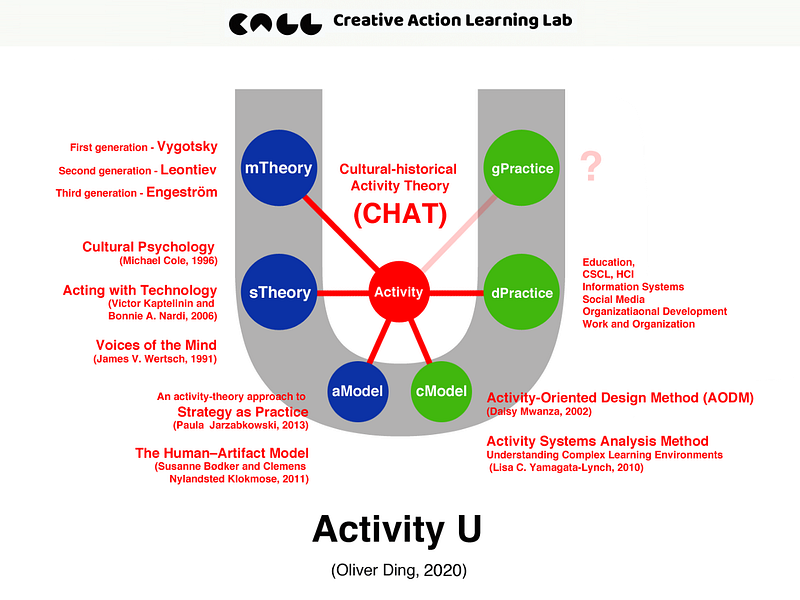
Activity Theory is a perfect case for making use of HERO U’s framework and Diagram U because we can find various usages of activity theory. I selected some examples and placed them on Diagram U and made the above diagram which is the foundation of my case study. Part I has provided more details about the diagram. If you are not familiar with Activity Theory, you can find relevant information in Part I. If you want to know the HERO U framework and Diagram U, you can read this article: HERO U — A New Framework for Knowledge Heroes.
Part 1: Spinuzzi’s Typology of Activities
This section will introduce a typology of activities developed by Clay Spinuzzi in 2015.
1.1 A Typology of Activities
Typology is a great tool for learning and using theories. We can consider typology as a type of intermediate knowledge for connecting theoretical research and domain practice. As an information architect, I create typologies for curating data and information and designing websites and app structures. I also collect typologies for learning new knowledge.
In 2014, I started learning Activity Theory. After reading some books and papers about Activity Theory, I moved to search for some typologies of activities. In 2015, I found Clay Spinuzzi’s paper Toward a Typology of Activities: Understanding Internal Contradictions in Multiperspectival Activities. He pointed out, “AT (Activity Theory) currently lacks a suitable typology for characterizing ideal types of activities in terms of multiperspectivity, so it has had trouble systematically characterizing the resulting sets of internal contradictions.”
Spinuzzi (2015) summarized several typologies made by other activity theorists before presenting his own idea. For example, “Y. Engeström (1987) characterized activities in terms of craft activity, rationalized activity, humanized activity, and collectively and expansively mastered activity…In his later work, Y. Engeström (2008b, pp. 190–191) drew on Victor and Boynton (1998) to describe historically different types of production (craft, mass production, lean production, mass customization, and coconfiguration), each with its own objects and contradictions.” Spinuzzi commented on Engeström’s typology and pointed out its limitation, “…this typology depicts a historical progression of separate ideal types of activity with separate axes, not a matrix with the same axes — making comparison difficult. ”
Other activity theorists created typologies of activity with a 2x2 matrix format. For example, “…Engeström, Brown, Christopher, and Gregory (1997) used a matrix with the axes of flexibility and collectivity to characterize a zone of proximal development whose quadrants represented professional craftwork, market-driven case management, bureaucratically regulated work, and informal, networked processing…Jarzabkowski (2003) proffered a typology of activities based on the axes of actors, collective structures, and strategic activity…” Spinuzzi argued that “these matrix-based typologies have tended to not be broadly applied, serving rather as a way to characterize specific cases. More important, they have tended to not illuminate internal contradictions based on competing perspectives within the activity.”
Spinuzzi came to the conclusion that there is a need to make an ideal typology of activities for general purpose to “explore internal contradictions resulting from hybrid activities”.
How did he create an innovative idea? The answer was starting from the object of activity.
1.2 The Object of Activity
According to Kaptelinin and Nardi (2012), “In Russian there are two words with similar but distinct meanings: objekt and predmet. Both refer to objectively existing entities, but the notion of predmet typically also implies a relevance of the entity in question to certain human purposes or interests…Leontiev deliberately referred to the object of activity as predmet rather than object. However, this distinction is usually lost in English translation since both words are translated as ‘object.’ ” (p.29)
Following Wertsch (1981), Kaptelinin and Nardi (2012) identified five basic principles of Leontiev’s activity theory:
- Object-orientedness
- The hierarchical structure of activity
- Mediation
- Internalization and externalization
- Development
The Object-orientedness principle is similar to other theories’ terms such as “needs”, “intentionality” or “intention”. According to Kaptelinin and Nardi (2012), “…all human activities are directed toward their objects and differentiated from one another by their respective objects. Objects motivate and direct activities, around them activities are coordinated, and in them activities are crystallized when the activities are complete.” (p.29)
As organizational scholar Frank Blacker (2009) claimed, “For newcomers to activity theory, the notion of the object of activity is unfamiliar and may not be easy to understand. Indeed, the term is complex; objects of activity need to be understood as simultaneously given, socially constructed, contested, and emergent.” He also pointed out, “The complexity of the term should not be thought of as a shortcoming of activity theory, however. Rather, it both reflects and reveals the complexity of human activity.”
If we want to apply it to the field of organization, it’s better to parry the prescribed objectives of an organization and follow Blacker’s advice, “When it is applied to organizational analysis, it can be said that organizations coalesce around objects of activity that are partly shared, partly fragmented, possibly contested, and certainly emergent, and because objects of activity are likely to be rooted in multiple activity systems, they may not be at all easy to change in the short term.” (2009)
It is easy to create a 2x2 matrix, however, it is hard to build a great matrix for general purposes. The key is to find the right object and the right dimensions for understanding the object. Now we can claim that Spinuzzi’s choice is a smart decision.
1.3 How and Where
Spinuzzi said, “To develop an adequate typology of activities, then, we must characterize these objects — keeping in mind that since objects are multiperspectival, specific activities will often appear as hybrids located within this typology rather than fit neatly into a given type.”
He proposed a new matrix with the following two dimensions:
- How is the object defined? Is it defined explicitly and deductively or tacitly and inductively?
- Where is the object defined? Is it defined within the activity’s division of labor or outside it?
The outcome is a matrix with four quadrants (see the diagram below) which represent four ideal activity types.
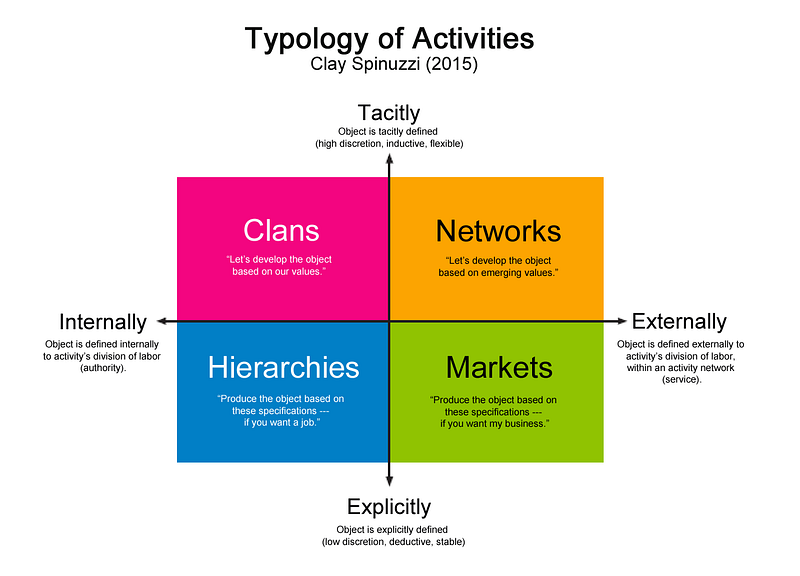
Spinuzzi named these four ideal types of activities as Hierarchies, Markets, Clans, and Networks. We have to notice these words are just names of ideal types. Spinuzzi said, “I use the term markets in the sense of most organizational typologies (e.g., Adler & Heckscher, 2007; Boisot & Child, 1999; Boisot et al., 2001; Cameron & Quinn, 2011; Ouchi, 1980; Ronfeldt, 2007), not strictly in the sense of commerce. Clan may be too precise; I prefer Adler and Heckscher’s (2007) ‘community.’ But the term community already denotes a different concept in activity theory.”
1.4 Hierarchies, Markets, Clans, and Networks
Activity theorists see activity as a system. We have learned from Engeström’s Activity System model, an activity system includes several elements such as Object, Subject, Instruments, Outcome, Rules, Community, and Division of labor. Following this model, Spinuzzi discussed four ideal types of activities.
Hierarchies
- Object and outcome: Hierarchies excel at pulsing explicitly and internally defined objects, producing highly predictable outcomes.
- Tools and rules: Hierarchies tend to use well-defined tools and rules to keep the pulse steady, the object explicitly defined, and the outcome predictable. Information tools such as databases tend to demand structured, explicit information. Knowledge about this information tends to be explicit and formalized rather than tacit.
- Actors and community stakeholders: Hierarchies require a great deal of internal trust; they trust intensive. They tend to focus internally and to define the outcome in terms determined by the actors who pulse the object, not by the community stakeholders who receive it.
- Division of labor: Hierarchies demand control. So the division of labor involves clear lines of authority. Relationships between actors tend to be dependent — with those lower in the hierarchy depending on those above them — and trust intensive.
Markets
- Object and outcome: Markets are good at pulsing objects that are explicitly defined and differentiated — objects that compete with other objects. The outcomes tend to be externally defined; an organization must give up control to seek market solutions. But in return, the organization gains the outcomes of competitiveness and flexibility.
- Tools and rules: For market solutions to work, inputs and outputs have to be explicitly specified and often standardized. Tools must include highly structured communication, such as exchange prices — a high level of abstraction and codification — so that the market can perform the job competently and efficiently without too much supervision. Rules are spelled out in formal contracts and enforced via reciprocal self-regulation: The market determines the price.
- Actors and community stakeholders: In a market, the object is defined…by people in other activities who purchase it. Relationships between actors and community stakeholders are not necessarily steady from exchange to exchange, pulse to pulse.
- Division of labor: Relations between activities in a market are independent and formal, based on the exchange of goods and services. The labor is coordinated horizontally via self-regulation; that is, buyers and sellers coordinate their negotiations via highly structured but contextually shallow information such as price and specifications.
Clans
- Object and outcome: Clans work well for addressing customized objects, such as craft objects. The objects themselves are defined tacitly rather than explicitly and often inductively rather than deductively. They are also internally defined, typically leading to outcomes of team identity or belonging. Outcomes are often customized. In the case of internal culture, clans inductively develop their own internal values over time, based on their internal needs and experiences.
- Tools and rules: Since objects are defined tacitly and internally, they often involve tools that are unstructured and diffuse. Face-to-face coordination is common, especially in terms of mutual adjustment. In this context, rules tend to be commonly held traditions, values, and beliefs within the tight-knit group of actors.
- Actors and stakeholders: Actors are especially tight knit as they pulse the object. They sometimes become very clannish, defining themselves against others in the same organization.
- Division of labor: Since they are so tight knit, clans tend to have a very flexible division of labor, coordinating horizontally via negotiation. They are interdependent, that is, dependent on each other as they coordinate to pulse the object.
Networks
- Object and outcome: Networks pulse objects that require various types of expertise, particularly objects that require collaboration across specialties (and thus activities)…This configuration is especially well positioned for producing innovative outcomes, outcomes that cannot be achieved by individual specialties.
- Tools and rules: The tools used by networks can be, and often are, unstructured, diffuse, and loosely coupled. They are pulled together across specialties to attack unique problems, so they are often cobbled together for a unique engagement. Rules are emergent and tend to develop over the life of the collaboration.
- Actors and community stakeholders: Actors in networks can be internal to an organization or cross-organizational. Like actors in clans, actors in networks tend to be interdependent: Specialists need each other’s contributions if they are to complete the project.
- Division of labor: Networks do not have a necessary center of control; typically, they are horizontally controlled via the emerging collaboration. They tend to establish interdependent relations, and they must develop swift trust in order to work well.
Spinuzzi also pointed out, “…organizational typologies generally acknowledge that organizations tend to be hybrids, not ideal types. Similarly, we can understand.” He also noticed that “…at different points, the same object can be understood as the object of a hierarchy, a market, and a network.”
Part 2: Case study: Andmind Group
I really like Spinuzzi’s typology of activities and applied it to a strategy development discussion in 2017. I’d like to share this story as a case study.
2.1 The background
The hero of the story is Mr. Seldon who names his enterprise Andmind Group.
Mr. Seldon is an ambitious serial entrepreneur with a unique educational background of psychological science. In 2015, Mr. Seldon moved to the educational field and started his third business: Andmind Group. Mr. Seldon didn’t use “Andmind Group” as a name for his business. I just use this term to refer to various activities of his new enterprise.
An interesting theme of this story is a personal enterprise which goes beyond the narrow narrative of a business startup. Thus, I will use Andmind Company to refer to his business and Andmind Group to refer to the whole scope of his business activities and related personal activities.
2.2 The situation
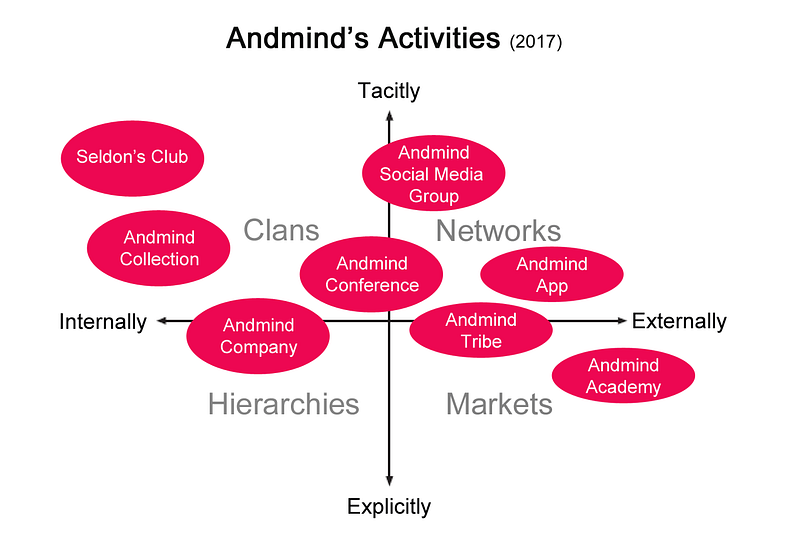
In 2014, Andmind Group started as a social media group with about 250 members. In 2015, Mr. Seldon registered Andmind Company as a business entity and started formal daily operations. By 2017, the enterprise of Andmind Group expanded to various activities (see the diagram below).
- Seldon’s Club: a mentor-mentee kind of group with about 25 members.
- Andmind Collection: a publishing program that focuses on “the third culture”.
- Andmind Social Media Group: a social network app-based cross-disciplinary elite group. About 250 members including 100 PhDs.
- Andmind Conference: an annual offline event program.
- Andmind Company: a registered business entity with about 9 employees. For the diagram below, I use “Andmind Company” to refer to the activity of their work team.
- Andmind Tribe: a social learning program provided by Andmind Company. About 300 paid learners.
- Andmind App: a mobile app developed by Andmind Company.
- Andmind Academy: a business brand name of Andmind Company. In 2015, the brand name was Andmind Media Communication. Why did I consider it an activity? Because the company used it to host social media marketing activities.
I was deeply involved in Mr. Seldon’s enterprise. As a reader, I read his blog articles. As a member of Andmind social media group, I was an active participant. As an adviser, I watched the transformation of Andmind Group and gave suggestions to the team. As a friend, I gave support to and gained motivation from the development of his life trajectory and life theme.
What I learned from the case of Andmind Group is the complexity of human activity in a collective context. If we consider Andmind Group as a normal business case, it is easy to jump to a conclusion that he should focus on one thing and make it big. However, it is better to see Andmind Group as Mr. Seldon’s personal enterprise or a vehicle for archiving his life mission.
In order to understand the whole story, we should trace back to his psychobiography (including self-identity). Mr. Seldon is not a normal entrepreneur, he likes reading and writing. The essential activity of his life is embracing “the third culture” by writing scientific articles on his personal blog. His social models are Steven Pinker, James G. March, Richard Dawkins, Vladimir Nabokov, Isaac Asimov, and Paul Graham. If we connect Andmind Group with his personal life theme, then we can understand it is not a simple business.
However, the Andmind Group is not a personal blog. The above diagram represents its various collective activities in which different actors have their own goals. I observed that many contradictions emerged from the development of the Andmind Group.
2.3 The strategy
In Sept 2017, I adopted Spinuzzi’s typology of activities to analyze the situation of Andmind Group and hosted a strategic discussion about the potential development directions of the enterprise. During the discussion, I realized the practical value of typology is really impressive.
Since Andmind Group’s activities were widely distributed in four quadrants, I just gave a simple suggestion: Let’s reduce the scope to two quadrants. This heuristic method generated six possible directions: Political Group, Technological Platform, Traditional Business, Communities of Practice, Family Gang, and Social Enterprise.
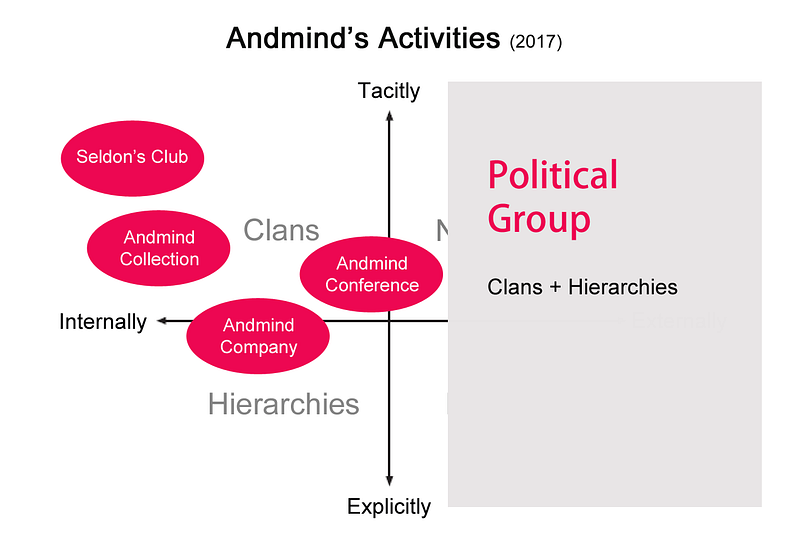
If we cut the Networks and Markets, but keep Clans and Hierarchies. This means we don’t care about business and money, thus the object of running a structured group with internal high trust is clear: change the society. In other words, this is a Political Group. We definitely abandon this direction.
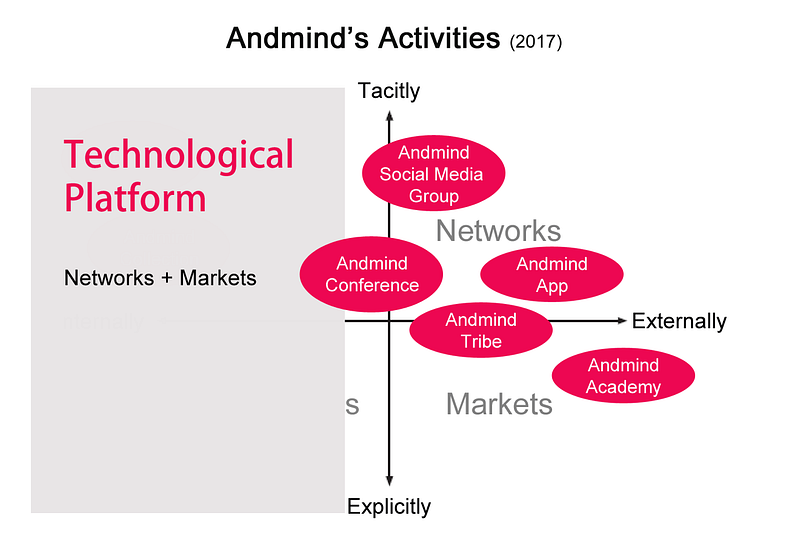
The second direction is keeping networks and markets. For example, we could focus on the Andmind App and expand it to a large-scale mobile educational platform. We called this direction a Technological Platform. This is also the final solution I suggested.
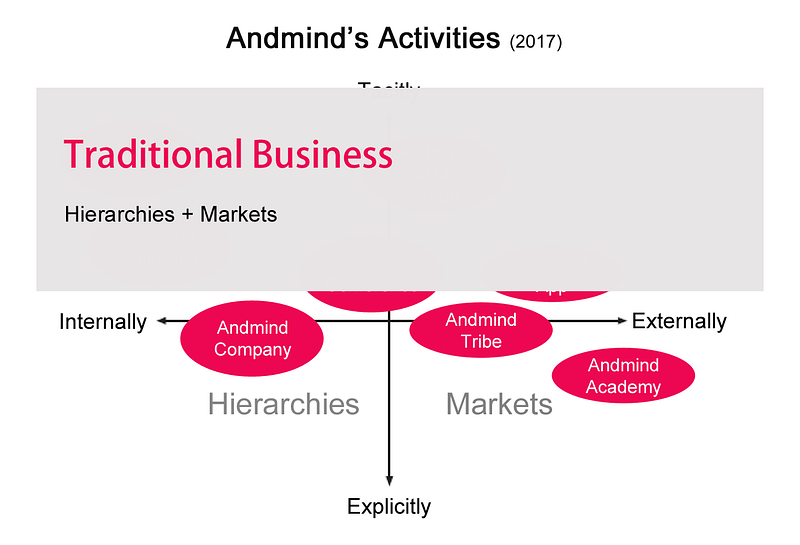
If we combine Hierarchies and Markets, we meet a familiar animal: Traditional Business. The difference between Technological platforms and Traditional Business is if we leverage the power of the Internet to drive growth. From the perspective of business models, some authors called traditional business models pipelines.
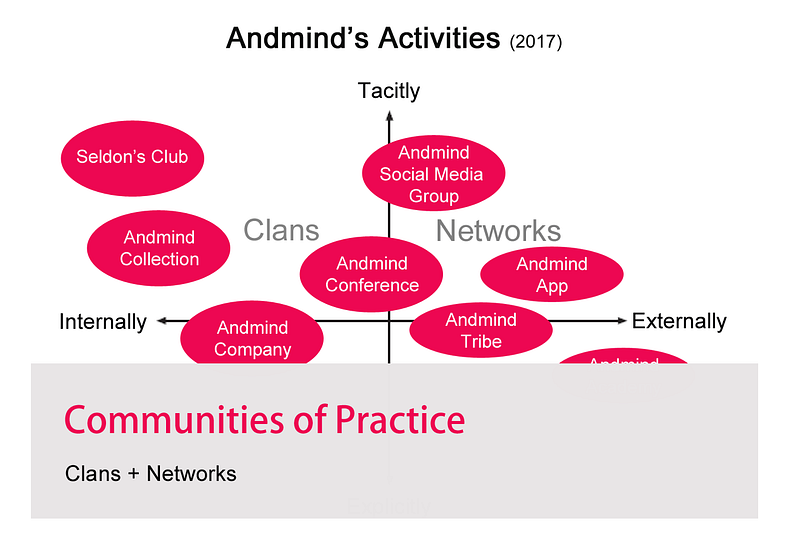
One of the unique aspects of Andmind Group is knowledge-centered content and activities. Many participants use “Andmind Community” to describe the enterprise. If we remove Hierarchies and Markets, we get what wenger called “Communities of Practice”. Here we see a contradiction between business and non-business.
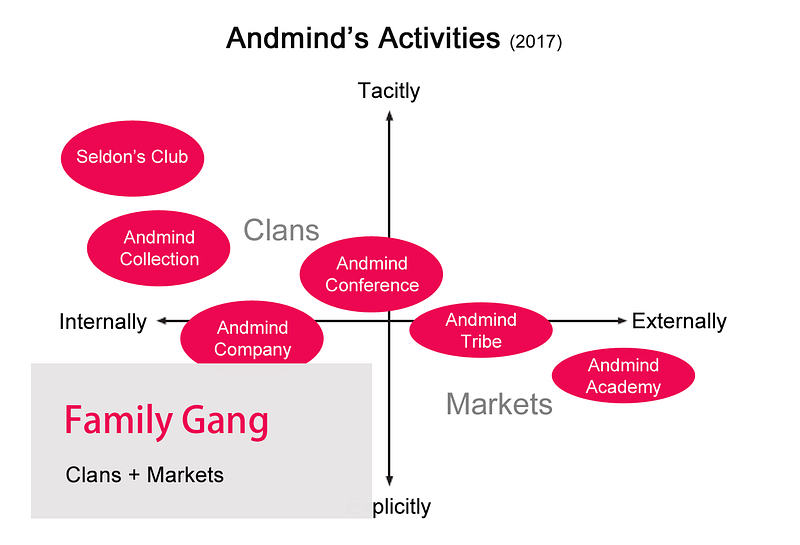
The fifth direction is a hybrid of Clans and Markets. I used “Family Gang” to name this type. It refers to a highly efficient “family” kind of private business.
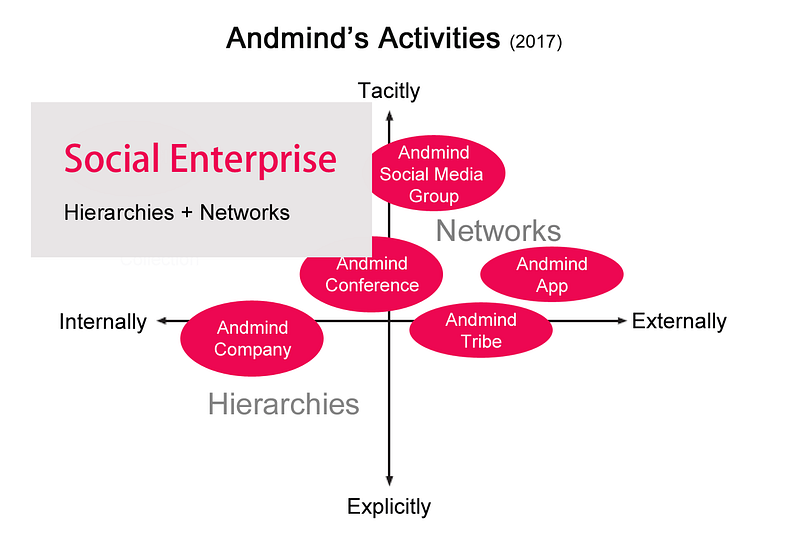
The last one is Social Enterprise. For example, we could consider Andmind Group as another Edge.org which was founded by John Brockman.
If we put these six types with Spinuzzi’s original four types, we found there are ten ideal types of activities. Unlike traditional business strategy matrices, Spinuzzi’s matrix focuses on the object of activity and the contradiction between multiple subjects. The case of Andmind Group tells us that the usefulness of the typology is super powerful.
PART 3: Discussion
To my suprise, I found Spinuzzi’s typology of activities roughly corresponds to anthropologist Alan Fiske’s Relational models theory (RMT). This section will compare these two frameworks.
3.1 Relational Models Theory
In 1992, Alan P. Fiske published a paper titled The Four Elementary Forms of Sociality: Framework for a Unified Theory of Social Relations on Psychological Review. Fiske argued that people in all cultures use just four relational models to generate most kinds of social interaction, evaluation, and affect.
These four models are Communal Sharing (CS), Authority Ranking (AR), Equality Matching (EM), and Market Pricing (MP). In communal sharing, people treat all members of a category as equivalent. In authority ranking, people attend to their positions in a linear order. In equality matching, people keep track of the imbalances among them. In market pricing, people orient to ratio values. In a broad sense, these four modes roughly match Spinuzzi’s four ideal types of activities (see the diagram below).
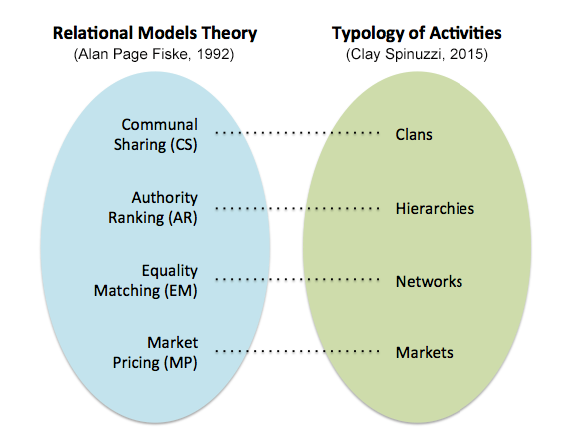
Are they saying the same thing with different words?
A major difference is that these two frameworks work on two levels, Relational Models Theory is about individual psychological models while Typology of Activities is about collective activities. The former is actor-centered perspective while the latter is activity-centered perspective.
Fiske used “Four Elementary Forms of Sociality” to describe these four relational models, but he used “4 psychological models” to describe them. Is his framework for describing patterns of interactions or subjective mental thinking? Fiske said, “People construct complex and varied social forms using combinations of these models implemented according to diverse cultural rules. People’s chief social conceptions, concerns, and coordinating criteria, their primary purposes and their principles, are usually derived from the four models; they are the schemata people use to construct and construe relationships.” It seems these four models are subjective mental thinking.
However, Fiske also claimed these models also are types of relationships. For example, “Communal Sharing (CS) is a relationship in which people treat some dyad or group as equivalent and undifferentiated with respect to the social domain in question…In Authority Ranking (AR) people have asymmetric positions in a linear hierarchy in which subordinates defer, respect, and (perhaps) obey, while superiors take precedence and take pastoral responsibility for subordinates…In Equality Matching (EM) relationships people keep track of the balance or difference among participants and know what would be required to restore balance…Market Pricing (MP) relationships are oriented to socially meaningful ratios or rates such as prices, wages, interest, rents, tithes, or cost-benefit analyses.”
I consider these four models are both basic psychological models and ideal types of social relations. The trick here is three levels of explanation: the level of psychological thinking, the level of interaction, and the level of relationship (Fiske didn’t distinguish these different levels, this is my explanation). At the basic level, there are only four elementary forms of psychological thinking. At the higher level, there are many types of social interactions that require more than one actor. Each actor has his own relational models for a particular interaction. If two people adopt the same type of relational model — for example CS — for a particular interaction, then we can say this is a CS type of interaction. If there are many CS types of interactions between two people, then we can say these two people are in a CS type of relationship.
For any typology, types are the basic thing. However, the secret of adopting a typology is not knowing types, but using types to understand the dynamics between types. The following section will put Fiske’s model and Spinuzzi’s framework together and discuss this issue further.
3.2 Multiperspectivity, Contradictions and Relationship
Activity theorists often talk about “multiperspectivity” and “contradictions”. Spinuzzi (2015) said, “Activities are multiperspectival in that different people who are involved in the same activity tend to perceive different aspects of it and consequently tend to pulse the shared object in different ways, with different tempos, using different configurations of the resources.”
Fiske also pointed out the conflict in social life, “What is crucial isn’t just that there are four ways in which we relate to each other. It’s that misunderstandings and conflict in social life occur because two of us are using different models, or using the same model in different ways. Interacting with co-workers, spouses, or neighbors, we take it for granted that the other person is using the same model we are. Often we are wrong.” (Source: Basic Relationships)
Based on a meta-diagram called ARCH, I drew the diagram below to combine Fiske’s model and Spinuzzi’s framework for our discussion.
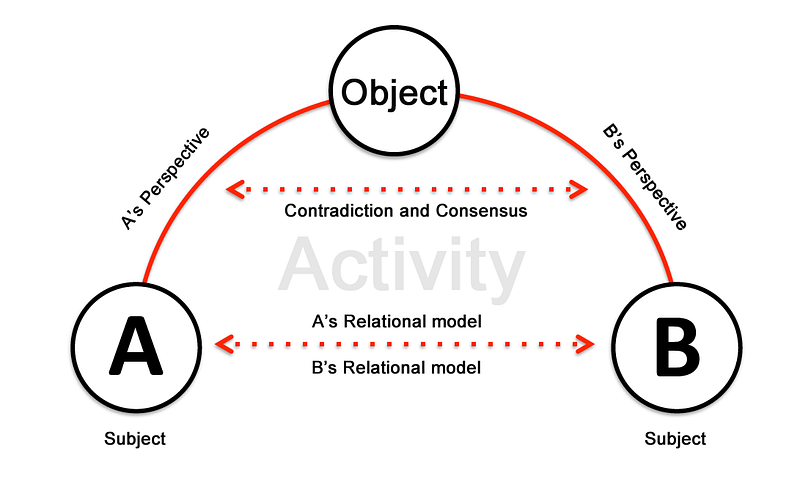
The above diagram represents a basic joined action with two people: person A (subject A) and person B (subject B). Following Activity theory’s terms, this action is part of a collective activity with a shared Object. Subject A and Subject B have their own perspectives on the Object, these perspectives may generate contradictions or consensus. Relational Models Theory doesn’t have the term “object”, Fiske just directly talked about social interactions and social relationships. As I pointed out in the last section, person A and person B have their own relational models of a particular interaction. These difference models might generate contradictions or consensus too.
Spinuzzi said, “In a complex collective activity, different stakeholders may have different motives and perspectives on the shared object. In any collective activity, an object is ‘‘multifaceted, evolving,’’ and even ‘‘dialogical’’, understood differently by different participants at different points, developing over time. Activities become polycontextual and polymotivated; stakeholders become more heterogeneous…Activity theorists have recognized this issue of multiperspectivity and its resulting internal contradictions. Such contradictions may become more prevalent and important as activities become more connected and interpenetrated. In response, activity theorists have attempted to describe different types of activities in order to better characterize such internal contradictions.”
Activity theorists don’t talk about “relationship” directly, they like “contradictions” because it drives the development and transformation of activity. According to Nicolini (2012), “…the (activity) theory addresses the traditional opposition between change and stability. One of the great merits of the theory is to provide strong support to the idea that, from a practice-based perspective, change and not stability is primordial.” (p.118)
Fiske paid attention to similar contradictions, but more on individual personal behavior and emotion. He said, “One member of a work team assumes implicitly that it is a matching operation — each person on the team should contribute equally. But others assume the task is a shared responsibility of the group as a whole, so everyone should simply pitch in and do whatever is necessary. The sharers are offended when the matchers keep precise track of how much each person does. The matchers get angry when the sharers fail to take regular turns, or when one sharer does extra work and the matchers don’t try to keep up. Everyone is doing something reasonable and legitimate, but people offend each other because they are operating with different models. It doesn’t occur to them that the others have different unstated assumptions about how to coordinate.”
Fiske also used marriage as an example to discuss conflicts, “One spouse is a pricer. He assumes household repairs and cooking should be done in the most efficient way possible. Whoever can do a task quickest ought to take care of it. The other spouse is a matcher. She assumes work should be divided equally into matching tasks. The pricer gets irritated when the matcher tries to take a turn doing jobs she can’t do quickly or well. It seems to him inefficient and silly. The matcher is hurt that the pricer doesn’t take turns cooking and doesn’t appreciate her trying to pitch in on electrical repairs. Both are trying to be responsible (acting in accord with the model they take for granted.) Neither can understand why the other one fails to do what makes sense.”
This example is about conflicts in the “division of labor” which is a term of activity theory. Now, we can say these two frameworks can work together. Spinuzzi’s typology is more about collective configurations of activity while Fiske’s framework is more about individual moral intuitions on social interaction.
PART 4: Other Tools
The final part goes back to Clay Spinuzzi’s work and recommends some great tools and ideas he developed during the past decade.
4.1 The expansion and evolution of Activity
Though Spinuzzi’s focus is technical communication and writing studies, he didn’t only adopt activity theory for his research projects but also contributed to the development of activity theory. Nardi once said, “…We believe that HCI researchers can be described as not only ‘theory users’, but also as ‘theory-makers’.” We can say Spinuzzi is also a “theory maker” too.
Spinuzzi has published several papers about the historical development of activity theory. For example:
- 2011: Losing by Expanding: Corralling the Runway Object
- 2019: Fourth-Generation Activity Theory: An Integrative Literature Review and Implications for Professional Communication
- 2020: “Trying to predict the future”: Third-generation activity theory’s codesign orientation
The diagram below is quoted from Losing by Expanding: Corralling the Runway Object. He focused on the “object” and traced the change of the concept of “object” within different versions of activity theory.
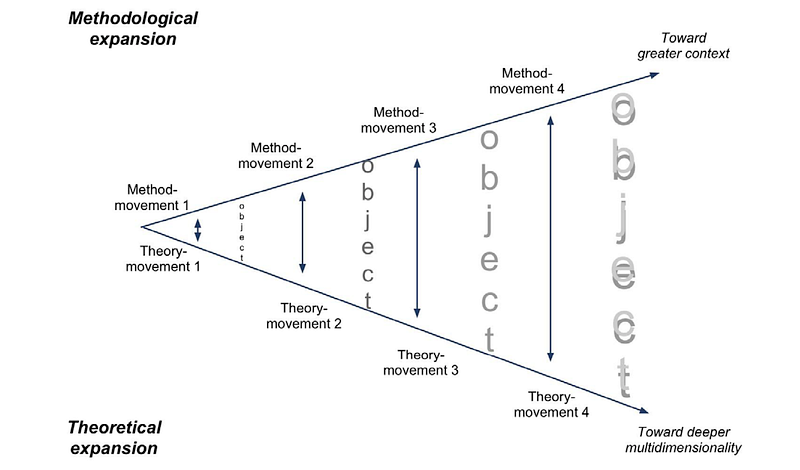
Spinuzzi said, “For activity theorists, this linchpin is the object, particularly in its relation to the outcome. Kaptelinin called it “the sense–maker,” which “gives meaning to and determines values of various entities and phenomena” (Kaptelinin, 2005, p. 5). Engeström, Puonti, & Seppänen (2003) declared that “the object determines the horizon of possible actions” (p. 152).”
However, Spinuzzi noticed that “After 1992, though, the object began to expand and diffuse, even in case studies…The object becomes even more difficult to identify in complex work in which the activity crosses field, trade, and disciplinary borders.” He further argued that there are two challenges for activity theorists, “The first problem is methodological: The activity theory framework is being applied more and more broadly, to more broadly scoped cases. The second is analytical: The activity theory framework is becoming more multidimensional, as more and more human activity is not fitting the past characteristics to which activity theory was developed as a response.”
I would highly recommend these papers and the above presentation for those who like to understand the recent development of activity theory and its future.
4.2 Topsight: activity theory-based research models
Spinuzzi has over 20 years of activity theory-based empirical research. In the recent 2020 Activity Theory Summer School, Spinuzzi hosted a workshop about “Analyzing qualitative data with activity theory-based models”.
Since I missed the workshop, I bought his book Topsight: A Guide to Studying, Diagnosing, and Fixing Information Flow in Organizations. Inspired by David Gelernter’s 1993 book Mirror Worlds, Spinuzzi named his methodology Topsight. Gelernter said, “Ant-vision is humanity’s usual fate; but seeing the whole is every thinking person’s aspiration. If you accomplish it, you have acquired something I call topsight.”
The book organizes 25 chapters into five parts. Each part focuses on a major step of a field study project: Designing (planning a study), Conducting (the study), Navigating (data), Analyzing (the data), and Writing (reporting the results).
Again, buy the book. If you want to find more practical techniques. Even if you don’t have a need to do a field study, you can understand the connection between activity theory and empirical research.
4.3 Life as Activity: Time Management from an Activity Theorist
I have mentioned an idea called “Life as Activity.” Though activity theory (especially the activity system model) focuses on collective activity, I’d like to apply it to discuss personal development. I said, “Though activity theory is a theory for professional research, I do believe it is useful for ordinary people to reflect on their daily life. We can see our daily life and the whole life as an activity. In fact, the founder of activity theory once considered using Life Theory to name his theory.”
Acualty, we can pay attention to what activity theorists are doing and saying about their career. In fact, I have talked about “Bonnie Nardi’s Choices and Boundary Knowledge Work.” This time we can learn about time management from a young activity theorist.
Spinuzzi suggested that we can organize our activity into 10 levels:
- Level 0: Remembering things
- Level 1: Doing things right away
- Level 2: Creating an interrupter
- Level 3: Make a list
- Level 4: Attach tasks to information
- Level 5: Organize and prioritize a list
- Level 6: Calendar a task list
- Level 7: Define and schedule projects
- Level 8: Interconnect planning system
- Level 9: Establish and Review career goals
What I learned from this amazing presentation is: if you can master the hierarchy of activity, you can gain freedom in your life.
4.4 Blogging as Activity
The last resource is Spinuzzi’s personal blog and his related social media accounts. Spinuzzi once suggested “social cognitive” as a direction for the future of activity theory. In the digital age, the social web has become a large also personal instrument for improving social learning, social cognition, and collective cognition.
Sara Kjellberg did research on scholarly blogs. Kijellberg said, “My results show that the researchers’ use of blogs are in many ways similar to previous descriptions of blogging practices. Six themes concerning researchers’ blogging practices were constructed, based on how the participants describe the function of their blogs. They describe how the blogs function as a way to disseminating content, expressing opinions, keeping up–to–date and remembering, writing, interacting and creating relationships.”
In 2013, The Journal of Rhetoric in Society published an interview with Clay Spinuzzi: That Light-Bulb Feeling. One topic of the interview is the research methods in the age of platform. I quoted this pieces for readers:
Brian: How will research methods need to change and evolve in this age of big data, ubiquitous computing, and social software?
Clay: I’m really mostly focused on the latter two: ubiquitous computing — everybody has a supercomputer in their pocket now, and social media — everybody essentially has a printing press.
As researchers, we’re used to thinking of ourselves as hav[ing] to protect our participants, we have to make sure that we’re fair to them — we should probably do member checks, because it’s a nice thing to do, sort of noblesse oblige, and I think we have to start thinking in terms of well, no, they’re actually partners who have a voice. Sometimes they’re going to have a voice that’s bigger than ours, and we better take seriously this idea of member checks, of making sure that we’re representing them fairly.
So that’s something that I woke up to a few years ago because I was interviewing coworking spaces and these guys have enormous sets of Twitter followers. I thought, “I’ve got to be able to find ways to confirm that I’m seeing what they’re seeing,” so I worked at several different ways of trust-building and eventually I was able to make statements [to which] they would sometimes say “I wish that weren’t true, but it is true; ok, you can go with it.” I think that’s going to be really important especially for the next generation of researchers, to realize that our IRB process is mired in that printing press era, and we’re not in that era anymore.
As the editor said, “Spinuzzi is also a public intellectual. He has maintained an influential blog since 2003, and he routinely works with industry professionals, both in the U.S. and abroad. His recent work effectively bridges the academic and public aspects of his career.”
From the perspective of activity theory, we can consider blogging as activity and blog as an instrument. The object of blogging is defined by the blogger, his readers, and other related bloggers. For Spinuzzi, the blog is also a mediator between academic researchers and public intellectuals.
CALL for Action
I have created a template of the Activity System model on Miro, you can access it at the following board:
This board is part of the Activity U project, it will be a fun place for collective learning and creating. If you want to join the project, you can DM me on Twitter.
You are most welcome to connect via the following social platforms:
Twitter: https://twitter.com/oliverding Doowit: https://doowit.co/profile/gm0k2ax9 Linkedin: https://www.linkedin.com/in/oliverding
License
This work is licensed under the Creative Commons Attribution-NonCommercial-ShareAlike 4.0 International (CC BY-NC-SA 4.0) License. Please click on the link for details.
References
Blacker, F. (2009) Cultural-Historial Activity Theory and Organization Studies. In Sannino, A.; Daniels, H. & Gutierrez, K. (Eds.) Learning and Expanding with Activity Theory. Cambridge University Press.
Fiske A.P. (1992) The four elementary forms of sociality: framework for a unified theory of social relations. Psychol Rev. 1992;99(4):689–723. doi:10.1037/0033–295x.99.4.689
Fiske A.P. and Ehrenhalt A. Basic Relationships (a non-technical introduction to relational models theory) http://www.sscnet.ucla.edu/anthro/faculty/fiske/RM_PDFs/Puppy_barks.doc
Fiske A.P. — Relational Models Theory at UCLA http://www.rmt.ucla.edu/
Kaptelinin V., & Nardi B. (2012) Activity theory in HCI: fundamentals and reflections. Morgan & Claypool Publishers.
Kjellberg, Sara (2010) I am a blogging researcher: Motivations for blogging in a scholarly context, in First Monday, Volume 15, Number 8–2 August 2010 https://firstmonday.org/article/view/2962/2580
Nicolini, D. (2012) Practice Theory, Work, & Organization: An Introduction. Oxford University Press.
Spinuzzi, C. (2011) Losing by expanding: Corralling the runaway object. Journal of Business and Technical Communication 25 (4), 449–486.
Spinuzzi, C. (2015) Toward a Typology of Activities: Understanding Internal Contradictions in Multiperspectival Activities, Journal of Business and Technical Communication, 29:1, 3–35, https://doi.org/10.1177/1050651914548277
Spinuzzi, C. and Guile, D. (2019) Fourth-Generation Activity Theory: An Integrative Literature Review and Implications for Professional Communication, 2019 IEEE International Professional Communication Conference (ProComm), Aachen, Germany, 2019, pp. 37–45, doi: 10.1109/ProComm.2019.00012.
Spinuzzi, C. (2020) “Trying to predict the future”: third-generation activity theory’s codesign orientation, Mind, Culture, and Activity, 27:1, 4–18, DOI: 10.1080/10749039.2019.1660790


