
The Concept of Supportance
An Ecological Approach to Social Support and Beyond

One year ago, I used the above picture for a design project. I recently found it has a new meaning for me. This time I use it as a story for developing a theoretical concept: Supportance.
Two women are standing on the beach by the sea, carrying a big picture frame. It is a normal sense. How can I use it for theoretical development?
Let’s consider it as a minimal collective activity. There are at least three people here, the two women carrying the frame, and a photographer taking the picture. It is worth noting that any one of these three people is an indispensable component of the activity. Without the photographer, no one comes to take this picture. If there is only one woman, she can’t carry such a big picture frame, thus this shooting activity — taking such a specific photo — can’t be accomplished.
This article aims to introduce a meta-concept of Supportance as a new member of the Ecological Practice approach. The concept of Supportance offers a new perspective on social support and other social phenomena. I consider it a starting point for a new theory of social action.
Contents
Part 1: A Brief of Supportance
1.1 A story about Support 1.2 Search for a new unit of analysis 1.3 A Gibsonion Trick 1.4 World meaning and Concept
Part 2: Supportance as A Meta-conceptby
2.1 Meta-concept and Intermediate Concept 2.2 Supportance v.s. Social Affordance 2.3 Supportance v.s. Social Support 2.4 Supportance v.s. Developmental Platform
Part 3: Actualization of Supportances
3.1 Perception: Potential v.s. Actual 3.2 Action: Challenge v.s. Response 3.3 Curation: Individual v.s. Collective
Part 4: The Relevance of Gibson’s Social Mind
4.1 Gibson as A Social Psychologist 4.2 Proper Behavior v.s. Expedient Behavior 4.3 Gibson’s understanding of Marxism 4.4 Social Appropriation of Ecological Values
Epilogue: Possible Practice
Part 1: A Brief of Supportance
The term Supportance is inspired by Ecological psychologist James J. Gibson’s writings about an example of the theoretical concept of Affordance.
1.1 A Story about Support
Let’s return to the picture. Usually, the story I described could lead readers to the notion of ‘Social Support.’ Traditionally, researchers pay attention to the effect of social support on health, quality of life, and especially mental health. I aim to adopt the ecological practice approach to discuss the notion of ‘social support’ in a broader scope in a general sense.
Suppose there is only one woman and a 3-year-old girl at the scene. The woman can’t hold the picture frame because the little girl doesn’t have enough strength to help her. Thus, the woman should look for potential support from others who could offer such support with corresponding capacities.
The concept of Supportance refers to potential supportive action possibilities offered by a social environment. It is inspired by Ecological psychologist James J. Gibson’s concept of Affordance which refers to potential action possibilities offered by environments. Both two concepts are potential action possibilities. However, the concept of Affordance can be applied to both animals and humans and Gibson uses it for talking about visual perception. In order to discuss potential supportive action possibilities between a person and other people and social environments in general, I coined the term Supportance and developed it as a theoretical concept for the Ecological Practice approach.
1.2 Search for a new unit of analysis
If a person can accomplish something by himself/herself, then the person doesn’t need support from other people. For this situation, I consider the action is only about the relationship between people and natural (physical/technological) environments. Let’s call this type of action individual action.
If a person needs at least one other person to support him in accomplishing something, we can refer to this type of action as intersubjective action.
Moreover, some actions need indirect support from other people within the settings of an organization or other social entities. We can define the third type of action as institutionalized action.
I consider the latter two are about the relationship between ‘people — social environments.
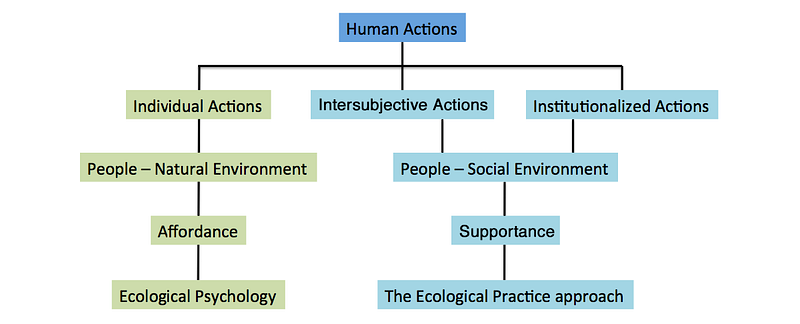
The above chart represents the complexity of these ideas. Why do I emphasize the distinction between the natural environment and the social environment? There are at least four important aspects that we can’t ignore:
- Rational agency
- Language engagement
- Ownership
- Remote presence
Physical artifacts and animals don’t have rational agency. They also can’t negotiate through language such as text. Artifacts don’t claim ownership of environments and affordances, however, humans consider ownership as a critical right for social life. Finally, humans can present remotely by adopting emerging communication technologies.
According to Gibson, “This is not a new environment — an artificial environment distinct from the natural environment — but the same old environment modified by man. It is a mistake to separate nature from the artificial as if there were two environments: artifacts have to be manufactured from natural substances. It is also a mistake to separate the cultural environment from the natural environment as if there were a world of mental products distinct from a world of material products. There is only one world, however diverse, and all animals live in it, although we human animals have altered it to suit ourselves. We have done so wastefully, thoughtlessly, and, if we do not mend our ways, fatally.” (1979/2015, p.122)
Gibson doesn’t agree with the distinction between the artificial environment and the natural environment. I follow his stance and consider natural/physical/technological environments as a whole. However, we have to notice Gibson’s idea of “one world, however diverse.” In order to discuss the complexity of “one world”, we need a concept such as ‘social environment’ to describe the diverse context of social life. Thus, I believe that there is a need to adopt the ‘social environment’ as a new unit of analysis while remaining the basic philosophical stance behind Gibson’s ecological psychology.
Once we move the unit of analysis from natural environments to social environments, we can make a distinction between the concept of Affordance for discussing natural environments and a brand new concept for discussing social environments. Furthermore, we can form a hierarchical loop of ‘Affordance —a new concept’ and discuss the relationship between the two layers because the discussion of ‘taking affordances’ also needs to consider social conditions.
From the perspective of the ecological practice approach, I believe the concept of Supportance is a perfect notion as a new unit of analysis for developing a new social theory that goes beyond the scope of ecological psychology.
1.3 A Gibsonion Trick
In fact, I have been searching for such a concept for about two years after I finished the draft of Curativity: The Ecological Approach to Curatorial Practice in March 2019.
The Ecological Practice approach is inspired by James J. Gibson’s Ecological Psychology. There are two goals behind the Ecological Practice approach:
- 1) Expanding Ecological Psychology from native natural environments to modern digital environments.
- 2) Expanding Ecological Psychology from perception-centered psychological analysis to social practice analysis.
In May 2020, I wrote the draft of After Affordance: The Ecological Approach to Human Action in which I proposed several new theoretical ideas for the above task #1. However, I think it still doesn’t provide an ideal solution for task #2. That is the reason I use ‘human action’ for the subtitle of the draft.
Eventually, I realized that it is better to escape from Ecological Psychology and find a brand new concept as a theoretical foundation if I want to develop a new social theory.
How can I detach from Gibson’s ideas? The answer is a Gibsonion trick.
In Oct 2020, I got an idea for the new concept when I was reading Gibson’s book The Ecological Approach to Visual Perception. I have been reading the book many times. The book has a chapter that presents the theory of Affordance. One day, I found the classical example of Affordance Gibson offered had a new meaning for me. Let’s read the example:
If a terrestrial surface is nearly horizontal (instead of slanted), nearly flat (instead of convex or concave), and sufficiently extended (relative to the size of the animal) and if its substance is rigid (relative to the weight of the animal), then the surface affords support. It is a surface of support, and we call it a substratum, ground, or floor. It is stand-on-able, permitting an upright posture for quadrupeds and bipeds. It is therefore walk-on-able and run-over-able. It is not sink-into-able like a surface of water or a swamp, that is, not for heavy terrestrial animals. Support for water bugs is different. (1979/2015, p.119)
Usually, people use this example for understanding the concept of Affordance. Since I had read the book many times, I didn’t have to do it in such a way. I paid attention to one sentence “…the surface affords support…” and the word “support.” Then, I realized that I could coin a new term Supportance and develop it as a new theoretical concept.
The concept of Supportance has been introduced in the Platform-for-Development framework only briefly. This article aims to offer more details on the concept. I am still working on developing this new idea as a meta-concept for the Ecological Practice approach at the meta-theory level, so it has not been fully finalized. The more I think about it, the more I feel that it has the potential to grow into a foundation for a new social theory.
1.4 Word meaning and Concept
In fact, the Gibsonion trick is inspired by the Wittgenstein trick which is offered by Howard S. Becker in his 1998 book Tricks of the Trade: How to think about your research while you’re doing it. Becker shares a special way of reading books:
I’ve owned a copy of Ludwig Wittgenstein’s Philosophical Investigations for years, but I read it the way Everett Hughes told me to read the sociological writings of Georg Simmel: not to get a full understanding of what the author might have meant, but rather as a way of generating ideas I could use in my own research and thinking. One of Wittgenstein’s ideas has become a standard part of my repertoire. Because it was provoked by a passage in the Investigations, I think of it as the Wittgenstein trick. (1998, p.138)
What Everett Hughes suggested is that we can use books as triggers for our own creative thinking. For my Gibsonion trick, I use Gibson’s writings as a trigger for coining a new term in order to give a name for the new concept.
As James G. March mentioned, the evocation of meaning is a natural product of crossing disciplinary, cultural, national, and linguistic boundaries. He says, “Nevertheless, for those who see the creative beauty generated by the wanderings of ideas, the magic and mystery of language is a wonder of intellectual discourse. Scholars celebrate the evocation of new meanings that arise when others discover, not exactly what they thought they meant when they wrote their words or characters but rather what the words or characters themselves might be imagined to mean.” (2008, p.140)
However, the new term is not a real concept even though it has its own word meaning. According to Andy Blunden, “…we must always remember that a word meaning is only the realisation of a concept, not a concept in itself. The human mind is an indivisible whole. A concept is the sum of all the meanings it produces, but these meanings have to be taken in the context in which they are produced. A concept may be realised in quite different meanings according to whether a person has to give an instant definition, recognise an object, use the concept to complete a categorisation task, write an extended essay on the concept, evoke the concept in an intellectual action of some other kind or is simply mistaken…In short, it is only possible to say what a concept is, even in terms of its realisation in word meanings, in the context of the activity in which the concept is to be realised. A word is meaningful only within the context of the relevant project. One and the same concept will be realised differently in different projects.” (2012, pp. 292-293)
Blunden’s view on ‘concept’ is inspired by Hegel and Lev Vygotsky. His suggestion points out that concepts are equally subjective and objective, they are units both of consciousness and of the cultural formation of which one’s consciousness is part.
I have been working on idea generation which can be considered a practice of conceptual development for many years. I recently developed a tool called the Concept Dynamics framework for my own works. The framework echoes Blunden’s view to a certain extent. I agree that a word doesn’t equal a concept. I also consider the dynamic development process of a concept and its social context. However, my framework primarily pays attention to the structure of a theoretical concept.
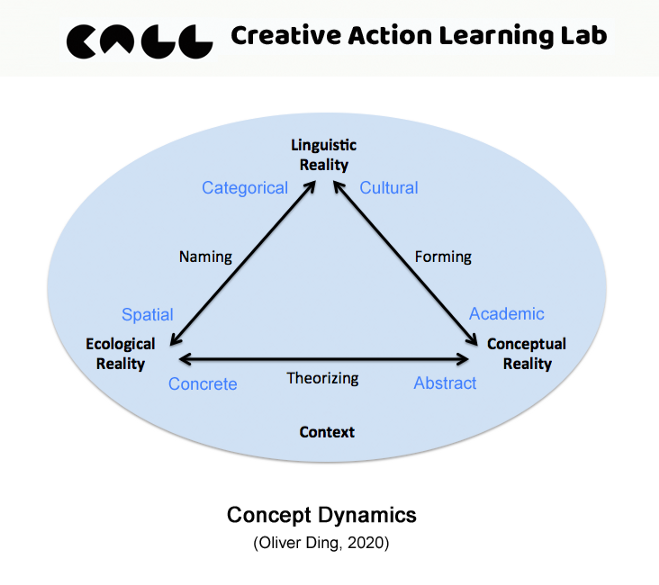
As Berger et al. (1972) argue, “it is difficult to build meaningful theoretical research programs without concepts that are internally consistent and clearly defined in relation to other existing concepts.” (cited in Kallinikos, Leonardi, and Nardi, 2012). In order to discuss the complexity of theoretical concepts, I created the above diagram which suggests every theoretical concept has three basic aspects: ecological reality, conceptual reality, and linguistic reality.
- Ecological reality refers to the real experience of discovery in the real world from the perspective of researchers.
- Conceptual reality refers to the outcome of the creative conceptualization process.
- Linguistic reality refers to expressional form with verbal and rhetorical effects.
Based on the framework, I believe that an ideal theoretical concept should not have intrinsic contradictions between these three aspects and extrinsic contradictions between these aspects and context which means the dynamic background of concepts. Thus, it is hard work to create an ideal theoretical concept. The harder work is detaching an existing concept from its original context and attaching it to a new context by reconceptualizing it with new meaning.
Back to the case of Supportance, it has a name (linguistic reality) and a primary definition (conceptual reality). However, the ecological reality part is missing. In Blunden’s words, I should do more real work with the concept of Supportance. For example, “use the concept to complete a categorisation task, write an extended essay on the concept.”
The next part will claim Supportance as a meta-concept and discuss it with some related ideas.
Part 2: Supportance as A Meta-concept
I recently adopted the HERO U framework for the Platform-for-Development project. The framework highlights six types of ‘objects of knowing’ and a set of ‘personal conditions of knowing.’ One member of the latter group is ‘Concept’.
In order to develop the concept of ‘Developmental Platform’, I start using the ‘intermediate concept’ to describe a special type of concept which is for connecting theory and practice. I also make a distinction between theoretical concepts and practical concepts. The former is for theory-based reflection while the latter is for practice-based reflection. Thus, there is a three-level hierarchy corresponding to three containers of the HERO U framework.
In fact, the HERO U framework has six types of ‘objects of knowing’: mTheory (Meta-theory), sTheory(Specific Theory), aModel (Abstract Model), cModel (Concrete Model), dPractice (Domain Practice), and gPractice (General Practice). This means we could expand the three-level hierarchy to a six-level hierarchy if we need it (see here).
2.1 Meta-concept and Intermediate Concept
Today I am going to use ‘Meta-concept’ and ‘Intermediate concept’ to discuss the idea of ‘Supportance.’ The diagram below presents the structure of our discussion. First, I consider the Ecological Practice approach as a meta-theory. As the newest member of the approach, I consider the concept of Supportance as a meta-concept. Second, I select three ideas as intermediate concepts which correspond to three types of practices. Third, I will discuss the relationship between Supportance and three intermediate concepts.
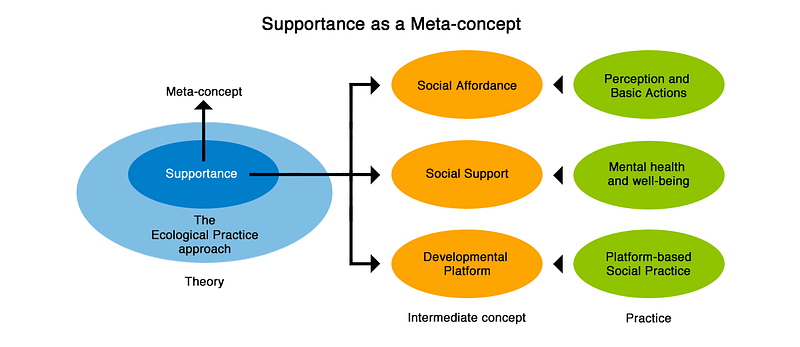
The above steps are designed for testing the concept of Supportance. This method is inspired by Dave Elder-Vass (2010)’s work on developing a brand-new social ontology. He mentions the relationship between theory and meta-theory, “In practice, such iteration of the metatheory — the general ontology and methodology — is unlikely to take place within the confines of an applied research project. It is more likely that difficulties in a series of projects will lead to dissatisfaction that must eventually be resolved by iterating the metatheory; but the principle remains that the relationship between metatheory and theory is a two-way one. We validate theory by working out its implications for the actual world in the form of hypotheses that can be tested against empirical evidence, and then revise the theory if it proves inadequate to the case. In a meta-methodological parallel, we can validate metatheory by working out its implications for the development of theory in the form of methodological inferences that can then be tested in the process of theorising. Just as we should be prepared to revise theory that proves inadequate, we should be prepared to revise metatheory if it proves inadequate. The formulation of a methodology is a key moment in this cycle of validation, just as the formulation of a hypothesis is a key moment in the cycle of validating a theory.” (2010, p.75)
What I learned from this method is that there is a way to develop highly abstract concepts. We can validate a meta-concept by applying it in the discussion of intermediate concepts. If a meta-concept can contribute to the development of some intermediate concepts, then the meta-concept can find its unique implications and values.
2.2 Supportance v.s. Social Affordance
The concept of Supportance is inspired by Gibson’s idea. Since Gibson has offered the concept of Affordance, can I just directly use it without coining a new term?
Though the term Affordance is coined by Gibson for his theory of ecological perception, the term is often misused in the literature in diffuse and imprecise ways. This section focuses on Gibson’s discussion on the relationship between affordance and people. Gibson doesn’t use “Social Affordance” in his book. In this section, I’d like to use “Social Affordance” as an intermediate concept for our discussion.
There is a section titled Other Persons and Animals in the chapter about Affordance, Gibson uses three paragraphs to discuss Affordances offered by people. Thus, these texts are highly relevant to Supportance. I will present them with annotations.
The richest and most elaborate affordances of the environment are provided by other animals and, for us, other people. These are, of course, detached objects with topologically closed surfaces, but they change the shape of their surfaces while yet retaining the same fundamental shape. They move from place to place, changing the postures of their bodies, ingesting and emitting certain substances, and doing all this spontaneously, initiating their own movements, which is to say that their movements are animate. These bodies are subject to the laws of mechanics and yet not subject to the laws of mechanics, for they are not governed by these laws. (1979/2015, pp.126–127)
We have to notice that Gibson uses some strange terms such as detached objects, surfaces, shapes, and substances to describe people. It’s hard to understand these words if we don’t read the whole book. In order to present a brand new theory of visual perception, Gibson develops a series of new terms which form the Ecological Physics Method. I have introduced the method in the article #SocialPxD — ReEngagement with Twitterville. Gibson focuses on the terrestrial environment for animals (including humans). Animals, plants, humans, natural objects such as rock, sand, mud, clay, metal… These are Substances. Air and water are Medium because they afford locomotion to animate bodies and they are generally transparent, transmitting light. The medium is separated from the substances of the environment by Surfaces. And a detached object refers to a layout of surfaces completely surrounded by the medium.
In simple words, Gibson’s discussion focuses on other persons’ Bodies.
They are so different from ordinary objects that infants learn almost immediately to distinguish them from plants and nonliving things. When touched they touch back, when struck they strike back; in short, they interact with the observer and with one another. Behavior affords behavior, and the whole subject matter of psychology and of the social sciences can be thought of as an elaboration of this basic fact. Sexual behavior, nurturing behavior, fighting behavior, cooperative behavior, economic behavior, political behavior — all depend on the perceiving of what another person or other persons afford, or sometimes on the misperceiving of it. (1979/2015, p.127)
It is clear that Gibson is calling for a brand new social theory that should consider affordance-based perception as its starting point. In fact, Gibson worked on social psychology in his early career. According to Reed, “At the beginning of his notes for teaching social psychology in 1936, Gibson (7.20) reminded himself, ‘give a lecture on values as the objective aspect of human motivation (economic, sexual, ethical, aesthetic values).’ Gibson spent the next four decades analyzing the implications of external values. The story of affordances that played such an important role in Gibson’s later theory has its roots in this early concern to understand the objective values that motivate human behavior.”(1988, p.55) However, Gibson never completed his projected book on socialization. Also, we have to notice that the above piece is quoted from The Ecological Approach to Visual Perception which was published in 1979. Unfortunately, Gibson died in December 1979.
What the male affords the female is reciprocal to what the female affords the male; what the infant affords the mother is reciprocal to what the mother affords the infant; what the prey affords the predator goes along with what the predator affords the prey; what the buyer affords the seller cannot be separated from what the seller affords the buyer, and so on. The perceiving of these mutual affordances is enormously complex, but it is nonetheless lawful, and it is based on the pickup of the information in touch, sound, odor, taste, and ambient light. It is just as much based on stimulus information as is the simpler perception of the support that is offered by the ground under one’s feet. For other animals and other persons can only give off information about themselves insofar as they are tangible, audible, odorous, tastable, or visible. (1979/2015, p.127)
This piece highlights the mutual affordances between self and other persons. However, Gibson still remains his discussion at the perception level. He suggests that these mutual affordances are based on “the pickup of the information in touch, sound, odor, taste and ambient light. ” Gibson highlights the difference between radiant light and ambient light. While radiant light comes from a point source, ambient light comes to a point in the medium. Thus, the Surfaces become very important because they reflect light and make ambient light available.
The other person, the generalized other, the alter as opposed to the ego, is an ecological object with a skin, even if clothed. It is an object, although it is not merely an object, and we do right to speak of he or she instead of it. But the other person has a surface that reflects light, and the information to specify what he or she is, invites, promises, threatens, or does can be found in the light. (1979/2015, p.127)
Though Gibson talks about mutual affordances between a person and other persons, he keeps his analysis with the ecological physics method. The rest of the book doesn’t expand on this piece but focuses on basic actions such as postural actions, exploratory actions, locomotion, and manipulation.
I consider Gibson’s ‘Social Affordance’ to be the seed of the concept of Supportance. The Supportance project aims to continue Gibson’s unfinished social account in an interdisciplinary way.
Why don’t I directly use the term ‘Social Affordance’ for my project? There are three reasons that I have to choose Supportance.
First, if we remain our discussion about mutual affordances between a person and other persons at the perception level, then we can use ‘social affordance’ to refer to this topic and the concept of Supportance is not needed. However, if we want to move to ‘actualizing social affordances,’ we have to go beyond the perception level because other persons have their agency, ownership, privacy, intentions, needs, and emotions, and there are various relationships between self and others. Moreover, how about the ‘affordances offered by organizations’ and their actualizations? I believe the new account should develop its own analysis framework and method which are different from Gibson’s Ecological Physics Method.
Second, there is a babble of voices around the term ‘social affordance.’ Some ecological psychologists use the term ‘social affordance’ for three domains of contemporary ecological research: social perception, social interaction, and cultural practices. Outside ecological psychology, some authors use the term ‘Social Affordance’ for special purposes in their domains, most authors expand the original meaning of Affordance from perception-based relative aspects to non-perception analysis. I personally don’t like this approach because the perception level analysis and the non-perception analysis have different conditions and require different analysis frameworks. It’s hard to maintain a consistent theoretical meaning for the concept of Affordance. Some authors’ re-conceptualization of Affordance may have a special contribution to their domains, however, their new definitions of Affordance may add misunderstanding to Gibson’s original meaning. Eventually, the term Affordance became a normal word. I want to keep Gibson’s original meaning for the concept of Affordance and remain it at the analysis level of the natural/material/technological environment.
Third, I want to develop a hierarchical loop of ‘Affordance — a new concept’ and discuss the relationship between these two layers. The affordance is located at the lower layer while the new concept is located at the higher layer. If I adopt the term ‘Social Affordance’ for the higher layer, I will face a logical challenge because ‘Social Affordance’ is a subcategory of the concept of Affordance. How can we use a subcategory concept as a higher layer for its master category concept?
If I want to jump from the perception analysis to a new level of analysis and bypass the unnecessary terminology trouble and logical error, the best strategy is to use a brand new term instead of redefining the concept of Affordance or adopting the term ‘Social Affordance.’ Though the concept of Supportance is inspired by Gibson’s writings and his theoretical ideas, the new term gives me a new creative space for developing a new theory of social action. The new theory may go beyond Gibson’s ideas, even the ecological framework. For Gibson, Affordance is a scientific concept. For me, Supportance is a meta-concept that is not a scientific concept, but a philosophical concept.
2.3 Supportance v.s. Social Support
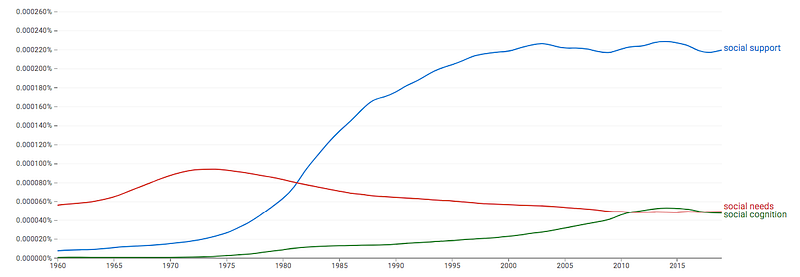
The root word of Supportance is Support, so I have to discuss the relationship between Supportance and Social Support which is an established intermediate concept for several domains. Data from Google’s Ngram Viewer (see the figure below) shows an interesting fact. Looking at word usage in indexed books we can find a significant difference between the word ‘social support’ and the other two words. The appearance of “social support” has climbed steeply since the 1980s. Compared with the other two, it keeps a higher level in the first 20 years of the 21st century.
As mentioned above, word meaning and concept are two different things. If we consider ‘social support’ as a concept for research, then we have to connect it to some particular domains. In 1988, Alan Vaux wrote a book titled Social Support: Theory, Research, and Intervention. He mentioned there are several views about social support from different disciplines, “In the past decade, social support has become an immensely popular area of research. The topic is fascinating. At a personal level, it engages some of our most intimate experiences regarding love, friendship, and belonging. To the social scientist, it represents a focal point around which social ecological models of distress can be developed. To the interventionist, it promises powerful techniques for the amelioration and prevention of psychological problems. Initial excitement over the topic gave rise to a flood of empirical articles. Within the past few years, many writers have turned increasingly to theory, in an effort to make sense of the growing and often puzzling literature.” (1988, p.xiii)
For social scientists, the term ‘social support’ is related to ‘social ties’ and ‘social disintegration.’ According to Vaux, “Social disintegration attendant upon industrialization and urbanization persisted as a common theme in European and U.S. sociology through the first part of this century. The face-to-face, multidimensional, and person relationships characteristic of rural village life were contrasted with the impersonal, specialized, and formal relationships thought to dominate urban life (Simmel 1902/1950). The dramatic disruptions in the social life of Polish peasants who migrated from rural villages to large U.S. cities were documented by Thomas and Znaniecki (1920/1950), for example. The view that disrupted social ties led to psychological and social problems was perpetuated in the ‘Chicago School’ of sociology by Robert Park, Ernest Burgess, and Roderick Mckenzie, who examined the spatial distribution of disorder in Chicago (Catalano 1979).” (1988, p.2)
For psychologists, the term ‘social support’ is connected to ‘social relationships’ and “mental health”. As Vaux quoted, “In sum, as Kahn and Antonucci (1980) have noted, ‘Psychoanalytic, ethnological, and social-learning theories, each for different reasons and utilizing different mechanisms, emphasize the importance of the dyadic relationship between infant and primary caregiver ’ (p.258). These theories too provide a precedent for the study of social relationships and well-being: they highlight the importance of early attachment and the needs served by later social relationships that in some views harken back to childhood issues.” (1988, p.3) However, from a social exchange perspective, ‘resources’ become a primary idea for the development of social relationships and the status of mental health. Vaux says, “In contrast to psychodynamic thinking, social exchange theory views social relationships in terms of their more immediate and surface benefits (Homans 1961; Thibaut and Kelley 1959). From this perspective, individuals engage in social behavior that is rewarding, and relationships develop and persist over time to the extent that each individual involved can provide resources of value to the other (Burgess and Huston 1979). These resources might take any form, though Foa (1971) has suggested that the major kinds of rewards exchanged are love, status, information, money, goods, and services. According to these writers, relationships may begin with the exchange of tangible and universal resources (for example, goods, and services), but close relationships are marked by symbolic and particularistic exchanges (for example, signs of affection) in which the identity of exchange participants is crucially important.”
Social Support is a great intermediate concept because it connects the individual and social context, it refers to objective and subjective. It can be a starting point for psychological research and sociology research.
What’s the relationship between ‘Supportance’ and ‘Social Support’?
First, Supportance is a meta-concept that doesn’t directly tie to the operational level studies such as measurement, assessment, and interventions. The concept of Supportance aims to highlight the aspect of potential action possibilities from social environments at the meta-theoretical level.
Second, Supportance focuses on the relationship between people and social environments while current social support studies focus on mental health and well-being.
Third, Supportance is a theoretical concept of the ecological practice approach which refers to a particular theoretical stance. As an intermediate concept, Social Support refers to a general research topic. Different theorists can provide different theories for understanding the same general topic. The above social relationship theory and social exchange theory are two good examples.
Since the field of ‘social support — mental health’ is established, I don’t think I can offer a better contribution to the field than existing researchers. However, the concept of Supportance can bring us a new perspective on social environments. If we expand the concept of “social support” from the field of ‘social support — mental health’ to cover more topics, then the concept of Supportance is very useful as a meta-concept.
If we consider the word ‘social’ within the term ‘social support’ as a wider meaning, not an interpersonal relationship, then we can redefine ‘social support’ as an interdisciplinary concept.
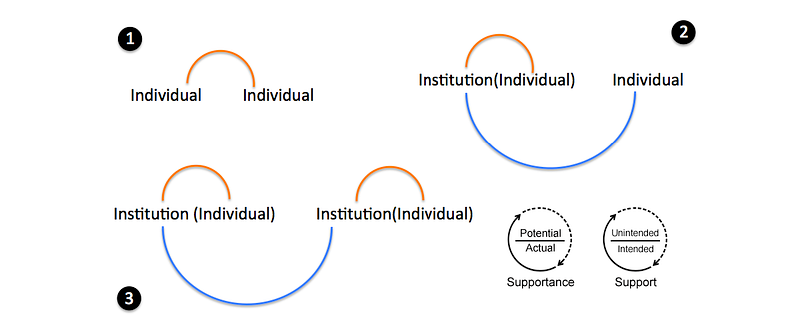
The above diagram shows three types of social support:
- Type 1: Individual-to-Individual social support
- Type 2: Institution-to-Individual social support
- Type 3: Institution-to-Institution social support
Type 1 social support is the existing social support within the field of ‘social support — mental health.’ Type 2 and type 3 go beyond the individual psychological analysis. I use ‘Institution(Individual)’ to represent Institution because any institution is formed by individuals and any decision of any institution is made by individuals.
This reconceptualization of social support echoes Derek Layder’s criticism of reductionist explanations from social psychology (1981). Layder says, “There are various forms of reductionist explanation of social phenomena, and social psychologists have flirted with several of them. However, the common feature which unites them is their inappropriate (literal) reduction of the explanation of social phenomena to the level of subjective states of mind or intersubjective relationships rather than seeking explanations in terms of impersonal social forces. ”(p.28)
If we adopt the concept of Supportance for understanding these three types of social support, then we move our focus to the transformation of ‘potential — actual.’ The notion brings a new layer to social support and gives individuals more opportunities to get support from their social environments. Moreover, from the perspective of Supportance, ‘support’ means not only intended support but also unintended support.
- Intended support: Person A intends to give some support to person B.
- Unintended support: Person A doesn’t intend to give some support to person B, but person B actualizes some supportances which are offered by Person A.
Both intended support and unintended support require Perception and Capability from Person B, however, unintended support doesn’t require Intentionality from Person A. The same logic can be applied to the level of institutionalized actions.
2.4 Supportance v.s. Developmental Platform
I have introduced the concept of Developmental Platform and the Infoniche framework in recent articles.
The concept of the Developmental Platform is developed as an intermediate concept for interdisciplinary study from the perspective of adult development. It doesn’t only talk about digital platforms, but also about large organizations and established theoretical traditions. It focuses on the relationship between platforms and people. As a micro level of analysis, it aims to observe the development of knowledge, skills, and competence, but also the social status of individuals.
Like the concept of Social Support, the concept of Developmental Platform doesn’t tie to any theoretical account. It is fruitful to make distinctions between two different uses of Developmental Platform: a concept for ontological level analysis and a concept for epistemological level analysis. As an ontological concept, Developmental Platform refers to a thing we want to study, we don’t have to adopt any theoretical approach as presupposition and basis. As an epistemological concept, Developmental Platform can refer to a particular theoretical account as a stance for studying a thing.
At the epistemological level, I also contribute one solution from the perspectives of the Ecological Practice approach and the Life-as-Activity approach.
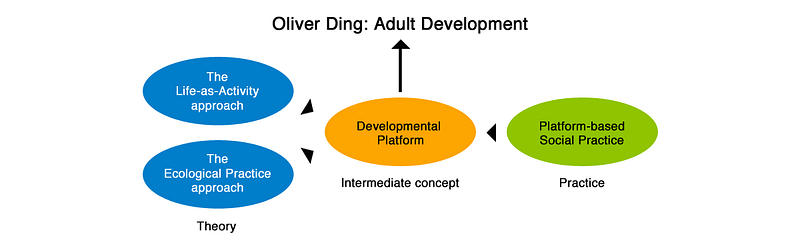
The Life-as-Activity approach is for understanding “development” while the Ecological Practice approach is for understanding both “development” and “platform”.
Inspired by Lev Vygotsky and Urie Bronfenbrenner, I conceptualize “Development” as a double transformation between “potential” and “actual”. A person’s development means the transformation between Potential Self and Actual Self, this process is related to the transformation between Supportance (potential) and Action (actual).
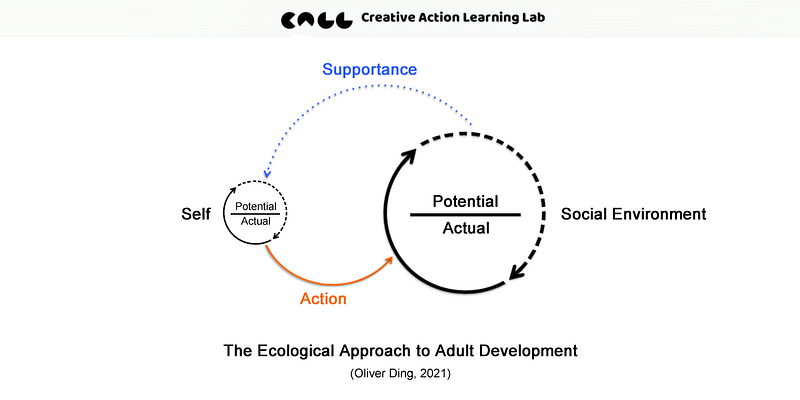
The above diagram represents a new model of adult development from the perspective of the Ecological Practice approach. A person’s development means the transformation between the Potential Self and the Actual Self, this process is related to the transformation between Supportance (potential action possibility) offered by the social environment and Actual Action.
Based on this new theoretical foundation of adult development, I introduce the Infoniche framework and apply it to develop a model for conceptualizing the structure of Developmental Platform with the following formula. The numerator refers to supportance level analysis which is all about social activities. The denominator refers to affordance level analysis which considers the individual body scale intermediate actions.
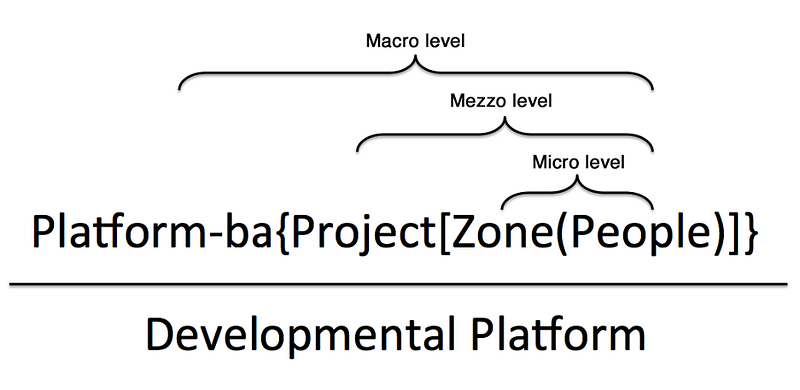
The core of the ecological practice approach to the developmental environment is the “affordance — supportance” potential hierarchical loop. At the concrete level, I adopt the multi-level method for studying a set of nested structures. For the Platform-for-Development project, I select three levels and offer a framework for analyzing corresponding supportances.
- Micro level: Zone (social environment) — Offer (supportance)
- Mezzo level: Project (social environment) — Projectivity (supportance)
- Macro level: Platform-ba (social environment) — Platform-ship?(supportance)
Though the macro level work is not done yet, this case can be considered as a testing of the concept of Supportance. Obviously, the concept of Supportance is the foundation of the Platform-for-Development project. As a meta-concept, Supportance sets the theoretical base on which I can develop the Infoniche framework and the Supportive Cycle model.
Part 3: Actualization of Supportances
The last part connects the concept of Supportance with several intermediate concepts. Now let’s return to the concept itself and develop a general framework for understanding social actions. In other words, a Supportance-based theory of action.
The new framework is based on a simple assumption:
Social Actions are dynamic processes of Actualization of Supportances.
Since Supportance is potential, if we don’t talk about its actualization, then this concept doesn’t have any value. Once we pay attention to the actualization of supportances, we see a new creative space for developing a new theory of social actions.
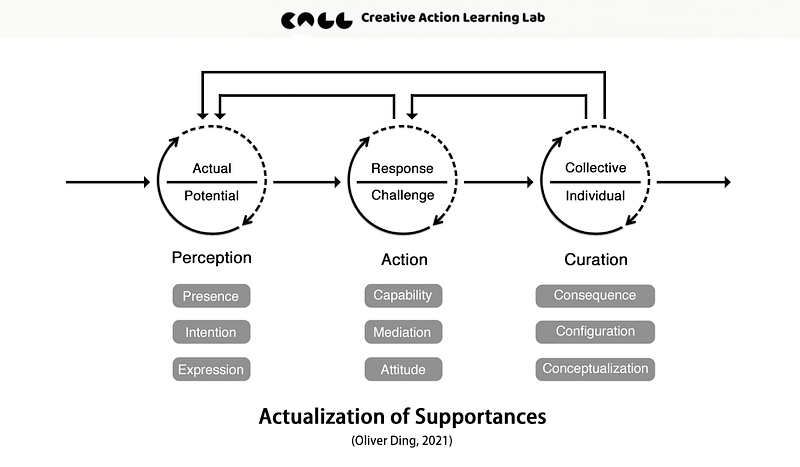
The above diagram roughly presents my ideas on the Actualization of Supportances which considers a structure of three phases. Phase 1 is Perception, it focuses on the transformation between Potential and Actual. Phase 2 is Action, it focuses on the transformation between Challenge and Response. Phase 3 is Curation, which focuses on the transformation between the Individual and the Collective. As a dynamic process, these three phases don’t form a simple linear process. Phase 2 and phase 3 often provide feedback to phase 1.
The major difference between this model and normal discussions on the Actualization of Affordances is the Curation phase. The idea of Curation is inspired by my 2019 book Curativity: The Ecological Approach to Curatorial Practice. The new term Curativity refers to “curating pieces into a meaningful whole”.
I also highlight some topics for each phase. The following sections will discuss these topics. In order to simplify our discussion, I will use a pair of concepts for each topic. This pattern highlights two opposite tendencies and creates room for more possibilities. Also, I will use the Person and Others for our discussion. The Person wants to actualize supportances while Others mean social environments including other persons and organizations.
3.1 Perception: Potential v.s. Actual
The pair of concepts ‘Potential — Actual’ is the core of Gibson’s perception theory. For his visual perception, what organisms perceived are Affordances. For our discussion, Suppotrance refers to potential while Action refers to actual. The key to the transformation between Supportances and Actions is Perception. However, we should expand the meaning of Perception from Gibson’s Direct Perception to Indirect Perception. Otherwise, we couldn’t solve the mystery of Supportance.
I select the following three topics for the Perception phase:
- Presence: Near v.s. Remote
- Intention: Unintended v.s. Intended
- Expression: Tacit v.s. Explicit
Presence: this topic refers to the place and attendance of the subject. The person and others should enter the same place where they can perceive supportances from each other. The place can be a near physical space or a remote virtual space.
Intention: Since the person intended to look for supportances, the focus of this topic is Others’ intentions. From the perspective of Supportance, ‘support’ means not only intended support but also unintended support. The former refers to an ordinary situation: Others intend to give some support to the person. This is the normal definition of Support or Help. Unintended support goes beyond the traditional understanding of Support, it refers to a special situation: Others don’t intend to give some support to the person, but the person actualizes some supportances which are offered by Others.
Expression: For Gibson, the key to perception is ecological information which informs Affordances from the environment. For our discussion, the key to perceiving Supportance is the Other’s expressions: what Others said, what Others acted, what Others published, etc. By observing Others’ expressions, the person can understand the relationship between him and Others for making sense of a particular Supportance. Intended support is always expressed explicitly. However, the unintended support is not expressed explicitly. The person should pay attention to the tacit expression of Others in order to find supportances and actualize them as unintended support.
3.2 Action: Challenge v.s. Response
The pair of concepts “Challenge — Response” was developed by myself in 2019. The term Challenge is used to highlight the intention of the person who wants to find supportances. If the person can’t do something by himself, that means he faces a challenge. The term Response refers to related actions from Others. Since Supportance is an intersubjective concept, the process of actualizing Supportance should consider both the person and Others.
I select the following three topics for the Action phase:
- Capability: Capable v.s. Incapable
- Mediation: Direct v.s. Indirect
- Attitude: Attractive v.s. Defensive
Capability: this topic refers to the person’s skill, knowledge, body, or other aspects. Both Affordance and Supportance are not single-side ideas such as Features and Help, they consider aspects of the environment and aspects of people at the same time. While Others offer Supportances to the person, there is a connection between the person’s capability and some aspects of Others. The person may be capable or incapable to actualize some Supportances.
Mediation: The person may directly actualize a supportance offered by Others. Or, he may indirectly actualize another supportance. This issue refers to tools as mediators of social actions. The term Mediation is also an important concept of Lev Vygotsky’s psychology theory. For Vygotsky, the concept of Mediation aims to emphasize the value of tools and signs for the development of consciousness. However, here I use the term Mediation to describe the Directness of action. We should distinguish between Tools for Mind (consciousness) and Tools for Actions. The former is about psychological theories while the latter is about social theories.
Attitude: This topic can be applied to both two sides. For the person, what is his attitude toward his own life situation? How do Others perceive and interpret his actions for actualizing supportances? Aggressive? Creative? …We also have to pay attention to Others’ responses. How do Others respond to the person’s actions? If Others perceive the person’s actions as creative behavior, they may respond to him amicably. For the person, this response is perceived as an Attractive action. If Others perceive the person’s actions as aggressive behavior, they may respond to him discreetly. For the person, this type of response is perceived as a Defensive action.
The issue of Attitude is a significant difference between Supportance and Affordance since the latter only considers one-sided agency. We should notice that the actualization of Supportances is a dynamic interactive process that involves two-sided agency.
3.3 Curation: Individual v.s. Collective
As mentioned above, a major difference between this model and normal discussions on the Actualization of Affordances is the Curation phase. The idea of Curation is inspired by my 2019 book Curativity: The Ecological Approach to Curatorial Practice. The new term Curativity refers to “curating pieces into a meaningful whole”.
The book developed a new theory called Curativity Theory and applied it to several case studies such as toy design, family curation, cloth customization, and knowledge curation. I also developed a framework for discussing the transformation between individual experience and collective culture. One concept of the framework is Themes of Practice. Though I intended to apply Curativity Theory to Social Action, however, it is too hard to incorporate such a discussion within the book. Thus, the book remains at the level of analysis of ecological interaction.
Now it is time to consider a new theory that sees perception, action, and curation as a whole. I think it is useful to adopt the curation for discussing the relationship between individual and collective. We can start the discussion with the following three topics:
- Consequence: Positive v.s. Negative
- Configuration: Piece v.s. Whole
- Conceptualization: Abstract v.s. Concrete
Consequence: this topic refers to social evaluation from multiple sides such as the person, others, and third parties. It also considers private impacts and public impacts. In general, the consequence of the actualization of supportance can be positive or negative, either way, the consequence may lead to a new interaction that brings new challenges and new responses. The new challenges lead to a new process of looking for new supportances.
Configuration: I use this term to refer to my own framework about the transformation between individual experience and collective culture. There are at least three ideas we can learn from this framework. First, the person can actualize multiple supportances from more than one source and make a configuration of supportances. Second, the person can turn his several experiences of actualizing supportances into a meaningful whole and use this new whole to explore new supportances. I call this a configuration of experience. Third, the person can have a landscape of his infoniche and work on improving the configuration of infoniche. Following Gibson’s definition of niche, I coined a new term Infoniche which is defined as a set of potential action possibilities such as affordances and supportances. I have introduced the infoniche framework in a previous article.
Conceptualization: this topic refers to the transformation between percept and concept. As mentioned above, I have developed a framework for the transformation between individual experience and collective culture. In fact, this framework addresses the issue of percept and concept and argues that the original source of concept should be percept. At the individual level, a person can perceive his own life course and generate abstract life themes from concrete daily life activities. For society, social life at the collective level can generate cultural themes. These ideas lead to my notion of Themes of Practice which aims to connect personal life themes and collective cultural themes. The key to conceptualization is turning concrete experiences into abstract concepts. This is also a major difference between Affordance-related discussion and Supportance-related discussion.
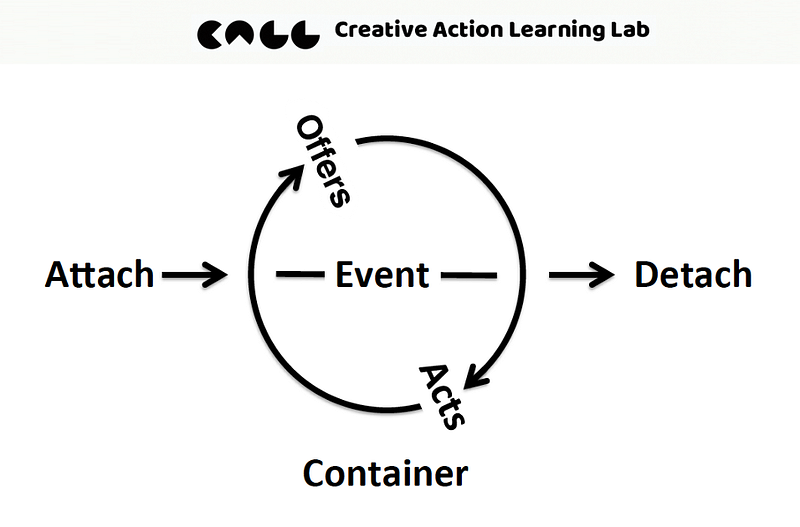
The above topics are just examples of thinking about a Supportance-based theory of social action. By expanding Action to the whole of ‘Perception — Action — Curation,’ we set a container for social action. The above diagram is the germ cell of the Ecological Practice approach. The Perception phase corresponds to the Attach stage. The Action phase corresponds to the Event stage. The Curation phase corresponds to the Detach stage. The Social Environment corresponds to Container. Supportances correspond to Offers while the actions of actualizing supportances correspond to Acts.
Part 4: The Relevance of Gibson’s Social Mind
The concept of Supportance is inspired by Gibson’s ideas. Though Gibson is known as an ecological psychologist and his idea of Affordance, he was a social psychologist when he was young. This part reviews some ideas from young Gibson’s social mind.
4.1 Gibson as A Social Psychologist
James Gibson’s major contributions throughout his career were published in three of his major works: The Perception of the Visual World (1950), The Sense Considered as Perceptual Systems (1966), and The Ecological Approach to Visual Perception (1979). However, he was recognized as one of a number of young radical psychologists who were propounding a new understanding of socialization in his early thirties.
In a biography titled James J. Gibson and The Psychology of Perception (1988), Edward S. Reed uses The Motives of a Social Realist as a title for a chapter that describes Gibson’s early ideas. According to Reed, “American social thought is largely built around the myth that isolated individuals exist in, and sometimes fight against, society. In the drafts for his never-completed book on socialization, Gibson attacked this theory from the outset. ‘The great fallacy of the older group theorists was in believing that the group thwarted and cramped the individuality of a member, and the individual tended to rebel against this oppressive influence. The truth is that the function of the group is to develop individuality in its members. Only in a group can a person become highly individualized’ (1.25, 1932). A self cannot be a ‘personal possession.’ In a way strikingly reminiscent of Baldwin (1897), Gibson argued that the ‘self is not something private, incommunicable, or knowable, only by itself. It arises as a ‘reflection of the discovery of other selves’ and in connection with group life’ (3.48, 1960). The self is both a person’s way of acting among other people and his or her awareness of social relations. Although the awareness of the self is difficult to make explicit, ‘that does not mean that the self is inner and secret. On the contrary, it is one of the most public aspects of personality, expanding and contracting with public esteem’ (3.48, 1960)”. (1988, p.59)
Gibson’s social mind is similar to his theory on perception. Reed says, “Gibson’s later work on perception showed how individuals can obtain veridical information through their own actions. We are able to see for ourselves, Gibson asserted, despite the blinders of accepted proprieties. Thus Gibson’s social theory mediates between a form of social determinism and a form of pure individualism. The norms of the group do have an effect on individuals, but they cannot predetermine an individual’s acts.” (1988, p.65)
It’s clear that Gibson was looking for a third way which is behind social determinism and pure individualism. The concept of Supportance echoes such a great vision. If we want to escape from the conflict of control and autonomy, we should adopt a new concept in order to keep balance. At the epistemological level, it is better to adopt the neutral monism approach to solve the contradiction between self and others. If we accept the limitations of individuality, then the concept of Supportance points to a way of reciprocal intersubjectivity.
4.2 Proper Behavior v.s. Expedient Behavior
Though Gibson didn’t finish his book about socialization, his idea on expedient and proper behavior has been published. According to Gibson, “The chief lesson of modern anthropology…(all behavior is)…both proper and expedient…both socially permissible and individually workable.” (1950b, 154).
Reed points out, “Conflicts between propriety and expediency are not inevitable, for there are many acts that are both proper and expedient. It is proper and expedient to keep one’s distance from strangers and to make friendly gestures if an approach is necessary. Whenever there is a conflict between propriety and expediency, however, the discordance is perceptible, for the ability to act properly is, however social, still motivated by the external value desired and cannot blind one completely to alternative ways of achieving the same goal, or Gibson (1950b) argued. A starving person may live in a ‘socially constructed reality,’ but may nevertheless choose to ignore certain properties in order to obtain food. Both the social norms and the biological facts relevant to action are perceptible, and therefore neither necessarily dominates the other.” (1988, p.64)
Gibson’s distinction between expedient and proper behavior also leads to an explanation of the development of technology. According to Reed, “When the conflict between propriety and expediency is persistent enough, someone who perceives it may be able to invent a technique to make proper acts more expedient…Technology is not just a method for dealing with nature; it can be (and often is) a way of dealing with social relations as well.” (1988, pp.64-65)
We have discussed nine topics about a new theory based on the concept of Supportance. The topic of ‘expedient—proper’ can be considered a new topic in our future discussion. At the epistemological level, the neutral monism approach can guide us in developing a consistent theoretical account in order to respond to these topics.
4.3 Gibson’s understanding of Marxism
There is a connection between Gibson’s social mind and Marxism. According to Reed, “Gibson felt that his distinction between expedient and proper ways ‘takes into account the essentials of Marx’s theory.’ The key problem for Gibson’s (and for Marx’s) theory is to explain how an individual raised in one society with one set of proprieties comes to be able perceive the limits of that tradition. How can awareness break through the encrusted ideology of a dominant social group? Why can’t the ruling class fool members of the other classes — or can they?”(1988, p.65)
A related topic is education and propaganda. Reed says, “In Gibson’s view, propaganda (or education) could be either good or bad, depending upon whether it was helpful or harmful to the individual or to the group…The educator has his or her students’ interests in mind; yet this alone does not make the educator superior to the propagandist. What is important is how effectively each does the job of adapting his or her intended audience to the developing social tasks around them.” (1988, pp.62–63)
From the perspective of neutral monism, Supportance doesn’t refer to good or bad, it is a type of ecological value. However, the process of Actualization of Supportances could be either good or bad, depending upon its consequence. One’s self-actualization may lead to exploiting others by arranging an unfair division of labor. One’s vision and leadership may lead to a creative collaboration that accomplishes great human achievement. Our view echoes Gibson’s view on social agendas.
4.4 Social Appropriation of Ecological Values
The focus of Gibson’s ecological psychology is ecological values. Reed uses the term ‘Social Appropriation’ to highlight this theoretical meaning. He emphasizes, “We all live in the same environment, even though our habits differ, showing that a variety of combinations of proper and expedient ways can be successful. Underlying this process of social appropriation of the valuable resources of the environment are the various human techniques for sharing the socializing awareness.” (1988, p.66)
Reed also comments on the different ways of perceiving ecological values. He says, “Pictures, language, maps, measuring systems, and so on enable people to communicate about the facts of the environment. These techniques can fix and constrain awareness for good or for ill. Symbols do not create realities, but they do help specify the realities that we are interested in…Gibson’s later distinction between direct perception (first-hand experience) and indirect perception (second-hand knowledge, usually socially mediated) emerged from his early concern to try to separate veridical perception from stereotyped, schematized, or otherwise constrained perception. ”(1988, p.66)
The above discussion about the Actualization of Supportances has mentioned the distinction between direct perception and indirect perception. Our discussion on Curation of Supportances also echoes Reed’s idea of Social Appropriation.
Epilogue: Possible Practice
I have mentioned the vision of the Ecological Practice approach with the following diagram several times.
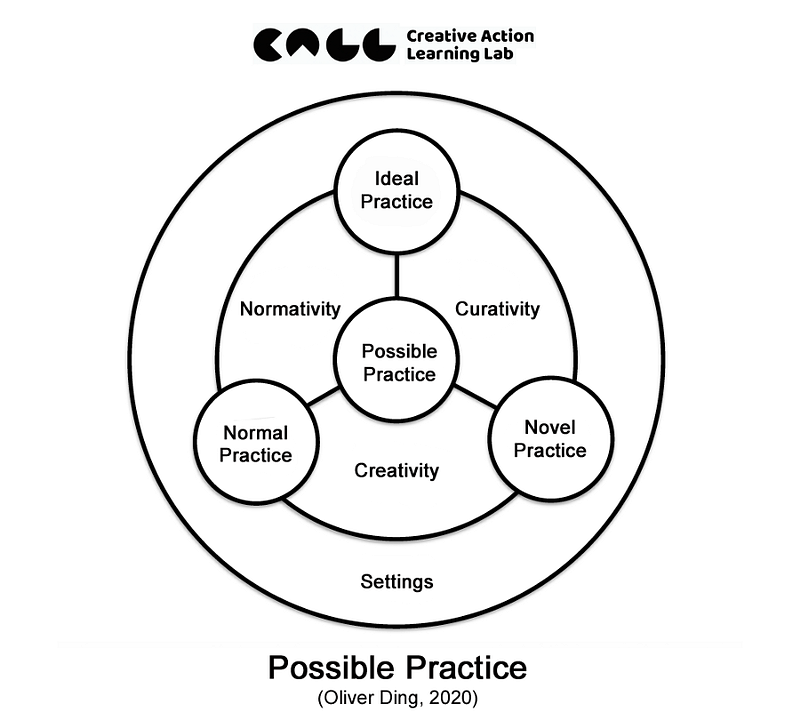
I consider actions at the individual level and practice at the collective level. The four types of actions correspond to four types of social practices.
- Possible Practice — Possible Actions
- Normal Practice — Normal Actions
- Novel Practice — Creative actions
- Ideal Practice — Exemplary Actions
Why do I place Possible Practice at the center of the new framework? I consider the possible practice as the origin of all types of practice. If we trace back the historical development of any social practice, we can always find that their sources are possible actions. I consider Affordance and Supportance are two major sources of possible actions.
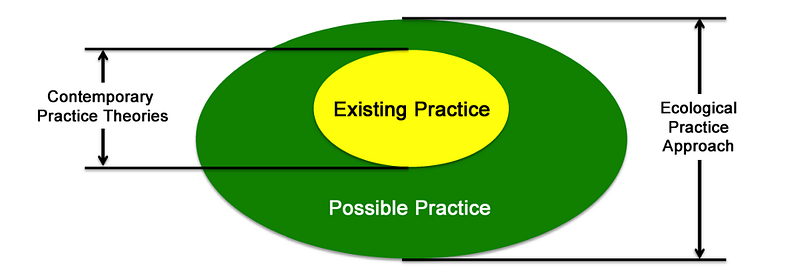
If we put Normal Practice, Novel Practice, and Ideal Practice into one category: Existing Practice, then we can get the diagram below.
Since 2001, a group of philosophers, sociologists, and scientists have rediscovered the practice perspective and used it as a lens to explore and examine the role of practices in human activity. Researchers called it The Practice Turn in Contemporary Theory. As Schatzki pointed out, “there is no unified practice approach.”(2001, p.2) Davide Nicolini uses a toolkit to introduce the following six different ways of theorizing practice in his 2012 book Practice Theory, Work, & Organization:
- Praxeology and the Work of Giddens and Bourdieu
- Communities of Practice (Lave & Wenger, 1991)
- Activity Theory / Cultural-historical activity theory (the Marxian/Vygotskian/Leont’evian tradition)
- Ethnomethodology (Harold Garfinkel, 1954)
- The Site of Social (contemporary developments of the Heideggerian/Wittgensteinian traditions, by Theodore R. Schatzki)
- Conversation Analysis / Critical Discourse Analysis (the Foucauldian tradition)
Nicolini also pointed out, “Practice theories are fundamentally ontological projects in the sense that they attempt to provide a new vocabulary to describe the world and to populate the world with specific ‘units of analysis’; that is, practice. How these units are defined, however, is internal to each of the theories, and choosing one of them would thus amount to reducing the richness provided by the different approaches.” (2012, p.9)
I suggest ‘Possible Practice’ as a new term that expands the scope of contemporary practice theories from ‘actual actions and existing practice’ to ‘possible actions and possible practice.’ I consider ‘Possible Practice’ as the special unit of analysis for the Ecological Practice approach. Again, the Ecological Practice approach is not an alternative to contemporary practice theories, but expands their scope and contains more theoretical concepts such as James J. Gibson’s Affordance.
The Ecological Practice approach claims that the original source of all human actions is affordances and supportances. The goal of the Ecological Practice approach is to build a new unit of analysis for discussing action and practice. The concept of Supportance is just the beginning.
You are most welcome to connect via the following social platforms:
Twitter: https://twitter.com/oliverding Doowit: https://doowit.co/profile/gm0k2ax9 Linkedin: https://www.linkedin.com/in/oliverding
License
This work is licensed under the Creative Commons Attribution-NonCommercial-ShareAlike 4.0 International (CC BY-NC-SA 4.0) License. Please click on the link for details.


