
The Curated Mind: Creative Holism and Applied Knowledge Curation
Managers as Knowledge Curators

Three weeks ago, Geoff Elliott shared several e-books about System Thinking with me. These are really wonderful knowledge resources.
I immediately started reading Mike Jackson’s Systems Thinking: Creative Holism for Managers (2003).
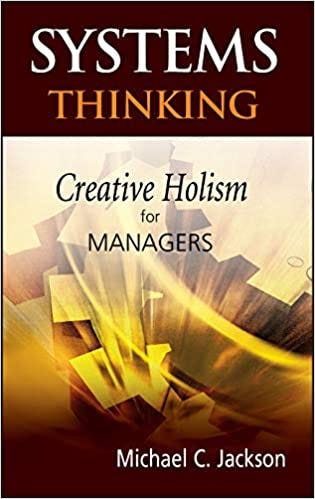
The subtitle of the book is Creative Holism for Managers.
What’s Creative Holism?
Part III of the book is called ‘creative holism’ and is concerned with the use of different systems approaches, reflecting alternative holistic perspectives, in combination. The various systems approaches cannot be used all at once but they can be employed creatively, in an informed and ethical way, to promote together the overall improvement of organizational performance. This is the essence of creative holism.
It seems very interesting to me because it reminds me of “Curativity” which is my term for describing “turning pieces into a meaningful whole”.
I wrote a book titled Curativity: The ecological approach to general curation practice and develop a new theory called Curativity Theory. One application of the book and the theory is Knowledge Curation and its focus is Connecting Theory and Practice.
For example, the Knowledge Curation perspective sees managers as “knowledge curators” because they always curate different knowledge resources together in order to make situational decisions. In the real practice of management, managers don’t have to apply one theoretical approach to solve their problems. They can, and they always, try several approaches to a particular challenge. In this manner, I call them knowledge curators.
To be honest, I didn’t know “Total systems intervention” and “Critical Systems Practice” until now.
It is great to start a new learning journey.
This article aims to 1) share some quotations from Mike Jackson’s Systems Thinking: Creative Holism for Managers (2003), and 2) share more ideas about the newest development of Curativity Theory, especially the Curated Mind.
Contents
Part 1: Creative Holism for Managers
1.1 Against the Suboptimization 1.2 Creative Holism as Curativity 1.3 The Development of Applied Systems Thinking 1.4 Habermas on Postmodern Thoughts 1.5 Critical Systems Thinking (CST) and Practice 1.6 Call for Meta-methodology 1.7 Habermas’s solution for CST 1.8 Creativity, Choice, and Implementation
Part 2: The Curated Mind of Managers
2.1 The Gap between Theoretical Knowledge and Situational Practices 2.2 Knowledge Engagement 2.3 Managers as Knowledge Curators 2.4 The Curated Mind 2.5 The Canvas of Applied Knowledge Curation
Part 1: Creative Holism for Managers
Part 1 is about the book Systems Thinking: Creative Holism for Managers (2003).
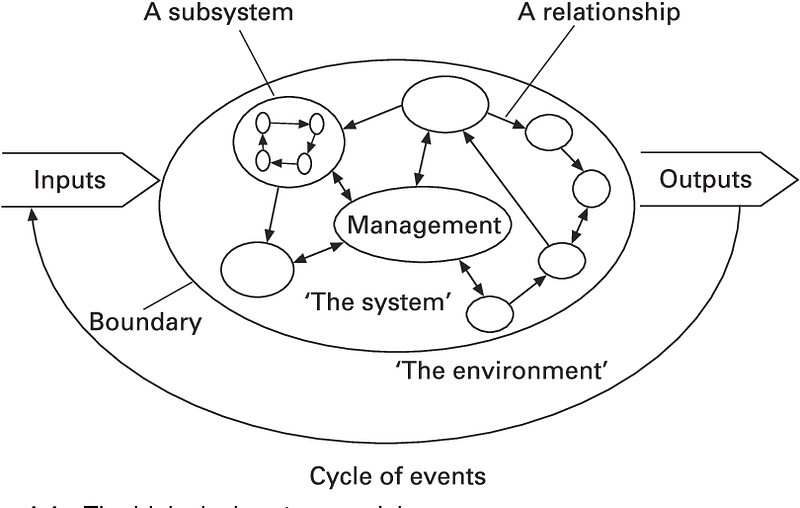
1.1 Against the Suboptimization
At the beginning of the book, Mike Jackson criticizes the popular “quick-fix” management “fad” such as the following methods:
- Scenario planning
- Benchmarking
- Rightsizing
- Value chain analysis
- Continuous improvement
- Total quality management
- Learning organizations
- Process re-engineering
- Knowledge management
- Balanced scorecard
- Customer relationship management
According to Mike Jackson, “Fundamentally, simple solutions fail because they are not holistic or creative enough. They are not holistic because they concentrate on the parts of the organization rather than on the whole. In doing so they miss the crucial interactions between the parts. They fail to recognize that optimizing the performance of one part may have consequences elsewhere that are damaging for the whole. This fault is known as ‘suboptimization’…It fails to see that, even if each part is optimized, the performance of the whole organization can be disastrous if the parts do not interact together well.” (p.16)
1.2 Creative Holism as Curativity
After setting the stage for system thinking, Mike Jackson goes deep on connecting System thinking and Creativity, “Because of the growing popularity of holistic thinking, there is now a rich storehouse of different systems approaches. While these all employ holism they do not all encourage creativity. Some fall prey to the fault found with so many management fads — they encourage us to look at organizations from only one perspective. Increasingly, being systemic is also coming to mean being able to look at problem situations and knowing how to resolve them from a variety of points of view and using different systems approaches in combination. Critical systems thinking specifically encourages this kind of creativity. Creativity is made possible by this book because it presents a full range of systems approaches and discusses how they can be used together.” (p.16)
Mike Jackson should use my term “Curativity” to replace “Creativity” for his solution. See the following new version:
Increasingly, being systemic is also coming to mean being able to look at problem situations and knowing how to resolve them from a variety of points of view and using different systems approaches in combination.
Critical systems thinking specifically encourages this kind of Curativity.
Curativity is made possible by this book because it presents a full range of systems approaches and discusses how they can be used together.
In the introduction of the book, Mike Jackson also emphasizes that “Many of these holistic approaches employ systems ideas in a manner that enhances creativity. The maximum creative use of holism to assist managers, however, comes from using the different approaches in combination. This is the focus of the final part of the book.”(p.21)
It’s clear that there are two types of Creativity for Mike Jackson. Creativity 1 refers to the creative aspect of an individual holistic approach while Creativity 2 refers to using different approaches together.
Curativity doesn’t refer to Creativity 1, but Creativity 2.
Moreover, Curativity is about “turning pieces into a meaningful whole” which is about holistic thinking too.
1.3 The Development of Applied Systems Thinking
After introducing the language of system thinking in Chapter 1, Mike Jackson quickly moves to the field of Applied Systems Thinking in Chapter 2 where I found a great typology called SOSM (System of Systems Methodologies).
The history of applied systems thinking can be presented in terms of efforts to overcome the weaknesses of hard systems thinking as set out in the previous section. Success in this endeavor has been hard-won, but over the last 30 years or so significant developments have taken place and the systems approach is now valued as making an important contribution to resolving a much wider range of complex problems than hard systems thinking was able to deal with. We can understand these developments best using a framework for classifying systems methodologies, developed by Jackson and Keys in 1984, called the System Of Systems Methodologies (SOSM). (pp.43–44)
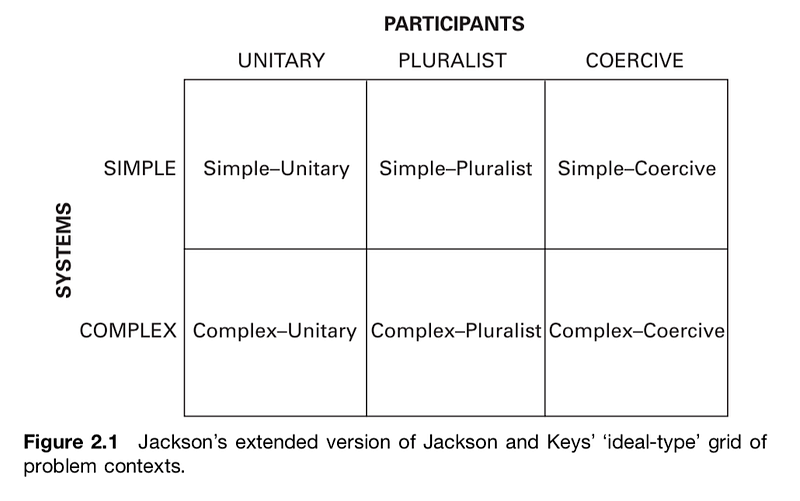
The above diagram is a model of “problem contexts” of systems thinking. It’s a two-dimension grid. The “System” dimension considers two types of complexities of systems: Simple and Complex. The “Participants” dimension classifies the relationship between participants in three types: “unitary”, “pluralist”, and “coercive”.
The second step of building the SOSM framework is to use it to understand the development of applied systems thinking over the past few decades. The outcome is the following diagram.
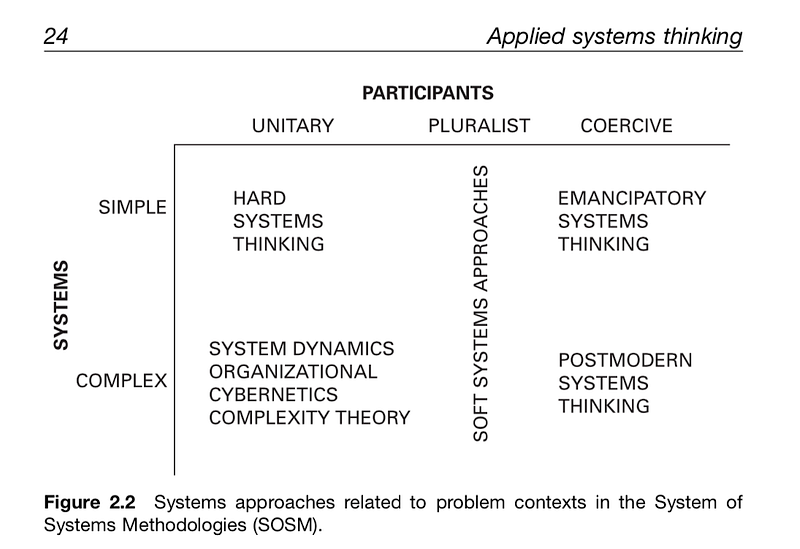
In the 1970s, therefore, came a general understanding of the lack of usefulness of hard systems thinking for more complex problem situations, and in problem contexts that were deemed to be more pluralist and coercive in character.
It is to the credit of applied systems thinking that it has not remained stuck in its simple-unitary ghetto. The last 30 or so years have seen an attempt to extend the area of successful application of systems ideas by developing methodologies that assume that problem contexts are more complex, pluralist and/or coercive in nature. (p.47)
The end of Chapter 2 identifies ten systems approaches and divides them into four types:
- Improving Goal Seeking and Viability
- Exploring Purposes
- Ensuring Fairness
- Promoting Diversity
Based on the type, Part II of the book introduces those systems approaches. See the table below.
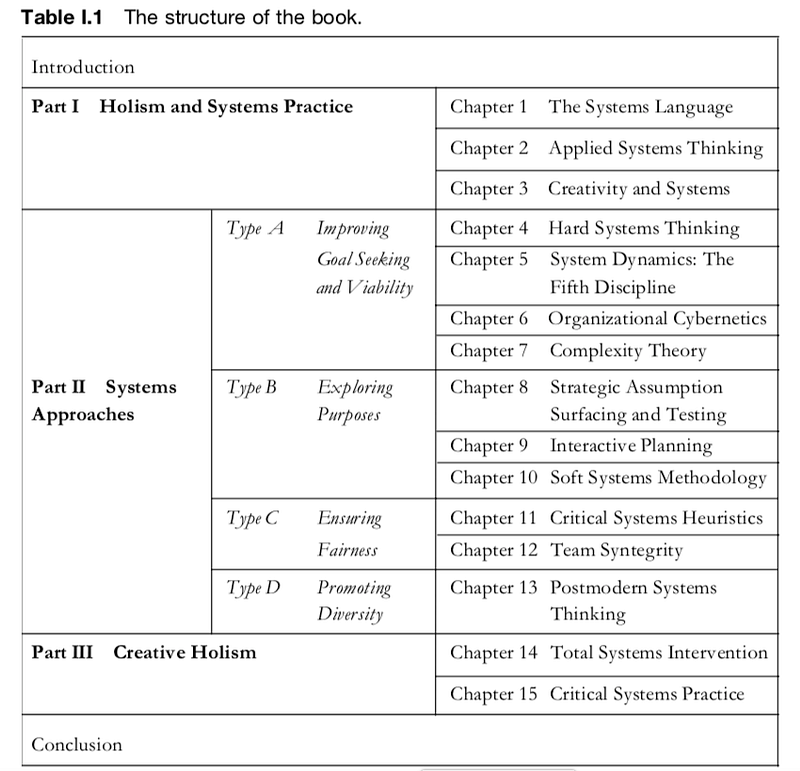
Part III is titled Creative Holism and it introduces Total Systems Intervention which is the best known approach to combining different systems approaches and Critical Systems Practice as the modern expression of creative holism.
1.4 Habermas on Postmodern Thoughts
At the end of Chapter 13 which is about Postmodern Systems Thinking, Mike Jackson mentions a series of 12 lectures by Habermas (1987). I’d like to quote this piece here for readers.
It is worth concluding by referring to a series of 12 lectures by Habermas (1987) in which he seeks to respond to the postmodern attack on his own modernist position. In the process he develops a critique of postmodernists, such as Nietzsche, Heidegger, Derrida and Foucault. In each case he shows that the theorist he is critiquing has something valid to say, but exaggerates it out of all proportion.
Foucault, for example, focuses on certain dysfunctions associated with rationalization processes in society. He ignores the undeniable achievements of those same forces.
Derrida concentrates on certain defects that arise in argumentation. Habermas acknowledges they exist, but details all the positive aspects of language as a means of dealing with problems in the world. We should continue to value it and develop communicative approaches that increase mutual understanding and learning. Language remains a vehicle through which reason can reach out to the ideals of truth and justice.
In short, Habermas recognizes that the postmodernists have something to say, but believes that rather than abandoning the Enlightenment vision we need to renew and revitalize it. (p.299)
Management practices are part of social life and the development of management thoughts is a mirror of the change in social thoughts.
1.5 Critical Systems Thinking (CST) and Practice
In fact, the term “Creative Holism” refers to a multi-methodology practice: Critical Systems Thinking (CST) in the book.
Chapter 14 introduces ‘Total Systems Intervention’, the best known critical systems or multimethodological approach. Chapter 15 describes the latest research in ‘Critical Systems Practice’.
According to Mike Jackson, there are two steps in the development of Critical Systems Thinking and Practice: 1) formulate it as a new philosophy and theory, and 2) develop practical frameworks for practice.
It was becoming apparent, however, in the 1980s and 1990s, that something more was needed if systems thinking was ever to realize its potential as a guide for managers. It was Critical Systems Thinking (CST) that provided this ‘something more’. CST has supplied the bigger picture, has allowed systems thinking to mature as a transdiscipline and has set out how the variety of approaches, methodologies, methods and models, now available, can be used in a coherent manner to promote successful intervention in complex organizational and societal problem situations.
Once CST had been formulated as a philosophy and theory, it needed guidelines that would enable it to be applied in practice. These were provided in 1991 with the publication of Flood and Jackson’s (1991a) book Creative Problem Solving: Total Systems Intervention. Total Systems Intervention (TSI) was heralded as a new approach to planning, designing, problem-solving and evaluation based on CST. This chapter outlines the development of CST and highlights the ¢rst critical systems methodology: TSI.(pp.303–304)
There are two significant events in the history of CST. In 1984, Linstone released his book Multiple Perspectives for Decision Making and Jackson and Keys first published their System Of Systems Methodologies (SOSM).
Mike Jackson claims that “these two events signalled the birth of a more advanced form of pluralism that required systems practitioners both to look at problem situations from a variety of different perspectives and to use different systems methodologies in combination” (p.305)
1.6 Call for Meta-methodology
There are three sources behind the development of CST and TSI (p.304):
- A growing critical awareness of the strengths and weaknesses of individual systems approaches;
- An appreciation of the need for pluralism in systems thinking;
- The rise of emancipatory systems thinking.
I am attracted to the need for Pluralism in systems thinking and its development. Here we have to pay attention to contributions made by Linstone and Jackson. According to the author, there are some significant milestones in this process (pp.305–306)
- There has always been a tendency to pluralism in systems thinking applied to management - presumably on the basis that it assists with being holistic. Sociotechnical systems theory (concerning itself with the social, technical, and economic subsystems of organizations) and contingency theory (interested in the goal, human, technical and managerial subsystems) are cases in point.
- Linstone’s form of multiperspective research seeks to use three different viewpoints to gain a rich appreciation of the nature of problem situations. The Traditional or technical (T) perspective, dependent on data and model-based analysis, is augmented by an Organizational (O) or societal perspective, and a Personal (P) or individual perspective. The T, O, and P perspectives act as filters through which systems are viewed, and each yields insights that are not attainable with the others.
- The SOSM offered a way forward from the prevailing systems thinking ‘in crisis’ debates. In doing so it established pluralism as a central tenet of CST and encouraged mutual respect between proponents of different approaches who had previously seen themselves as being at war with one another. Furthermore, going beyond Linstone, the SOSM recognized that pluralism could be achieved based on methodologies (hard, cybernetic, soft, etc.) that were developed from more than one paradigm.
The debate between T-O-P perspectives is a typical academic controversy. We can see many similar examples in different fields. It can be applied to personal knowledge creation. For example, I developed several frameworks for platform-based social practices.
- The Platform-for-Development Framework: this is based on the Personal (P)-perspective. The primary focus of the framework is adult development and the Platform is considered an environment for adult development.
- The Concept-fit framework for Platform Innovation: this is based on the perspective of Platform Owners or a Socio-technical (ST) perspective.
- The Platform Genidentity Framework: this is based on the perspective of Platform Owners, or an Organizational (O) perspective.
It all depends on the motivation of knowledge creators and the need of knowledge users. In March 2020, I published an article titled Social Platform Experience Design (#SocialPxD) and introduced the PxD framework from the perspective of Curativity.
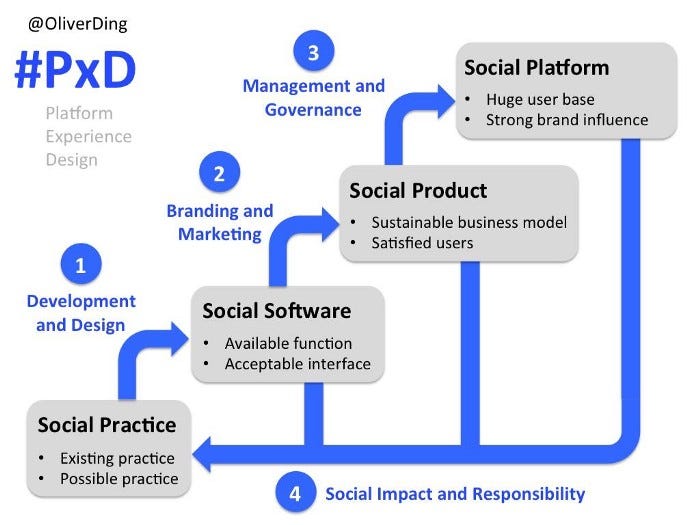
The above diagram is a basic model of the PxD framework. Unfortunately, it doesn’t fully describe the whole framework because the framework curates the following four perspectives:
- Digital Technology Perspective
- Interaction Design Perspective
- Business Ecology Perspective
- Social Practice Perspective
How can we use different theoretical perspectives together? As a designer and a researcher, I faced this challenge many times and I found the best approach is the Curativity approach. Every time I work as a knowledge curator and curate several perspectives together.
My approach is very similar to CST to System thinking.
In 1987, Jackson published an article about the pluralism of system thinking. He compares “Pluralism” with “isolationism”, “imperialism”, and “pragmatism” as a developmental strategy for system thinking (p.306).
- Isolationists, who believed in just one systems methodology, divided the discipline and discredited the profession.
- Imperialists, who sought to incorporate different methodologies within their favoured systems — theoretical orientation, ignored the benefits of other paradigms and ‘denatured’ many of the approaches they used.
- Pragmatists, who eschewed theoretical distinctions and concentrated on building up a ‘toolkit’ of methods and techniques on the basis of what ‘worked’ in practice, limited the possibilities for learning (e.g., why the method worked) and passing on knowledge to future generations.
- Pluralism, however, offered excellent opportunities for future progress. It respected the different strengths of the various strands of systems thinking, encouraged their theoretical development and suggested ways in which they could be appropriately fitted to the diversity of management problems that arise.
For Applied Knowledge Curation, I found there are two types of Applied Knowledge Curators: Pragmatists and Pluralists. While Pragmatists tend to curate different knowledge for their practice purpose, they don’t intend to create new knowledge for others. In contrast, Pluralists tend to create new knowledge for others by curating existing knowledge together.
What could Pluralists make?
According to the author, “It was argued that a meta-methodology (TSI was still to come) would develop that could guide theoretical endeavour and advise practitioners, confronted with problem situations, which approach or combination of approaches is most suitable.” (p.306)
1.7 Habermas’s solution for CST
According to Habermas (1970, 1975, 1984), there are two fundamental conditions underpinning the sociocultural life of the human species: “Work” and “Interaction” (p.309)
- Work enables us to achieve goals and to bring about material well-being through social labour. Its success depends on achieving technical mastery over natural and social processes. Human beings, therefore, have a ‘technical interest’ in the prediction and control of natural and social systems.
- The other anthropologically based cognitive interest is linked to interaction and is labelled the ‘practical interest’. Its concern is with securing and expanding the possibilities for mutual understanding among all those involved in social systems. Disagreements between individuals and groups are just as much a threat to the sociocultural form of life as a failure to predict and control.
Habermas also emphasizes the important issue of “Power” and “emancipatory interest”.
- If we are to understand past and present social arrangements. The exercise of power can prevent the open and free discussion necessary for the success of work and interaction. Human beings have, therefore, an ‘emancipatory interest’ in freeing themselves from constraints imposed by power relations and in learning, through a process of genuine participatory democracy conducted in ‘ideal speech situations’, to control their own destiny.
In 1991, Flood and Jackson adopt Habermas’s ideas as a foundation for solving the problem of “paradigm incommensurability” between different system thinking approaches at the level of human interests. Also, the SOSM model became a container for containing various approaches (p.309).
- As a result the SOSM could be rescued as a vehicle for promoting methodological pluralism. Complementarism at the theoretical level provided the basis and justi¢cation for complementarism at the methodological level. The SOSM could point to the strengths and weaknesses of different strands of systems thinking and put them to work in a way that respects and takes advantage of their own particular theoretical predispositions in the service of appropriate human interests.
- As we saw in the previous subsection, the SOSM benefitted CST by providing a warm embrace to emancipatory approaches. By 1991, however, it was possible to see that it was necessary to keep emancipatory systems thinking at arm’s length as far as becoming a permanent partner was concerned. The appropriate relationship became clear once CST had attached itself to Habermas’ theory of three human interests: the technical, practical and emancipatory. It then became possible to de¢ne CST’s ‘emancipatory commitment’ in terms of a much broader dedication to ‘human improvement’.
- Flood and Jackson (1991a) saw this as meaning bringing about those circumstances in which all individuals could achieve the maximum development of their potential. This, in turn, means raising the quality of work and life in the organizations and societies in which they participate. Habermas had shown that human improvement required that each of his three interests needed serving by systems methodologies. Critical systems thinkers made the point that this was exactly what their approach wanted to achieve.
However, CST is not emancipatory systems thinking. The difference between these two is the former puts all the different system approaches to work, according to their strengths and weaknesses while the latter only considers the perspective of emancipatory.
1.8 Creativity, Choice, and Implementation
Flood and Jackson (1991) define TSI as a meta-methodology with the following seven principles (P.311):
- Problem situations are too complicated to understand from one perspective and the issues they throw up are too complex to tackle with quick fixes;
- Problem situations, and the concerns, issues and problems they embody, should therefore be investigated from a variety of perspectives;
- Once the major issues and problems have been highlighted it is necessary to make a suitable choice of systems methodology or methodologies to guide intervention;
- It is necessary to appreciate the relative strengths and weaknesses of different systems methodologies and to use this knowledge, together with an understanding of the main issues and concerns, to guide choice of appropriate methodologies;
- Different perspectives and systems methodologies should be used in a complementary way to highlight and address different aspects of organizations, their issues, and problems;
- TSI sets out a systemic cycle of inquiry with interaction back and forth between its three phases;
- Facilitators and participants are engaged at all stages of the TSI process.
The three phases of the TSI meta-methodology are labeled Creativity, Choice, and Implementation.
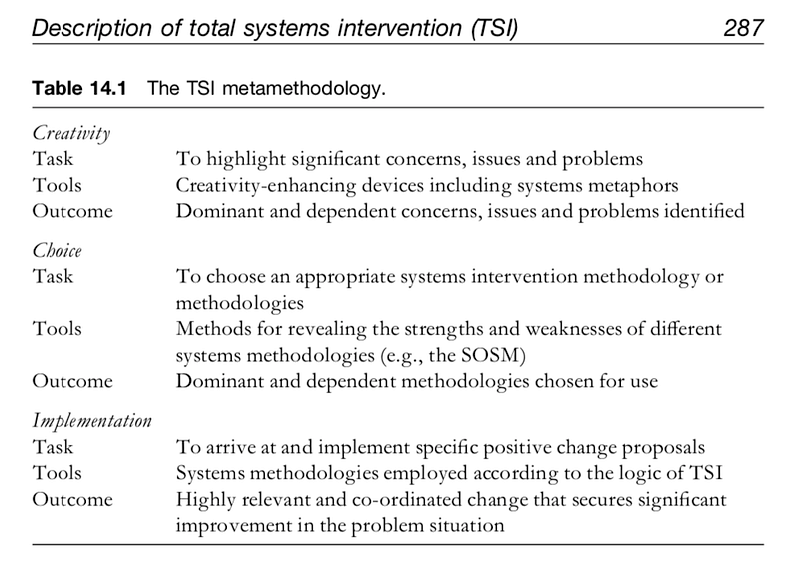
As a dynamic meta-methodology, TSI should be considered as a continual cycle around creativity, choice, and implementation.
In the past six months, I designed several toolkits and programs by curating knowledge frameworks as modules. Eventually, I used Applied Knowledge Curation to define this activity. To my surprise, the process of Applied Knowledge Curation echoes the TSI meta-methodology. See the diagram below.
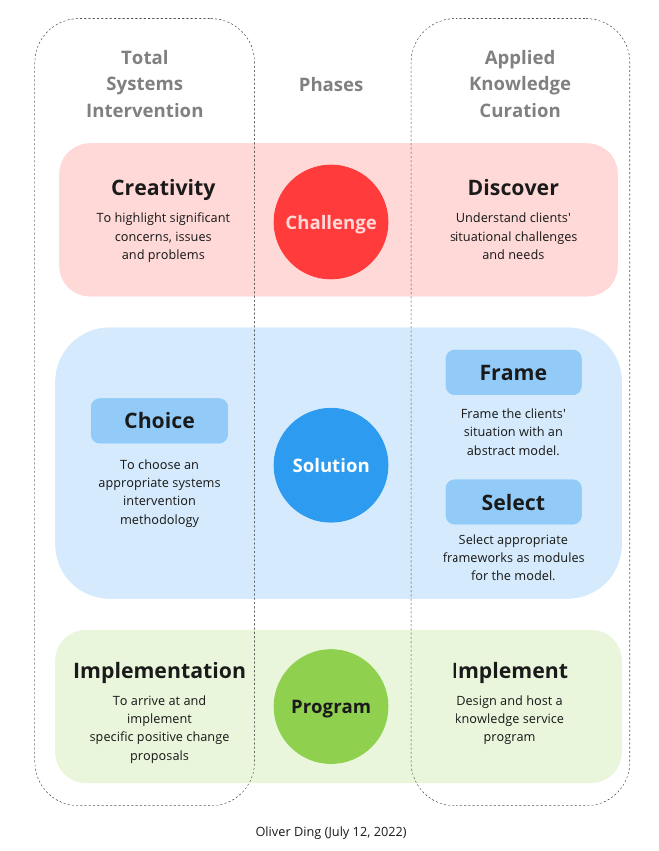
Both TSI and Applied Knowledge Curation adopts can be understood as three-phase activities: 1) understanding the challenge, 2) developing a solution, and 3) implementing a program to deliver the solution.
In phase 2, there is a difference between TSI and Applied Knowledge Curation. For TSI, phase 2 means choosing an appropriate systems intervention methodology as a dominant approach. For Applied Knowledge Curation, I have to achieve the goal with two steps: 1) frame the clients’ situation with an abstract model, and 2) select appropriate frameworks as modules for the model.
For example, I recently shared the Knowledge Engagement Program (public, v1) on Milanote and Medium. Originally, the program is developed as a knowledge management intervention program for a software outsourcing service provider. I used the Project Engagement approach and the Anticipatory Activity System (AAS) framework to frame the client’s situation and defined it as “Service Knowledge Management”.
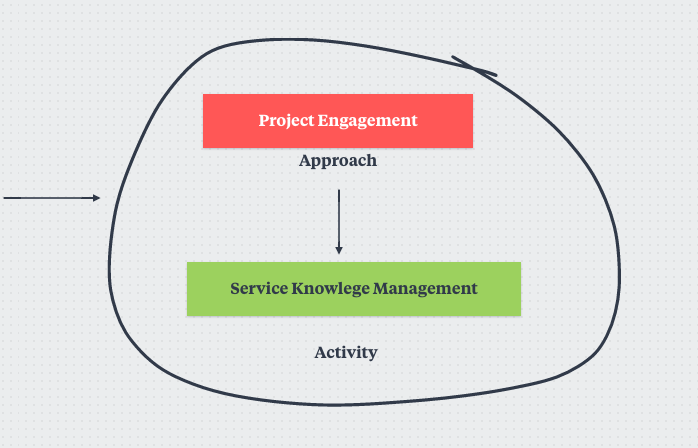
After defining the activity, I selected several frameworks as modules to design a program. For example, I adopted the ECHO Way framework to develop a new framework called “Service-fit” for understanding “Service Knowledge Management”. See the screenshot below.
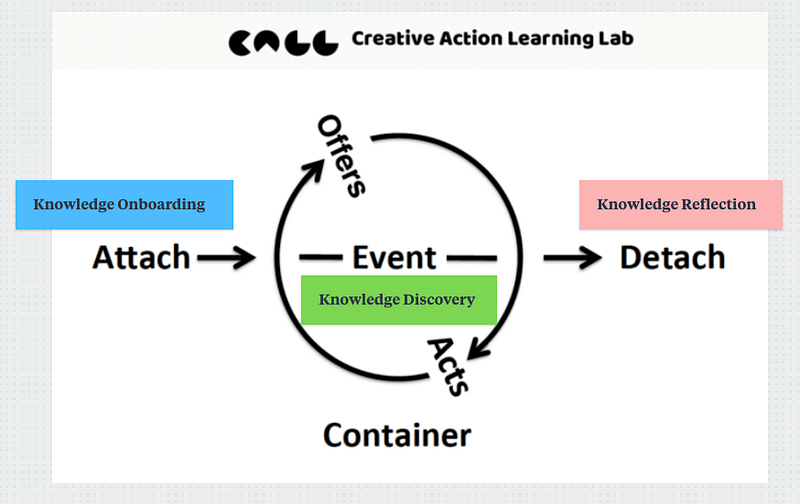
Why did I need to take two steps while TSI only needs one step for phase 2?
The answer is the Maturity of knowledge frameworks.
TSI’s knowledge resources are well-developed systems approaches. Each approach has been developing for many years. However, my approach to Applied Knowledge Curation only considers selecting modules from my frameworks.
For example, the AAS4LT program has 8 steps and I selected 8 modules from my frameworks. The reason is that I want to test both the program and the modules.
Since the Applied Knowledge Curation only has a six-month history, we need to watch its own development in the next six months.
Part 2: The Curated Mind of Managers
Part 1 focuses on the perspective of the knowledge creator, let’s move to the perspective of end-users such as Managers and practitioners in general.
The subtitle of Jackson’s book is Creative Holism for Managers. In this part, I will use Managers as a sample of Practitioners.
2.1 The Gap between Theoretical Knowledge and Situational Practices
For managers, their primary context is daily management routines and dynamic business activities. If we consider their WORK as their LIFE, then we can use the “Flow — Story — Model” metaphor to understand the gap between theoretical knowledge and situational practices.
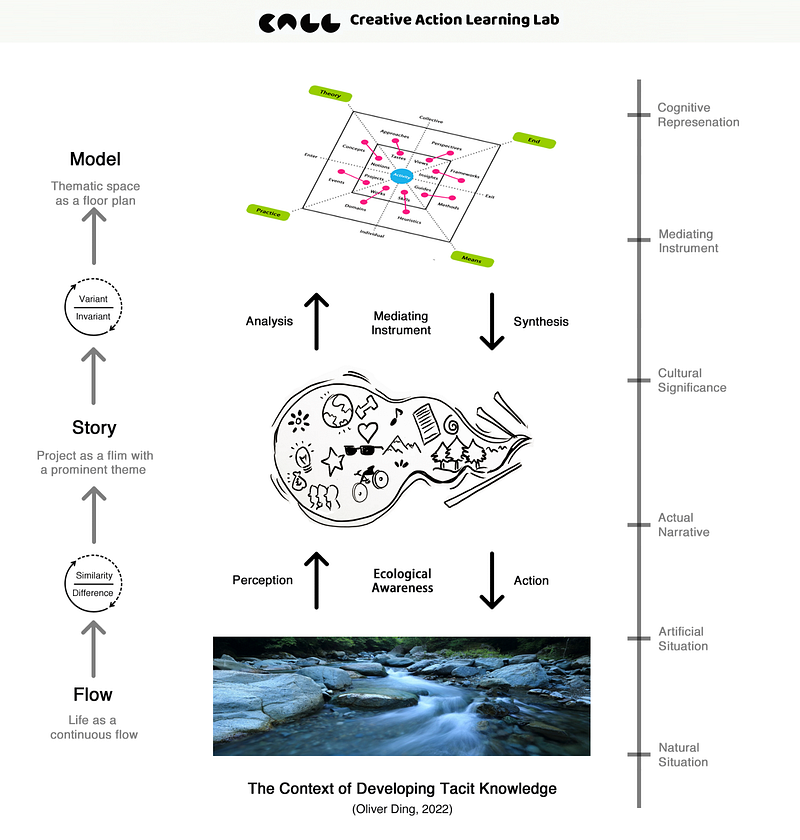
The above picture is the “Flow — Story — Model” metaphor. Although the original title is called the Context of Developing Tacit Knowledge. I think the metaphor can be used as a framework for understanding the mind or cognition.
- Flow: Life as a continuous flow
- Story: Project as a film with a prominent theme
- Model: all knowledge frameworks and models as floor plans
The model is about Developing Tacit Knowledge. What about if the Tacit Knowledge is about “Mind’? What about if the Tacit Knowledge is about “Self”? What about if the Tacit Knowledge is about Life?
The essential idea of Developing Tacit Knowledge is the Objective — Subjective Knowledge Curation which corresponds to the Outer Space — Inner Space Mapping of Thematic Space. For example, you can know my knowledge about “Life” by reading my article Mapping Thematic Space #6: The “Life” thematic space. My “Life” thematic space is a large cognitive container that contains many ideas I developed in the past several years.
For managers, Objective Knowledge refers to several established systems thinking approaches while Subjective Knowledge refers to their tacit knowledge about their routines, situational challenges, and skills of using special tools. The Objective — Subjective Knowledge Curation means that managers have to curate systems thinking approaches and their own situational challenges together.
2.2 Knowledge Engagement
The “Flow—Story — Model” metaphor is also inspired by James G. March (1928–2018) who was an American political scientist, sociologist, and pioneer of organizational decision-making. He mentioned that there are three types of wisdom in his 2010 book The Ambiguities of Experience.
What are the three types of wisdom?
- Models: a model is an abstract cognitive representation.
- Stories: a story is a model too, but it is easy to understand.
- Actions: you just do it, then you get it.
What March suggested roughly echoes three types of social sciences.
- Models: Explanation (such as Systems and Rational Choices)
- Stories: Understanding (such as Culture and Subjective meanings)
- Actions: Intervention (Such as Critical theory and Action Science)
For managers, the final outcome of the Subjective — Objective Knowledge Curation should curate models, stories, and actions together too. They have to build a model to explain the development of their activity. They have to tell people the model through storytelling. They have to use the model to guide their activity and modify the model due to the newest change in their activity.
In fact, this insight was just confirmed by a recent project I conducted two months ago. The project is about a friend of mine and a digital adult development program. As the founder and manager of the program, my friend always updates her models of the program.
By tracing the historical development of her models, I realized that she is doing the job of a knowledge curator. Each time, she always adopts some knowledge resources such as the OKRs method, the “end with the beginning” mindset, the Agile method, the LEAN startup method, etc. She modified her model of the program by curating these knowledge resources, her experiences, and program design together.
Based on the case study, I developed the following model for Modeling Developmental Projects. Now we can use the model as a general framework for Managers.
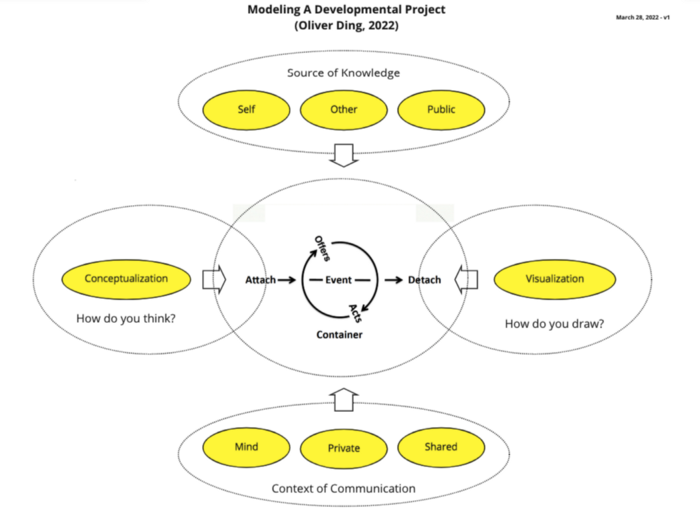
Moreover, the above “modeling” process is one of five movements of the Anticipatory Activity System (AAS) framework.
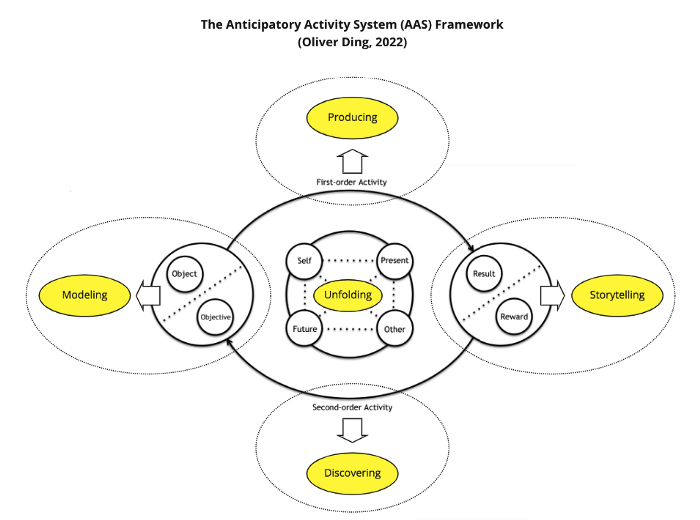
- Unfolding
- Discovering
- Modeling
- Producing
- Storytelling
Originally, the Anticipatory Activity System (AAS) framework was not developed for studying knowledge management. However, I recently applied it to discuss “Service Knowledge Management”.
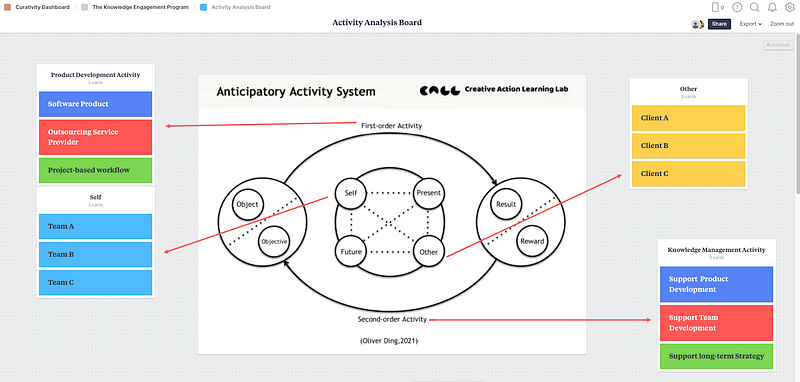
The Anticipatory Activity System (AAS) framework is developed for understanding “Self, Other, Present, and Future”. It is formed by First-order Activity, Second-order Activity, and the Self — Other Relevance.
- First-order Activity: Software Product Development
- Second-order Activity: Service Knowledge Management
- The Self — Other Relevance: Self refers to a service provider while Other refers to a client.
In a general sense, the five movements of the AAS framework can be applied to discuss managers' knowledge management activity. From the perspective of the Project Engagement approach, I call the process “Knowledge Engagement”.
2.3 Managers as Knowledge Curators
In my 2019 book Curativity, I developed a concept called Curatorial Crafting for discussing the competence of Curation. There are various cognitive skills of curatorial actions such as perceiving, selecting, reflecting, connecting, organizing, presenting, etc. Though I emphasize the principle of “Everyone A Curator”, I highlight different types of situations for curating: First-order Curating, Second-order Curating, and Third-order Curating.
We can use three types of curating to discuss managers and their knowledge engagement activity with systems thinking approaches.
- First-order Curating: collecting pieces of real-life work experiences, turning these pieces into a meaningful whole, and discovering primary “themes of practice” which indicate problems, challenges, and opportunities. This refers to Subjective Knowledge Curation.
- Second-order Curating: applying the TSI meta-methodology, selecting an appropriate systems intervention methodology, and designing and hosting an intervention program. This refers to Objective — Subjective Knowledge Curation.
- Third-order Curating: reviewing the historical development of various systems thinking approaches, discovering the newest development of management practices, and developing a brand new system thinking approach for explanation or methodology for intervention. This refers to Objective Knowledge Curation.
Most managers work in First-order Curating and Second-order Curating. If they move to Third-order Curating, they transform their identity from knowledge users to knowledge creators. We could call them theorists or scholars.
I’d like to share David Hurst’s story as an example for the present discussion. Originally, David Hurst joined Hugh Russel Inc. as a manager in 1979. He watched the company thrown into crisis and how they discovered some complexity management practices that allowed them not only to survive but to thrive. Eventually, he worked with a researcher on developing a model called Ecocycle. In 1984, he wrote an article titled “Of Boxes, bubbles and effective management” which was published in Harvard Business Review. In 1995, he published a book titled Crisis & Renewal: Meeting the Challenge of Organizational Change.
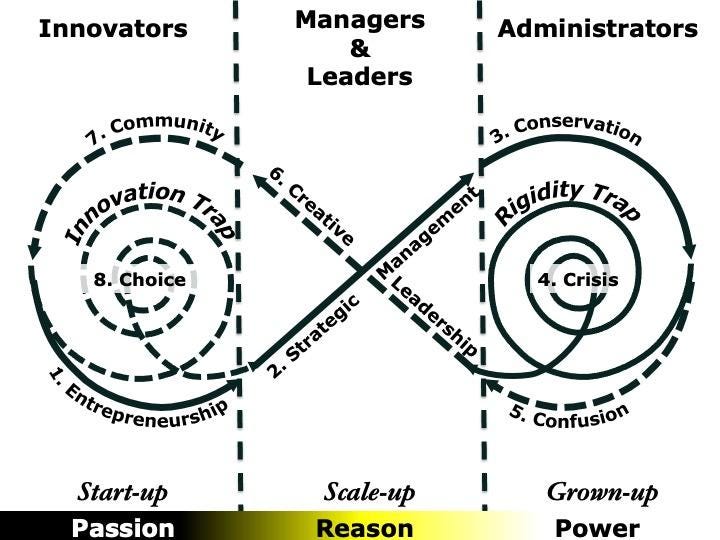
The above diagram is quoted from Discovering Complexity: A Story of an Organization in Crisis and its Response (David Hurst, May 2019). You can find the historical development of the Ecocycle model. Initially, David Hurst developed the following “yang-yin” model for his 1984 article.
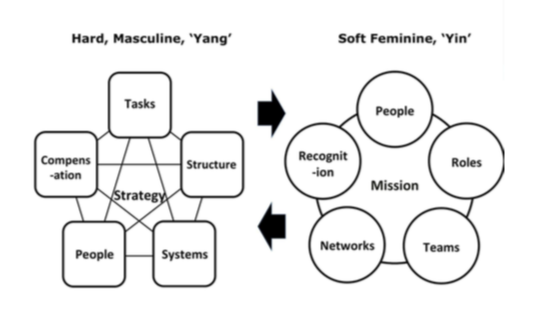
Later, he met Brenda Zimmerman at York University and she introduced Canadian ecologist, C.S. Holling’s adaptive cycle. See the diagram below.
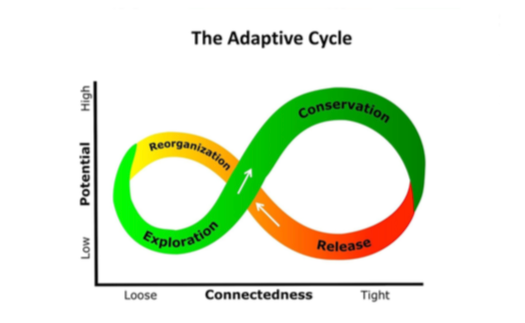
In a recent blog post titled The Ecology of Digital Transformation: Sense-Making in Silicon Valley, David Hurst highlighted the uniqueness of the Ecocyle model.
The ecological framework, based on Canadian ecologist C.S. “Buzz” Holling’s work on the adaptive cycle and the multilevel panarchy frameworks, does not abstract organizations and people from time, space and scale, the key elements of context. Rather, it acts as a theory of context that an inquirer uses as a preliminary screen to help form their expectations, sensitize them to the relevant cues and suggest plausible goals and actions.
David Hurst’s story can be understood in the following three phases:
- Phase 1 — Practice of Organizational Change
- Phase 2 — Practice-based reflection
- Phase 3 — Theory-based reflection
Phase 1 is about situational challenges and responses in the development of Hugh Russel Inc.’s organizational change. It refers to First-order Curating which focuses on sensemaking on pieces of information and facts about crisis and renewal.
Phase 2 refers to the practice-based reflection and Second-order Curating. David Hurst transforms the outcome of First-order Curating into raw materials of Second-order Curating. The “yang-yin” model is the outcome of Practice-based reflection. This is about Subjective Knowledge Curation at the abstract level.
Phase 3 refers to the Theory-based reflection and Third-order Curating. In this phase, David Hurst adopted C.S.Holling’s adaptive cycle to improve the “yang-yin” model and the outcome is the Ecocyle model. This journey is a great example of Subjective — Objective Knowledge Curation.
2.4 The Curated Mind
On March 15, 2022, I published an article about the notion of “Curated Mind”. The diagram below is the basic model of the Curated Mind. This model adopted the ecological approach to reflect on the Mind. While Proximal Mind corresponds to Proximal Contexts, Pervasive Mind corresponds to Pervasive Mind.
- Proximal Contexts (Proximal Mind)
- Pervasive Contexts (Pervasive Mind)
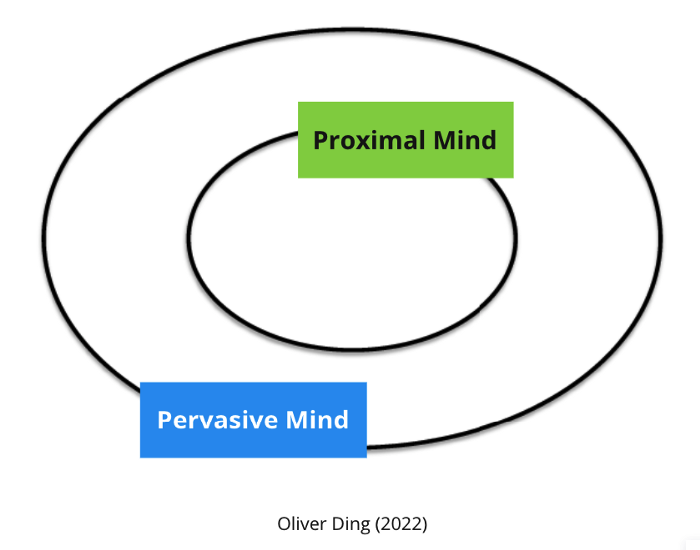
The purpose behind the Curated Mind framework is to develop a framework for discussing the mind and developing tacit knowledge from the perspective of Curativity Theory.
The Curated Mind Framework is defined with the following theoretical concepts:
- Curativity
- Attachance
- Contexts (Mind)
- Proximal Mind
- Pervasive Mind
- Curated Mind
- Proximal Contexts
- Pervasive Contexts
- Ecological Awareness
- Symbolic Awareness
I also adopted the perspective of Attachance to understand the “Proximal Mind — Pervasive Mind” relationship. We can detach from Proximal Mind and attach to Pervasive Mind, and vice-versa.
We also can pay attention to the following three types of Curativity:
- The Curativity of Proximal Mind: Turning pieces of experiences into a meaningful whole at the loop of Proximal Mind. For example, David Hurst made the “yang — yin” model.
- The Curativity of Pervasive Mind: Turning pieces of experiences into a meaningful whole at the loop of Pervasive Mind. For example, Jackson made the TSI meta-methodology.
- The Curativity of Mind: Turning “Proximal Mind” and “Pervasive Mind” into a meaningful whole. For example, David Hurst made the Ecocycle model.
I also expanded the basic model of Curated Mind into a framework by adding eight operational concepts. See the diagram below.
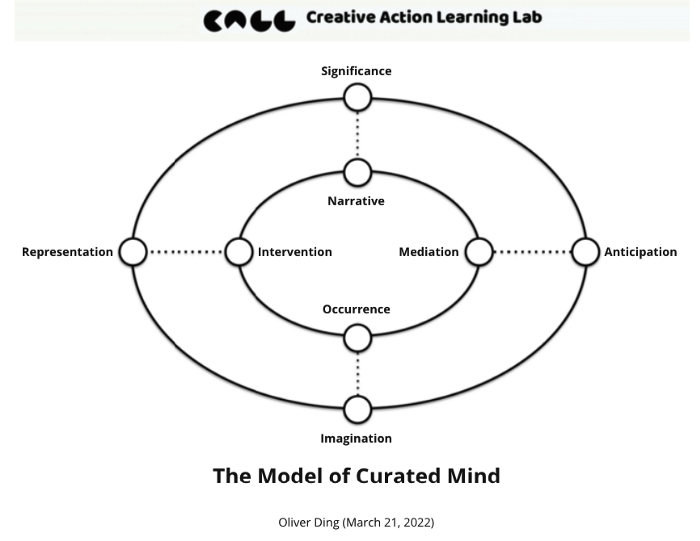
Now the loop of the Proximal Mind is represented with the following four operational concepts:
- Occurrence: It refers to the original “Natural Situation” which means non-designed situations and environments.
- Intervention: It refers to the original “Artificial Situation” which means designed situations and environments.
- Mediation: It refers to the original “Mediating Instrument” which means material objects and other tools for human activities and social practices.
- Narrative: It refers to the original “Actual Narrative” which means storytelling.
I also use the following four operational concepts for the loop of Pervasive Mind:
- Significance: It refers to the original “Cultural Significance” which means the dynamic historical development of cultural signs and other symbolic cultures.
- Representation: It refers to the original “Cognitive Representation” which means objects for solving cognitive tasks. For example, Diagrams, models, theories, floor plans, etc.
- Imagination: It refers to imagining some novel things that could guide dramatic experiences and creative actions.
- Anticipation: It refers to predicting the future and managing the complexity of anticipation and performance.
Though I offer the above eight operational concepts for understanding the Curated Mind, It doesn’t mean that the Curated Mind is only about these ideas.
For managers, these eight operational concepts point to eight directions for improving skills of experience curation and knowledge curation.
2.5 The Canvas of Applied Knowledge Curation
Finally, I’d like to introduce a tool for applied knowledge curation for managers.
On Feb 4, 2022, I shared The Dialogue Knowledge Curation Framework on Linkedin. See the canvas below.
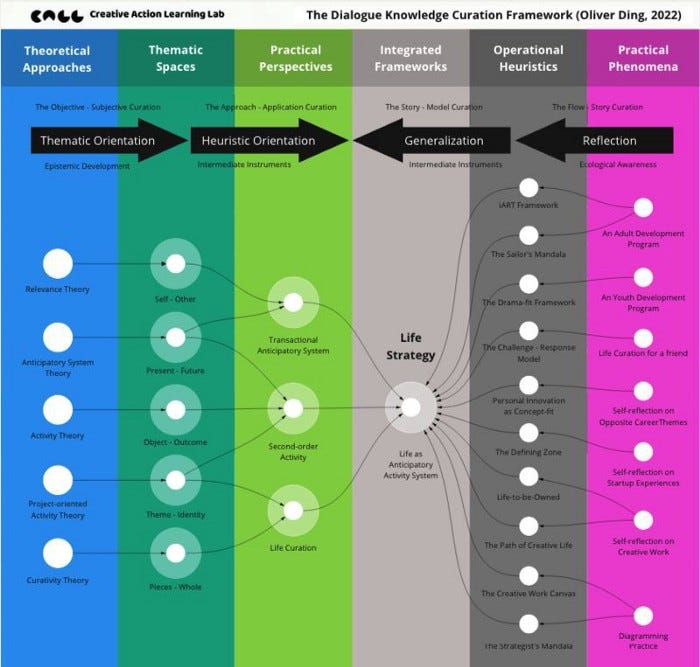
The example is “Life Strategy” (Life as Anticipatory Activity System) and I used the draft I made on Jan 28, 2022.
The Knowledge Curation Framework suggests three approaches for multiple-theory knowledge curation:
You can find the same canvas in the above three links. For Applied Knowledge Curation, we can pay attention to the RIGHT side of the canvas:
- Integrated Frameworks
- Operational Heuristics
- Practical Phenomena
Managers can use the canvas as a map to explore some directions for their journey of knowledge curation.
I am also working on building a new website for the Platform Ecology project. You can save the following links:
- PlatformEcology.org
- Twitter: @PlatformEcology
- Linkedin: @PlatformEcology
You are most welcome to connect via the following social platforms:
Linkedin: https://www.linkedin.com/in/oliverding Twitter: https://twitter.com/oliverding Polywork: https://www.polywork.com/oliverding Boardle: https://www.boardle.io/users/oliver-ding


