
#TalkThree 02: How to Name “X Innovation”?
Example, Meaning, and Name

People tend to use exist words to name their new ideas, I often use new terms to name new ideas. This morning I saw an example on Twitter, this article will use this example as the starting point.
An Example about “X Innovation”.
Raghav Agrawal is an independent interface design researcher and he is working on developing something about UI and Innovation. Yesterday he shared a list on Twitter and asked an interesting question. See the image below:
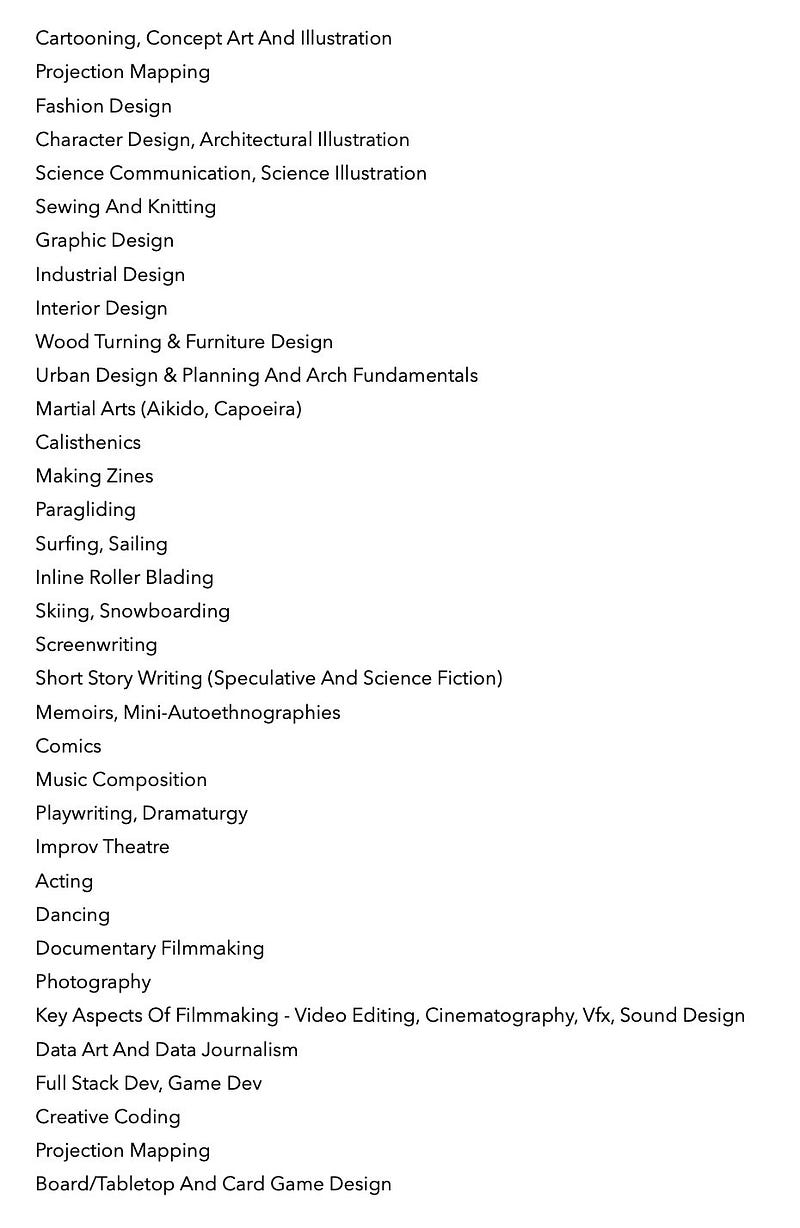
What’s his question?
Is there any person with all these skills and knowledge of social theory?
I was curious the list and his question. He wrote the list and wanted to 1) learn all these in his lifetime gradually, starting with a new kind of UI designing, 2) create free OER (open educational resources) for each of the above and make a residency for them.
For the “new kind of UI designing”, he shared more details in a tweet thread, see below:
- What’s the most significant UI convention, paradigm, pattern, affordance, concept since the past decade? Eg — Concept like Undo that introduced a new social practice that doesn’t have an equivalent IRL. What’s an Undo-level UI innovation since the last decade in your opinion?
- So a UI concept that isn’t about mediation or representation of some existing activity, routine of a user but rather which introduced a new activity which doesn’t have any equivalent in real life, something unique to the computing medium.
- So a ui innovation doesn’t just “solve” a problem, render a set of interactions, cater to people’s needs or whatever or simplify but actually introduce entirely new ways of being, new ways of thinking about stuff…
- Think about interface innovations in media authoring tools. Liquid text for example. Think about the social practices unique to the computing medium Undo, redo, drag and drop, cut, copy paste, multi-select for example That hardly have an equivalent in our physical world.
- UI ideas that aid & tweak how you can create & imagine An interface is not just rendering of interactions but also CREATION of entirely new interactions. Like where you basically invent new social practices as opposed to rendering the existing ones via novel UI affordances.
- Like imho a ui innovation doesn’t just “solve” a problem, render a set of interactions, cater to people’s needs or whatever or simplify but actually introduce entirely new ways of being, new ways of thinking about stuff…
- For eg the whole nodemap diagramming interface paradigm that’s going in via roam, obsidian has changed how people think about interlinking ideas and how they take notes. It didn’t just render a system Idea of backlinking via hashtags and their visualization was a novel practice…
- My definition of UI innovation Introducing new ways of doing, saying, feeling, thinking things. Anything that expands people’s range/capacity to imagine and conceive of.
- So helping people conceive of new and improving existing practices (patterns of behavior, routinized ways of understanding and thinking, knowing how and desiring) via computers.
- How do you teach examining and coming up with novel UI patterns, affordances that literally change social practices? UIs that create such unique social practices, activities that hardly have an equivalent in our physical world. Undo, Redo for example.
- How do you teach UI designing in a way that makes you imagine coming up with new social practices via properties that are unique to computers.
- Interface ideas, widgets, conventions, affordances which have nothing to do with communication, task or transaction completion.
If we pay attention to the above tweets, we can find “Example, Meaning, and Name” from his ideas:
- Example: Undo, Redo.
- Meaning: Unique social practices, activities that hardly have an equivalent in our physical world…new ways of doing, saying, feeling, thinking things. Anything that expands people’s range/capacity to imagine and conceive of.
- Name:Novel UI patterns, UI Innovation.
Then, I suggested a new name for his idea:
This is a good idea, but you don’t have to use “UI Innovation” to name it. Try to think a new term. For example, “Digital Frame Innovation”? : )
My idea of the name was inspired by Erving Goffman’s 1974 book Frame Analysis. You can find more details in my 2020 article Frame Analysis in Context.
A Framework for “X Innovation”.
The idea of “Example, Meaning, and Name” is adopted from the Concept Dynamics Framework. See the diagram below.
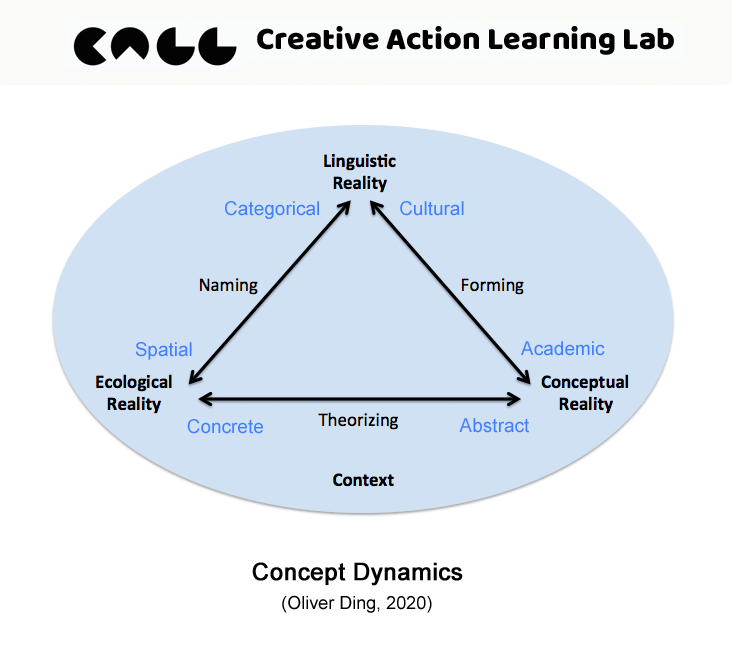
The Concept Dynamics Framework emphasizes that every theoretical concept has three basic aspects: ecological reality, conceptual reality, and linguistic reality.
- Ecological Reality refers to the real experience of discovery in the real world from the perspective of researchers.
- Conceptual Reality refers to the outcome of the creative conceptualization process.
- Linguistic Reality refers to expressional form with verbal and rhetorical effects.
Based on the framework, I believe that an ideal theoretical concept should not have intrinsic contradictions between these three aspects and extrinsic contradictions between these aspects and context which means the dynamic background of the concept. Thus, it is a hard work to create an ideal theoretical concept. The harder work is detaching an existing concept from its original context and attaching it to a new context by reconceptualizing it with new meaning.
Originally, I developed the Concept Dynamics Framework for discussing the complexity of theoretical concepts. For example, the evolution of the concept of Affordance.
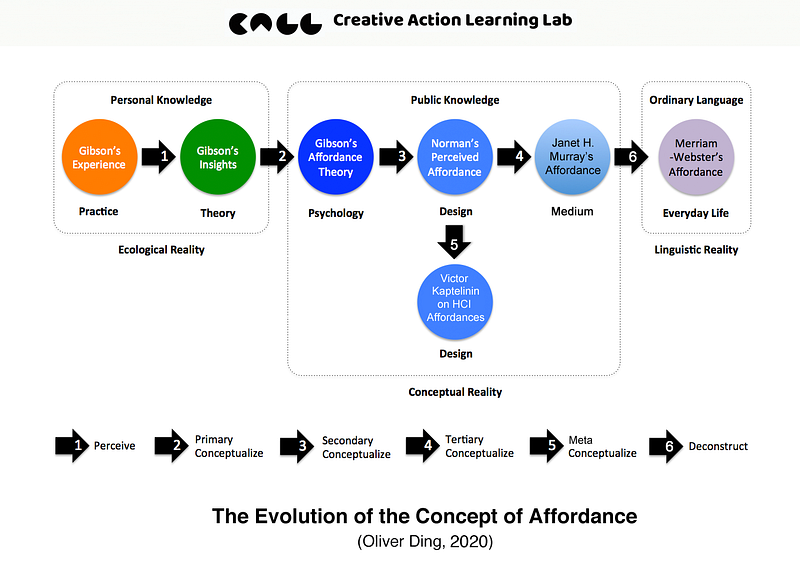
If you pay attention to the above diagram, you will find the following terms:
- Ecological Reality: Personal Knowledge
- Conceptual Reality: Public Knowledge
- Linguistic Reality: Ordinary Language
Originally, I used these terms to define different zones of Concept Ecology. Later, I realized that it can be used to develop a new framework. The above case study is only about the “Affordance” concept ecology. There are many ways to create new concepts. Not all theoretical concepts start from the Ecological Reality.
The idea of “Example, Meaning, and Name” echoes the Concept Dynamics Framework. “Example” refers to “Ecological Reality”, “Meaning” refers to “Conceptual Reality”, and “Name” refers to “Linguistic Reality”.
Any innovation can be understood as a Concept Change. A new innovation may starts from “ecological reality” without a new name, however, if the innovation is a real innovation, you can’t use exist words to name it. Eventually, a new innovation will lead to a new word which is an innovation of language.
Now let’s return to Raghav Agrawal’s example. The term “UI” can be “User Interface” or “User Interaction”. So, what does “UI Innovation” mean? User Interface Innovation, or User Interaction Innovation?
“User Interface” is about a “material thing” while “User Interaction” is about a “relational behavior”. These two concepts of “UI” share the same short term “UI”.
Do we have some social theories about “UI”? Yes, we have many social theories about “material thing” or “relational behavior”. However, some social theories are not useful for making novel digital material things.
The innovation of material thing is always driven by the innovation of technology. For example, Computer Mouse is a new technology. Touchscreen is a new technology too.
Once we have Computer Mouse, Touchscreen, or other innovation of technology, we can start a new innovation of “user interaction”. First, we do something about “human — computer interaction (HCI)”. Later, we do something about “human — human interaction with computer” (it is called HCI too!)
That’s the reason that we should start from some theories about the innovation of material technology first. These theories are not social theories, but computing science and other natural sciences.
The name “Digital Frame Innovation” is more about “relational behavior” because the term “Frame” is about social interaction from the perspective of Frame Analysis which refers to a social theory. However, we can develop some new meaning for the concept of “Digital Frame” since “Digital” refers to the aspect of technology.
Start from a new name.
Where is the starting point of the Concept Dynamics Framework? It’s not a linear framework.
We can start from a real example by observation or a fake example by imagination.
We can start from an exist name or a new name.
We can start from an exist meaning or a new meaning.
As a dynamic system, the complexity is born from the whole of “Example, Meaning, and Name”.
Most people don’t start with a new name, they tend to start from a problem and search for a problem — solution fit. They often use a word as a code name for their project. In this way, they work on the “example — meaning” fit first.
If we consider Innovation as Concept Innovation, there is a possible way to start with a new name.
What can we find if we reach the edge of language?
The final words.
It’s a dangerous way to start from a new Name. You should try Example first.
Find a real Example, then move to Name or Meaning.
However, if you are working on knowledge innovation, you can start from a new name for a new concept.


