
The Knowledge Curation Toolkit #4: Project I and The HERO I Canvas
Running a Knowledge Curation Project with the HERO I Canvas
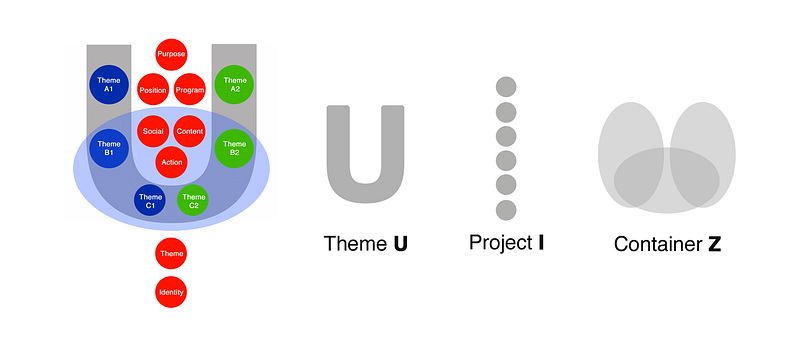
Two years ago, I published an article titled HERO U — A New Framework for Knowledge Heroes on June 26, 2020. Two months later, I started testing the HERO framework by writing a series of articles about Activity Theory. I called this project the Activity U project which is considered a knowledge curation project.
Since then, I have been using the HERO U framework to guide my knowledge curation projects. From August 2020 to March 2021, I wrote the following three books:
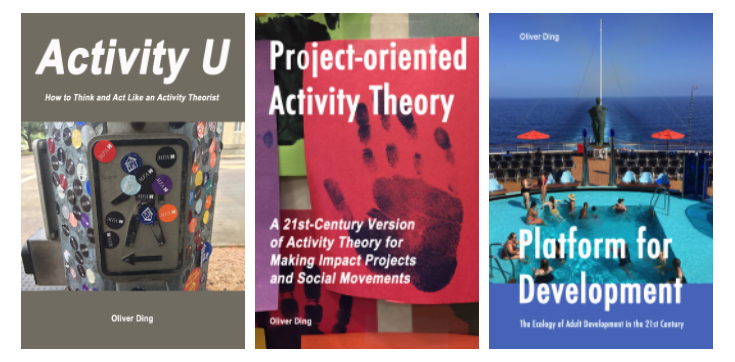
In April 2021, I wrote a book called The ECHO Way to reflect on the HERO U framework and the process of writing the above three books. On June 30, 2021, I wrote an article titled The ECHO Way (v2.0) and upgraded the HERO U framework to the ECHO Way (v2.0) from a practical framework for Knowledge Curation to a general framework for Boundary Innovation.
Both the HERO U framework and the ECHO Way (v2.0) share a set of meta-diagrams:
- Theme U
- Project I
- Container Z (WXMY/Echozone)
I have introduced Theme U and WXMY for the Knowledge Curation Toolkit. This article aims to introduce Project I and the HERO I canvas for Knowledge Curation Project. The HERO I canvas is originally called HERO U canvas.
Contents
1. Project I 2. HERO I 3. Spatial Structures of HERO I 4. Attaching with Resources 5. Detaching with Results 6. Challenges and Responses 7. The HERO I Canvas 8. Case Study: The Born of the HERO I Canvas 9. Case Study: The HERO I Canvas for Reflecting 10. Case Study: The HERO I Canvas for Planning 11. HERO I and Knowledge Discovery 12. Summary
1. Project I
The “Project I” meta-diagram is inspired by the Developmental Project Model which was formed by two triangles. You can find more details about the Developmental Project Model in this article.
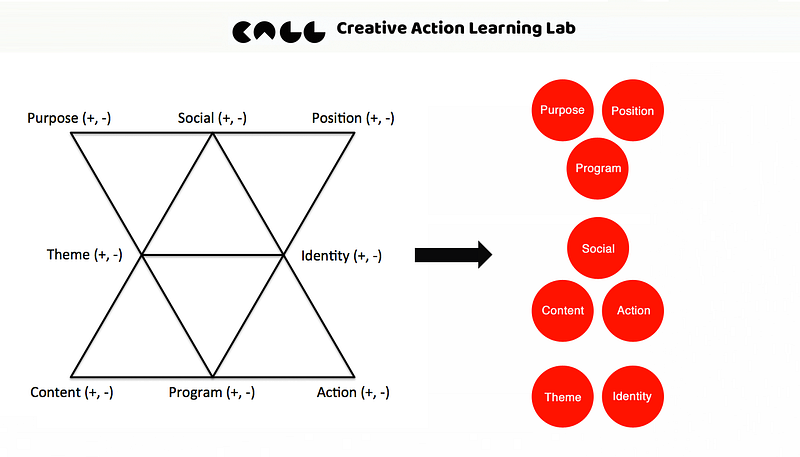
I changed the shape and layout in order to make a Diagram Blending that can be used for curating two or more frameworks together.
While the left part is called “Developmental Project Model”, the right part is called “Project I” which only means a meta-diagram.
2. HERO I
The “HERO I” is an application of the “Project I” meta-diagram. Originally, I didn’t use the term “HERO I” to name the seven dots of the HERO U framework (See the diagram below).
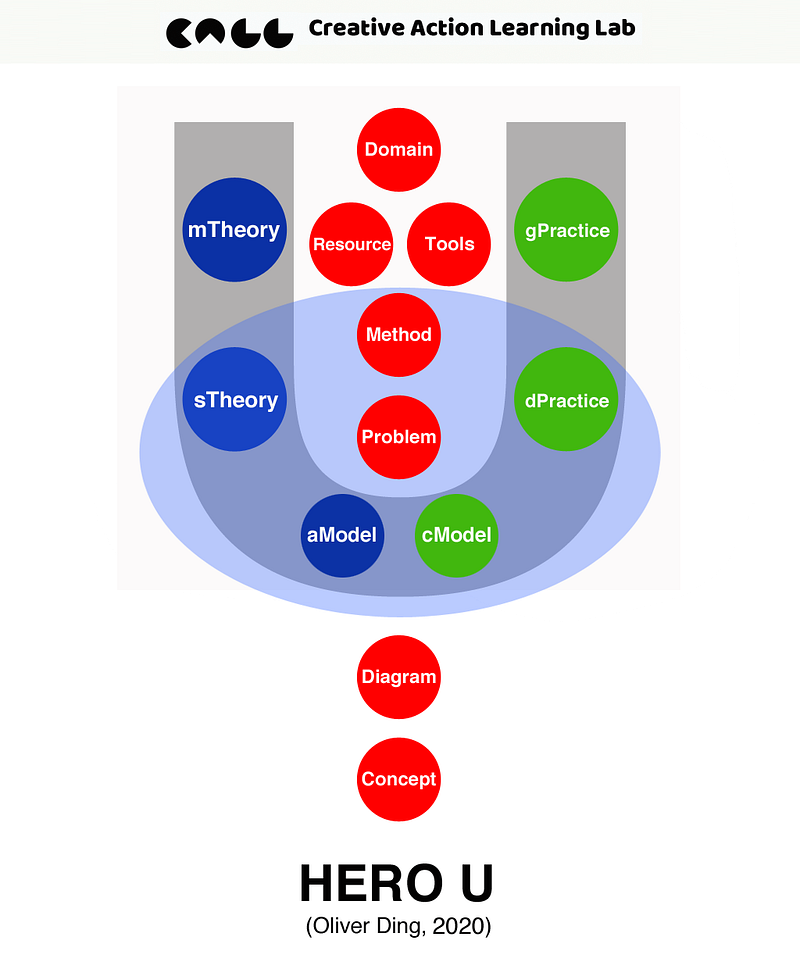
I have introduced Theme U and HERO U in The Knowledge Curation Toolkit #1: Theme U for Single-theory Curation. Now we see two pairs of concepts:
- Theme U > HERO U
- Project I > HERO I
While “Theme U” and “Project I” are meta-diagrams, “HERO U” and “HERO I” are their applications.
3. Spatial Structures of HERO I
I consider the HERO U framework as “an ecological approach” to knowing because it refers to the structure of “organism (personal conditions of knowing) — action (knowing) — environment(objective of knowing)”.
- HERO U: environment (objectives of knowing)
- HERO I: organism (personal conditions of knowing)
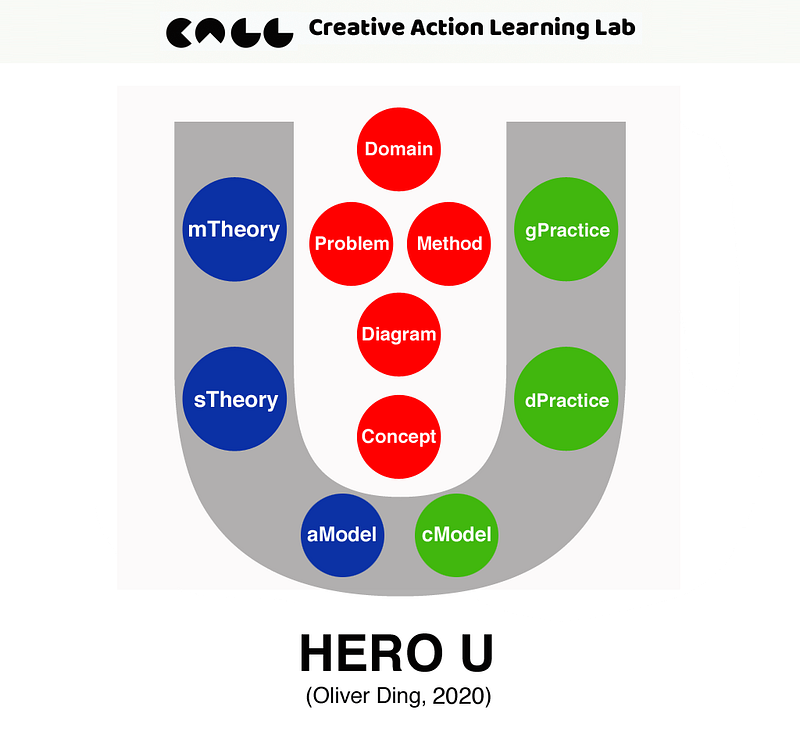
The HERO U diagram looks like a pipeline and balls. It presents six types of “Objective of Knowing”. Let’s look at the terms I used for the diagram.
mTheory: Meta-theory sTheory: Specific Theory aModel: Abstract Model cModel: Concrete Model dPractice: Domain Practice gPractice: General Practice
The HERO I diagram presents a set of “Personal Conditions of Knowing”. The first group is Domain, Resource, and Tools, they define the outside setting of the knowing activity. The second group is Method and Problem, they define the source of competence and solution. The third group is Diagram and Concept, they define the represent format of outcome of knowing. These three groups form a process of knowing.
The process of knowing can be understood from the Ecological Practice approach. If we return to the following original diagram of the approach, we can find “attach/detach” and “offers/acts”. The term “Offers” is an affordance-inspired concept, it refers to opportunities afforded by the Container. The group of “Offer — Act” forms an “Event” which changes the status of the Container. The new status of the Container affords new opportunities which guide the new acts and events.
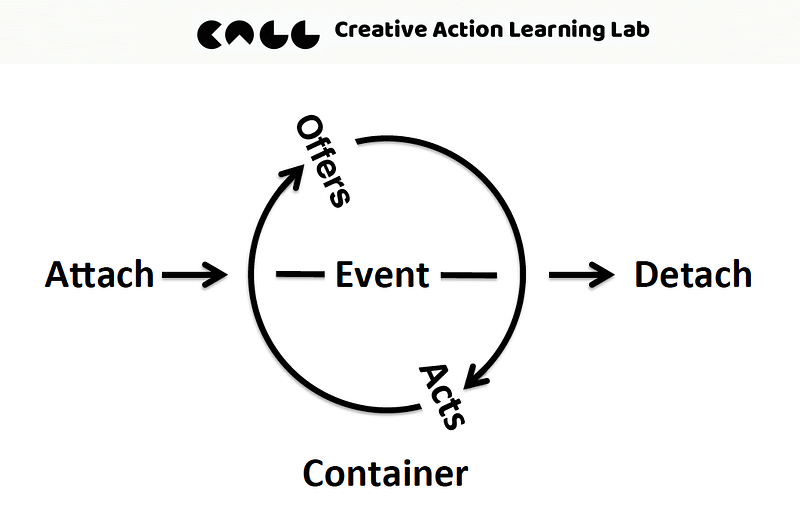
The HERO U framework is developed with a synthesis of knowing and acting. While HERO U diagram refers to knowing, the HERO I diagram refers to acting. The Container Z (Echozone) refers to a creative space since it connects knowing and acting together.
A core idea of my knowledge curation approach is Cognitive Containers. Books and courses are typical cognitive containers, however, there are more types of cognitive containers. I highlighted six types of cognitive containers in my book Curativity:
- Knowledge Card
- Knowledge Framework
- Knowledge Diagram
- Knowledge Chart
- Knowledge Workshop
- Knowledge Sprint
This is not an accurate classification, but a rough recommendation. Also, I suggested that we not only adopt existing types of cognitive containers, but also create new types of cognitive containers. Actually, this is the essential point of Curativity Theory. We are shaped by containers and we can make containers too.
While the HERO U framework is a Cognitive Container, HERO I is a sub-container of the HERO U framework. The three groups of “Personal Conditions of Knowing” represents the Attach > (Offers/Acts) > Detach process.
See the diagram below.
Then see the diagram below.
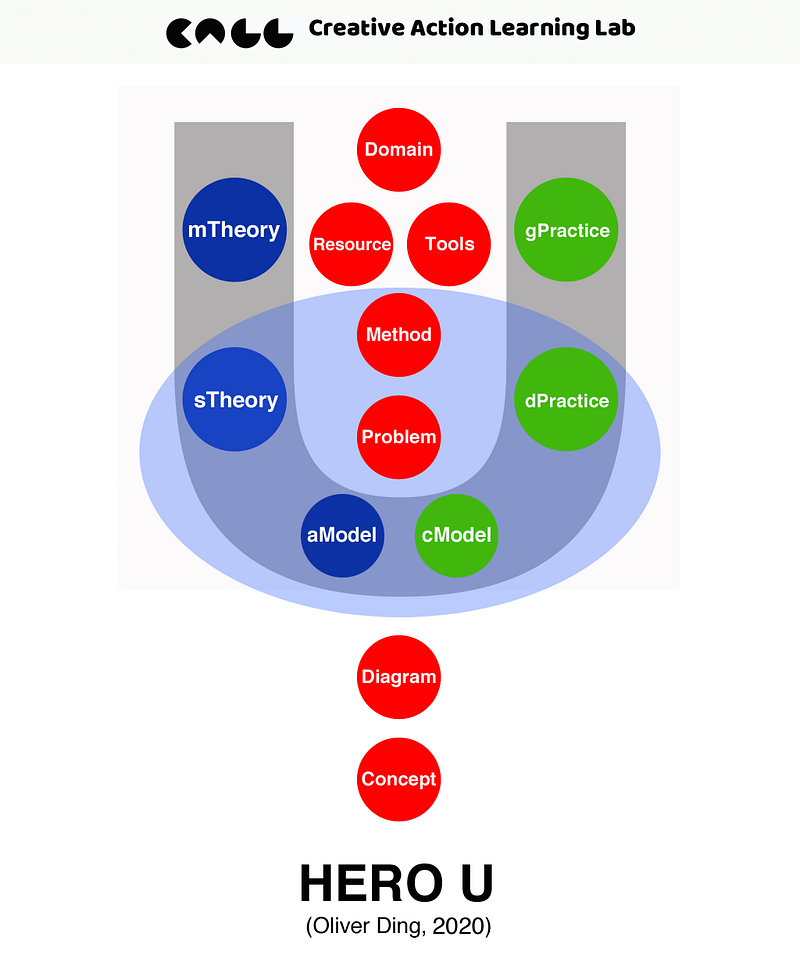
The blue part of the above diagram refers to Echozone. You can find more details about it in The Knowledge Curation Toolkit #2: WXMY for Interdisciplinary Curation.
Did you see the Attach > (Offers/Acts) > Detach process from the above two diagrams?
4. Attaching with Resources
The starting point of the process is “Domain” which refers to a particular domain as the context of a knowledge project.
Let’s look at HCI scholar Bonnie Nardi’s personal experience, “…At the time, I was experiencing some frustrations with my home discipline (note: she was trained in anthropology). The 1980s were a period of turmoil in anthropology, and certain disciplinary moves were made that I believe have continued to stymie anthropology’s influence. I was disgruntled with anthropology’s total lack of interest in digital technology, its insular jargon, and its somewhat negative attitude. During anthropology’s relentless critique of issues of race-class-gender, my head was in a different space — I was energized and excited about what I perceived to be the development of rapidly changing life-altering digital technologies…”
Here we see a conflict between Old Domain (academic job in anthropology) and New Domain (high-tech research). Nardi was trained in anthropology and had an academic job in anthropology. At that time, she was interested in emergent digital technologies. She had to make a choice between the old domain and the new domain.
She said, “In the mid-1980s, I left a tenure-track job in anthropology to follow my bliss and began working in the high-tech industry in Silicon Valley. My initial encounter with activity theory, in 1993, was a transformative moment of discovery revealing a whole group of scientists who, although far away in Northern Europe, thought digital technology was as interesting as I did. Even better, they were working within a mature social scientific theoretical tradition. This tradition took culture seriously but also had a set shared, well-developed concepts with which to theorize human activity (something I felt anthropology lacked). Discovering activity theory was wickedly empowering: I was, unexpectedly, going to have my cake and eat it too!”
As an established theoretical tradition, Activity Theory brings a new Meta-theory, a new Domain, a new Method, new Tools, and new Resources to Nardi. She embraced the opportunity and made a significant contribution to the development of Activity Theory in the HCI field and in North America.
After finding a domain, we can evaluate Resources and Tools for our knowledge projects.
In 2016, Information Science scholar Diane H. Sonnenwald edited a book titled Theory Development in the Information Sciences, she presented a three-stage framework for understanding the theory development process. At the center of the diagram she drew, Resource is the core of theory development.
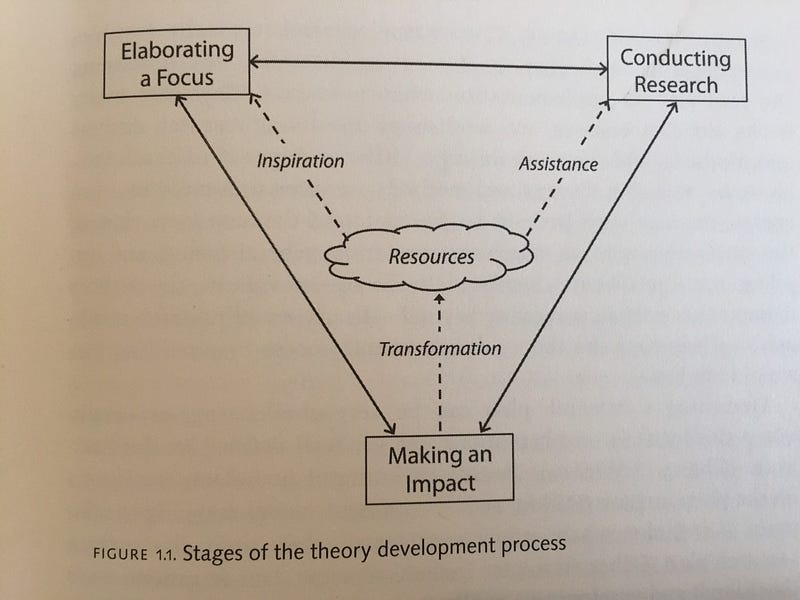
According to Sonnenwald, Resources mentioned by chapter authors are literature, personal experiences, their own research, colleagues, technology, institutions, and societal issues.
- Literature: read literature deeply, dissatisfaction and disagreement, etc.
- Personal experiences: observations, work experiences, personal challenges, etc.
- Own research: positive and negative results, tests, real-world applications, etc.
- Colleagues: inspiration, valuable feedback, disseminate and apply, etc.
- Technology: new behavior and phenomena, new types of data, etc.
- Institutions: guide of research focus, funding, expert network, etc.
- Societal issues: social problems, funding, evaluation, impact, etc.
We have to notice that these personal conditions of knowing are not separate, but intertwined.
5. Detaching with Results
For the Knowledge Curation approach, I roughly define the outcome of a knowledge curation project as a knowledge framework that is formed with Concepts and Diagrams.
A Knowledge Framework = Concepts + Diagrams
In Knowledge Discovery: The “Frameworks — Insights” Mapping, I developed the following typology of Frameworks.
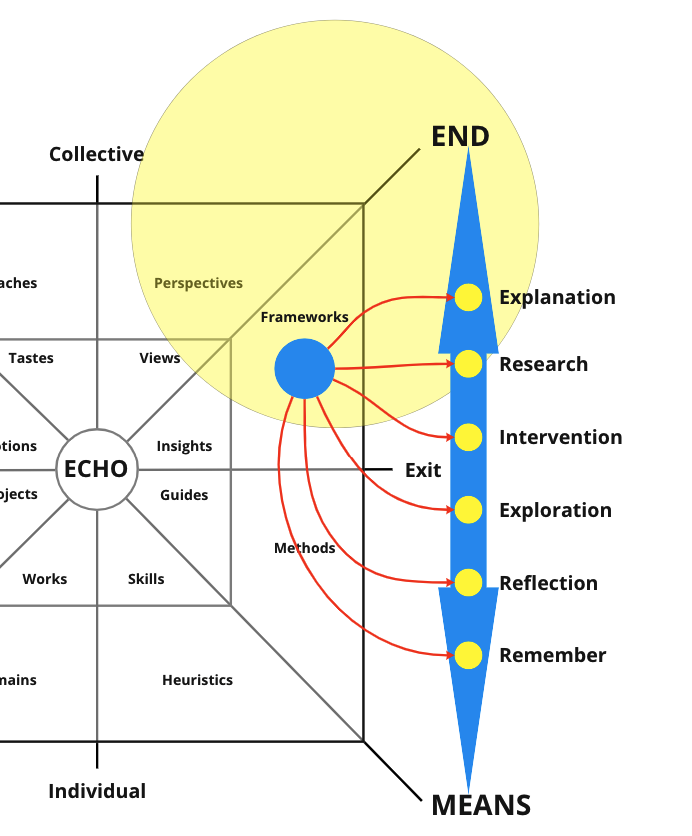
By using the MEANS — END spectrum, I identify six purposes for using and making Knowledge Frameworks.
- Explanation
- Research
- Intervention
- Exploration
- Reflection
- Remember
You can find more details in the original article.
A knowledge framework is a bridge that connects theory and practice. An ideal knowledge framework should contain two types of concepts:
- Theoretical Concepts
- Operational Concepts
Theoretical Concepts are adopted from Meta-theory or Specific Theory. Some frameworks don’t associate with any theories, they only have operational concepts.
Operational Concepts are framework-dependent concepts for guiding research and reflection. For example, Yrjö Engeström’s Activity System Model is a knowledge framework. Its diagram displays seven operational concepts.
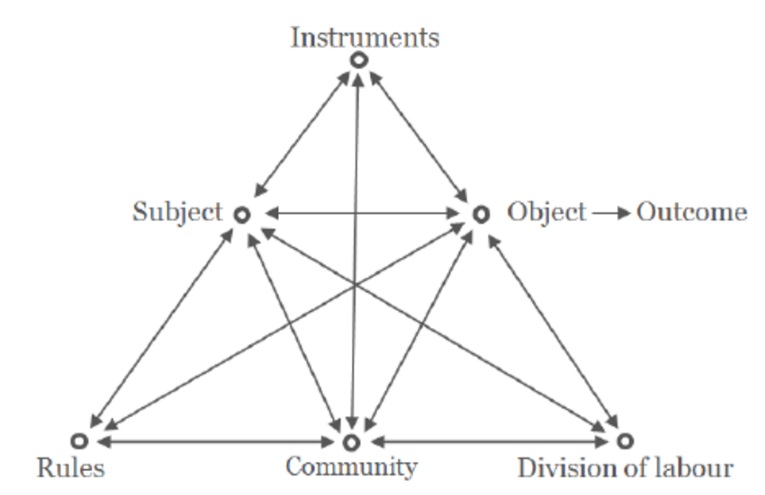
We should notice that a knowledge framework can directly adopt some theoretical concepts as its operational concepts. For example, the above diagram shows “Subject” and “Object” which are core theoretical concepts of Activity Theory. However, some researchers use “Actor” to replace “Subject” with the same diagram for their own work. The concept of “Actor” should be understood as an operational concept. For real-life research, the difference between “Subject” and “Actor” doesn’t matter since we need to see the final data which refers to a person or several people.
While Yrjö Engeström uses the word “Instruments”, other researchers use “Mediating Tool” or similar words. For example, Maral Babapour, Antonio Cobaleda-Cordero, and Marianne Karlsson adopt Activity Theory to develop a framework for understanding the interrelations between users and workplace design. They use the word “Mediating Tool”.
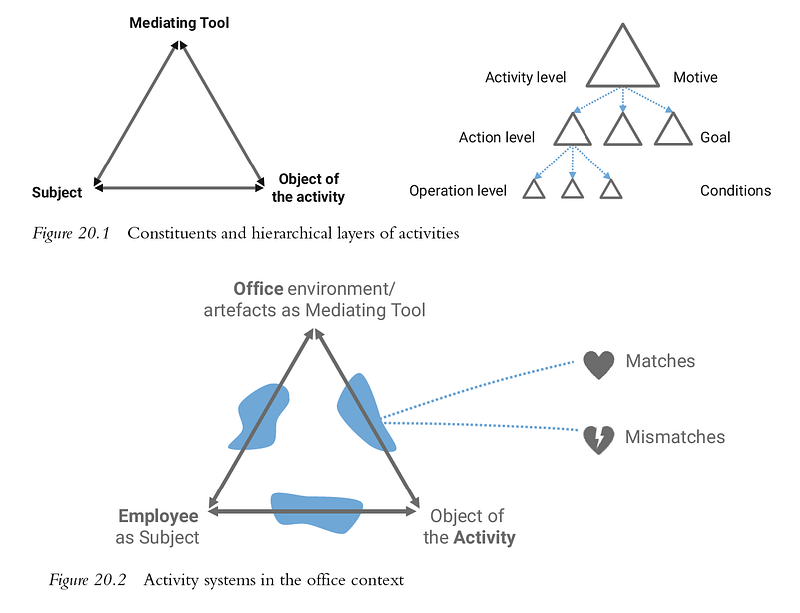
Both theoretical concepts and operational concepts can be defined precisely or vaguely. For example, the scope of the concept of “Instruments/Mediating Tool” is very broad in Activity Theory. The above diagram shows an example, the authors understand “Office Environment” as a “Mediating Tool” from the perspective of Activity Theory. Since Activity Theory doesn’t have a theoretical concept of “Environment,” researchers tend to use the concept of “Instruments/Mediating Tool” to understand “Environment”.
We also should notice that a knowledge framework’s diagram may not display some key theoretical concepts. In fact, we don’t have to display theoretical concepts in a diagram because we can discuss them with words in a research report. For example, the concept of “Mediation” is a foundational theoretical concept of Activity Theory. In fact, Yrjö Engeström’s Activity System Model was developed with double mediations. However, the Activity System Model doesn’t display the word “Mediation” in its diagram.
6. Challenges and Responses
I use “Offers/Acts” for the middle part of the process of “Attach > (Offers/Acts) > Detach”. For the Knowledge Curation approach, I consider “Challenges/Responses” as a special type of “Offers/Acts”.
Each action always has its corresponding things. For “Challenges/Response”, we see “Problems/Methods”.
- Challenges are caused by Problems
- Response with Methods
By curating some theories, I identified three types of challenges. See the diagram below.
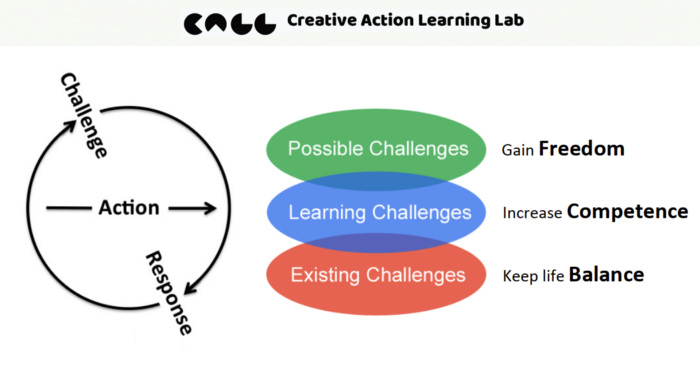
The Existing Challenges are about keeping life balanced. I adopted Ellen Skinner and Kathleen Edge’s motivational model of Context, Self, Action, and Outcomes (2002) as a resource. I defined the Positive Existing Challenges as the actions which respond to aggressive tasks while the Negative Existing Challenges as the actions which respond to defensive tasks. The Positive Existing Challenges refers to Engagement which is a concept of Skinner and Edge’s model. The Negative Existing Challenges refer to Coping.
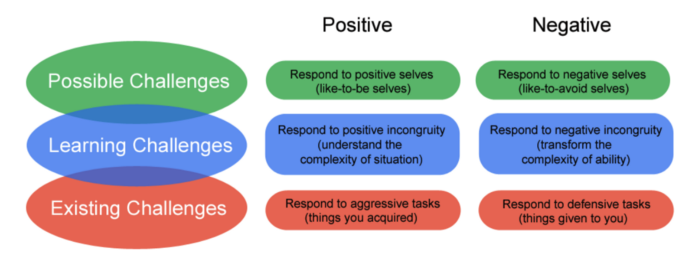
The concept of Incongruity is the core of an action theoretical approach that was developed by Matthias Rauterberg in 1999. According to Rauterberg, the difference between the complexity of the mental model (MC) and the complexity of the external context (EC) is called incongruity: IC = EC -MC. There are two types of incongruity: Positive Incongruity and Negative Incongruity. For Rauterberg, only the positive incongruity leads to learning.
Based on the approach, I defined two types of Learning Challenges. The Positive Challenges refer to actions that respond to positive incongruity (understand the complexity of the situation) while the Negative Challenges refer to actions that respond to negative incongruity (transform the complexity of ability). Based on my own experience, I thought the negative incongruity could lead to learning too. However, it refers to transforming the complexity of ability. For example, an expert faces a negative incongruity if the complexity of a situation is lower than the complexity of his mental model. However, if he wants to teach others how to cope with the same type of situation, he needs to learn communicative skills in order to reduce the complexity of ability for others to learn. My suggestion expanded Rauterberg’s model from an individual perspective to an interpersonal perspective.
The Possible challenges are inspired by Hazel Rose Markus’ Possible Selves Theory (1986). The Positive Possible Challenges refer to actions responding to positive selves (like-to-be selves). The Negative Possible Challenges refer to actions responding to negative selves (like-to-avoid selves).
Now, let’s apply this framework to my decisions in 2018. First, let’s have look at the two options:
- Building a community of inquiry about Epistemic Development
- Keep on the journey of personal intellectual discovery
Both the above two options are not Negative Existing Challenges because they are not things given to me by others. They are not Positive Existing Challenges too because they are not related to my daily life work. Both options are Positive and Possible Challenges because they refer to like-to-be selves. However, I chose one possible self from these two options. I rejected challenge 1 because I knew an expert in community building is my past self. I accepted challenge 2 because I wanted to be an expert in theory-based reflection.
Second, let’s review the process of writing the book Curativity:
- Apply Activity Theory to general curation practice.
- Develop an ecological approach and apply it to general curation practice.
Both challenges are Learning Challenges. For this case, the external context refers to general curation practice while the mental model refers to my understanding of theoretical approaches. There is no incongruity for challenge 1 because I knew both sides. That was the reason that I thought challenge 1 was not enough for me. Challenge 2 is a Positive Learning Challenge because there was a positive incongruity. I didn’t have a clear mental model of the ecological approach. Thus, the complexity of the mental model is lower than the complexity of the external context. This led to learning.
Also, both challenges can be considered Positive and Possible Challenges. Challenge 1 could lead to the developmental direction of becoming an expert in Activity Theory while challenge 2 refers to the direction of the ecological approach. Since Activity Theory is an established theoretical tradition, I chose the ecological approach because there are no established frameworks and that meant a creative space. This is a radical exploratory strategy.
However, I returned to Activity Theory and worked on the Activity U project in 2020.
Why?
Because I wanted to make a balance between exploration and exploitation.
Also, I realized that the complexity of my mental model in 2020 was higher than it was in 2018. Thus, I found that my understanding of Activity Theory was not deep enough. I needed to re-explore it.
7. The HERO I Canvas
Now we can start playing a Canvas for the HERO I diagram.
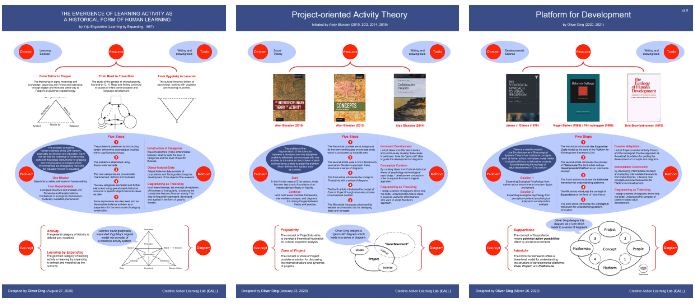
The above picture shows three examples using HERO I Canvas which was originally named HERO U Canvas.
In the beginning, I designed the HERO I Canvas to visualize thIn the beginning, I designed the HERO I Canvas to visualize the development process of Yrjö Engeström’s Activity System model when I was writing Activity U (IV): The Engeström’s Triangle and the Power of Diagram.
Later, I realized that I could use the canvas to guide my knowledge curation work. Thus, I applied to a sub-project of the Activity U project and reviewed Andy Blunden’s project-oriented activity approach. The outcome of the sub-project is the book Project-oriented Activity Theory.
Finally, I used the canvas to guide my writing on my own approach to Platform(Project) and wrote the third book Platform for Development.
Thus, the HERO I Canvas is an important tool for my knowledge curation projects. However, I didn’t design it originally with the HERO U framework. It was just emergent from the Activity U project.
8. Case Study: The Born of the HERO I Canvas
In June 2020, I started the Activity U project which aims to curate the landscape of Activity Theory from different perspectives. On Sept 3, 2020, I published the fourth article of the project:
The article focuses on Finnish educational researcher Yrjö Engeström’s work and reviews his theoretical building from the perspective of diagrams and diagramming. Yrjö Engeström upgraded the activity theory from the individual activity level to the collective activity level with a conceptual model of “activity system” in order to apply activity theory to educational settings, organizational development, and other fields (Engeström,1987).
In 1987, he published his keystone work titled Learning by Expanding (1987/2014) in which he developed the now-famous Activity System triangle, the concept and model of Expansive Learning, and the early version of the methodology of development work research. Since then, his research has significantly advanced our understanding of development and learning in different work settings and made significant contributions to cultural-historical activity theory.
The subtitle of Learning by Expanding is An Activity-theoretical Approach to Developmental Research. Usually, we will consider this work as an application of Activity Theory. There is a theory called Activity Theory, he just applied it to generate a new idea about Developmental Research. Actually, this is not a simple “theory use” work, but an excellent “theory make” case.
Learning of Expanding has five chapters, and the following titles of each chapter point out different goals.
- Chapter 1: Introduction
- Chapter 2: The emergence of learning activity as a historical form of human learning
- Chapter 3: The Zone of Proximal Development as the basic category of expansive research
- Chapter 4: The Instruments of Expansion
- Chapter 5: Towards an expansive methodology
In order to develop a model of learning in the work setting, Engeström decided to develop a model of “learning activity”. In order to understand the “learning activity”, he chose to trace back to two lines. One line is about “activity” while another line is about “learning”. During the process, he had to develop a collective level version of “activity theory” for his research. This process is clearly displayed in Chapter 2.
I designed the picture below to visualize Engeström’s thoughts about this process. The picture has seven red dots: Domain, Resource, Tools, Problem, Method, Concept, and Diagram.
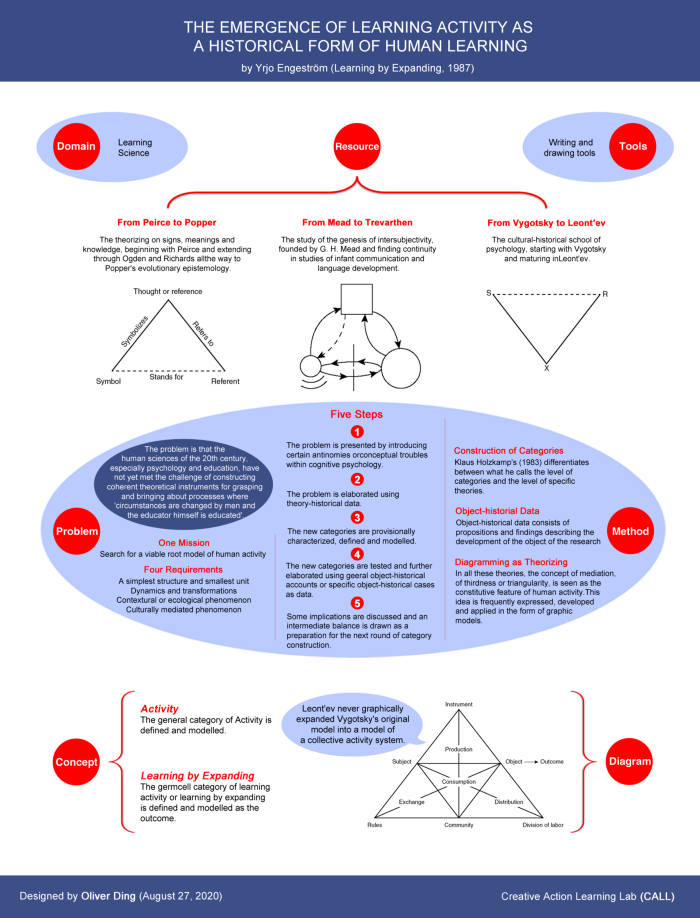
At that time, I didn’t intend to design a thing called “the HERO I Canvas”. It just appeared because I want to visualize Engeström’s thoughts about Chapter 2 of his book. Since this article is only about the Activity System Triangle, the above picture only summarizes half of the thoughts behind Chapter 2. I didn’t put the other half which is about “learning” into the picture.
Now we can consider the HERO I Canvas as a by-product of the Activity U project.
9. Case Study: The HERO I Canvas for Reflecting
From December 2020 to February 2021, I worked on Project-oriented Activity Theory which is inspired by Andy Blunden’s notion of “Project as a unit of Activity”.
A major development of Activity Theory during the past decade is Andy Blunden’s account “An Interdisciplinary Theory of Activity”. Andy Blunden is an independent scholar in Melbourne, Australia. He works with the Independent Social Research Network and the Melbourne School of Continental Philosophy and has run a Hegel Summer School since 1998.
Blunden’s vision of the interdisciplinary theory of Activity is inspired by Vasily Davydov’s argument:
I always argue that the problem of activity and the concept of activity are interdisciplinary by nature. There should be specified philosophical, sociological, culturological, psychological and physiological aspects here. That is why the issue of activity is not necessarily connected with psychology as a profession. It is connected at present because in the course of our history, activity turned out to be the thing on which our prominent psychologists focused their attention as early as in the Soviet Union days. Things just turned out this way. (Davydov, 1999: 50.)
In order to develop the notion of “Project as a unit of Activity” as a theoretical foundation of the new interdisciplinary theory of Activity, Blunden adopts Hegel’s logic and Vygotsky’s theory about “Unit of Analysis” and “Concept” as theoretical resources. The process is documented in four books: An Interdisciplinary Theory of Activity (2010), Concepts: A Critical Approach (2012), Collaborative Projects: An Interdisciplinary Study (2014), and Hegel for Social Movements (2019).
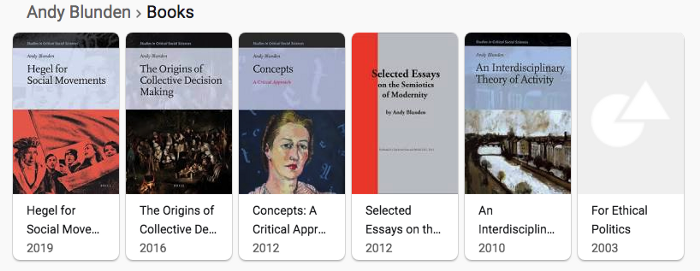
In his 2010 book An Interdisciplinary Theory of Activity, Blunden traces the roots of Activity Theory from Goethe, Hegel, and Marx in order to present an immanent critique of Activity Theory and its contemporary version CHAT. The core of Blunden's argument is a theoretical-methodological issue: Unit of Analysis. For Blunden, the concept of “Unit of Analysis” should be understood as Goethe’s Urphanomen which is also known as the ‘cell’. Blunden believes that the unit of analysis should be followed by an explanatory principle of “the part contains the whole”.
The solution of “Project as a unit of Activity” is summarized in a paragraph at the end of Introduction to Collaborative Projects. Blunden said, “How can we understand the relation between the motivation of individual actions on one hand, and on the other hand, the immanent objective of the project which forms the unifying principle of the project uniting all the disparate individual actions into a single activity? Hegel resolved this problem in his solution to the problem of the subsumption of any number of individual actions under a concept, but there is no criteria other than the concept itself determining this subsumption. The relation between an action and the project which gives to the action its rational meaning is the same as the relation between any individual discursive act and the concept which it instantiates, and the same as the relation between any individual thing and the category under which the thing is subsumed. The relation between the individual and the universal is mediated by the particular, that is by praxis, and it not to be conflated with the subjective-objective relation which is a quite distinct relation. The universal has no separate existence, but exists only in and through its particularization by individuals.” (2014, p.26)
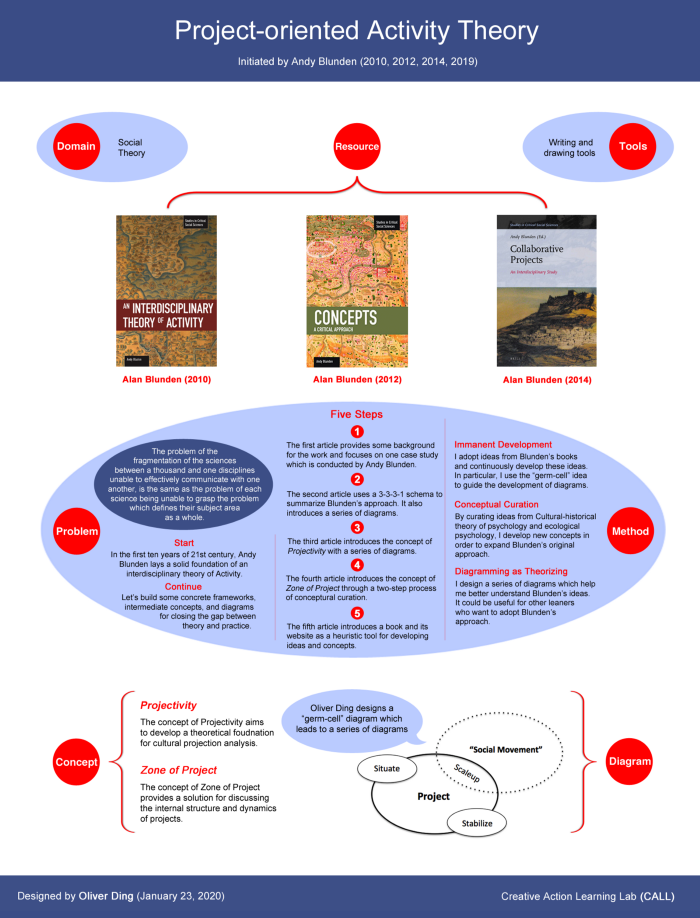
I wrote several articles to introduce Andy Blunden’s ideas and designed a series of diagrams to visualize these ideas. I also expanded his ideas from a general interdisciplinary theory of Activity as a meta-theory to a Project-oriented approach for practical studies.
Eventually, I wrote a new book titled Project-oriented Activity Theory. On Jan 23, 2021, I used the HERO I Canvas to reflect on my thoughts behind the process of writing the book.
The main part of the book is five articles. I considered them as Five Steps. You can find more details on the canvas. My work also produced one brand-new diagram and two brand-new concepts.
It was interesting that I didn’t use the HERO I Canvas for my thoughts before starting to write these articles. I just used the canvas to reflect on the process after the work was done.
However, this reflection brings me a new insight: I can use the HERO I Canvas for planning too. While the whole canvas offers a framework for the landscape view, the Five-Step area offers a guide for actual actions.
10. Case Study: The HERO I Canvas for Planning
From February 2021 to March 2021, I worked on a new book titled Platform for Development: The Ecology of Adult Development in the 21st Century.
On Dec 13, 2020, I published the Platform-for-Development (P4D) framework (v1.0) which introduced a new unit of analysis: Platform (Project).
The v1.0 didn’t officially adopt the Ecological Practice approach as a theoretical resource for discussing platform ecology. In Feb, I decided to do it. This decision led to the v2.0 of Platform-for-Development. Eventually, the framework expands from the original settings Platform(Project) to a three-level analysis framework: Platform-ba[Project(Zone)]. The new structure is guided by an intermediate framework: Infoniche, a sub-framework of the Ecological Practice approach.
Readers have to notice that the v1.0 was published on Dec 13, 2020, before I started the project of “Project-oriented Activity Theory”. During the process of writing about the theory, I learned more about the approach and developed some new ideas such as Zone of Project and Projectivity.
On Jan 24, I closed the project “Project-oriented Activity Theory (Booklet)”. On Jan 26, I had an email conversation about the Ecological Practice approach and the concept of Supportance with two friends. Thus, these activities inspired me to write an article about the concept of Supportance.
On Feb 9, 2021, I wrote an article titled The Supportive Cycle (v1.0) and used it to apply the concept of Supportance to the unit of analysis: Platform(Project). This article also introduced a new concept called “Platform-ba”.
The concept of “Platform-ba” is part of my thoughts about Platform Ecology. So, I realized that I need to offer readers more details about Platform Ecology. On Feb 14, 2021, I wrote Platform, Platform-ba, and Platform Ecology.
On Feb 18, 2021, I reflected on these articles. At that time, I intended to use the HEUO I Canvas and the Five-Step method to guide my plan of writing a new book.
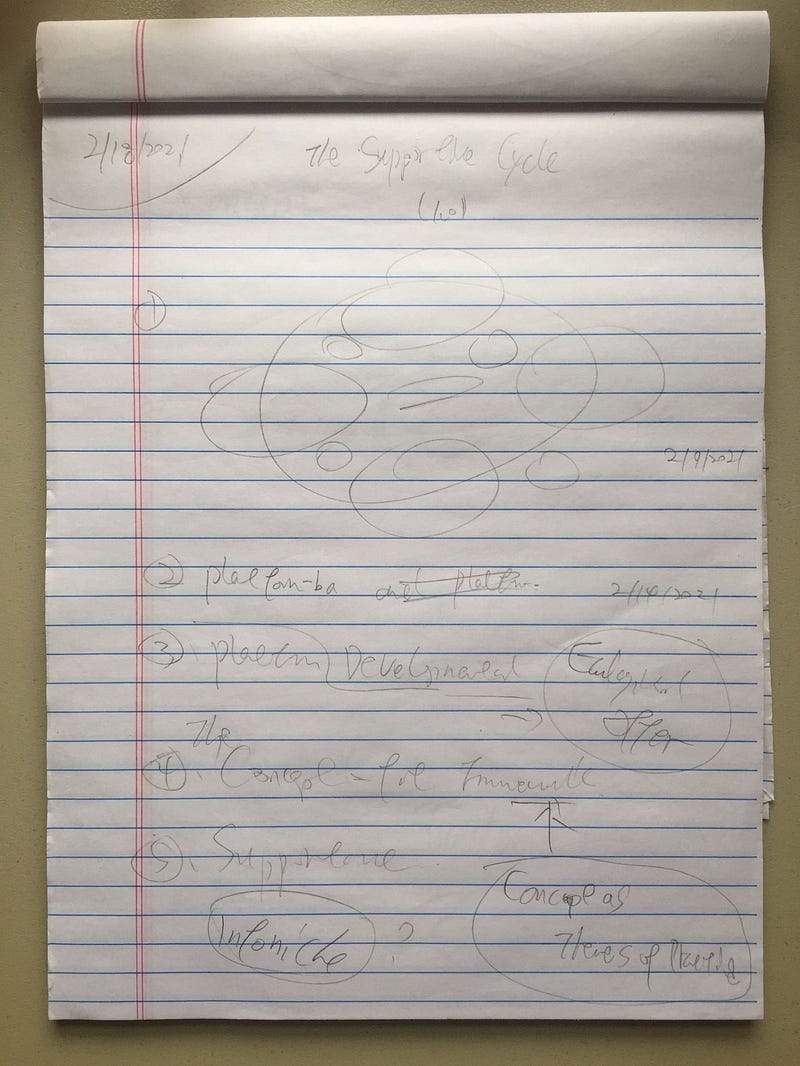
The above picture is a note about a plan of five steps. The diagram below is the HERO I Canvas for the project.
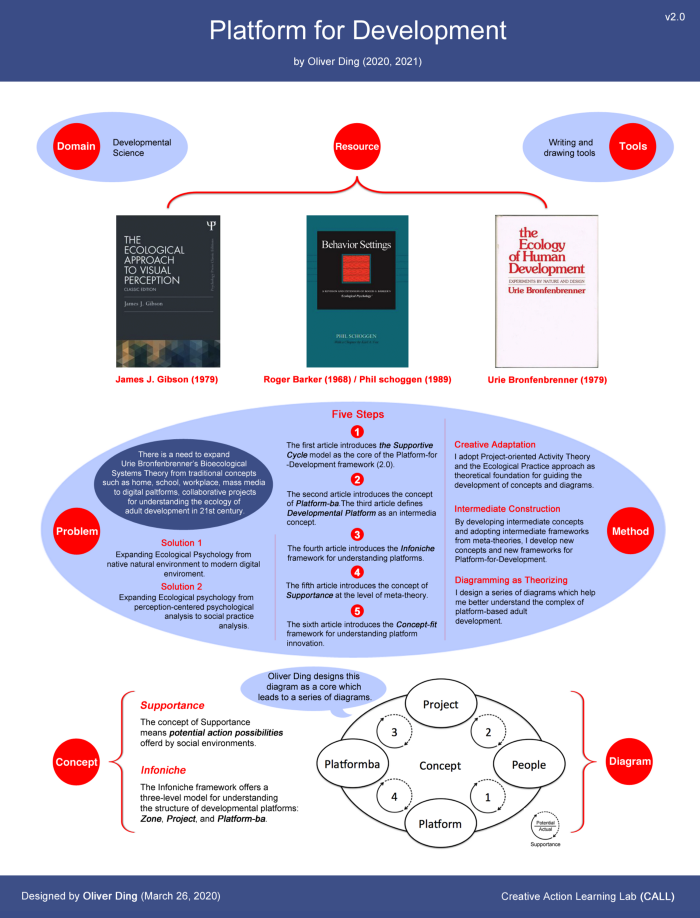
To be honest, the concepts of “Supportance” and “Infoniche” were born before the project. I just used the book to officially introduce these two concepts to readers.
This strategy is planned for producing the Ecological Practice approach. Each year, I plan to write a new book. Each book intends to introduce at least one theoretical concept of the approach. The mission of the Platform-for-Platform project is to introduce the concept of Supportance.
The outcome is pretty amazing. I didn’t expect that I could develop a new theory about adult development. See the diagram below.
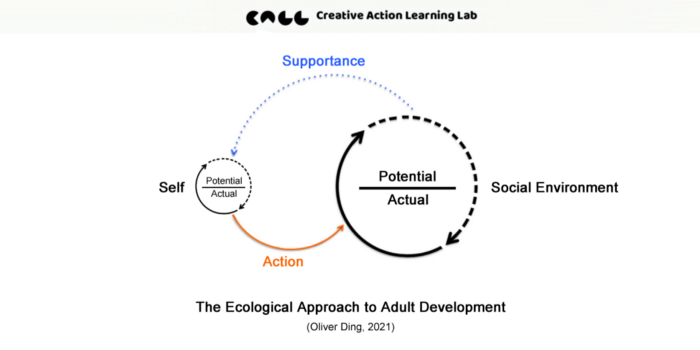
The above diagram is the outcome of a dialogue between Lev Vygotsky’s concept of “ZPD (Zone of Proximal Development)” and Ecological Psychology. The above diagram represents a new model of adult development from the perspective of the Ecological Practice approach. A person’s development means the transformation between Potential Self and Actual Self, this process is related to the transformation between Supportance (potential action possibility) offered by the social environment and Actual Action.
You can find more details about the above new model here.
11. HERO I and Knowledge Discovery
The HERO I meta-diagram and the HERO I Canvas are two heuristics for the Knowledge Curation approach. From the perspective of the Knowledge Discovery Canvas (see the picture below), the “Heuristics — Skills” mapping is located in the MEANS area. It considers individuals’ practical situations as the context of using knowledge as cognitive heuristics for solving problems and producing some outcomes.
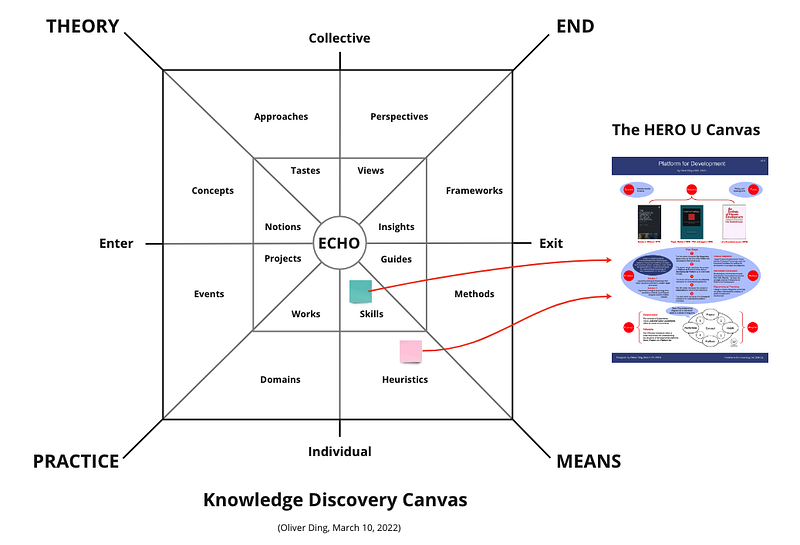
Heuristics are used in various fields such as scientific discovery, professional work, and the tasks of everyday life. Originally, the concept of heuristics was introduced by the Nobel laureate Herbert A. Simon for problem-solving and design science in general.
For the Knowledge Discovery Activity, I develop the following typology of Heuristics for further discussion:
- Theoretical Knowledge as Heuristics
- Practical Knowledge as Heuristics
- Situational Heuristics
This typology is based on the source of heuristics. While Theoretical Knowledge as Heuristics and Practical Knowledge as Heuristics are from Others, Situational Heuristics are self-made.
For me, the HERO I Canvas is a Situational Heuristic because it was made by myself.
For you, the HERO I Canvas is a Practical Heuristic because it is not supported by theoretical knowledge.
How to acquire new skills? It takes time to practice new knowledge and tools. For the Knowledge Curation project, I suggest the following simple rule:
Try something new at least three times.
This rule can be applied to both Theoretical Knowledge and Practical Knowledge.
12. Summary
Both the HERO U framework and the ECHO Way (v2.0) share a set of meta-diagrams:
- Theme U
- Project I
- Container Z (WXMY/Echozone)
I have introduced Theme U and WXMY for the Knowledge Curation Toolkit. This article aims to introduce Project I and the HERO I canvas for the Knowledge Curation Project. The HERO I canvas is originally called HERO U canvas.
- Theme U > HERO U
- Project I > HERO I
While “Theme U” and “Project I” are meta-diagrams, “HERO U” and “HERO I” are their applications.
The HERO U framework is developed with a synthesis of knowing and acting. While the HERO U diagram refers to knowing, the HERO I diagram refers to acting. The Container Z (Echozone) refers to a creative space since it connects knowing and acting together.
The whole process can be understood as “Attach > (Offers/Acts)>Detach” from the perspective of the Ecological Practice approach.
- Attaching with Resources
- Challenges and Responses
- Detaching with Results
The above three case studies show three ways of using the HERO I Canvas.
- The Born of the HERO U Canvas
- The HERO I Canvas for Reflecting
- The HERO I Canvas for Planning
How to use the HERO I Canvas for your knowledge curation projects?
As discussed above, the canvas can be used for different purposes at different stages.
It all depends on your creative situation.
Related Articles:
- Curativity Theory: The Ecological Approach to General Curation Practice
- Curativity Theory: Table of Contents and Related Articles
- The Knowledge Curation Project
- Activity U — A Knowledge Curation Project
- HERO U — A New Framework for Knowledge Heroes
- The ECHO Way (v2.0)
- Activity U (III): Bonnie Nardi’s Choices and Boundary Knowledge Work.
- D as Diagramming: Challenge as Opportunity
- D as Diagramming: From Sandwich to Containers
- Life Discovery: Running A Developmental Project
- The Knowledge Curation Toolkit #1: Theme U for Single-theory Curation
- The Knowledge Curation Toolkit #2: WXMY for Interdisciplinary Curation
- The Knowledge Curation Toolkit #3: Hamburger for Contextural Curation
You are most welcome to connect via the following social platforms:
Linkedin: https://www.linkedin.com/in/oliverding Twitter: https://twitter.com/oliverding Polywork: https://www.polywork.com/oliverding Boardle: https://www.boardle.io/users/oliver-ding


