avatarOliver Ding

Free AI web copilot to create summaries, insights and extended knowledge, download it at here

4384

Abstract

2> <div><h3>Affordances, Supportances, and Social Innovation</h3></div> <div><p>medium.com</p></div> </div> <div> <div style="background-image: url(https://miro.readmedium.com/v2/resize:fit:320/1*PTNh2Q1k8Afsq4xMjf_VMA.jpeg)"></div> </div> </div> </a> </div><h1 id="0303">The Supportive Cycle Expanded</h1><p id="e79d">Originally, I didn’t intend to upgrade the v1.0 to v2.0. After publishing <a href="https://readmedium.com/cycle-fec3716f4dc6?sk=07866b65ee44135225c7a6947937c0ed"><i>the Supportive Cycle (v1.0) model</i></a>, I realized there is a need to offer readers a deep theoretical background for the ideas I mentioned within the model. Also, I have planned to write something about Supportance for a while. The idea of Supportance was born in Oct 2020. On Jan 24, I closed the project “Project-oriented Activity Theory (Booklet)”. On Jan 26, I had an email conversation about the Ecological Practice approach and the concept of Supportance with two friends. Thus, these activities inspired me to write an article about the concept of Supportance.</p><p id="d972">The v1.0 didn’t officially adopt the Ecological Practice approach as a theoretical resource for discussing platform ecology. In Feb, I decided to do it. This decision led to the v2.0 of Platform-for-Development. Eventually, the framework expands from the original settings <b><i>Platform(Project)</i></b> to a three-level analysis framework: <b><i>Platform-ba[Project(Zone)]. </i></b>The new structure<b><i> </i></b>is guided by an intermediate framework: <i>Infoniche, </i>a sub-framework of the Ecological Practice approach.</p><p id="8134">Readers have to notice that the v1.0 was published on Dec 13, 2020, before I started the project of “Project-oriented Activity Theory (Booklet)”. During the process of writing about the theory, I learned more about the approach and developed some new ideas such as <b><i>Zone of Project </i></b><i>and <b>Projectivity.</b></i></p><p id="6d39">Eventually, I realized the Supportive Cycle (v1.0) model is a summary of my new thinking about Platform-for-Development and Platform Ecology in general. On Feb 18, I planned to write five articles to expand the Supportive Cycle model.</p><h1 id="7c5d">A Knowledge Creation Work</h1><p id="5348">The v2.0 framework aims to contribute to both theoretical and practical sides. On the academic side, the framework offers a brand new ecological-supportive approach to understanding adult development in the 21st century. On the practical side, the framework provides a Supportive Cycle model for discussing case studies and real-life applications.</p><p id="90f8">The diagram below presents my mind behind the work. The picture has seven red dots: <i>Domain</i>, <i>Resource</i>, <i>Tools</i>, <i>Problem</i>, <i>Method</i>, <i>Concept</i>, and <i>Diagram</i>. These elements are from the HERO U framework (<a href="https://readmedium.com/herou-70e455c60352?sk=2b05a2d783206c5d8bdd22520b1d8bc1">the article</a>, <a href="https://miro.readmedium.com/proxy/1*GEQ2zsJYn1VlQzxtLaiz5g.png">the diagram</a>). The seven red balls refer to <i>Personal Conditions of Knowing</i>. The first group is <i>Domain</i>, <i>Resource,</i> and <i>Tools</i>, they define the outside setting of the knowing activity. The second group is <i>Method</i> and <i>Problem</i>, they define the source of competence and solution. The third group is <i>Diagram</i> and <i>Concept</i>, they define the representation format of the outcome of knowing. These three groups form a process of knowing.</p><figure id="8879"><img src="https://cdn-images-1.readmedium.com/v2/resize:fit:800/1*UqaDym3p2LKnDsWE9nyahA.png"><figcaption></figcaption></figure><p id="546f">I have used the same diagram for my interpretation of Yrjö Engeström’work on <a href="https://readmedium.com/triangle-fdbecbba7ac2?sk=54e8e6a6a7b3b531febc83ab6be1f040">developing the model of human activity</a> and Andy Blunden’s <a href="https://readmedium.com/book-a7e4ac1688c?sk=77efc7733b6fcb2bc52210a134c953e8">“Project as a unit of analysis of activity”</a> approach. However, these two projects are knowledge curation work. This time, I use it for knowledge creation.</p><p id="de7c">Readers can use this diagram as a map for reading my articles. The most important piece is t

Options

he five steps.</p><ul><li>The first article introduces the Supportive Cycle model as the core of the Platform-for-Development framework (2.0).</li><li>The second article introduces the concept of Platform-ba. The third article defines the Developmental Platform as an intermedia concept.</li><li>The fourth article introduces the Infoniche framework for understanding platforms.</li><li>The fifth article introduces the concept of Supportance at the level of meta-theory.</li><li>The sixth article introduces the Concept-fit framework for understanding platform innovation</li></ul><p id="50ad">Readers can also pay attention to my methods: <i>Creative Adaptation</i>, <i>Intermediate Construction</i>, and <i>Diagramming as Theorizing</i>.</p><ul><li><i>Creative Adaptation: </i>I adopt Project-oriented Activity Theory and the Ecological Practice approach as the theoretical foundation for guiding the development of concepts and diagrams.</li><li><i>Intermediate Construction: </i>By developing intermediate concepts and adopting intermediate frameworks from meta-theories, I develop new concepts and new frameworks for Platform-for-Development.</li><li><i>Diagramming as Theorizing: </i>I design a series of diagrams that help me better understand the complexity of platform-based adult development.</li></ul><h1 id="fab9">A Toolkit</h1><p id="7613">The v2.0 framework is a set of sub-frameworks that can be considered a toolkit. The below infographic is a visual summary of my writings.</p><figure id="e272"><img src="https://cdn-images-1.readmedium.com/v2/resize:fit:800/1*z5Zv_BPaFe5GEsGI8YwYiQ.png"><figcaption></figcaption></figure><h1 id="0094">A Possible Book</h1><p id="64e9">If we consider these articles as a book, then we can reorganize their structure. Also, we can add some sections of articles from “<a href="https://readmedium.com/book-a7e4ac1688c?sk=77efc7733b6fcb2bc52210a134c953e8"><i>Project-oriented Activity Theory (Booklet)</i></a>” for this new book.</p><p id="08a9">I’d like to divide this new book into the following five parts:</p><p id="67e4"><i>Part 1: Development Part 2: Affordance Part 3: Supportance Part 4: Infoniche Part 5: Concept-fit</i></p><h2 id="b745">The following section lists the Contents of the book. If you want to know more details, you can click this link.</h2><h1 id="0c76">Part 1: Development</h1><ul><li>Chapter 1: The Environment of Adult Development</li><li>Chapter 2: Developmental Platform</li><li>Chapter 3: The Socio-Ecological Approach to Development</li></ul><h1 id="4466">Part 2: Affordance</h1><ul><li>Chapter 4: Hammer, Hammering, Affordance</li><li>Chapter 5: Ecological Physics Method</li><li>Chapter 6: Affordance-in-Context</li></ul><h1 id="6aa1">Part 3: Supportance</h1><ul><li>Chapter 7: The Ecological Practice Approach</li><li>Chapter 8: Supportance as A Meta-concept</li><li>Chapter 9: Actualization of Supportances</li></ul><h1 id="6307">Part 4: Infoniche</h1><ul><li>Chapter 10: The Infoniche Framework</li><li>Chapter 11: The Structure of Developmental Platforms</li><li>Chapter 12: The Supportive Cycle</li></ul><h1 id="d2e6">Part 5: Concept-Fit</h1><ul><li>Chapter 13: Activity as Formation of Concept</li><li>Chapter 14: The Objectification of Concept</li><li>Chapter 15: The Concept-fit Framework</li></ul><h1 id="93e2">Epilogue</h1><ul><li>Toward a Platform Ecology</li></ul><p id="f6fe">The v2.0 framework also adopts <b>Project-oriented Activity Theory</b> to discuss the idea of the Project. If you want to learn more about the theory, you can click <a href="https://readmedium.com/book-a7e4ac1688c?sk=77efc7733b6fcb2bc52210a134c953e8">here</a>.</p><p id="5b05"><i>You are most welcome to connect via the following social platforms:</i></p><p id="51b0"><i>Twitter: <a href="https://twitter.com/oliverding/">https://twitter.com/oliverding</a> Doowit: <a href="https://doowit.co/profile/gm0k2ax9"></a></i><a href="https://doowit.co/profile/gm0k2ax9">https://doowit.co/profile/gm0k2ax9<i></i></a><i> Linkedin: <a href="https://www.linkedin.com/in/oliverding/">https://www.linkedin.com/in/oliverding</a></i></p><h1 id="d7b9">License</h1><p id="598f">This work is licensed under the <a href="https://creativecommons.org/licenses/by-nc-sa/4.0/">Creative Commons Attribution-NonCommercial-ShareAlike 4.0 International (CC BY-NC-SA 4.0)</a> License. Please click on the link for details.</p></article></body>

Platform for Development (2.0)

A summary of the Platform-for-Development (2.0) framework
On Dec 13, 2020, I published the Platform-for-Development (P4D) framework (v1.0). This month I renamed it “Developmental Project” and worked on v2.0 of Platform-for-Development. An outcome is a supportive approach to adult development with an ecological mindset.

The v2.0 framework adopts Project-oriented Activity Theory and the Ecological Practice approach as theoretical resources. In order to connect theory and practice, I develop several intermediate concepts and frameworks. These ideas are presented in several articles.

Below are friend links for my articles about the v2.0 framework.

1. The Supportive Cycle (v1.0)

2. The Concept of Supportance

3. The Developmental Platform

4. Platform, Platform-ba, and Platform Ecology

5. Platform as Infoniche

6. Platform Innovation as Concept-fit

The Supportive Cycle Expanded

Originally, I didn’t intend to upgrade the v1.0 to v2.0. After publishing the Supportive Cycle (v1.0) model, I realized there is a need to offer readers a deep theoretical background for the ideas I mentioned within the model. Also, I have planned to write something about Supportance for a while. The idea of Supportance was born in Oct 2020. On Jan 24, I closed the project “Project-oriented Activity Theory (Booklet)”. On Jan 26, I had an email conversation about the Ecological Practice approach and the concept of Supportance with two friends. Thus, these activities inspired me to write an article about the concept of Supportance.

The v1.0 didn’t officially adopt the Ecological Practice approach as a theoretical resource for discussing platform ecology. In Feb, I decided to do it. This decision led to the v2.0 of Platform-for-Development. Eventually, the framework expands from the original settings Platform(Project) to a three-level analysis framework: Platform-ba[Project(Zone)]. The new structure is guided by an intermediate framework: Infoniche, a sub-framework of the Ecological Practice approach.

Readers have to notice that the v1.0 was published on Dec 13, 2020, before I started the project of “Project-oriented Activity Theory (Booklet)”. During the process of writing about the theory, I learned more about the approach and developed some new ideas such as Zone of Project and Projectivity.

Eventually, I realized the Supportive Cycle (v1.0) model is a summary of my new thinking about Platform-for-Development and Platform Ecology in general. On Feb 18, I planned to write five articles to expand the Supportive Cycle model.

A Knowledge Creation Work

The v2.0 framework aims to contribute to both theoretical and practical sides. On the academic side, the framework offers a brand new ecological-supportive approach to understanding adult development in the 21st century. On the practical side, the framework provides a Supportive Cycle model for discussing case studies and real-life applications.

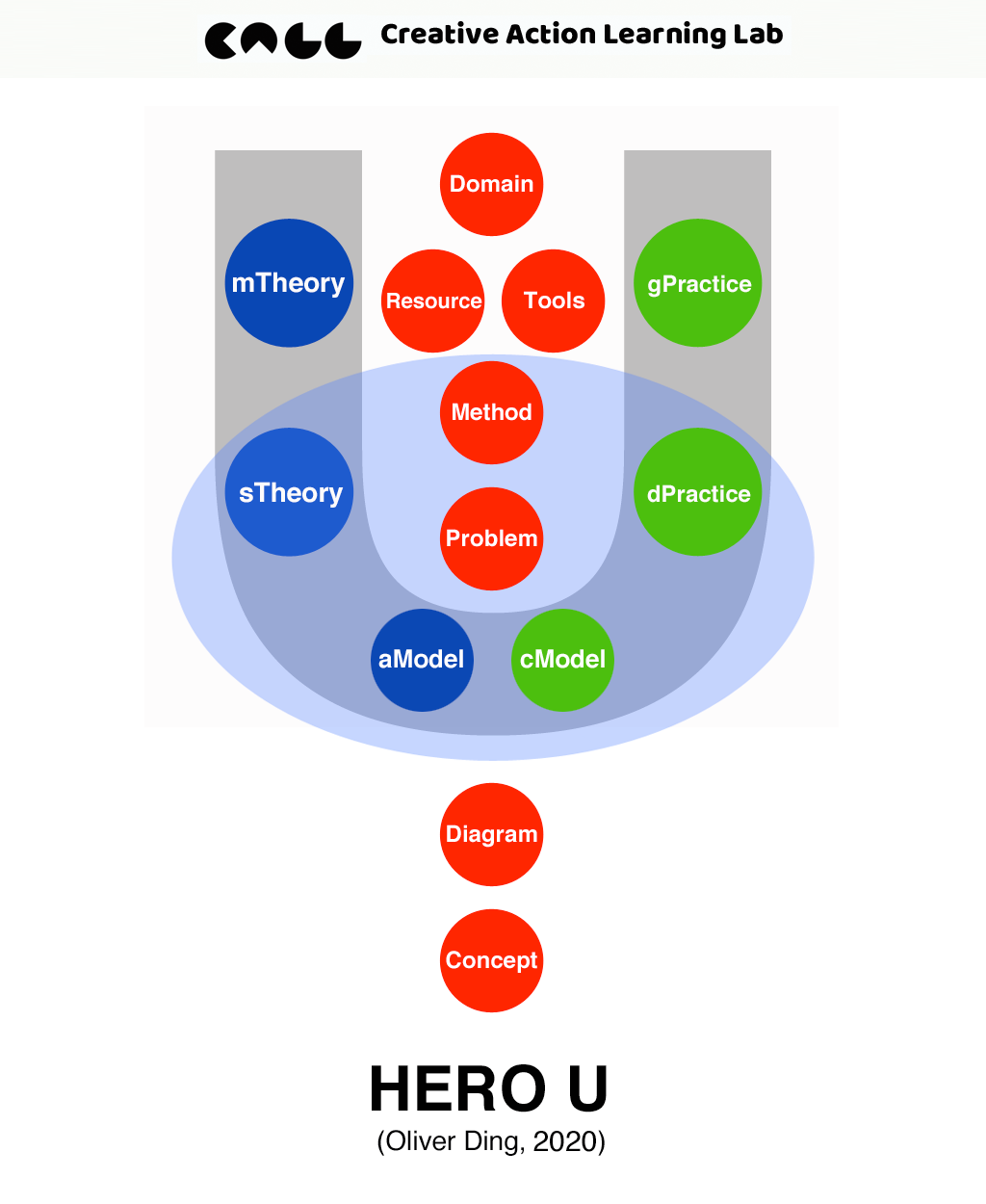
The diagram below presents my mind behind the work. The picture has seven red dots: Domain, Resource, Tools, Problem, Method, Concept, and Diagram. These elements are from the HERO U framework (the article, the diagram). The seven red balls refer to Personal Conditions of Knowing. The first group is Domain, Resource, and Tools, they define the outside setting of the knowing activity. The second group is Method and Problem, they define the source of competence and solution. The third group is Diagram and Concept, they define the representation format of the outcome of knowing. These three groups form a process of knowing.
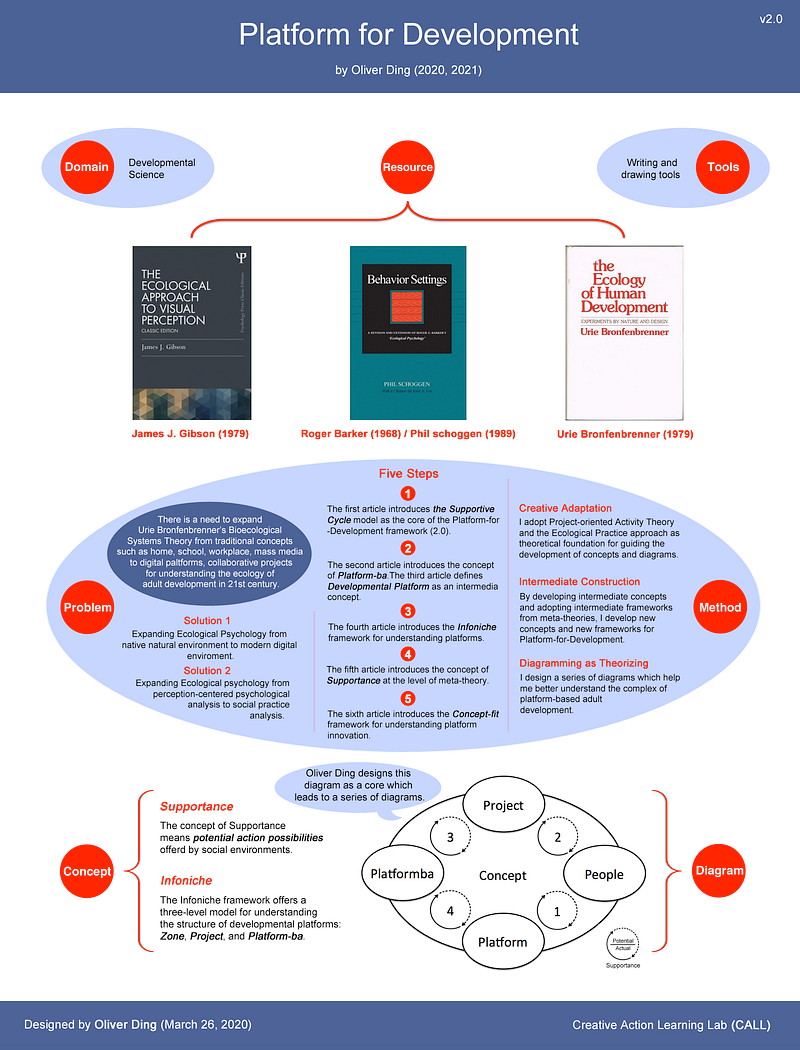
I have used the same diagram for my interpretation of Yrjö Engeström’work on developing the model of human activity and Andy Blunden’s “Project as a unit of analysis of activity” approach. However, these two projects are knowledge curation work. This time, I use it for knowledge creation.

Readers can use this diagram as a map for reading my articles. The most important piece is the five steps.

  • The first article introduces the Supportive Cycle model as the core of the Platform-for-Development framework (2.0).
  • The second article introduces the concept of Platform-ba. The third article defines the Developmental Platform as an intermedia concept.
  • The fourth article introduces the Infoniche framework for understanding platforms.
  • The fifth article introduces the concept of Supportance at the level of meta-theory.
  • The sixth article introduces the Concept-fit framework for understanding platform innovation

Readers can also pay attention to my methods: Creative Adaptation, Intermediate Construction, and Diagramming as Theorizing.

  • Creative Adaptation: I adopt Project-oriented Activity Theory and the Ecological Practice approach as the theoretical foundation for guiding the development of concepts and diagrams.
  • Intermediate Construction: By developing intermediate concepts and adopting intermediate frameworks from meta-theories, I develop new concepts and new frameworks for Platform-for-Development.
  • Diagramming as Theorizing: I design a series of diagrams that help me better understand the complexity of platform-based adult development.

A Toolkit

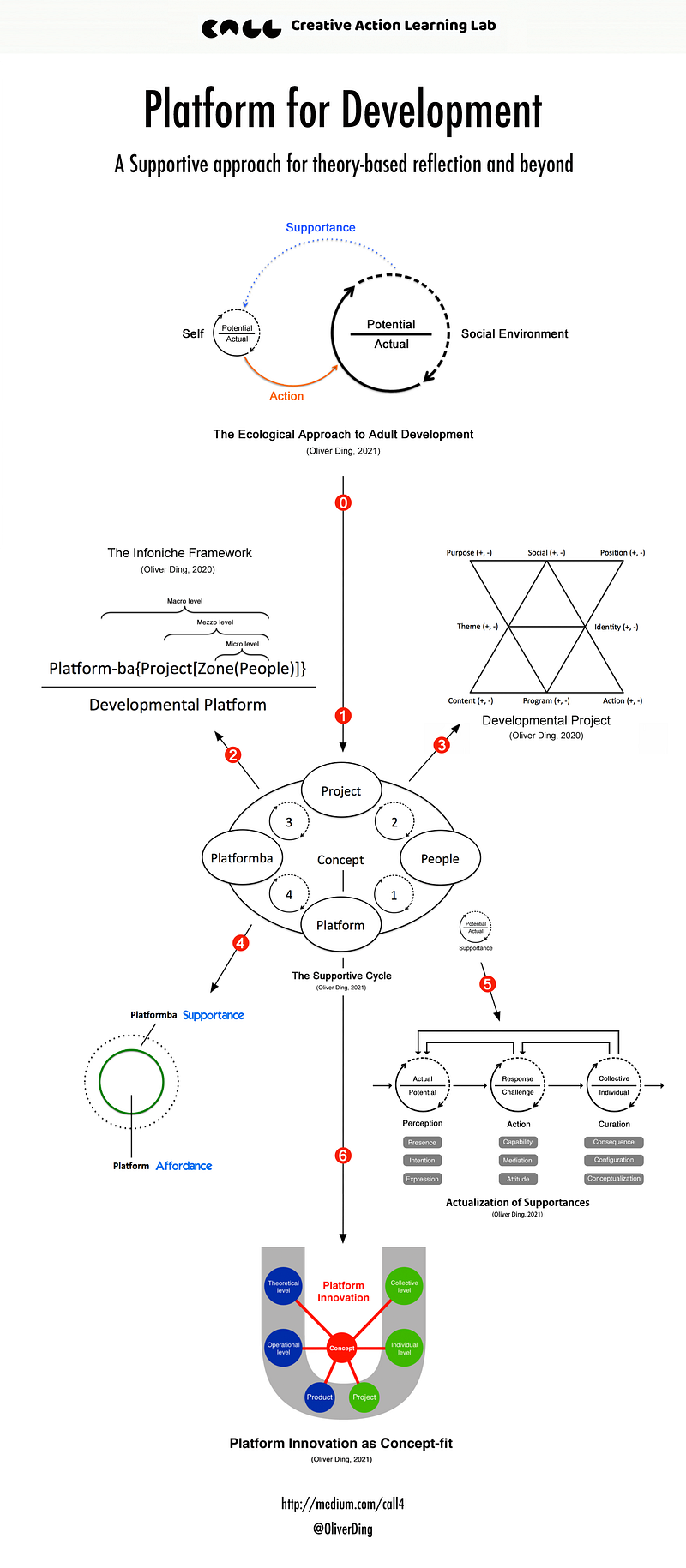
The v2.0 framework is a set of sub-frameworks that can be considered a toolkit. The below infographic is a visual summary of my writings.
A Possible Book

If we consider these articles as a book, then we can reorganize their structure. Also, we can add some sections of articles from “Project-oriented Activity Theory (Booklet)” for this new book.

I’d like to divide this new book into the following five parts:

Part 1: Development Part 2: Affordance Part 3: Supportance Part 4: Infoniche Part 5: Concept-fit

The following section lists the Contents of the book. If you want to know more details, you can click this link.

Part 1: Development

  • Chapter 1: The Environment of Adult Development
  • Chapter 2: Developmental Platform
  • Chapter 3: The Socio-Ecological Approach to Development

Part 2: Affordance

  • Chapter 4: Hammer, Hammering, Affordance
  • Chapter 5: Ecological Physics Method
  • Chapter 6: Affordance-in-Context

Part 3: Supportance

  • Chapter 7: The Ecological Practice Approach
  • Chapter 8: Supportance as A Meta-concept
  • Chapter 9: Actualization of Supportances

Part 4: Infoniche

  • Chapter 10: The Infoniche Framework
  • Chapter 11: The Structure of Developmental Platforms
  • Chapter 12: The Supportive Cycle

Part 5: Concept-Fit

  • Chapter 13: Activity as Formation of Concept
  • Chapter 14: The Objectification of Concept
  • Chapter 15: The Concept-fit Framework

Epilogue

  • Toward a Platform Ecology

The v2.0 framework also adopts Project-oriented Activity Theory to discuss the idea of the Project. If you want to learn more about the theory, you can click here.

You are most welcome to connect via the following social platforms:

Twitter: https://twitter.com/oliverding Doowit: https://doowit.co/profile/gm0k2ax9 Linkedin: https://www.linkedin.com/in/oliverding

License

This work is licensed under the Creative Commons Attribution-NonCommercial-ShareAlike 4.0 International (CC BY-NC-SA 4.0) License. Please click on the link for details.

Platform
Platform Thinking
Project Based Learning
Framework
Adult Development Theory
Recommended from ReadMedium