
Knowledge Discovery: The “Frameworks — Insights” Mapping
The END of Knowledge Discovery Activity
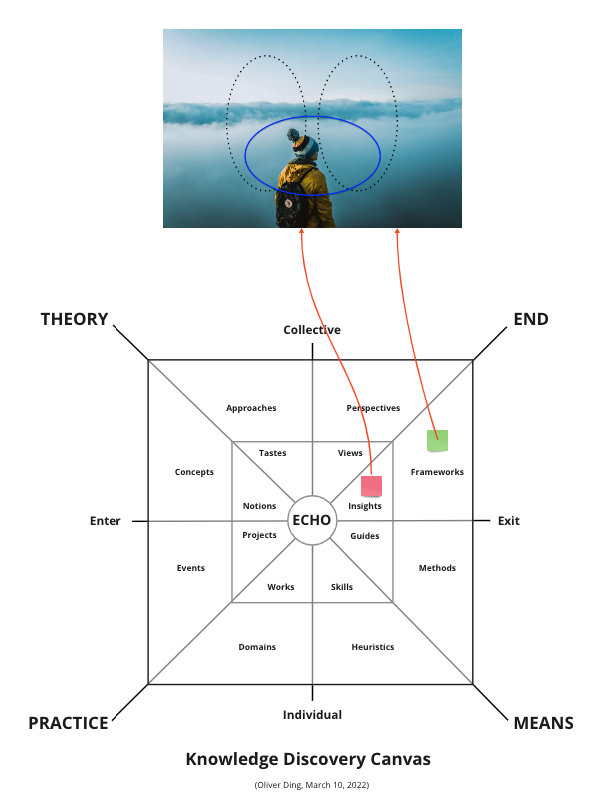
This article is part of the Slow Cognition Project which focuses on Developing Tacit Knowledge with Thematic Space Canvas. The Knowledge Discovery Canvas is an application of the Thematic Space Canvas.
The Knowledge Discovery Canvas has two nested squares which divide the thematic space into two sub-spaces: inner space and outer space. For Developing Tacit Knowledge, the inner space is all about personal knowing activities while the outer space is related to social interactions.
Based on the above settings, I generated a series of mapping between outer space and inner space:
- Approaches — Tastes
- Concepts — Notions
- Events — Projects
- Domains — Works
- Perspectives — Views
- Frameworks — Insights
- Methods — Guides
- Heuristics — Skills
Today I’ll focus on the Frameworks — Insights mapping and discuss a related issue: the END of Knowledge Discovery Activity.
1. Frameworks are Models of Reality
For the Knowledge Curation Project and the Knowledge Discovery Canvas, I use Frameworks and Models interchangeably.
Based on the HERO U framework, I understand Knowledge Frameworks as a category that contains two types of models: Abstract Model (aModel) and Concrete Model (cModel).
1.1 Meta-theory v.s. Specific Theory
Last year I developed the HERO U framework for knowledge heroes. The framework uses the following diagram to display six types of “objective of knowing”.
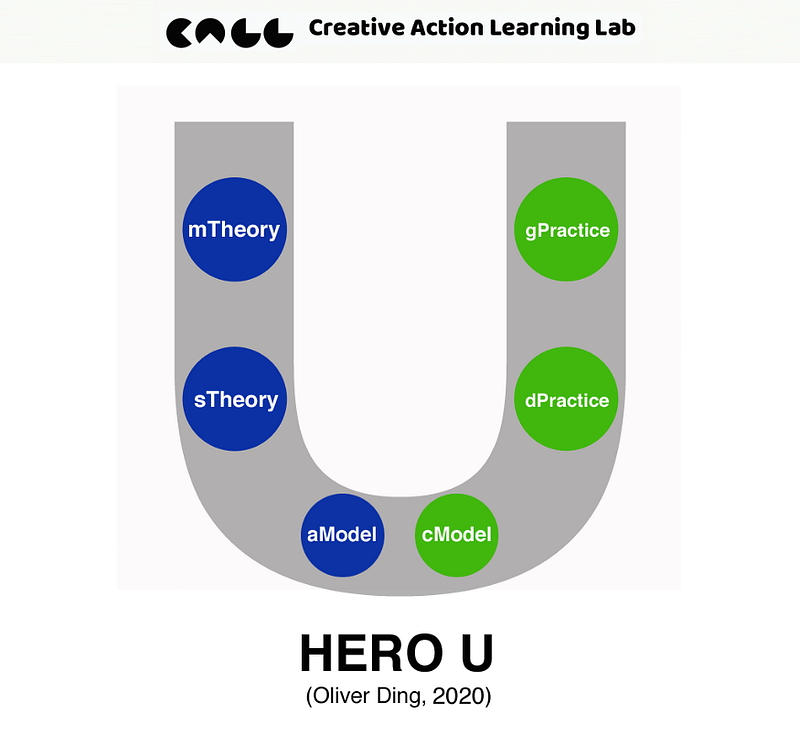
- mTheory: Meta-theory
- sTheory: Specific Theory
- aModel: Abstract Model
- cModel: Concrete Model
- dPractice: Domain Practice
- gPractice: General Practice
Meta-theory (mTheory) means philosophical approaches or theoretical perspectives which can guide researchers to develop their own theory in a special domain. For example, Activity Theory or the “Cultural-historical theory of activity (CHAT)” is an interdisciplinary philosophical framework for studying both individual and social aspects of human behavior. I also consider some established theories in special domains as meta-theory. For example, Self-Determination Theory (SDT) is a type of psychological motivation theory. As a meta-theory, SDT represents a broad framework for the study of human motivation and personality with six mini-theories.
Specific Theory (sTheory) refers to discipline-dependent theories. This type theory only applies to a particular domain or field. For example, Event System Theory is an event-oriented approach to the organizational sciences. Specific theory can be guided by meta-theory. For example, the Job Crafting Theory is a theory about career and it is based on the Self-Determination Theory. Expansive Learning Theory is developed within the framework of Activity Theory.
The bridge between theory and practice is Model. I defined two types of models, one is Abstract Model (aModel) and the other one is Concrete Model (cModel).
1.2 Abstract Models v.s. Concrete Models
Abstract Models (aModel) are high-level models which connect theoretical approaches with special domains. For example, Paula Jarzabkowski introduced Activity Theory to Strategy as Practice in a paper, she explained some specific concepts associated with Activity Theory and indicated its value for studying Strategy as Practice. She presented an activity system framework with a new diagram.
Concrete Models (cModel) are lower-level models with details for directly guiding domain practice. For example, researchers of the HCI (Human-Computer Interaction) discipline found that the Activity Theory conceptual approach highlights the importance of computer users’ social and cultural behavior in context and helps designers and developers understand complex and intertwining issues that impact the usefulness of objects. However, there is no established standard method for connecting Activity Theory concepts with HCI practice. Activity Theory doesn’t provide ready-made techniques and procedures for research and design.
Noticing the lack of a standard and specified method for applying Activity Theory within HCI, Daisy Mwanza developed an Activity-Oriented Design Method (AODM) with four methodological tools. Mwanza highlighted the benefits of AODM for HCI researchers and designers: 1). AODM provides a structured and grounded approach for operationalizing Engestrom’s (1987) activity triangle model; 2). The AODM approach can easily be integrated with other design methods; 3). AODM can be successfully applied to the analysis of real-world settings; 4). AODM produces data that can be meaningfully interpreted and usefully incorporated in system design; 5). AODM can be easily used by designers and other users with little knowledge of Activity Theory (p.198).
While theories are represented with theoretical concepts without diagrams, models usually rely on diagrams for visual representation. People also called these models frameworks.
2. Concepts and Frameworks
A knowledge framework is a bridge that connects theory and practice. An ideal knowledge framework should contain two types of concepts:
- Theoretical Concepts
- Operational Concepts
Theoretical Concepts are adopted from Meta-theory or Specific Theory. Some frameworks don’t associate with any theories, they only have operational concepts.
Operational Concepts are framework-dependent concepts for guiding research and reflection. For example, Yrjö Engeström’s Activity System Model is a knowledge framework. Its diagram displays seven operational concepts.
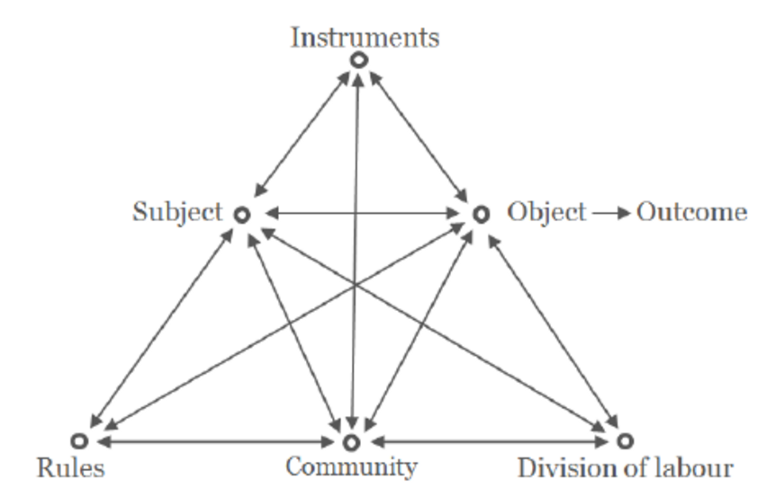
We should notice that a knowledge framework can directly adopt some theoretical concepts as its operational concepts. For example, the above diagram shows “Subject” and “Object” which are core theoretical concepts of Activity Theory. However, some researchers use “Actor” to replace “Subject” with the same diagram for their own work. The concept of “Actor” should be understood as an operational concept. For real-life research, the difference between “Subject” and “Actor” doesn’t matter since we need to see the final data which refers to a person or several people.
While Yrjö Engeström uses the word “Instruments”, other researchers use “Mediating Tool” or similar words. For example, Maral Babapour, Antonio Cobaleda-Cordero, and Marianne Karlsson adopt Activity Theory to develop a framework for understanding the interrelations between users and workplace design. They use the word “Mediating Tool”.
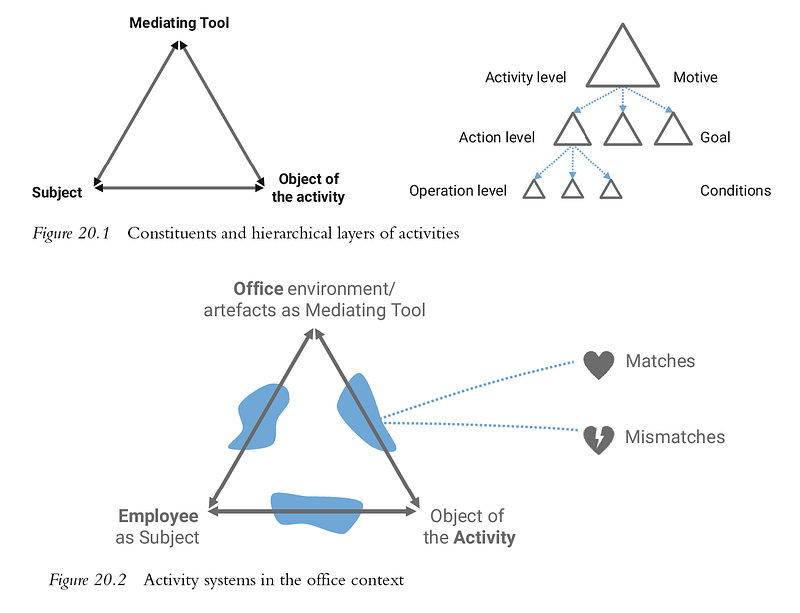
Both theoretical concepts and operational concepts can be defined precisely or vaguely. For example, the scope of the concept of “Instruments/Mediating Tool” is very broad in Activity Theory. The above diagram shows an example, the authors understand “Office Environment” as a “Mediating Tool” from the perspective of Activity Theory. Since Activity Theory doesn’t have a theoretical concept of “Environment,” researchers tend to use the concept of “Instruments/Mediating Tool” to understand “Environment”.
We also should notice that a knowledge framework’s diagram may not display some key theoretical concepts. In fact, we don’t have to display theoretical concepts in a diagram because we can discuss them with words in a research report. For example, the concept of “Mediation” is a foundational theoretical concept of Activity Theory. In fact, Yrjö Engeström’s Activity System Model was developed with double mediations. However, the Activity System Model doesn’t display the word “Mediation” in its diagram.
3. Intermediate Frameworks
In Knowledge Discovery: The “Middleware” Strategy, I discuss using Intermediate Constructions to connect Theory and Practice. In April 2021, I wrote a book titled The ECHO Way: Echozone and Boundary Knowledge Work to reflect on connecting Theory and Practice via the HERO U framework. In the book, I wrote a chapter called Intermediate Construction and discussed several cases I made during the process of writing three books.
I used the following types of Intermediate Constructions for my work:
- Intermediate Concepts
- Intermediate Frameworks
- Intermediate Diagrams
The article about the “Middleware” strategy shares one example of Intermediate Concepts and a related Intermediate Framework. For the present discussion, I’d to share one more example from The ECHO Way.
On Jan 18, 2021, I published an article titled Activity U (XI): Process, Position, and Zone of Project and introduced a new concept called Zone of Project. This concept is part of Project-oriented Activity Theory.
In order to understand the internal structure and dynamics of Project from the perspective of Activity Theory, I propose the concept of Zone of Project which is inspired by Lev Vygotsky’s Zone of Proximal Development and Roger Barker’s Behavior Settings theory.
As an important step in expanding the approach of Project-oriented Activity Theory, the concept of “Zone of Project” is an outcome of a conceptual curation that is inspired by the Ecological ZONE framework and Project-oriented Activity Theory. The theoretical resources of these two frameworks are the ecological approach and the cultural-historical approach. Thus, it is a challenge to achieve this goal.
I focused on the possible connection behind the thread of “Vygotsky-Cole-Barker”. The following diagram represents my strategy for this complex conceptual curation.
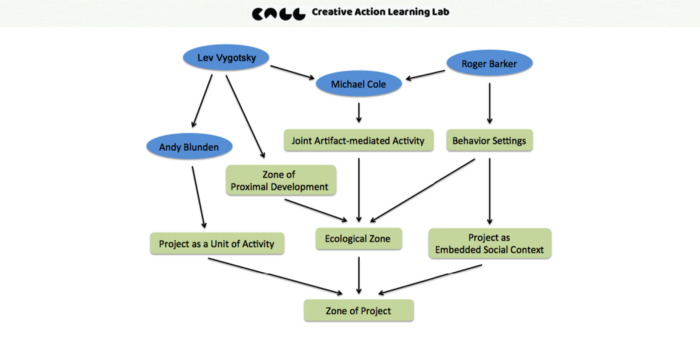
Position and Process are two useful concepts for discussing the internal structure and dynamics of Projects. In addition, I also add Themes as an important concept for this discussion.
In particular, I use a unique way to explain these three concepts by curating “Project as a Unit of Activity”, “Ecological Zone” and “Project as Embedded Social Context”. The final outcome is the new concept “Zone of Project”.
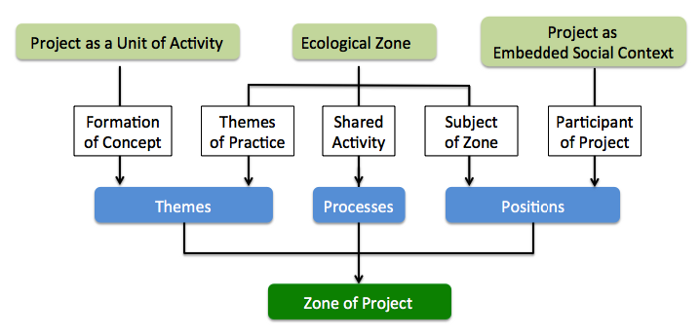
The above diagram represents the structure of this conceptual curation. You can find more details here.
The above two frameworks are only for producing the new concept of “Zone of Project”. As Intermediate Frameworks, they represent a theoretical dialogue between ecological psychology and the cultural-historical approach.
4. Integrated Frameworks
In recent knowledge curation projects, I also use “Integrated Frameworks” to describe multiple-perspective knowledge frameworks.
What’s the difference between normal frameworks and integrated frameworks? While the former is formed by several concepts, the latter is formed by several perspectives.
For example, the Diagramming as Practice framework is an Integrated Framework because it was made with four practical perspectives.
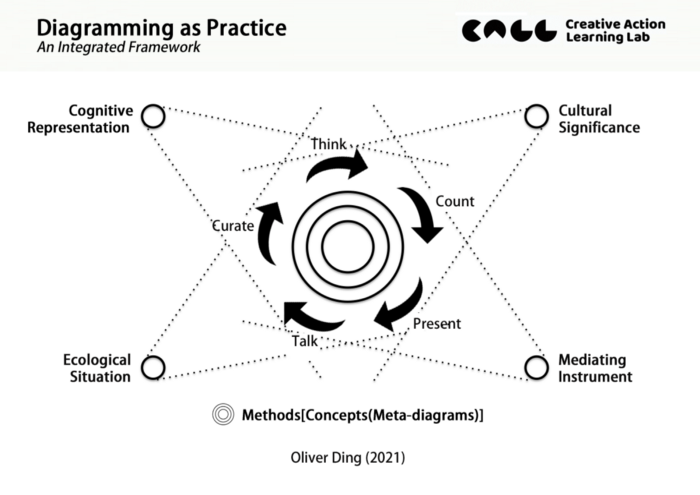
The above diagram is an integrated framework for studying knowledge diagrams. I used the following four practical perspectives to build the framework:
- Cognitive Representation
- Cultural Significance
- Mediating Instrument
- Ecological Situation
If you pay attention to the following model of Knowledge Curation. You can find two small circles: Practical Perspectives and Integrated Frameworks.
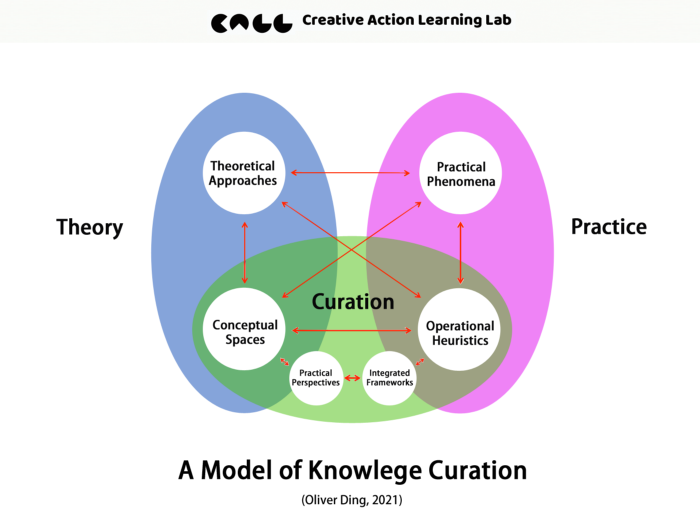
In fact, the above model presents six types of objects for curating. In order to present details of the case, I developed a canvas for mapping six types of Objects of Curating.
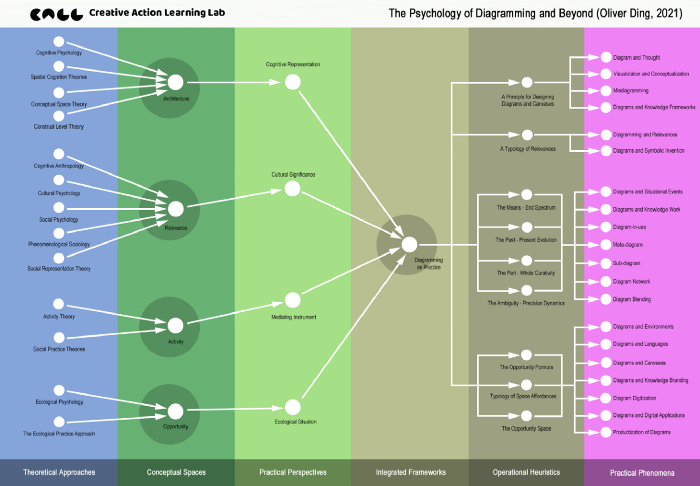
I used the integrated framework to summarize insights I discovered from the D as Diagramming project (phase I) and edited a book. You can find more details here (1, 2).
5. Frameworks, Diagrams, and Canvases
How to develop a knowledge framework? There are at least two ways:
- Curating Concepts
- Curating Perspectives
If we want to curate several concepts or perspectives together and make a new meaningful whole, what kind of tools can we use?
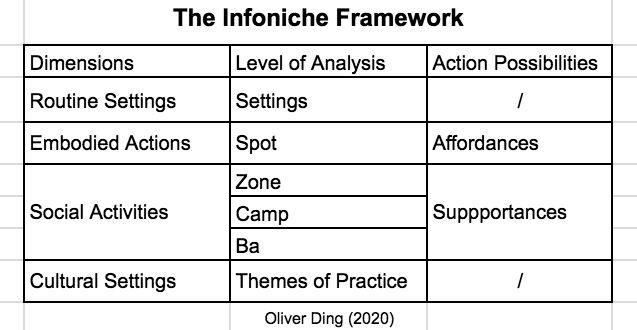
I have tried tables and diagrams. For example, I made the table below for building the Infoniche Framework in 2020. The concept of “Infoniche” was inspired by James Gibson’s concept of “Niche”. Unlike Roger Barker, Gibson doesn’t develop a systematic analysis framework for his version of “Niche”. Inspired by Barker’s work on the theory of Behavior Settings, I develop a concrete analysis framework for applying the concept of Infoniche to empirical studies.
In April 2021, I designed the following diagram for the Infoniche Framework.
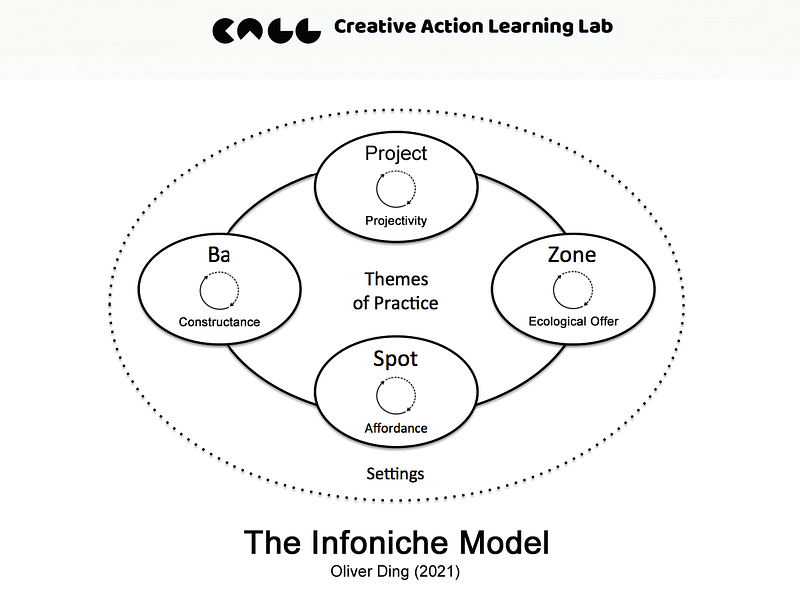
The above diagram offers a visual layout for the Infoniche Framework. You can find more details here.
I’d like to point out that diagramming is not only for thinking. We don’t have to use a diagram to represent an idea. We can also use diagramming to develop an idea. I use diagrams for knowledge curation because diagrams are a great effective meditation for curating concepts and presenting relationships between concepts. The outcome of Diagramming as Thinking are frameworks, sub-frameworks, models, etc.
Some thinkers tend to use writing as thinking. The difference between Diagramming as Thinking and Writing as Thinking is the ways we use words. For the former, the words are used independently. These words are keywords that build connections to my memories about some theoretical knowledge and my previous ideas. For the latter, the words are used within sentences. You can find an example here.
There is another issue to consider in the present discussion since we are talking about frameworks and diagrams. In the past years, the knowledge canvas became a popular knowledge container in various fields. What is the major difference between a framework/diagram and a canvas? A simple answer is that the former focuses on expressing the relationship between several concepts while the latter primarily offers spaces for posting notes which can be considered as data about concepts. In other words, a canvas is a situational application of a framework/diagram.
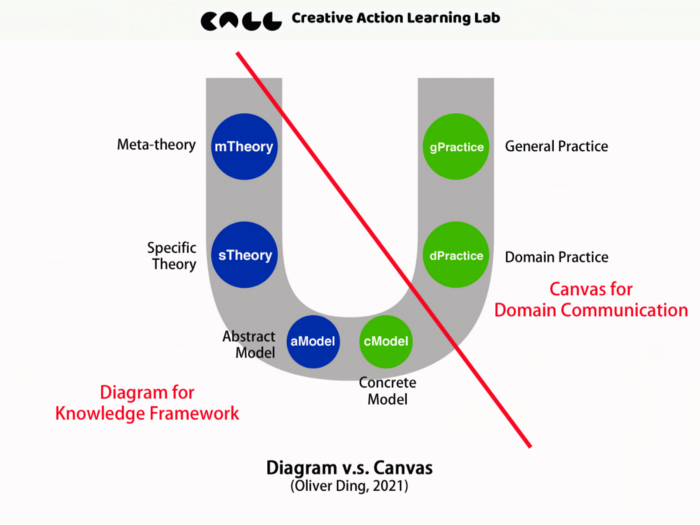
When you design a diagram, your goal is to find an ideal spatial structure to represent a set of concepts and their relationship. You don’t have to consider making spaces for others to add data about concepts. People tend to add notes around the diagram if they need to do it. For example, I made the diagram below in July 2021. I just added some texts which refer to a set of metaphors about Strategy and Design around the diagram.
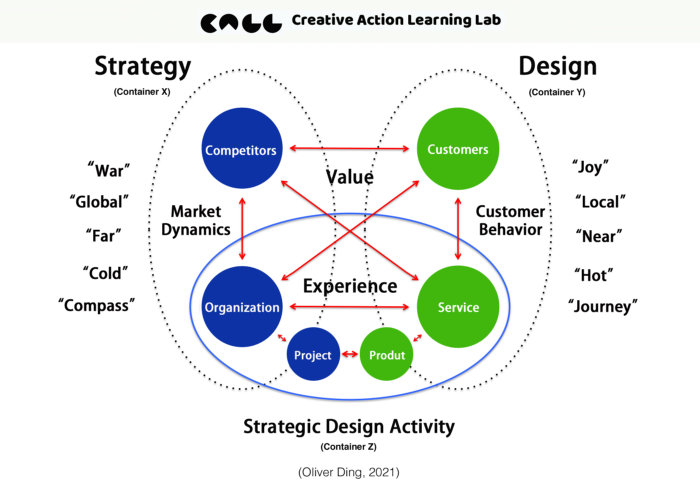
The original diagram is When X Meets Y (WXMY). I didn’t design spaces for adding notes. I discovered these spaces for adding notes which don’t correspond to the concepts of the diagram. Here we have to pay attention to the picture and the diagram. The picture is a container that contains the diagram. However, the space outside the diagram is part of the picture. The act of adding notes on the space refers to the picture, not the diagram. This insight is very important if we talk about diagram-in-use for a particular situation in a particular environment. For further discussion, you can read this one: Physical Space Affordances and Graphic Space Affordances.
You can find more details about diagrams and canvases in D as Diagramming: The Creative Work Canvas.
6. The END of Knowledge Discovery Activity
The Knowledge Discovery Canvas was designed with the following dimensions:
- The Enter—Exit dimension
- The Individual — Collective dimension
The Enter—Exit dimension is inspired by my work on the Ecological Practice approach which highlights the concept of Container. As mentioned above, the thematic space is a super cognitive container. The Enter—Exit dimension describes the whole process of interaction with the container.
For the Knowledge Curation project, the Enter is related to Resources and the Exit is related to Results. That means we consider two types of resources for Developing Tacit Knowledge: Theory and Practice. There are two types of Results for Developing Tacit Knowledge: End and Means. The End refers to “Knowing for All” while the Means refers to “Knowing for Me”.
The “Knowing for All” and “Knowing for Me” are two types of motivations, the former is developing knowledge for public benefit while the latter is developing knowledge for personal practice. This leads to the second dimension: individual — Collective.
The Individual — Collective dimension is inspired by Activity Theory and other social practice theories. I personally consider them as knowledge resources for my “Activity” thematic space. The major notion behind these theoretical approaches is that they consider individual actions within a social practice context or a human activity. For Developing Tacit Knowledge, I also consider personal actions and social context. This is the reason that I don’t use the term “Personal Knowledge Development”.
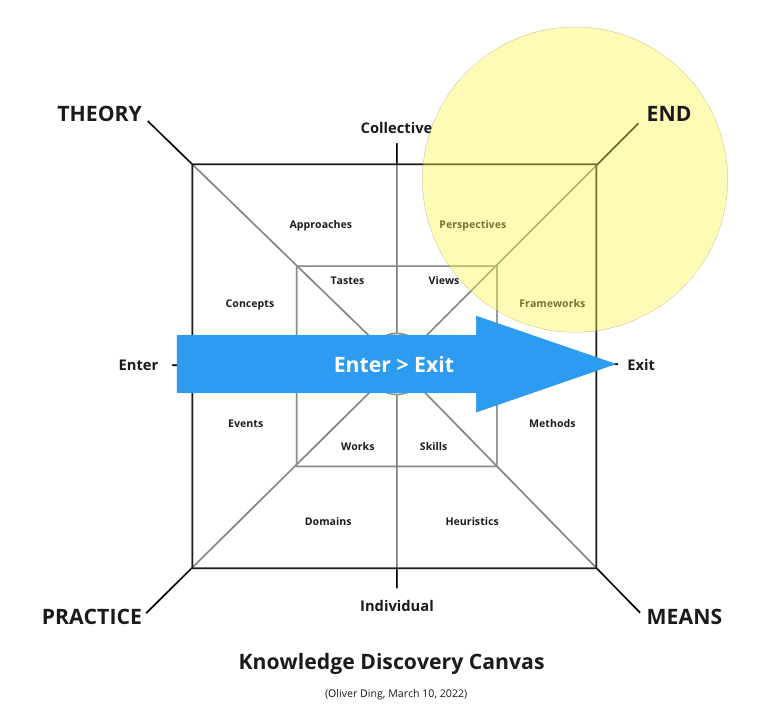
The “Frameworks — Insights” Mapping is located at the END area. While Insights refer to personal knowing, Frameworks are about public contributions. These two things can transform into each other. For example, the diagram below is an insight that was born from writing the article D as Diagramming: An Integrated Framework for Studying Knowledge Diagrams (Part 3A). After publishing, it became a framework.
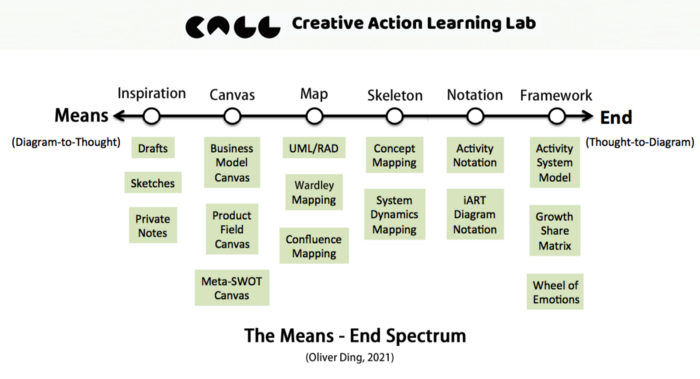
Later, I got some insights from the above framework. For example, I can use it to discover the market niches for diagramming-based products. Also, I can use the model to discuss other things, see this article: Life Discovery: The “Means-End” Spectrum and Becoming.
Now let’s apply the Means-End Spectrum to understand the purposes of using and making Frameworks. I roughly list six purposes for the present discussion.
- Explanation
- Research
- Intervention
- Exploration
- Reflection
- Remember
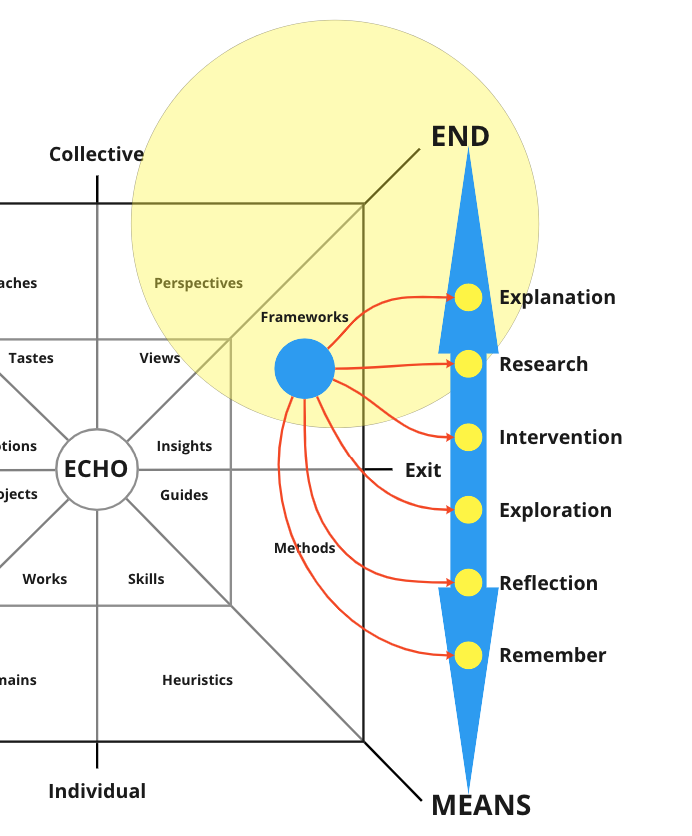
The rest of the article will offer some examples for each type of purpose.
7. Frameworks for Explanation
There are three purposes for making public benefits on the END side:
- Explanation
- Research
- Intervention
Many knowledge frameworks are developed for the purpose of Explanation. They aim to offer a solution for understanding a particular topic or theme, not for designing a program and real actions.
For example, the Concept Dynamics Framework is for understanding the complexity of a concept.
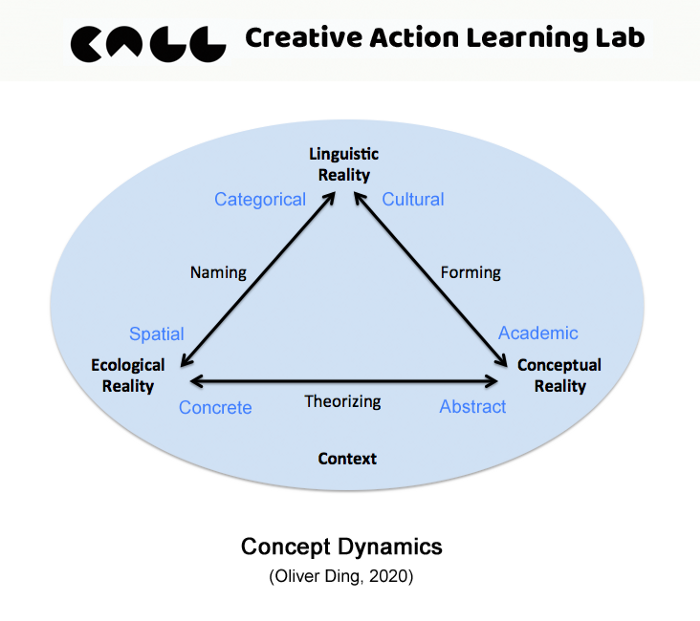
As mentioned above, there are two types of frameworks: abstract model and concrete model. The Concept Dynamics Framework is an abstract model. A related concrete model is the following framework called the evolution of the concept of Affordance.
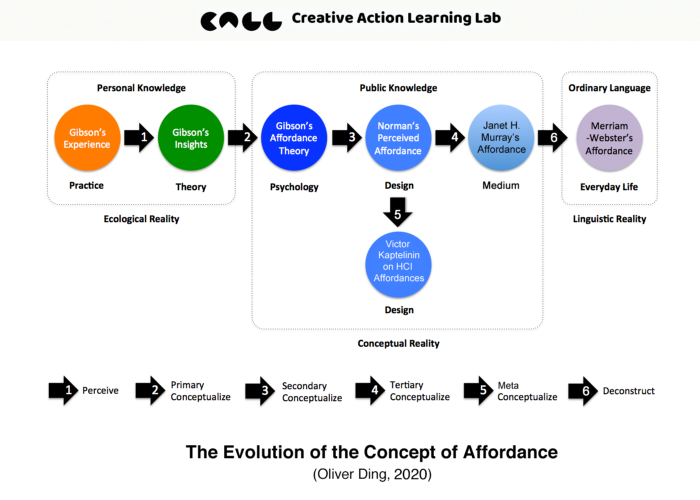
The above model is the outcome of a genetic analysis of the development of the “Affordance” Concept Ecology. You can find more details here.
8. Frameworks for Research
Some frameworks are developed for empirical research. In order to support empirical research, creators tend to use operational concepts to develop frameworks. In this way, people can use these operational concepts to guide the data collecting process.
For example, the diagram below is the basic model of the Lifesystem framework. As an abstract model, it only shows the pair of concepts of “Lifeway — Lifeform”.
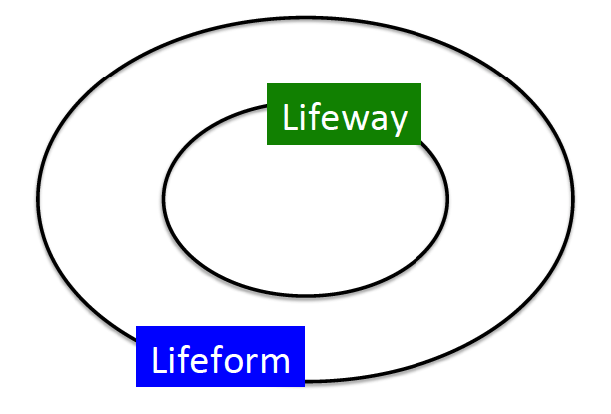
It’s fine to use the above model to discuss theoretical perspectives and theoretical explanations. However, It’s not enough to use it to guide empirical research.
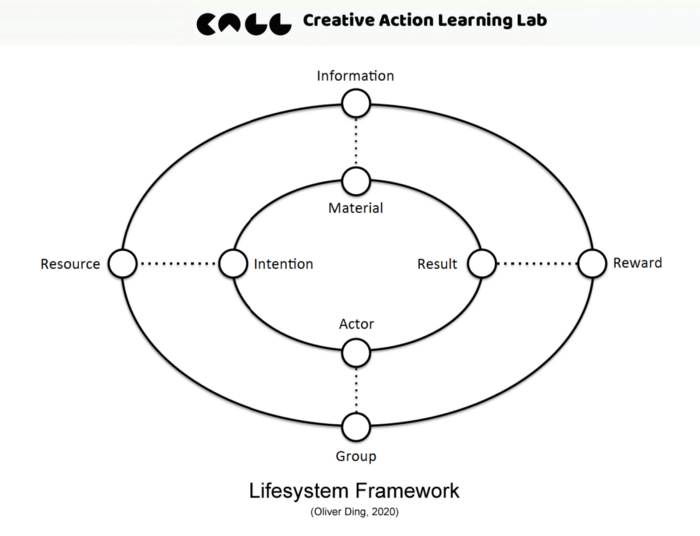
The above diagram is the concrete version of the Lifesystem framework. I defined eight operational concepts for connecting Theory and Practice. As a tool for guiding research and reflection, a knowledge framework is a whole that contains concepts, diagrams, and methods. An ideal knowledge framework should contain two types of concepts:
- Theoretical Concepts
- Operational Concepts
Theoretical Concepts are adopted from Meta-theory or Specific Theory. Some frameworks don’t associate with any theories, they only have operational concepts. Operational Concepts are framework-dependent concepts for guiding research and reflection.
There are two types of reflection. Theory-based reflection adopts theoretical concepts as instruments for reflection while Practice-based reflection uses operational concepts or other heuristics as instruments for reflection. The Lifesystem framework is a member of the family of the Ecological Practice approach, so theory-based reflection is one of the methods of using the Lifesystem framework.
You can find more details here.
9. Frameworks for Intervention
Intervention is about designing a practical intervention program with a framework. For example, the AAS4LT framework which is an eight-step practical framework for dealing with a difficult challenge: Life Transitions.
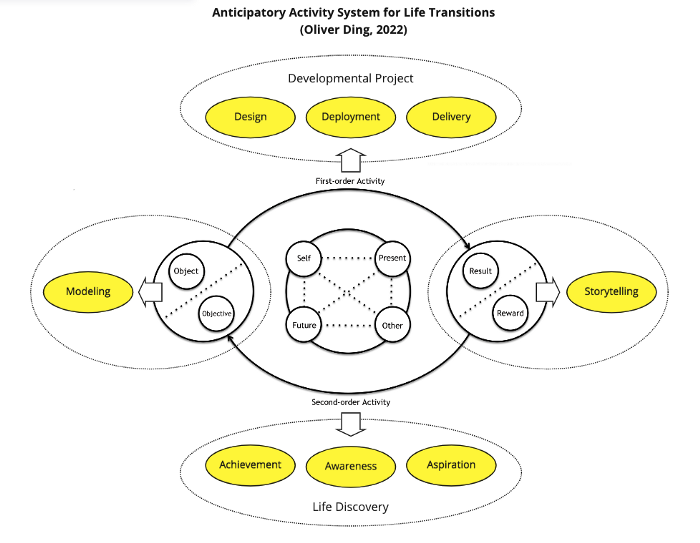
The above diagram is the model of AAS4LT framework. I designed it on March 22, 2022. You can find more details here. By using the framework, I designed a real 1:1 life coaching program on Milanote.com on March 26, 2022.
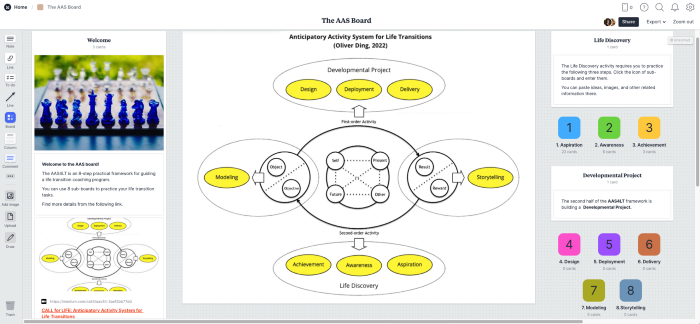
The above picture is a screenshot of the 1:1 life coaching program. You can find more details here.
10. Frameworks for Exploration
There are three purposes for making personal benefits on the MEANS side:
- Exploration
- Reflection
- Remember
Exploration refers to the unknown which means a creative space. For example, the Life Discovery Orientation model is for exploring a possible dialogue between Humanistic Psychology and Activity Theory.
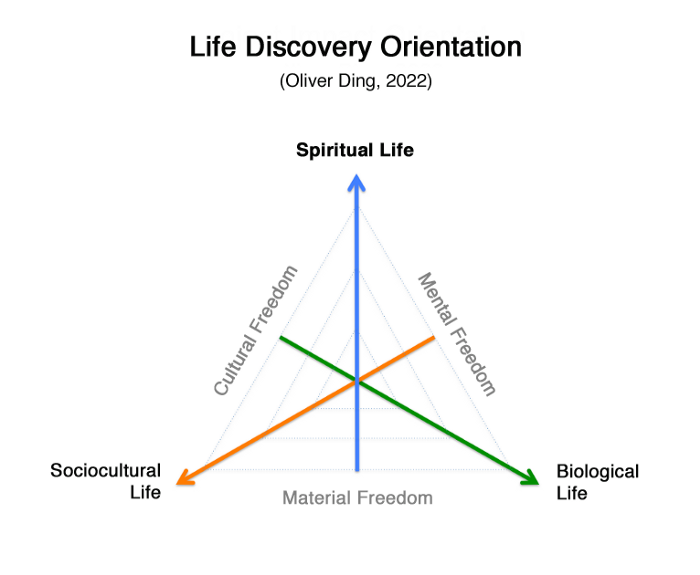
I use three dimensions of the concept of “Life” to develop the above model for the Life Discovery Toolkit. There are at least three ways to understand the concept of “Life”.
- Life as Organism: this is the perspective of biological theories.
- Life as Practice: this is the perspective of social theories.
- Life as Ideal Type: this is the perspective of humanities.
These three perspectives can be called Biological Life, Sociocultural Life, and Spiritual Life. I also defined three types of Freedom.
- Material Freedom: Independence of both Sociocultural Life and Biological Life.
- Mental Freedom: Independence of both Spiritual Life and Biological Life.
- Cultural Freedom: Independence of Sociocultural Life and Spiritual Life.
This model leads to a challenge: What’s Freedom? My rough answer is the following diagram.
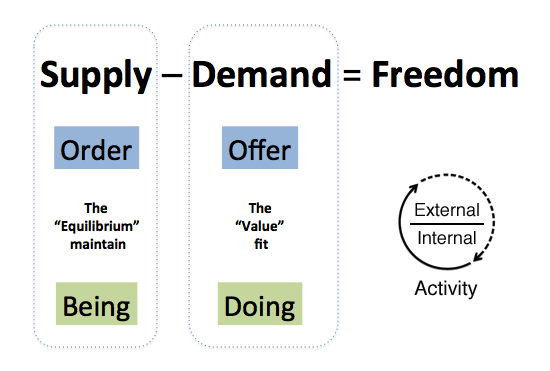
I use a simple formula to define “Freedom”. The pair of concepts of “Supply — Demand” is inspired by economics. Also, I was inspired by the developmental psychologist Robert Kegan’s 1994 book In Over Our Heads: The Mental Demands of Modern Life.
In Over Our Heads focuses on the fit or lack of fit between what the culture demands of our minds and our mental capacity to meet these demands. According to Robert Kegan, “The psychological phenomenon is the evolution of consciousness, the personal unfolding of ways of organizing experience that are not simply replaced as we grow but subsumed into more complex systems of mind…The cultural phenomenon is the ‘hidden curriculum,’ the idea that to the list of artifacts and arrangements a culture creates and the social sciences study we should add the claims or demands the culture makes on the minds of its constituents.”(1994, p.9)
Kegan’s “psychological — cultural” dialogue approach is the seed of my ideas about the above three types of freedoms. It’s clear that I want to expand the “psychological — cultural” dialogue to the “psychological — biological” dialogue and the “cultural — biological” dialogue.
The above diagrams are my intuitive ideas for a possible dialogue between Humanistic Psychology and Activity Theory.
- Activity Theory: Doing means delivering “Value” as Offers to others.
- Humanistic Psychology: Being means maintaining “Equilibrium” as Order for self.
If a person wants to offer values to satisfy others’ demands, he or she should keep a good order for internal equilibrium in order to maintain the supply system.
This is an interesting idea. However, it requires more deep work. Thus, this framework is for exploration.
11. Frameworks for Reflection
Frameworks can be used to reflect on personal work or teamwork. For example, I used a metaphor to develop a framework for reviewing CALL’s projects from 2020 to 2021.
Inspired by Howard E. Gruber’s Evolving Systems Approach to the study of Creative Work (1974,1989), I use his idea “Network of Enterprise” to manage my creative work.
According to Gruber, “We use the term enterprise to stand for a group of related projects and activities broadly enough defined so that (1) the enterprise may continue when the creative person finds one path blocked but another open toward the same goal and (2) when success is achieved the enterprise does not come to an end but generates new tasks and projects that continue it.” (1989, p.11)
I only work on one framework: the Knowledge Curation framework.
However, it is a meta-framework. The purpose of the meta-framework is to produce more knowledge frameworks.
Eventually, I developed a set of knowledge frameworks that form an ecology of ideas. In order to visualize this complicated network of ideas, I use the Big Dipper as a metaphor to design the following diagram.
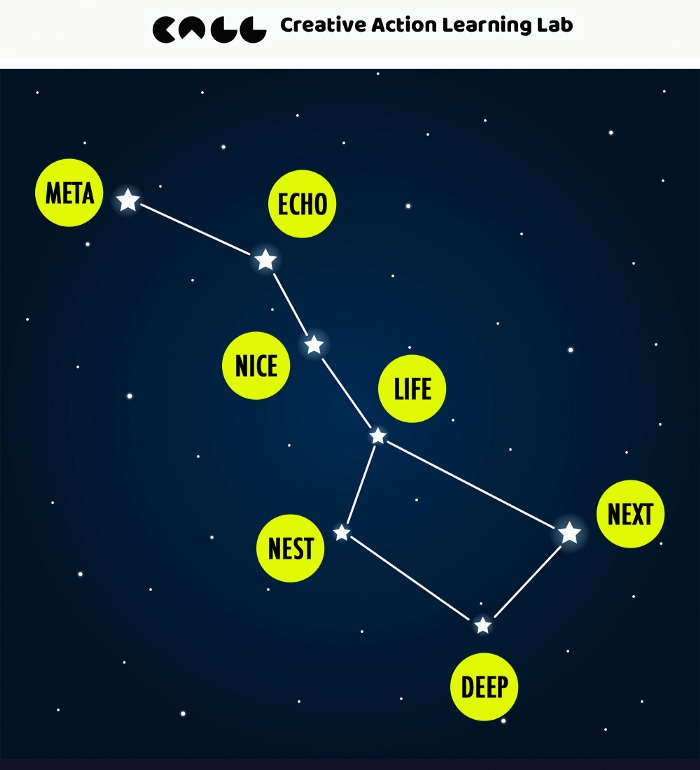
I sort my frameworks into seven enterprises. Each enterprise has a short nickname.
- CALL for ECHO → Boundary Innovation
- CALL for LIFE → Creative Life
- CALL for NICE → Creative Action
- CALL for NEST → Part — Whole
- CALL for DEEP → Supportive Development
- CALL for NEXT → Present — Future
- CALL for META → Meta-knowledge
Each enterprise has its primary theme. Each theme refers to a core framework and a set of related concepts, diagrams, and sub-frameworks.
It’s clear that the above framework is only useful for CALL. It doesn’t have any value for others.
12. Frameworks for Remembering
I often use frameworks/diagrams to curate pieces of information into a meaningful whole. For example, the Sailor’s Mandala and the Drama-fit.
I have mentioned an Online Adult Development program in CALL: Annual Review (2020–2021). In June 2021, one friend of mine started an online adult development program. The program was designed with three components: 1) Life Purpose Awareness, 2) Personal OKR Practice, 3) Peer Review and Feedback. The major part of the program is a monthly peer-support group on several social media platforms.
In Dec 2021, she launched the Phase II of the program and the new program focuses on the issue of Life Transition. On Jan 2, 2022, she closed the first monthly group of Master Life Transition and shared some feedback from participants and her review report with me. Then, we started a conversation about the program.
On Jan 4, 2022, I adopted the hubhood meta-diagram to design the following diagram in order to summarize our discussion about the program.
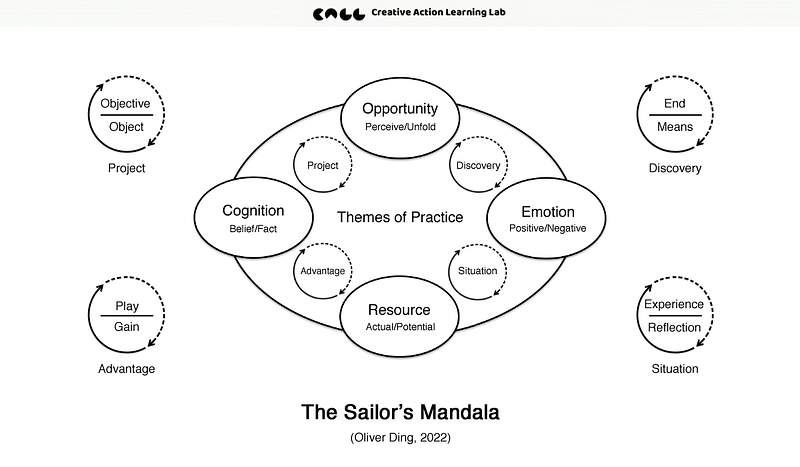
In order to explain the diagram, I sent her a long email. You can find more details here.
Four days later, I had a 99-minute conversation with another friend and I did the same thing. I used the ECHO Way diagram to make the following diagram:
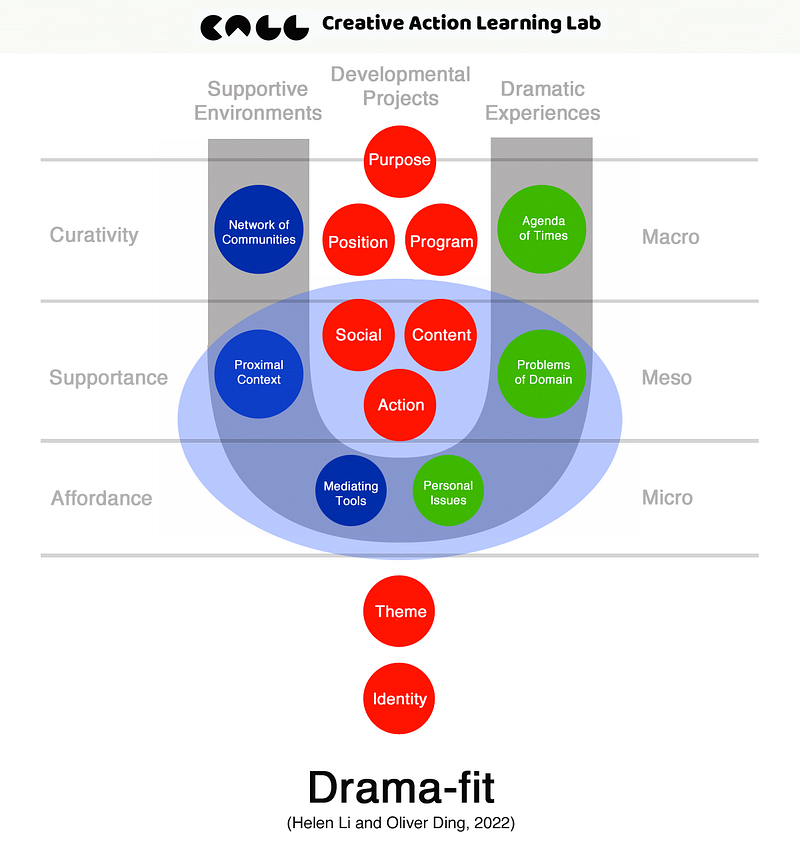
The primary theme of the conversation is about applying theories to youth charity education and youth development in general. So I did a knowledge curation with the above diagram. You can find more details here.
The above two frameworks are only useful for my friends and me. They are used for remembering our discussions.
Related articles
- The Slow Cognition Project
- Slow Cognition: A Meta-canvas for Developing Tacit Knowledge
- Knowledge Discovery: Concepts, Notions, and the Concept Dynamics Framework
- Knowledge Discovery: The “Approaches — Tastes” Mapping
- Knowledge Discovery: The “Perspectives — Views” Mapping
- Knowledge Discovery: The “Frameworks — Insights” Mapping
- Knowledge Discovery: The HERO U Canvas
- Knowledge Discovery: The Concept Dynamics Framework
- Knowledge Discovery: The “Double Theme” Strategy
- Knowledge Discovery: The “Middleware” Strategy
I am also working on building a new website for the Platform Ecology project. You can save the following links:
- PlatformEcology.org
- Twitter: @PlatformEcology
- Linkedin: @PlatformEcology
You are most welcome to connect via the following social platforms:
Linkedin: https://www.linkedin.com/in/oliverding Twitter: https://twitter.com/oliverding Polywork: https://www.polywork.com/oliverding Boardle: https://www.boardle.io/users/oliver-ding


