
CALL for LIFE: Modeling A Developmental Project
Introduce a new framework for modeling developmental projects
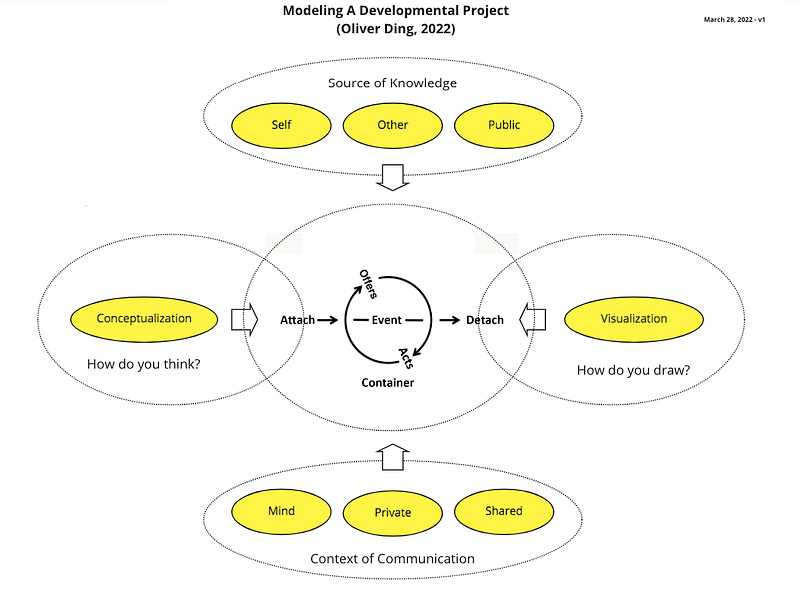
This article is part of both the AAS project and the Life Discovery project. AAS stands for Anticipatory Activity System.
The above diagram is a framework for Modeling a Developmental Project. The Developmental Project is an independent project, I adopted it for the AAS project.
The AAS4LT Framework
On March 22, I developed the AAS4LT framework (AAS4LT stands for “Anticipatory Activity System for Life Transitions”). It was a great milestone for the AAS project.
The AAS4LT framework is born from curating insights from both theoretical development and empirical research.
Though most of the ideas are adopted from the Anticipatory Activity System framework and other knowledge frameworks, the whole structure is inspired by an empirical research project about a person’s one-year life transitions.
If you read my articles about the iART Framework, you probably know that The Anticipatory Activity System is an expanded version of the iART Framework which was born from an empirical research project about an adult development program.
I’d like to call the program SSL which stands for Shaper & Supporter Lab. Anyway, it is just a codename. SSL was founded by a friend of mine in April 2021.
My friend started the journey in Feb 2021. Last month, we worked on reflecting on her life transition in the past 12 months. In the process of reflection, I realized that she did two activities during the one-year journey.
- Second-order Activity: She spent several months on Life Discovery.
- First-order Activity: Seh started the Shaper & Supporter Lab program as a Developmental Project.
I also observed that she also worked hard on modeling her project and storytelling about her life discovery.
This insight inspired me to create the AAS4LT framework. This is an awesome discovery!
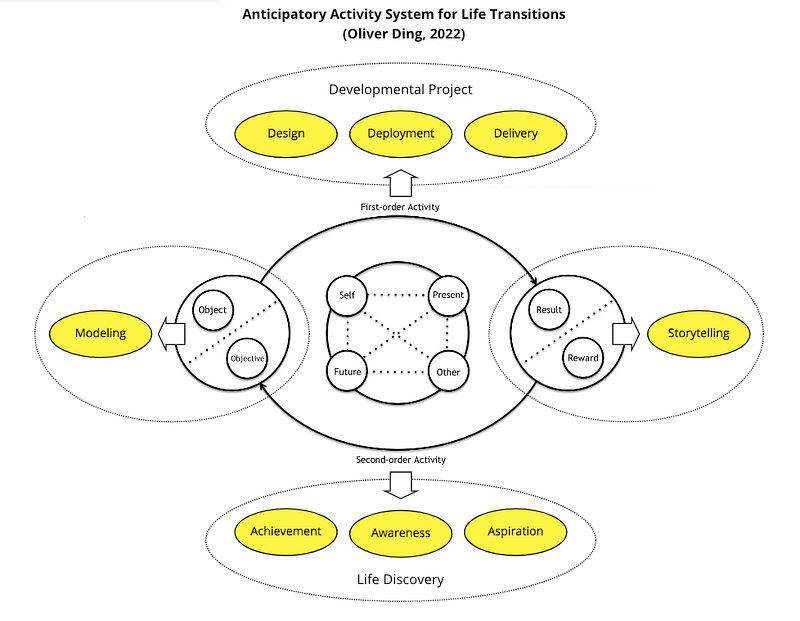
Yesterday I and my friend had a 90-minute video conversation about her project and the AAS project. It was a wonderful movement for both of us. We were super excited to SEE a real connection between Theory and Practice.
The AAS Board
I also started hosting an AAS board on Milanote for a life transition coach program on March 26, 2022.
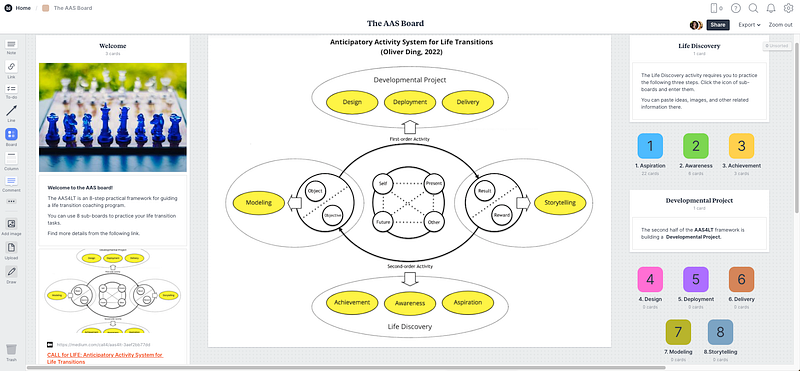
The program is based on the following knowledge models:
- The AAS4LT framework
- The Life-as-Project approach
- The Life Discovery Toolkit (v1.0)
- The Life Discovery Canvas (v1.0)
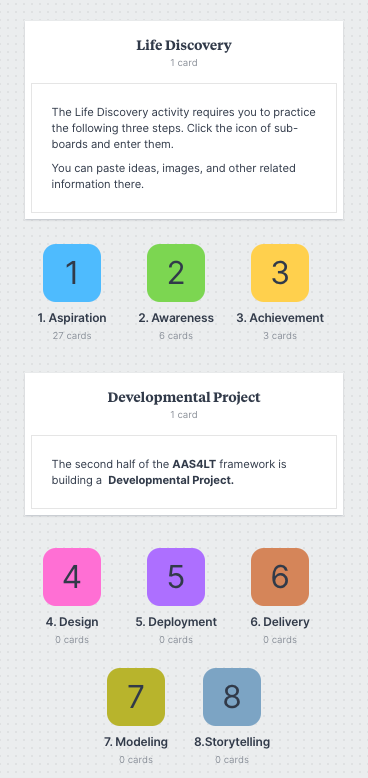
The program is designed with the above eight steps. Each step has its own sub-board where I and a client can work together on the following tasks:
- 1. Understanding The Concept
- 2. Understanding The Example
- 3. Share Your Information
- 4. Discussions
- 5. Reflection
Task 1 and Task 2 are for the client to learn basic ideas about each step. For Task 3, the client has to reflect on her or his own situations and experiences and share relevant information through text, images, links, etc on the sub-board. I will lead Task 4 and respond to the client’s information. Task 5 is for both of us.
A framework for Step 7: Modeling
This morning I designed a new diagram for discussing “Modeling A Developmental Project” which is one of eight steps of the AAS4LT framework. I had discussed this step with my friend.
It’s a huge challenge to model a developmental project. This new diagram fully represents my thought about this issue and I SAW it in my friend’s case.
I use the visual style of the AAS4LT framework to design the above diagram. It has five parts:
- Life Container
- Conceptualization
- Visualization
- Source of Knowledge
- Context of Communication
The center of the diagram is a diagram about Life Container which is adopted from my theoretical work on the Ecological Practice approach:
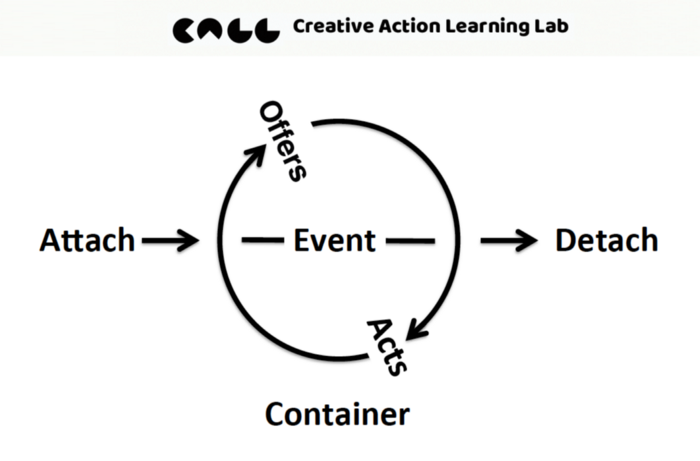
The above diagram combines three core concepts of the Ecological Practice approach together: Affordance, Attachance, and Containance. The term “Offers” is an affordance-inspired concept, it refers to opportunities afforded by the Container. The group of “Offer — Act” forms “Event” which changes the status of the Container. The new status of the Container affords new opportunities which guide the new acts and events. In a broad sense, the Ecological Practice approach has its philosophical roots in traditional Pragmatism.
For the analysis of social contexts, people attach to a life container which is a social container too and detach from the life container. For Life Discovery Activity, we can use “Life Container” to understand some activities. For example, a Developmental Project is a Life Container. A Developmental Project offers new possible action opportunities to a person and the person acts upon these opportunities.
One action opportunity is Modeling A Developmental Project. It is also one of the challenges of running a developmental project. It refers to how a person thinks about a developmental project and builds a model for the project. In the process of running the project, how does she or he change thoughts and modify the model?
A model can be described with text only. Diagrams or other visual things are not necessary for modeling a project. However, if a person can use visual skills to express her or his mind, it would be great for discussing with others.
Conceptualization and Visualization
The process of modeling a developmental project can be understood as a process of developing tacit knowledge about the project.
There are two types of cognitive operations for modeling a developmental project:
- Conceptualization: How do you think about the project?
- Visualization: How do you draw your thoughts?
However, the Visualization operation is not necessary. It all depends on a person’s skills.
I have written several articles about designing knowledge diagrams and knowledge canvases. In an article about knowledge canvases, I suggested a foundational principle for designing canvas:
A good canvas matches visual areas and conceptual spaces with a simple and unique style of spatial configuration.
The principle leads to the following rules:
- Rule 1: Separate several visual areas clearly with lines. Make sure each visual area is identified easily.
- Rule 2: Adopt a special and unique perspective to develop conceptualized knowledge for building conceptual spaces. The more unique the perspective, the greater the value of the canvas.
- Rule 3: Make sure the layout of visual areas matches the structure of conceptual spaces. Take the visualization radically.
- Rule 4: Develop a simple and unique visual style that represents a spatial configuration. The uniqueness is the starting point of a knowledge brand.
I also designed a series of meta-diagrams that can be used for modeling a developmental project.
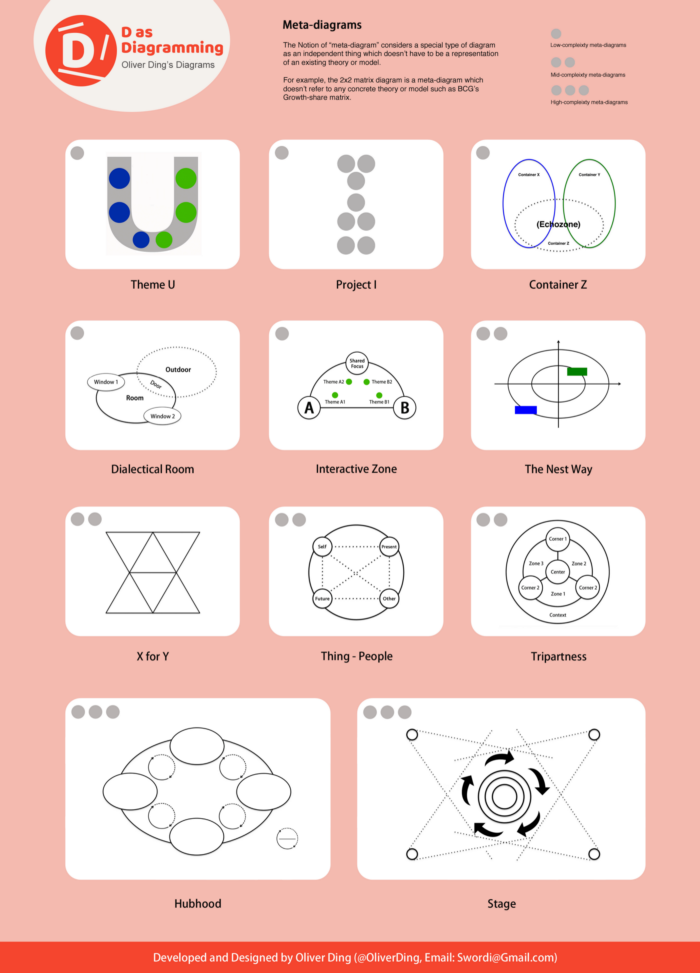
You can find more details from the following related articles and my two book-in-drafts about diagramming.
- D as Diagramming: The Creative Work Canvas
- Diagramming as Practice (Book, version 1.0)
- Diagram Blending: Building Diagram Networks (Introduction)
- Diagram Blending: Building Diagram Networks (Table of Contents)
- Slow Cognition: A Meta-canvas for Developing Tacit Knowledge
While meta-diagrams can help people on dealing with the spatial structure and the challenge of visualization, we also need knowledge resources for conceptualization.
Source of Knowledge
Each project has its own challenges and situations. A person could adopt knowledge from different sources to build a model or modify a model. I roughly consider three types of sources of knowledge:
- Self: the person’s own ideas, experiences, creations, etc.
- Other: a person’s friends or contacts offer some relevant knowledge resources.
- Public: a person can search for relevant knowledge in public spaces such as the internet or libraries.
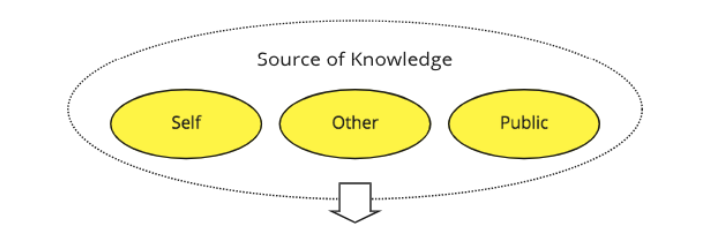
As mentioned above, I am working on an empirical research project about Shaper & Supporter Lab (SSL). From my research, I see the above pattern from my friend’s activities of modeling the SSL program.
The SSL program has been launching three adult developmental services. Each service has its own target users and value proposition. My friend has to curate different knowledge resources with her own insights together to form a model which represents the core idea of service.
In fact, the process of conceptualization is a special type of knowledge curation:
The Theory — Practice Knowledge Curation
My friend has to select some theoretical concepts such as “Flourish Life”, existing thinking tools such as “Write your own eulogy” and practical methods such as OKRs and PDCA for her services. By curating these knowledge resources and insights from market research, she can design a concrete model to guide the development of a service.
Context of Communication
A model can appear in different spaces. I consider the following three spaces:
- Mind: a person thinks about a project and has a rough idea bout it. However, she can’t express it. Or she doesn’t want to express it.
- Private: the person expresses a model of a project in text, voice, or diagram. But she doesn’t share it with others.
- Shared: the person shared the model with others through some communicative channels.
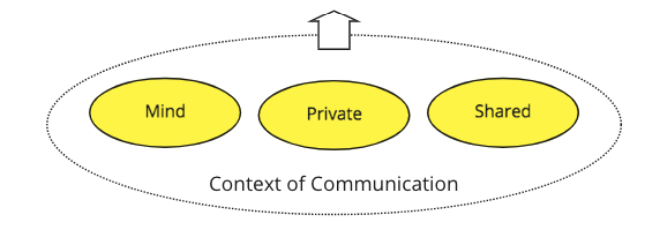
This idea roughly echoes the following model about academic creativity.
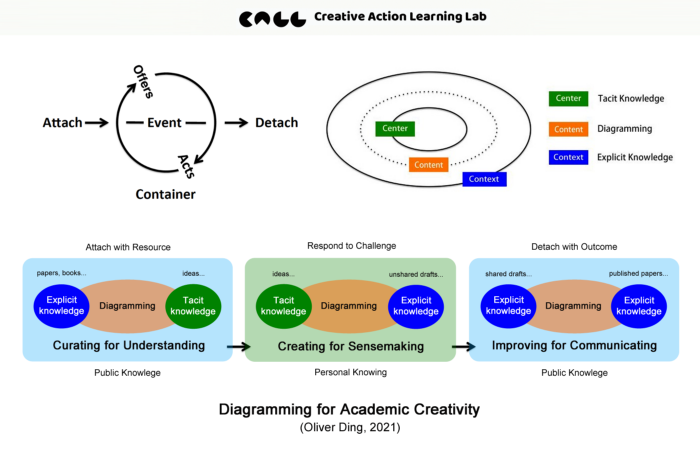
The above diagram highlight three phases and three functions of diagramming for academic knowledge building:
- Phase 1: Curating for Understanding
- Phase 2: Creating for Sensemaking
- Phase 3: Improving Communicating
At different phases, creators act with diagrams for different purposes.
In Phase 1, creators tend to curate existing public knowledge from published papers and books. By acting with existing diagrams, creators turn public explicit knowledge into personal tacit knowledge. This echoes the place of MIND.
In Phase 2, creators work hard for solving theoretical problems and discovering new insights. By creating diagrams, creators turn personal tacit knowledge into personal explicit knowledge. This echoes the place of PRIVATE.
In Phase 3, creators tend to share their personal explicit knowledge with friends or the community and expect feedback from others. The focus of knowledge-building activity moves from sensemaking to communicating in order to produce the final outcome such as published papers or books. This echoes the place of SHARING.
Though my friend is not an academic scholar, she adopts the “HYPOTHESIS — INTERVIEW — TEST — MODELING” process to design and develop her services. It roughly echoes academic research.
You are most welcome to connect via the following social platforms:
Linkedin: https://www.linkedin.com/in/oliverding Twitter: https://twitter.com/oliverding Polywork: https://www.polywork.com/oliverding Boardle: https://www.boardle.io/users/oliver-ding


