
Knowledge Discovery: The “Middleware” Strategy
Developing Intermediate Constructions to connect Theory and Practice
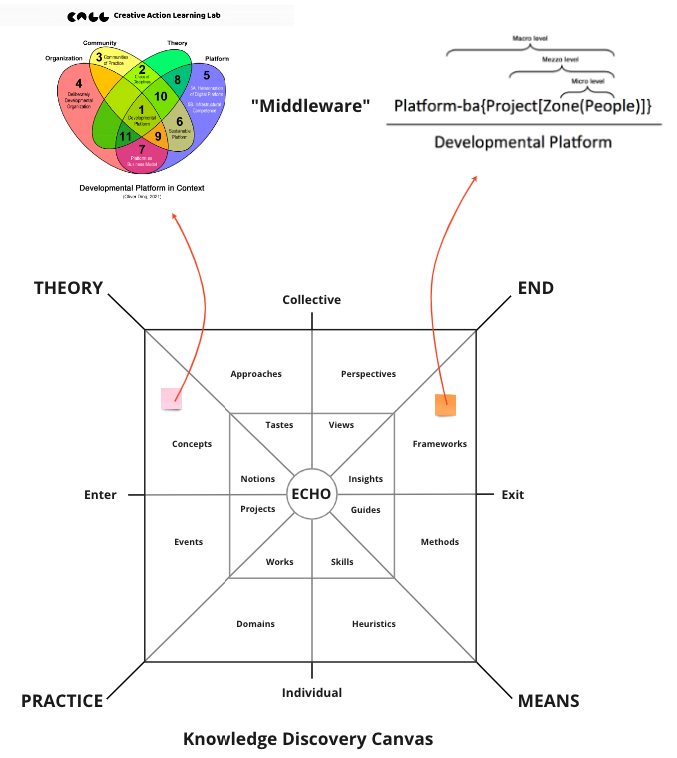
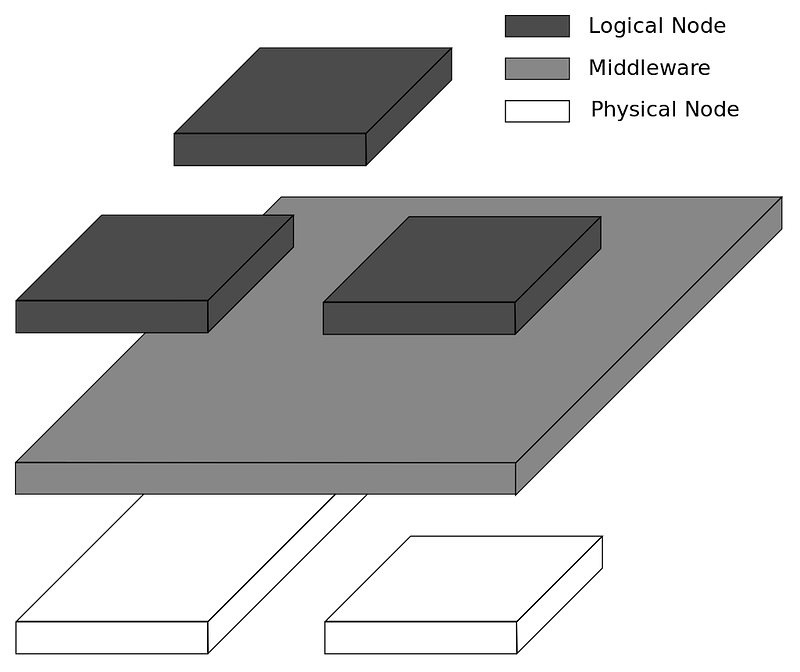
In April 2021, I wrote a book titled The ECHO Way: Echozone and Boundary Knowledge Work to reflect on connecting Theory and Practice via the HERO U framework. In the book, I wrote a chapter called Intermediate Construction and discussed several cases I made during the process of writing the following three books:
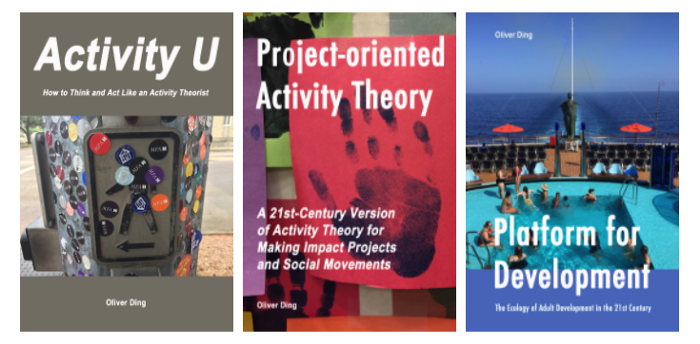
Today I’d like to use the “Middleware” strategy to describe the decision I made. The term “Middleware” refers to a type of computer software that provides services to software applications beyond those available from the operating system.
I use the term “Middleware” as a metaphor to refer to Intermediate Constructions of knowledge-building activities. If you don’t like the “Middleware” metaphor, you can use the “Bridge” metaphor.

I used the following types of Intermediate Constructions for my work:
- Intermediate Concepts
- Intermediate Frameworks
- Intermediate Diagrams
This article focuses on Intermediate Concepts and Intermediate Frameworks. If you want to find an example of Intermediate Diagrams, you can check out Diagram Explained: The Supportance Model and Its History.
The Concept of “Developmental Platform”
In 2021, I wrote a book titled Platform for Development: The Ecology of Adult Development in the 21st Century. The term “Platform” refers to a new concept: Developmental Platform.
Though the original inspiration of the Platform for Development framework (P4D) is digital platforms, I don’t want to limit the scope of the framework inside the domain of digital technological platforms. The P4D framework is expected to apply to various domains such as Startup Ecosystem, Brand and Communication, Community Engagement, Content Curation, Theoretical Traditions, Knowledge Platforms, etc. In other words, I need an interdisciplinary definition of “Platform” for this framework. Thus, I defined a new concept called Developmental Platform in order to avoid misunderstanding.
As an interdisciplinary concept, the term Developmental Platform refers to a social environment that could strongly support adult development in various ways. There are three keywords in this definition:
- social environment
- strongly support
- adult development
The term “social environment” is a rough term. It can refer to traditional social structures such as organization and community. I also consider emergent social contexts such as digital platforms as social environments.
The term “strongly support” divides social environments into two groups from the perspective of strongness. Any social environment could support people, however, there are only a few social environments that could strongly support people. Thus, we can consider some strong social environments as platforms.
The term “adult development” is a solid term in developmental science. Thus, the Developmental Platform highlights the perspective of developmental science.
Do we need such a new concept? In order to answer this question, I used the following Venn diagram to find a creative space for the Developmental Platform. You can find more details here.
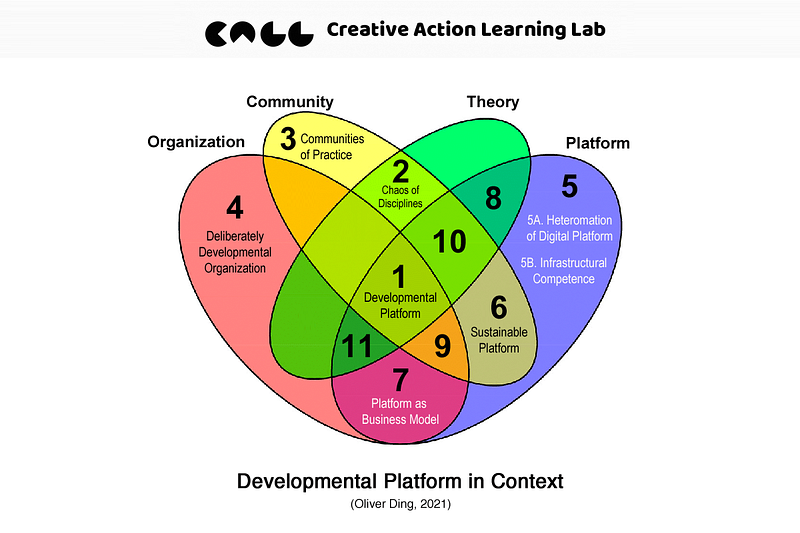
The new concept of “Developmental Platform” is unique because it emphasizes the following aspects:
- It is an interdisciplinary concept that doesn’t only talk about digital platforms, but also about large organizations and established theoretical traditions.
- It is an interdisciplinary concept that adopts the perspective of developmental science.
- It is a concept that focuses on the relationship between platform and people.
- It is a concept that is located at the micro-level of analysis.
- It is a concept that aims to observe the development of knowledge, skills, and competence, but also the social status of individuals.
I consider the Developmental Platform as an intermediate concept that aims to connect theory and practice.
An intermediate concept for connecting Theory and Practice
The diagram below shows three containers. Container X refers to Theory while container Y refers to Practice. The container Z refers to a boundary creative space which is named Echozone. This model is based on the Ecological Practice approach and the HERO U framework. The Echozone is a perfect space for creating brand new intermediate concepts.
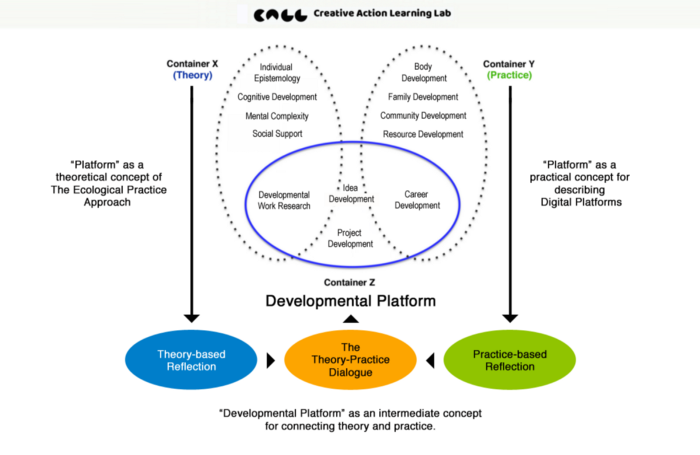
The term “Echo” of “Echozone” refers to the dialogue between theory-based reflection and practice-based reflection. The theory-based reflection means adopting theoretical concepts to reflect on practical experience while the practice-based reflection means using cases from the real world to reflect on theoretical concepts. Furthermore, the most important movement within the eurozone is the dialogue between two types of reflections. In other words, the Echozone is designed as a creative space with a potential hierarchical loop: reflection — dialogue.
As an intermediate concept, the function of “Developmental Platform” is to inspire the theory-practice dialogue. On the theoretical side, I use “Platform” as a theoretical concept of the Ecological Practice Approach because I need it for building a triad: Network — Container — Platform. I consider the triad as a basic form of collective context. On the practical side, people use “Platform” to describe digital platforms. By using an intermediate concept such as Developmental Platform, I expect to make a room for the theory-practice dialogue. It is a little more abstract than the practical concept version of “platform,” but less abstract than the theoretical concept version of “platform”.
The above diagram also lists various ideas about “development.” Inside Container X (Theory), we see Individual Epistemology, Cognitive Development, Mental Complexity, Social Support, and Developmental Work Research. These ideas refer to established theoretical approaches or theoretical themes. For example, Mental Complexity is the foundation of Robert Kegan’s developmental psychology while Developmental Work Research is founded by Activity Theorist Yrjö Engeström. Inside Container Y (Practice), there are several ordinary topics about adult development: Body Development, Family Development, Community Development, Resource Development, and Career Development.
At Container Z (Echozone), we see four ideas: Developmental Work Research, Idea Development, Project Development, and Career Development. I have to point out that the orientation behind the selection of these ideas is the Life-as-Activity approach which is an activity-based approach to adult development.
However, the concept of Developmental Platform doesn’t tie to any theoretical account. It is fruitful to make distinctions between two different uses of Developmental Platform: a concept for ontological level analysis and a concept for epistemological level analysis. As an ontological concept, Developmental Platform refers to a thing we want to study, we don’t have to adopt any theoretical approach as presupposition and basis. As an epistemological concept, Developmental Platform can refer to a particular theoretical account as a stance for studying a thing.
Mental Complexity as an intermediate concept
The above Venn diagram reviews the concept of Deliberately Developmental Organization (DDO). I consider DDO as an epistemological concept because it has a strong theoretical presupposition that defines Adult Development as the development of Mental Complexity.
According to Kegan and Lahey, “What’s ‘the development itself?’ For more than a hundred years, researchers have studied the ways human beings construct reality and have observed how that constructing can become more expansive, less distorted, less egocentric, and less reactive over time…Forty years ago this science took a significant, and controversial, turn with the investigation of adult development. Many theorists and researchers, ourselves among (Kegan and Lahey), advanced an understanding of a succession of more complex mental logics after adolescence. Informed by our research subjects whom we followed over many years, we began to see further possibilities in adulthood for overcoming limitations in the ability to understand oneself and one’s worlds — even if not every adult traveled the full course of this trajectory.” (2016, p.58)
Furthermore, we have to notice that Robert Kegan is not a normal researcher, but an excellent psychological theorist. By rejecting both the existential and dynamic personality psychologies, Kegan embraces a third psychological tradition. In a 1982 book The Evolving Self, he said, “This third tradition I will call the ‘constructive-development’ (it attends to the development of the activity of meaning-constructing), and it has a venerable past in the meaning-making ranks. It origins lie in the work of James Mark Baldwin (1906), John Dewey (1938), and George Herbert Mead (1934); and its central figure has certainly been Jean Piaget (1936)…My ‘neo-Piagetian’ approach to the person will suggest that not only is this tradition capable of addressing these issues…but it may be capable of doing so in a way that gives a new kind of strength to whatever lens the counselor or therapist holds most dear. ”(1982, p.4)

The above diagram represents the landscape of Robert Kegan’s idea ecology. By using the same diagram, I visualize my idea ecology as the diagram below:
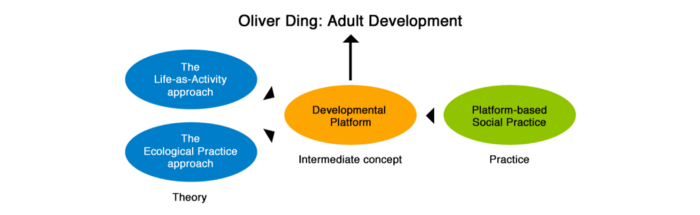
The major difference between my idea ecology and Kegan’s idea ecology is the theory section in which I place two theoretical approaches there. The Life-as-Activity approach is for understanding “development” while the Ecological Practice approach is for understanding both “development” and “platform”.
As mentioned above, readers can select other theoretical approaches or develop their own accounts for understanding the intermediate concept Developmental Platform. The value of an intermediate concept is for connecting theory and practice, not for locking in intellectual independence.
The Framework of “Structure of Platform”
After defining the concept of Developmental Platform, I adopted the Infoniche framework from the Ecological Practice approach to conceptualize the structure of Developmental Platform.
The outcome is a three-level model which includes Zone (micro level), Project (mezzo level), and Platform-ba (macro level). See the diagram below:
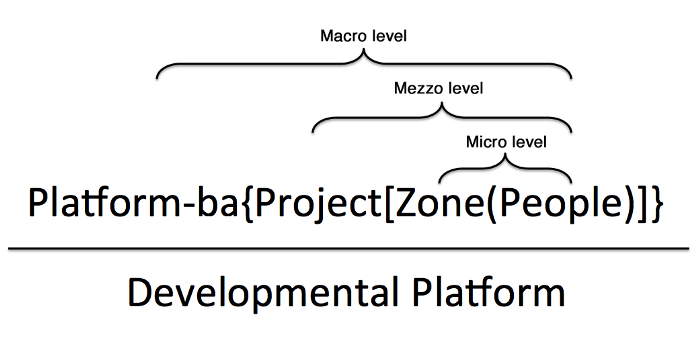
The above diagram is an intermediate framework for understanding the Structure of Developmental Platform.
The Infoniche Framework originally appeared in my 2020 book After Affordance: The Ecological Approach to Human Action in which I used one chapter to develop this idea as an intermediate theoretical framework for discussing various action possibilities.
After reviewing Gibson’s idea Niche, Barker’s idea Behavior Settings, and Urie Bronfenbrenner’s Bioecological Systems, I coined a new term Infoniche and developed an analytical framework for understanding ecological niches in the information age.
The term “niche” is originally from ecology, Gibson redefines it from the perspective of ecological psychology. According to Gibson, “Ecologists have the concept of a niche. A species of animal is said to utilize or occupy a certain niche in the environment. This is not quite the same as the habitat of the species; a niche refers more to how an animal lives than to where it lives. I suggest that a niche is a set of affordances. The natural environment offers many ways of life, and different animals have different ways of life. The niche implies a kind of animal, and the animal implies a kind of niche. Note the complementarity of the two. But note also that the environment as a whole with its unlimited possibilities existed prior to animals. The physical, chemical, meteorological, and geological conditions of the surface of the earth and the pre-existence of plant life are what make animal life possible. They had to be invariant for animals to evolve.” (1979/2015, pp.120–121)
Following Gibson’s definition of niche, I coined a new term Infoniche which is defined as a set of potential action possibilities such as affordances and supportances. The part of “info” means the new version of niche aims to expand Gibson’s idea into the information age and digital environments. However, I want to claim that Infoniche doesn’t only refer to information environments or digital environments, but both traditional environments and digital environments. Moreover, the Infoniche framework also expands Gibson’s idea from the natural environment to the social environment by working with the concept of Supportance.
Unlike Roger Barker, Gibson doesn’t develop a systematic analysis framework for his version of niche. Inspired by Barker’s work on the theory of Behavior Settings, I develop a concrete analysis framework for applying the concept of Infoniche to empirical studies.
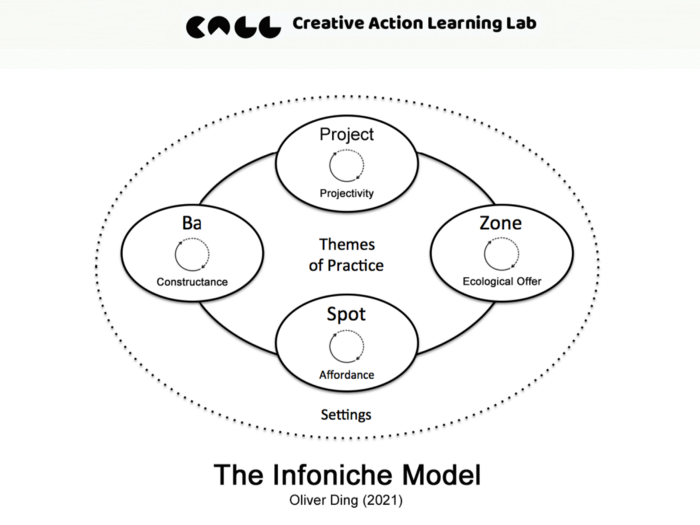
The above diagram is the newest version of the Infoniche Framework. A similar diagram is the following Supportive Cycle:
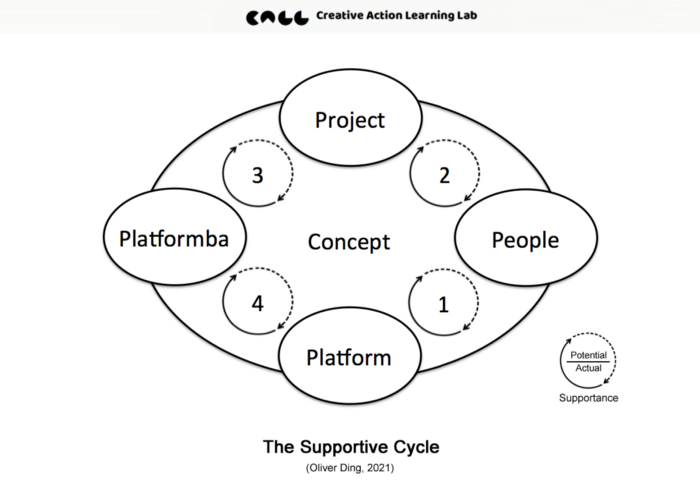
If we use the “Structure of Platform” to connect the above two diagrams, then it’s clear that the Supportive Cycle model is an application of the Infoniche Model.
In other words, the “Structure of Platform” is an intermediate framework.
When do you use the “Middleware” strategy?
Two months ago, I shared three approaches to Knowledge Curation on Linkedin.
- The “Top-down” Knowledge Curation Framework
- The “Bottom-up” Knowledge Curation Framework
- The “Dialogue” Knowledge Curation Framework
I used a term called “Intermediate Instruments” for these frameworks. It roughly refers to “Intermediate Constructions”, but I used “Instruments” to emphasize the perspective of “Mediating Instruments” from Activity Theory.
The “Top-down” approach has three stages:
1. The Objective — Subjective Curation
This stage is guided by Thematic Orientation. The goal is to build Thematic Spaces which could support long-term tacit knowledge development. The key is Epistemic Development.
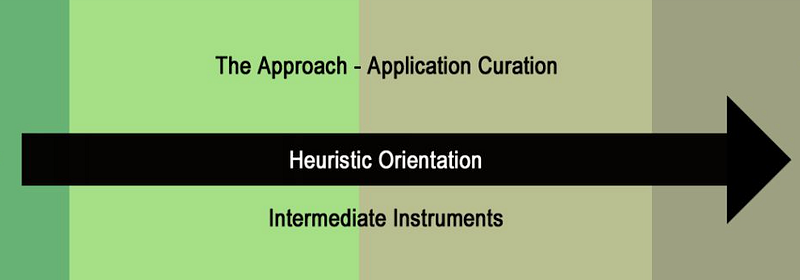
2. The Approach — Application Curation
This stage is guided by Heuristic Orientation. The strategy is to design Intermediate Instruments which could be mediating tools for the cross-boundary activity.
3. The Explanation — Operation Curation
This stage is guided by Situated Orientation. The goal is to apply knowledge to real work activities. The key is understanding Double Containers: abstract containers and concrete containers.
You can find the full canvas of the top-down approach here.
The “Bottom-up” approach has three stages:
1. The Flow — Story Curation
This stage is guided by Reflection. The goal is to turn daily life experience and work experience into tacit knowledge. The key is Ecological Awareness.
2. The Story — Model Curation
This stage is guided by Generalization. The strategy is to design Mediating Instruments which could be considered cognitive containers.

3. The Model — Theory Curation
This stage is guided by Meta-analysis. The goal is to discover a knowledge niche for your own brand new theories. This is a process of individual epistemic development.
You can find the full canvas of the Bottom-up approach here.
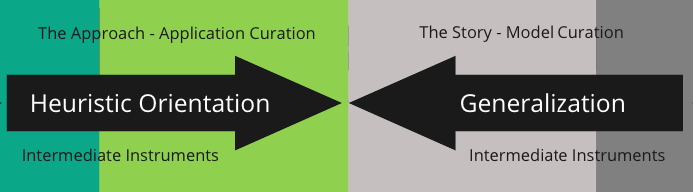
The Dialogue approach has two directions: Theory > Practice and Practice > Theory. There are four types of knowledge curation activities:
1. The Flow — Story Curation
This activity is guided by Reflection. The goal is to turn daily life experience and work experience into tacit knowledge. The key is Ecological Awareness.
2. The Story — Model Curation
This activity is guided by Generalization. The strategy is to design Mediating Instruments which could be considered cognitive containers.
3. The Objective — Subjective Curation
This activity is guided by Thematic Orientation. The goal is to build Thematic Spaces which could support long-term tacit knowledge development. The key is Epistemic Development.
4. The Approach — Application Curation
This activity is guided by Heuristic Orientation. The strategy is to design Intermediate Instruments which could be mediating tools for the cross-boundary activity.
You can find the full canvas of the Dialogue approach here.
When do you use the “Middleware” strategy?
I used the top-down approach to apply the Ecological Practice Approach to Platform-based social practices. I don’t want to directly apply the approach to Digital Platforms, so I decided to develop an intermediate concept called “Developmental Platform”.
During the process, I developed the following model:
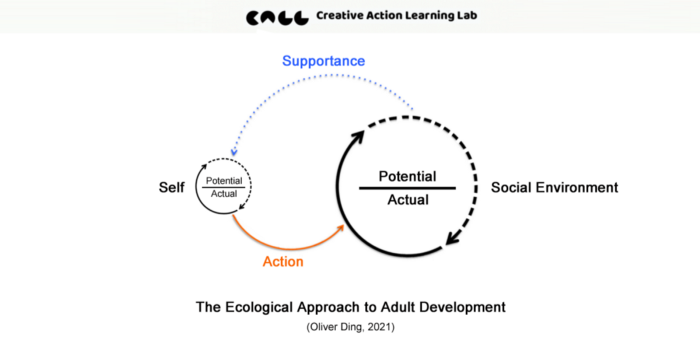
This is a major milestone in my knowledge enterprise because it means a brand new theory of adult development. It goes beyond the field of platform-based social practices. It’s a new foundation for the ecological approach to developmental science.
You can try the “Bottom-up” approach and the Dialogue approach too.
It’s a challenge to develop intermediate constructions because they don’t directly deliver value to people. However, challenges always mean opportunities.
Related Articles
- The Developmental Platform
- Platform as Infoniche
- Diagram Explained: The Supportance Model and Its History
- The “Top-down” Knowledge Curation Framework
- The “Bottom-up” Knowledge Curation Framework
- The “Dialogue” Knowledge Curation Framework
- D as Diagramming: Challenge as Opportunity
I am also working on building a new website for the Platform Ecology project. You can save the following links:
- PlatformEcology.org
- Twitter: @PlatformEcology
- Linkedin: @PlatformEcology
You are most welcome to connect via the following social platforms:
Linkedin: https://www.linkedin.com/in/oliverding Twitter: https://twitter.com/oliverding Polywork: https://www.polywork.com/oliverding Boardle: https://www.boardle.io/users/oliver-ding


