
The Developmental Platform
An ecological concept for interdisciplinary developmental study.
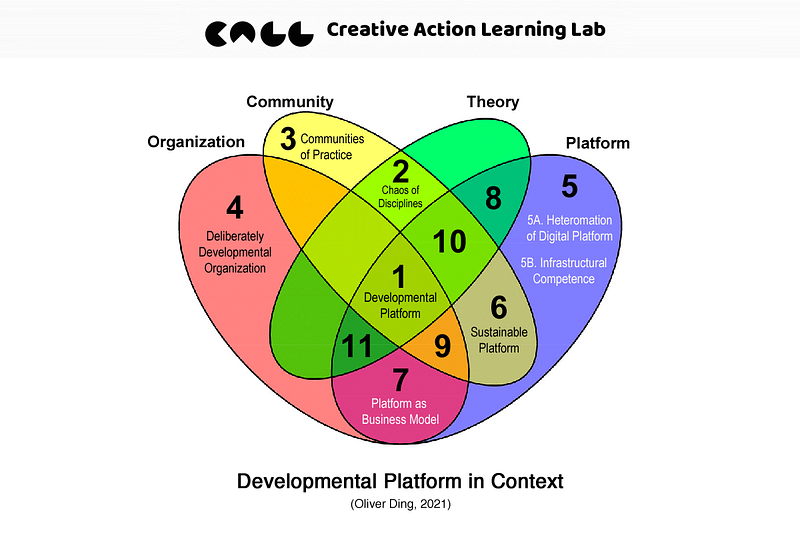
This article aims to define a new concept for the Platform for Development (P4D) framework. Some readers argue that the framework doesn’t have a clear definition of “Platform.” In order to clarify the ambiguity in the previous article, I suggest that there is a need to develop a new concept about platforms for interdisciplinary developmental studies.
First, I will use the above Venn diagram to highlight the need for interdisciplinary development. The concept of Developmental Platform is defined as an intermediate concept for connecting theory and practice.
The following article Platform as Infoniche introduces the Infoniche framework for understanding the structure of Developmental Platform.
Contents
Part 1: Digital Platform and Adult Development
Part 2: Developmental Platform in Context
2.1 Deliberately Developmental Organization (DDO) 2.2 Communities of Practice (CoP) 2.3 Chaos of Disciplines 2.4 Platform as Business Model 2.5 Heteromation of Digital Platform 2.6 Sustainable Platform 2.7 Infrastructural Competence
Part 3: An Intermediate Concept
3.1 An intermediate concept for connecting Theory and Practice 3.2 Mental Complexity as an intermediate concept 3.3 Development-in-context
Part 4: Summary
Part 1: Digital Platform and Adult Development
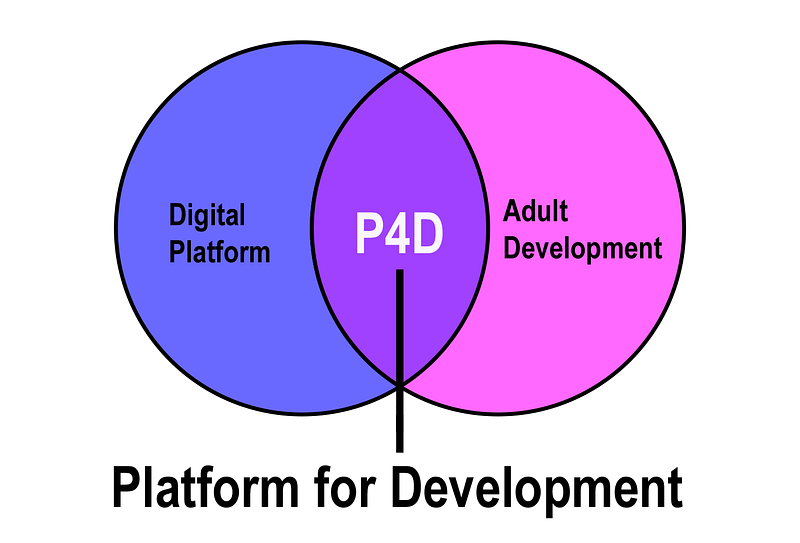
The Platform for Development framework refers to an intersection between digital platforms and adult development. I have been paying attention to these two domains for over ten years. As a participant in digital platforms, I am both a user, a curator and a maker. As a participant in adult development, I have founded several non-profit online communities which aim to support the life development of university students and young professionals.
In the past several years, I also developed several models to guide my reflections on practical experiences on digital platforms and adult development. For example, I was attracted to biographical studies since I wrote my first learning autobiography in 2015. In order to help a friend, I developed a framework called Career Landscape which is inspired by Activity Theory, Communities of Practice, and other ideas in 2016. I recently reconstructed the framework with more theoretical resources and the outcome is a new method named the Life-as-Activity approach.
On the other side, I have been working on developing several models for reflecting on digital platforms. I shared these models with my co-workers and friends. In 2019, I started sharing some models on Medium. The Social Platform Experience Design (#SocialPxD) framework is the first one.
However, these models are separate. The Platform for Development is my first model which combines these two topics together. The major theoretical resources behind the framework are Activity Theory (the project-oriented approach, Andy Blunden, 2014), Social Domains Theory (Derek Layder, 1997), Ecological Psychology (James Gibson, 1979), and Self-Determination Theory (Edward Deci and Richard Ryan, 1971, 2017). I was also inspired by Knud Illeris’ How We Learn (2007) and John Hagel’s The Power of Platform (2015).
Though the original inspiration of the Platform for Development framework is digital platforms, I don’t want to limit the scope of the framework inside the domain of digital technological platforms. The P4D framework is expected to apply to various domains such as Startup Ecosystem, Brand and Communication, Community Engagement, Content Curation, Theoretical Traditions, Knowledge Platforms, etc.
In other words, I need an interdisciplinary definition of “Platform” for this framework. Thus, I defined a new concept called Developmental Platform in order to avoid misunderstanding.
Part 2: Developmental Platform in Context
As an interdisciplinary concept, the term Developmental Platform refers to a social environment that could strongly support adult development in various ways. There are three keywords in this definition:
- social environment
- strongly support
- adult development
The term “social environment” is a rough term. It can refer to traditional social structures such as organization and community. I also consider digital platforms and other emergent social contexts as social environments.
The term “strongly support” divides social environments into two groups from the perspective of strongness. Any social environment could support people, however, there are only a few social environments that could strongly support people. Thus, we can consider some strong social environments as platforms.
The term “adult development” is a solid term in developmental science. According to Wikipedia, “Adult development encompasses the changes that occur in biological and psychological domains of human life from the end of adolescence until the end of one’s life. These changes may be gradual or rapid and can reflect positive, negative, or no change from previous levels of functioning.” Thus, the Developmental Platform highlights the perspective of developmental science.
Do we need such a new concept? Let’s use the following Venn diagram to find a creative space for Developmental Platform.
The above diagram is a four-set Venn diagram. Four sets are Organization, Community, Theory, and Platform. How to read this diagram?
First, let’s focus on the shared developmental part which is located in the #1 area. This space is what I called Developmental Platform.
Second, let’s look around other areas and place related theoretical ideas in some spaces.
Third, let’s compare the #1 area with other areas. In this way, we can find the real need for the concept of Developmental Platform.
The following sections will introduce related ideas and compare them with Developmental Platform one by one.
2.1 Deliberately Developmental Organization (DDO)
In the #4 area, we find an idea named Deliberately Developmental Organization (DDO) which was introduced by Robert Kegan and Lisa Laskow Lahey in their 2016 book An Everyone Culture. According to Kegan and Lahey, DDO are the most powerful settings in the world we have found for developing people’s capabilities, precisely because they have created a safe enough and demanding enough culture that everyone comes out of hiding. (2016, p.3) From the research, they found DDO has three characters:
- They are doing what the science of human development recommends, and they are doing so in ingenious and effective ways.
- They are taking these concepts to scale so that everyone in the organization — workers, managers, and leaders alike — has the opportunity to develop.
- They intentionally and continuously nourish a culture that puts business and individual development — and the way each one supports the other — front and center for everyone, every day.
This sounds like an ideal type of organization. Kegan and Lahey also develop a framework for building a DDO culture. According to them, “We’ve found it useful to think of the conceptual structure of a DDO in terms of depth, breadth, and height — the depth of its developmental communities (which we call home); the breadth of its developmental practices (which we call its groove); and the height of its developmental aspirations (which we call its edge). By considering all three dimensions at once (and the way each intersects with the other two) the DDO comes into view as a single, dynamic system.”(2016, p.85)
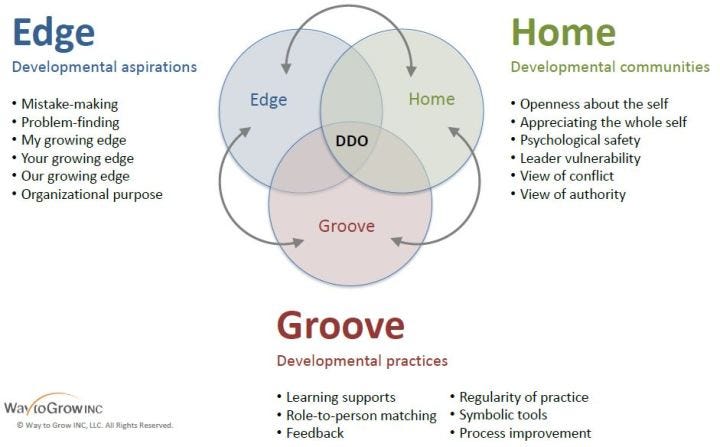
It is clear that DDO is not the normal type of organization. Unfortunately, Kegan and Lahey only conduct their research from three organizations (Bridgewater, Decurion, and Next Jump). It seems like a call from the perspective of developmental psychologists. It argues that we should rethink the very place of people development in organizational life.
In fact, the idea of Developmental Platform is inspired by DDO. In order words, we can roughly consider the Developmental Platform as an expanded version of DDO. However, there are two major differences between these two ideas. First, DDO is only about organizations while Developmental Platform considers other types of social environments. Second, DDO is an objective category while Developmental Platform is an ecological concept that allows “perceived developmental platform” by people. In other words, the developmental platform is perceived by people in their specific life situations. Due to individual differences, one organization may be perceived as a developmental platform by only a few people.
2.2 Communities of Practice (CoP)
There are many theories of Community, my favorite one is Community of Practice (CoP) which was developed by Etienne Wenger in 1998. Originally, the theory is designed as a brand-new theory of learning. In the 1991 book Situated Learning: Legitimate Peripheral Participation, Jean Lave and Etienne Wenger expand the traditional connotations of the concept of apprenticeship — from a master/student or mentor/mentee relationship to one of changing participation and identity transformation in a community of practice. In the 1998 book, the concept of Community of Practice became the center and core of a social theory of learning. Later, organizational managers adopt it for knowledge management and turn it into a theory of community building.
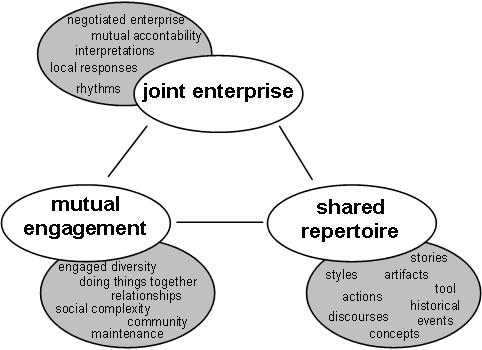
A Community of Practice (CoP) is a special type of community. According to Wenger, “A residential neighborhood, for instance, is often called ‘the community’ but it is usually not a community of practice. Playing scales on the piano is often called practice — as in ‘practice makes perfect’ — but it does not define what I called a community of practice.” In order to associate practice and community, Wenger emphasizes three dimensions of CoP:
- Mutual engagement of participants: Practice does not exist in the abstract. It exists because people are engaged in actions whose meanings they negotiate with one another. (1998, p.73)
- Negotiation of a joint enterprise: Participants must find a way to do something together, and even living with their differences and coordinating their respective aspirations. (1998, p.79)
- Shared repertoire: The elements of the repertoire can be very heterogeneous. They gain their coherence not in and of themselves as specific activities, symbols, or artifacts, but from the fact that they belong to the practice of a community pursuing an enterprise. (1998, p.82)
The subtitle of Communities of Practice is Learning, Meaning, and Identity. Wenger spent Part II discussing the concept of Identity with four chapters. He pointed out, “Issues of identity are an integral aspect of a social theory of learning and are thus inseparable from issues of practice, community, and meaning.” In particular, he claimed identity as negotiated experience, community membership, learning trajectory, and nexus of multi-membership. (1998, p.149)
While Communities of Practice focused on building a social theory of learning, Developmental Platform aims to build a brand new concept of social environment. From the ecological perspective, the concept of Developmental Platform focuses on potential action opportunities and potential developmental resources. Unlike Communities of Practice, the concept of membership is not at the center of Developmental Platform.
2.3 Chaos of Disciplines
The set of Theory refers to science domains and academic knowledge fields. I adopt Andrew Abbott’s term “Chaos of Disciplines” for our discussion. In fact, the term is the title of his 2001 book.
The most important idea we can learn from the book is the concept of “fractal distinction.” Andrew Abbott started an insight that claims many social structures look the same on large scale and on a small scale. He called this insight “Self-similar social structure” and applied it to discuss academic social science in general and sociology in particular.
He also found there is a classical example from Kant, “…Kant obviously does not think there is an infinite gradation from absolute pure reason through some proportionately mixed varieties of reason to absolute practice reason. He has done something else. He has created what I shall call a ‘fractal distinction.’ The name captures the fact that such a distinction repeats a pattern within itself, as geometric fractals do…There are, of course, dozens of general sources on fractals…I have tended to focus on fractals that are nested dichotomies. There is no necessary restriction to this case; it is simply the most familiar and hence makes for the easiest exposition.”(p.9)
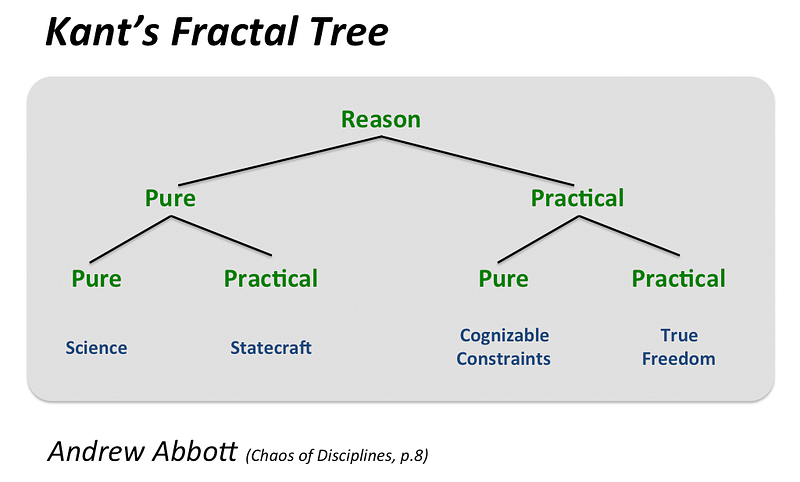
The above diagram is adopted from Andrew Abbott and it represents Kant’s fractal tree. After reviewing Kant’s writing, Abbott summarized that “Kan has first split pure and practical reason and then, under each of those headings, has split pure and practical reason once again.” (p.8)
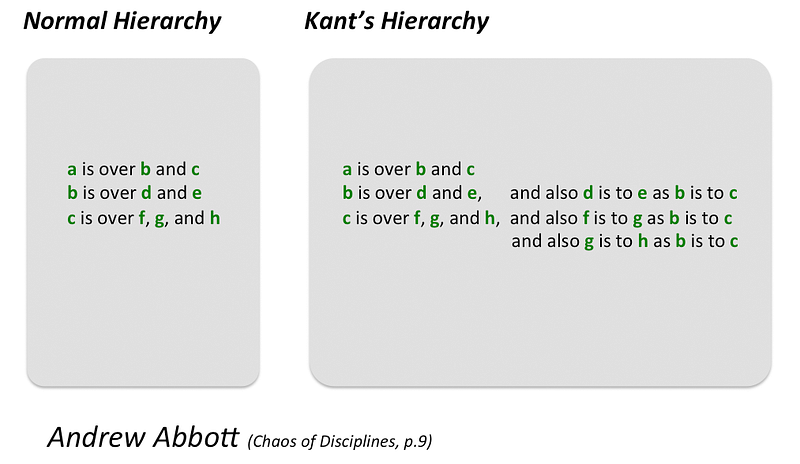
Abbott also pointed out Kant’s approach is not normal hierarchy, “…Kant has made a relational judgement at one level and then repeated it at the next…the relation of the general terms is recapitulated in the specific ones…This is not a simple hierarchy.” (2001, p.9) Further, Abbott claimed that the power of fractal distinction, “The concept of fractal distinctions not only proves useful in understanding the external location of the social sciences generally. It also provides an essential tool for understanding relations within them. Indeed, as I shall show, both the external and the internal structures are produced by the same mechanism.”(2001, p.10)
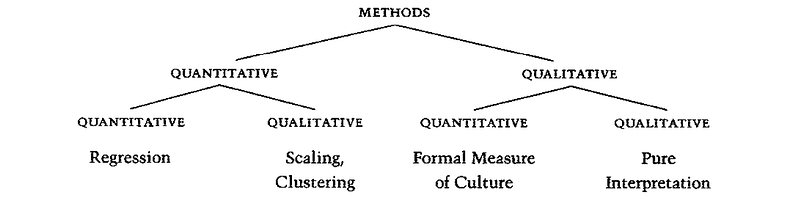
The above diagram shows an example of the fractal distinction of the methodological approaches. Abbott said, “For about sixty years, sociology has been divided into two broad methodological strands, usually called quantitative and qualitative. Put starkly, the quantitative position recognizes only those social phenomena measurable on univocal scales. The qualitative side attributes multivocality to all social phenomena and therefore denies strong measurability. This sounds like a simple opposition. But within each one of these strands can be distinguished ‘quantitative’ and ‘qualitative’ positions. On the quantitative side, for example, the admired ‘causal’ methods like regression contrast with the denigrated ‘descriptive’ methods like scaling and clustering. On the qualitative side, there are relatively formalized measurement procedures that are used by some sociologists of culture and by most practitioners of conversational analysis, while strongly interpretive strategies characterize much of the new sociology of science.” (2001, p.10)
What a simple but powerful heuristic tool! Abbott focused on academic activity, he doesn’t directly talk about adult development within science domains and academic fields. From the perspective of Developmental Platform, an established theoretical tradition is a great developmental platform for knowledge workers.
2.4 Platform as Business Model
Now we turn to the set of Platform. I shall review three ideas and compare them with Developmental Platform.
The #7 area is shared by the set of Organization and the set of Platform. I place the idea of “Platform as Business Model” at the #7 area. This view is presented in many popular business books. In the 2016 book Platform Revolution, Parker, van Alstyne, and Choudary (2016) define a platform as “a business based on enabling value-creating interactions between external producers and consumers. The platform provides an open, participative infrastructure for these interactions and sets governance conditions for them. The platform’s overarching purpose: to consummate matches among users and facilitate the exchange of goods, services, or social currency, thereby enabling value creation for all participants.” (p.5)
In fact, what the authors suggested is not a new theoretical concept, but a new metaphor for an old concept: two-sided markets. In order words, we can reduce their term Platform to the old-fashioned term Market. The authors use Pipelines and Platforms as metaphors for describing business models. According to the authors, the “Pipeline” metaphor refers to the traditional businesses which succeed by optimizing the activities in their value chains — most of which they own or control while the “Platform” metaphor refers to the networked businesses which bring together consumers and producers in order to turn external assets into the core of the business model.
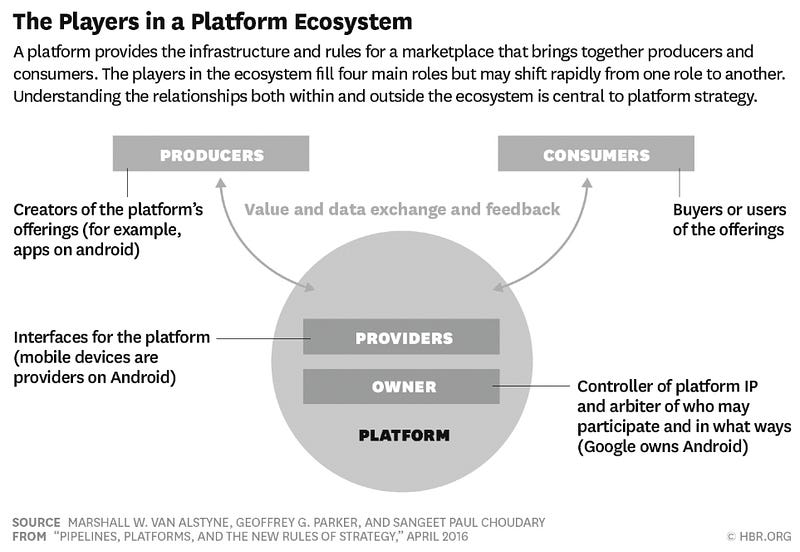
The view of Platform as Business Model doesn’t compete with the idea of Developmental Platform because it only considers the business model from the perspective of the owners of platforms. However, the concept of Developmental Platform adopts the perspective of developmental science and pays attention to the relationship between platform and people.
2.5 Heteromation of Digital Platform
In recent years, scholars have begun to use various theories to study emergent larger digital platforms. Most authors adopt a critical stance to develop their views. For example, the 2017 book Heteromation, and Other Stories of Computing and Capitalism aims to explore the relationship between computing and capitalism with a focus on the division of labor between humans and machines.
Hamid R. Ekbia and Bonnie A. Nardi, the authors of the book, introduce a new term “Heteromation” to present their conceptual lens: the extraction of economic value from low-cost or free labor in computer-mediated networks. They identified five types of Heteromation: communicative labor, cognitive labor, creative labor, emotional labor, and organizing labor.
In their original research paper Heteromation and its (dis)contents (2014), they said there are four perspectives for studying computing and human behavior:
- The history of computing: the mainframe era, personal computing, the Internet, and Web 2.0…
- The human-computer interaction (HCI)
- Information Systems: the development of computing from an organizational perspective
- The political economy of computing
In the introduction section of the paper, they also claimed that “the paper provides an analysis of the ‘division of labor’ between humans and machines from the perspective of political economy.”
If we see their 2014 paper and 2017 book as a whole theoretical work and ignore the writing style of academic papers and books. We can claim they adopt the perspective of the political economy of computing for their level of analysis.
It is clear that they don’t consider the perspective of developmental science for this project. The major difference between “Heteromation of Digital Platform” and “Developmental Platform” is the former focuses on what platforms can get from people while the latter focuses on what people can get from platforms.
2.6 Sustainable Platform
The #6 area is labeled with the idea of Sustainable Platform which refers to the intersection between platform economy and sustainable development of society. I consider it is shared by the set of Platform and the set of Community.
In a 2021 article, Morell, Espelt, and Hidalgo review the landscape of sustainable platform and discuss the relationship between platform models and sustainable development goals. According to the authors, “The emergence of the platform economy has become a priority for governments due to its possible contribution to the sustainable development of society. It has also become of great interest in the field of social sciences. At the same time, regarding their socioeconomic impact, there are different types of platform economy models. For example, platforms including Uber, Airbnb, and Deliveroo are provoking considerable discussion, due to being regarded as a new form of extractive capitalism or ‘platform capitalism’. Although successful alternative models based on open knowledge and the social economy exist, usually shaped under the concept of ‘platform cooperativism’, they have received little research and policy attention.”
The exemplar of the model of Platform Cooperativism is Wikipedia which was conceptualized as the case of Mass Collaboration by Don Tapscott and Anthony D. Williams in their 2006 book Wikinomics.
Morell, Espelt, and Hidalgo point out, “Another matter of growing interest, although still hardly addressed in platform economy research, is the relationship with the global indicators formulated by the United Nations’ Sustainable Development Goals (SDGs). Some studies highlight the need to focus on the role of information and communications technology (ICT) in the SDGs’ formulation, and therefore in shaping contemporary development. For example, Unwin stated that ICT is not directly mentioned in any of the SDGs and is only mentioned in four out of 169 sustainability targets. Indeed, some studies recently pointed out that digital technologies are considered essential enablers of the circular economy, which contributes to the 12th SDG (sustainable consumption and production). In any case, while circular economy scholars have long lauded digital technologies such as platforms as key enablers, they have not fully explored the potentials of information systems for a circular economy and its connection with SDGs.”
In a 2020 article, Kolk and Ciulli also connect digital platforms with Sustainability Transitions Research (STR), “In their comprehensive stock-taking article, Köhler et al. (2019) highlight the many insights from a decade of sustainability transitions research (STR), and indicate further areas and challenges for scholars. Building on these suggestions, we argue for more attention to insights from the subfields of international business (IB) and strategic management, applied to newly-emerging ‘digital’ actors that have the potential to address and accelerate multi-sector transitions across geographies. Our contribution focuses on what we call sustainability-oriented digital platform multinationals (SO-DPMs).”
Though this line of research emphasizes the aspect of human development, they remain on the macro level such as the perspective of United Nations’ Sustainable Development Goals (SDGs). The concept of Developmental Platform focuses on the micro-level analysis of individual adult development.
2.7 Infrastructural Competence
The information infrastructures and digital platforms are important contexts for contemporary knowledge workers. In 2019, Steve Sawyer, Ingrid Erickson, and Mohammad Hossein Jarrahi published a paper titled Infrastructural Competence. The authors were inspired by Star and Ruhleder’s (1996) ’s notion that infrastructures are sociotechnical entities and Claudio Ciborra (2000)’s idea of bricolage which refers to the making-do practices people use to ply resources at hand toward desired goals.
The authors pointed out the rising standardization of a project-based economy, an organizational structure in which specialists can be efficiently leveraged, “The ways of working have also been evolving, and the current primacy of project-based work not only has increased the shift to specialization among workers, but also is one of the forces underpinning today’s ‘gig economy’ and its related dependence on freelance or contract workers. Global platforms such as Mechanical Turk and Upwork reify the identity of knowledge workers as itinerant experts who move from one project to the next as they amalgamate a career. In some ways, the rising recognition of expertise in knowledge work has been the undoing of work itself, as workers are now more valued for their skills than they are for their humanity.”
The authors defined Infrastructural Competence as an individual’s user-oriented relationship with infrastructure that enables him or her to generate a functional, operable, personalized, patterned, or routinized set of sociotechnical practices that accomplish a necessary task or set of tasks. (2019, p.271) Based on the use-centered and practice- or routines-oriented perspective on using infrastructure, the authors identify five attributes of infrastructural competence:
- Goal oriented
- Reliant on digital assemblages
- Enacted and operationally resilient
- Situated and relational
- Expectation based on professional identity
I have reviewed the idea of Infrastructural Competence in Life as Activity, “From the perspective of Activity Theory, the Infrastructural Competence connects to skills of using digital instruments within the collective activity systems. From the perspective of temporal activity chains, mapping infrastructural competence means measuring the change of skills of using digital instruments. Furthermore, we can also watch the creativity of making new instruments.”
Both Infrastructural Competence and Developmental Platform are about individual adult development, however, Infrastructural Competence only talks about competence while Developmental Platform refers to a broader scope. In fact, we can consider Infrastructural Competence as a sub-topic of Developmental Platform.
Part 3: An Intermediate Concept
The above discussion points out a new creative space for the concept of Developmental Platform:
- It is an interdisciplinary concept that doesn’t only talk about digital platforms, but also large organizations and established theoretical traditions.
- It is an interdisciplinary concept that adopts the perspective of developmental science.
- It is a concept that focuses on the relationship between platforms and people.
- It is a concept that is located at the micro level of analysis.
- It is a concept that aims to observe the development of knowledge, skills, and competence, but also the social status of individuals.
I consider Developmental Platform as an intermediate concept that aims to connect theory and practice.
3.1 An intermediate concept for connecting Theory and Practice
The diagram shows three containers. Container X refers to Theory while container Y refers to Practice. Container Z refers to a boundary creative space which is named Echozone. This model is based on the Ecological Practice approach and the HERO U framework. The Echozone is a perfect space for creating brand-new intermediate concepts.
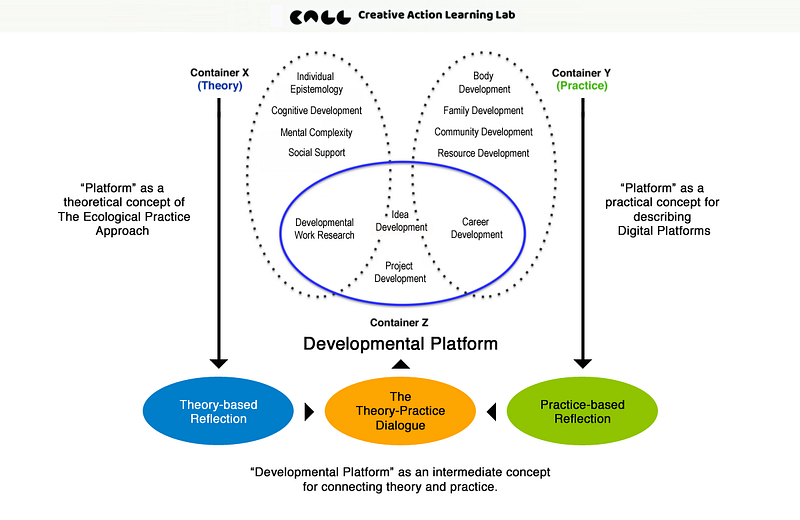
The term “Echo” of “Echozone” refers to the dialogue between theory-based reflection and practice-based reflection. Theory-based reflection means adopting theoretical concepts to reflect on practical experience while practice-based reflection means using cases from the real world to reflect on theoretical concepts. Furthermore, the most important movement within the echozone is the dialogue between two types of reflections. In other words, the Echozone is designed as a creative space with a potential hierarchical loop: reflection—dialogue.
As an intermediate concept, the function of Developmental Platform is to inspire the theory-practice dialogue. On the theoretical side, I use “Platform” as a theoretical concept of the Ecological Practice Approach because I need it for building a triad: Network — Container — Platform. I consider the triad as the basic form of collective context. On the practical side, people use “Platform” to describe digital platforms. By using an intermediate concept such as Developmental Platform, I expect to make a room for the theory-practice dialogue. It is a little more abstract than the practical concept version of “platform,” but less abstract than the theoretical concept version of “platform”.
The above diagram also lists various ideas about “development.” Inside Container X (Theory), we see Individual Epistemology, Cognitive Development, Mental Complexity, Social Support, and Developmental Work Research. These ideas refer to established theoretical approaches or theoretical themes. For example, Mental Complexity is the foundation of Robert Kegan’s developmental psychology while Developmental Work Research is founded by Activity Theorist Yrjö Engeström. Inside Container Y (Practice), there are several ordinary topics about adult development: Body Development, Family Development, Community Development, Resource Development, and Career Development.
At Container Z (Echozone), we see four ideas: Developmental Work Research, Idea Development, Project Development, and Career Development. I have to point out that the orientation behind the selection of these ideas is the Life-as-Activity approach which is an activity-based approach to adult development.
However, the concept of Developmental Platform doesn’t tie to any theoretical account. It is fruitful to make distinctions between two different uses of Developmental Platform: a concept for ontological level analysis and a concept for epistemological level analysis. As an ontological concept, Developmental Platform refers to a thing we want to study, we don’t have to adopt any theoretical approach as presupposition and basis. As an epistemological concept, Developmental Platform can refer to a particular theoretical account as a stance for studying a thing.
3.2 Mental Complexity as an intermediate concept
The above discussion has reviewed the concept of DDO. I consider DDO as an epistemological concept because it has a strong theoretical presupposition that defines Adult Development as the development of Mental Complexity. According to Kegan and Lahey, “What’s ‘the development itself?’ For more than a hundred years, researchers have studied the ways human beings construct reality and have observed how that constructing can become more expansive, less distorted, less egocentric, and less reactive over time…Forty years ago this science took a significant, and controversial, turn with the investigation of adult development. Many theorists and researchers, ourselves among (Kegan and Lahey), advanced an understanding of a succession of more complex mental logics after adolescence. Informed by our research subjects whom we followed over many years, we began to see further possibilities in adulthood for overcoming limitations in the ability to understand oneself and one’s worlds — even if not every adult traveled the full course of this trajectory.” (2016, p.58)
Furthermore, we have to notice that Robert Kegan is not a normal researcher, but an excellent psychological theorist. By rejecting both the existential and dynamic personality psychologies, Kegan embraces a third psychological tradition. In a 1982 book The Evolving Self, he said, “This third tradition I will call the ‘constructive-development’ (it attends to the development of the activity of meaning-constructing), and it has a venerable past in the meaning-making ranks. It origins lie in the work of James Mark Baldwin (1906), John Dewey (1938), and George Herbert Mead (1934); and its central figure has certainly been Jean Piaget (1936)…My ‘neo-Piagetian’ approach to the person will suggest that not only is this tradition capable of addressing these issues…but it may be capable of doing so in a way that gives a new kind of strength to whatever lens the counselor or therapist holds most dear. ”(1982, p.4)

The above diagram represents the landscape of Robert Kegan’s ideas. By using the same diagram, I visualize my ideas as the diagram below:
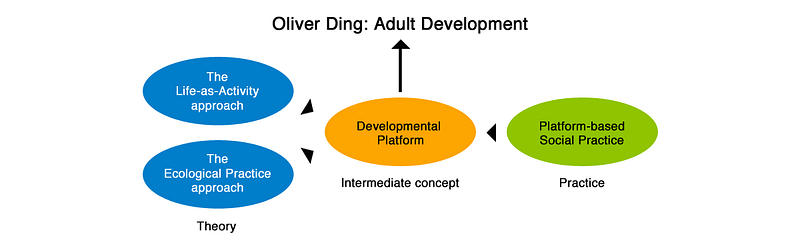
The major difference between my ideas and Kegan’s ideas is the theory section in which I place two theoretical approaches there. The Life-as-Activity approach is for understanding “development” while the Ecological Practice approach is for understanding both “development” and “platform”.
As mentioned above, readers can select other theoretical approaches or develop their own accounts for understanding the intermediate concept Developmental Platform. The value of an intermediate concept is for connecting theory and practice, not for locking in intellectual independence.
3.3 Development-in-context
The subtitle of this article is An ecological concept for interdisciplinary developmental study. Thus, my focus on the concept of Developmental Platform is not only about psychological development, but the phenomenon of development-in-context in general. The boundaries between disciplines don’t need to be the limits of our inquiry.
Developmental psychologist Urie Bronfenbrenner mentioned a similar issue in his book The Ecology of Human Development (1979), “One may well ask how an ecology of human development differs from social psychology on the one hand and sociology or anthropology on the other. In general the answer lies in the focus of the present undertaking on the phenomenon of development-in-context. Not only are the above three social science disciplines considerably broader, but none has the phenomenon of development as its primary concern, To describe the ecology of human development as the social psychology, sociology, or anthropology of human development is to overlook the crucial part played in psychological growth by biological factors, such as physical characteristics and in particular the impact of genetic propensities.” (1979, pp. 12–13)
The concept of Developmental Platform doesn’t aim to develop a brand new psychological theoretical approach but highlights a creative space of interdisciplinary developmental study. I think we can adopt various theoretical ideas from psychology, sociology, anthropology, etc.
Part 4: Summary
This article introduces a new concept Developmental Platform which is defined as an ecological concept for interdisciplinary developmental study.
The term Developmental Platform refers to a social environment that could strongly support adult development in various ways. As an intermediate concept, it aims to connect theory and practice.
The following article introduces the Infoniche framework to conceptualize the structure of Developmental Platform. The outcome is a three-level model which includes Zone (micro level), Project (mezzo level), and Platform-ba (macro level). Furthermore, I introduce the Ecological Offer framework for the Zone level analysis. I also review some ideas about Project and Platform-ba from previous articles.
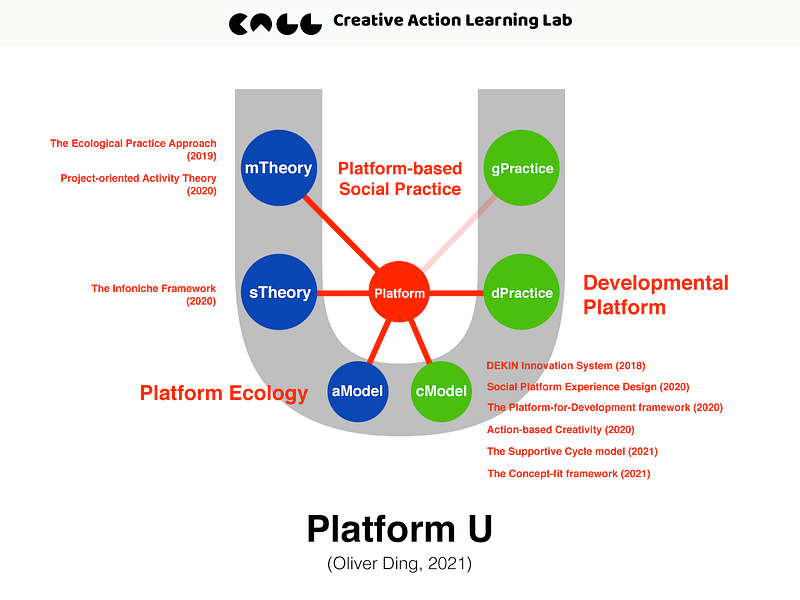
The above picture is the Platform U diagram which is updated with two ideas. The Infoniche Framework is considered a specific theory (sTheory). The concept of Developmental Platform is considered a domain practice (dPractice).
My vision is to connect theory and practice by curating knowledge projects. The goal of the Platform Ecology project is to develop a series of heuristic models and frameworks for theory-based reflection and practice-based reflection.
You are most welcome to connect via the following social platforms:
Twitter: https://twitter.com/oliverding Doowit: https://doowit.co/profile/gm0k2ax9 Linkedin: https://www.linkedin.com/in/oliverding
License
This work is licensed under the Creative Commons Attribution-NonCommercial-ShareAlike 4.0 International (CC BY-NC-SA 4.0) License. Please click on the link for details.
References
Abbott, A, (2001). Chaos of Disciplines. W.W. Norton & Company.
Robert Kegan & Lisa Laskow Lahey (2016) An Everyone Culture: Becoming a Deliberately Developmental Organization. Harvard Business Review Press.
Ans Kolk and Francesca Ciulli (2019) The potential of sustainability-oriented digital platform multinationals: A comment on the transitions research agenda. Environmental Innovation and Societal Transitions, Volume 34, March 2020, Pages 355–358; https://doi.org/10.1016/j.eist.2019.12.008
Daniel J. Levinson, D. J. (1986) A conception of adult development. American Psychologist, 41(1), 3–13
Etienne Wenger (1998) Communities of Practice: Learning, Meaning and Identity. Cambridge University Press.
Geoffrey G. Parker, Marshall W. Van Alstyne, and Sangeet Paul Choudary (2016) Platform Revolution: How networked markets are transforming the economy and how to make them work for you. W. W. Norton & Company.
Hamid R. Ekbia and Bonnie A. Nardi (2017) Heteromation, and other stories of computing and capitalism. The MIT Press.
Hamid R. Ekbia and Bonnie A. Nardi (2017) Heteromation and its (dis)contents: The invisible division of labor between humans and machines. In First Monday, Volume 19, Number 6–2 June 2014 doi: http://dx.doi.org/10.5210/fm.v19i6.5331
Ian Leslie (2016) The scientists who make apps addictive. 1843 Magazine.
James J. Gibson (1979/2015). The ecological approach to visual perception: classic edition. New York: Psychology Press. (originally published in 1979).
Jaan Valsiner and Rene van der Veer (2014) Encountering the border: Vygotsky’s zona blizhaishego razvitia and its implications for theories of development. In Anton Yasnitsky, Rene van der Veer and Michel Ferrari (eds.), The Cambridge Handbook of Cultural-Historical Psychology. Cambridge University Press.
Jean Lave and Etienne Wenger (1991) Situated Learning: Legitimate Peripheral Participation.Cambridge University Press
Mayo Fuster Morell, Ricard Espelt, and Enric Senabre Hidalgo (2020) Data for Sustainable Platform Economy: Connections between Platform Models and Sustainable Development Goals. Data 2021, 6(2), 7; https://doi.org/10.3390/data6020007
Don Tapscott and Anthony D. Williams (2006) Wikinomics: How mass collaboration changes everything. Portfolio.
Reed, E.S. (1996). Encountering the world: toward an ecological psychology. Oxford University Press.
Richard M. Ryan and Edward L. Deci (2017) Self-Determination Theory: Basic psychological needs in motivation, development, and wellness. The Guilford Press.
Robert Kegan (1982) The Evolving Self: Problem and process in human development. Harvard University Press.
Ronald E. Robertson (2018) The 21st Century Skinner Box, Behavioral Scientist.
Steve Sawyer, Ingrid Erickson, and Mohammad Hossein Jarrahi (2019) Infrastructural Competence. In Janet Vertesi & David Ribes (eds.), digitalSTS: A field guide for science & technology studies. Princeton University Press.
Urie Bronfenbrenner (1979) The Ecology of Human Development. Harvard University Press.


