
Knowledge Discovery: The “Approaches — Tastes” Mapping
Taste, Tasting, and Afford-to-taste
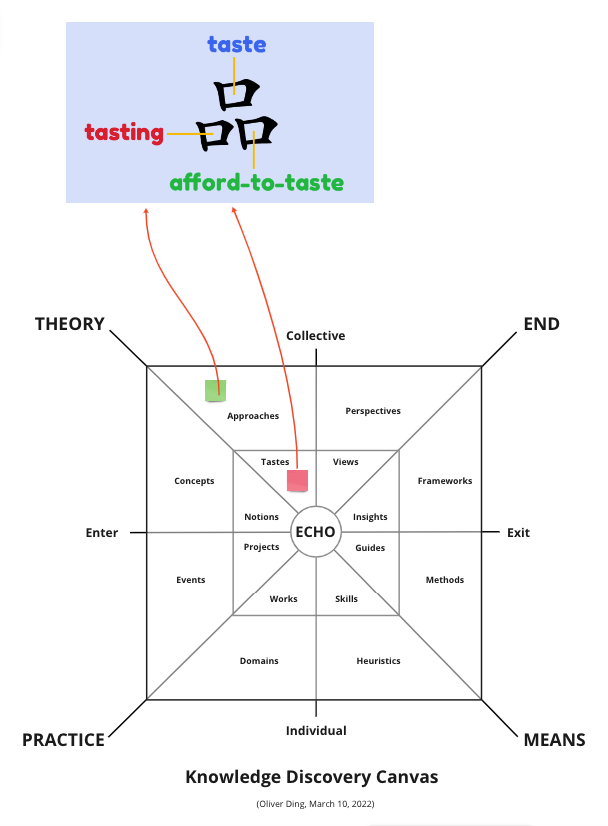
This article is part of the Slow Cognition Project which focuses on Developing Tacit Knowledge with Thematic Space Canvas. The Knowledge Discovery Canvas is an application of the Thematic Space Canvas.
The Knowledge Discovery Canvas has two nested squares which divide the thematic space into two sub-spaces: inner space and outer space. For Developing Tacit Knowledge, the inner space is all about personal knowing activities while the outer space is related to social interactions.
Based on the above settings, I generated a series of mapping between outer space and inner space:
- Approaches — Tastes
- Concepts — Notions
- Events — Projects
- Domains — Works
- Perspectives — Views
- Frameworks — Insights
- Methods — Guides
- Heuristics — Skills
Today I’ll focus on the Approaches — Tastes mapping and use a metaphorical sign to discuss the issue of Personal Epistemology.
The Approaches — Tastes Mapping
Let’s start from my “Activity” thematic space. On Jan 9, 2022, I use my experience in Developing Tacit Knowledge about Activity Theory as an example of Mapping Thematic Spaces.
The “Activity” Thematic Space refers to Activity Theory and Social Practice Theories in general. Its unit of analysis is not individual behavior, it is not macro-social structure or cultural meaning either. Since 2001, a group of philosophers, sociologists, and scientists have rediscovered the practice perspective and used it as a lens to explore and examine the role of practices in human activity. Researchers called it The Practice Turn in Contemporary Theory. As Schatzki pointed out, “there is no unified practice approach”(2001, p.2). Davide Nicolini adopted a way of toolkit to introduce six different ways of theorizing practice in his 2013 book Practice Theory, Work, & Organization. Activity Theory is considered one of six social practice theoretical approaches.
Though I read books and papers about Activity Theory and Social Practice Theories, most of my projects are related to Activity Theory.
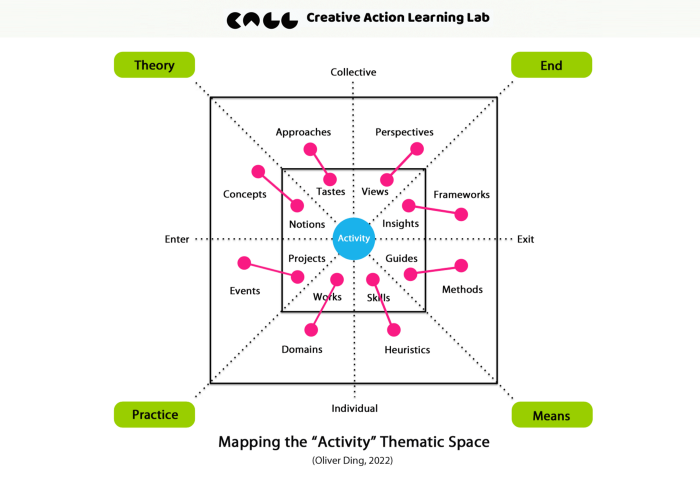
I reviewed all eights types of mapping with the above diagram. You can find more details here. Today I will focus on the Approaches — Tastes mapping.
A thematic space may contain many similar theoretical approaches. If we pay attention to two thematic spaces, then we will focus on similarities between a group of approaches inside a thematic space. However, if we move to the inside of a thematic space, we should pay attention to the differences between the same group of approaches.
How do we deal with these similarities and differences? It all depends on our tastes which are related to our values, experience, motivation, and more personal aspects. Moreover, tastes are learnable and changeable.
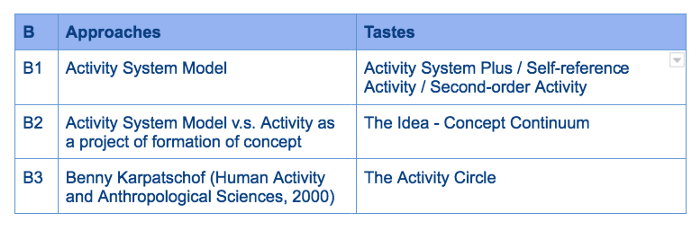
Activity Theory is not a single theory, but a theoretical tradition that has several theoretical approaches. I started learning Activity Theory with the Activity System Model which is really useful for studying organizational activities and collective activities in general. The model offers a series of concepts for connecting theory and practice.
B1 refers to my ideas based on the Activity System Model’s concept and framework. For example, I coined the concept of “Self-reference Activity” to connect Activity Theory and Self-reference System theory. It refers to a special type of activity that can support self-reference development. I also coined the term “Second-order Activity” for discussing a special type of activity that considers an Outcome as an Object.
B2 refers to a solution for connecting two approaches together. In 2010, Andy Blunden published a book titled An Interdisciplinary Theory of Activity and suggested a new theoretical approach to Activity. The new approach considers an activity as a project of the formation of a concept. In order to develop the theoretical foundation of “Project as a unit of Activity”, Blunden adopts Hegel’s Logic and Vygotsky’s theory about Concepts as theoretical resources. The process is documented in three books: An Interdisciplinary Theory of Activity (2010), Concepts: A Critical Approach (2012), and Collaborative Projects: An Interdisciplinary Study (2014).
The Activity System Model and Project as a unit of Activity are two different theoretical approaches to Activity. Can we connect them together?
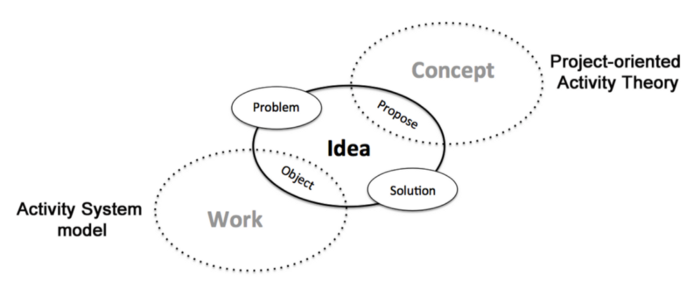
The above diagram is my solution for connecting these two approaches. I made a distinction between Idea and Concept in order to build a continuum. The above diagram represents a path in which the idea defines an object and the object defines the work or regular activity. This path is covered by the statement of “Object-orientedness” which is initiated by Leontiev’s approach and supported by Engeström’s Activity System model. On the other hand, the “Idea” is a pre-concept process that can lead to the “Concept” and the “Project”. This path is the focus of Blunden’s approach.
B3 refers to Karpatschof’s 2000 book Human Activity: Contributions to the Anthropological Sciences from a Perspective of Activity Theory. I found this book online three months ago. Though I have read many books and papers about Activity Theory, Karpatschof’s theoretical approach opened a new door for me. Inspired by his ideas, I am thinking if I could use Activity Circle to rename the iART framework.
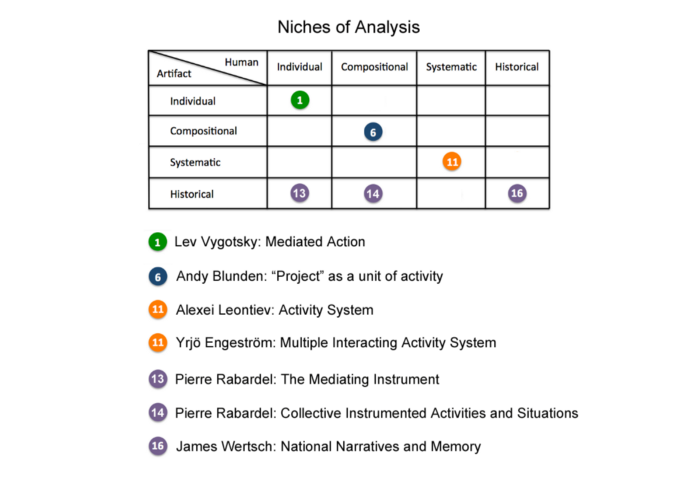
The above review only mentions three theoretical approaches to Activity Theory. In fact, there are more than three approaches in the large knowledge enterprise. For example, I use the following chart to analyze the niches of Activity Theory.
Yrjö Engeström (2010) has mentioned the evolution of activity theory, he said “The first generation built on Vygotsky’s notion of mediated action. The second generation built on Leont’ev’s notion of “activity system”. The third generation, emerging in the past 15 years or so, built on the idea of multiple interacting activity systems focused on a partially shared object.” I made the diagram below to present diagrams for these three generations of theoretical development.
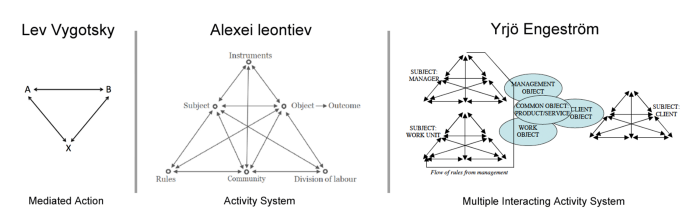
Based on Engeström’s description, I place Vygotsky’s work in niche #1 because the concept of “mediated action” is about individual-level analysis. Leontiev’s Activity System and Engeström’s Multiple Interacting Activity System are placed at niche #11 which means systematic level analysis, the former focuses on a single system while the latter focuses on multiple systems.
Some researchers argued that the third generation of activity theory shifted from a focus on individuals-in-society toward organizations. Spinuzzi (2020) said, “Whereas 1GAT and 2GAT both represented a cultural psychology, 3GAT has more or less become an organizational sociology”. Spinuzzi and Guile (2019) also pointed out the limits of the third generation of activity theory, “3GAT has built-in limits. Specifically, activity theorists have noted limitations that 3GAT faces when accounting for social production, peer production, and similar cases of post-bureaucratic work, cases that do not resemble traditional work with known cycles and an agreed-upon object. Unlike cases traditionally explored by activity theory (e.g., education, health, law, and other long-term, stabilized activities), these cases tend to be unsettled, unstable, and interconnected with many other activities (e.g., open-source software, coworking, entrepreneurship, and client-focused projects). Such cases tend to include objects that are fractional rather than unified; emergent rather than established; and transformed through multiple, loosely synchronized cycles rather than a single developmental cycle.”
The compositional dimension and systematic dimension both consider multiple entities, but the former refers to a loose relationship within a group of entities while the latter refers to a group of entities with a stable structure. I placed Andy Blunden’s “Collaborative Projects” the niche #6 because collaborative projects are less stable than organizations.
In 2014, Andy Blunden edited a book titled Collaborative Projects: An Interdisciplinary Study and argued that there is a need to establish a concept of “project” as a unit of activity theory and human sciences. He said, “There are already many writers who address themselves to collaborative projects as part of their research, and among these, some who share a commitment to Activity Theory or the Cultural-Historical Psychology which underpins Activity Theory. However, these writers do not constitute a coherent current of thinking, as each writer does not take the concept of ‘project’ as central to their own project. Nonetheless, this literature provides a beginning for interdisciplinary research in the human sciences which can reach across the chasm between the sciences of the individual and the science of society… In what follows I will outline the origins of ‘project’ as a unit for the human sciences and its value as an interdisciplinary concept, then briefly review the foundation of the concept in different domains of theory, and conclude with a concise definition of the concept of ‘collaborative project’.”
Pierre Rabardel’s Instrumental Genesis theory is unique, his idea “utilization schemes” is about using artifacts. Thus, I placed his ideas in niche #14 and niche #16. The mediating instrument considers individual-level analysis while the CIAS (Collective Instrumented Activities and Situations) model works on the collective level.
James Wertsch chose the historical dimension as his unit of analysis and focused on national narratives and memory, collective memory and identity, especially in Russia and other countries of the former Soviet Union, as well as in the United States. I placed his work at niche #16.
A Heuristic Tool for Tasting Theoretical Approaches
As mentioned above, tastes are related to our values, experience, motivation, and more personal aspects. Moreover, tastes are learnable and changeable.
Tastes are about perceiving differences, appreciating creativity, and discovering fitness.
In the above discussion, I use a heuristic tool called “Niches of Analysis”. Originally, I developed it for discussing Artifact-centered Interaction. I named the following chart “the landscape of Artifact-centered Interaction”.
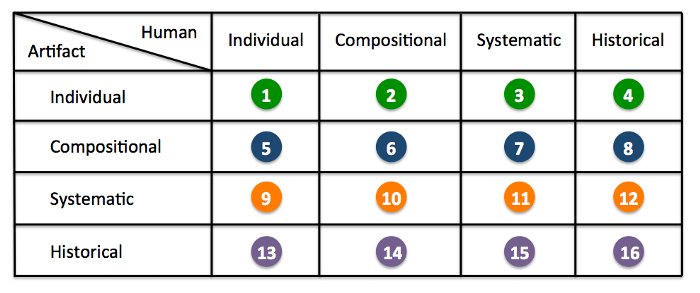
I used four dimensions and two components (artifact and human) to make the chart. The four dimensions are individual, compositional, systematic, and historical. I don’t consider the imaginative and fictional dimensions, you can add them to the chart if you need them.
As a heuristic tool for thinking, this chart identifies 16 niches that mean creative spaces of theory-building. For example, we can place Gibson’s affordance at the nice #1. My own idea Curativity theory is about curating pieces into a meaningful whole, thus I can place it at niche #5. Another idea of Social Platform Design is about one systematic artifact with many people, it locates at niche #10. Most researchers of IS (information systems) and communication, pay attention to the context of the organization, thus their ideas belong to niches #3, #7, #11, and #15. For some archaeologists, their theories can be placed in niche #16. For example, Ian Hodder’s entanglement theory (Entangled, Hodder 2012) can be seen in niche #16 but his other idea assemblage (Assembling Catalhoyuk, Hodder and Marciniak 2015) should be placed in the niche #7.
By renaming it Niches of Analysis, we can use it as a general heuristic tool. We can modify its basic components and four dimensions. You can also find more details about “Unit of Analysis” and “Levels of Analysis” here.
The Issue of Personal Epistemology
The Approaches — Tastes Mapping is the hardest part of Developing Tacit Knowledge because it is about the issue of Personal Epistemology.
So, what’s Personal Epistemology? I have a diagram for you.
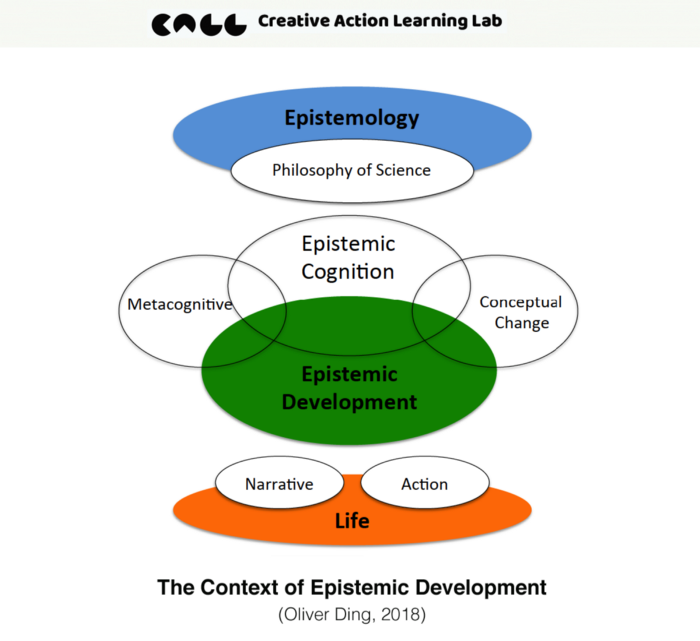
In June 2018, I did a rough literature review about personal knowing and found there is an established discipline called Personal Epistemology or Epistemic Cognition. I made the above “Sandwich” diagram for understanding the whole picture of personal knowing.
At the top of the Sandwich, there is a branch of philosophy: epistemology. Also, a related discipline is the Philosophy of Science.
At the bottom of the Sandwich, there is a real daily life world. I pointed out two keywords: Narrative and Action. These two keywords refer to two approaches: the narrative approach is about biographical studies while the action science approach refers to Chris Argyris’ Action Science and Donald Schön’s Theory in Practice and The Reflective Practitioner.
In the middle of the Sandwich, there are several areas. One layer is about academic professional research themes such as Metacognition, Epistemic Cognition, and Conceptual Change. These themes belong to different disciplines and different theoretical research traditions. For example, Metacognition is part of cognitive psychology. Epistemic Cognition belongs to educational studies. The term Conceptual Change is only used by North American scholars.
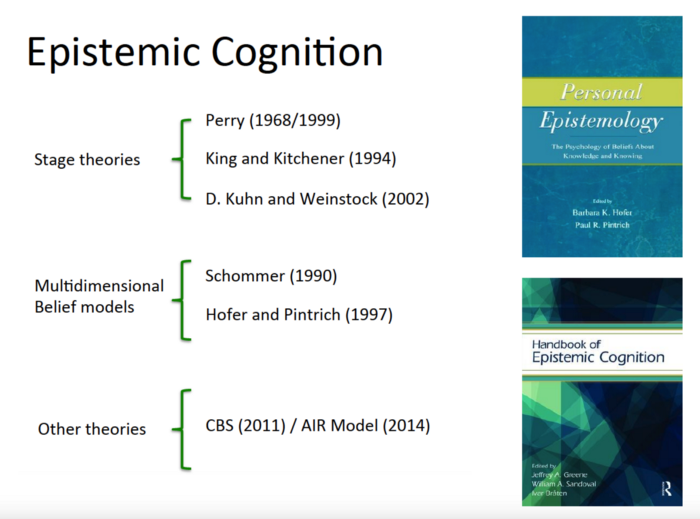
In order to connect academic research and the daily life world, I coined the term Epistemic Development and used it to replace my old terms such as intellectual development and life reflection. You can find more details here.
As mentioned above, the Approaches — Tastes Mapping is about — at least — the following three things:
- Perceiving Differences
- Appreciating Creativity
- Discovering Fitness
Perceiving Differences refers to cognitive skills and knowledge. You have to at least read and understand two theoretical approaches, then you can start perceiving the differences between these two approaches. If you read more theoretical approaches, you can identify more differences. This is the foundation of developing your tastes.
Appreciating Creativity is about the attitude of openness and fairness. A theoretical approach is the outcome of a hard work of a creative person. It’s not easy to develop a brand new theoretical approach. Once we find an innovative approach or a near-innovative approach, it’s better to open our minds to watch a wonderful show. We should also pay attention to the creativity of the work itself, not the popularity of the creator.
For example, I read Karpatschof’s 2000 book Human Activity: Contributions to the Anthropological Sciences from a Perspective of Activity Theory in Oct 2022. Though I have read many books and papers about Activity Theory and written two books about Activity Theory, Karpatschof’s theoretical approach opened a new door for me. I realized that there is always a possibility to develop a new approach to Human Activity.
Discovering Fitness emphasizes the objective — subjective knowledge curation. The goal of Developing Tacit Knowledge is about developing our knowledge and skills and applying them to our work and life. We need to identify our real situations and suitable theoretical approaches and discover a way to connect Theory and Practice.
In Activity U (III): Bonnie Nardi’s Choices and Boundary Knowledge Work, I shared Bonnie Nardi’s story of connecting Theory and Practice. Nardi was a trained anthropologist, but she was disgruntled with anthropology’s total lack of interest in digital technology in the 1980s. Here we see a conflict between Old Domain (academic job in anthropology) and New Domain (high tech research). Nardi was trained in anthropology and had an academic job in anthropology. At that time, she was interested in emergent digital technologies. She had to make a choice between the old domain and the new domain. Finally, in the mid-80s, she left a tenure-track job in anthropology and moved to the high-tech industry in Silicon Valley.
As an HCI researcher, Nardi met her challenge again. The second wave of HCI was emergent around the late 1980s to early 1990s. In order to overcome the limitations of information processing psychology as a theoretical foundation for HCI, some researchers proposed several other theoretical approaches as alternative frameworks. In 1987, Susanne Bødker argued that activity theory could form a strong theoretical basis for HCI. Other options are phenomenology, the situated action perspective, and distributed cognition.
This time, Nardi’s choice was activity theory because her preference is a systematic theoretical framework. She shared an example, “One of the key points Kaptelinin makes about a strength of activity theory is the importance of its integrating framework linking a set of theoretical principles — rather than what we often get in HCI, which is an insight here and an insight there. Kaptelinin provides an example of the power of a larger theoretical framework, comparing Norman’s (1991) notion of “cognitive artifacts” and activity theory’s notion of tools. Cognitive artifacts are on one level almost identical to tools, but in activity theory, the notion of tools draws on principles of mediation, internalization, and functional organs, leading to very different conclusions about the nature of tools, as Kaptelinin details. Finally, Kaptelinin discusses some of the limitations of activity theory.” (1996)
As an established theoretical tradition, Activity Theory brought a new meta-theory, new domain, new methods, new tools, and new resources to Nardi. She embraced the opportunity and made a significant contribution to the development of Activity Theory in the HCI field and in North America.
The change in Personal Epistemology will lead to changes in knowledge creation and other life activities.
The “PIN” Strategy
I’d like to use a metaphorical sign to summarize the above discussion. See the picture below.
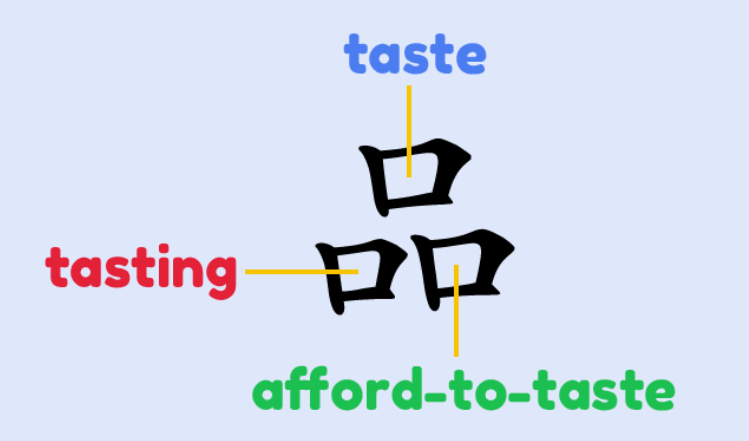
I made the above picture which presents a metaphorical sign in early 2020. The sign is made in two languages: Chinese and English. For readers who are not familiar with Chinese, you can check out the Chinese character “品(pin)” on Wiktionary.
The structure of “品” is three “口” which means mouth. Basically, it means that we have to eat something at least three times, then we can say we have a taste of the thing. In Chinese, the character “品” also refers to 1) article, item, product, commodity; 2) personality, character; 3) grade, level, rank, class, etc. These meanings are also about more than One.
I used the structure of “品” to highlight three perspectives of Personal Epistemology:
- Taste
- Tasting
- Afford-to-taste
The “Taste” perspective refers to the third-person perspective. There is a thing and a person. The person has a high sensitivity to a specific taste and he uses the taste to judge and review the thing. This perspective emphasizes the distance between the thing and the person. There should be an objective standard for measuring the thing.
The “Tasting” perspective refers to the first-person perspective. There is a thing and a person. Though the person has a high sensitivity to a specific taste, he decides to Suspend the Taste and starts to interact with the thing and develop a new meaning about the thing from the real experience. This perspective focuses on the real experience of acting with the thing. The meaning and value of the thing all depend on the subjective experience.
The “Afford-to-taste” perspective is inspired by Affordance Theory which is a core of Ecological Psychology. There is a thing and a person. The thing is there, the person perceives some potential acts upon the thing. If the potential acts match the needs of the person in a particular situation, then there is a real-tasting act. This perspective doesn’t emphasize either objective standard or subjective experience. It focuses on the objective — subjective fit.
Moreover, we have more choices than the above three perspectives. A person can switch between these perspectives.
Do you want to adopt the PIN strategy to your life activities?
Related Articles
- Mapping Thematic Spaces #2 — The “Activity” Thematic Space
- Activity U (II): Unit of Analysis, Niches of Analysis, Levels of Analysis
- Activity U (III): Bonnie Nardi’s Choices and Boundary Knowledge Work
- D as Diagramming: Challenge as Opportunity
- Knowledge Discovery: Concepts, Notions, and the Concept Dynamics Framework
- Knowledge Discovery: The Concept Dynamics Framework
- Knowledge Discovery: The HERO U Canvas
- Knowledge Discovery: The “Double Theme” Strategy
- Knowledge Discovery: The “Middleware” Strategy
I am also working on building a new website for the Platform Ecology project. You can save the following links:
- PlatformEcology.org
- Twitter: @PlatformEcology
- Linkedin: @PlatformEcology
You are most welcome to connect via the following social platforms:
Linkedin: https://www.linkedin.com/in/oliverding Twitter: https://twitter.com/oliverding Polywork: https://www.polywork.com/oliverding Boardle: https://www.boardle.io/users/oliver-ding


