
D as Diagramming: The Creative Work Canvas
How to design a canvas with a diagram?
This article is part of the D as Diagramming project which aims to explore the power of diagrams and diagramming. The previous article talked about diagram blending and canvas. I mentioned three ways of designing a canvas:
- Directly design spaces for concepts without a diagram.
- Expand a diagram into a canvas.
- Generate a canvas by adopting a meta-canvas.
This article will try the second way again. The goal of the challenge is designing a new canvas for Creative Work which is a special type of activity. I will use the Creative Work canvas as a container to curate several frameworks and concepts from my previous work.
- Part 1 reviews the historical development of the concept of Creative Work. You can skip this part and directly jump to Part 2 or Part 3.
- Part 2 discusses the relationship between diagrams and canvases.
- Part 3 introduces the process of making the Creative Work canvas.
- Part 4 reflects on the canvas practice in the context of knowledge curation.
This article also produces a by-product: a brief of the book Career Curation: Curativity Theory for Personal Innovation. I wrote 106 pages for the book in Chinese and stopped the project in July. Part 1 summaries the core ideas of the draft.
Contents
Part 1: The Creative Work
1.1 The Career Curation project 1.2 The Lifeworld of Career 1.3 Life Coordinate 1.4 The World of Working 1.5 Schutz’s Creative Life 1.6 Moment, Project, and Life
Part 2: Designing for Knowledge Canvas
2.1 Diagram v.s. Canvas 2.2 How to design a good canvas? 2.3 Visual Areas 2.4 Conceptual Spaces 2.5 Match Visual Areas with Conceptual Spaces 2.6 Unique Style
Part 3: The Creative Work Canvas
3.1 The starting point 3.2 Two types of concepts 3.3 Diagram Blending 3.4 The first draft 3.5 The second draft 3.6 The third draft
Part 4: Reflection
4.1 The Pre-canvas Diagramming 4.2 Four rules of design canvas 4.3 Digital whiteboards 4.4 Cognitive Containers
Part 1: The Creative Work
The idea of Creative Work is inspired by my previous work the Life-as-Activity framework (v0.3, v2.0) and the Path of Creative Life framework. Since my primary audiences are creative workers, especially knowledge workers, I’d like to define Creative Work as a special type of Activity.
Two major theoretical resources behind the Creative Work are Activity Theory and The evolving systems approach to the study of creative work (Howard E. Gruber, 1974,1989). In a previous article D as Diagramming: The Path of Creative Life, I mentioned Lev Vygotsky’s ideas about Creativity and Development. I realized that Vygotsky’s lifespan perspective echoes Gruber’s approach. Thus, the term “Creative Work” is perfect for connecting these two theoretical resources together.
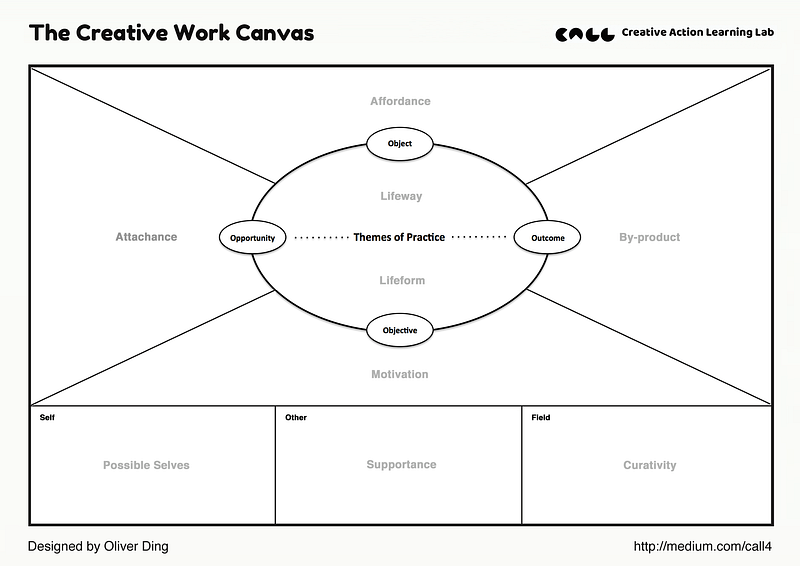
The above canvas contains a diagram in its center. The diagram is named “the Life-as-Activity framework (v1.5)” which was born from the process of writing a new book titled Career Curation: Curativity Theory for Personal Innovation.
1.1 The Career Curation project
Why did I start the Career Curation book project?
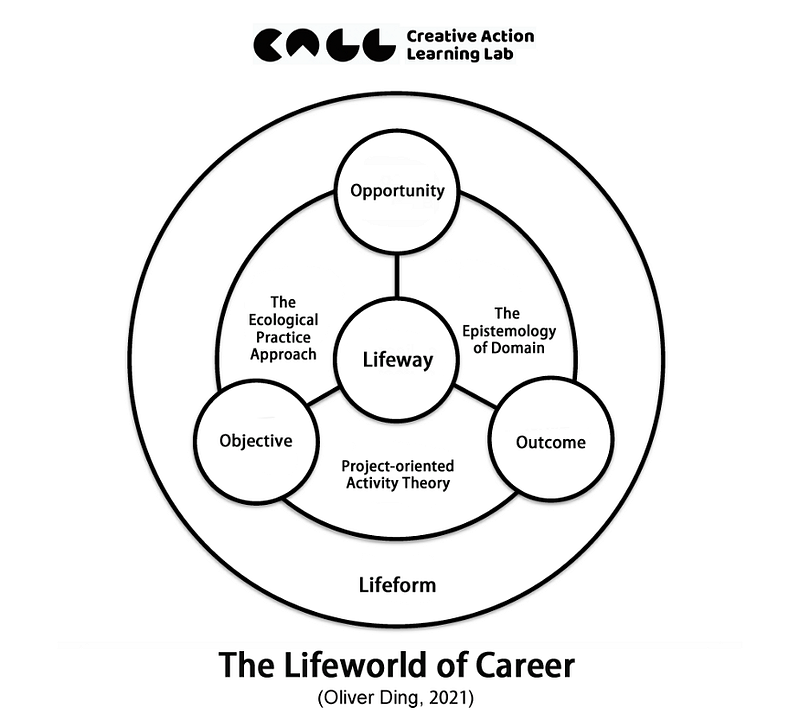
On July 4, 2021, I finished a 64-page thesis titled The Epistemology of Domain which offers a brand new theory about Domain. On July 5, 2021, I sent an email to a friend with my draft. At the end of the email, I used the following three keywords to summarize my three major theoretical creations.
- Opportunity: The Ecological Practice Approach
- Objective: Project-oriented Activity Theory
- Outcome: The Epistemology of Domain
Later, I used the Tripartness diagram to re-organize these ideas. I also adopte the pair of concepts “Lifeway/Lifeform” to the diagram. Finally, I made a new framework for discussing career development.
This led to a new book! I added the new diagram to the Career Curation board and started writing! I have written 106 pages for the first draft in Chinese. However, I stopped the project on July 17, 2021.
1.2 The Lifeworld of Career
The first draft of Career Curation has six chapters:
- Chapter 1: The background (32 pages). I introduced my three theoretical creations: a). The Ecological Practice Approach, b). Project-oriented Activity Theory, c). The Epistemology of Domain.
- Chapter 2: Lifeway, Lifeform, and Lifeworld (6 pages). This chapter introduced “Lifeway/Lifeform” which are core concepts of the Lifesystem framework. I also adopted the concept of Lifeworld from Alfred Schutz. Thus, I used “The Lifeworld of Career” as the name of the above diagram. It means the Lifeworld is the Container of Career.
- Chapter 3: Opportunity, Object, and Outcome (22 pages). I adopted ideas from the above three theoretical accounts to discuss these three key words. It is a hard task of deep conceptual inquiry. Eventually, I discovered nine insights about the Lifeworld of Career. See the diagram below.
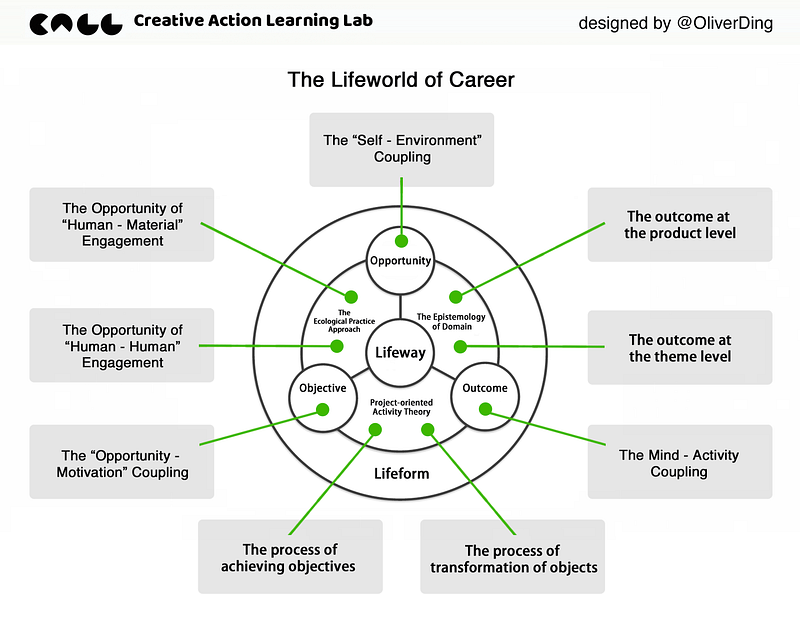
At the end of Chapter 3, I introduced a new diagram as a summary of the discussion. I noticed that the difference between “the process of achieving objectives” and “the process of transformation of objects” is significant because it challenges the traditional concept of “object” in Yrjö Engeström’s Activity System model which is an established branch of Activity Theory. Later, I confirmed this insight from the perspective of the iART framework in Sept. From the perspective of the iART framework,it’s clear that we have to use two terms because Objective (what is motive about) is about Future while Object (what is acted on) is about Present. Moreover, for the iART framework, Objective is related to Anticipation while Object is related to Performance.
I used the diagram below to expand the original three keywords into five keywords: Concept (Opportunity > Objective > Object > Outcome). I didn’t give a name to this diagram. Later, I realized that it could be considered a new version of the Life-as-Activity framework.
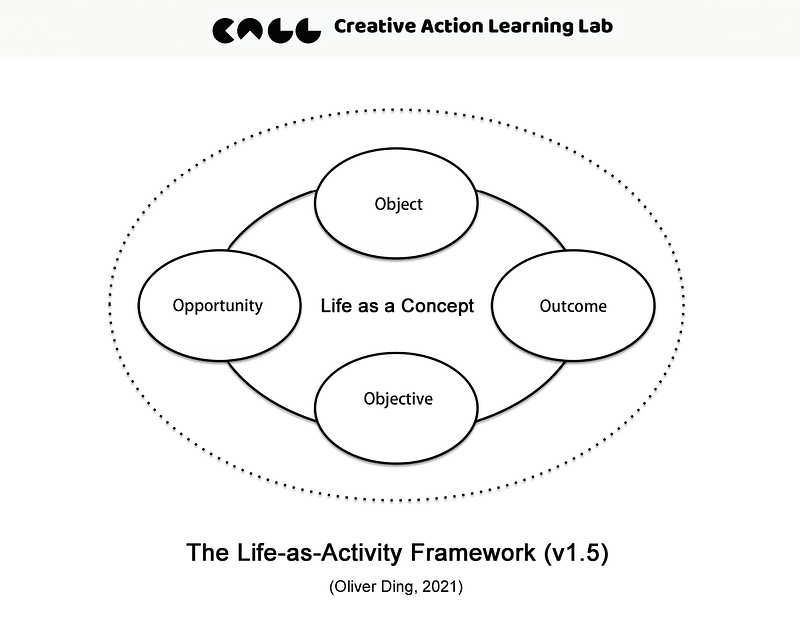
Eventually, I destroyed “The Lifeworld of Career” diagram and rebuilt a new diagram. However, this is just a beginning.
1.3 Life Coordinate
I did not stop on the above “Life-as-Activity (v1.5)” diagram, but went further and found a deep structure behind the diagram. I called the new structure Life Coordinate.
- Chapter 4: Lifesystem (20 pages). This chapter introduces the Lifesystem framework by conducting a diagram blending. You can find the details about the Lifesystem framework from a previous article: Lifesystem: Modeling Ice Skating and Other Social Practices. In fact, I forgot to mention the following Life Coordinate diagram in the article.
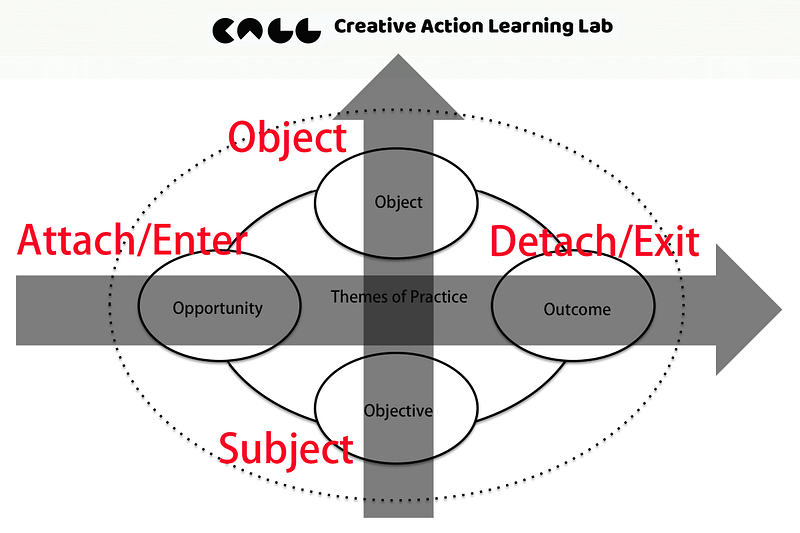
Chapter 4 started from building this new diagram from the above “the Life-as-Activity framework (v1.5)” and blended it with the diagram of “Lifeway/Lifeform”. Also, Chapter 4 contained a case study of the Lifesystem framework.
1.4 The World of Working
The Career Curation project aims to apply the Ecological Practice approach to study career development. Thus, I started looking for a theoretical approach to define the concept of “Career”.
The purpose behind the Lifesystem framework is developing a framework for discussing work-related design innovation and career development. It is close to Alfred Schutz’s concept “The World of Working” which is the opposite of the World of Fantasy and Dream. I think the concept “The World of Working” is perfect for defining the concept of “Career” in order to consider paid work and non-paid work as a whole.
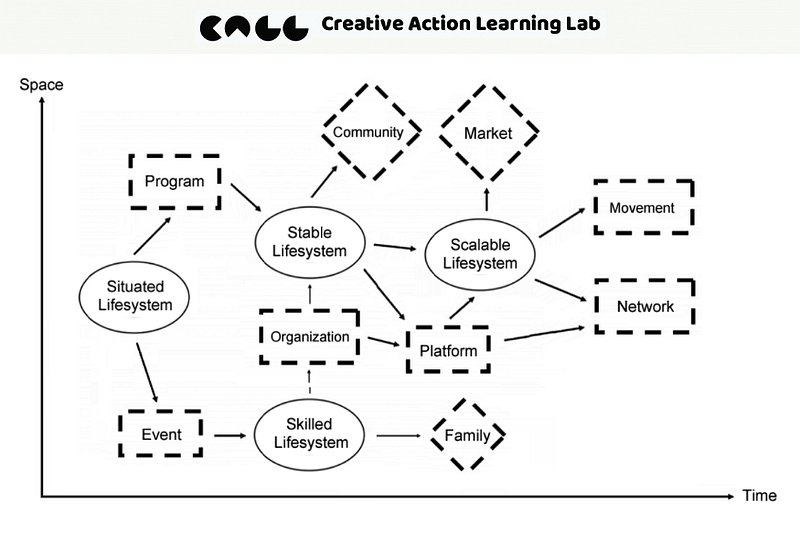
- Chapter 5. The Landscape of Lifeworld (10 pages). This chapter is a draft. It aims to claim that the basic unit of Lifeworld is Lifesystem. I planned to review the historical development of the concept of Lifeworld. In fact, I wrote a short version of the chapter as a section of the article Lifesystem: Modeling Ice Skating and Other Social Practices. I consider Lifesystem as a basic unit of analysis of the World of Working. In order to understand the structure and dynamics of the World of Working, I developed a typology of Lifesystem and the diagram below.
- Chapter 6: The Method (6 pages). These pages are just notes about methods. I mentioned Ecological Interaction Analysis and other ideas.
I stopped writing the book in July because I realized that I need to read more about Alfred Schutz’s ideas and books. Thus, I changed my plan from writing to reading. This journey led to the discovery of the concept of “The World of Working” from Schutz’s writings.
1.5 Schutz’s Creative Life
Moreover, my primary interest is creative career or the career of creative people. I found the Austrian philosopher and social phenomenologist Alfred Schutz’s ideas and his career are perfect for the Career Curation project.
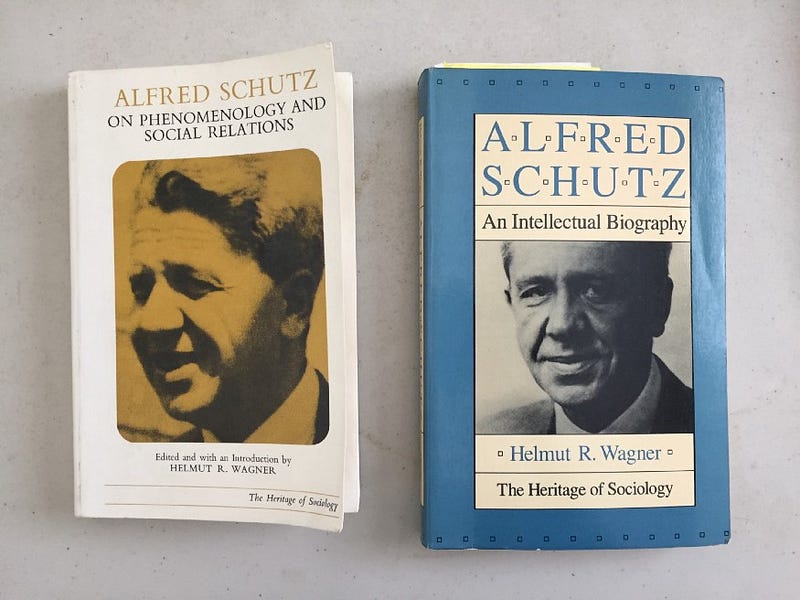
Schutz is a creative theorist whose work applied phenomenology to sociology. His works are recognized as creative projects. However, his life can be considered a creative life too. Though Schutz had a very short teaching career at the Graduate Faculty of the New School for Social Research, he was not a formal scholar who had a job in a research university during most of his intellectual career. We can say that he was an extremely excellent independent researcher.
According to Helmut R. Wagner who is the author of Alfred Schutz: An Intellectual Biography, “In organizing his time, Schutz gave priority to four sets of relevant interests. Each of them belonged to a different area of concern, each had its own primary relevance, and each formed a relatively self-contained sphere of life. ” Schutz’s four life spheres are family life, business activities, theoretical-philosophical activities, and music.
1.6 Moment, Project, and Life
In a previous article titled D as Diagramming: The Path of Creative Life, I mentioned a significant insight which connects my research on creative actions and the Life-as-Activity framework.
I recently added a small piece to my framework about Creativity: The NICE Way and Creative Actions. I realized that there are three timescales for the 3i model which is a part of my framework.
Moment: creative action Project: creative work Life: creative life
The NICE Way framework goes beyond traditional view which focuses on creative products. It considers creative actions as products. From the perspective of timescales, a person can produce a creative action at a particular moment. A person also can run a creative project for a short period of time or a long period of time. Finally, we can consider the whole life of a creative person as a creative product.
I used Schutz’s career as an example of Creative Life, “For example, the Austrian philosopher and social phenomenologist Alfred Schutz is a creative theorist whose work applied phenomenology to sociology. His works are recognized as creative projects. However, his life can be considered a creative life too. Though Schutz had a very short teaching career at the Graduate Faculty of the New School for Social Research, he was not a formal scholar who has a job in a research university during most time of his intellectual career. We can say that he was an extremely excellent independent researcher.”
Schutz’s life is a creative life of intellectuals. I’d like to point out that there are many kinds of creative lives. For example, Steve Jobs, Neil Alden Armstrong, Martin Luther King, and Malala Yousafzai. Moreover, we should notice that there are many creative lives that are not “Big-C” such as famous figures. Scholars have offered us a 4C model of creativity.
- Big-C: famous creative achievements such as music, paints, inventions, theories, etc.
- little-c: creative behavior in everyday life. For example, making waffle art, using cardboard boxes for sliding, decorating a place for a birthday party, etc.
- Mini-c: the novel and personally meaningful interpretation of experience, actions, and events.
- Pro-c: “amateur” creators and professional creators who are successful, but have not reached a level of prominence as eminent creators achieved.
Later, I used “Moment > Project > Theme” for the diagram of the Life-as-Activity framework (v2.0).
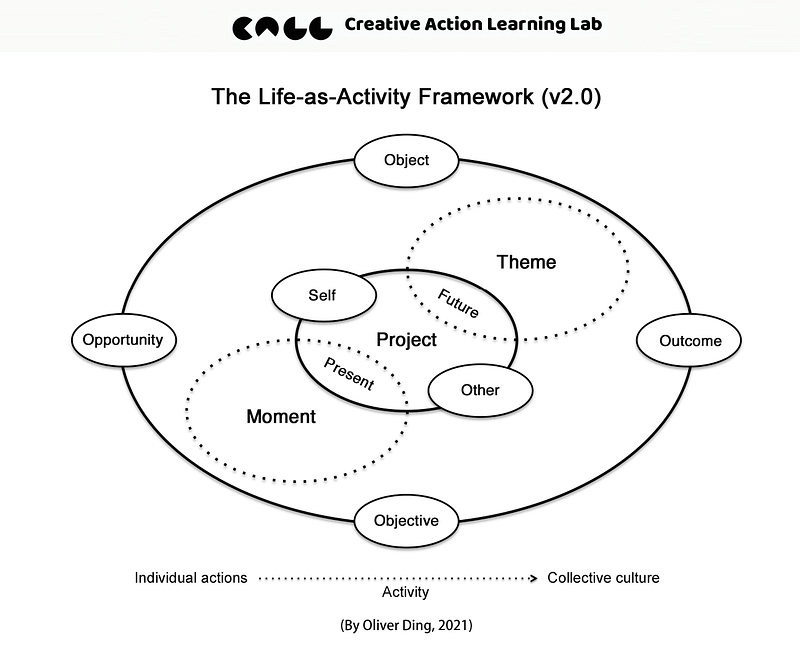
Now, I want to claim that Creative Work is a special type of Activity from the perspective of the Life-as-Activity framework. We can also consider Creative Work as a unit of analysis for discussing a creative person’s career and work.
The term Creative Work also echoes Howard E.Gruber’s theoretical approach: The Evolving System Approach to Creative Work. However, Gruber focuses on Big-C and his method is based on biographical study. My approach expands his ideas to all types of creative workers and considers anticipation and future.
Part 2: Designing for Knowledge Canvas
Why do I need to design a canvas for Creative Work? First, it is a learning process for exploring the relationship between Diagram and Canvas. This topic is part of the D as Diagramming project. Second, both Diagram and Canvas are Cognitive Containers which is a concept of Knowledge Curation. Third, a canvas is a good tool for curating my concepts about adult development and creative life.
However, it is a challenge to expand a diagram into a canvas.
2.1 Diagram v.s. Canvas
Since I use the ECHO way and the HERO U framework to guide my knowledge curation activity, I’d like to use the HERO U framework to discuss the difference between Diagram and Canvas.
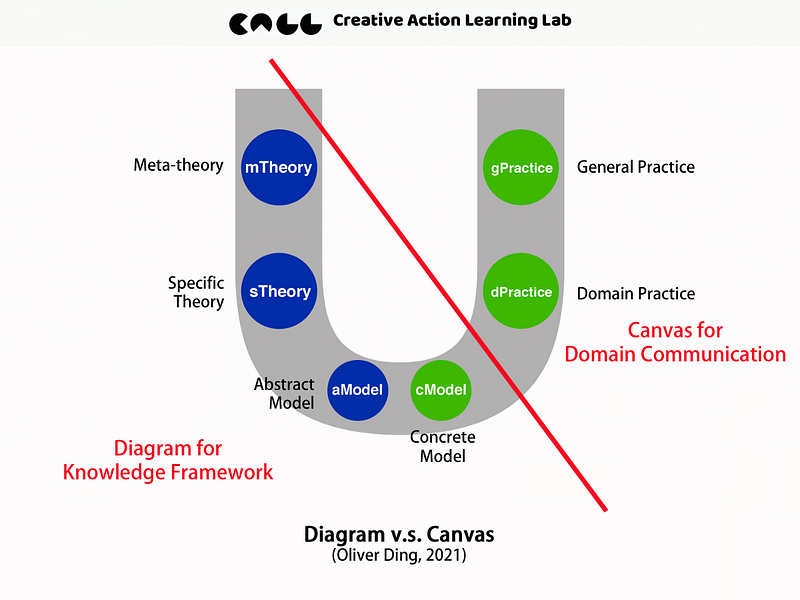
The HERO U diagram presents six types of “Object of Knowing”. Let’s look at the terms I used for the diagram.
mTheory: Meta-theory sTheory: Specific Theory aModel: Abstract Model cModel: Concrete Model dPractice: Domain Practice gPractice: General Practice
What is the major difference between a framework/diagram and a canvas? A simple answer is that the former focuses on expressing the relationship between several concepts while the latter primarily offers spaces for posting notes which can be considered as data about concepts. In other words, a canvas is a situational application of a framework/diagram.
When you design a diagram, your goal is finding an ideal spatial structure to represent a set of concepts and their relationship. You don’t have to consider making spaces for others to add data about concepts. People tend to add notes around the diagram if they need to do it. For example, I made the diagram below in July. I just added some texts which refer to a set of metaphors about Strategy and Design around the diagram.
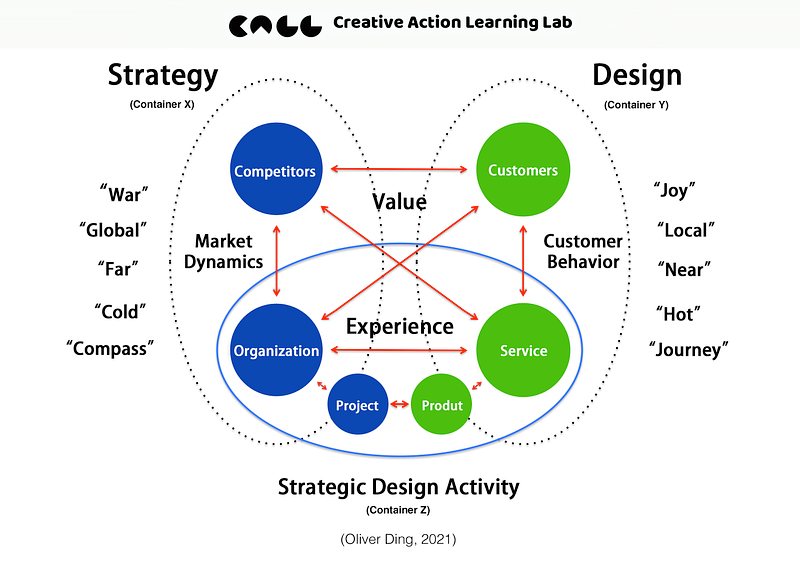
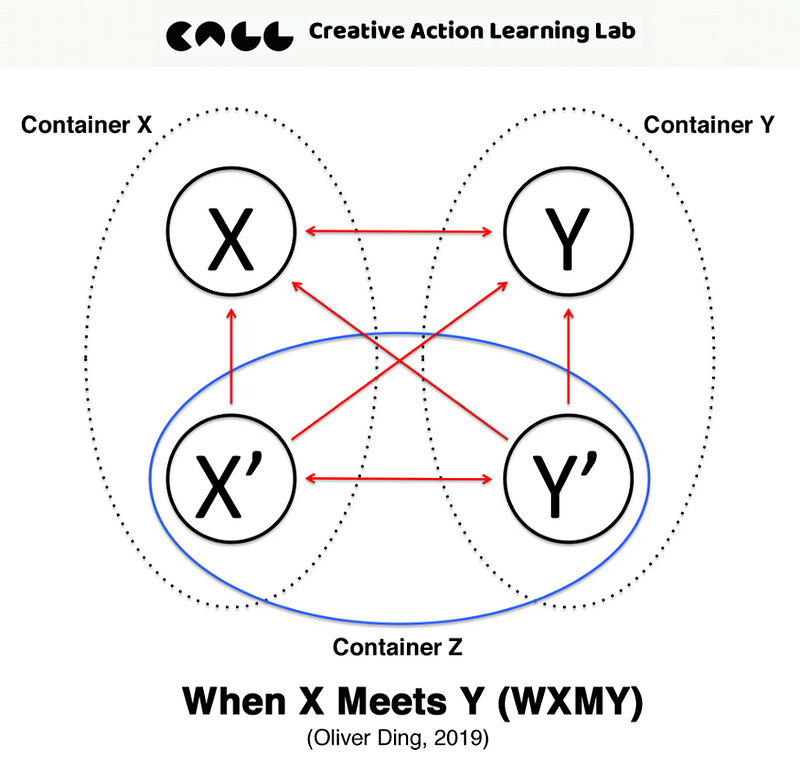
The original diagram is When X Meets Y (WXMY). I didn’t design spaces for adding notes. I discovered these spaces for adding notes which don’t correspond to concepts of the diagram. Here we have to pay attention to the picture and the diagram. The picture is a container which contains the diagram. However, the space outside the diagram is part of the picture. The act of adding notes on the space refers to the picture, not the diagram. This insight is very important if we talk about diagram-in-use for a particular situation in a particular environment (Updated Jan 17, 2022: for further discussion, you can read this one: Physical Space Affordances and Graphic Space Affordances.)
However, the purpose of a canvas is just offering spaces for adding notes and stickers which contain data corresponding to concepts. For example, A 2014 book titled Value Proposition Design offers a canvas for understanding value propositions and customer segments. The Customer Profile module sets three spaces for sensemaking: Customer Jobs, Gains, and Pains. According to the authors,
- Customer Jobs: describe what customers are trying to get done in their work and in their lives, as expressed in their own world.
- Gains: describe the outcomes customers want to achieve or the concrete benefits they are seeking.
- Pains: describe bad outcomes, risks, and obstacles related to customer jobs.
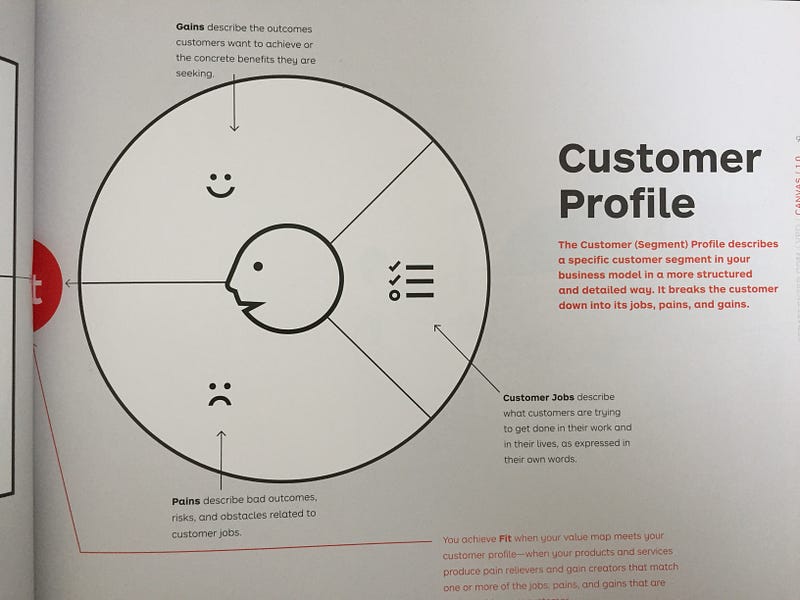
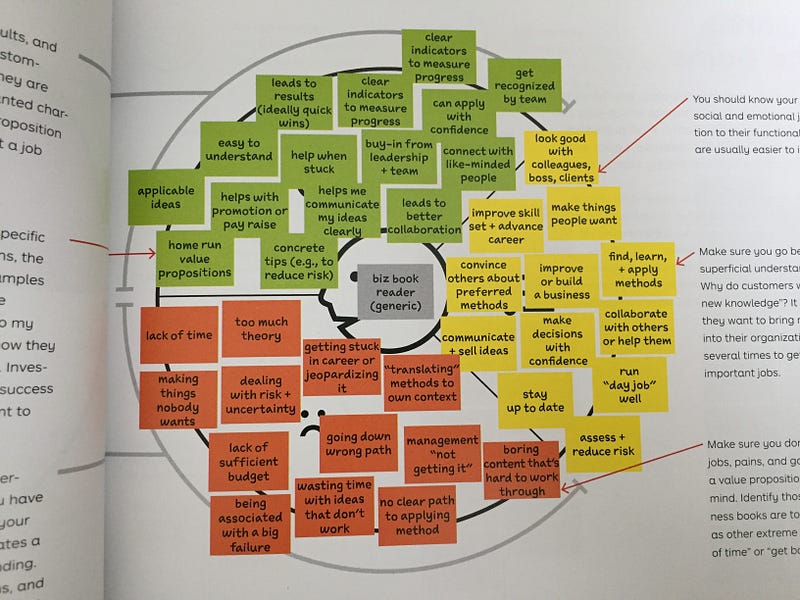
The above two pictures show the original canvas and its one use case. It is clear that the value of a canvas is its status of canvas-in-use for understanding data in order to achieve sensemaking in a special situation. For the case of Value Proposition Design, the situation is designing a business model for a new/old product/service.
Since canvases are designed for encouraging contributions, it became a popular instrument in several fields such as educational workshops, team meetings, design and innovation events, and other creative communication activities. The situational function requires makers to print canvases in a large size and post them on physical walls.
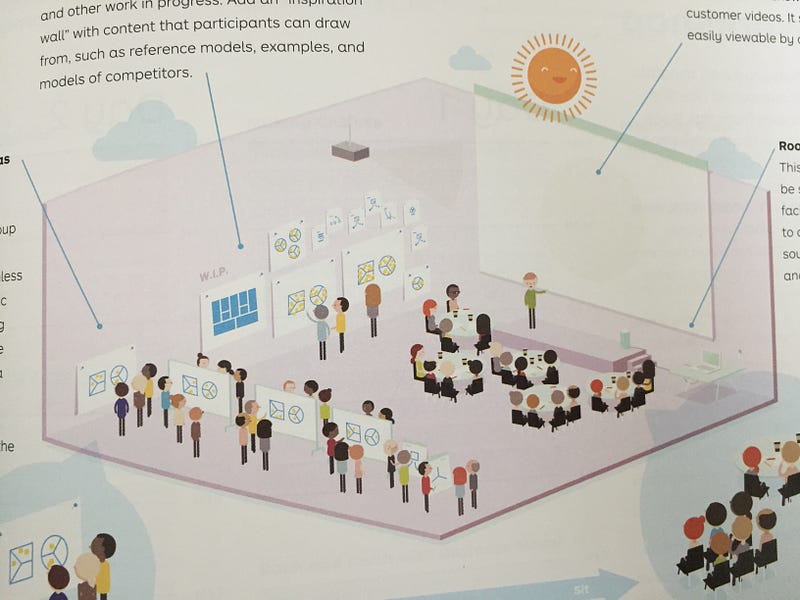
According to the authors of Value Proposition Design, the walls of the venue are important for a workshop. They emphasize, “Walls: Large vertical surfaces are indispensable, whether movable or part of the building. Make sure you can stick large posters, sticky notes, and flip chart paper on them…Set up an area where you can expose canvases and other work in progress. Add on ‘inspiration wall’ with content that participants can draw from, such as reference models, examples, and models of competitors.”(2014, p.167)
The same method is applied to the online environment too. Thanks to the rise of collaborative whiteboard platforms, now we can design, deliver and use canvas in digital spaces.
Let’s summarize the discussion, a diagram is a representation of conceptualized knowledge while a canvas is an instrument of practical communication. The primary goal of diagrams is visually expressing knowledge frameworks while the primary goal of canvases is enabling situational interaction around data and concepts.
2.2 How to design a good canvas?
Though I am not an experienced canvas designer, I’d like to suggest that there is a foundational principle for designing canvas:
A good canvas matches visual areas and conceptual spaces with a simple and unique style of spatial configuration.
The above principle doesn’t mention Content because I think content is not part of the designing process. The Content of a canvas is the outcome of the thinking process. I am not going to claim that designers don’t think and thinkers don’t design. I am both a designer and a thinker. Both Content and Form are important for making a canvas, however I think it is better to talk about them one by one while we consider them as a whole. The above principle uses the following three ideas to discuss Form of canvases:
- Visual Areas
- Conceptual Spaces
- Unique Style
The following sections will unpack these ideas.
2.3 Visual Areas
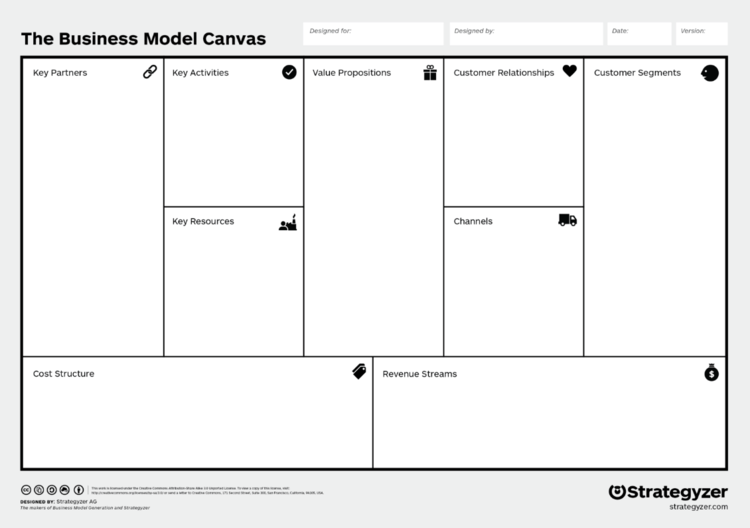
Visual Areas refer to several spaces in a canvas. The creators of Business Model Canvas use “Building Blocks” to describe nine visual areas of the canvas. Their simple design established a model of knowledge canvas and attracted many followers.
Rule 1: Separate several visual areas clearly with lines. Make sure each visual area is identified easily.
2.4 Conceptual Spaces
Conceptual Spaces refer to a curated group of conceptualized knowledge. This idea is adopted from Peter Gardenfors’ Conceptual Space: The Geometry of Thought. According to Gardenfors, a Conceptual Space is defined as a set of Quality Dimensions with a geometrical structure. Also, there is a middle layer called Domain in Cardenfors’ theory. As Gardenfors explained, “A domain is a set of integral dimensions that are separable from other dimensions… A conceptual space can then be defined as a collection of one or more domains.”
Let’s use the Customer Profile module as an example. As mentioned above, the Customer Profile module suggests three ideas: Customer Jobs, Gains, and Pains. That means the makers of the canvas set two dimensions for a conceptual space named Customer Profile.
- Dimension 1: Customer Jobs
- Dimension 2: Gains and Pains are two values of a same quality dimension.
Is this conceptualized knowledge a perfect solution for understanding customers? It depends on your perspective. You definitely can develop your knowledge frameworks for studying customers. This is the issue of Content. I don’t want to touch this issue here. If you want to know more about Business Model Canvas which is the master canvas of Customer Profile, you can check out JP Castlin’s article Models & Canvases.
Rule 2: Adopt a special and unique perspective to develop a conceptualized knowledge for building conceptual spaces. The more unique the perspective, the greater the value of the canvas.
2.5 Match Visual Areas with Conceptual Spaces
Now we reach the challenge of matching Visual Areas with Conceptual Spaces. Let’s use the Customer Profile module again. If we review its three ideas and we could find there are two quality dimensions:
- Dimension 1: Customer Jobs
- Dimension 2: Impact (Gains=positive impact + Pains=negative impact)
This is the structure of the conceptual space of Customer Profile. Now, let’s review its visual areas. There are three visual areas which correspond to three ideas. However, it doesn’t match the structure of the conceptual space. We can’t perceive any cues of the two dimensions.
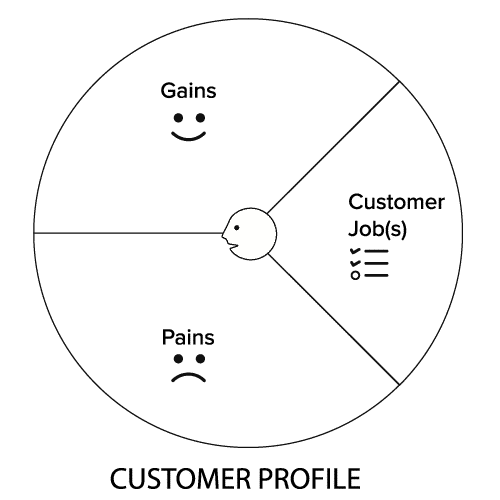
It seems this is a “bug” from the perspective of the Conceptual Spaces theory. Can we fix this “bug”? I made a new version of the Customer Profile canvas. See the diagram below.
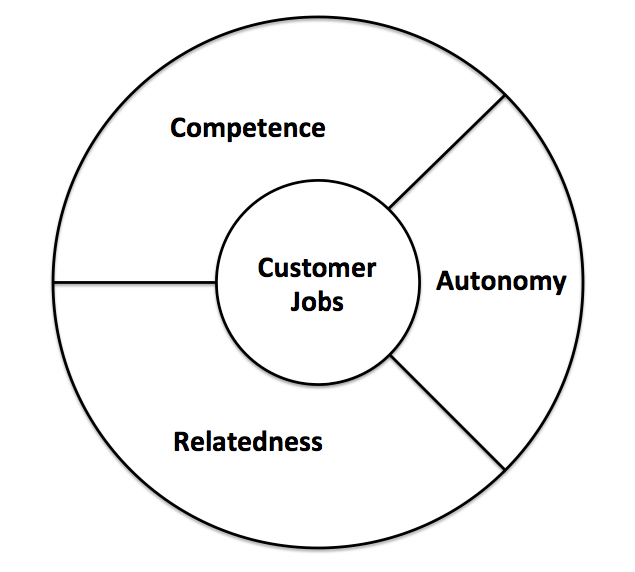
First, I moved “Customer Jobs” into the center. Second, I use “Competence”, “Autonomy” and “Relatedness” to replace “Gains” and “Pains”. The new version clearly displays two types of Visual Areas: the center and the surrounding space. People can directly perceive the difference between these two types of areas. The center refers to a dimension while the surrounding space refers to the other one dimension. Even there are three visual areas in the surrounding space, they are perceived as a whole. In this way, we can fix the “bug”.
The three new terms are adopted from Self-Determination Theory (SDT) which is an established psychological theory about human motivation. SDT claims that there are three basic psychological needs for human beings. Thus, the new version of Customer Profile uses Basic Psychological Needs as a domain which has three dimensions.
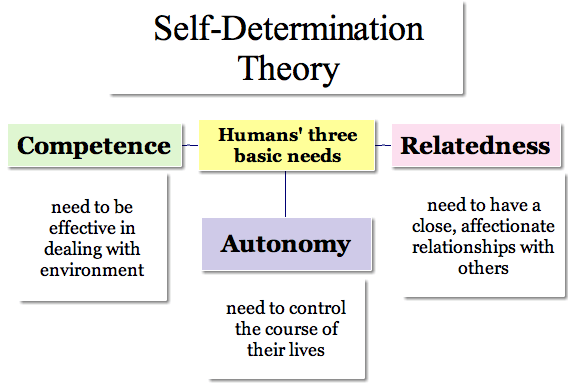
The new version adopts a special psychological theory to develop the conceptual space. Does every canvas need to adopt theoretical concepts from scholars? It depends on your motivation. This is about the issue of Content too.
Rule 3: Make sure the layout of visual areas matches with the structure of conceptual spaces. Take the visualization radically.
2.6 Unique Style
Unique Style refers to a simple and unique style of spatial configuration. This idea is about knowledge branding. Let’s use a diagram as an example first, then expand the discussion to canvas.
Yrjö Engeström’s Activity System model is an established branch of Activity Theory. The diagram of the model is called the Engeström’s triangle.
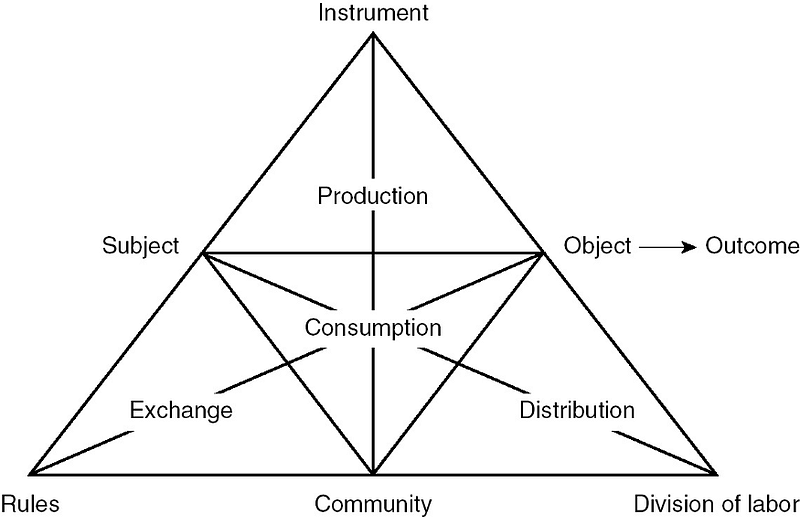
From the perspective of knowledge diffusion, I want to claim that the Engeström’s triangle is an important part of Engeström’s successful research career. David Nicolini (2012) commented on Engeström’s work in his book Practice Theory, Work, & Organization, “As I have noted above, the idea of the complex and systemic-like nature of activity is one of the central and defining aspects of the theory. This dimension is captured in Engeström’s triangle that has become not only a powerful intermediary for the theory but also something of a brand. For example, the picture constitutes a powerful analytical tool of immediate utility for all those who need to analyse and describe practice for different purposes (for example, those who are in the business of designing systems for integrating work practices: see e.g. Nardi 1996), and as such it has effectively supported the circulation and take-up of the theory.”(p.119)
Nicolini indecisively used “brand” to describe Engeström’s triangle. I want to go further and definitely claim the Engeström’s triangle and his theory is a knowledge brand. Traditionally, “brand” is used in the field of marketing. I coined the term “knowledge brand” to adopt the branding perspective to explain the micro level activities of knowledge diffusion.
There are many theories of brand and branding, I’d like to suggest three core aspects of knowledge brand for our discussion: identity, reality, and engagement. The Engeström’s triangle is the “logo” of Engeström’s activity system model, this is the aspect of visual identity. The Engeström’s triangle represents the activity system model, this is the aspect of conceptual reality. The Engeström’s triangle is also an instrument for researchers, learners and participants, this is the aspect of practical engagement.
Rule 4: Develop a simple and unique visual style which represents a spatial configuration. The uniqueness is the starting point of a knowledge brand.
Now let’s look at some examples of canvas. I picked Event Design Canvas and Design Ops Canvas for present discussion. You can find more canvases here.
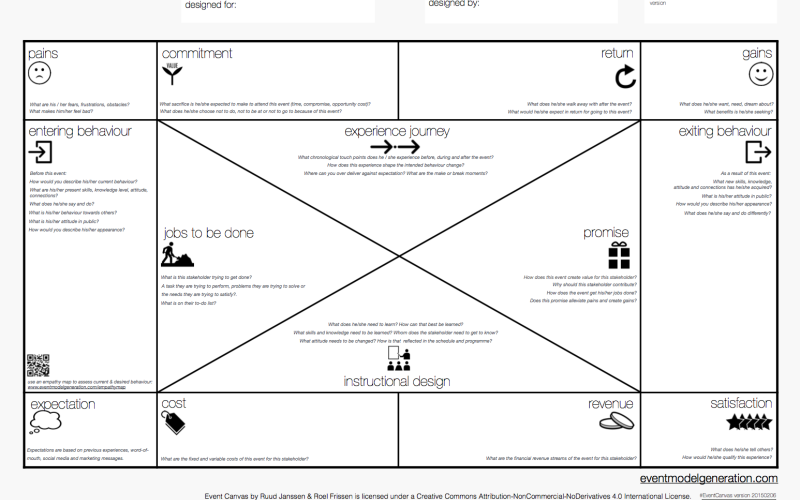
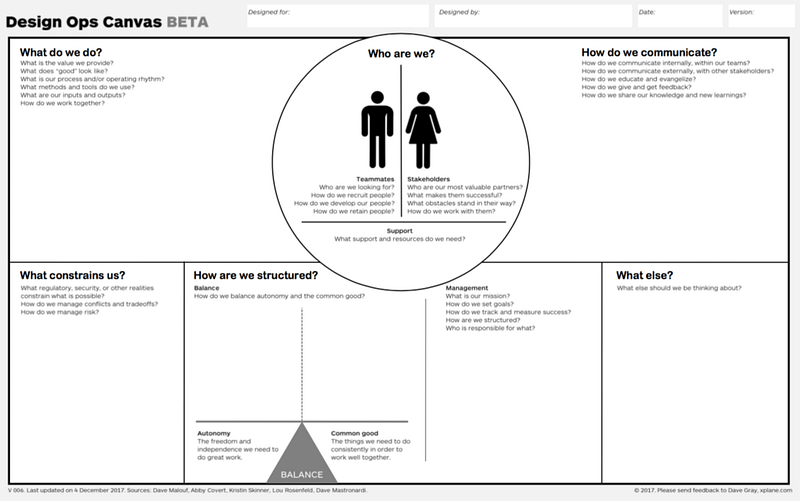
The above left picture is Event Design Canvas and the right picture is Design Ops Canvas. As mentioned above, the Business Model Canvas made a standard format for Knowledge Canvas and it attracted many followers.
However, there are two strategies of adopting a standard format: 1) you can adopt both the concept of Knowledge Canvas and the visual layout from the Business Model Canvas, 2) you can only adopt the concept of Knowledge Canvas and create your own visual layout.
Can we find an example of the second approach? I mentioned the Product Field canvas in the previous article. Let’s look it again:
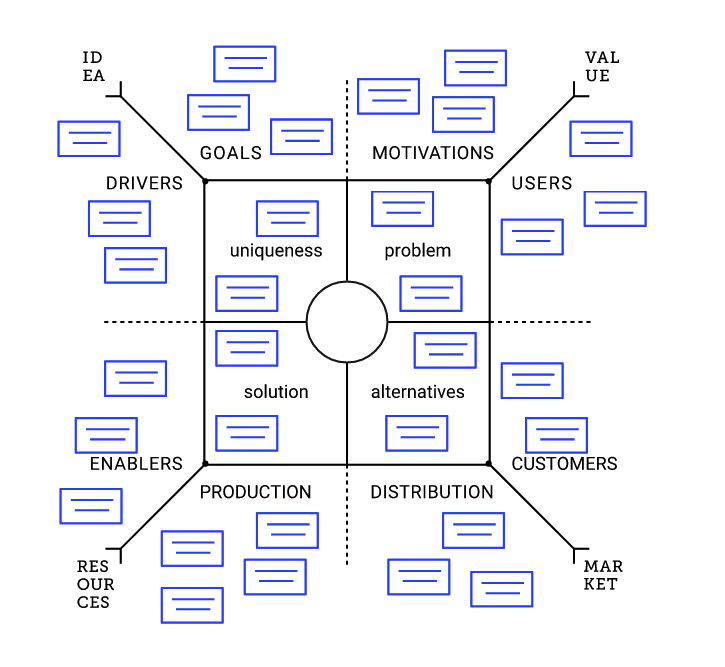
According to the authors of the framework, “The visual form of the Product Field is a Mandala. According to the Groups Keyboard a mandala helps you and your team to perceive wholeness and see gaps and unities under a diversity of perceptions.”
This is the difference! While The Business Model Canvas puts a set of “building blocks” in an A4 sheet, The Product Field Canvas jumps out of the box and gives a Mandala a free space.
Part 3: The Creative Work Canvas
This part focuses on my own experience of designing a canvas from a diagram. As mentioned above, this is a learning process.
3.1 The Starting Point
I have created several frameworks and diagrams, I found there is a diagram which is a good starting point. The diagram below uses four key words which are perfect for developing a canvas.
As mentioned above, this diagram is a by-product of writing of Career Curation. I intended to use it as a bridge to import the Lifesystem framework in the book. The writing of the book is part of the large enterprise of building the Ecological Practice approach. Each year, I write a book and each book primally introduces a core concept of the theoretical approach. The book Career Curation aimed to introduce the concept of Lifesystem (Lifeway/Lifeform). That was the reason that I considered the above diagram as a bridge.
Now I consider it as a good candidate for developing a canvas.
Why?
Because the Lifesystem framework is an abstract model which aims to offer a brand new framework for guiding research and study. However, a canvas is for communication in a domain practice. Thus, it is better to use normal words to name visual areas and conceptual spaces when we are designing a canvas.
3.2 Two Types of Concepts
In a previous article Lifesystem: Modeling Ice Skating and Other Social Practices, I mentioned two types of concepts:
- Theoretical Concepts
- Operational Concepts
As a tool for guiding research and reflection, a knowledge framework is a whole which contains concepts, diagrams, and methods. Theoretical Concepts are adopted from Meta-theory or Specific Theory. Some frameworks don’t associate with any theories, they only have operational concepts. Operational Concepts are framework-dependent concepts for guiding research and reflection.
Though it is about knowledge frameworks, the same logic can be applied to canvas.
- Theoretical Concepts: you can directly show them on a canvas or not.
- Operational Concepts: use them as names for visual areas and conceptual spaces.
For example, I added three theoretical concepts from SDT to replace Gains and Pains and designed a new version of the Customer Profile canvas. I also mentioned the Actant Mapping Canvas in a previous article. The Actant Mapping Canvas was created by Monika Sznel who is a design anthropologist, UX researcher and service designer. By adopting a term called Actant from the Actor-network theory, Sznel expanded the well-known stakeholder mapping to non-human stakeholder in order to develop an environment-centered design method.
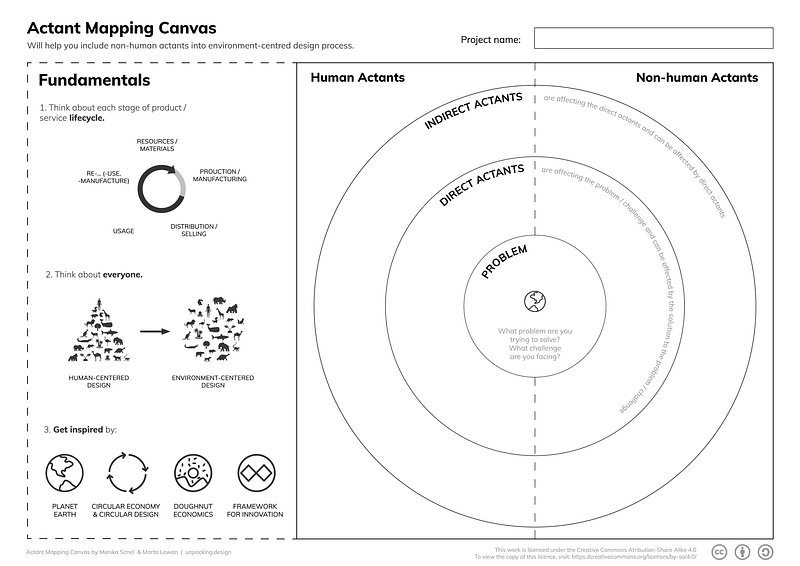
You can find more details from Sznel’s articles (1, 2, 3). The Actant Mapping Canvas directly puts the term “Actants” on the canvas. I have been reading some books and papers about the Actor-Network theory (ANT) for several years. It is interesting to know that there is an ANT-inspired canvas for designers. However, if a person isn’t familiar with the Actor-Network theory, he can’t quickly understand the meaning of the term “Actants” and the value of the canvas.
It is a risk to directly use uncommon theoretical terms to name visual areas and conceptual spaces for a canvas because people can’t understand it easily. It is also a risk to only use common words to name visual areas and conceptual space because people can’t directly perceive the innovative value of a canvas.
This is a trade-off between easy-to-learn and learn-for-deep.
For the Creative Work Canvas, I think the set of concepts of “Opportunity > Objective > Object > Outcome” are perfect for naming visual areas because they are both common words and theoretical terms. For example, Object and Outcome are important concepts in Activity Theory.
I also use grey words to display some relevant theoretical concepts for each visual area. Eventually, I developed a two types of words for designing canvases:
- Names: this type of words are operational concepts which refer to visual areas.
- Cues: this type of words are theoretical concepts which offer perspectives for thinking about the data inside visual areas.
In this way, a canvas becomes a powerful tool for knowledge curation. For theorists, it is a container for curating various theoretical concepts. For practitioners, it is a container for curating various data for sensemaking.
For the Creative Work Canvas, I personally recommend my own theoretical concepts. However, the canvas is also free for adopting theoretical concepts from others. In this manner, the canvas makes a good balance between my creations and users’ creations.
3.3 Diagram Blending
The next step is adding something to support the “Opportunity > Objective > Object > Outcome”.
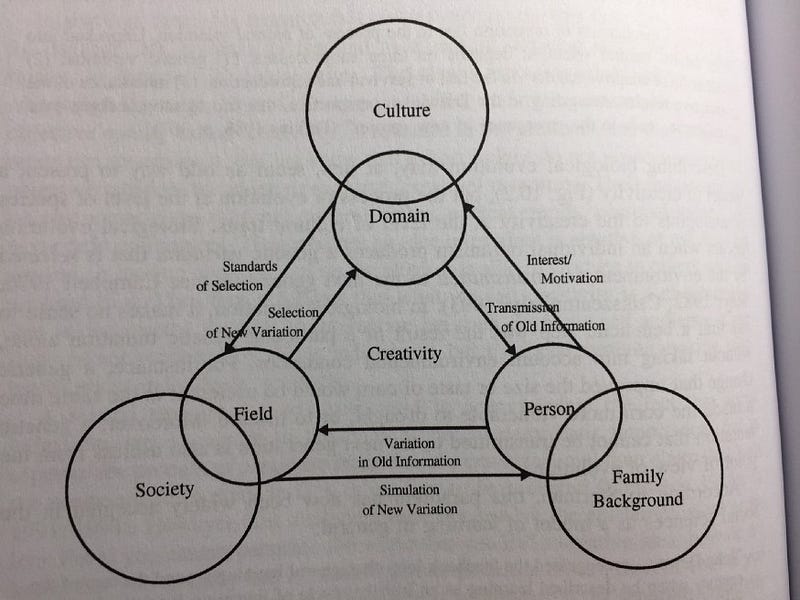
After looking at the Life-as-Activity Framework (v2.0) and the Systems Model of Creativity (Mihaly Csikszentmihalyi, 2014), I realized that I can use “Self > Other > Field” as an additional Conceptual Space for the Creative Work Canvas.
This process can be understood as a rough diagram blending because the outcome is not a diagram, but an abstract conceptual space.
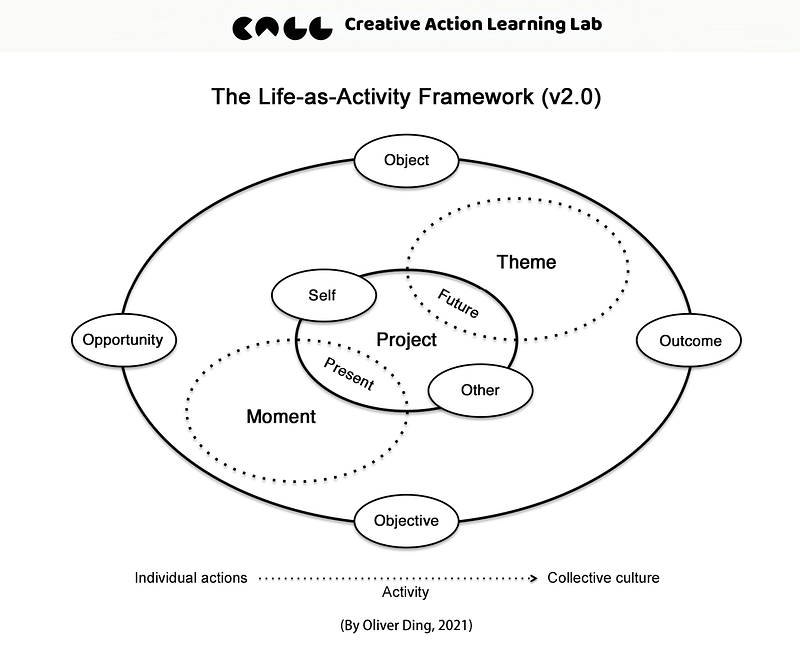
For the Life-as-Activity Framework (v2.0), The “Self — Other” relationship is placed in the structure of “Self — Other — Present — Future” which refers to iART framework.
The above right diagram is the Systems Model of Creativity (Mihaly Csikszentmihalyi, 2014). In order to understand the impact of social context, Mihaly Csikszentmihalyi and other researchers developed the Social Systems Model of creativity during the 1980s and 1990s. The diagram shows the model contains three components: Person, Domain and Field.
Csikszentmihalyi said, “Creativity occurs at the interface of three subsystems: An Individual who absorbs information form the culture and changes it in a way that will be selected by the relevant Field of gatekeepers for inclusion into the Domain, from whence the novelty will be accessible to the next generation.” (2014, p.166)
The Systems Model of creativity adopts the sociocultural approach which focuses on culture. Csikszentmihalyi defined the Domain as a symbolic aspect of the environment while the Field as a social aspect of the environment. He didn’t include the material aspect into the concept of Domain. Thus, he defined culture as symbolic domains, “It is useful in this context to think about cultures as systems of interrelated domains … The claim is simply that in order to understand creativity, it is useful to think of culture in this way.” (2014, pp.105–106) In other words, we have to notice Csikszentmihalyi’s “sociocultural approach” is a pure symbolic approach which doesn’t consider the material aspect as part of culture.
Moreover, he adopted Dawkins’s idea “Memes” as a foundational concept to explain Domain. He said, “Typically, the memes and rules that define a domain tend to remain stable over time. It takes psychic energy to learn new terms and new concepts, and in so far as psychic energy is a very scarce and necessary resource, and provided that the old terms and rules are adequate to the task, it makes sense for domains to remain stable.” (2014, p.106)
Though I accept the importance of social context, I don’t totally accept his idea about the “domain”. For the Creative Work Canvas, I use “Other” to replace “Domain”.
3.4 The First Draft
In order to simplify the design process, I adopted the A4 sheet style as a background and placed a diagram in the space. It defines five visual areas and each area refers to a conceptual space:
- Opportunity
- Objective
- Object
- Outcome
- Themes of Practice
The second group of visual areas are about “Self > Other > Field”. I used three building blocks for them and placed these visual areas under the above areas.
I also put some grey words on the canvas. These grey words are theoretical concepts.
- Opportunity → Attachance: it means detaching from an existing container and attaching to a new container. This concept is for discovering new opportunities.
- Objective → Motivation: it refers to psychological theories about human motivation. I personally like Self-determination theory (SDT).
- Object → Affordance: it refers to the Ecological Psychologist James. J. Gibson’s Affordance theory.
- Outcome → By-product: it refers to Howard E.Gruber’s theoretical approach: The Evolving System Approach to Creative Work.
- Themes of Practice → Lifeway/Lifeform: It refers to the Themes of Practice framework and the Lifesystem framework.
- Self → Possible Selves: it refers to Hazel Markus’s theory of Possible Selves.
- Other → Supportance: It refers to my own idea of Supportance.
- Field → Curativity: It refers to my own idea of Curativity.
I have introduced the above concepts in previous articles. You can search and find more information about them.
3.5 The Second Draft
As mentioned above, I discovered nine insights about the Lifeworld of Career. After reviewing these insights, I modified the first draft and added more words to the canvas.
I also reviewed the visual design of the first draft. I noticed that there is a micro visual style inside the ellipse in the center: I used a dotted line to divide a visual area into two parts. So, I applied the same visual style to the other four visual areas.
Then, I added more theoretical concepts into these visual areas. Four bold black texts were added to the canvas in order to highlight themes of visual areas:
- Opportunity: The Self — Environment Coupling
- Objective: The Opportunity — Motivation Coupling
- Object: The Material — Information Coupling
- Outcome: The Mind — Activity Coupling
I also re-organized grey words into pairs of concepts:
- Affordance — Attachance
- Anticipation — Performance
- Resources — Mediation
- Product — By-product
- Lifeway — Lifeform
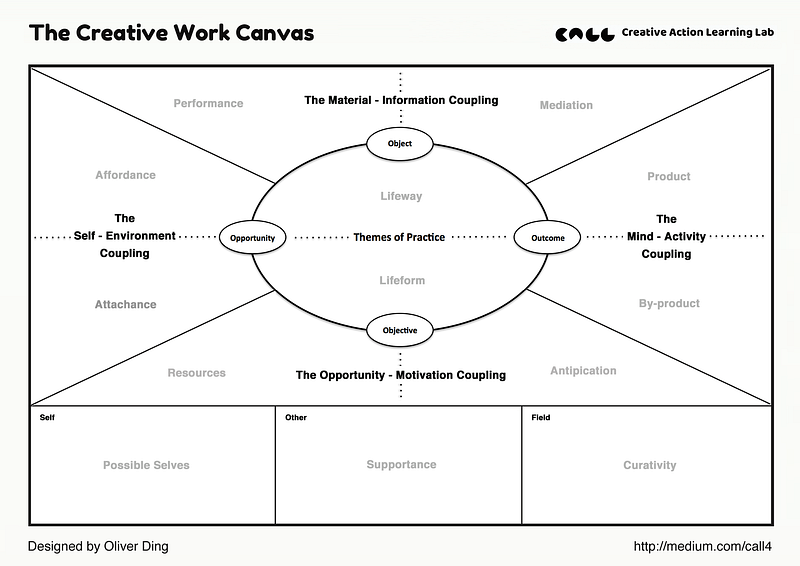
The second draft is very interesting because these pairs of concepts form a new framework. I did similar work for the Lifesystem framework. However, the Lifesystem framework started from “Subject, Object, Enter, Exit” and developed a set of different operational concepts.
3.6 The Third Draft
At the moment, I returned to the Life-as-Activity framework (v2.0). I found that I have translated most parts of the diagram into the canvas. The only thing missing is “Moment, Project, and Theme”.
As discussed above, the part of “Moment, Project, and Theme” is extremely important for discussing Creative Work. I reflected on the diagram and the canvas. By combining “Self → Other → Field” and “Moment → Project → Theme” together, I realized that there is a new conceptual space.
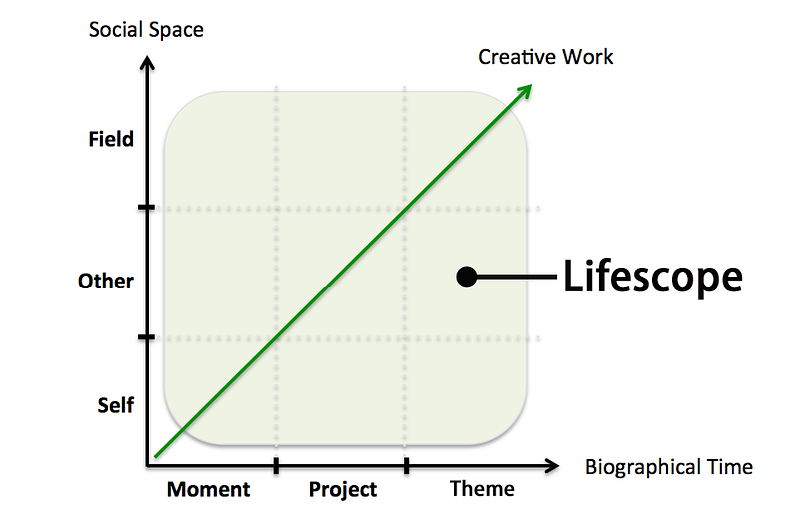
I drew the above diagram to visualize the new conceptual space. There is a dimension called Social Space behind “Self → Other → Field” and “Moment → Project → Theme” refers to another one dimension called Biographical Time. These two dimensions form a domain which is a new conceptual space.
I called this new conceptual space Lifescope. A creative person’s lifescope is defined by his creative work which can be measured with social space and biographical time. This idea is fantastic, I should explore it further later.
I decided to add “Moment → Project → Theme” into the canvas. This time I rearranged the visual layout in order to make space for the new dimension.
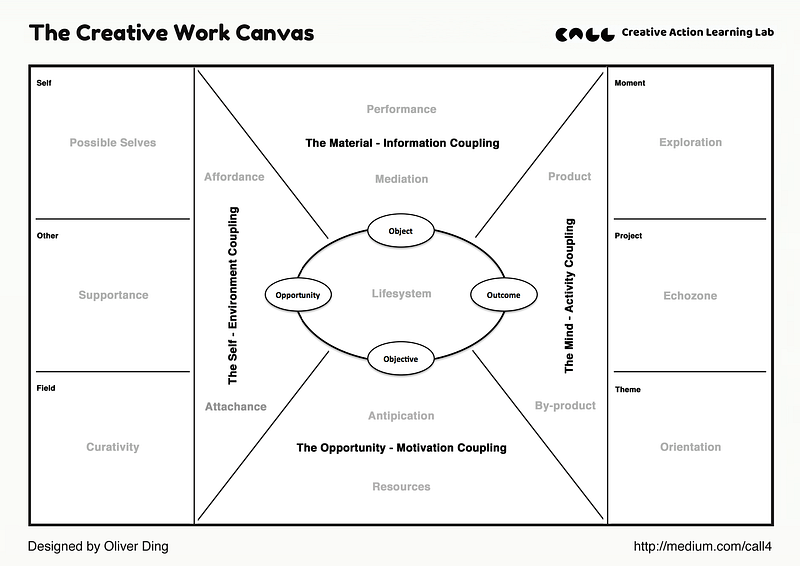
The above picture is the third draft. A big change is the ellipse in the center. It became smaller. I also removed “Themes of Practice” from the ellipse since I gave a space for “Theme” in the right row. Since the ellipse is smaller, I used “Lifesystem” to replace “Lifeway/Lifeform” because one word matches a smaller space. A Lifesystem is formed by a Lifeway and a Lifeform, so it is fine to use the whole to refer to the system.
Part 4: Reflection
Do we really need knowledge canvas? If we need post-it sticky notes, we definitely can have canvases. I think the issue is not if we need it, but how to improve the quality of canvas. Furthermore, the rise of knowledge canvas refers to the evolution of cognitive containers and the knowledge curation activity in general.
4.1 The Pre-canvas Diagramming
From the perspective of Activity Theory, both diagram and canvas are mediating tools for the knowledge curation activity. And, we can trace the root of knowledge canvas back to the pre-canvas diagramming practice.
For example, Yrjö Engeström’s Activity System model was published in 1987. In a 1999 book titled Perspectives on Activity Theory, there is a diagram picture which shows the Engeström’s Triangle in a particular situation.
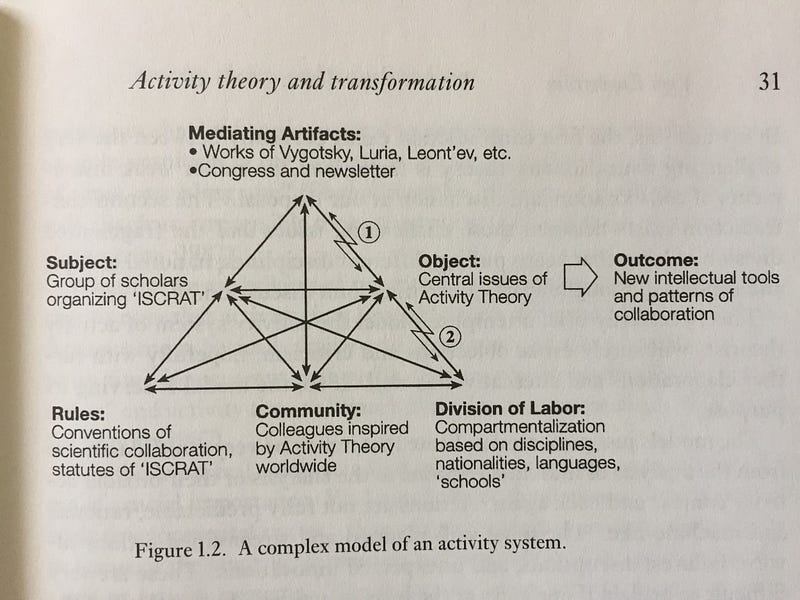
We have to notice that there are several pieces of data under each concept. For example:
- Mediating Artifacts: Works of Vygotsky, Luria, Leontev, etc; Congress and newsletter.
- Division of Labor: Compartmentalization based on disciplines, nationalities, languages, ‘schools’.
The bold and black words such as Mediating Artifacts and Division of Labor are Operational Concepts of the diagram. The other words are Data.
Though the diagram doesn’t clearly set visual areas for posting data, its surrounding area offers a space for such needs. Thus, we should consider diagram-in-use as the predecessor of canvas.
4.2 Four Rules of Design Canvas
Based on the Conceptual Spaces theory, the above discussion suggests a basic principle of design canvas:
A good canvas matches visual areas and conceptual spaces with a simple and unique style of spatial configuration.
This principle leads to four rules:
- Rule 1: Separate several visual areas clearly with lines. Make sure each visual area is identified easily.
- Rule 2: Adopt a special and unique perspective to develop a conceptualized knowledge for building conceptual spaces. The more unique the perspective, the greater the value of the canvas.
- Rule 3: Make sure the layout of visual areas matches with the structure of conceptual spaces. Take the visualization radically.
- Rule 4: Develop a simple and unique visual style which represents a spatial configuration. The uniqueness is the starting point of a knowledge brand.
Can we apply these rules to design diagrams? Let’s test it with the WXMY diagram.
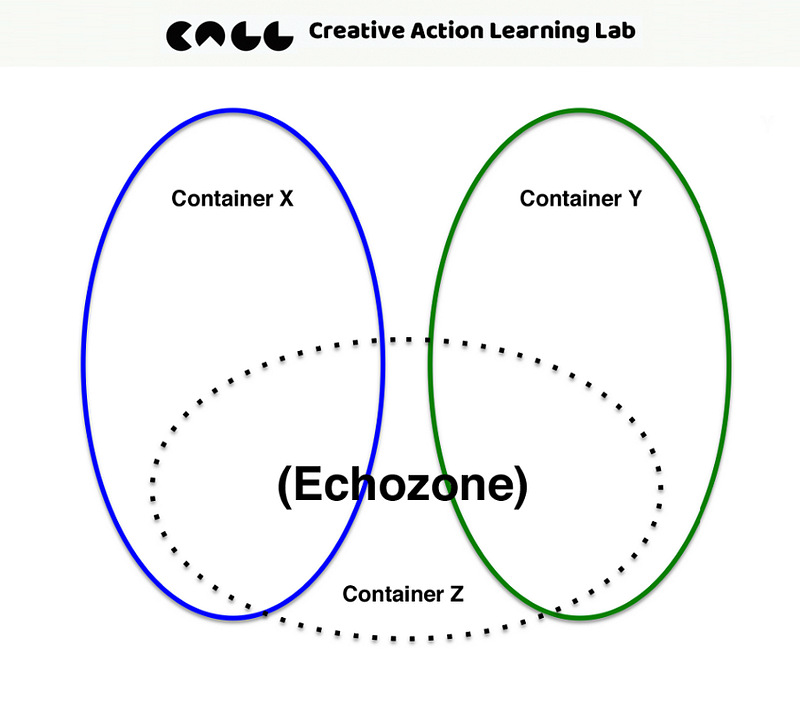
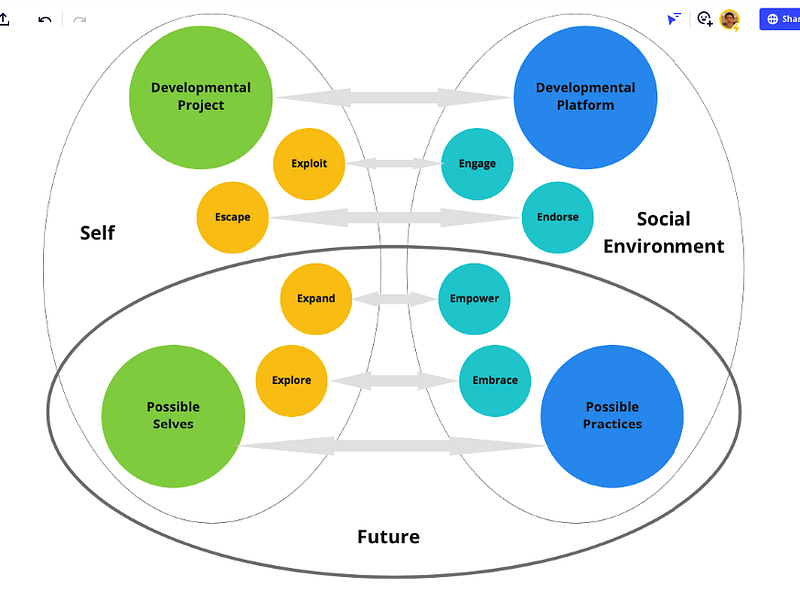
The above left diagram has several names such as the WXMY diagram, Container Z diagram, or Echozone diagram, etc. The basis of the diagram is using three containers to explore boundary innovation. The above right diagram is an application of the left diagram, it is called the DEEP framework.
Now we can consider big dots on the DEEP framework as data and the left diagram as canvas. Let’s use the above four rules to review them.
- Rule 1: Separate several visual areas clearly with lines. Make sure each visual area is identified easily. → Yes! The WXMY diagram has several identified visual areas.
- Rule 2: Adopt a special and unique perspective to develop a conceptualized knowledge for building conceptual spaces. The more unique the perspective, the greater the value of the canvas. → Yes! The unique perspective is the Ecological Practice approach which emphasizes concepts such as Container and Attachance. These concepts can generate several conceptual spaces easily.
- Rule 3: Make sure the layout of visual areas matches with the structure of conceptual spaces. Take the visualization radically. → Yes!
- Rule 4: Develop a simple and unique visual style which represents a spatial configuration. The uniqueness is the starting point of a knowledge brand. → Yes!
Let’s have a look at the Career Theme Canvas which is based on the Themes of Practice framework. You can find more details about the canvas here.
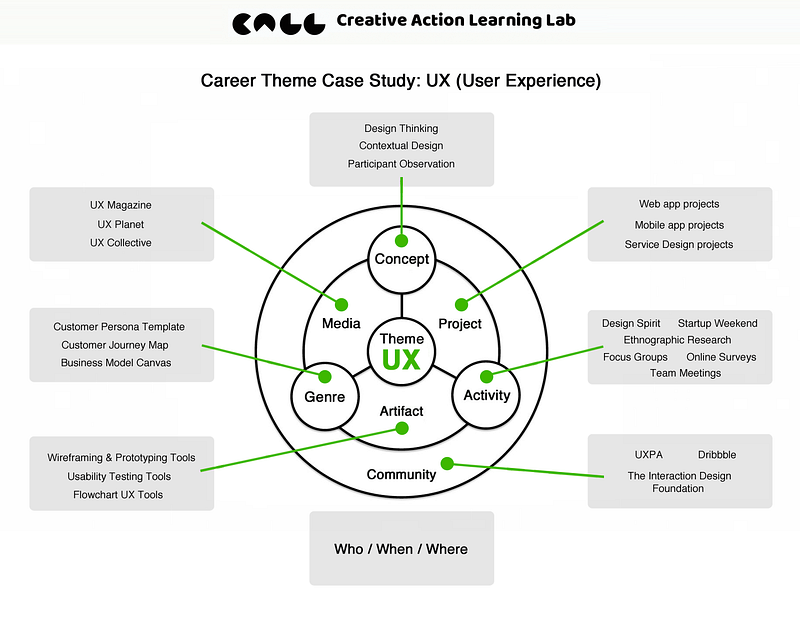
Why did I design this layout for this canvas? The original diagram is named Tripartness which is a meta-diagram. It has eight visual areas. In order to keep the visual layout, I use outside space for posting data. The issue is not the diagram, but the size of the picture. I can’t type these words inside eight visual areas in a small picture. However, if we print it in a large size, then we can directly post sticky notes in these eight visual areas.
Now let’s test the NEST Way diagram. You can find more details here. Also, I use it to generate the Lifesystem framework.
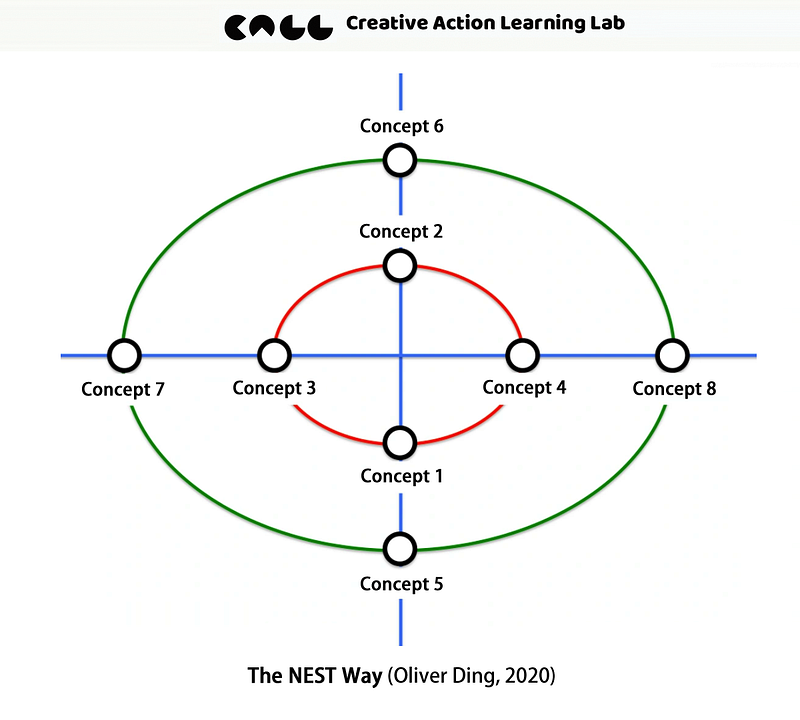
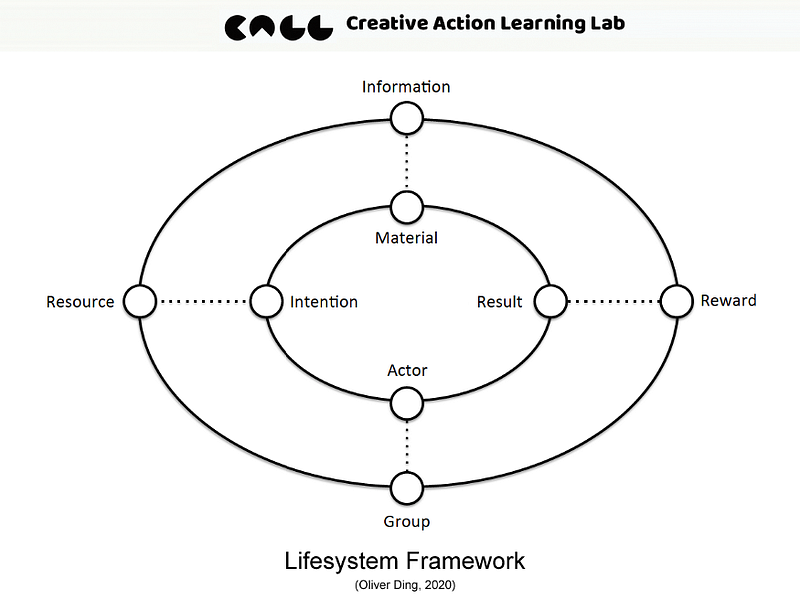
The above diagram has eight visual areas, however, its eight concepts don’t match these visual areas. The issue is the NEST Way diagram focuses on two loops which are lines, not spaces.
I think we don’t need to test more cases. It’s clear that there are two types of diagrams, one has clear visual areas, another one doesn’t care about visual areas.
4.3 Digital Whiteboards
As discussed above, canvas is a situational tool for domain communication. Though the A4 sheet is the original situational environment of canvases, the rise of digital whiteboard platforms brings us a new environment of using canvases.
The change of environments leads to a change of using canvases. The digital whiteboards has a big space for curating data and processes. We don’t have to follow the A4 sheet style for designing canvas on digital whiteboards platforms. We have huge spaces to collect data for diagram-based discussions.
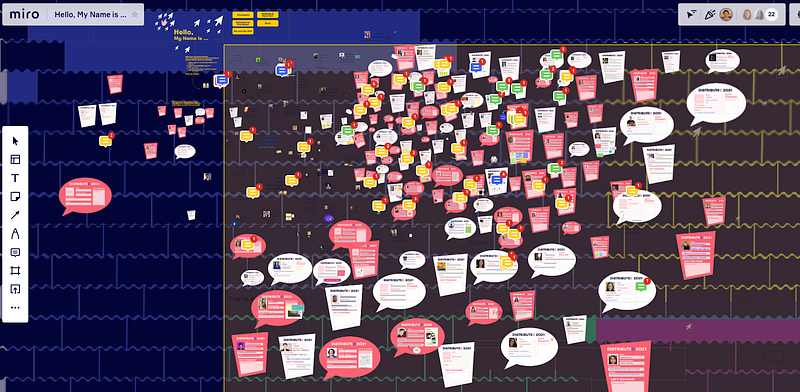
We don’t even need the term Canvas to name Mediating Tools for creative communication activities on digital whiteboards platforms.
However, we still need Concepts and Diagrams because these knowledge representations are not tied to situational environments.
4.4 Cognitive Containers
In 2019, I wrote a book titled Curativity which developed a theory for understanding general curation practice. I have applied the theory to discuss Toy Design, Family Development, Knowledge Curation, Online Workshop, Digital Platforms, etc.
The core idea of Curativity Theory is very simple:
In order to effectively curate Pieces into a meaningful Whole, we need Container as Part to contain pieces and shape them.
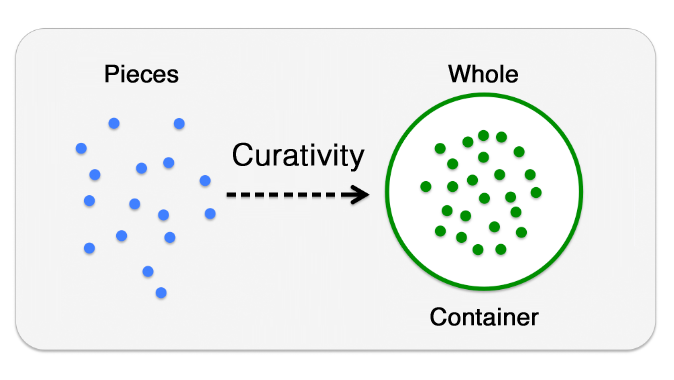
In 2020, I started working on the Knowledge Curation direction. I identified three types of containers. Sometimes we can see them as three dimensions of one container.
- Physical container
- Social container
- Cognitive container
I have written a chapter discussing knowledge curation in the book Curativity. For academic knowledge curation, I mentioned Dean Keith Simonton’s chance-configuration theory, Victor Kaptelinin and Bonnie A. Nardi’s scientific curation case study “curation at Ajaxe”, and qualitative research. For practical knowledge curation, I focus on Cognitive Container since Container is a core concept of Curativity Theory.
Books and courses are typical cognitive containers, however, there are more types of cognitive containers. I highlighted six types of Cognitive Containers:
- Knowledge Card
- Knowledge Framework
- Knowledge Diagram
- Knowledge Chart
- Knowledge Workshop
- Knowledge Sprint
It is not an accurate classification, but a rough recommendation. Also, I suggested that we not only adopt existing types of cognitive containers, but also create new types of cognitive containers. For example, the knowledge canvas.
Actually, this is the essential point of the Curation Theory. We are shaped by containers and we can create containers too.
You are most welcome to connect via the following social platforms:
Polywork: https://www.polywork.com/oliverding Twitter: https://twitter.com/oliverding Boardle: https://www.boardle.io/users/oliver-ding Linkedin: https://www.linkedin.com/in/oliverding
License
This work is licensed under the Creative Commons Attribution-NonCommercial-ShareAlike 4.0 International (CC BY-NC-SA 4.0) License. Please click on the link for details.


