
Platform Creativity: Domain, Field, and Person
This article is the section 9 of The NICE Way and Creative Actions. This section introduces Mihaly Csikszentmihalyi’s Social Systems Model of Creativity and reviews its core concepts: Domain, Field and Person in the age of Platform.
As we discussed early, the sociocultural approach of creativity research highlights the issue of cultural context. Appropriateness is defined by social groups, and it’s culturally and historically determined. In order to understand the impact of social context, Mihaly Csikszentmihalyi and other researchers developed the Social Systems Model of creativity during the 1980s and 1990s. The diagram below shows the model contains three components: person, domain and field. Csikszentmihalyi said, “Creativity occurs at the interface of three subsystems: An Individual who absorbs information form the culture and changes it in a way that will be selected by the relevant Field of gatekeepers for inclusion into the Domain, from whence the novelty will be accessible to the next generation.” (2014, p.166)
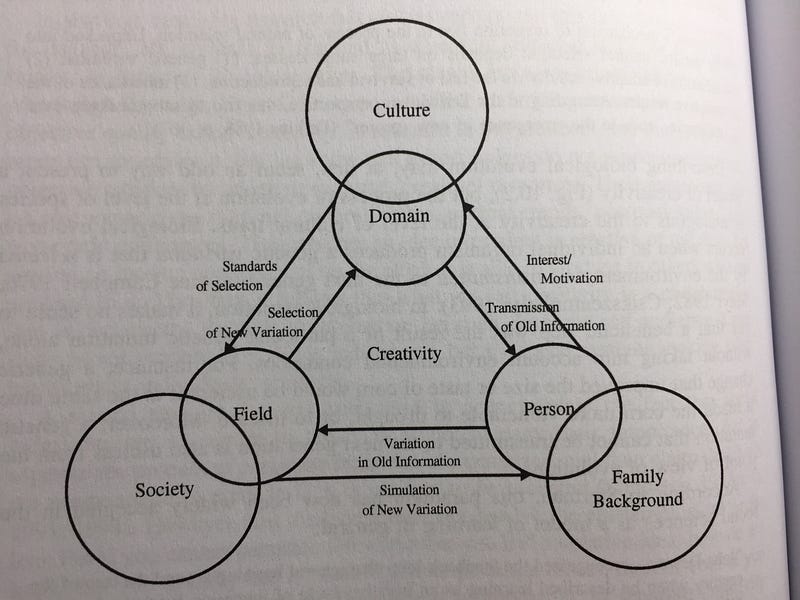
The Systems Model of creativity is suitable for traditional domains such as art, scientific, film, performance, etc. However, the model is reliant on a stable set of gatekeepers as a Field and a bounded Domain which requires a stabilized social structure. For BED Talks and other stay-at-home challenges, it is hard to find Field and Domain for these creative actions. Also, it is obvious that emergent digital platforms are key context for these creative actions. The Field and Domain can’t explain digital Platform.
Culture as Symbolic Domains
The Systems Model of creativity adopts the sociocultural approach which pays attention to culture. We have to notice that Csikszentmihalyi defined the Domain as a symbolic aspect of environment while the Field as social aspect of environment. He didn’t include the material aspect into the concept of Domain. Thus, he defined culture as symbolic domains, “It is useful in this context to think about cultures as systems of interrelated domains … The claim is simply that in order to understand creativity, it is useful to think of culture in this way.” (2014, pp.105–106) In other words, we have to notice Csikszentmihalyi’s “sociocultural approach” is a pure symbolic approach which doesn’t consider the material aspect as part of culture.
Moveover, he adopted Dawkins’s idea “Memes” as a foundational concept to explain Domain. He said, “Typically, the memes and rules that define a domain tend to remain stable over time. It takes psychic energy to learn new terms and new concepts, and in so far as psychic energy is a very scarce and necessary resource, and provided that the old terms and rules are adequate to the task, it makes sense for domains to remain stable.” (2014, p.106)
Memes v.s. Ideas
I have to point out the similarity and difference between “Memes” and “Ideas” which I used for the 3I model. Csikszentmihalyi claimed, “Memes are similar to genes in that they carry instructions for action. The notes of a song tell us what to sing; the recipes for a cake tells us what ingredients to mix and how to bake. But whereas genetic instructions are transmitted in the chemical codes we inherit on our chromosomes, the instructions contained in memes are transmitted through learning. By and large we learn memes and reproduce them without change; when a new song or a new recipe is invented, then we have creativity.” (2014, p.105)
Though “Ideas” carry instructions for action too, they can be expressed in symbolic way and non-symbolic way. For example, if a person is doing a creative action, another person see it. Then, the other person can learn the creative action by directly perceiving without any symbolic mediation. Also, 3I model claims the creative process is a collaboration between the initiator and the initiatee. The initiator may define the name and form of a creative action, but the content part should be contributed by the initiatee. Thus, there is a creative space for the initiatee. The 3I model refused the view of “learn memes and reproduce them without change”.
Furthermore, some “Ideas” may contain multiple layers and each layer is a creative space. For example, the “idea” behind “Try Something new for 30 days” refers to multiple layers. I adopted this idea and created a sub creative action: Meet Muse for 30 Days. I asked people to find a free academic chapter or book on Project MUSE website for 30 days (1, 2).
Csikszentmihalyi’s view of Domain can be seen as a pure ideal frame. The view of Field also claimed that only established organizations and professional experts can evaluate creativity. This leads to two issues. First, at the practical level, it’s hard to only talk about “memes and rules” for a domain without discussing its material, technolocial, geographic, political aspects. Second, it only considers experts inside the domain for evaluating creativity and ignores the creator-consumer relationship.
Professional Domains
Sawyer pointed out that many scientific books about creativity have been limited to those expressions of creativity that are highly valued in Western culture. For example, “Csikszentmihalyi’s 1996 book Creativity is based on interviews with approximately 100 highly creative individuals; all of these individuals create in areas highly valued in dominant cultural groups in Western, European cultures: the sciences, the fine arts.”(2012, p.6, p.8) From the Four-C model’s perspective, the Systems Model is perfect for “Big-C”, but it is hard to apply the concept of Field and Domain to “mini-c ” and “little-c”.
Though we can apply Field and Domain to “Pro-c”, we still can argue that professional domains (Pro-c domains) are not stable as Big-C domains. The reason is Pro-c domains change fast and can’t maintain a clear boundary. Also, the competition between similar domains are dynamic and it became new normal. Thus, it is hard to only use “memes, rules and system of notation” to identify a professional domain.
Let’s look at an example of dynamics of professional domains. In recent years, new professional domains emerged and grew fast also disappeared quickly, especially web/mobile practice related domains. Information Architecture (IA) as a professional practice went popular in the mid 1990s and changed in the mid 2020s. In 2002, the Information Architecture Institute was registered as a nonprofit (501c6) organization. In 2019, their board of directors decided to dissolve the IA Institute as a legal business entity. Before the final announcement, insiders have discussed reframing the domain of Information Architecture in order to adopt the change of context. In 2013, 42 researchers, educators, and practitioners attended a workshop called “Reframing Information Architecture” in ASIS&T Information Architecture Summit in Baltimore, Maryland. Later, they collected papers and published a book for pushing the conversation further. One author suggested reframing Information Architecture as a sub-section under the User Experience umbrella. Then, we see another professional organization: User Experience Professionals Association.
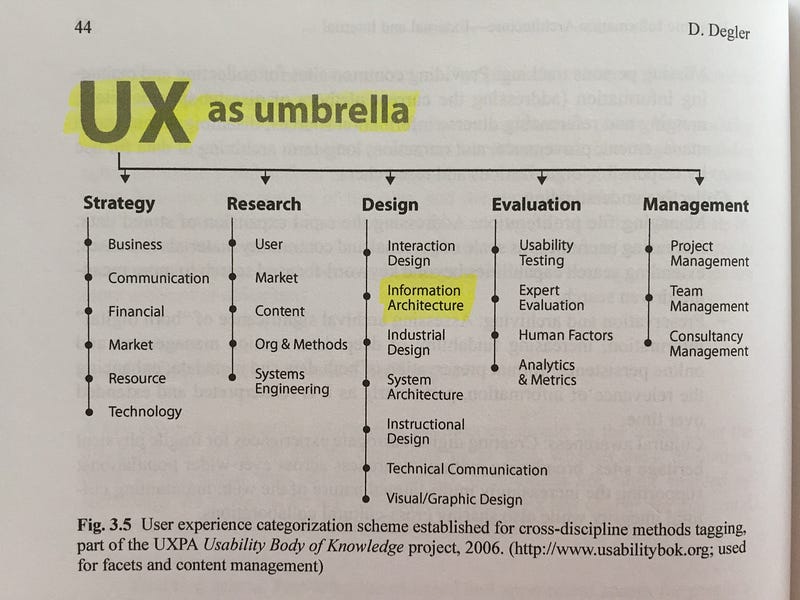
Source: Duane Degler (Reframing Information Architecture, 2014. p.44)
Domain and Cultural Evolution
Though Csikszentmihalyi talked about the change in Domains, he suggested that the change is caused by the long term cultural evolution. For example, he identified “the game of marbles played by Swiss children” as an informal Domain. He said, “For instance Piaget gave a very detailed description of how rules are transmitted in a very informal domain: that of the game of marbles played by Swiss children. This domain is relatively enduring over several generations of children, and it consists in specific names of marbles of different sizes, colour, and composition. Furthermore, it consists in a variety of arcane rules that children learn from each other in the course of play. So even without a notation system, domains can transmitted from one generation to the next through imitation and instruction.” (2014, p.106)
Csikszentmihalyi also mentioned the example of ancient Greece. He said, “Domains tend to change when one culture is exposed to the memes of another, usually equally advanced but different culture. Thus ancient Greece, being at the cross-roads of trade between the North and the South, and between the East and the West, was influenced by ideas and practices converging from the Asiatic steppers and from Egypt, and from Europe as well as Persia and the Middle East. In Europe, similar melting pots for ideas arose later in Venice, Florence, Burgundy, the Hanseatic ports and the great sea-faring nations such as Portugal, Spain, England, and the Netherlands.” (2014, p.107)
If we pay attention to the professional domains such as IA and UX, the perspective of long term cultural evolution is too restrictive. It’s better to include the short term cultural dynamics for considering the change of Domain in order to maintain the social system model of creativity. The short term cultural dynamics is not only about memes and rules, but also related to material, technolocial, geographic, and political aspects.
Creator — Customer
The second issues is about the relationship of “Person — Field” and “Creator — Customer”. Csikszentmihalyi defined “Field” as a group of gatekeepers such as teachers, critics, journal editors, museum curators, agency directors, and foundation officers who decide what belongs to a domain and what does not. (2014, p.104) For the high art and other Big-C domains, the relationship between “Person-Field” are important for creativity as the social system model claimed. However, for “Pro-c”, “mini-c” and “little-c”, we have to consider the relationship of “Creator — Customer” too.
Today, most creators can share their creative ideas and products on digital platforms and gain feedback and support from their customers directly. For example, Kickstarter and other crowdfunding platforms allow various types of creators to get funded by potential customers directly. Patreon and other membership platforms makes it easy for artists and creators to get paid by their customers. Musicoin built a blockchain platform for music creators directly connecting their customers.
Platform Curativity
The Platform also brings us a new issue for discussing the evaluation of creativity: machine algorithms. In 2016, Michael Bhaskar suggested a hybrid model in his book Curation. He said, “Selection is about finding the right things. Defining what is ‘right’ in any given context can’t be boiled down to the information analysed by a machine. Which is not to say machines aren’t valuable — they are, and will be a massive part of curatorial business over the next century. But we will see a balance. Human and algorithmic curation working together, complementing each other.” (p.115)
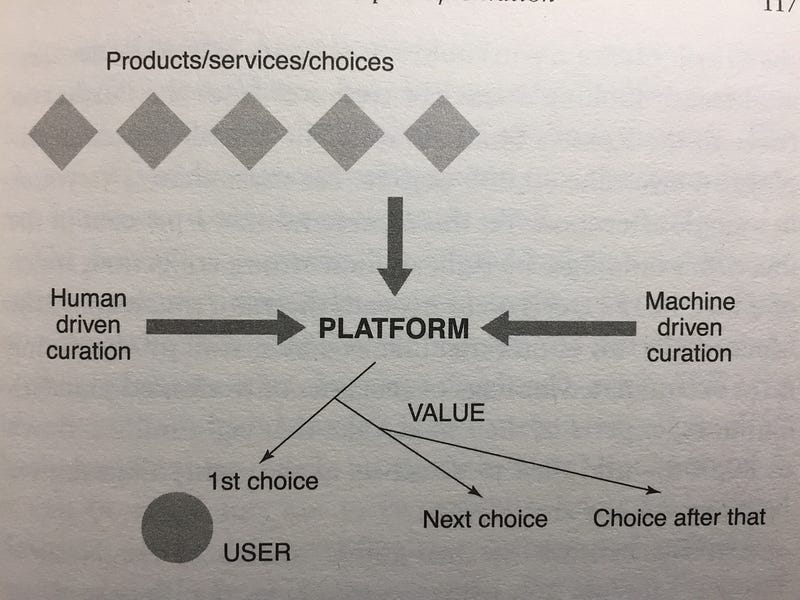
Though Bhaskar talked about business curation, his insight on the complementation between human driven curation and machine driven curation can be applied to discussing creative actions. For BED Talks and other stay-at-home challenges, the appropriateness is defined by both human opinions and machine algorithms.
In the age of platform, the traditional “Person — Field” relationship has been transformed to more complex “Creator — Customer — Curator — Platform” relationship.
Full article:
Sections:
The 3I Model: Idea, Initiator and Initiatee
You are most welcome to connect via the following social platforms:
Twitter: https://twitter.com/oliverding Doowit: https://doowit.co/profile/gm0k2ax9 Linkedin: https://www.linkedin.com/in/oliverding
License
This work is licensed under the Creative Commons Attribution-NonCommercial-ShareAlike 4.0 International (CC BY-NC-SA 4.0) License. Please click on the link for details.


