
Diagram Blending: “Activity Circle” + “Concept Dynamics”
Developing a framework for the Thematic Controversy Project

Last month I read Controversy Mapping: A Field Guide (Tommaso Venturini & Anders Kristian Munk, 2022) which connects ANT (Actor-network theory) with digital methods for social cartography.
Algirdas Greimas’ Two Diagrams
According to the authors, ANT is inspired by Algirdas Greimas’ semantics and narrative theory in particular.
- Generalizing the system introduced by Russian narratologist Vladimir Propp (1968) to catalogue folktales, Greimas (1989) defined the elements of any text according to what they do rather than what they are. A classic feature of traditionuseal tales is indeed that their protagonists are not only humans, but also animals, spirits, and animated objects. Anything that acts is a character in its own right and it can fill a role in the story in the same way in which a human being would (a magic ring can cast spells like a magician, a magic sword can fight like an army of soldiers).
- Extending this idea to all types of texts, Greimas introduced the notion of “actants,” defined as anything that “accomplish tasks, undergo tests, reach goals” (Ricoeur, 1989, p.588). The openness of the notion of “actant” struck a chord in ANT, to which it offered a way to identify the ingredients of sociotechnical networks without having to bother whether they were human beings (e.g., scientists and engineers), natural elements (e.g., microbes, stars, molecules), objects (e.g., laboratory tools, technological artefacts) or something else.
The authors combine two different but related schemas — the “actantial model” (proposed by Greimas, 1966, to categorize actors) and the “canonical narrative schema” (proposed by Greimas, 1970, to categorize action) — to suggest a way to dissect collective “programs of actions” into their components.
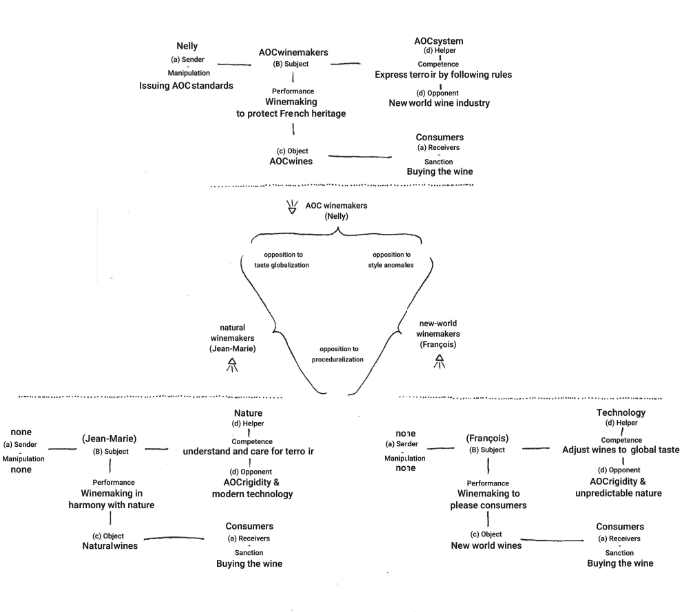
The authors use a story about French wine and terroir as an example to show the power of the method. You can find a large size picture of the above diagram here. You can also find more details about the two schemas in the following articles:
I have read the diagram many times. On June 27, 2022, I realized the above diagram is an example of Diagram Blending and I can use the pattern to blend two of my diagrams together.
Acantial Model > Concept Dynamics
What’s the pattern of the above diagram? First, the center of the diagram is a semiotic triangle which is also called the Acantial Model. I can use my diagram about Concept Dynamics as the center of the new framework. See the diagram below. While the Acantial Model is for categorizing actors, the Concept Dynamics is used for categorizing Concepts or Themes.
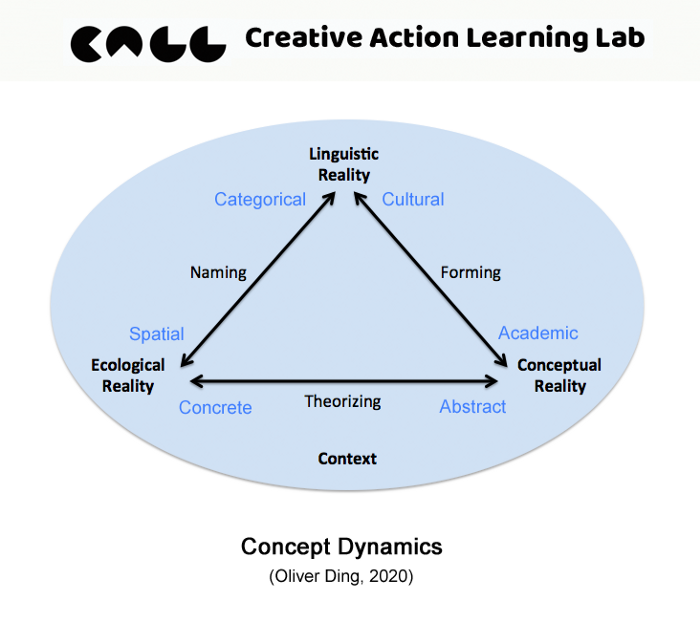
The Concept Dynamics Framework emphasizes that every theoretical concept has three basic aspects: ecological reality, conceptual reality, and linguistic reality.
- Ecological Reality refers to the real experience of discovery in the real world from the perspective of researchers.
- Conceptual Reality refers to the outcome of the creative conceptualization process.
- Linguistic Reality refers to expressional form with verbal and rhetorical effects.
Based on the framework, I believe that an ideal theoretical concept should not have intrinsic contradictions between these three aspects and extrinsic contradictions between these aspects and context which means the dynamic background of the concept. Thus, it is hard work to create an ideal theoretical concept. The harder work is detaching an existing concept from its original context and attaching it to a new context by reconceptualizing it with new meaning.
The original purpose of the Concept Dynamics framework is for reviewing and developing theoretical concepts. However, I recently realized that it can be used for discussing theme-based communicative actions such as a discussion about a topic on Linkedin and other social media platforms.
A Discussion about “System Mapping”
One month ago, I joined a discussion about “System Mapping” on Linkedin.
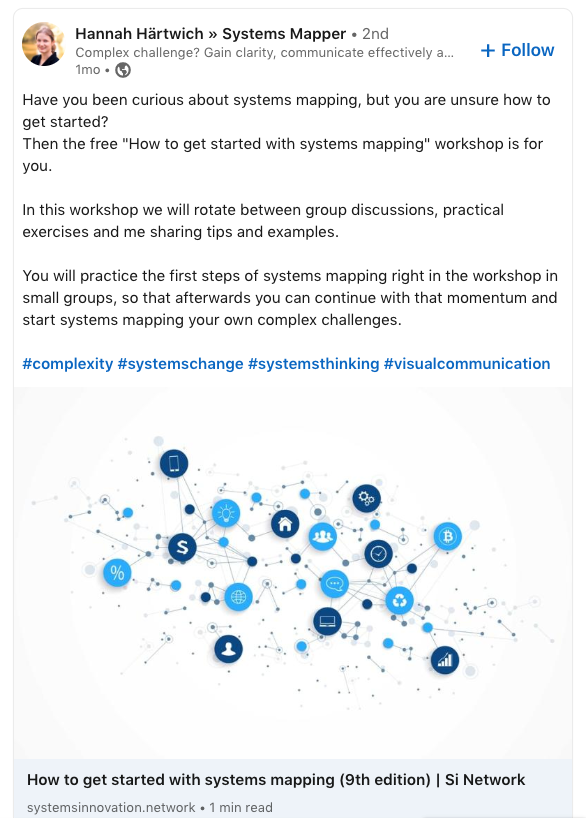
There is a debate about what “Systems Mapping” looks like. You can find more details in the original post’s comments section.
I visit Hannah Hartwich’s website and find her examples of “system mapping” and made the following comment:
Now there are at least three types of audiences:
Group 1: For people who are familiar with Hannah Hartwich’s method, then the word “System Mapping” is the name of the method.
According to John Evans, we should focus on the activity of “System Mapping” for this particular post. The workshop is about a practical method for the activity of “System Mapping”.
Hannah Hartwich may or may not adopt an academic version of the System thinking approach to guide her method. However, she uses the term “System Mapping” to name her method.
If we like her method, we don’t have to care about the name.
Group 2: For people who are not familiar with Hannah Hartwich’s method, the name “System Mapping” refers to a word.
For Group 2, there are two sub-groups.
- Group 2a: people who aren’t familiar with any traditional academic version of “System Mapping”, and they want to learn “System Mapping”.
For this group of people, Hannah Hartwich is perceived as an expert in “System Mapping”. If they join the workshop and learn the method, they will understand the theme “System” and the activity “System Mapping” in the way of Hannah Hartwich defined it.
- Group 2b: people who are familiar with some traditional academic versions of “System Mapping” which are guided by some versions of “System thinking approaches”.
For example, Geoff Elliott is familiar with many traditional systems thinking approaches. From his perspective, Hannah Hartwich’s method is not an “official” System Mapping.
Now the debate between Group 1 and Group 2b impacts to Group 2a. Both Group 1 and Group 2b are right.
As a member of Group 2a, I’d like to see more details about Hannah Hartwich’s “System Mapping”.
- 1. What’s her working definition of “System”? She can use the word “System Mapping” to name her method. If there is a clear definition of her way of using the word “System”, this would be great for me to understand her method.
The webpage about the workshop doesn’t offer details about the term “System Mapping”. It only says, “In this workshop, Hannah Härtwich will share her practical tips and tricks on how to get started with systems mapping, based on her own experience working with systems mapping on a daily basis.”
If I can read her definition of “System” and her context. I can find a fit between my learning need and her method.
- 2. What’s the uniqueness of her method of “System Mapping”?
What’s the difference between her method and other methods?
Finally, I’d like to share my framework about concepts with you and all Linkedin users since this debate refers to a general thing that someone called “Linkedin Sport”.
The framework is called Concept Dynamics.
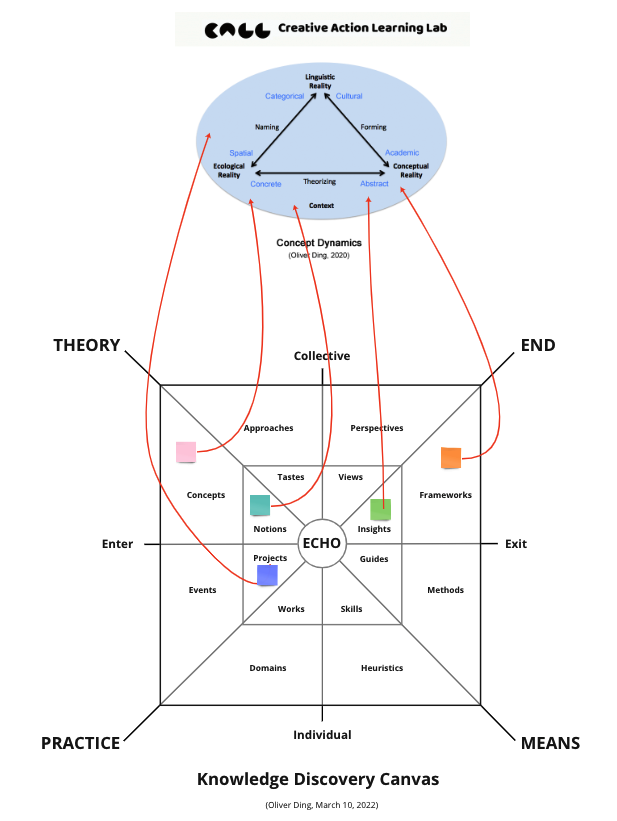
If you pay attention to the diagram, you will find the following terms:
- Ecological Reality
- Conceptual Reality
- Linguistic Reality
For a given term such as “System Mapping” which is a concept, we can understand it from three aspects.
- Ecological Reality: the real activity/practice of the term.
- Conceptual Reality: the idea about the term.
- Linguistic Reality: the word we used for the concept.
Now let’s apply this framework to the “Knowledge Service” activity. For example, if you are going to host a workshop and offer an introduction to a method, then you are offering a “Knowledge Service”.
As a knowledge Creator, you create a method and give it a name.
- Ecological Reality: You have practiced the method in your own life/work.
- Conceptual Reality: you have made some ideas about your practices and you have learned about the activity and the subject. You curated them together and developed a method.
- Linguistic Reality: you give a name to your method.
Let’s switch to the side of learners who want to learn something about the topic.
If the name is a general word such as “System” and “Mapping”, people understand it from their learning experience and domain-related communities of practice.
At least, we understand “System” as 1) a system is a whole that is formed by several parts, and 2) the whole has its own meanings than the parts.
As a learner, I want to learn more about “System”. For example, how to grasp a system in a real project? How to define the whole and how to identify its parts in a real project? How to understand the process of generating the meaning of the whole?
As a learner, I want to learn “Ecological Reality” and “Conceptual Reality” from a Knowledge Creator.
However, I want to make sure we are using the same word to refer to the same meaning. Though the Knowledge Creator names his method “X”, it doesn’t mean that he is talking about the “X” that I want to learn.
There is an easy way to close the gap between learners’ needs and creators’ offers.
A knowledge creator should give more information about his method to his audiences. The information should cover the above three aspects.
Canonical Narrative Model > Relevance of Zone
Second, the authors use the Canonical Narrative Model three times in order to present three types of actions. I can use the Relevance of Zone model to discuss theme-based communicative actions.
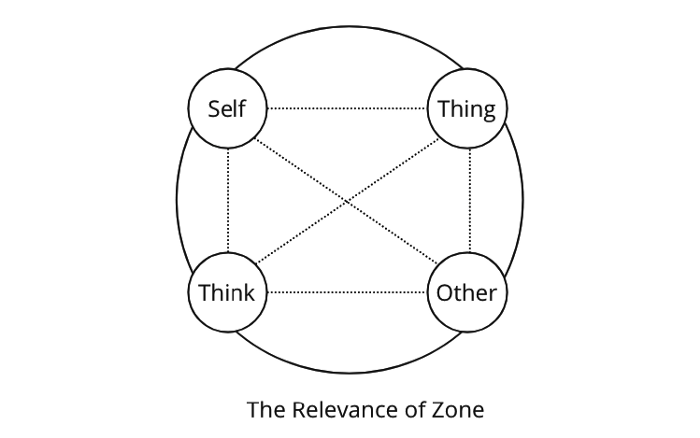
The above diagram is called “the Relevance of Zone” which is an Abstract Model. It considers four keywords: Self, Other, Thing, and Think. It was inspired by the iART Framework and the Typology of Relevance.
The Relevance of Zone focuses on “Self, Other, Thing, and Think”. Originally, I used “Thought” for the diagrams below. It is perfect for discussing a special object which has double properties: material property and mental property. This idea was inspired by cultural-historical psychologist Lev Vygotsky’s two types of mediating tools: technological tools and psychological tools.
The diagram below is an example of the Relevance of Zone: Art as Activity. Art is such a special object, at least for the field of Art Inventory, we have to pay attention to the content of Art (what the artist created) and the form of Art (what the material thing is). For example, a painting has a material aspect and a mental aspect which means an idea.
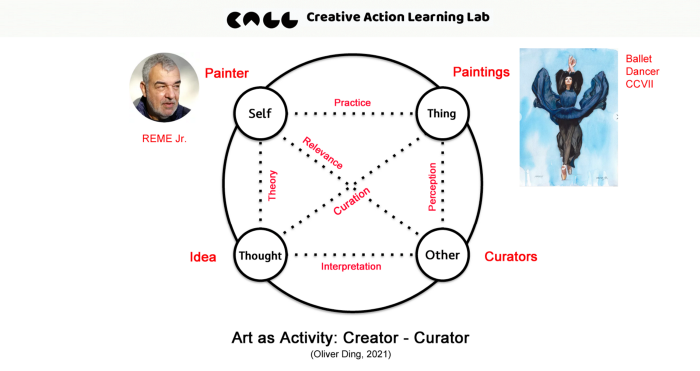
The “Art as Activity” model also considers the “Self — Other” Relevance, it offers a creative space for discussing various types of social roles and relationships. For the Art as Activity model, I defined four types of roles. Let’s use paintings as an example.
- Creators: they create paintings.
- Curators: they buy paintings to sell them.
- Collectors: they buy paintings for using them.
- Commenters: they view paintings and talk about them.
I use the “Self — Other” relevance to represent three Zones between four roles. A Zone means a long-term social interaction between two actors around a particular theme or a thing. You can find more details about the concept of Zone in Activity U (XI): Process, Position, and Zone of Project.
- The Creator — Curator Zone
- The Curator — Collector Zone
- The Collector — Commenter Zone
You can find more details about using the Relevance of Zone in #TalkThree 03: How to Use an Abstract Model?
Relevance of Zone > Activity Circle
Finally, I decided to use “Activity Circle” to name the outcome of the diagram blending for discussing theme-centered conversation. However, I am not sure if it is appropriate to propose the term “Activity Circle” as a new concept for the field of Activity Theory.
Several months ago, I found Benny Karpatschof’s 2000 book Human Activity: Contributions to the Anthropological Sciences from a Perspective of Activity Theory. Though I have read many books and papers about Activity Theory, Karpatschof’s theoretical approach opened a new door for me. The most important idea of his account is to bring Sign/Meaning/Concept back to Activity Theory.
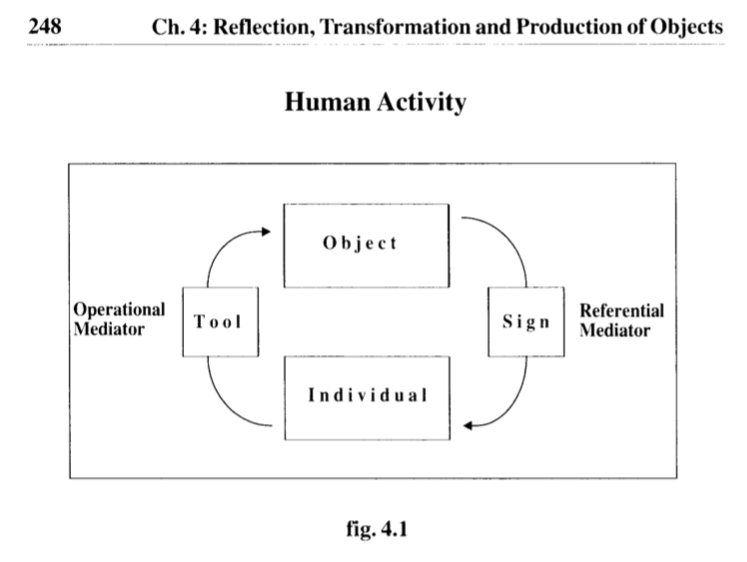
According to Benny Karpatschof, “…the full context of activity in which the category of meaning (“ideas”) is situated can be seen. In the feedback circle, there is an operational as well as a referential mediation. I call the referential side meaning production. The other side is the category of object production, where production is to be understood in a broad sense, including interventions that only modified the object. If we now consider the relation between meaning and object production in human activity, there are 3 logical types: 1. The object-reflecting meaning production, 2. The symmetric interplay of objects and meaning production, 3. The concept based object production. ”(2000, p.248)
Benny Karpatchof’s approach to human activity considers both Tool and Sign. This approach echoes Lev Vygotsky’s two types of mediating tools. This is the reason that I pay attention to Benny Karoatchof’s 2000 book.
The difference between Benny Karpatschof’s model of Human Activity and my model of Activity Circle is the former only talks about the individual—object interaction and the latter considers the self—other relevance.
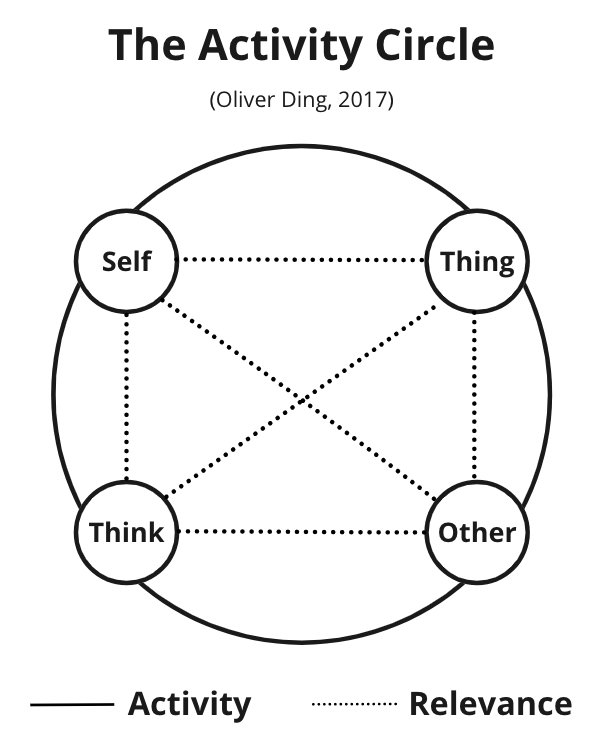
In fact, the Activity Circle was developed in 2017. It was the outcome of my project “Activity as Container” which aims to discuss “Activity as social environment”. Later, I used the Activity Circle diagram to generate a meta-diagram for discussing the Thing-People ecological structure. See the diagram below.
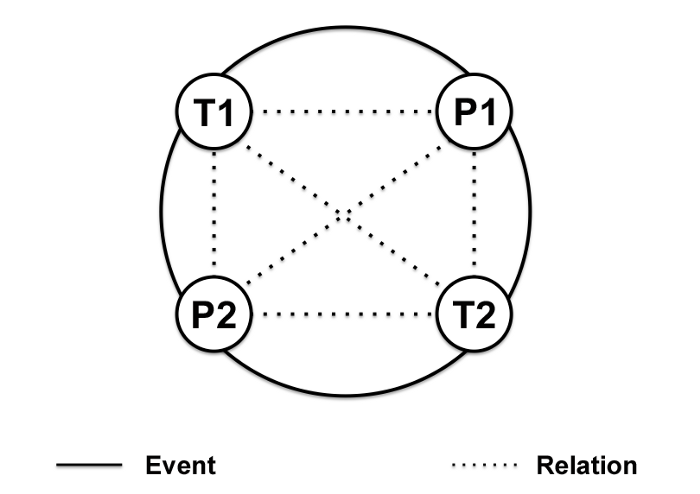
The above diagram is the final model of the Thing-People ecological structure. T means Thing while P means People. 1 means Here while 2 means There. The circle means one event.
I also use another version for this diagram: This (T1), That (T2), Self (P1), Other (P2), and Activity (Event). This version is close to the iART framework.
The Activity Circle uses Thing (T1), Think (T2), Self (P1), Other (P2), and Activity (Event).
These models share the same meta-diagram which presents six types of relations. There are four dimensions behind these six types of relations. The table below offers a full configuration. The pair of “Homogeneous — Heterogeneous” refers to Categorical Difference while the pair of “Close — Remote” refers to Spatial Difference.
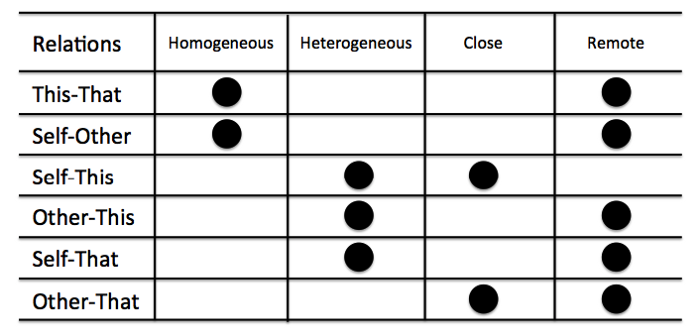
If you find Categorical Differences and Spatial Differences behind a situation or a phenomenon, then you can adopt this meta-diagram to visualize your thinking. You can make a new framework with it too.
Also, I have mentioned Andy Blunden’s approach “Formation of Concept as Activity”. Though Andy Blunden combined “Project — Concept — Theory” together, I consider the notion of “Formation of Concept of Activity” as a perspective and use it to support my work “Themes of Practice”.
Thus, the “Activity Circle” framework echoes both Karpatschof and Blunden’s ideas. It also echoes some Activity Theorists’ work on connecting Lev Vygotsky and Mikhail Bakhtin (1, 2).
The Thematic Controversy Project
Now we have a new framework for theme-centered conversation and controversy.
Why do I want to blend the Concept Dynamics framework and the Relevance of Zone model together?
In the past several weeks, I noticed that there is a pattern behind many discussions on Linkedin. These discussions always present a theme-centered conversation or controversy.
I also realized that the Concept Dynamics framework and the Relevance of Zone are suitable for mapping these discussions.
This is the beginning of a new project.
You are most welcome to connect via the following social platforms:
Polywork: https://www.polywork.com/oliverding Twitter: https://twitter.com/oliverding Boardle: https://www.boardle.io/users/oliver-ding Linkedin: https://www.linkedin.com/in/oliverding
License
This work is licensed under the Creative Commons Attribution-NonCommercial-ShareAlike 4.0 International (CC BY-NC-SA 4.0) License. Please click on the link for details.


