
Activity U (X): Projecting, Projectivity, and Cultural Projection
The Concept of “Projectivity” is inspired by Ecological Psychologist James J. Gibson’s Affordance Theory and Andy Blunden’s Project-oriented Activity Theory.

This article develops a new concept called “Projectivity” and uses it as a foundation of Cultural Projection Analysis which is a module of the Platform-for-Development framework.
The Concept of “Projectivity” is inspired by Ecological Psychologist James J. Gibson’s Affordance Theory and Andy Blunden’s Project-oriented Activity Theory. The concept of Projectivity can be considered as a new idea for the Project-oriented Activity Theory and other Project-oriented approaches.
The last part discusses Lev Vygotsky’s “ecological mind” ideas and the possible connection between Activity Theory and Ecological Psychology.
Contents
Part 1: The Concept of “Projectivity”
1.1 Affordance 1.2 Supportance 1.3 Projectivity 1.4 Sense-makers
Part 2: Primary Projectivity
2.1 Diagram 2.2 Events
Part 3: Secondary Projectivity
3.1 Diagram 3.2 Identity of Project
Part 4: Tertiary Projectivity
4.1 Diagram 4.2 Themes of Project 4.3 Acquisition of Ideas
Part 5: Zone of Project
Part 6: Cultural Projection Analysis
Part 7: Discussion
7.1 Vygotsky, Kurt Lewin, and “Ecological Mind” 7.2 “Sign Meaning Develops” and Affordance 7.3 Affordance, Projectivity, ZPD, and Social Situation 7.4 Zone of Project, ZPD and Behavior Settings
Part 1: The Concept of “Projectivity”
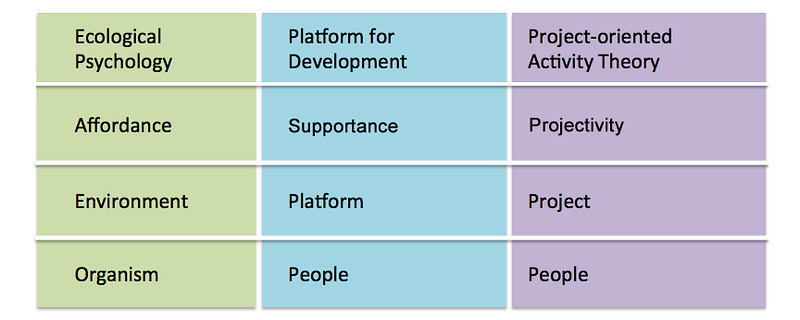
The Concept of “Projectivity” is inspired by Ecological Psychologist James J. Gibson’s Affordance Theory and Andy Blunden’s Project-oriented Activity Theory. The chart below presents three similar concepts: Affordance, Supportance and Projectivity. Both three concepts share the same deep structure: the Reciprocal Relationship between Environment and Organism. For the Platform-for-Development framework, we can consider Platform as Environment. For Project-oriented Activity Theory, we can consider Project as Environment.
1.1 Affordance
What’s Affordance? Let’s have a look at the original definition made by Gibson, “The affordances of the environment are what it offers the animal, what it provides or furnishes, either for good or ill. The verb to afford is found in the dictionary, but the noun affordance is not. I have made it up. I mean by it something that refers to both the environment and the animal in a way that no existing term does. It implies the complementarity of the animal and the environment.” (1979, p.119)
The affordance concept describes the possibilities for action that the environment including objects and other people offer for a particular person. The theory is complex, according to ecological psychologist Edward S. Reed (1996), there are two ways of using the concept of affordances: concrete analysis of an affordance and abstract analysis of an affordance. The former shows “how particular environment properties can promote a particular species’ habits of life (e.g., how this kind of terrain does or does not support human locomotion).” while the latter shows “these particular relationships between an organism and its habit are instances of ecological regularities or laws.”(p.40)
I adopted both two ways of affordance analysis for Platform Ecology. At the concrete analysis level, I developed an ecological physics method for discussing Twitter in June. At the abstract analysis level, I developed a new concept called Supportance for Platform Ecology in October.
1.2 Supportance
In order to develop the Platform-for-Development framework, I define a nested social system Platform[Project(People)] as a foundation for the framework.
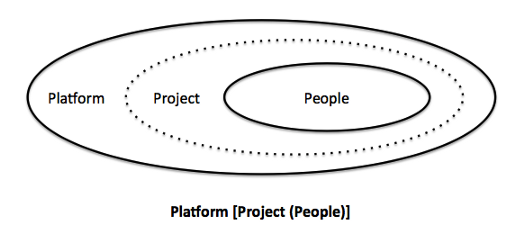
The framework claims that Project is embedded social context and Platform is the setting of Project. Without any Project (informal and flexible social activities), a Platform is only a Tool which helps People take individual actions.
In order to understand the relationship between “Platform — People”, I develop a new concept called “Supportance”.
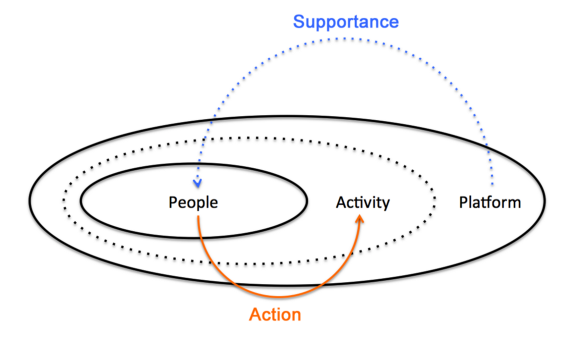
The above diagram represents the concept of supportance. There are three theoretical claims behind the diagram:
- As an ecological environment, a Platform offers Supportance for People. Supportance refer to potential action opportunities which could support people from the perspective of development.
- People are both perceivers and participants in Platform. They perceive and select some supportances and take actions for their Purpose.
- Some actions are curated within Programs and organized into Activity as Projects which offer Positions in order to service the function of Activity.
1.3 Projectiviy
Now, we can apply the logic behind Supportance to the relationship between Project and People. Thus, we can develop Projectivity as a theoretical concept to better describe this special type of relationship.
So, what’s Projectivity? It refers to potential action opportunities of forming a project or participating in a project for people to actualize their development with others.
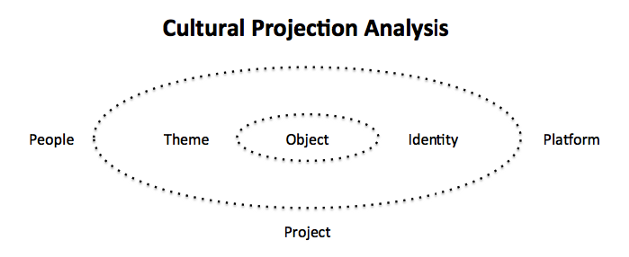
The concept of Projectivity connects Project, Projecting, Projection together and can be used to service the Platform-for-Development framework as a foundation for the module of Cultural Projection Analysis.
1.4 Sense-makers
Traditional Activity Theory has a key concept Object which is a sense-maker of Activity because Activity Theorists use Object to define an Activity. They use the term “Sense-maker” to highlight the importance of the concept of Object.
For Ecological psychologists, they use “Ecological Information” to make sense of “Affordance”. From the perspective of Ecological Psychology, the “Organism-Environment” relationship is explained by a “perception-action” loop. At a particular situation, there is information specifying the structure of the environment; by pickuping ecological information, people perceive affordances of the environment; then, people select one or more affordances and take real actions.
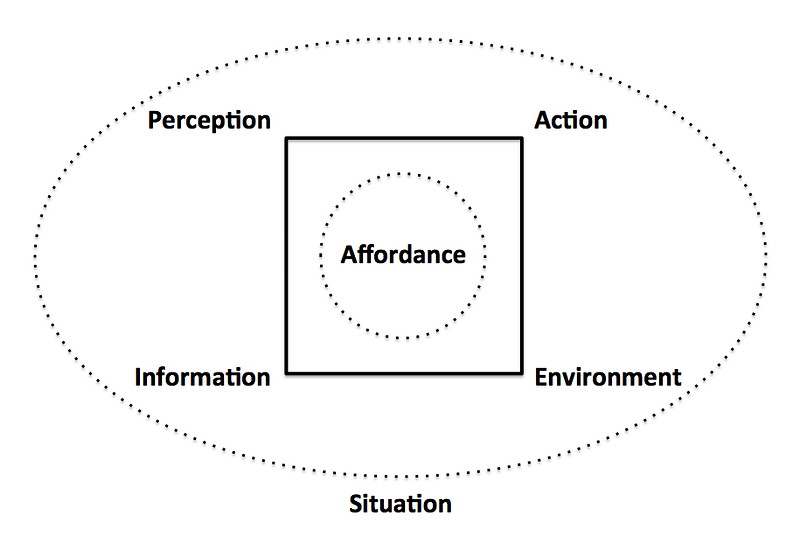
Though ecological psychologists don’t use “sense-maker” to describe the importance of “Ecological Information” within Affordance Theory, we can claim the role of “Ecological Information” is just a sense-maker because it specifies Affordances.
I apply the same logic to the concept of Projectivity. First, there is a social/cultural environment which contains Events. By perceiving and knowing Events, people recognize the Primary Projectivity which is offered by the social/cultural environment and initiate a Project. For the Primary Projectivity, its sense-maker is Events.
Once a project is initiated, it offers the Secondary Projectivity for other people to recognize the potential action opportunities of participating in the project. For the Second Projectivity, its sense-maker is the Identity of an established Project.
Third, the participants of a project could perceive and know the Tertiary Projectivity and initiate a new project which is inspired by the project. For the Tertiary Projectivity, its sense-maker is Themes and Identity of an established Project.
The Part 1 set the basis for our discussion. The rest of the article shall unpack the concept of Projectivity with a series of diagrams.
Part 2: Primary Projectivity
Andy Blunden mentions the origin of a project in a 2014 book Collaborative Projects: An Interdisciplinary Study. He says, “What distinguishes Activity Theory from Phenomenology and Existentialism is that for Activity Theory, the project has its origin and existence in the societal world in which the person finds themself; for Phenomenology and Existentialism the psyche projects itself on to the world. For Activity Theory, commitment to a project and formulation of actions towards it, are mediated by the psyche, but a project is found and realized as something existing in the world, be that an entire civilization, a single personality, or anything in between. (See MacIntyre, 1981, p.146)” (2014, p.7).
2.1 Diagram
The Primary Projectivity starts from the above message, especially the important statement “…a project is found and realized as something existing in the world…”. Inspired by Ecological Psychology, I define the “…something existing in the world…” as Primary Projectivity which is offered by the social/cultural environment and refer to potential action opportunities of initiating a brand new Project.
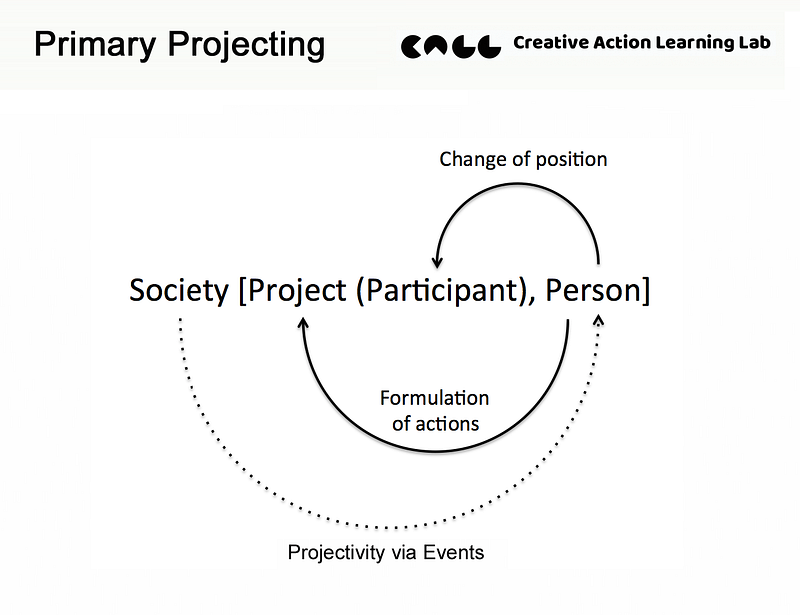
The above diagram represents the spatial logic of Primary Projecting. A person perceives and knows a projectivity offered by Society through the sense-maker Events. Then the person actualizes the projectivity by formulating actions. The outcome is a brand new project is initiated and the person moves his position from outside space to inside space. By changing his position, the person became a participant of the project as the founder or initiator of the project.
2.2 Events
Here the “Events” refers to any change of society. For Gibson, Ecological Events refers to “change in the layout of surfaces, change in the color and texture of surfaces, and change in the existence of surfaces”. For cultural projection analysis, I consider society as a dynamic process which is formed by big changes and small changes. A big event/change can be a social movement, a major technological invention, a political crise, etc. A small event/change can be a neighborhood party, a minor traffic accident, a twichat, etc.
I have mentioned there are three phases of formation of concept in Project-oriented Activity Theory: Phase 1 — Initialization, Phase 2 — Objectification, Phase 3 — Institutionalization. The Primary Projectivity corresponds to the phase of Initialization.
Part 3: Secondary Projectivity
At the phase of Objectification, an established project starts attracting people as its participants. Once a Project is initiated, it offers the Secondary Projectivity for other people to recognize the potential action opportunities of participating in the project. For the Second Projectivity, its sense-maker is the Identity of an established Project.
3.1 Diagram
I apply the same spatial logic for the diagram of Primary Projectivity to Secondary Projectivity. The diagram below shows an abstract model of secondary projecting with two people and one project. Participant A is the first person who initiates the project while Participant B is the second person who recognizes Secondary Projectivity and participates in the project.
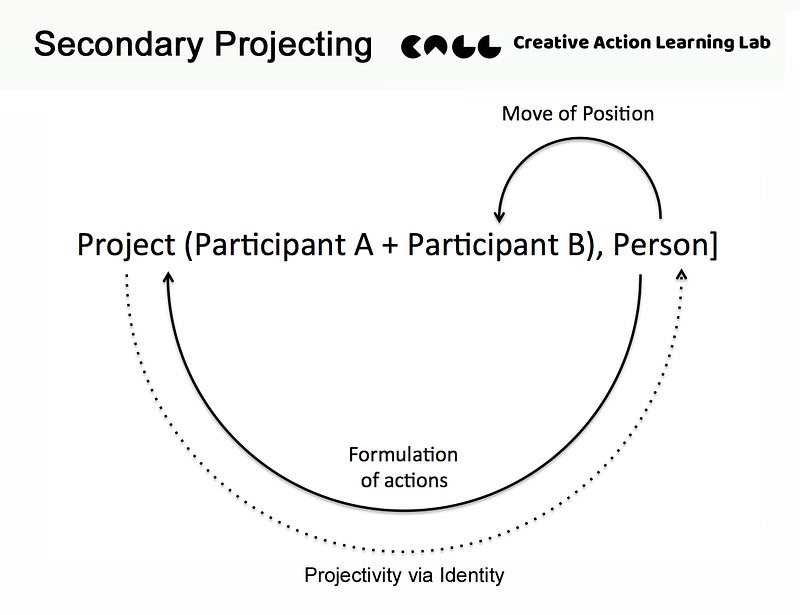
The core of the spatial logic is the synchronization of formulation of actions and move of position. The second person moves from the outside space of the project into the inside space of the project while he actualizes the Secondary Projectivity of the project by taking real actions.
Here we have to pay attention to the spatial boundary of the project. Before becoming the Participant B, the second person only can perceive the secondary projectivity of the project through its sense-maker Identity of Project because he is not at the inside space of the project.
3.2 Identity of Project
What’s Identity of Project? I define it as the perceived meaning of the sum of the objectification of the project. This definition includes three keywords:
- “perceived meaning”
- “the sum of…”
- “the objectification…”
Objectification is the core concept of Project-oriented Activity Theory. Blunden clearly claims that there are three aspects of objectification of concept: symbolic, instrumental and practical. Symbolic objectification refers to naming, coining a term, keywords, hashtags, inscription in documents, laws, signage, literature, etc. Instrumental objectification refers to making material artifacts and tools. Practical objectification refers to normalization of use in actions and common practice in a community.
All of concrete objectifications form a whole as the Identity of the Project. However, the whole is an ideal abstract entity. For practical study, what does matter is not the Ideal Identity of a project, but the Perceived Identity of the project.
Further, the perceived meaning is only half the story. The person rely on the “perceiving meaning — personal condition” fit to decide if he wants to actualize the secondary projectivity and participate in the project. The personal condition refers to multiple individual facts such as skills, knowledge, health, career, family, etc.
Part 4: Tertiary Projectivity
The Tertiary Projectivity refers to the relationship between a project and its participants. Since the participants stay in the inside space of a project, the way they perceive and know the project is different from outside people’s way.
4.1 Diagram
Tertiary Projecting is about initiating a new project which is inspired by an established project. For the Tertiary Projectivity, its sense-maker is Theme and Identity of an established Project.
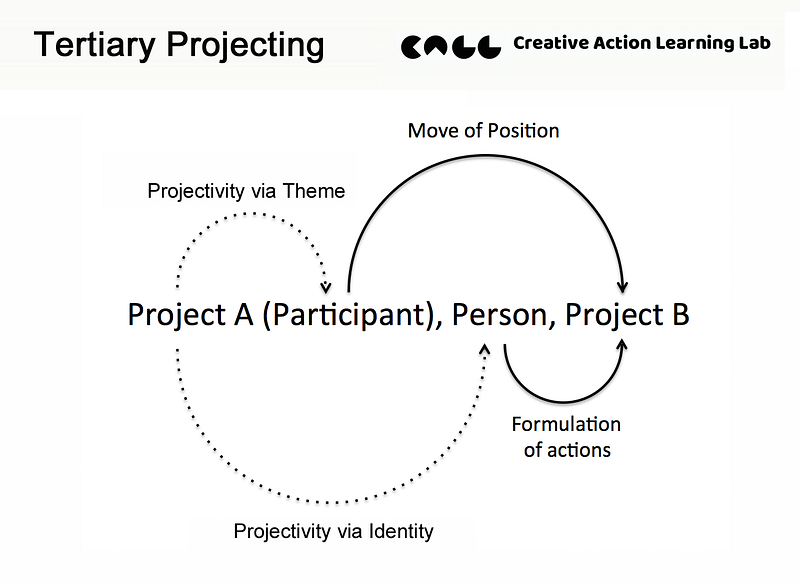
The above diagram continuously represents our spatial logic. This time we see two projects. Project A is an established project while Project B is a potential new project. One Participant of Project A perceives the Tertiary Projectivity of the Project A and takes actions to initiate Project B. By actualizing the Tertiary projectivity, the participant moves his position from inside space of Project A to the inside space of Project B.
4.1 Themes of Project
The sense-maker of tertiary projectivity is Theme of Project. From the perspective of Project-oriented Activity Theory, the Theme of Project is just the Concept of Project. My original idea about Theme is from my own concept “Theme of Practice”. Blunden’s argument on Concept echoes my consideration of the concept of Theme. Since Theme is a particular concept, I can adopt Blunden’s proposal — the “Hegel-Marx-Vygotsky” account of “Concept” — as a theoretical foundation to support the concept of “Themes of Practice”. Also, the notion of “Formation of Concept” is the foundation of Blunden’s Project-oriented Activity Theory.
Furthermore, I think it is also useful to keep the concept of “Themes of Practice” in order to discuss the internal dynamics of Project. For instance, I find the following “Themes of Practice” are ideal concepts for our discussion.
- “Idea”
- “Resource”
- “Program”
- “Performance”
- “Solution”
I have made a distinction between Idea and Concept from the perspective of Project-oriented Activity Theory in the previous article. As Blunden emphasises, “The formation of a project with a concept of the problem is an original and creative social act.” However, it is hard to require every project to be an original and creative social act. In order to keep using the term “Project”, I suggest that it is possible to allow the formation of a project with a regular idea which refers to normal works. In this manner, I keep a room for normal projects within Project-oriented Activity Theory. Thus, we can claim that the “Idea” of a project is a “Theme of Practice”.
Other four “Themes of Practice” are also suitable for both creative projects with Concepts and normal projects with Ideas. Though Project-oriented Activity Theory emphasises three aspects of Objectification of Concept, I think “Resource”, “Program”, “Performance” and “Solution” are great keywords for reflecting on their concrete daily actions related to three types of objectification.
4.2 Acquisition of Ideas
Here we have to mention Blunden’s message about “Acquisition of Ideals”. In an article about Agency, Blunden argues that the term “Agency” covers a range of distinct phenomena and different units are required for an analysis of the whole field. For instance, he claims that “Acquisition of Ideals” should be considered as an independent phenomenon. He says, “There is more to this appropriation than the incorporation of signs and tools in actions. In the course of acquiring the meaning of the various words and artefacts in the course of their participation in the broader circle of social life — work, politics, social life generally — a person grasps the various concepts which are orienting the practices pr activities (referred to above in the synopsis of Leontyev’s work) in which they participate or interact with. A concept is not merely a neutral representation of a form of activity but represents some motive. In acquiring the concept, through participation at some level in the relevant practice, the person makes a commitment. To acquire a content is to determine the will. That commitment may be marginal or it may be life-defining. Leontyev (1978/2009) shows how the personality includes a hierarchy or structure of such commitments.”
I have mentioned that Project means Formation of Concept in the previous article Activity U (VIIII): Project-oriented Activity Theory. Thus, joining a project is making a commitment to a concept. Blunden points out, “This idea is central to the conception of free will and self-determination. It is in the course of making these commitments that a person shapes their own desire and at the same time, by engaging with others who share that commitment. at one level or another, the person is able to realise that motive.”
The final part of the message is highly relevant to Tertiary Projectivity. Blunden says, “Further, in the course of pursuing its motive, the project to which a person is committed comes up against difficulties and conflicts. In the course of the resulting crises two things happen: (1) the project enters into relations with other projects, be they supportive or opposing, deepening and broadening the conception of its motive, and (2) the individual is faced with personal crises (impossible situations) which have to be overcome. The unit of analysis for these aspects of the development of the will is the collaborative project and the commitment of the person to the project.”
So, the potential new project B may support or oppose the established project A. The participants of Project A may leave Project A and join Project B. This is our spatial logic and the nature of Project.
The diagram also represents another type of Tertiary Projectivity: a person stay at the outside space of the Project A and he initiates the Project B which is inspired by the Project A. However, the sense-maker is Identity of Project.
Part 5: Zone of Project
If we continue to explore our spatial logic, we will reach the following diagram which points to a space between two participants within one project.
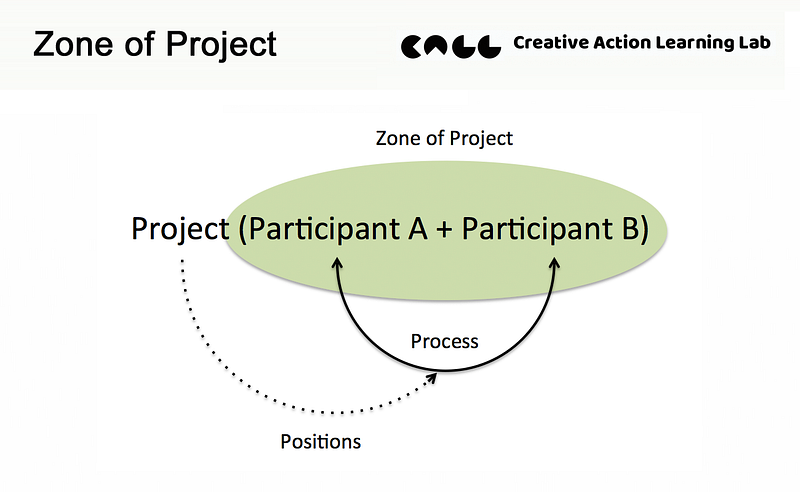
I name this space “Zone of Project” which is inspired by my 2018 work “Ecological Zone” or “ZONE”. I have mentioned the ZONE framework in the article Activity U — A Knowledge Curation Project.
As an important step of expanding the approach of Project-oriented Activity Theory, the concept of “Zone of Project” is a conceptual combination which is inspired by the ZONE framework and Project-oriented Activity Theory. The theoretical resources of these two frameworks are ecological approach and cultural-historical approach. Thus, it is a challenge to achieve this goal.
I will go deep with the concept of “Zone of Project” in the next article.
Part 6: Cultural Projection Analysis
I have mentioned the module of “Cultural Projection Analysis” in The Platform for Development (P4D) Framework (1.0). This article introduces the concept of “Projectivity” with a concrete analysis framework.
The term “Cultural Projection” is inspired by Brecht De Smet who adopts Andy Blunden’s idea “project as a unit of activity” to analyze the 25 Jan Revolution. In an article titled Tahrir: A Project(ion) of Revolutionary Change, Smet (2014) said, “The collaboration of Tahrir not only entailed a project, in the sense of people jointly working towards a shared goal, but also a projection: an image that shone forth from this activity.” (p.297) He also pointed out, “The concept of projection denotes the capacity of a project to universalize itself and attract new participants to its cause, and, most importantly, it underscores collaboration as a process of learning and instruction.” (p.299)
For normal people, the 25 Jan Revolution is an event. For participants of the Revolution, it is a project. As Smet emphasized, “Hence, a projection also constitutes the inward appearance of the project to its own participants. Tahrir was not only the actual collaboration of protesters on the Square (project), it was also a glimpse of a better society (projection); an imagination that moved ahead of their current project and instructed and inspired them to develop their activity accordingly. Within the development of revolutionary collaboration, there was a continuous, reciprocal transformation of imagined goals by actual activities and vice versa, which highlights the dual character of a project as both a teleological and immanent movement.” (p.299)
Smet adopts the narrative approach to describe the 25 Jan Revolution. Now we have another way to expand Project-oriented Activity Theory. The concept of Projectivity and its framework provides a series of diagrams with a spatial logic. This is a solid foundation for an analysis approach.
Part 7: Discussion
The concept of “Projectivity” and “Zone of Project” are inspired by Ecological Psychology. However, the theoretical roots of Project-oriented Activity Theory is the Hegel-Marx-Vygotsky account. I’d like to trace back to Lev Vygotsky and look for some potential support for “Projectivity” and “Zone of Project” from his theoretical concepts.
Though Lev Vygotsky is best known for his cultural-historical theory of psychological functions, he certainly developed at least three ideas for understanding social context and environment: Zone of Proximal Development (ZPD), Perezhivanie, and Social Situation of Development. These three ideas work together and form an “ecological mind” account in a broad sense.
- Zone of Proximal Development (ZPD) : “…the distance between the actual developmental level as determined by independent problem solving and the level of potential development as determined through problem solving under adult guidance or in collaboration with more capable peers. (Vygotsky, 1978, p. 86, originally Vygotsky, 1935, p. 42)”
- Perezhivanie: “…So, in a perezhivanie we are always dealing with an indivisible unity of personal characteristics and situational characteristics, which are represented in the perezhivanie. (Vygotsky, 1934, p. 342)” According to Andy Blunden, “Perezhivanie is a Russian word, usually translated as ‘a lived experience.’ and used in connection with “social situation of development,” which has multiple shades of meaning. It indicates a person’s situation with special emphasis on the subjective significance, especially the emotional and visceral impact of the situation on the person, recollection of which summons up the entire situation.”
- Social Situation of Development: According to Andy Blunden, “In The Problem of the Environment, Vygotsky illustrates the idea of perezhivanie by the case of three siblings coping or not with their single mother who is a drunk. The infant is indifferent to this situation, being too young to know; the middle child is traumatised; and the oldest child, a teenage boy, understands that he must become ‘the senior man’ in the family, makes an accelerated development and takes responsibility for looking after his siblings and his mother. That is, it is only the adolescent who is able to master the perezhivanie, and even in his case, without outside assistance, his own development may be damaged by his loss of childhood. In this way, Vygotsky showed how not just the social environment, but the significance of features of the environment for the subject and the subject’s capacity to process them, make up the essential units of analysis for understanding the development of the child.”
If we go deep to the theoretical development of Vygotsky’s creative thinking, it is perhaps no surprise that Vygotsky developed this “ecological mind” account because Kurt Lewin (1890–1947) is his major theoretical inspiration in his later years. This cue is very important for connecting my idea “Projectivity” and “Zone of Project” with Vygotsky’s “ecological mind”.
7.1 Vygotsky, Kurt Lewin, and “Ecological Mind”
According to Yasnitsky, “As it is already perfectly clear from considerable research and publications (Chaiklin,2003; Valsiner & van der Veer, 1993), ‘Vygotskian ZPD’ is neither original, nor the most essential of Vygotsky’s contributions to the social and human sciences. First, the notion of ‘zone’ migrated into Vygotsky’s work from his contemporary German American scholar Kurt Lewin (1890–1947), the founder of the so-called ‘topological and vector psychology’ and, allegedly, ‘field theory’ in psychology. The analogy between the ‘zone’ and ‘field’ is quite clear, and Lewin’s considerable in fluence on Vygotsky of the last two or three years of the latter’s life is well documented and discussed at length (Yasnitsky, 2018; Yasnitsky & van der Veer 2016a).”
We have to notice that Vygotsky’s “ecological mind” account is not a complete project because he died in 1934. According to Yasnitsky, “…the ‘ZPD’ does not appear in Vygotsky thinking and writing until 1933, and figures on the margins of his work at the time(Chaiklin, 2003).” A classic text about Vygotsky’s “ecological mind” is The Problem of the Environment (1934) which is a text of a lecture delivered in 1934.
Jaan Valsiner and Rene van der Veer share a story of the development of ZPD in their article Encountering the border. The authors use ZBR (zona blizhaishego razvitia) which is the original Russian of ZPD. They points out, “Around 1931, Vygotsky had reached the theoretical necessity to conceptualize the “making of the future” in human ontogeny (Zaretskii, 2007, 2008, 2009)…The earliest documented mention of ZBR can be found in a lecture in Moscow, at the Epshtein Institute of Experimental Defectology on March, 17, 1933…The third relevant presentation involving the introduction of the ZBR concept took place two months later — when Vygotsky gave a presentation on the development of everyday and ‘scientific’ concepts at Leningrad Pedagogical Institute on May, 20, 1933 (Vygotsky, 1933/1935e)…with in the two-month period (March — May, 1933) Vygotsky was observed to pick up the concept of ZBR and use it actively in different contexts. In all of these uses the concept remained a descriptive one — marking the emphasis on the study of developing (as opposed to already developed) psychological functions. In the final fifteen months of his life, Vygotsky made numerous (but often passing) use of the ZBR concept. The surviving texts of Vygotsky provide us with a potpourri of examples of the use of the ZBR concept. ”
According to Oishi and Graham (2010), “Within various areas of psychology, there have been several historical waves of ecological movements… ” The diagram below presents these waves.
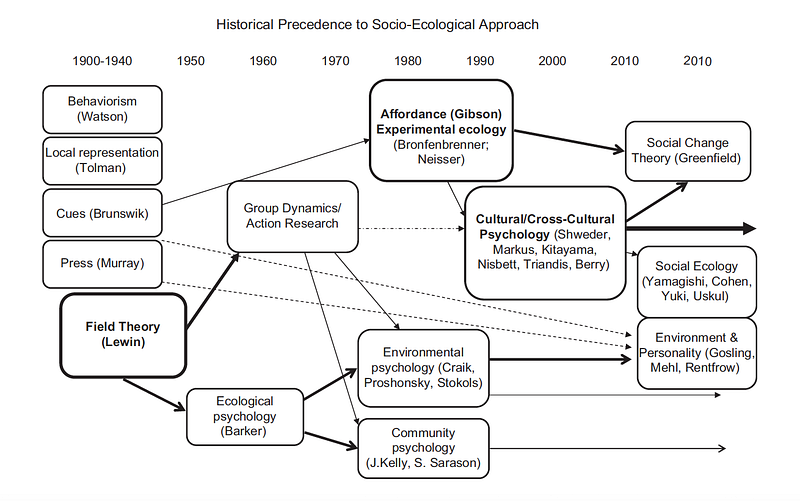
Oishi and Graham (2010) does not mention Vygotsky’s ideas in their paper and the above diagram. However, we can find Kurt Lewin’s idea is a major account of the ecological movement.
In Ecological Psychology in Context (2001), Harry Heft points out Kurt Lewin’s ideas are major theoretical resource of James J. Gibson and Roger G. Barker. According to Heft, “J.J.Gibson (1979) traced the origins of the concept of affordance to the writings of Lewin and Koffka (J.J. Gibson, 1979, pp.138–140). In Lewin’s case, the term is tied to valence, which is an English translation of Lewin’s German neologism Aufforderungscharakter…Valence in its older sense of ‘value, worth, power, strength, and significance,’ rather than the more limited ‘attracting versus repelling’ connotations, is probably closer to his intentions…Still, Gibson appeared to have had something a little bit different in mind than did Lewin.” (2001, p.220)
Roger G. Barker was a postdoctoral student with Lewin at the University of Iowa, and this contact with Lewin had a lasting effect on him. According to Heft, “It was Lewin’s conviction that actions are rarely understandable as being triggered by a single environmental precipitant or personal disposition; instead, converging influences from multiple sources are the rule. Moreover, an action is not caused by a stimulus; rather, an actor is situated in a field of multiple environmental and personal influences, and the observed pattern or direction of action is an outcome of their mutual convergence. With this field-theoretical framework, Lewin challenged psychologists to think about psychological processes and the psychological environment in more complex ways than they ever had before.” (2001, p.205)
Barker went a further step than Lewin. While Lewin focuses on the psychological environment, Barker moves to the ecological environment. In Behavior Settings (1968, 1989), Barker says, “The ecological environment shares with the first of these two conceptions a concern for the physical and geographical environment but, more than this, the ecological environment includes also the objectively observable standing patterns of behavior of people — that is, specific sequences of people’s behavior that regularly occur within particular settings. For example, the standing patterns of behavior in a basketball game include the playing of the players, the watching and cheering of the spectators, the refereeing of the referees, and the recording and posting of the scores by the scorekeepers.” (1989, p.3)
Heft also connects Barker’s account and Gibson’s account together in order to form a larger ecological psychology. He says, “Barker and his colleagues discovered through their empirical work in psychology a dynamic ecobehavioral structure, the behavior settings, that operates at an extra-individual level of analysis. This dynamic social structure goes a long way in helping to account for much of the order and regularity we observe in daily social life. Its value in this regard pushed the present analysis in the direction of considering collective social structures that are sustained by individuals’ actions and that reciprocally constrain these actions. Importantly, in this respect, it expands the ecological perspective developed by Gibson, recognizing the significance of higher order extra-individual structures in everyday life. Reciprocally, Gibson’s account of animal-environment reciprocity at the level of individual functioning shores up a problematic feature of Barker’s framework.” (pp. 205-206)
In fact, Barker points out that there is a need for an eco-behavioral science independent of psychology. He says, “Ecological problems and methods of science can be differentiated with precision from experimental problems and methods…Ecological approaches to scientific problems are not incomplete or defective experimental approaches. On the contrary, they provide knowledge that the best experimentation cannot provide, because experimentation by arranging conditions according to the concerns of the experimenter destroys the very thing an ecological investigation seeks to determine. The importance to science of experimental methods is everywhere recognized, but it is perhaps less widely realized that the ecological side of science is also essential.” (p.356)
What does eco-behavioral science mean? Maybe we can consider the discipline of Activity Theory and CHAT (Cultural-historical Activity Theory) is close to Barker’s vision.
Michael Cole echoes Barker’s idea in his 1996 book Cultural Psychology. In particular, he writes about “Context/Practice/Activity and Ecological World Views” and encourages readers to embrace ideas from ecological psychologists. He says, “There are important affinities between the various views about a supra-individual unit of analysis associated with the notions of context, practice, activity, and so on, and the views of those who identify themselves as ecological psychologists (Altman and Rogoff, 1987). These affinities grow out of a common starting point, the ecology of everyday human activities, and are evident in the proclivity of researchers of both views to conduct their research in naturally occurring social settings rather than experimental laboratories. These affinities can also be seen in the appearance of the metaphor of weaving in the writings of both groups. The following example is taken from the work of the pioneer ecological-developmental psychologists Roger Barker and Herbert Wright, who were attempting to characterize the relation of ecological setting to psychological processes.” (pp. 141–142)
Though Vygotsky’s theory account is named with Cultural-Historical Theory, his ideas about “ecological mind” open a room for connecting Activity Theory and Ecological Psychology.
7.2 “Sign Meaning Develops” and Affordance
In an article about “Mediation” which is a main theme of Lev Vygotsky’s writings, James V. Wertsch points out there are two basic types of mediation from Vygotsky’s early research and later studies: explicit mediation and implicit mediation. Wertsch also emphasizes that these two forms of mediation are part of a broader conceptual framework “sign meaning develops”.
According to Wertsch, “The general line of reasoning Vygotsky employed in this respect grew out of his critique of theorists who assumed that the relationship between word and thought remains constant. In contrast to this, he began with the assumption that signs first emerge in social and individual action without their users’ full understanding of their meaning or functional role. What then follows is a process of coming to understand the meaning and functional significance of the sign forms that one has been using all along. In an important sense humans use signs before understanding what they are doing, or demonstrate ‘performance before competence,’ as Courtney Cazden (1981) succinctly and elegantly put it.”(2007, p.196)
Now let’s recall ecological psychologist James J. Gibson’s comments on category and things which is mentioned in my previous article Hammer, Hammering, and Affordance. Traditionally, psychologists assumed that objects are composed of their qualities. Gibson rejected this view, “…But I now suggest that what we perceive when we look at objects are their affordances, not their qualities…The fact that a stone is a missile does not imply that it cannot be other things as well. It can be a paperweight, a bookend, a hammer, or a pendulum bob. It can be piled on another rock to make a cairn or a stone wall. These affordances are all consistent with one another. The differences between them are not clear-cut, and the arbitrary names by which they are called do not count for perception. If you know what can be done with a graspable detached object, what it can be used for, you can call it whatever you please.”(p.126)
The radical aspect of affordance theory is that it challenges the traditional view on the meaning of objects “concept first” and turns it to “percept first”. Concept is about linguistic meaning and ordinary classes of objects. Gibson arguted, “To perceive an affordance is not to classify an object…The theory of affordances rescues us from the philosophical muddle of assuming fixed classes of objects, each defined by its common features and then given a name. As Ludwig Wittgenstein knew, you cannot specify the necessary and sufficient features of the class of things to which a name is given. They have only a ‘family resemblance.’ But this does not mean you cannot learn how to use things and perceive their uses. You do not have to classify and label things in order to perceive what they afford.” (p.126)
Though the focus of Vygotsky is the development of higher psychological functions, his views emphasize “action first” instead of “meaning first”. Since the ‘performance before competence’ is important in using sign, it is possible to claim that percept leads to actions which lead to understanding. In this manner, we can consider Gibson’s Affordance Theory as lower level support for Vygotsky’s ideas at the higher level.
In fact, Wertsch already points out this connection. He says, “From this perspective, the general goal of instruction is to assist students in becoming fluent users of a sign system. The outcome is a new level, often a qualitatively new type, of “distributed cognition” (Salomon, 1993). Namely, it involves distribution between signs and the active agents employing them. In this approach, instruction amounts to a sort of “taming,” or “domestication,” of novices’ actions in the world. This domestication has both benefits and costs because cultural tools inevitably bring with them “constraints” as well as “affordances” (Gibson, 1979; Wertsch, 1998).” (2007, p.186)
7.3 Affordance, Projectivity, ZPD, and Social Situation
As mentioned above, the concept of “Projectivity” is inspired by “Affordance”. In a broad sense, both “Affordance” and “ZPD” share a pair of analytical levels “actual — potential” and a transformative process “actualizing”. The concept of “Projectivity” keeps this theoretical characteristic.
As Blunden emphasizes, “In this way, Vygotsky showed how not just the social environment, but the significance of features of the environment for the subject and the subject’s capacity to process them, make up the essential units of analysis for understanding the development of the child.” This is the core of Vygotsky’s concept “Social Situation of Development”. This statement also echoes Gibson’s Affordance since it points to both the features of the environment and the subject’s capacity. As discussed above, the concept of “Projectivity” also keeps this theoretical characteristic too.
7.4 Zone of Project, ZPD, and Behavior Settings
Gibson’s Affordance Theory is placed at the animal-environment analytical level while Barker’s Behavior Settings Theory is placed at the level of higher order extra-individual social activity. However, the concept of Behavior Settings is defined as a combination of social program and physical place. Thus, there is a room for developing a new analytical level which should avoid the restriction of physical place.
In 2018, I developed the Ecological Zone framework to highlight this theoretical creative space. I used the term Ecological Zone to describe a basic unit of my social analysis. It refers to an interactive space between two subjects with a shared activity in a short duration or long duration. Though a ZONE is a basic unit, I use at least three ZONEs together for concrete analysis because I need one ZONE as an environment for another ZONE.
This is not a normal account of intersubjectivity because my focus is Ecological Aspects. My goal is adding a layer between Gibson’s Affordance Theory and Barker’s Behavior Settings Theory. It is also inspired by Gibson’s idea “Ecological Self”.
Ecological Zone is similar to ZPD. First, they both use the term “Zone” which is inspired by Kurt’s “Field”. Second, they both have a same structure “subject 1 — subject 2”. Third, they both have “a shared activity”. The difference between two ideas is while ZPD focuses on education and development, the Ecological Zone aims to develop a general framework of intersubjectivity.
From the perspective of Activity Theory, I think we can roughly consider the Ecological Zone as a generalization of ZPD. Though this connection is weak, we can see the potential of connecting Ecological Psychology and Activity Theory since the limitation of Vygotsky’s ideas is individual level analysis.
You are most welcome to connect via the following social platforms:
Twitter: https://twitter.com/oliverding Doowit: https://doowit.co/profile/gm0k2ax9 Linkedin: https://www.linkedin.com/in/oliverding
License
This work is licensed under the Creative Commons Attribution-NonCommercial-ShareAlike 4.0 International (CC BY-NC-SA 4.0) License. Please click on the link for details.
References
Andy Blunden (2014) Collaborative Project: An interdisciplinary study. Brill.
Andy Blunden, Translating perezhivanie into English
Andy Blunden, Agency
Anton Yasnitsky (2019) Vygotsky’s Science of Superman: From Utopia to concrete psychology in Anton Yasnitsky (Eds.) Questioning Vygotsky’s Legacy: Scientific Psychology or Heroic Cult. Routledge.
Brecht De Smet (2014) Tahrir: A Project(ion) of Revolutionary Change. In Andy Blunden (Eds.) Collaborative Project: An interdisciplinary study. Brill.
Edward S. Reed (1996). Encountering the world: toward an ecological psychology. Oxford University Press.
Harry Heft (2001). Ecological Psychology in Context: James Gibson, Roger Barker, and the Legacy of William James ’s Radical Empiricism. New York: Psychology Press.
Jaan Valsiner and Rene van der Veer (2014) Encountering the border: Vygotsky’s zona blizhaishego razvitia and its implications for theories of development. In Anton Yasnitsky, Rene van der Veer and Michel Ferrari (eds.), The Cambridge Handbook of Cultural-Historical Psychology. Cambridge University Press.
James J. Gibson (1979/2015). The ecological approach to visual perception: classic edition. New York: Psychology Press. (originally published in 1979).
James V. Wertsch (2007) Mediation. In Harry Daniels, Michael Cole and James V. Wertsch (eds.), The Cambridge Companion to Vygotsky. Cambridge University Press.
Michael Cole (1996). Cultural psychology: A once and future discipline. The Belknap Press of Harvard University Press.
Roger Barker (1968, 1989). Behavior settings: A revision and extension of Roger G. Barker’s ‘ecological psychology’. Stanford University Press.
Shigehiro Oishi and Jesse Graham (2010) Social Ecology: Lost and Found in Psychological Science.In Perspectives on Psychological Science, vol. 5, no. 4, 2010, pp. 356–377. JSTOR, www.jstor.org/stable/41613443. Accessed 10 Jan. 2021.


