
Activity U — A Knowledge Curation Project
A brief of the Activity U project and knowledge curation.
I started the Activity U project on August 19, 2020. Initially, I just made a diagram called “Activity U” which is a test of the “HERO U” framework. I wrote a post to explain the diagram “Activity U”.
The original title of the post is Activity U: The Landscape of Activity Theory. Later, I added “(Part I)” to the end of the title. It expanded from one post to a series of articles. In Sept, I wrote an article about one of the popular diagrams of Activity Theory: Activity U (IV): The Engeström’s Triangle and the Power of Diagram and created a template of the diagram on Miro. I added a note for the template at the end of the article, “This board is part of the Activity U project, it will be a fun place for collective learning and creating.”
On October 1, I wrote a post to review the first year of CALL (Creative Action Learning Lab) and claimed that Activity Theory as a learning object for Transdisciplinary Thinking which means the knowing between academic domains and non-academic domains. I pointed out four reasons of selecting Activity Theory for Transdisciplinary Thinking:
- It is an established theoretical tradition.
- It is an interdisciplinary philosophical framework for studying both individual and social aspects of human behavior.
- It has inspired many empirical studies in various domains.
- Its root is in a culture background and psychological research tradition outside North America.
The last reason is unique. In a general sense, the mainstream of North America psychology is dominated by individual perspective. In contrast, the psychological root of Activity Theory is social perspective. Thus, I want to bring the new perspective to the next generation of knowledge workers and boundary creators in North America.
In November, I designed the above picture as a birthday gift for myself. I also create a first draft on LeanPub.com in order to organize Activity U articles into a book. The Medium Publication doesn’t provide advanced features for organizing articles. By adopting LeanPub as a new tool for writing about Activity Theory, I can push myself to think systematically.
This is the short history of Activity U. Eventually, a diagram transformed to a project!
The Project
What’s the essence of the Activity U project?
It is a knowledge curation project.
I have been working in the curation field for over ten years. I was the Chief Information Architect of BagTheWeb which was an early tool for content curation (We launched the site in 2010). This experience inspired me to make a long term commitment to the Curation theme. After having 10 years of various curation-related practical work experiences and theory learning, I coined a term called Curativity and developed it as Curativity Theory.
During Sept 2018 to March 2019, I wrote a book titled Curativity: The Ecological Approach to Curatorial Practice. The book presents the Curativity Theory with a theoretical foundation Ecological Practice approach. Here is a brief of the book and the approach: The Ecological Practice Approach Toolkit.
After March 2019, I continuously worked on revising Curativity and developing the Ecological Practice Approach as a new project. For the direction of Curativity Theory, I am looking for practical applications, for example:
- Knowledge Curation
- Action Curation
- Life Curation
- Platform Curation
I have written a chapter for discussing knowledge curation in the book Curativity. For academic knowledge curation, I mentioned Dean Keith Simonton’s chance-configuration theory, Victor Kaptelinin and Bonnie A. Nardi’s scientific curation case study “curation at Ajaxe”, and qualitative research. For practical knowledge curation, I focus on Cognitive Container since Container is a core concept of Curativity Theory.
Books and courses are typical cognitive containers, however, there are more types of cognitive containers. I highlighted five types of Cognitive Containers:
- Knowledge Card
- Knowledge Framework
- Knowledge Diagram and Chart
- Knowledge Workshop
- Knowledge Sprint
It is not an accurate classification, but a rough recommendation. Also, I suggested that we not only adopt existing types of cognitive containers, but also create new types of cognitive containers. Actually, this is the essential point of the Curation Theory. We are shaped by containers and we can make containers too.
The Activity U project started from the HERO U framework and diagram. I consider the HERO U framework as “an ecological approach” of knowing because it refers to the structure of “organism (personal conditions of knowing) — action (knowing) — environment(objective of knowing)”. The U diagram presents six types of Objective of Knowing: mTheory: Meta-theory, sTheory: Specific Theory, aModel: Abstract Model, cModel: Concrete Model, dPractice: Domain Practice, and gPractice: General Practice. The second dimension (red balls) presents a set of Personal Conditions of Knowing: Concept, Diagram, Problem, Method, Resource, Tools, and Domain.
The foundation of Activity Theory and CHAT in general is Lev Vygotsky’s idea “mediated action”. Vygotsky claimed that human action and psychological functions are mediated by tools which refers to technical tools that work on objects and psychological tools that mediate the mind and environment. The idea of “mediated action” is usually represented by a triangle which contains three elements: subject, mediating artifact/tool, and object. If we use this model to explain the first stage of Activity U project, we get the following diagram.
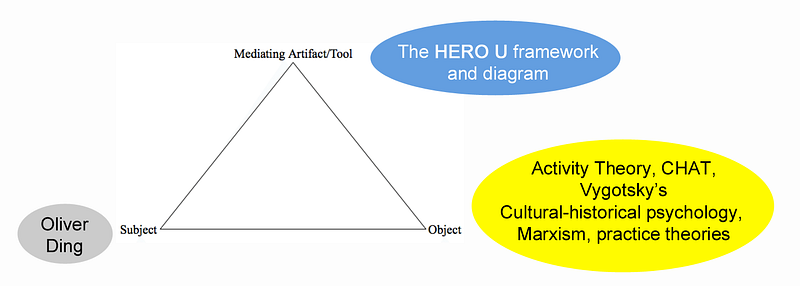
Though the name of Activity U refers to Activity Theory and CHAT (Cultural-historical Activity Theory), I also consider other related theoretical approaches for my learning objects. For example, Vygotsky’s Cultural-historical theory (CHT), Marxism, and practice theories.
According to Nikolai Veresov (2020), “Both CHAT and cultural-historical theory emphasise the importance of cultural mediation in the process of formation of identity as a sociocultural phenomenon. However, they provide different perspectives in relation to what is the basic unit of analysis. For CHAT this unit is a mediated action; cultural-historical theory emphasises dialectical and dynamic aspects by introducing the mediating activities of an individual within changing social environments. In other words, cultural-historical theory is not focused on mediated actions, but on a human being who uses or create cultural tools in order to reorganise the social situation and overcome existing challenges.
Mediated actions are the results of development and they are important for maintaining or re-establishing an inner sense of identity. Mediating activities are activities of a human being who actively creates and recreates his/her sense of identity interacting with the sociocultural environment. In other words, CHAT provides strong theoretical tools to study various types of mediated actions and cultural mediators. The cultural-historical approach opens a perspective of researching the very process of how an individual uses or creates various cultural tools of mediation in situations of choice or challenge.”
We should pay attention to the difference between “mediated action” and “mediating activities”. For Vygotsky, “Man himself determines his behavior with the help of artificially created stimuli-devices…human behavior was determined not only by the stimuli present, but by a new or changed psychological situation created by the man himself. (Vygotsky 1977, pp. 49–54)”. Thus, the key of the Activity U project is the action of creating and using the HERO U framework and diagram which can be considered as “cultural tools”.
However, the Activity U project went beyond the HERO U framework during the writing process. I started to expand it by adding more “social aspects”. The “U” of “Activity U” became “You” which refers to potential audentices of my articles and potential learners of Activity Theory and Transdisciplinary Thinking.
Also, I was motivated by Bonnie A. Nardi’s story. Bonnie A. Nardi is an activity theorist, HCI researcher and anthropologist. She is well known for her work on activity theory, interaction design, games, social media, and society and technology. The third article of Activity U is about her story: Activity U (III): Bonnie Nardi’s Choices and Boundary Knowledge Work.
What I learned from Nardi is not only about the knowledge of applying Activity Theory to HCI field, but also the attitude of Appropriating Theory. I am not saying everyone needs to learn theory, I just personally believe the value of theory. In other words, Nardi influences me on the level of personal epistemology which is about an individual’s belief on knowledge and knowing.
Can I say Nardi is my mentor? I didn’t direct contact with her. I only read her books, papers, and information on her website. However, I can claim that she is one of my “symbolic mentors”.
I learned the term “symbolic mentor” from Mihaly Csikszentmihalyi’s book The Systems Model of Creativity. Csikszentmihalyi pointed out, “Levinson (1978) also noted the complexity and variation inherent in mentoring relationships in general. They are not, as he said, ‘simple or an all-or-none matter’ (p.100). Rather, they may be only partially beneficial to a young person or seriously flawed and destructive, depending on the motives, capabilities, and disposition of the mentor (and of the apprentice). It is also possible for a mentoring relationship to be very limited and yet highly valuable to a young person’s development. For example, some people have purely symbolic mentors whom they have never met, such as an inspiring figure from the past, but who nonetheless may have taught them a great deal about the nature and standards of a domain of interest.” (2014, p.209)
So, it is better to describe the Activity U project with the following diagram.
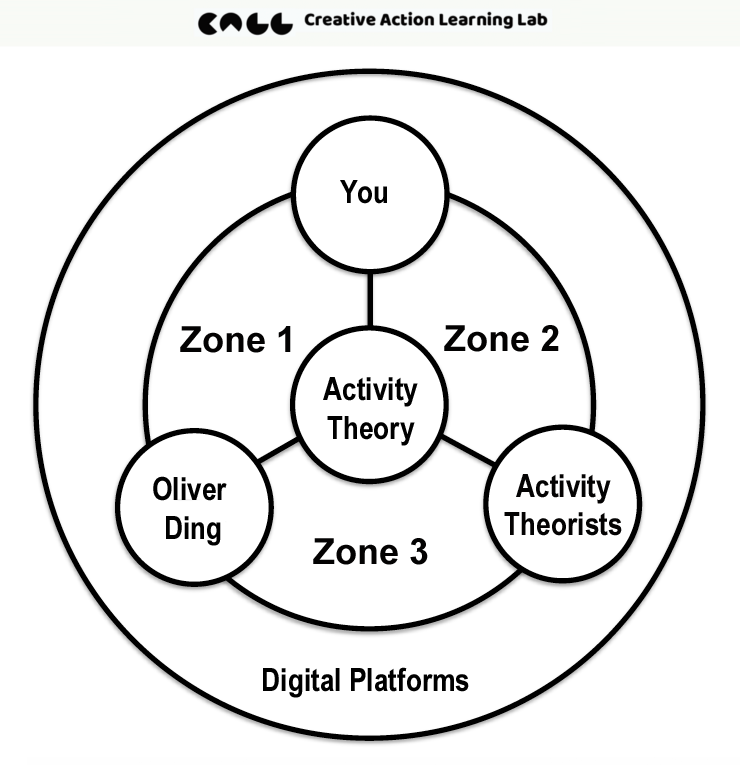
I made this diagram with a meta-diagram called ZONE I made two years ago. The center of the diagram is the “object”, for the Activity U project, the object is “activity theory”. The three small circles at the middle loop refer to three types of subjects. For the Activity U project, I consider the following subjects:
- Subject 1: “You”.
- Subject 2: Oliver Ding.
- Subject 3: Activity Theorists.
The peripheral circle refers to settings. For the Activity U project, the settings are digital platforms such as Medium, Twitter, Linkedin, Miro, Google Books, Academic.org, and Gmail.
The essential notion of the diagram is ZONE. Each ZONE is a social interactive space between two types of subjects. For example, ZONE 1 refers to interactions between “You” and Oliver Ding. ZONE 2 refers to interactions between Oliver Ding and Activity Theorists. ZONE 3 refers to interactions between Activity Theorists and “You”. There are four concepts for understanding ZONE: Structural distinctions, Situational dynamics, Themes of Practice, and Boundaryless Echoes.
- Since three subjects have their own identities, positions, and motivations, there are Structural Distinctions between three ZONEs.
- There are personal differences between individual members of each ZONE. The real interactions happen between real people. So, there are Situational Dynamics inside each ZONE.
- In order to curate various experiences of daily interactions, I adopt the concept Themes of Practice from Curativity Theory for ZONE. A Theme of Practice refers to a set of interactions which share a common issue, an agenda or a theme.
- For each subject/person, they have their own experience of each ZONE. These experiences can be negative or positive. In order to cope with negative experiences at one ZONE, the subject/person can utilize positive experiences from other ZONEs. Also, the subject/person can curate interactions from different ZONEs with similar Themes of Practice. I call this notion Boundaryless Echoes.
The ZONE diagram matches the status of the Activity U project. It is still a personal project, however it has its own social context. There are social interactions generated by the project. For example, I connected to some Activity Theorists through Twitter, Gmail, and Academic.org during the past several months. I also got feedback and advice from these Activity Theorists.
I expect “You” to join the Activity U project and transform it into a collaborative project. Then, we can use the Activity System model (The Engeström’s Triangle) to make a new diagram for our story.
The Book
Now the book Activity U is planned. The above picture is the cover I designed for publishing the draft of the book on Leanpub.
The book has the following parts.
- Part 1: Background
- Part 2: Theory
- Part 3: Project-oriented Activity Theory
- Part 4: Practice
- Part 5: Heuristics
- Part 6: Life as Activity
- Appendix: The Curativity of Activity
Part 1: Background
This part focuses on the introduction and background of the Activity U project. During the last almost five years, my personal learning journey focused on ecological psychology, practice theories, cognitive science and the philosophy of science.
I started learning Activity Theory in 2014 and started CALL (Creative Action Learning Lab) in 2019. The Activity U project is a case study of the HERO U framework which is based on the WXMY diagram. An interesting thing is that the WXMY diagram was born from my experience of reading papers about Vygotsky and Dewey.
In August 2019, I read several academic papers around a debate between Jim Garrison who is a philosopher and Dewey scholar and Reijo Miettinen who is an Activity theorist and Vygotsky scholar. They discussed the relationship between Deweyan pragmatism and Cultural-historical activity theory which was founded by Soviet psychologist Lev Vygotsky. This reading experience inspired me to create the WXMY diagram which has three containers: X, Y, and Z. For the academic debate between Jim Garrison and Reijo Miettinen, X means John Dewey and X’ means Jim Garrison, Y means Lev Vygotsky and Y’ means Reijo Miettinen. The debate means Z.
This part collects several articles about the background of the Activity U project. The first article of the project — The Landscape of Activity Theory (Part I) — is for testing the HERO U framework. I do not want to deliberately review the development of Activity Theory. Thus, I just select works of activity theorists based on my personal reading history for the testing.
- CALL: The House of Boundary Innovation (18 min read)
- When X Meets Y (The WXMY diagram) (13 min read)
- HERO U — A New Framework for Knowledge Heroes (16 min read)
- Theory: Concept, Diagram, and Method (coming soon)
- The Landscape of Activity Theory (19 min read)
- Activity Theory, CHAT, and Vygotsky’s CHT (coming soon)
- Activity Theory and The Practice Turn (coming soon)
However, I found that the “landscape” I wrote is not the real landscape of Activity Theory. As Sannino, Daniels and Gutierrez mentioned, the theory is not one theory, but a group of theories. They said, “As a unified theory, activity theory has shown consistent viability throughout its history, beginning in the 1930s when Leont’ev formulated its basic principles and proposed the structure of activity. In addition, activity theory today attracts more interest globally than ever before. The term ‘unified’ does not refer to a closed and fixed theory. However, it rules out an interpretation of activity theory as an eclectic grouping of multiple theories.” (2009, p1)
There are endless debates about Activity Theory, CHAT (Cultural-historical activity theory), and Lev Vygotsky’s CHT (Cultural-historical theory of development). Some researchers argued that these three theories should not be considered as one theory with several generations.
As a knowledge curator, I like this chaos of discipline. In fact, this is one of the reasons I choose Activity Theory for testing the HERO U framework. However, I need to write a new article to present the real landscape of the knowledge enterprise.
I am not an activity theorist. My goal is closing the gap between theory and practice. Before touching Activity Theory, I was influenced by Chris Argyris’ Action Science and Donald Schön’s Theory in Practice and The Reflective Practitioner.
Since 2001, a group of philosophers, sociologists and scientists have rediscovered the practice perspective and used it as a lens to explore and examine the role of practices in human activity. Researchers called it The Practice Turn in Contemporary Theory. As Schatzki pointed out, “there is no unified practice approach”(2001, p.2). Davide Nicolini adopted a way of toolkit to introduce the following six different ways of theorizing practice in his 2013 book Practice Theory, Work, & Organization. Nicolini selected Activity Theory as one of six approaches for his book.
The Activity U project is also inspired by Nicolini’s book. While his book gives one chapter for each theoretical approach, my project only focuses on Activity Theory. However, I’d like to provide more theoretical resources for discussing some ideas from other practice theories. For example, I mentioned Theodore Schatzki’s social practice theory when I talked about the Hierarchy of human activity and social practice.
Part 2: Theory
This part focuses on theoretical reviews and discussions. Each article talks about one idea.
There is an emergent pattern in my writing: HERO — IDEA — OTHER — ECHO. Each time I focus on an activity theorist (HERO) and one related notion of activity theory (IDEA), I then expand the scope of discussion by adding related resources from other activity theorists and other disciplines (OTHER), I also share my own experience and reflection on some topics (ECHO).
This pattern is not a rule for me. I don’t apply this pattern to every article. It depends on the topic.
- Unit of Analysis, Niches of Analysis, Levels of Analysis (11 min read)
- The Hierarchy of Human Activity and Social Practice (43 min read)
- The Engeström’s Triangle and the Power of Diagram (47 min read)
- The Chain of Activity and Life as Temporal Activity Chains (53 min read)
- The Materiality Turn and Artifact-centered Interaction (33 min read)
- The Placeness of Activity (coming soon)
- The Virtuality of Activity (coming soon)
- The Network of Activity (coming soon)
Part 3: Project-oriented Activity Theory
A major development of Activity Theory during the past decade is Andy Blunden’s account “Project as a unit of Activity”. In order to develop the theoretical foundation of “Project as a unit of Activity”, Blunden adopts Hegel’s logic and Vygotsky’s theory about Concept as theoretical resources. The process is documented in three books: An Interdisciplinary Theory of Activity (2010), Concepts: A Critical Approach (2012), and Collaborative Projects: An Interdisciplinary Study (2014).
After deliberately reviewing the unique theoretical concept of “Project-oriented Activity Theory”, I was attracted by its significance and promising prospect. I also found some of my ideas echoes Blunden’s approach. Furthermore, Blunden’s approach is perfect for supporting my newest frameworks the Life-as-Activity approach and the Platform for Development framework.
Eventually, I wrote five articles about Project-oriented Activity Theory. Blunden doesn’t use this term to name his account. I also designed a series of diagrams and expand Blunden’s approach with some new ideas.
- Project as a Unit of Activity (40 min read, Dec 26, 2020)
- Project-oriented Activity Theory (50 min read, Jan 3, 2021)
- Projecting, Projectivity, and Cultural Projection (26 min read, Jan 9, 2021)
- Process, Position, and Zone of Project (47 min read, Jan 18, 2021)
- 136 Ideas for Impact Projects and Micromovements (18 min read, Jan 20, 2021)
Part 4: Practice
Activity Theory has inspired many empirical studies in various domains. This part focuses on domain special empirical research. I’d like to pick the following domains for writing in the next stage.
There are two types of practice domains: horizontal domains and vertical domains.
- Horizontal domains refer to general functions in society such as “organization, strategy and innovation”.
- Vertical domains refer to specific industries, for example, farm (agriculture), bus (transportation), and movies (entertainment).
I choose horizontal domains for the Activity U project because I want to service boundary innovators and knowledge workers.
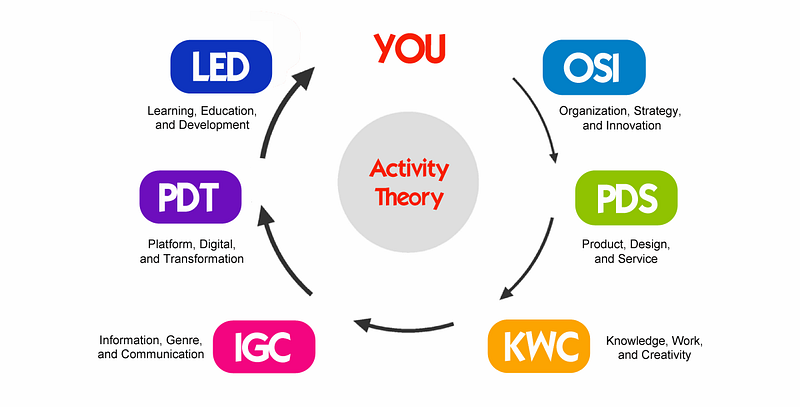
- Organization, Strategy, and Innovation (OSI)
- Product, Design, and Service (PDS)
- Knowledge, Work, and Creativity (KWC)
- Information, Genre, and Communication (IGC)
- Platform, Digital, and Transformation (PDT)
- Learning, Education, and Development (LED)
Inspired by the naming approach of Academy of Management’s Divisions and Interest Groups (DIGs), I set six Learning Interest Groups (LIGs) to represent horizontal domains about knowledge works.
Part 5: Heuristics
This part aims to introduce some useful heuristics developed by Activity Theorists. I also want to recommend some useful tools for thinking about action, practice and activity. In addition, this section contains my own frameworks.
I have mentioned some frameworks and models for PART 1’s articles. However, it is hard to find them from theoretical concept discussions. Thus, this part aims to sort these tools for practical purpose.
- Typology of Activities and Other Practical Tools (25 min read)
- Three Levels of Scope (Activity U (VI) 1.2)
- Activity Notation (Activity U (IV) 4.1)
- Activity Network (Activity U (IV) 4.2)
- Complex Mediation (Activity U (VII) Part 1)
- Temporal Activity Chains (Activity U (VII) 2.3)
- Human-Artifact Model (Activity U (VI) 2.2)
- A Diagram for “Project-oriented Activity Theory” (Activity U (VIII) 3.3)
- The NICE Way and Creative Actions (42 min read)
- Social Platform Experience Design (#SocialPxD)(12 min read)
- Action-based Creativity #1 The Pinwheel Framework (12 min read)
- The Zone of Penetration framework (Activity U (XI) 2.3)
- TRIZ and Activity Theory (coming soon)
- A Checklist for Activity-theoretical Studies (coming soon)
- The GREAT Method (coming soon)
In addition to the book format, maybe it is better to use databases or wiki to curate more heuristics for activity-theoretical studies.
Part 6: Life as Activity
The Life-as-Activity approach is a by-product of the Activity U project. Initially, I want to discuss temporality of activity. During the process of writing Activity U (VII): The Chain of Activity and Life as Temporal Activity Chains, I found Paul Richard Kelly’s Temporal Activity Chains and I adopted for connect Activity Theory and Biography Studies.
This is an amazing discovery!
In fact, this is not the first time I touched biographical studies. I wrote my first learning autobiography in 2015 and started learning biographical studies. In 2016, I also developed a framework called Career Landscape which is inspired by Activity Theory, Communities of Practice, and other ideas. However, I didn’t adopt the Activity System model for the Career Landscape framework. This time I find Temporal Activity Chains is great because it provides a temporal analysis method for activity-theoretical studies. And, biographical studies are about temporal activity analysis too.
- Life as Activity (version 0.3) (37 min read)
- Activity U (III): Bonnie Nardi’s Choices and Boundary Knowledge Work (21 min read)
- Bonnie Nardi: Appropriating Theory (Autobiography)
- Clay Spinuzzi: That Light-Bulb Feeling (Interview)
- Yrjö Engeström’s development as an activity theorist (the last section of this paper, p.11)
- On Third Generation Activity Theory: Interview With Yrjö Engeström (Interview)
- Susanne Bødker: Past Experiences and Recent Challenges in Participatory Design Research (Autobiography)
I’d like to collect more autobiographies, biographies, interviews or personal narratives from activity theorists.
The Future
(this section is added on March 16, 2021)
This morning I had a short conversation with an independent social worker and I shared files about Activity Theory and Public Sociology with him. After lunch, I realized this is the future of the Activity U project.
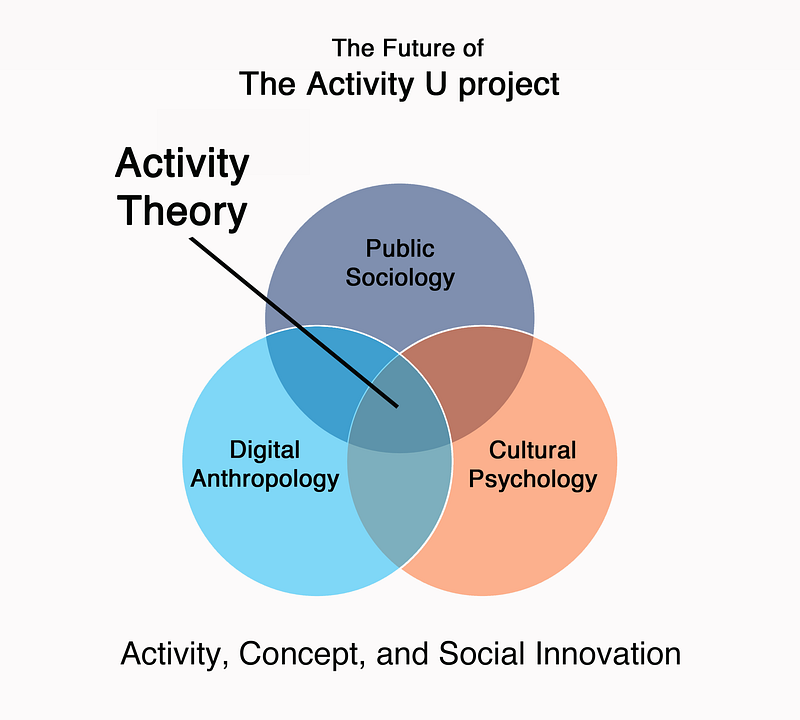
The above diagram presents three shifts of attentions:
- From professional sociology to public sociology
- From individual psychology to cultural psychology
- From traditional anthropology to digital anthropology
Activity Theory, especially the Activity System model has been adopted by professional researchers from various domains. For example, organizational study scholars use the model to guide their research projects. However, most of these projects remain within academic fields. It can be seen roughly a branch of professional sociology. The Activity U project aims to connect Activity Theory with normal knowledge workers, this vision means we are going to expand Activity Theory from professional sociology to public sociology.
Second, the unit of analysis of Activity Theory is not an isolated individual, but an activity. Andy Blunden places Activity Theory within the scope of Cultural Psychology since the origin theoretical source of Activity Theory is Cultural-historical psychology.
Third, North American anthropology has been becoming an important theoretical resources for the development of Activity Theory in North America for many years. Now it is time to embrace the newest development of anthropology in the digital age.
Appendix: The Curativity of Activity
The term “Curativity” refers to “curating pieces into a meaningful whole” which means general curatorial practice. The reason why I coined the term is I was not satisfied with the specific view of curation such as “professional curation means art and museum.” I argued that there is a need to redefine “curatorial practice” as a general social activity and a universal experience. In other words, I was calling an interdisciplinary view of curation or curatorial practice.
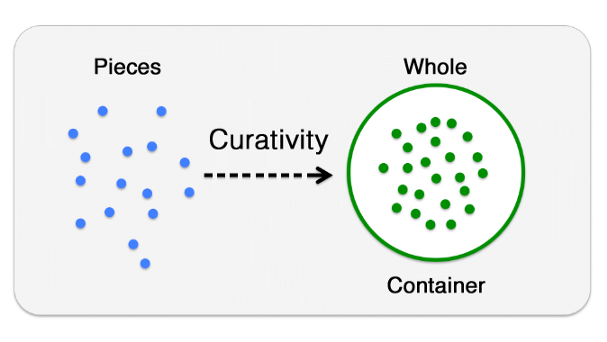
The above diagram represents the notion of Curativity. Pieces, Container and Whole together form a triad which is the basic unit of analysis of Curativity Theory. Also, this unit of analysis establishes a new theoretical category at the ontological level. The concept of Curativity indicates to three statuses of things:
- Things-in-Pieces
- Things-in-Container
- Things-in-Whole
Thus, Curativity Theory is all about understanding the structure and dynamics of these three statuses.
During the process of writing articles about Activity Theory, I often adopt the Curativity perspective to reflect Activity Theory and other practice theories. Since the book is about Activity Theory, I’d like to share my thoughts about Curativity within the appendix.
From the perspective of Curativity, Activity Theory and social practice theories are about the curating of human actions and experiences. For Activity Theory, human actions and experiences are organized with “hierarchy,” “system,” “temporal chains,” “project,” and “network.” Schatzki’s hierarchical structure of social practice is very similar to Leontiev’s hierarchical structure of human activity. The essential theoretical value of Activity Theory is not its psychological aspects, but the function of understanding “social.” The jump from “action” to “activity” makes a simple but powerful thinking tool for theorizing “social”.
I have suggested a universal hierarchy of activity and practice. Based on perspectives from activity theorists and other researchers, I found there are eight levels of hierarchy of activity and practice.
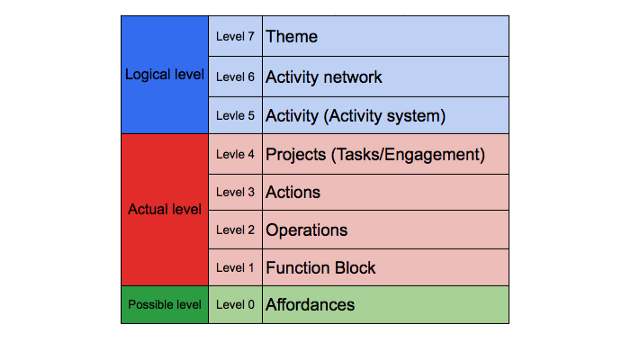
I also classify these eight levels into three types: “logical level,” “actual level,” and “possible level.” We can call logical level as ideal level too. I don’t have perfect terms to name these types. Bedny and other SSAT theorists distinguished “Objects of study” and “Units of analysis.” They consider “activity” and “task” as the objects of study while the other levels as the units of analysis. “Logical level” is similar to their “objects of study,” I think both “theme,” “activity network,” and “activity (or activity system)” are only needed for the analysis requirement. “Actual level” is similar to their “units of analysis”.
Can we live only with “actions” without “activity” or “practice”?
Of course.
However, if we want to reflect on our life, we need concepts such as “activity” and “practice” because these concepts help us understand the complexity of social life.
You are not alone.
CALL for Action
I have created a template of the Activity System model on Miro, you can access it at the following board:
This board is part of the Activity U project, it will be a fun place for collective learning and creating. If you want to join the project, you can DM me on Twitter.
You are most welcome to connect via the following social platforms:
Twitter: https://twitter.com/oliverding Doowit: https://doowit.co/profile/gm0k2ax9 Linkedin: https://www.linkedin.com/in/oliverding
License
This work is licensed under the Creative Commons Attribution-NonCommercial-ShareAlike 4.0 International (CC BY-NC-SA 4.0) License. Please click on the link for details.


