
Activity U (XII): 136 Ideas for Impact Projects and Micromovements
Introduce a pattern language for communication revolution and social change
This article is part of the series of Project-oriented Activity Theory. I will use terms such as Objectification, Concept and Idea from the perspective of the theory. Readers can find details about these terms in Activity U (VIIII): Project-oriented Activity Theory.
The theme of the article is Idea Development which is discussed in Part 1. The rest of the article aims to introduce a book as a resource for idea development. I have mentioned in Activity U — A Knowledge Curation Project, there is a part for curating heuristics. In order to support the applications of Project-oriented Activity Theory, I’d like to recommend Douglas Schuler’s book Liberating Voices: A Pattern Language for Communication Revolution for readers.
You can use this book and its website as a heuristic tool for developing your own ideas. Now, it is time to start your impact projects.
Part 1: The Concept of “Idea Development”
Every project starts with an idea. It is very hard to start something from zero. Also, it is a challenge to develop a useful, workable and novel idea. Thus, the idea of “Idea Development” became a solid concept which guides various types of Objectifications in several practical domains such as startup, product innovation and social change.
First, we can see there is a type of software called Idea Management Software. According to G2.com, “Idea management software, also called innovation management software, structures the process of gathering insights on products and then organizing and managing those ideas for improvement or development. Feedback can be solicited from employees, stakeholders, customers, or multiple groups with the aim of improving a product or brainstorming.”
The Idea Management Software is the new version of the traditional office suggestion box. You can consider this is a great example of digitalization of organizational management.

According to G2.com, “Idea management software is a step up from the traditional office suggestion box. It enables companies of all sizes to continuously innovate and grow by deliberately leading the ideation process. Idea management software facilitates the full transparency of a company, as anyone who has access to the database can track ideas from inception to implementation. Ideas are collected from all areas of the organization, beyond specialized departments such as R&D, product management, and marketing. These products can integrate with enterprise feedback management software to allow users to manage both internally and externally sourced recommendations.”
The term “externally sourced recommendations” is related to Crowdsourcing which is also an established concept. According to Wikipedia, “The term ‘crowdsourcing’ was coined in 2005 by Jeff Howe and Mark Robinson, editors at Wired, to describe how businesses were using the Internet to ‘outsource work to the crowd’, which quickly led to the portmanteau ‘crowdsourcing’. Howe first published a definition for the term crowdsourcing in a companion blog post to his June 2006 Wired article.”
Open IDEO is a great example of Crowdsourcing of Idea Development. As a crowdsourcing platform, OpenIDEO enables people everywhere to collaborate in developing innovative solutions to pressing social and environmental challenges. Here we can consider the case of Open IDEO as objectifications of two concepts. Let’s look at an example on the Open IDEO platform: Reimagine Charitable Giving Challenge.
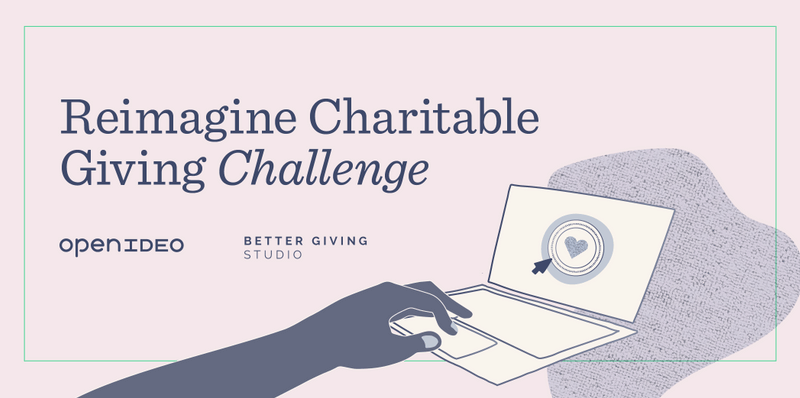
First, the challenge is hosted by Open IDEO and Better Giving Studio and supported by Bill & Melinda Gates Foundation. OpenIDEO is part of IDEO, a design and innovation firm that uses a human-centered, collaborative approach to solving complex issues — a methodology they call design thinking. Better Giving Studio is launched by Giving By All which is an initiative of the Philanthropic Partnerships team of the Bill & Melinda Gates Foundation. They ask the following question:
How might we reinforce a culture of generosity by creating charitable giving solutions that are more accessible, inclusive, and effective?
The users of the Open IDEO platform can submit their ideas. According to the platform, “Up to 10 concepts will be selected as finalist concepts. Each concept will receive a share of up to $100k USD in prize funding. Selected concepts will receive refinement support from IDEO designers. Selected concepts will also be shared on the Better Giving Studio website and made available under Creative Commons License. Learn more about about the Better Giving Studio.”
Now we see a clear way of collaboration between Better Giving Studio and the users of Open IDEO. This is a case of Objectification of the concept of Crowdsourcing.
Second, the Open IDEO organizes the whole process of idea development as “challenge journey”. According to Open IDEO, “During the Ideas Phase, we’ll call on our global community to share ideas that empower the everyday giver, creating charitable giving solutions that are sustainable, equity-centered, and work for everyone. The ideas do not need to be perfect or fully polished — in fact, we encourage early entry in the six-week Ideas phase so that community engagement and feedback can support you to iterate and improve your idea.”
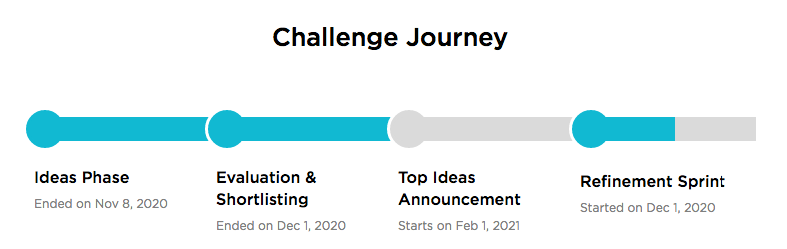
Thus, the design thinking method behind the Open IDEO platform, the challenge journey process and the website of Open IDEO, are Objectifications of the concept of Idea Development.
We can also understand the concept of Idea Development from an individual perspective. As a founder of a startup or an initiator of a project, how does a person find or create an idea? There are only two ways to cope with this challenge.
- First, the person can find an existing idea from the outside outsource if the person doesn’t have a good skill on idea development.
- Second, the person can create his own ideas if he is a master of idea development.
Both ways refer to opportunities for people who are idea machines or works on products about idea development. For example, Steven Johnson wrote a book titled Where Good Ideas Come From. You can watch his TED talk to learn his ideas about ideas. You can also watch Vittorio Loreto’s TED talk about new ideas.
For new product design and development, many consultants and designers write books about Idea Generation. They also develop various frameworks, toolkits and cards. For example, you can download the Human-Centered Design toolkit from IDEO’s website.
David Delahunty created over 3400 ideas of new product and published them as eBooks.
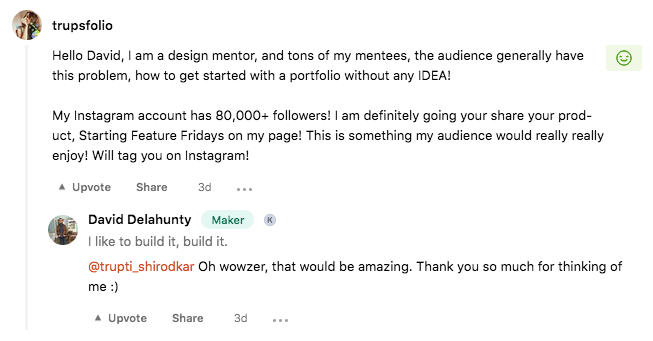
Delahunty launched his project on Product Hunt and you can see the following comment on the project’s page. Wow, people really need some ideas as their starters!
From the perspective of traditional Activity Theory, an Activity or Activity System is defined by its Object (or objective). I personally consider the idea is the source of the objective. Thus, idea development should be considered as a meta-activity.
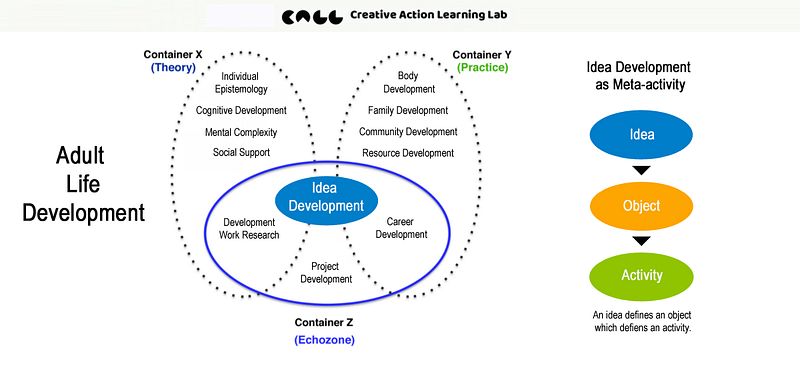
The above diagram places Idea Development in the context of adult life development. I use the WXMY diagram to present my ideas. The Container X lists some theories about adult life development. The Container Y lists some practical topics about adult life development. In the middle position, I place Idea Development at the Container Z in which you can see Development Work Research, Project Development and Career Development too.
From the perspective of Project-oriented Activity Theory, there is a distinction between Idea and Concept. As I mentioned in the section 5.1 of the article Activity U (VIIII): Project-oriented Activity Theory, there are many ideas for “problem-solution”, but not all ideas can generate a proposal of a new concept.
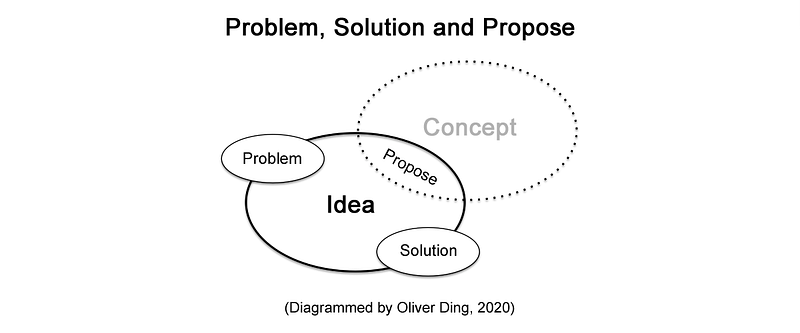
As Blunden emphasises, “The formation of a project with a concept of the problem is an original and creative social act.” However, it is hard to require every project to be an original and creative social act. In order to keep using the term “Project”, I suggest that it is possible to allow the formation of a project with a regular idea which refers to normal works. In this manner, I keep a room for normal projects within Project-oriented Activity Theory. Anyway, an Idea is the beginning of a Concept.
Part 2: The Liberating Voices Project
According to Andy Blunden, “What distinguishes Activity Theory from Phenomenology and Existentialism is that for Activity Theory, the project has its origin and existence in the societal world in which the person finds themself; for Phenomenology and Existentialism the psyche projects itself on to the world. For Activity Theory, commitment to a project and formulation of actions towards it, are mediated by the psyche, but a project is found and realized as something existing in the world, be that an entire civilization, a single personality, or anything in between. (See MacIntyre, 1981, p.146)” (2014, p.7).
In the article Activity U (X): Projecting, Projectivity, and Cultural Projection, I use Primary Projectivity to highlight the important statement “…a project is found and realized as something existing in the world…” I also point out that the sense-maker of Primary Projectivity is Events which refer to any change of society. I consider society as a dynamic process which is formed by big changes and small changes. A big event/change can be a social movement, a major technological invention, a political crise, etc. A small event/change can be a neighborhood party, a minor traffic accident, a twichat, etc.
In fact, there is a special type of project which aims to help people to find and realize primary projectivity. I name this type of project as meta-project. For instance, I’d like to introduce the Liberating Voices project as an exemplar of meta-project.
2.1 Douglas Schuler and Patterns for Social Change
The Liberating Voices Project is initiated by Douglas Schuler who is a member of the faculty at The Evergreen State College, former Chair of Computer Professionals for Social Responsibility (CPSR), and a founding member of the Seattle Community Network (SCN). His research interests include civic intelligence, social responsibility, pattern languages and participatory design.
Inspired by Christopher Alexander’s A Pattern Language (1977), Schuler starts the Liberating Voices Project which aims to develop a series of patterns of information and communication for social change. According to Schuler, “We named our pattern language Liberating Voices to signify its descriptive and prescriptive functions. Pattern languages comprise patterns, and each pattern is an encapsulated, peaceful revolt. Each pattern contains within it a built-in confrontation with a problem, and the application of the pattern is intended to help us overcome the problem and bring us closer to a more humane existence. The problem described in each pattern contains features of the world that we think need changing, features that perpetuate the status quo, with its system of few winners and many losers, a category that seemingly includes most people and the natural environment. The last part of the pattern is the solution, which summarizes the ideas that people are using to confront the problem, wrestle with it, and make some progress at subduing it, while the problem resurrects itself in another form. A pattern, then, is a form of seed. It contains a reflection of current work and thinking, as well as the vision of a future in which the seeds have sprouted and borne fruit.” (2008, p.3)
The purpose of the Liberating Voices project is developing a thinking tool which can help people think about, design, develop, manage and use information and communications that more fully meet human needs. In 2008, the project reached a significant milestone. They published a book which collects 136 patterns, developed by 85 authors. They also host the project online with a database of patterns.
Today, you can find 913 patterns in their patterns pool.
2.2 Pattern #36: Participatory Design
Let’s look at one pattern within the project: Participatory Design.
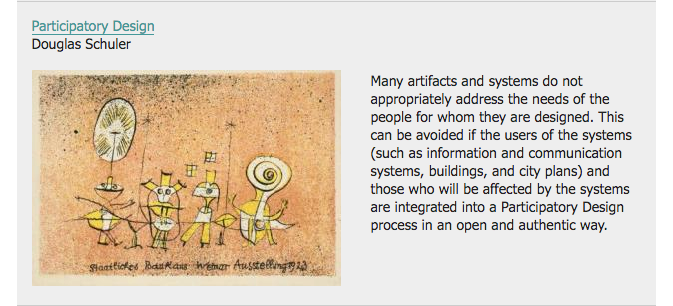
- Problem: “A large number of artifacts that people use every day are ill designed and they do not appropriately address the needs of the people for whom they are designed and produced. The problems range from the inconvenient (in setting an alarm on an unfamiliar alarm clock, for example) to the dangerous (an inadequately marked pedestrian crosswalk or scalding water from the tap when cold was expected). And in the design of groupware, software systems that facilitate group collaboration, developers can create systems that embed users in a system like cogs in a machine where a more human-centered system that was more humane and more effective could be developed.”
- Context: “This pattern is intended to be used in any situation in which a service, policy, or other artifact is being designed. Those who will use the artifact and those who will be affected by it should be included in the design process.”
- Solution: “There should be a strong effort to include the users of any designed system (software, information and communication systems, administrative services and processes, art, city plans, architecture, education, governance, and others) into its design process in an open, authentic, and uncoerced fashion. Participatory Design, according to Finn and Blomberg, has made no attempt to demarcate a category of work called cooperative, but instead has focused on developing cooperative strategies for system design PD is not defined by the type of work supported, nor by the technologies developed, but instead by a commitment to worker participation in design and an effort to rebalance the power relations between users and technical experts and between workers and managers. As such PD research has an explicit organizational and political change agenda. (See Eevi Beck’s “P is for Political” for more insight on this important observation.)”
There is also a section called Discussion which includes some background, reference and insights about Participatory Design. The final section is Linked Patterns which lists related patterns. The list below is found from linked patterns of Participatory Design.
- Working-Class Consciousness (12)
- Sustainable Design (22)
- Democratic Political Settings (31)
- Opportunity Spaces (33)
- Meaningful Maps (47)
- Intermediate Technologies (57)
- Digital Emancipation (60)
- Online Community Service Engine (62)
- Participatory Budgeting (71)
- Grassroots Public Policy Development (78)
- Users’ Information Technology Quality Network (80)
- Voices of the Unheard (83)
- Design for Unintended Use (84)
- Civic Capabilities (85)
- Future Design (88)
- Document-Centered Discussion (92)
- Shared Vision (101)
- Self-Designed Development (106)
- Engaged Tourism (107)
- Appropriating Technology (108)
- Community Telecenters (117)
- Open Source Search Technology (125)
What’s Opportunity Spaces (33)? We can find the pattern here.
- Problem: “Inequality can be understood to a large degree as unfair access to opportunities. In the U.S. opportunities for education, employment and health are often tied to economic status. Current social and technological systems are often not being used to create or support opportunity spaces that are equitable even though these are the hallmark of a just society. Without adequate opportunity spaces, marginalized people will almost necessarily prevented from meaningful participation in the society at large.”
- Solution: “People and communities need help realizing their potential. They also need support as they work to repair social and environmental problems. It is important to devote attention and resources (including policy, services, media and technological systems) to help create new (and improve existing) “opportunity spaces” for people — and communities — who need them.”
What’s Self-Designed Development (106)? We can find the pattern here.
- Problem: “All too often development initiatives are designed and implemented by outside professionals, politicians and wealthy elites. Neither community empowerment nor fundamental sustainability plays a central role in many of these interventionist projects. And just as bad, they fail to honor the basic desires and knowledge possessed by these people. Thus displacement, increased unemployment and the overall degeneration of livelihoods becomes the normative result of mis-planned, mis-interpreted and thus, mis-implemented development. Similarly, even among the well-meaning development NGOs a culture of dependence tends to emerge with communities being perpetually tied to the expertise and monetary assets that these organizations bring with them.”
- Solution: “First, those among the professional development community should not always assume that a community wishes to be or needs to be developed. Rather support to communities should be pursed based on invitation. For the communities themselves this is an opportunity to empower themselves and to project the ways in which they wish to interact and be defined in the process of modernization that is going on everywhere. It is an opportunity to exert their own sense of identity and influence their livelihoods as best and most effectively as possible in the face of so many outside forces that are consciously and unconsciously seeking to define their collective futures. ”
You can buy the book or visit their website at publicsphereproject.org
Part 3: Patterns as “Orienting Concepts”
From the perspective of Project-oriented Activity Theory, Douglas Schuler’s patterns for social change is very close to “Concepts” of “Social Movements”. Each pattern can be considered as a concept which can lead to a project or social movement.
However, you probably find these patterns are too general. Though Blunden uses “Tree” and “Freeway” as examples of Concepts for discussing his approach on Concepts, it is not possible to create a brand new project with such normal concepts. For example, the pattern of “Opportunity Spaces (33)” is too abstract. We can’t directly start a project with this pattern. The better way is adopting this pattern as the starting point and developing a new idea, then a new concept.
I’d like to recommend the notion of “Orienting Concepts” which is coined by Derek Layder in his 1998 book Sociological Practice: Linking theory and social research.He says, “In a previous book (Layder, 1993) I refer to the use of ‘background’ concepts as a useful means of developing theory, although here I prefer the term ‘orienting’ concepts. Examples of these, taken at random from the sociological literature, are ‘emotional labour’, ‘musical worlds’, ‘the dialectic of control’, ‘career’, ‘power and surveillance’, ‘organizational morality’. Two important features of orienting concepts are their ‘two-sided’ nature and their reference to social processes. The two-sided nature of orienting concepts concerns their dual reference to objective and subjective aspects of social life. A concern with social processes focuses on their ability to trace social activity and events over time and space.” (1998, p.101)
It is hard to claim that all patterns of the Liberating Voices project have both objective and subjective aspects of social life. I do think it is fine to use the term “Orienting Concepts” to define a way of appropriating patterns for social change. We can adopt these patterns as our starting point of our journey of innovation.
For example, let’s look at the pattern of “Design for Unintended Use (84)”.
- Problem: A designable and open technology like the Internet is never finished or final. This type of open technology invites ongoing creative use, which in turn drives the evolution and development of the technology. While creative use is associated with active and engaged users, it can present severe challenges in the design of public systems. From the perspective of the designer, the creative user is unpredictable and random and uses the system in unintended ways that can be detrimental to the overall functionality and robustness of the system. Unfortunately this often leads designers to create closed systems with little or no room for user action outside the intended scope. This approach, however, can result in systems that are unattractive to a creative and imaginative community that desires ownership and opportunity to develop a system that is effective from their perspective.
- Solution: The solution is to intentionally design for creative unintended use. Design principles for creative unintended use can be formulated and used to inform new designs (Stolterman, 2001). Some examples of such principles are: (1) the system must be sufficiently robust to withstand creative use attacks from users, (2) the system must also be “forgiving,” which means it has some ability to accept creative use changes without demanding complete safety, (3) a system whose purpose is to elicit creative and radical use, must also present a sufficiently rich, inspiring, and complex environment, and (4) also provide the user with tools for exploring and changing the system itself, (5) the system must also be designed as an open system, i.e., it should be possible for users to expand the scope and breadth of the system without demanding too much structure and administration. These high-level design principles must be further developed and expanded. There is a need for experimental approaches to design for unintended use that are relevant to the situation at hand.
I have mentioned the same phenomenon in the article Hammer, Hammering, and Affordance: The Materiality Turn and Artifact-centered Interaction. Scholars also used other words such as “appropriation” to describe the difference between “design” and “use” (Jennie Carroll, 2004; Wakkary & Maestri, 2008). According to Carroll, “Appropriation describes the way that users ‘take possession’ of a technology innovation over time. This is more fundamental than configuring a packaged system prior to implementation or tailoring it to individual users’ needs. Appropriation involves mutual adaptation: users reshape the features of an ICT (information and communication technologies), they may use it for unanticipated purposes and at the same time their practices are shaped by the ICT.” Wakkary & Maestri argued that the traditional understandings of use and design are too limited, and they suggested adopting the notion of Design-in-use which is understood as the ongoing design and change through the use of artifacts and surroundings.
Thus, we can start from the pattern of “Design for Unintended Use (84)” and move to the notion of “Appropriation” and get a deep understanding about the phenomenon.
One more way of working with “Orienting Concepts” is “Boundary Exploration” which is inspired by IDEO CoLab’s homepage. They say, “We work across industries at the intersection of emerging technologies and societal trends”.
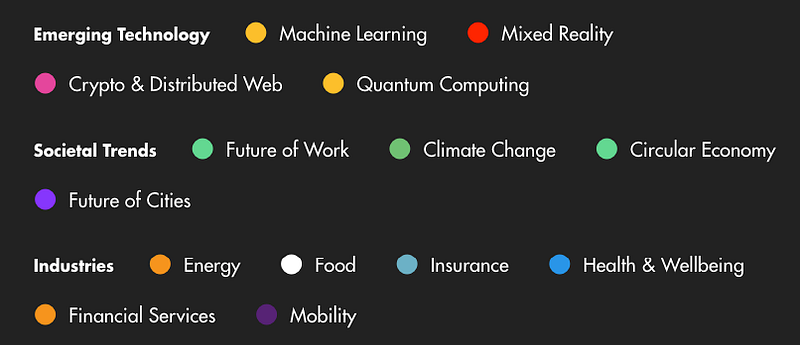
The above screenshot presents IDEO Colab’s approach. I name this approach as “Boundary Exploration”. Since the pattern for social change focuses on societal trends, we can put these patterns at the intersection of emerging technologies and industries.
Part 4: Start Your Impact Projects
In the article Activity U (VIII): Project as a Unit of Activity, I defined a new role called Serial Creators.
The projectification of work is an emerging trend. From the perspective of personal development, this trend means the projectification of career. In order to better describe the new type of career, I defined a new role called Serial Creators which means a career role based on project-oriented creative knowledge work. The new concept of Serial Creators is a broad category which includes some sub-categories such as microentrepreneurs and serial entrepreneurs.
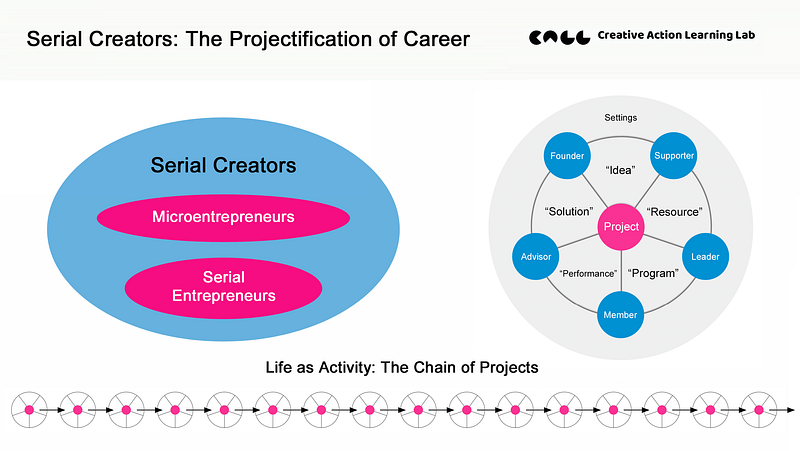
Blunden has pointed out the relation between Identity and Project. He says, “A person’s identity is that central, concrete project (or narrative) which is realized and concretized through a person’s life, subsuming the diversity of projects to which a person commits themselves over their lifetime…So a person’s identity is not just formed by collaborative projects, it is a collaborative project. Projects create themselves at the same time as they create social bonds.” (2014, p.16) This statement echoes the idea of “Life as Activity: The Chain of Projects”. By defining a new concept OF Serial Creators and connecting it to the projectification of career, we can adopt the Project-oriented Activity Theory as a new theoretical resource for a new version of Life-as-Activity: The Chain of Projects.
In addition, Blunden also describes the connection between personality and social position, “A central and defining aspect of the personality is the will. Growth from infancy to adult citizenship entails the development of self-mastery and a will moderated by consciousness of one’s social position. Exercise of the will is in principle possible only through collaborative projects — the person as a sovereign subject comes into being only thanks to communicative self-determination achieved in the realization of shared goals in collaboration with others. The study of projects insights into the formation of will. As human beings are formed as sovereign subjects, so also are the social bonds which will sustain them formed.” (2014, p.17)
In the previous article Activity U (XI): Process, Position, and Zone of Project, I develop the Zone of Project framework which highlights five positions and five processes.
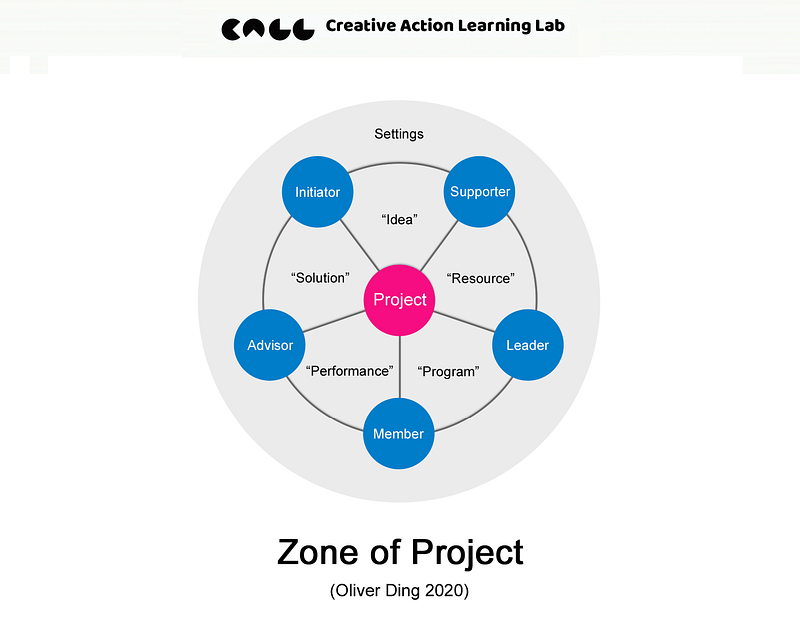
A diagram is a way of objectification of theoretical concepts. We should not only use a diagram without understanding related theoretical concepts. If someone understands the concept of “Zone of Project”, he should not limit his imagination on the above diagram.
A Serial Creator may take one position or several positions within one project or multiple projects. On the other side, one project may contain one serial creator or several serial creators. Multiple projects may share one serial creator. By identifying these five social positions, we can build a map of the project network through social bonds.
Finally, I encourage readers to start your own impact projects. I wish Project-oriented Activity Theory could help you on the knowledge side. However, the real impact should be created by you.
You are most welcome to connect via the following social platforms:
Twitter: https://twitter.com/oliverding Doowit: https://doowit.co/profile/gm0k2ax9 Linkedin: https://www.linkedin.com/in/oliverding
License
This work is licensed under the Creative Commons Attribution-NonCommercial-ShareAlike 4.0 International (CC BY-NC-SA 4.0) License. Please click on the link for details.
References
Andy Blunden (2014) Collaborative Project: An interdisciplinary study. Brill.
Derek Layder (1998) Sociological Practice: Linking theory and social research. SAGE Publications.
Douglas Schuler (2008) Liberating Voices: A Pattern Language for Communication Revolution. The MIT Press.
Steven Johnson (2011) Where Good Ideas Come From: The natural history of innovation. Riverhead Books.


